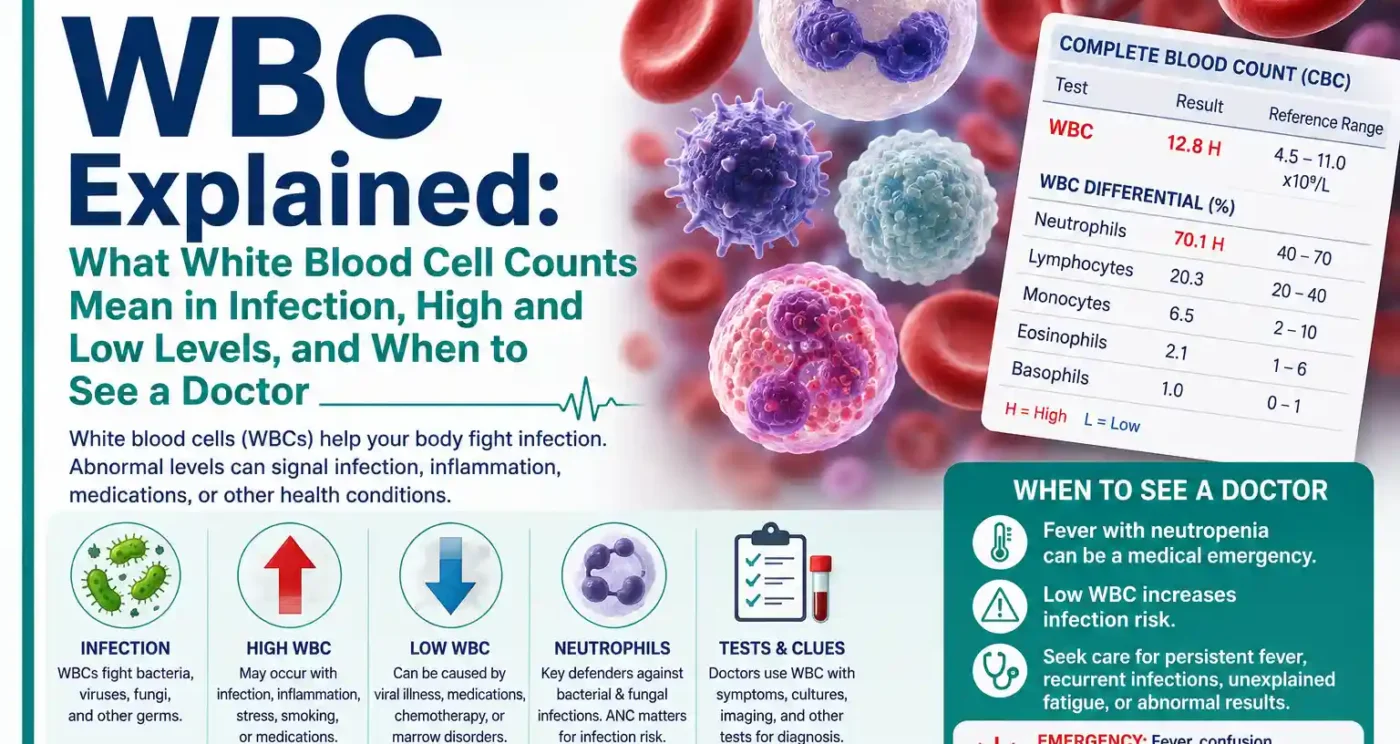
A white blood cell count can provide useful clues when someone has an infection, but the number does not tell the whole story.
A high WBC may occur when the immune system is responding to bacteria, viruses, inflammation, physical stress, or certain medications. A low WBC can occur with some viral illnesses, medications, chemotherapy, bone-marrow conditions, autoimmune disease, and even severe infections. And it is entirely possible to have a significant infection while the total WBC remains within the laboratory’s normal range.
WBC stands for white blood cell count. White blood cells, also called leukocytes, are immune cells made primarily in the bone marrow. They circulate through the blood and tissues, where they help the body respond to infection and other disease processes.
For many adults, a commonly used reference range is approximately 4,500 to 11,000 white blood cells per microliter (µL). But that range is not universal. Laboratories establish their own reference intervals, and factors such as age, pregnancy, medications, and individual health can affect the result.
The most useful question, therefore, is usually not simply, “Is my WBC high or low?” It is:
Why is the count abnormal, which type of white blood cell has changed, and what else is happening clinically?
Contents
- 1. What Is WBC?
- 2. Why Are White Blood Cells Important During an Infection?
- 3. What Is a Normal WBC Count?
- 4. What Does a High WBC Count Mean?
- 5. What Is Leukocytosis?
- 6. Does a High WBC Usually Mean a Bacterial Infection?
- 7. Can a Viral Infection Cause a High WBC?
- 8. Can Viral Infections Lower the WBC Count?
- 9. What Does a Low WBC Count Mean?
- 10. What Is Leukopenia?
- 11. Is a Low WBC Always Dangerous?
- 12. What Is a WBC Differential?
- 13. What Are Neutrophils?
- 14. What Can Cause High Neutrophils?
- 15. What Is the Absolute Neutrophil Count?
- 16. What Is Neutropenia?
- 17. Why Does an ANC Below 500 Matter?
- 18. Why Is Fever With Neutropenia an Emergency?
- 19. What Are Lymphocytes?
- 20. What Are Monocytes?
- 21. What Are Eosinophils?
- 22. What Are Basophils?
- 23. High Neutrophils vs. High Lymphocytes
- 24. Can WBC Tell Whether an Infection Is Bacterial or Viral?
- 25. Does a Normal WBC Rule Out Infection?
- 26. Can a Severe Infection Cause Low WBC?
- 27. Can Sepsis Cause a High or Low WBC?
- 28. Can WBC Be High Without Any Infection?
- 29. Can Medication Affect WBC Results?
- 30. Why Might WBC Remain High After an Infection?
- 31. How Quickly Should WBC Return to Normal?
- 32. What Is a “Left Shift”?
- 33. What Is a CBC With Differential?
- 34. What Other Tests May Be Ordered When Infection Is Suspected?
- 35. Can WBC Show Where an Infection Is Located?
- 36. Is WBC Part of Routine Blood Work?
- 37. When Should an Abnormal WBC Be Rechecked?
- 38. When Should You See a Doctor About a High WBC?
- 39. When Should You See a Doctor About a Low WBC?
- 40. When Should You See an Infectious-Disease or Blood Specialist?
- 41. When Is an Abnormal WBC With Infection an Emergency?
- 42. Frequently Asked Questions
- 42.1. Does high WBC always mean infection?
- 42.2. What WBC count means I have a bacterial infection?
- 42.3. Is a WBC of 12,000 high?
- 42.4. Is a WBC of 20,000 always serious?
- 42.5. Can an infection happen with normal WBC?
- 42.6. Can an infection lower WBC?
- 42.7. Does viral infection usually cause low WBC?
- 42.8. What is more important: WBC or neutrophils?
- 42.9. What ANC is considered high risk for infection?
- 42.10. What does ANC mean on a blood test?
- 42.11. Is fever dangerous when WBC is low?
- 42.12. Should I take antibiotics because my WBC is high?
- 42.13. Can steroids raise WBC?
- 42.14. Can stress increase WBC?
- 42.15. Can smoking increase WBC?
- 42.16. Does sepsis always cause high WBC?
- 42.17. Can chemotherapy lower WBC?
- 42.18. How can I raise my WBC quickly?
- 43. Conclusion
- 44. Resources
- 44.1. MedlinePlus — White Blood Count
- 44.2. MedlinePlus — Blood Differential
- 44.3. MedlinePlus — Complete Blood Count
- 44.4. National Cancer Institute — Infection and Neutropenia
- 44.5. National Cancer Institute — Absolute Neutrophil Count
- 44.6. CDC — Sepsis
- 44.7. MedIntelHub — Understanding Your Annual Physical
- 44.8. MedIntelHub — Preparing for a Specialist Appointment
- 44.9. MedIntelHub — Editorial Policy
- 45. Editorial Disclaimer
What Is WBC?
WBC stands for white blood cell count.
The test measures the total number of white blood cells circulating in a sample of blood.
White blood cells are part of the immune system and help defend the body against bacteria, viruses, fungi, parasites, and other threats. They are produced mainly in the bone marrow and are also found in lymphatic tissues.
A WBC count is commonly included in a complete blood count (CBC).
A CBC also provides information about:
- Red blood cells
- Hemoglobin
- Hematocrit
- Platelets
- Other red-blood-cell measurements
A CBC with differential goes one step further by measuring the different types of white blood cells individually.
That distinction becomes especially useful when infection is suspected.
Why Are White Blood Cells Important During an Infection?
White blood cells form a major part of the body’s defense system.
When germs enter the body, immune cells can move from the bloodstream into affected tissues and participate in recognizing, containing, and eliminating the infection.
But “white blood cell” is an umbrella term. There are several different types, and each plays a somewhat different role.
The five major groups are:
- Neutrophils
- Lymphocytes
- Monocytes
- Eosinophils
- Basophils
A total WBC count combines all of them into one number.
That means a WBC of 12,000 does not tell you whether neutrophils, lymphocytes, eosinophils, or another cell type produced the increase. A differential count provides that additional information.
What Is a Normal WBC Count?
MedlinePlus lists a commonly used adult reference range of approximately:
4,500 to 11,000 WBCs per microliter of blood
or:
4.5 to 11.0 × 10⁹/L
This should be treated as a general reference rather than a universal cutoff.
Your laboratory may use a slightly different range.
WBC counts can also vary because of factors such as:
- Age
- Pregnancy
- Medications
- Smoking
- Physical stress
- Recent surgery or injury
- Underlying medical conditions
For that reason, the reference interval printed beside your own result is generally more useful than comparing your number with one found online.
What Does a High WBC Count Mean?
A higher-than-normal white blood cell count is called leukocytosis.
Infection is one possible explanation, but it is far from the only one.
WBC can rise because of:
- Infection
- Inflammatory or autoimmune disease
- Allergic reactions
- Physical injury or burns
- Surgery
- Significant emotional or physical stress
- Smoking
- Certain medications
- Pregnancy
- Leukemia and some other blood disorders
This is why the statement “high WBC means infection” is too simplistic.
A person taking certain corticosteroids, for example, can develop an elevated WBC even without a new bacterial infection.
What Is Leukocytosis?
Leukocytosis simply means that the white blood cell count is above the laboratory’s expected range.
It describes a laboratory finding, not a diagnosis.
A mildly elevated WBC may be temporary and occur during stress or recovery from illness.
A markedly elevated or persistently abnormal count may deserve additional investigation.
Clinicians often look at:
- How high the count is
- Which white cells are elevated
- Whether immature cells are present
- Whether red blood cells or platelets are also abnormal
- Symptoms
- Medication history
- Previous CBC results
One isolated number is rarely enough to explain the cause.
Does a High WBC Usually Mean a Bacterial Infection?
Not necessarily.
Many bacterial infections can raise the total WBC count, particularly by increasing neutrophils.
But bacterial infection is only one possible reason for neutrophilia or leukocytosis. Inflammation, trauma, physical stress, smoking, corticosteroids, and certain blood disorders can produce similar changes.
Likewise, a bacterial infection does not have to produce an elevated WBC.
The result is best viewed as one clue within a larger clinical picture.
Can a Viral Infection Cause a High WBC?
Yes.
Some viral infections can raise the total WBC count or increase particular white-cell populations.
Lymphocytes are heavily involved in immune responses to viruses, and certain viral infections can be associated with lymphocytosis, meaning an increased number or proportion of lymphocytes.
Examples can include infections such as infectious mononucleosis.
But there is no simple rule that says:
bacteria = high neutrophils
and:
viruses = high lymphocytes
Real infections are more complicated than that.
The pattern can change according to the virus, timing of the blood test, age, medications, immune status, and severity of illness.
Can Viral Infections Lower the WBC Count?
Yes.
Some viral illnesses can temporarily suppress white blood cell production or change the number of circulating cells.
MedlinePlus identifies viral illnesses such as infectious mononucleosis among possible causes of a reduced WBC count and notes that influenza and other viral infections can reduce neutrophil percentages.
A temporarily low WBC during a viral illness may recover as the infection resolves.
Persistent or substantially low counts may require additional investigation.
What Does a Low WBC Count Mean?
A lower-than-normal white blood cell count is called leukopenia.
Possible causes include:
- Certain viral infections
- Bone-marrow disorders
- Chemotherapy
- Radiation therapy
- Some medications
- Autoimmune diseases
- HIV
- Liver or spleen disease
- Cancers affecting the bone marrow
- Severe bacterial infection in some cases
The clinical importance depends partly on which white cells are low.
A person can have a low total WBC while maintaining an adequate number of neutrophils, or the low count may be driven specifically by significant neutropenia.
For infection risk, that difference matters.
What Is Leukopenia?
Leukopenia means that the total number of white blood cells is below the expected reference range.
MedlinePlus uses fewer than approximately 4,500 WBCs/µL as a general adult example, while emphasizing that laboratory reference ranges vary.
Leukopenia is not itself an infection.
Instead, it may be:
- A consequence of an illness
- A side effect of treatment
- A sign of impaired blood-cell production
- A feature of an immune or bone-marrow condition
Because white blood cells help defend against infection, certain forms of significant leukopenia can increase susceptibility to infection.
Is a Low WBC Always Dangerous?
No.
The seriousness depends on the cause, degree of reduction, duration, and which cells are affected.
A mildly reduced WBC discovered incidentally in someone who feels well can mean something very different from a rapidly falling WBC in someone receiving chemotherapy.
Doctors also pay particular attention to the absolute neutrophil count, or ANC.
A low total WBC can be less concerning if the ANC remains adequate, while significant neutropenia can create substantial infection risk even if the total WBC number does not initially look dramatic.
What Is a WBC Differential?
A white blood cell differential breaks the total WBC down into its individual cell types.
It can report both percentages and absolute counts.
The five major types are:
| White Blood Cell | General Role |
|---|---|
| Neutrophils | Important early defense against many infections, particularly bacterial and fungal infections |
| Lymphocytes | Include B cells and T cells; important in immune responses, including many viral infections |
| Monocytes | Help destroy germs and clear damaged or dead cells |
| Eosinophils | Participate in responses to parasites and allergic inflammation |
| Basophils | Participate in allergic and inflammatory responses |
The differential can therefore provide more useful information than the total WBC alone.
What Are Neutrophils?
Neutrophils are the most abundant type of circulating white blood cell in many healthy adults.
They act as rapid responders when the body encounters infection or tissue injury.
Neutrophils are particularly important for defense against many bacterial and fungal infections.
An increased neutrophil count is called neutrophilia.
A decreased count is called neutropenia.
Neither finding has only one possible cause.
What Can Cause High Neutrophils?
Neutrophils commonly rise with acute infection, but other causes include:
- Inflammation
- Physical stress
- Trauma
- Smoking
- Certain medications
- Some blood and bone-marrow disorders
MedlinePlus lists acute infection, inflammation, stress, trauma, smoking, and several inflammatory or blood conditions among possible causes of an increased neutrophil percentage.
So even a high neutrophil count does not identify the specific infection—or prove that bacteria are responsible.
What Is the Absolute Neutrophil Count?
The absolute neutrophil count (ANC) estimates how many neutrophils are present in a microliter of blood.
Because neutrophils play such an important role in infection defense, ANC can be more clinically useful for assessing infection risk than the total WBC count alone.
NCI explains that as ANC falls, susceptibility to infection rises. An ANC below 500 cells/µL is associated with a high risk of infection.
Many laboratories calculate ANC automatically as part of a CBC with differential.
When it is calculated manually, the general formula uses the total WBC and the percentages of mature neutrophils and bands.
You usually do not need to calculate it yourself—the laboratory report or healthcare team can provide the value.
What Is Neutropenia?
Neutropenia means there are fewer neutrophils than expected.
Possible causes include:
- Chemotherapy
- Radiation therapy
- Certain medications
- Viral infections
- Autoimmune diseases
- Bone-marrow disorders
- Some cancers
- Other medical conditions
The lower the ANC becomes, the less reserve the immune system has for fighting certain infections.
Duration matters too.
A brief period of mild neutropenia is different from profound neutropenia lasting for many days.
Why Does an ANC Below 500 Matter?
NCI identifies ANC below 500 cells/µL as a level associated with a high risk of developing infection.
At very low neutrophil levels, infections can progress more quickly because the body’s usual first-line inflammatory response is weakened.
Some classic signs of infection may even be less noticeable.
For example, a patient with severe neutropenia might not produce as much pus or local inflammation as someone with a normal immune response.
That is one reason fever can be particularly important.
Why Is Fever With Neutropenia an Emergency?
Fever plus significant neutropenia can represent febrile neutropenia, a condition that requires urgent medical assessment.
People receiving chemotherapy are a particularly important group because cancer treatment can suppress neutrophil production.
NCI warns that infections during cancer treatment can become life-threatening and require urgent attention. Its patient guidance advises contacting the healthcare team promptly for fever or other signs of infection.
Clinical definitions of febrile neutropenia commonly use a single oral temperature of 38.3°C (101°F) or higher, or a temperature of 38.0°C (100.4°F) sustained for approximately one hour, in a patient with significant neutropenia.
Cancer centers may give patients slightly different instructions.
If you are receiving chemotherapy or already know that you have neutropenia, follow the fever threshold given by your oncology team rather than waiting for symptoms to worsen.
What Are Lymphocytes?
Lymphocytes include B cells, T cells, and natural killer cells.
These cells are central to adaptive immune responses.
B cells can produce antibodies, while different T cells help coordinate immune responses or destroy infected cells.
Some viral infections can cause lymphocyte counts or percentages to increase.
Other infections, medications, immune conditions, and serious illnesses can lower them.
That is another reason the differential should be interpreted in context rather than using “high lymphocytes = virus” as a universal diagnostic rule.
What Are Monocytes?
Monocytes help remove germs, damaged cells, and other material from the body.
They also contribute to immune signaling and can move into tissues, where they develop into cells such as macrophages.
Monocyte counts can rise in several settings, including certain chronic infections, inflammatory conditions, and some viral illnesses.
A mildly elevated monocyte count by itself usually does not identify a specific infection.
What Are Eosinophils?
Eosinophils are commonly associated with:
- Parasitic infections
- Allergies
- Asthma
- Certain inflammatory conditions
An elevated eosinophil count therefore points clinicians toward a different group of possibilities than a typical neutrophilic response.
Not every parasitic infection causes eosinophilia, and eosinophilia itself does not confirm a parasite.
What Are Basophils?
Basophils are present in much smaller numbers than neutrophils or lymphocytes.
They release substances involved in allergic and inflammatory responses.
Basophil abnormalities are generally less useful than neutrophils or lymphocytes when evaluating an ordinary acute infection.
High Neutrophils vs. High Lymphocytes
Patterns in the differential can provide clues, but they should not be treated as diagnostic shortcuts.
| Blood Pattern | Possible Explanations |
|---|---|
| High neutrophils | Acute infection, inflammation, physical stress, corticosteroids, smoking, some blood disorders |
| High lymphocytes | Some viral infections, certain chronic infections, some blood disorders |
| Low neutrophils | Viral illness, chemotherapy, medications, bone-marrow disease, autoimmune causes |
| Low total WBC | Viral infection, medications, marrow suppression, immune conditions, severe infection |
| High total WBC | Infection, inflammation, medications, smoking, stress, pregnancy, blood disorders |
The pattern narrows the possibilities; it does not establish the diagnosis.
Can WBC Tell Whether an Infection Is Bacterial or Viral?
Not reliably by itself.
A CBC may support what the clinician already suspects, but there is no single WBC number that proves an infection is bacterial.
Doctors may combine the CBC with:
- Symptoms
- Physical examination
- WBC differential
- Cultures
- PCR or antigen tests
- Urinalysis
- Chest imaging
- Other blood tests
- Medical history
- Medication history
MedlinePlus specifically emphasizes that a WBC count can reveal whether the number of white cells is high or low but cannot confirm a diagnosis by itself.
That is one of the most important points when interpreting WBC results.
Does a Normal WBC Rule Out Infection?
No.
A person can have an infection while the total white blood cell count remains within the laboratory’s reference range.
Possible situations include:
- Early infection
- Certain viral infections
- Older age
- Immune suppression
- Medications affecting immune response
- Localized infection
- Individual variation
Doctors therefore do not use a normal WBC result as proof that an infection is absent.
If symptoms strongly suggest pneumonia, a urinary infection, meningitis, appendicitis, or another serious condition, the evaluation continues even when the CBC looks relatively normal.
Can a Severe Infection Cause Low WBC?
Yes.
Although infections frequently increase white blood cells, severe infections can sometimes produce leukopenia or neutropenia.
MedlinePlus lists very severe bacterial infection among potential causes of low WBC and widespread severe bacterial infection or sepsis among causes of reduced neutrophil percentages.
A falling WBC in a severely ill patient is therefore not automatically reassuring.
The patient’s overall condition matters much more than whether the number is technically high or low.
Can Sepsis Cause a High or Low WBC?
Yes.
Sepsis is the body’s extreme response to infection and is a life-threatening medical emergency.
WBC abnormalities can occur during severe infection, but doctors do not diagnose sepsis from the WBC count alone.
CDC lists warning signs that can include:
- Fever, shivering, or feeling very cold
- Confusion or disorientation
- Shortness of breath
- High heart rate or weak pulse
- Clammy or sweaty skin
- Extreme pain or discomfort
If an infection is getting rapidly worse and these symptoms appear, seek immediate medical care rather than waiting for another blood test.
Can WBC Be High Without Any Infection?
Absolutely.
Examples include:
Physical Stress
Major surgery, injury, burns, or other severe physical stress can temporarily increase circulating white cells.
Medications
Certain drugs, including corticosteroids, can raise WBC counts.
Smoking
Smoking is associated with higher white blood cell counts in some people.
Inflammatory Disease
Conditions such as rheumatoid arthritis and other inflammatory disorders can produce leukocytosis.
Pregnancy
Pregnancy can change WBC measurements.
Blood Disorders
Leukemia and certain other bone-marrow disorders can produce substantial increases in white blood cells.
This is why treating an elevated WBC with antibiotics simply because the number is high would be inappropriate.
Can Medication Affect WBC Results?
Yes.
Medication history is an important part of interpreting a CBC.
Some medications can raise WBC, while others suppress bone-marrow production and lower it.
Chemotherapy is a well-known cause of neutropenia.
Certain antibiotics, immune-suppressing drugs, and other medications can also affect blood-cell counts, while corticosteroids may increase circulating WBCs.
Do not stop a prescribed medicine simply because a CBC is abnormal.
The prescriber should determine whether the medicine is likely to be responsible and whether treatment needs to change.
Why Might WBC Remain High After an Infection?
A WBC count does not necessarily return to baseline the moment someone starts feeling better.
It may stay elevated for a period because:
- The infection is still resolving
- Inflammation remains active
- The body is recovering from physical stress
- Medication is affecting the count
- Smoking influences baseline WBC
- Another inflammatory condition is present
A single repeat count that remains mildly elevated does not automatically mean antibiotics failed.
The trend matters.
If the count continues rising, remains substantially abnormal, or is accompanied by persistent symptoms, the clinician may investigate further.
How Quickly Should WBC Return to Normal?
There is no universal timeline.
Recovery depends on:
- Cause of the abnormal count
- Type and severity of infection
- Treatment
- Bone-marrow function
- Medications
- Immune status
- Other medical conditions
A short-lived infection may produce a temporary abnormality that resolves quickly.
Counts altered by chemotherapy, bone-marrow disease, chronic inflammation, or certain medications may remain abnormal for much longer.
Doctors often compare current results with previous CBCs to determine whether the finding is new or part of a person’s usual baseline.
What Is a “Left Shift”?
You may hear a clinician mention a left shift when discussing a CBC differential.
The term generally refers to increased numbers of immature neutrophil forms—often called bands—appearing in the bloodstream.
Bone marrow may release these younger cells when demand for neutrophils rises rapidly, including during some infections or severe inflammatory states.
However, a left shift is another clue rather than a stand-alone diagnosis.
The amount and significance need to be interpreted alongside the rest of the CBC and the clinical picture.
What Is a CBC With Differential?
A CBC with differential combines two useful sets of information.
The CBC measures:
- White blood cells
- Red blood cells
- Hemoglobin
- Hematocrit
- Platelets
- Other red-cell measurements
The differential then breaks the WBC population into:
- Neutrophils
- Lymphocytes
- Monocytes
- Eosinophils
- Basophils
This can help a clinician determine whether the abnormal WBC appears to be part of an infectious pattern, an allergic response, bone-marrow suppression, a blood disorder, or another process.
What Other Tests May Be Ordered When Infection Is Suspected?
The tests depend on where the suspected infection is located and how sick the person is.
Blood Cultures
Blood cultures look for bacteria or fungi growing in the bloodstream.
They may be especially important in suspected bloodstream infection or sepsis.
Urinalysis and Urine Culture
These may be ordered when symptoms suggest a urinary tract or kidney infection.
Respiratory Testing
PCR, antigen, or other tests may identify viruses or bacteria responsible for respiratory illness.
Imaging
A chest X-ray or CT may be needed when pneumonia, an abscess, or another deep infection is suspected.
Other Blood Tests
Depending on the situation, clinicians may evaluate kidney and liver function, inflammatory markers, or other measurements.
The CBC contributes information to this process, but it usually does not replace testing directed toward the suspected infection.
Can WBC Show Where an Infection Is Located?
No.
A high WBC does not tell doctors whether the infection is in the:
- Lungs
- Urinary tract
- Skin
- Abdomen
- Bloodstream
- Sinuses
- Brain
- Another location
Symptoms and targeted testing are still necessary.
For example, cough and shortness of breath might lead to chest imaging, while painful urination could lead to urine testing.
The WBC simply provides another piece of evidence that the body may be responding to an illness or inflammatory process.
Is WBC Part of Routine Blood Work?
It often appears as part of a CBC, but not every healthy person automatically needs a CBC at every preventive visit.
Laboratory testing during routine care should be based on age, symptoms, medical history, medications, risk factors, and clinical judgment.
If you are unsure why a CBC was ordered or whether routine blood testing is appropriate for you, MedIntelHub’s preventive-care guide explains how laboratory testing fits into an annual physical.
Understanding Your Annual Physical: What Actually Gets Checked
When Should an Abnormal WBC Be Rechecked?
There is no one interval for everyone.
A healthcare professional may repeat the test when:
- The abnormality is mild but unexplained
- Someone recently had an infection
- A medication may be affecting the count
- WBC is being monitored during treatment
- Neutropenia is present
- The count is rising or falling
- Other CBC values are abnormal
Sometimes the trend is more informative than the first value.
For example:
WBC 13,000 → 10,500 → 8,000
during clinical recovery tells a different story from:
WBC 13,000 → 18,000 → 24,000
in a patient whose condition is worsening.
Even then, the numbers need clinical interpretation.
When Should You See a Doctor About a High WBC?
Discuss an elevated WBC with a healthcare professional when:
- It remains elevated on repeat testing
- You have persistent fever
- You have symptoms suggesting infection
- You experience unexplained weight loss
- You have drenching night sweats
- Lymph nodes remain enlarged
- You develop unusual weakness or fatigue
- Other blood counts are abnormal
- The WBC is markedly elevated
- There is no obvious explanation for the result
A mild elevation during an acute infection often has a straightforward explanation.
Persistent or unusual leukocytosis may require additional testing.
When Should You See a Doctor About a Low WBC?
Medical follow-up is particularly important when a low WBC occurs with:
- Fever
- Chills
- Recurrent infections
- Persistent sore throat
- Mouth sores
- New cough
- Painful urination
- Skin infection
- Chemotherapy or other immune-suppressing treatment
- A very low ANC
- Other abnormal blood counts
People receiving cancer treatment may have specific instructions about when to call their healthcare team.
NCI emphasizes that infections occurring during cancer treatment can be life-threatening and require urgent medical attention.
When Should You See an Infectious-Disease or Blood Specialist?
Most isolated WBC abnormalities can initially be assessed in primary care.
More specialized evaluation may be needed when there is:
- Persistent unexplained leukocytosis
- Persistent or severe leukopenia
- Significant neutropenia
- Recurrent or unusual infections
- Prolonged unexplained fever
- Abnormal or immature cells on a blood smear
- Suspected bone-marrow disease
- Multiple abnormal blood-cell lines
- Infection that is difficult to diagnose or treat
Depending on the problem, referral may be made to an infectious-disease specialist, hematologist, oncologist, or another specialist.
Preparing a timeline of infections, CBC results, medications, fever episodes, and previous treatments can make that consultation more useful.
How to Prepare Questions Before a Specialist Appointment
When Is an Abnormal WBC With Infection an Emergency?
The laboratory number itself is not usually what determines whether to go to the emergency department.
The person’s condition does.
Seek urgent or emergency medical care for signs such as:
- Confusion or disorientation
- Severe shortness of breath
- Fainting or severe weakness
- Rapid worsening of an infection
- Clammy or sweaty skin with serious illness
- Very fast heart rate or weak pulse
- Extreme pain or discomfort
- Signs of shock
- Fever in someone with known significant neutropenia
- Fever during chemotherapy when the oncology team has instructed that it requires immediate evaluation
CDC describes sepsis as a life-threatening emergency and advises acting quickly when an infection is worsening and symptoms such as confusion, breathlessness, fever or chills, extreme discomfort, clammy skin, or a rapid heart rate develop.
Do not wait for the WBC count to become “high enough” before seeking help.
Frequently Asked Questions
Does high WBC always mean infection?
No.
Infection is only one possible cause.
Inflammation, physical stress, corticosteroids, smoking, pregnancy, tissue damage, and certain blood disorders can also increase the WBC count.
What WBC count means I have a bacterial infection?
There is no single WBC number that diagnoses a bacterial infection.
The count must be interpreted alongside the differential, symptoms, examination, cultures or other infection testing, and medical history.
Is a WBC of 12,000 high?
Using the common MedlinePlus reference interval of approximately 4,500 to 11,000/µL, 12,000 would be mildly above that range.
But your own laboratory’s reference interval should be used, and the cause cannot be determined from the number alone.
Is a WBC of 20,000 always serious?
A WBC of 20,000 is clearly elevated in most adult laboratory ranges, but severity depends on the cause and the person’s clinical condition.
A strong immune response to infection can produce a substantial rise, but medications, inflammation, stress, and blood disorders can also cause high counts.
The number needs medical interpretation.
Can an infection happen with normal WBC?
Yes.
A normal WBC does not rule out infection.
Clinicians rely on the entire clinical picture rather than a single laboratory value.
Can an infection lower WBC?
Yes.
Certain viral infections can reduce white blood cells or neutrophils, and severe bacterial infections can sometimes produce low counts as well.
Does viral infection usually cause low WBC?
Some viral infections can cause low WBC, while others produce normal or elevated counts.
There is no universal viral pattern.
What is more important: WBC or neutrophils?
They provide different information.
The total WBC shows the overall number of white cells. The neutrophil count—and particularly the ANC—can be more useful for estimating susceptibility to certain infections when neutropenia is present.
What ANC is considered high risk for infection?
NCI states that an ANC below 500 cells/µL is associated with a high risk of infection.
What does ANC mean on a blood test?
ANC stands for absolute neutrophil count.
It estimates the number of neutrophils available to help fight infection.
Is fever dangerous when WBC is low?
It can be, particularly when the low WBC is caused by significant neutropenia.
Fever in a person receiving chemotherapy or known to have substantial neutropenia may require immediate medical assessment.
Should I take antibiotics because my WBC is high?
Not based on the WBC alone.
Antibiotics treat susceptible bacterial infections. They do not treat viral infections, inflammatory disease, medication-related leukocytosis, or other nonbacterial causes of a high WBC.
The underlying diagnosis should guide antibiotic treatment.
Can steroids raise WBC?
Yes.
Certain corticosteroids can raise circulating white blood cells, particularly neutrophils.
That effect can complicate interpretation of a WBC result when someone is also being evaluated for infection.
Can stress increase WBC?
Yes.
Severe emotional or physical stress—including injury or surgery—can temporarily elevate white blood cells.
Can smoking increase WBC?
Yes.
Smoking is among the factors associated with an elevated white blood cell count.
Does sepsis always cause high WBC?
No.
Severe infection can be associated with high, normal, or low WBC counts.
Sepsis is diagnosed from the clinical situation and evidence of infection and organ dysfunction—not simply from whether WBC is elevated.
Can chemotherapy lower WBC?
Yes.
Chemotherapy can suppress bone-marrow production of white blood cells, particularly neutrophils, increasing susceptibility to infection.
How can I raise my WBC quickly?
There is no safe universal method because treatment depends on why the WBC is low.
If chemotherapy is responsible, clinicians may sometimes use medicines that stimulate white blood cell production. Other causes require different treatment.
Dietary supplements should not be used as a substitute for finding the reason for significant leukopenia.
Conclusion
A WBC count can provide useful information about infection, but it should never be read as a simple positive-or-negative infection test.
White blood cells are part of the immune system, and a commonly used adult reference range is around 4,500 to 11,000 cells per microliter, although laboratory ranges differ.
A high WBC, or leukocytosis, may occur with infection, inflammation, smoking, physical stress, certain medicines, pregnancy, or blood disorders.
A low WBC, or leukopenia, can occur with viral infections, chemotherapy, medications, autoimmune disease, bone-marrow problems, and sometimes severe infection.
The differential often adds more meaning.
Neutrophils play an especially important role in fighting many bacterial and fungal infections. When neutrophils become severely depleted, infection risk rises substantially. NCI considers an ANC below 500 cells/µL a high-risk range for infection.
At the opposite end, an elevated neutrophil count may support the possibility of infection but does not prove that bacteria are responsible.
Perhaps the most useful lesson is this:
WBC results are clues, not diagnoses.
Doctors interpret them together with symptoms, the white-cell differential, previous results, medications, cultures, imaging, and other tests.
A normal WBC does not rule out an infection, and a high WBC does not automatically mean antibiotics are needed.
And when someone appears seriously ill, the clinical symptoms matter more than waiting for another CBC. Confusion, shortness of breath, rapidly worsening infection, extreme discomfort, a weak pulse, or other signs suggesting sepsis require urgent medical attention.
The same urgency applies to fever in someone with significant neutropenia, particularly during chemotherapy or other immune-suppressing treatment.
Resources
MedlinePlus — White Blood Count
A patient-focused explanation of WBC testing, common reference ranges, and causes of high and low white blood cell counts.
MedlinePlus: White Blood Count (WBC)
MedlinePlus — Blood Differential
This resource explains neutrophils, lymphocytes, monocytes, eosinophils, basophils, and why a differential can add information beyond the total WBC count.
MedlinePlus: Blood Differential
MedlinePlus — Complete Blood Count
MedlinePlus explains what a CBC measures and how WBC results fit alongside red blood cells, hemoglobin, hematocrit, and platelets.
MedlinePlus: Complete Blood Count (CBC)
National Cancer Institute — Infection and Neutropenia
NCI explains why low neutrophil counts increase infection risk during cancer treatment and why fever or other signs of infection may require urgent attention.
NCI: Infection and Neutropenia During Cancer Treatment
National Cancer Institute — Absolute Neutrophil Count
NCI defines ANC and explains why counts below 500 cells/µL are associated with a high risk of infection.
NCI: Absolute Neutrophil Count
CDC — Sepsis
CDC explains sepsis warning signs and why rapidly worsening infection can become a medical emergency.
MedIntelHub — Understanding Your Annual Physical
This guide explains how laboratory testing and preventive evaluation are individualized during routine healthcare visits.
Understanding Your Annual Physical: What Actually Gets Checked
MedIntelHub — Preparing for a Specialist Appointment
Useful when persistent abnormal blood counts, recurrent infections, or unexplained fever lead to infectious-disease or hematology referral.
How to Prepare Questions Before a Specialist Appointment
MedIntelHub — Editorial Policy
For information about MedIntelHub’s standards for healthcare sourcing, medical accuracy, transparency, and educational content:
Editorial Disclaimer
This article is provided for general educational and informational purposes only. It does not diagnose an infection, bacterial or viral illness, leukocytosis, leukopenia, neutropenia, sepsis, or a blood disorder.
White blood cell reference ranges vary by laboratory and can also be affected by age, pregnancy, medications, medical conditions, smoking, physical stress, and other factors. Always interpret a WBC result using the reference interval supplied with your own laboratory report.
A high WBC does not prove that an infection is bacterial or that antibiotics are needed. A normal WBC does not rule out a serious infection.
Low white blood cell counts and neutropenia require individualized interpretation. People receiving chemotherapy or other immune-suppressing treatment should follow their treating team’s instructions about fever and infection symptoms, because infection can progress quickly during significant neutropenia.
Seek urgent medical care for rapidly worsening infection, confusion, severe shortness of breath, fainting, extreme weakness or discomfort, signs of shock or sepsis, or fever in someone known to have severe neutropenia.

David Bennett
David Bennett is an author at MedIntelHub, where he creates clear, practical, and well-researched content about healthcare, medical billing, insurance, and patient education. His goal is to make complex healthcare topics easier for readers to understand and use in everyday situations. David emphasizes accuracy, transparency, and reliable sourcing, using information from trusted organizations and official healthcare resources whenever possible. Content published by David is intended for educational purposes and should not replace advice from qualified medical, legal, or healthcare professionals.