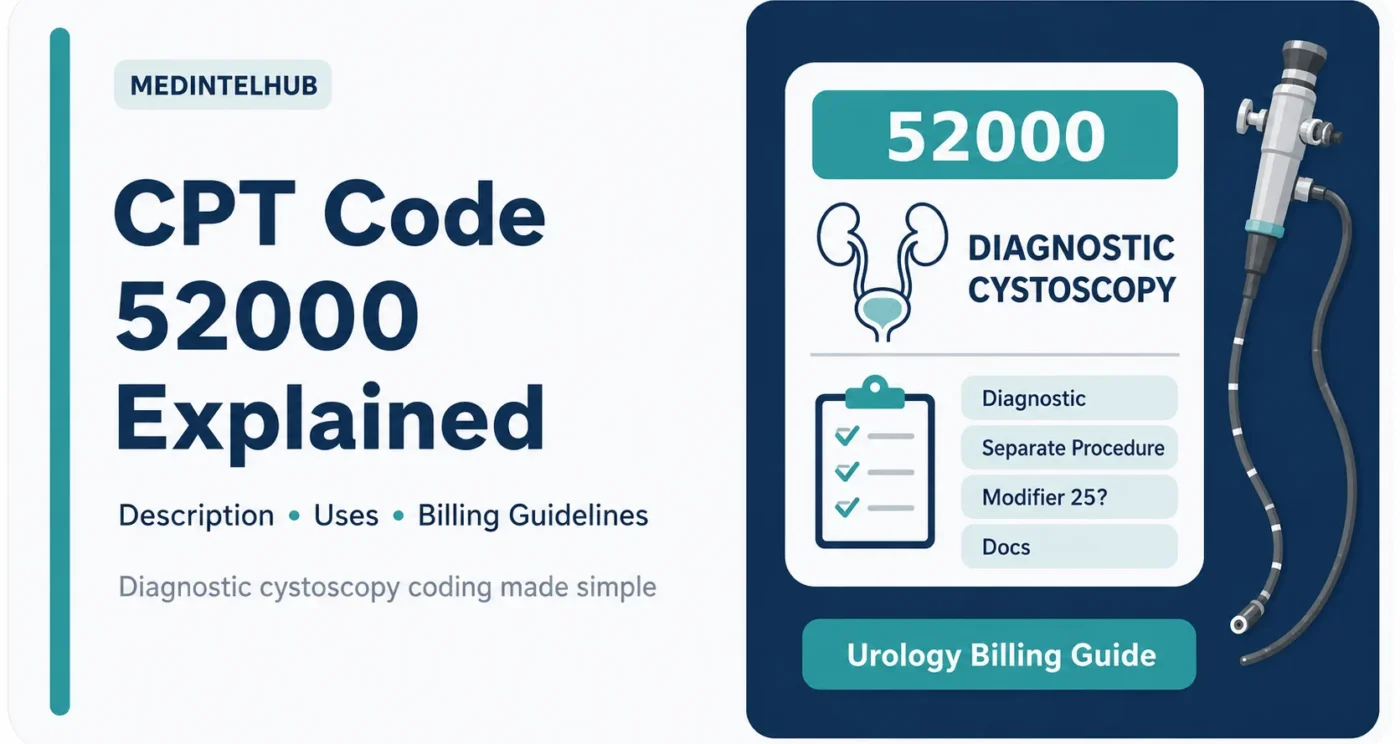
Medical coding in urology can become complicated quickly, especially when a diagnostic procedure leads to another service during the same encounter. One code billing teams frequently encounter is CPT code 52000, which is used for diagnostic cystourethroscopy.
The procedure allows a physician to directly examine the urethra and bladder with an endoscope. Although the basic purpose of the code is relatively straightforward, billing can become more complicated when a biopsy, ureteral catheterization, lesion treatment, urethral dilation, stent removal, or another procedure is also performed.
Another important consideration is that CPT 52000 carries a “separate procedure” designation. That wording affects when the code may be reported on its own and when the diagnostic cystoscopy is considered part of a more comprehensive service.
Understanding the 52000 CPT code description, documentation requirements, bundling rules, and payer policies can help urology practices reduce coding errors and unnecessary claim denials.
Coding rules can also change over time. MedIntelHub’s 2026 CPT Code Changes guide provides a broader look at why practices should review CPT updates, payer requirements, and billing edits regularly.
What Is CPT Code 52000?
CPT code 52000 represents cystourethroscopy performed as a separate procedure. In practical terms, it is commonly used for a diagnostic endoscopic examination of the urethra and bladder.
CMS describes 52000 in its Medicare data as a diagnostic examination of the bladder and urethra using an endoscope.
During the procedure, a cystoscope is passed through the urethra so the physician can directly inspect the urinary tract.
The examination may help identify abnormalities involving the:
- Urethra
- Bladder
- Bladder neck
- Urethral openings into the bladder
- Mucosal lining of the lower urinary tract
The procedure itself is diagnostic. If the physician performs an additional therapeutic procedure, biopsy, catheterization, dilation, lesion treatment, or another service, a more specific CPT code may apply.
For that reason, medical code 52000 should not automatically be reported for every procedure involving a cystoscope.
CPT 52000 Description and Purpose
The CPT 52000 description is “Cystourethroscopy (separate procedure).” CMS coding materials also identify 52000 as the basic diagnostic cystourethroscopy service.
A cystourethroscopy gives the physician a direct view of structures that may not be fully evaluated through laboratory testing or imaging alone.
Depending on the patient’s circumstances, cystoscopy may be used as part of the evaluation of:
- Hematuria, or blood in the urine
- Suspected bladder abnormalities
- Certain lower urinary tract symptoms
- Suspected urethral narrowing or stricture
- Previous bladder tumors requiring surveillance
- Abnormal urinary-tract findings that require direct visualization
The clinical reason matters because cystoscopy is not appropriate for every urinary complaint.
For example, the American Urological Association’s current microhematuria guidance uses a risk-based approach to determine which patients should undergo cystoscopy rather than recommending the procedure for every patient with microscopic blood in the urine.
Similarly, AUA guidance states that cystoscopy should not routinely be performed in the typical patient presenting with recurrent uncomplicated urinary tract infection unless other circumstances justify further evaluation.
Coding should therefore follow both the actual procedure performed and the documented medical reason for performing it.
What Does “Separate Procedure” Mean for CPT 52000?
The words “separate procedure” are particularly important when billing CPT 52000.
A separate-procedure designation generally means the service can be reported when it is performed independently. However, when that diagnostic procedure is an integral part of a more extensive related procedure during the same encounter, it generally should not be separately billed.
CMS’s 2026 NCCI Policy Manual instructs providers to report the code that describes the procedure performed with the greatest available specificity and warns against reporting multiple codes when one comprehensive code describes the services.
This means a practice should not routinely bill CPT 52000 in addition to a more comprehensive cystoscopic procedure merely because the physician first inspected the bladder.
The diagnostic examination may already be included in the more extensive service.
When Is Procedure Code 52000 Used?
Procedure code 52000 may be appropriate when the physician performs diagnostic cystourethroscopy and no more comprehensive cystoscopic service replaces the diagnostic examination.
The final procedure report should answer several questions:
- Was the procedure diagnostic only?
- Were the urethra and bladder examined?
- Was a biopsy performed?
- Was a lesion treated or removed?
- Was ureteral catheterization performed?
- Was a foreign body or stent removed?
- Was urethral dilation performed?
- Was another therapeutic procedure completed?
The most important rule is to code the completed service, not simply the procedure that appeared on the patient’s schedule.
For example, a patient may be scheduled for diagnostic cystoscopy. During the examination, the physician discovers a bladder lesion and performs a biopsy.
In that case, the final coding should be based on the biopsy procedure actually performed and current coding rules rather than automatically submitting CPT 52000 simply because diagnostic cystoscopy was originally planned.
CMS NCCI guidance states that when a diagnostic endoscopy leads to a surgical endoscopy during the same encounter, the diagnostic procedure is generally included in the surgical endoscopy and should not be separately reported.
Common Clinical Uses of CPT 52000
Cystourethroscopy can be used in several clinical situations, but the patient’s diagnosis and medical record should support the procedure.
Evaluation of Hematuria
Blood in the urine is one reason a physician may consider cystoscopy.
The AUA’s 2025 amended microhematuria guideline describes cystoscopy as an important method of evaluating the bladder in appropriately selected patients, particularly when risk factors increase concern for urothelial malignancy.
Bladder Cancer Surveillance
Patients with a history of non-muscle-invasive bladder cancer may undergo surveillance cystoscopy after treatment.
AUA guidance recommends surveillance schedules according to the patient’s recurrence and progression risk rather than using one schedule for every patient.
Suspected Urethral Stricture
Cystourethroscopy can also help confirm suspected urethral narrowing.
The AUA urethral stricture guideline identifies urethro-cystoscopy as one of the diagnostic methods that may be used to establish a urethral stricture diagnosis.
These examples illustrate why the diagnosis should accurately reflect the clinical reason for the procedure rather than being selected only because it appears on a payer’s coverage list.
Billing Guidelines for CPT Code 52000
Accurate CPT 52000 billing requires more than choosing the correct procedure number.
The coder should review the complete encounter to determine whether 52000 is separately reportable.
Review the Final Cystoscopy Report
Do not code from the schedule alone.
A procedure that begins as a diagnostic cystoscopy may result in:
- Biopsy
- Lesion treatment
- Ureteral catheterization
- Stent or foreign-body removal
- Urethral dilation
- Another endoscopic intervention
The final procedure note should establish exactly what occurred.
Use the Most Specific Procedure Code
The 2026 Medicare NCCI manual states that providers should report the HCPCS/CPT code describing the procedure with the greatest specificity possible and should not unbundle components of a more comprehensive procedure.
Therefore, if another cystourethroscopy code fully describes the diagnostic examination plus the therapeutic service, billing CPT 52000 separately may be inappropriate.
Do Not Automatically Report Diagnostic Cystoscopy With Surgical Cystoscopy
CMS states that surgical endoscopy includes diagnostic endoscopy.
When a diagnostic endoscopy leads to a surgical endoscopic service during the same patient encounter, only the surgical endoscopy is generally reported.
This is one of the most important rules for avoiding unbundling.
Comparing CPT 52000 with nearby codes can make the difference easier to understand.
| CPT Code | General Service |
|---|---|
| 52000 | Diagnostic cystourethroscopy |
| 52005 | Cystourethroscopy involving ureteral catheterization |
| 52204 | Cystourethroscopy with biopsy |
| 52214 | Cystourethroscopy involving certain fulguration/treatment services |
| 52224 | Cystourethroscopy with treatment of a minor bladder lesion |
| 52281 | Cystourethroscopy with urethral calibration/dilation |
| 52310 | Cystourethroscopy with simple removal of certain foreign bodies, calculi, or stents |
| 52315 | Cystourethroscopy involving more complicated removal |
The table is intended as a general comparison rather than a substitute for the official CPT descriptions.
For final code selection, practices should use the current licensed CPT code set and applicable payer guidance.
CMS also specifically states that CPT 52204 includes all biopsies performed during the cystourethroscopy and is reported with one unit of service.
Can CPT 52000 Be Billed With an Office Visit?
This is an important question in urology billing.
Performing cystoscopy during an office encounter does not automatically make a separate evaluation and management service billable.
CMS explains that for procedures treated under its minor-surgery rules, the routine evaluation associated with deciding to perform the procedure is generally included in the procedure payment.
However, when the physician performs a significant, separately identifiable E/M service beyond the normal procedural work, a separate E/M service may be reportable with modifier 25, assuming all requirements are met.
For example, simply:
- Reviewing the reason for the cystoscopy
- Obtaining routine consent
- Performing the usual pre-procedure assessment
- Discussing routine cystoscopy findings
does not necessarily support a separately billable E/M visit.
A separately reported office visit should be supported by distinct medical decision-making or other qualifying E/M work that goes beyond what is normally associated with the procedure.
Payer rules should always be checked before routinely billing an E/M service with CPT 52000.
Documentation Requirements for CPT 52000
Documentation should provide enough information for a coder or payer to understand why the cystoscopy was performed and what actually occurred.
A good procedure report should generally identify:
- The clinical reason for cystoscopy
- Relevant pre-procedure findings or diagnosis
- Whether the cystoscope was successfully inserted
- The structures examined
- Findings in the urethra
- Findings in the bladder
- Any lesions, masses, stones, strictures, or abnormalities identified
- Whether a biopsy or treatment was performed
- Whether another cystoscopic service occurred
- Complications, if any
- The resulting assessment and follow-up plan
Documentation should also support the diagnosis reported on the claim.
The purpose is not to add language solely for billing. The medical record should accurately describe the service that was actually provided.
Avoid Unbundling With CPT 52000
Unbundling is a significant issue with diagnostic cystoscopy.
The 2026 NCCI manual explains that endoscopic procedures include minor related functions performed during the same encounter. These functions generally cannot be billed separately simply because another CPT code exists.
CMS provides several useful examples of this principle.
For instance, transurethral procedures may already include cystoscopy as part of the more comprehensive service.
CMS also states that a cystourethroscopy such as CPT 52000 performed near the end of certain abdominal, pelvic, or retroperitoneal operations simply to confirm that the bladder or ureters were not injured is not separately reportable with the primary surgery.
This distinction can prevent a common coding mistake: billing for an endoscopic check that was actually an integral part of another operation.
Fluoroscopy and CPT 52000
Another NCCI issue involves imaging.
CMS states that fluoroscopy performed during an endoscopic procedure is considered integral to the endoscopy. Its 2026 policy specifically includes cystourethroscopy among the endoscopic procedures subject to this principle.
As a result, fluoroscopy should not automatically be separately reported simply because it was used during a cystoscopic procedure.
Practices should review the exact services, code descriptors, NCCI edits, and payer requirements before billing additional imaging.
CPT 52000 and Medical Necessity
Correct coding does not guarantee payment.
A claim may contain the right CPT code but still be denied when the insurer determines that:
- Medical necessity was not supported
- Required authorization was missing
- The diagnosis did not meet coverage criteria
- The service exceeded a frequency limitation
- The patient’s benefits did not cover the procedure
- The submitted documentation did not support the claim
- Another code should have been reported instead
Medical necessity should therefore be considered separately from code selection.
For a broader explanation of this distinction, MedIntelHub’s 2026 CPT coding guide discusses why the existence of a valid CPT code does not by itself establish payer coverage.
Place of Service and Reimbursement
CPT 52000 may be performed in different settings depending on the patient’s circumstances and clinical requirements.
The place of service can affect reimbursement because Medicare payment methodology differs between services performed in a physician office and those performed in facilities.
CMS’s current Physician Fee Schedule lookup system provides information about national payment policies, relative value units, and geographic adjustments.
Practices should avoid publishing or relying on one universal “CPT 52000 reimbursement rate.”
Actual payment may vary based on:
- Geographic locality
- Facility versus non-facility setting
- Medicare versus commercial coverage
- Contracted payer rate
- Modifier use
- Patient benefits
- Current fee schedule
The appropriate source for expected payment is the payer’s current fee schedule or provider contract.
Common CPT 52000 Billing Mistakes
Several errors regularly create problems when billing procedure code 52000.
1. Reporting 52000 With Every Cystoscopic Procedure
CPT 52000 represents diagnostic cystourethroscopy.
When the physician performs a more extensive cystoscopic service, the diagnostic portion may already be included.
2. Ignoring the “Separate Procedure” Designation
The separate-procedure status is important.
The code should not automatically be added to another related cystoscopic or surgical service performed during the same encounter.
3. Coding From the Schedule Instead of the Procedure Note
A scheduled diagnostic cystoscopy can become a different procedure once abnormalities are identified.
The final report should determine final code selection.
4. Separately Billing Included Services
Routine components of the endoscopic procedure should not be unbundled simply because individual codes exist for related services.
5. Automatically Billing an E/M Visit
An office visit on the same day as cystoscopy requires its own justification.
The normal assessment and decision to perform a minor procedure do not automatically qualify as a separately payable E/M service under Medicare rules.
6. Using an Unsupported Diagnosis
The diagnosis code should represent the documented clinical reason for the procedure.
A diagnosis should never be selected solely because it improves the likelihood of reimbursement.
7. Assuming CPT Coding Determines Coverage
CPT describes services.
Payers determine whether those services are covered and how they are reimbursed.
Tips for More Accurate CPT 52000 Billing
Before submitting a claim involving CPT code 52000, billing teams should consider the following:
- Review the finalized cystoscopy report.
- Confirm that the service was diagnostic.
- Identify whether any biopsy or therapeutic procedure was performed.
- Check whether a more specific cystoscopy code applies.
- Review the “separate procedure” implications.
- Match diagnosis coding to the documented clinical indication.
- Check current NCCI procedure-to-procedure edits.
- Verify whether any same-day E/M service is truly separate.
- Apply modifiers only when the documentation supports them.
- Verify payer-specific authorization and medical-necessity requirements.
- Confirm the correct place of service.
- Use the current CPT code set rather than an outdated online list.
CMS’s 2026 Medicare NCCI Policy Manual, Chapter 7, is particularly useful for current Medicare coding rules involving the urinary system.
Frequently Asked Questions
What is CPT code 52000 used for?
CPT code 52000 is generally used for diagnostic cystourethroscopy, an endoscopic examination of the urethra and bladder.
What is the CPT 52000 description?
The CPT 52000 description is “Cystourethroscopy (separate procedure).” The separate-procedure designation is important because the code may not be separately reportable when diagnostic cystoscopy is integral to a more comprehensive related procedure.
Is CPT 52000 diagnostic or therapeutic?
CPT 52000 is primarily a diagnostic cystourethroscopy code.
If biopsy, lesion treatment, ureteral catheterization, dilation, or another therapeutic service occurs, a different CPT code may better describe the completed procedure.
Does CPT 52000 include a biopsy?
No. A cystourethroscopy involving biopsy is represented by a different CPT code, such as CPT 52204 when its requirements are met. CMS states that 52204 includes all biopsies performed during that cystourethroscopy.
Can CPT 52000 and 52204 be billed together?
Generally, the diagnostic cystoscopy represented by CPT 52000 is not separately reported when the same cystoscopic encounter includes a biopsy represented by the more comprehensive procedure code. Current CPT instructions, NCCI edits, and payer policy should be reviewed for the specific claim.
Can CPT 52000 be billed with an office visit?
Potentially, but not automatically. A separately billable E/M service must meet applicable requirements and represent significant, separately identifiable work beyond the usual procedure-related service. Modifier 25 may be appropriate when those conditions are met under Medicare rules.
Is CPT 52000 used for bladder cancer surveillance?
Diagnostic cystoscopy may be used for bladder cancer surveillance when medically appropriate. AUA guidelines include risk-based surveillance cystoscopy schedules for patients with non-muscle-invasive bladder cancer.
Is CPT code 52000 covered by Medicare?
Medicare may reimburse CPT 52000 when applicable coverage, coding, documentation, and medical-necessity requirements are satisfied. Correct use of the CPT code alone does not guarantee payment.
Prior-authorization requirements vary by insurer and health plan. Practices should verify authorization requirements with the patient’s payer before the procedure when applicable.
Can CPT 52000 be billed when cystoscopy is performed during another surgery?
Not necessarily. CMS specifically states that cystourethroscopy performed near the completion of certain abdominal, pelvic, or retroperitoneal operations merely to verify that the bladder and ureters were not injured is not separately reportable with the primary procedure.
Conclusion
Understanding the 52000 CPT code description is important for urologists, medical coders, billing teams, and healthcare administrators.
CPT 52000 generally represents diagnostic cystourethroscopy of the urethra and bladder. However, the code’s “separate procedure” designation means that it should not simply be added whenever a cystoscope is used.
If the physician performs a biopsy, treats a lesion, inserts a ureteral catheter, removes a stent, dilates a stricture, or completes another more extensive endoscopic procedure, another code may be required.
Accurate billing begins with the final procedure report.
Before submitting a claim, healthcare organizations should verify what was actually performed, review NCCI bundling requirements, ensure medical necessity is documented, evaluate same-day E/M services carefully, and confirm payer-specific coverage policies.
Above all, procedure code 52000 should be used to represent the service actually provided—not as a universal code for every cystoscopic encounter.
Resources
The following authoritative resources can help billing professionals and healthcare providers verify current requirements related to CPT 52000 and urologic procedure coding.
1. CMS — Medicare NCCI Policy Manual
The Medicare National Correct Coding Initiative provides current bundling and correct-coding policies, including rules for diagnostic and surgical endoscopy.
CMS Medicare NCCI Policy Manual
2. CMS — 2026 NCCI Policy Manual, Chapter 7
Chapter 7 specifically covers urinary, male genital, female genital, and related CPT codes in the 50000–59999 range.
2026 Medicare NCCI Policy Manual — Chapter 7
3. CMS — Physician Fee Schedule Lookup
Healthcare organizations can use the CMS Physician Fee Schedule system to review Medicare payment policies and fee-schedule information.
CMS Physician Fee Schedule Lookup
4. American Medical Association — CPT Resources
The AMA develops and maintains the CPT code set. Final coding decisions should be based on the current licensed CPT codebook or another authorized CPT coding resource.
AMA CPT Code Set Quick Reference Guide
5. American Urological Association — Guidelines
AUA clinical guidelines provide evidence-based information about conditions in which cystoscopy may be used, including hematuria, bladder cancer, and urethral stricture evaluation.
6. AUA — Microhematuria Guideline
The current guideline provides risk-based recommendations concerning cystoscopy and other evaluation for patients with microhematuria.
AUA/SUFU Microhematuria Guideline
7. MedIntelHub — 2026 CPT Code Changes
This guide provides additional information about CPT updates, documentation, payer requirements, billing edits, and reimbursement considerations.
2026 CPT Code Changes: What Providers Need to Know
8. MedIntelHub — Editorial Policy
MedIntelHub’s editorial policy explains its standards for healthcare sourcing, accuracy, updates, transparency, and limitations.
Editorial Disclaimer
This article is provided for educational and informational purposes only. CPT coding requirements, CMS policies, Medicare Administrative Contractor guidance, commercial payer requirements, reimbursement rules, and documentation standards may change and can vary by payer, jurisdiction, provider type, place of service, and individual patient circumstances.
CPT is a registered trademark of the American Medical Association.
This article does not replace the current CPT codebook, official CPT instructions, CMS guidance, NCCI edits, payer policies, or advice from a qualified medical coding or compliance professional.
Healthcare organizations should verify current coding, billing, coverage, and reimbursement requirements before submitting claims.

David Bennett
David Bennett is an author at MedIntelHub, where he creates clear, practical, and well-researched content about healthcare, medical billing, insurance, and patient education. His goal is to make complex healthcare topics easier for readers to understand and use in everyday situations. David emphasizes accuracy, transparency, and reliable sourcing, using information from trusted organizations and official healthcare resources whenever possible. Content published by David is intended for educational purposes and should not replace advice from qualified medical, legal, or healthcare professionals.