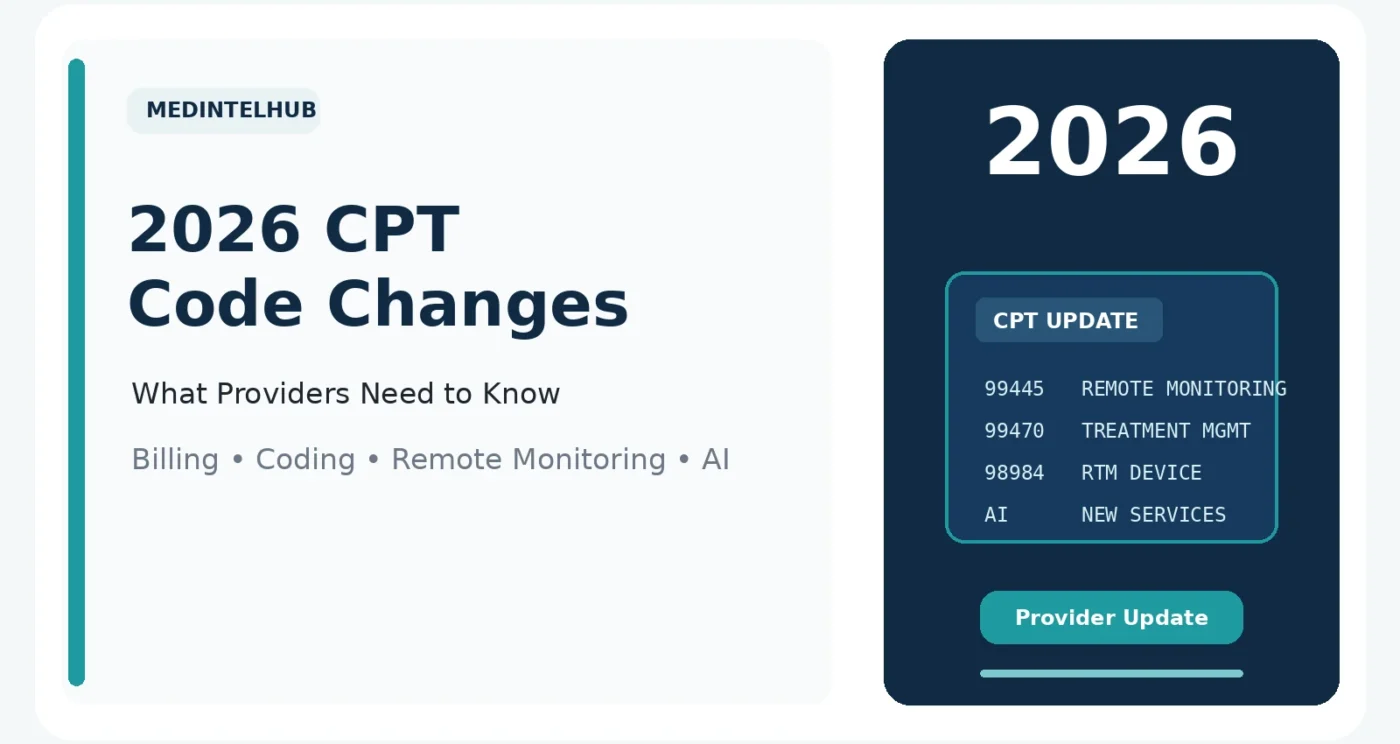
Knowing about the new CPT code changes for 2026 is important for providers.
The 2026 CPT update isn’t just a yearly “housekeeping” update. It contains changes affecting remote monitoring, vascular procedures, hearing-device services, AI-enabled care, and newer medical technologies.
The American Medical Association (AMA) announced that the 2026 CPT code set contains 418 changes — 288 new codes, 84 deletions, and 46 revisions. New Category I codes took effect on January 1, 2026.
According to the AMA, proprietary laboratory analysis codes account for 27% of the new codes. Category III codes for emerging medical technologies account for another 27%.
It’s not just about knowing that new codes exist. Providers, coding teams, and practice managers also have to work out how those changes fit into the practice.
The bigger task is getting outdated codes out of workflows, making sure updated documentation requirements are followed, checking payer policies, and updating billing systems before claims are submitted.
Important: This article provides a summary of publicly available information about the CPT 2026 update. The American Medical Association maintains the official CPT code set and coding guidelines. Providers should use the current CPT 2026 codebook or another properly licensed CPT resource and verify coverage and billing requirements with the applicable payer before submitting claims.
Providers who need official CPT information can also review the AMA’s CPT code set basics and resources.
2026 CPT Changes at a Glance
| Area | What changed | Why providers should care |
|---|---|---|
| Overall CPT set | 288 new codes, 84 deletions, 46 revisions | EHRs, charge masters, templates, and billing edits may need updating |
| Remote monitoring | New shorter-duration RPM and RTM options, plus new 10-minute treatment-management options | Payer rules still determine whether and how services are reimbursed |
| Lower-extremity revascularization | Major restructuring with 46 new codes | Vascular and interventional teams need to review procedure mapping carefully |
| Hearing-device services | 12 new codes | Audiology and hearing-care workflows may need updated documentation and billing logic |
| AI-enabled services | New codes involving assistive and augmentative AI applications | Using AI technology does not automatically create a separately billable service |
| Telehealth-related CPT guidance | Additional behavioral health services were added to CPT Appendices P and T | CPT recognition does not automatically mean that every payer will cover the service through telehealth |
The AMA provides a broader overview in its article, 288 New CPT Codes Cover Digital Health, AI and More.
Remote Monitoring Is One of the Biggest Practical Changes
Remote therapeutic monitoring (RTM) and remote patient monitoring (RPM) are still rapidly evolving, and the 2026 CPT changes reflect this change in how care is delivered.
Many remote-monitoring device-supply services were previously built around longer data-collection periods. The 2026 code set introduces reporting options for shorter monitoring periods, including services involving 2 to 15 days within a 30-day period.
It also provides treatment-management options beginning at 10 minutes during a calendar month.
Examples included in CMS’s 2026 coding systems include:
- 99445 — a new remote physiologic monitoring option involving 2–15 days of data collection in a 30-day period
- 99470 — a new RPM treatment-management option beginning at 10 minutes
- 98979 — a new RTM treatment-management option beginning at 10 minutes
- 98984 — a shorter-duration RTM device-supply option involving respiratory-system monitoring
- 98985 — a shorter-duration RTM device-supply option involving musculoskeletal-system monitoring
- 98986 — a shorter-duration RTM device-supply option associated with cognitive behavioral therapy monitoring
CMS also updated existing RTM codes 98976 and 98977 for 2026 to reflect the longer 16–30-day reporting period after the introduction of the shorter-duration alternatives.
For therapy practices, CMS added 98979, 98984, and 98985 to the 2026 list of codes that may sometimes describe therapy services.
CMS provides more information on its 2026 Therapy Services updates.
Providers can also review CMS’s current Remote Patient Monitoring guidance.
This does not take the place of other Medicare requirements. Therapists remain responsible for complying with applicable plan-of-care, modifier, supervision, and documentation rules.
A New CPT Code Doesn’t Necessarily Mean the Payer Will Pay It
This is especially important in digital health.
While the AMA develops and maintains CPT codes, insurance plans decide whether a service is covered and how it will be reimbursed under a particular health plan.
CMS makes its own Medicare payment policy. Commercial health plans can also implement their own coverage requirements, frequency limitations, prior-authorization requirements, and claim edits.
That means there may be three different questions to answer:
- Is there an appropriate CPT code for the service?
- Does the documentation support that code?
- Is the service covered or reimbursed by this patient’s payer?
If the answer to the first question is “yes,” that does not automatically mean the answer to the third question will also be “yes.”
When implementing a new remote-monitoring workflow, practices should check the CPT reporting requirements as well as the rules of the payer to which the claim is being submitted.
Lower-Extremity Revascularization Received a Major Update
One of the biggest structural changes for 2026 involves lower-extremity endovascular revascularization.
According to the AMA’s overview of the 2026 CPT changes, this section received a comprehensive update and 46 new codes were introduced.
This is an example of a change that a vascular or interventional practice can’t handle by simply swapping one old code for another.
The new organization is intended to better reflect modern technology and the way these procedures are performed, including the continued movement of some vascular procedures toward outpatient settings.
When coding teams review operative documentation, they should pay attention to:
- The vessel or vascular territory being treated
- The specific intervention performed
- More than one procedure performed during the same encounter
- Services that may be bundled
- Applicable parenthetical instructions
- Payer-specific coding edits
Practices should not rely only on 2025 coding habits. Old procedure templates should be reviewed and mapped to the new 2026 structure.
Medicare contractors may also update local billing and coding guidance as annual CPT/HCPCS updates are implemented. Practices can search current policies through the CMS Medicare Coverage Database.
Hearing-Device Services Have a New Code Family
Another noticeable feature of the 2026 CPT set is the introduction of 12 new codes related to hearing-device services.
According to the AMA, these changes reflect the broader work involved in modern hearing care. This may include assessing what a person needs and is capable of, selecting devices, validating their performance and sound quality, fitting devices, and supporting the patient’s use of connected personal technology.
This matters because hearing care today can involve much more than fitting a device and making a simple adjustment.
A patient’s dexterity, visual abilities, communication goals, smartphone use, device verification, and follow-up support may all affect how the service is delivered.
Audiology and hearing-care practices should consider which new services fall within their scope of practice and how those services need to be documented.
Coverage still needs to be verified separately.
Having a CPT code does not guarantee that Medicare or a commercial health insurance plan will pay for the service.
The AMA discusses these changes in 288 New CPT Codes Cover Digital Health, AI and More.
AI Is Becoming More Visible in CPT
Artificial intelligence is another clear theme in the 2026 update.
The AMA added codes involving medical services that use assistive or augmentative AI technology.
Public examples include technology used for:
- Assessment of coronary atherosclerotic plaque
- Analysis of perivascular fat to help assess cardiac risk
- Multispectral imaging used to help classify burn healing
- Algorithmic analysis used to help detect certain forms of cardiac dysfunction
The billing lesson here is important.
Using AI software does not automatically create a separately billable service.
A physician or practice still needs to determine whether the work performed meets the requirements of a particular CPT code.
Coverage is another issue. Even if a reportable CPT service exists, the payer may have separate guidelines involving medical necessity, coverage, or reimbursement.
The AMA’s CPT Appendix S classifies AI-enabled medical services into three general categories:
- Assistive
- Augmentative
- Autonomous
In 2026, the AMA updated that taxonomy again as the use of AI in medicine continued to develop.
Providers can review the AMA CPT Appendix S: Taxonomy for Artificial Intelligence in Medical Services and Procedures.
Behavioral Health and Telehealth Should Be Checked Separately
The AMA also updated CPT Appendices P and T to include additional behavioral health services.
These appendices help identify services that the CPT Editorial Panel recognizes as corresponding to in-person services when provided through audio-video or audio-only technology.
This can help practices understand how CPT treats certain telemedicine services.
It should not, however, be viewed as a guarantee that Medicare or a commercial health plan will reimburse a service when it is provided through telehealth.
CMS maintains its own telehealth rules and list of Medicare telehealth services.
Providers can review current Medicare information on the CMS Telehealth page.
CMS also streamlined the process for reviewing services for addition to the Medicare Telehealth Services List as part of the 2026 Physician Fee Schedule final rule.
Providers therefore need to review both:
- CPT reporting guidance
- The payer’s telehealth coverage policy
For a practical example of how behavioral-health coding and insurance coverage may vary by service and payer, read our related MedIntelHub guide:
Mental Health Screenings at Primary Care Visits: How Billing and Coverage Work
Providers can also review the CMS Calendar Year 2026 Medicare Physician Fee Schedule Final Rule.
Don’t Overlook Deleted and Revised Codes
New codes naturally receive most of the attention. However, it’s not hard to see how the 84 deletions and 46 revisions can cause just as many claim problems.
Any claim containing a deleted code that remains on a superbill, charge ticket, or EHR favorite list may be rejected.
Revised codes can be harder to notice because the code number may still be familiar even though the instructions or description have changed.
Practices should identify, as part of their annual update:
- Codes deleted for 2026
- Codes with revised descriptions
- Changes to parenthetical instructions
- New bundling or reporting rules
- New codes replacing services previously reported another way
- Changes affecting modifiers
- Changes involving time requirements
- Changes involving units
- Documentation requirements affected by a revised code
It should not be assumed that having a 2026 codebook means there will be no further corrections during the year.
The AMA maintains a CPT Errata and Technical Corrections resource. Coding departments should check it periodically.
CPT Code Changes Are Not the Same as Medicare Payment Changes
This causes confusion every year.
A CPT change generally tells the healthcare industry how a procedure or service can be described and reported.
It does not, by itself, determine Medicare reimbursement.
CMS separately makes decisions involving:
- Medicare coverage
- Relative value units
- Payment rates
- Bundling edits
- Supervision requirements
- Place-of-service policies
- Telehealth rules
- Medical necessity requirements
Commercial payers make their own coverage and reimbursement decisions as well.
For 2026, CMS made broader Physician Fee Schedule changes that may affect reimbursement even when a particular CPT code did not change.
Among other things, CMS finalized changes involving:
- Medicare Physician Fee Schedule conversion factors
- Practice-expense methodology
- An efficiency adjustment affecting many non-time-based services
- Remote-monitoring valuation
- Telehealth policies
In the real world, a CPT update is not the same as a payer fee-schedule update. They should be treated as two separate parts of the same annual billing review.
Providers can review the CY 2026 Medicare Physician Fee Schedule Final Rule for more information.
CMS also provides the complete CY 2026 Physician Fee Schedule regulation and supporting files.
Category III and PLA Codes Can Change During the Year
Not every coding update follows the same January 1 schedule.
Category III codes are used for emerging technologies, procedures, and services. According to the AMA, they made up more than one-quarter of the new codes in the CPT set for 2026.
A large number of the new codes were also Proprietary Laboratory Analyses, usually called PLA codes.
PLA codes are important because updates can happen throughout the year rather than only during the annual January CPT update.
New or deleted PLA codes may be published and become effective according to quarterly schedules.
Laboratories and practices using newer diagnostic technologies should therefore monitor AMA updates throughout the year rather than checking the code set only once in January.
The AMA maintains current information on its CPT Proprietary Laboratory Analyses Codes page.
What Providers Should Do Now
By August 2026, healthcare organizations should already be using the current CPT code set.
However, if a practice never formally completed a review of its 2026 coding practices, it is still worth doing. Legacy coding and mapping can lead to denials, undercoding, documentation issues, or missed reimbursement without being noticed immediately.
1. Make Sure Your Code Library Is Up to Date
Remove codes that were deleted and add relevant 2026 codes to the EHR and billing system.
It’s not a good idea to maintain codes that are no longer reportable “just in case.” This can make coding mistakes easier.
2. Check Revised Codes as Well as New Codes
A familiar number can create false confidence.
A code may still exist in 2026 even though its description, instructions, or relationship with other codes has changed.
3. Examine EHR and Charge-Capture Templates
Don’t stop with the billing software.
Old codes may still be sitting in:
- EHR favorites
- Order sets
- Superbills
- Procedure templates
- Charge tickets
- Automated billing rules
- Specialty-specific preference lists
A codebook update does not automatically correct all of these systems.
4. Review Documentation Templates
The first step to coding is documentation.
Even when the appropriate code is selected, a new or revised service may require information that the current note template does not contain.
Clinical and billing teams should review documentation requirements together.
5. Verify Payer Policies
Just because a CPT code is valid does not mean it will be covered.
Review the major commercial payers, Medicare, Medicare Advantage plans, and Medicaid programs that represent a substantial percentage of the practice’s patient population.
6. Review Medicare Policies Separately
For Medicare claims, review applicable CMS instructions, the Physician Fee Schedule, Medicare Administrative Contractor guidance, and National Correct Coding Initiative policies where relevant.
CMS maintains its Medicare National Correct Coding Initiative resources online.
7. Educate Clinical Staff
The coding team cannot report information if it wasn’t documented.
Clinicians who provide services affected by the 2026 changes should understand what their documentation needs to demonstrate.
8. Keep an Eye on Corrections and Quarterly Updates
The annual January update is not necessarily the final step in the process.
Keep an eye on CPT errata, technical corrections, and applicable PLA updates throughout the year.
9. Audit Claims Using New Code Families
Once a new code family has been implemented, review the first group of claims.
Look for:
- Rejections
- Denials
- Unexpected bundling
- Requests for medical records
- Modifier problems
- Incorrect patient cost-sharing
- Payments that are significantly different from expectations
It’s easier to find a workflow problem after 20 claims than after 2,000.
Questions to Ask Before Billing a New 2026 CPT Code
Before a practice starts routinely using a new code, the billing team should be able to answer some basic questions:
- Does this code actually describe the service that was performed?
- Is it a new code, a revised code, or a replacement for a deleted code?
- Does the medical record support the service?
- Are there same-day billing or bundling restrictions?
- Do NCCI edits apply?
- Does the payer recognize the code?
- Does the payer cover the service?
- Are there time or unit requirements?
- Are specific modifiers required?
- Does the place of service affect billing?
- Are there frequency limitations?
- Does Medicare have national or local coverage guidance that applies?
A short review before implementation is usually easier than dealing with a large number of denied claims afterward.
Which Practices Are Most Likely to Be Affected?
How important the 2026 update is will depend on the specialty.
A primary care practice may not have much exposure to lower-extremity revascularization changes, but it may be affected by remote patient monitoring.
The new RTM options could be more significant for a physical therapy practice.
Audiology practices should look closely at the new hearing-device services.
Vascular surgery, interventional cardiology, and interventional radiology practices may see larger workflow changes because of the restructuring of lower-extremity revascularization coding.
Organizations using newer diagnostic technology involving AI should also identify whether any of the new codes apply to services they provide.
For most practices, the goal should not be to memorize all 418 CPT changes.
The goal is to find out which changes affect the services your practice actually provides.
The Bottom Line
The 2026 CPT update is substantial — 418 total changes, including 288 new codes, 84 deletions, and 46 revisions.
Some of the more noticeable changes involve shorter-duration remote monitoring, new AI-enabled services, 12 new hearing-device service codes, and a major restructuring of lower-extremity revascularization coding.
Behavioral-health telehealth recognition and continued growth in Category III and proprietary laboratory codes also deserve attention.
The annual CPT update shouldn’t be treated simply as a checklist of new numbers for providers to add to their billing systems.
For every change that applies, connect it to:
- The actual service performed
- Clinical documentation
- CPT reporting requirements
- Payer coverage
- Medicare policy, where applicable
- Billing edits
- Reimbursement rules
The current CPT 2026 codebook or another properly licensed coding platform should remain the authoritative source for CPT coding. Coverage and reimbursement requirements should be checked with the appropriate payer before claims are submitted.
Sources and References
- American Medical Association — AMA Releases CPT 2026 Code Set — Overview of the 418 changes, including 288 new codes, 84 deletions, and 46 revisions.
- American Medical Association — 288 New CPT Codes Cover Digital Health, AI and More — Overview of major 2026 changes involving remote monitoring, AI, hearing-device services, and lower-extremity revascularization.
- American Medical Association — CPT Code Set: The Basics and Resources — Official AMA information and CPT coding resources.
- Centers for Medicare & Medicaid Services — Therapy Services — 2026 Medicare guidance concerning RTM codes 98979, 98984, and 98985 and related therapy requirements.
- Centers for Medicare & Medicaid Services — Remote Patient Monitoring — Current Medicare information about remote physiologic monitoring services.
- Centers for Medicare & Medicaid Services — CY 2026 Medicare Physician Fee Schedule Final Rule — Medicare payment, telehealth, practice-expense, and remote-monitoring policy changes for 2026.
- Centers for Medicare & Medicaid Services — Medicare Coverage Database — Searchable Medicare national and local coverage information, including applicable billing and coding policies.
- American Medical Association — CPT Appendix S: Taxonomy for Artificial Intelligence in Medical Services and Procedures — AMA guidance concerning assistive, augmentative, and autonomous AI-enabled medical services.
- American Medical Association — CPT Errata and Technical Corrections — Current corrections and clarifications affecting CPT 2026.
- American Medical Association — CPT Proprietary Laboratory Analyses Codes — Current information about PLA codes and quarterly publication schedules.
- Centers for Medicare & Medicaid Services — Medicare Telehealth — Current Medicare telehealth information and resources.
- Centers for Medicare & Medicaid Services — National Correct Coding Initiative — Medicare NCCI coding policies and edit resources.
Editorial Disclaimer
MedIntelHub provides healthcare billing, coding, and coverage information for educational purposes only. CPT coding, Medicare rules, payer policies, reimbursement, and documentation requirements can change and may vary by insurer, jurisdiction, provider type, and individual circumstances.
CPT is a registered trademark of the American Medical Association. This article summarizes publicly available information and does not replace the current CPT codebook, official CPT guidelines, payer policies, Medicare Administrative Contractor instructions, or advice from a qualified coding professional.
Healthcare organizations should verify current coding and coverage requirements before submitting claims.
For more information about our publication and editorial approach, visit About MedIntelHub.

David Bennett
David Bennett is an author at MedIntelHub, where he creates clear, practical, and well-researched content about healthcare, medical billing, insurance, and patient education. His goal is to make complex healthcare topics easier for readers to understand and use in everyday situations. David emphasizes accuracy, transparency, and reliable sourcing, using information from trusted organizations and official healthcare resources whenever possible. Content published by David is intended for educational purposes and should not replace advice from qualified medical, legal, or healthcare professionals.