Accurate coding is especially important in gynecologic surgery because procedures that appear similar may require different CPT codes depending on the surgical approach, structures removed, laterality, and circumstances of the operation.
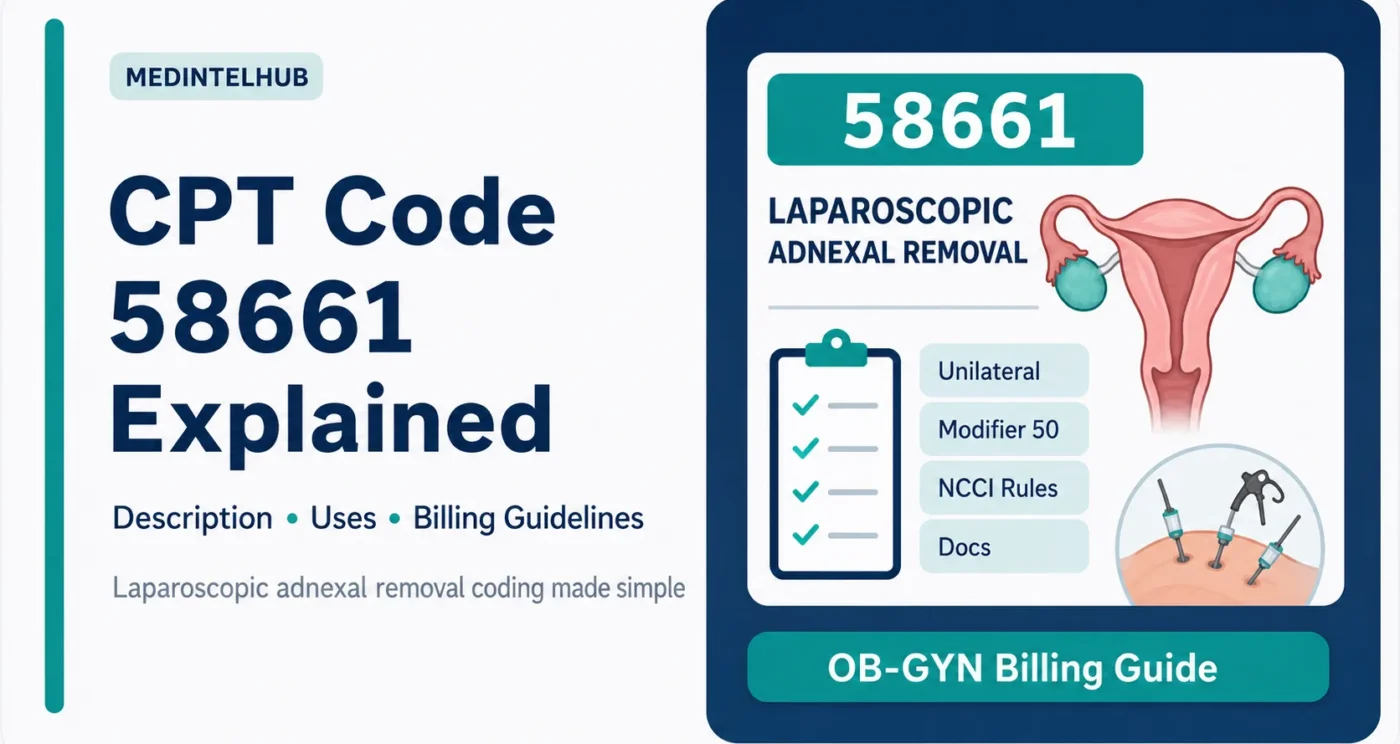
CPT code 58661 is used for laparoscopic surgical removal of adnexal structures. Depending on what the surgeon removes, the procedure may involve part or all of a fallopian tube, an ovary, or both structures on one side.
Although the 58661 CPT code description may appear straightforward, billing questions often arise around bilateral procedures, modifier 50, diagnostic laparoscopy, adhesiolysis, ovarian cyst surgery, and ectopic pregnancy.
These distinctions matter because the code on the claim should represent the procedure that was actually performed—not simply the surgery that was originally scheduled.
Coding requirements also change over time. For additional background on annual revisions, documentation, and payer considerations, see MedIntelHub’s 2026 CPT Code Changes: What Providers Need to Know.
What Is CPT Code 58661?
CPT 58661 represents a surgical laparoscopic procedure involving removal of adnexal structures.
In this context, the adnexal structures primarily include the:
- Fallopian tube
- Ovary
- Fallopian tube and ovary together
Depending on the operative report, the procedure may therefore represent a partial or complete salpingectomy, partial or complete oophorectomy, or removal of both structures.
The surgical approach is important. CPT 58661 applies to a laparoscopic procedure. If the physician performs an open procedure instead, a different CPT code may be appropriate.
The diagnosis by itself does not determine the procedure code. Final coding should reflect what the surgeon actually performed and documented.
CPT 58661 Description and Purpose
The CPT code 58661 description relates to surgical laparoscopy involving removal of adnexal structures, such as part or all of a fallopian tube or ovary.
There are several clinical circumstances in which this type of procedure may be performed. Examples can include treatment of certain ovarian or tubal abnormalities, removal of diseased adnexal tissue, risk-reducing surgery, or removal of fallopian tubes for sterilization when clinically appropriate.
However, the central coding question is not simply why surgery occurred.
Coders also need to determine:
- Which structure was removed
- Whether part or all of the structure was removed
- Whether surgery was performed on the right, left, or both sides
- Whether the procedure was laparoscopic or open
- Whether another procedure better describes the completed surgery
These details can materially affect final claim coding.
Is CPT 58661 Unilateral or Bilateral?
This is one of the most important current coding issues involving CPT 58661.
For the 2024 CPT code set, a parenthetical instruction was added to clarify that 58661 represents a unilateral procedure. Current CPT guidance directs users to report 58661 with modifier 50 when the procedure is performed bilaterally.
For example:
A laparoscopic removal involving only the right fallopian tube is unilateral.
A laparoscopic procedure involving both fallopian tubes is bilateral.
This clarification is especially important for practices using older coding references because previous CPT guidance concerning the bilateral status of 58661 differed from the current instruction.
Individual payers can also have specific claim-submission requirements. Some may expect modifier 50 on one claim line, while others may have their own electronic-claim formatting rules.
Practices should therefore follow current CPT guidance while also verifying how the patient’s payer expects bilateral procedures to be submitted.
When Is Procedure Code 58661 Used?
Procedure code 58661 may be appropriate when the surgeon laparoscopically removes part or all of an adnexal structure and the completed operation meets the requirements of the code.
The coder should rely on the final operative report, not merely the scheduled procedure.
Consider a patient who is scheduled for diagnostic laparoscopy because imaging identified an adnexal abnormality. During surgery, the physician determines that an affected fallopian tube should be removed.
The final claim should represent the surgical procedure actually completed rather than continuing to report only diagnostic laparoscopy.
CMS specifically states that surgical laparoscopy includes diagnostic laparoscopy. Its 2026 Medicare NCCI manual identifies CPT 49320 as included in surgical laparoscopy codes 58660 through 58673.
This makes careful review of the operative report essential.
Billing Guidelines for CPT Code 58661
Correct billing for CPT code 58661 involves more than selecting the procedure number from a code list.
The coder should determine what was removed, whether the procedure was unilateral or bilateral, whether other laparoscopic procedures occurred, and whether NCCI or payer-specific rules affect separate reporting.
CMS’s current Medicare NCCI manual is effective January 1, 2026 and contains the applicable correct-coding guidance for these procedure families.
You can review the current CMS Medicare NCCI Policy Manual directly.
Do Not Automatically Bill Diagnostic Laparoscopy Separately
Diagnostic laparoscopy is generally included when it leads to a surgical laparoscopic procedure during the same encounter.
CMS states that surgical laparoscopy includes diagnostic laparoscopy and specifically places CPT 49320 within the included services for codes 58660–58673.
Therefore, if the surgeon first examines the pelvis and then proceeds with the adnexal removal represented by 58661, the diagnostic laparoscopy generally should not be separately reported.
Simply documenting that the physician “looked around the pelvis” does not create a separate billable diagnostic procedure.
Can CPT 58660 Be Billed With 58661?
CPT 58660 generally represents laparoscopic lysis of adhesions involving the fallopian tubes or ovaries.
A surgeon may need to release adhesions before reaching or removing an ovary or fallopian tube. That does not necessarily mean 58660 should be added to the claim.
For Medicare, CMS states that laparoscopic lysis of adhesions represented by CPT 44180 or 58660 is not separately reportable with another surgical laparoscopic procedure.
Therefore, when adhesiolysis is necessary to perform the procedure represented by CPT 58661, billing an additional 58660 generally would not be appropriate under Medicare NCCI policy.
This is a useful reminder that every step documented in an operative report does not automatically represent a separately billable service.
Several procedures can look similar to medical code 58661, but they represent different surgical work.
| Code | General Purpose |
|---|---|
| 49320 | Diagnostic laparoscopy |
| 58660 | Laparoscopic lysis of adhesions involving tubes or ovaries |
| 58661 | Laparoscopic removal of adnexal structures |
| 58662 | Laparoscopic excision or treatment of certain pelvic or ovarian lesions |
| 58670 | Laparoscopic tubal fulguration for sterilization |
| 58671 | Laparoscopic tubal occlusion using a device |
| 59151 | Laparoscopic treatment of ectopic pregnancy involving removal of tube and/or ovary |
These descriptions are intentionally simplified. The current CPT codebook and official instructions should be used for final coding decisions.
CPT 58661 vs. 58662
The distinction between 58661 and 58662 can be particularly important in ovarian surgery.
If the surgeon removes a cyst or lesion without removing ovarian tissue, CPT 58662 may be more appropriate depending on the documented service.
If part or all of the ovary itself is removed, CPT 58661 may be relevant.
AAPC’s coding information for CPT 58662 describes it as involving laparoscopic destruction or excision of certain ovarian, pelvic, or peritoneal lesions.
The operative report should establish what tissue was actually removed.
CPT 58661 and Ectopic Pregnancy
Ectopic pregnancy requires special attention because the clinical context can lead to a different CPT code.
If the physician performs laparoscopic surgery specifically to treat an ectopic pregnancy and removes the affected fallopian tube and/or ovary, CPT 59151 may more specifically describe the procedure.
This is different from using CPT 58661 simply because a fallopian tube was removed.
The coding principle is straightforward: use the code that most specifically represents the complete procedure and clinical circumstances rather than choosing a code solely because the anatomy appears to match.
This also corrects an important error in the rewritten draft: 59151—not 58661—is the related code that should be evaluated when laparoscopic removal is performed in treatment of an ectopic pregnancy.
Bilateral Salpingectomy and Modifier 50
Bilateral salpingectomy is one of the most common situations in which the laterality instructions for CPT 58661 become important.
Current CPT guidance treats code 58661 as unilateral. When laparoscopic removal is performed on both ovaries and/or tubes during the same operative session, modifier 50 — Bilateral Procedure is used according to the current CPT instruction.
For example, laparoscopic removal of both fallopian tubes may be reported as a bilateral service using CPT 58661 with modifier 50 when appropriate.
The operative note should clearly document work on both sides.
Payer-specific billing instructions still matter. Practices should verify whether the particular insurer expects modifier 50 or has another claim-formatting convention for bilateral services.
Documentation Requirements for CPT 58661
Good documentation is especially important for 58661 CPT coding because the details in the operative report determine laterality, surgical approach, and whether another procedure code applies.
The operative note should clearly identify:
- The reason for surgery
- Whether the approach was laparoscopic
- The structures examined
- The structure or structures removed
- Right, left, or bilateral involvement
- Whether removal was partial or complete when relevant
- Significant operative findings
- Additional procedures performed
- Whether adhesiolysis was required
- Any complications
- Whether laparoscopic surgery was converted to an open procedure
The documentation should allow the coder to determine exactly what procedure occurred without having to infer or guess.
Diagnostic Laparoscopy
Diagnostic visualization performed as part of the surgical laparoscopy is generally included rather than separately billable.
Adhesions
If adhesiolysis was required to reach the surgical site and complete the laparoscopic procedure, Medicare NCCI guidance states that CPT 58660 is not separately reportable with another surgical laparoscopic procedure.
Bilateral Surgery
When modifier 50 is used, the operative note should support surgery on both sides.
Conversion to Open Surgery
If a laparoscopic procedure is converted to an open procedure, CMS states that only the open procedure should be reported. The unsuccessful laparoscopic procedure and diagnostic laparoscopy are not separately reported with the completed open procedure.
CPT 58661 and Medical Necessity
Choosing the right procedure code does not guarantee reimbursement.
The AMA specifically notes that the existence of a CPT code does not guarantee coverage, reimbursement, or payment. Insurers make separate decisions involving coverage and reimbursement.
Billing teams should therefore answer three separate questions:
- Does CPT 58661 accurately represent the surgery performed?
- Does the medical record support the diagnosis and medical necessity?
- Does the patient’s health plan cover the service under the applicable circumstances?
A correct answer to the first question does not automatically mean the claim will be reimbursed.
For a broader discussion of this distinction, MedIntelHub’s 2026 CPT coding guide explains why code validity and payer coverage should be evaluated separately.
Common CPT 58661 Billing Mistakes
1. Treating CPT 58661 as Inherently Bilateral
Current CPT guidance treats 58661 as unilateral and instructs users to report modifier 50 for bilateral procedures.
Older references may contain different guidance, making current resources particularly important.
2. Separately Billing Diagnostic Laparoscopy
If diagnostic laparoscopy leads directly to the surgical laparoscopy during the same encounter, CMS generally considers the diagnostic service included.
3. Separately Reporting Routine Adhesiolysis
CMS states that CPT 58660 is not separately reportable with other surgical laparoscopic procedures.
4. Coding From the Surgery Schedule
The procedure planned before surgery may differ from the procedure ultimately completed.
Final coding should be based on the operative report.
5. Failing to Document Laterality
The medical record should make clear whether the procedure involved the right side, left side, or both sides.
This is particularly important when modifier 50 is reported.
6. Confusing 58661 With 58662
Removing a lesion from an ovary is not necessarily the same as removing part or all of the ovary itself.
The amount and type of tissue removed can change the appropriate code.
7. Using 58661 When an Ectopic-Pregnancy Code Is More Specific
When laparoscopic removal of a tube and/or ovary is performed specifically as treatment for ectopic pregnancy, CPT 59151 may need to be considered instead.
8. Assuming Correct Coding Guarantees Payment
A CPT code describes the procedure. It does not determine whether a particular insurer will cover or reimburse it.
Tips for Accurate CPT 58661 Billing
Start with the final operative report rather than the surgery schedule.
Confirm exactly what structures were removed, the surgical approach used, and whether the operation was unilateral or bilateral.
For bilateral surgery, review current CPT guidance concerning modifier 50 and confirm how the patient’s payer wants bilateral procedures submitted.
Check current NCCI edits before separately reporting other laparoscopic services. In particular, avoid routinely adding diagnostic laparoscopy or laparoscopic adhesiolysis to 58661.
Also verify that the diagnosis, medical necessity, prior authorization when required, and payer coverage requirements match the documented service.
Finally, use the current CPT code set. The AMA states that CPT is updated routinely, and its 2026 resources should be used alongside applicable payer and CMS guidance.
Frequently Asked Questions
What is CPT code 58661 used for?
CPT code 58661 generally represents laparoscopic surgical removal of adnexal structures, which may involve partial or complete removal of a fallopian tube, ovary, or both.
What is the CPT code 58661 description?
The 58661 CPT code description relates to laparoscopic surgical removal of adnexal structures involving an ovary and/or fallopian tube.
Healthcare professionals should consult the current licensed CPT codebook for the complete official descriptor and instructions.
Is CPT 58661 unilateral or bilateral?
Current CPT guidance treats 58661 as a unilateral procedure. For bilateral procedures, CPT directs users to report 58661 with modifier 50.
Should modifier 50 be used with CPT 58661?
Under current CPT guidance, yes, when the procedure is performed bilaterally. Payer-specific claim-submission requirements should also be verified.
Can CPT 58661 be billed with 49320?
Generally not when diagnostic laparoscopy leads to the surgical laparoscopic procedure during the same encounter.
CMS specifically states that CPT 49320 is included in surgical laparoscopy codes 58660–58673.
Can CPT 58660 and 58661 be billed together?
Under Medicare NCCI policy, laparoscopic lysis of adhesions represented by CPT 58660 is not separately reportable with another surgical laparoscopic procedure.
What is the difference between CPT 58661 and 58662?
CPT 58661 generally involves removal of adnexal structures, while CPT 58662 is associated with laparoscopic treatment or excision of certain ovarian, pelvic, or peritoneal lesions.
The operative report should establish whether actual ovarian or tubal tissue was removed.
Is CPT 58661 used for an ectopic pregnancy?
Not automatically.
When laparoscopic surgery specifically treats an ectopic pregnancy and involves removal of the tube and/or ovary, CPT 59151 may more specifically represent the procedure.
Can CPT 58661 be used for bilateral salpingectomy?
CPT 58661 can represent laparoscopic removal involving the fallopian tubes. Because current CPT guidance treats the base code as unilateral, modifier 50 is used when the procedure is performed bilaterally.
What happens if CPT 58661 is converted to open surgery?
Under Medicare NCCI guidance, if the laparoscopic procedure is converted to an open procedure, only the completed open procedure is generally reported.
Is CPT 58661 always covered by insurance?
No. Correct use of a CPT code does not guarantee reimbursement. Coverage may depend on medical necessity, diagnosis, benefits, prior authorization, payer policy, and other claim-specific requirements.
Conclusion
Understanding CPT code 58661 requires more than knowing that it involves laparoscopic removal of a fallopian tube or ovary.
The operative report should establish exactly which structures were removed, whether surgery occurred on one side or both sides, what surgical approach was used, and whether another procedure code more specifically describes the completed service.
One particularly important current coding point is that CPT 58661 is treated as unilateral, with modifier 50 used for bilateral procedures under current CPT guidance.
Billing teams should also remember that diagnostic laparoscopy is generally included in surgical laparoscopy and that Medicare NCCI policy does not permit laparoscopic adhesiolysis represented by 58660 to be separately reported with another surgical laparoscopic procedure.
Accurate billing begins with a clear operative report, current coding guidance, correct modifier use, and verification of payer-specific requirements.
Resources
Centers for Medicare & Medicaid Services — Medicare NCCI Policy Manual
CMS publishes the National Correct Coding Initiative manual used to explain Medicare correct-coding policies and edits. The current 2026 edition took effect January 1, 2026.
CMS Medicare NCCI Policy Manual
CMS — 2026 Medicare NCCI Policy Manual, Chapter 7
Chapter 7 addresses procedures involving the urinary, male genital, female genital, maternity-care, and delivery systems and contains relevant laparoscopy rules.
2026 Medicare NCCI Policy Manual — Chapter 7
American Medical Association — CPT Coding Resources
The AMA develops and maintains the CPT code set and provides current coding resources for healthcare organizations.
AMA CPT Coding Resources
American Medical Association — CPT Code Set Basics and Resources
This resource explains the CPT system and emphasizes that having a CPT code does not guarantee coverage, reimbursement, or payment.
AMA CPT Code Set: The Basics and Resources
CPT Assistant Summary — Reporting 58661 for Bilateral Procedures
This resource summarizes the 2024 CPT clarification establishing unilateral reporting for 58661 and use of modifier 50 for bilateral procedures.
Reporting Code 58661 for Bilateral Procedure
MedIntelHub — 2026 CPT Code Changes
MedIntelHub provides additional background on annual CPT updates, documentation, payer rules, NCCI considerations, and reimbursement issues.
2026 CPT Code Changes: What Providers Need to Know
MedIntelHub — Editorial Policy
Readers can review MedIntelHub’s standards concerning authoritative sourcing, updates, healthcare accuracy, transparency, and editorial limitations.
MedIntelHub Editorial Policy
Editorial Disclaimer
This article is provided for educational and informational purposes only. CPT coding requirements, CMS policies, NCCI edits, commercial payer rules, modifier requirements, reimbursement policies, and documentation standards may change and can vary by payer, jurisdiction, provider type, place of service, and individual circumstances.
CPT is a registered trademark of the American Medical Association.
This article does not replace the current licensed CPT codebook, official CPT instructions, CMS guidance, NCCI edits, Medicare Administrative Contractor policies, commercial payer requirements, or advice from a qualified medical coding or compliance professional.
Healthcare organizations should verify current coding, billing, and coverage requirements before submitting claims.

David Bennett
David Bennett is an author at MedIntelHub, where he creates clear, practical, and well-researched content about healthcare, medical billing, insurance, and patient education. His goal is to make complex healthcare topics easier for readers to understand and use in everyday situations. David emphasizes accuracy, transparency, and reliable sourcing, using information from trusted organizations and official healthcare resources whenever possible. Content published by David is intended for educational purposes and should not replace advice from qualified medical, legal, or healthcare professionals.