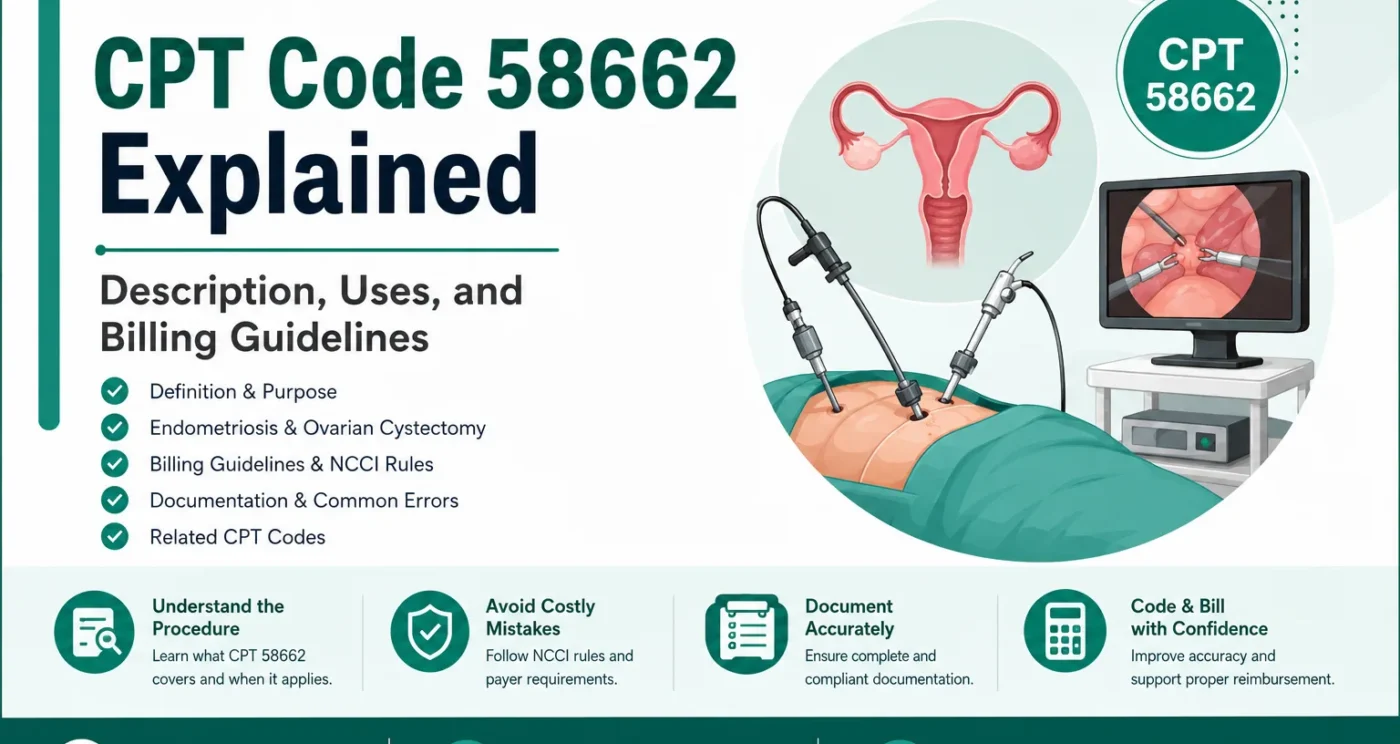
Accurate coding for gynecologic surgery requires more than knowing that a laparoscopic procedure was performed. Coders need to understand what the surgeon found, where the lesion was located, how it was treated, and whether any ovarian or fallopian-tube tissue was actually removed.
CPT code 58662 is commonly used for laparoscopic surgical treatment of certain lesions involving the ovary, pelvic viscera, or peritoneal surface. Depending on the operative findings, the procedure may involve excision or destruction of lesions associated with conditions such as ovarian cysts or endometriosis. AAPC summarizes the service as laparoscopic destruction or excision of lesions, tumors, or cysts involving qualifying ovarian, pelvic, and peritoneal structures.
The distinction between CPT 58662 and related codes such as 58661, 58660, 49320, and 49322 is especially important. Using the wrong code—or separately billing a service that is already included in another procedure—can lead to denials, undercoding, or inappropriate unbundling.
Coding rules and payer policies can also change. For additional information about keeping billing workflows current, see MedIntelHub’s guide to 2026 CPT updates. 2026 CPT Code Changes: What Providers Need to Know
What Is CPT Code 58662?
CPT code 58662 represents surgical laparoscopy involving the destruction or excision of qualifying lesions of the ovary, pelvic viscera, or peritoneal surface.
The surgeon accesses the pelvic cavity through a laparoscopic approach and treats abnormal tissue using an appropriate technique. Depending on the case, this may involve excising a lesion or destroying abnormal tissue through methods such as fulguration.
The procedure may apply to lesions involving areas such as:
- The ovary
- Pelvic peritoneum
- Certain pelvic organ surfaces
- Areas around the bladder
- Rectal or other pelvic visceral surfaces
- Other qualifying pelvic structures
CPT 58662 should not be treated as a general code for every laparoscopic gynecologic procedure. The completed operative report must support the work represented by the code.
CPT 58662 Description and Purpose
The CPT 58662 description centers on laparoscopic excision or destruction of qualifying pelvic, ovarian, or peritoneal lesions.
The key coding question is what the surgeon actually treated.
For example, removing an ovarian cyst while preserving the ovary can be different from removing part or all of the ovary itself. Similarly, destroying endometriosis lesions is different from simply inspecting the pelvis during diagnostic laparoscopy.
The procedure documentation should therefore establish:
- What abnormal tissue was identified
- Where it was located
- Whether it was excised or destroyed
- Whether ovarian tissue was preserved
- Whether an ovary or fallopian tube was removed
- Whether another separately identifiable procedure was performed
These details help distinguish CPT 58662 from related gynecologic surgery codes.
When Is Procedure Code 58662 Used?
Procedure code 58662 may be appropriate when a physician laparoscopically excises or destroys qualifying lesions involving the ovary, pelvic organs, or peritoneal surface.
One example is laparoscopic treatment of endometriosis.
A patient may undergo surgery because of symptoms or findings associated with endometriosis. During laparoscopy, the surgeon may identify lesions and excise or destroy qualifying abnormal tissue.
ACOG notes that laparoscopy may be used in the evaluation or treatment of conditions such as chronic pelvic pain, infertility, pelvic masses, and endometriosis. When endometriosis is identified during surgery, treatment may sometimes be performed during the same procedure.
It is important, however, not to imply that every patient suspected of having endometriosis must undergo surgery. ACOG’s 2026 guidance emphasizes that clinical evaluation and imaging can support a presumptive diagnosis in appropriate patients, while some patients may choose surgical diagnosis and treatment depending on their circumstances.
Another common situation is laparoscopic ovarian cystectomy, where a cyst is removed while ovarian tissue is preserved.
CPT 58662 and Endometriosis
Endometriosis is one of the conditions frequently associated with laparoscopic lesion treatment.
ACOG defines endometriosis as a chronic inflammatory disorder involving endometrial-like tissue lesions outside the uterus. It may be associated with pelvic pain, infertility, and reduced quality of life.
During laparoscopic surgery, a physician may:
- Identify endometriosis lesions
- Excise qualifying lesions
- Destroy or fulgurate abnormal tissue
- Treat ovarian endometriomas
- Treat qualifying lesions on pelvic or peritoneal surfaces
If the surgical work meets the requirements of CPT 58662, the code may be appropriate.
However, the diagnosis of endometriosis alone does not determine the procedure code. The operative report must show what the surgeon actually performed.
Is CPT 58662 Used for Ovarian Cystectomy?
Yes. CPT 58662 may be appropriate for a laparoscopic ovarian cystectomy when the surgeon removes the cyst or lesion while preserving the ovary.
This distinction is important.
If the cyst is excised without removing additional ovarian tissue, 58662 may represent the service. AAPC coding guidance similarly distinguishes laparoscopic cystectomy with ovarian preservation from procedures in which part of the ovary itself is removed.
If part or all of the ovary is removed, however, CPT 58661 may be more appropriate.
The operative report should be the primary source for procedure coding. A pathology report may provide useful supporting information about the specimen, but it should not replace the surgeon’s operative documentation when determining what procedure was performed.
CPT 58662 vs. CPT 58661
One of the most important distinctions is between CPT 58662 and CPT 58661.
| Code | General Purpose |
|---|---|
| 58661 | Laparoscopic removal of adnexal structures, including qualifying ovarian or fallopian-tube removal |
| 58662 | Laparoscopic excision or destruction of qualifying ovarian, pelvic, or peritoneal lesions |
The difference often depends on what tissue was actually removed.
For example, if the surgeon removes an ovarian cyst while preserving the ovary, CPT 58662 may apply.
If the surgeon performs a partial or complete oophorectomy, CPT 58661 may instead be relevant.
This determination should come from the final operative report—not from the procedure schedule, preoperative diagnosis, or procedure title alone.
CPT 58662 vs. Diagnostic Laparoscopy
CPT 58662 is not a diagnostic laparoscopy code.
Diagnostic laparoscopy is generally represented by CPT 49320.
A procedure may begin as diagnostic laparoscopy and then become surgical when the physician identifies and treats a lesion. In that situation, the diagnostic portion generally becomes part of the surgical laparoscopic procedure.
CMS’s 2026 NCCI Policy Manual specifically states that surgical laparoscopy includes diagnostic laparoscopy. It also lists CPT 49320 as included within surgical laparoscopy codes 58660 through 58673.
Therefore, coders generally should not report:
49320 + 58662
merely because the physician first inspected the pelvis before treating the lesion.
The diagnostic examination necessary to perform the surgery is already included.
Can CPT 58660 Be Billed With 58662?
CPT 58660 generally represents laparoscopic lysis of adhesions involving structures such as the fallopian tubes or ovaries.
Adhesions are commonly encountered during pelvic surgery. In some cases, the surgeon must release adhesions simply to reach an ovarian cyst, endometriosis lesion, or another operative site.
That does not automatically make adhesiolysis separately billable.
CMS states that laparoscopic lysis of adhesions represented by CPT 44180 or 58660 is not separately reportable with another surgical laparoscopic procedure under Medicare NCCI policy.
Therefore, Medicare claims should not automatically include 58660 with 58662 simply because the operative note mentions adhesiolysis.
The presence of the word “adhesiolysis” in the report does not by itself establish a separately payable procedure.
Can Multiple Lesions Be Reported Separately?
CPT 58662 reports the surgical treatment represented by the code rather than creating a separate charge for every lesion encountered.
A surgeon may treat several endometriosis implants or multiple lesions during the same laparoscopic session.
That does not automatically mean CPT 58662 should be reported multiple times.
CMS uses Medically Unlikely Edits, or MUEs, as units-of-service controls for many CPT and HCPCS codes. MUEs are intended to reduce incorrect reporting based on factors including anatomy, coding instructions, clinical practice, and the nature of the procedure.
Before reporting more than one unit, billing teams should check:
- Current CPT instructions
- Current CMS MUE files
- Payer units-of-service policies
- The operative documentation
The number of lesions by itself should not determine the number of billable units.
Should Modifier 50 Be Used With CPT 58662?
Modifier 50 should not automatically be added to CPT 58662 simply because lesions were treated on both ovaries or on both sides of the pelvis.
This differs from CPT 58661, for which bilateral reporting has specific CPT guidance.
For Medicare Physician Fee Schedule purposes, CPT 58662 has been assigned a bilateral surgery indicator of 0, meaning the standard 150% bilateral payment adjustment does not apply. CMS explains that an indicator of 0 means the usual bilateral adjustment is not appropriate for the service.
Therefore, practices should not assume that bilateral ovarian lesions justify modifier 50 or separate bilateral payment.
Commercial payer requirements may differ, so current payer instructions should still be checked before claim submission.
Billing Guidelines for CPT Code 58662
Accurate CPT 58662 billing begins with the finalized operative report.
Before submitting the claim, coders should determine:
- What lesion or lesions were treated?
- Where were they located?
- Were the lesions excised, destroyed, or treated by another qualifying method?
- Was ovarian tissue preserved?
- Was an ovary or fallopian tube removed?
- Did the procedure begin as diagnostic laparoscopy and become surgical?
- Was adhesiolysis performed as part of surgical access?
- Were any other separately identifiable procedures completed?
- Do NCCI edits affect the proposed code combination?
- Are payer-specific authorization or modifier requirements applicable?
CMS instructs providers to report the code describing the completed procedure with the greatest available specificity and not to separately report services that are routinely integral to a more comprehensive procedure.
The current NCCI manual can be reviewed directly through CMS. CMS Medicare NCCI Policy Manual
NCCI Bundling Rules for CPT 58662
Several NCCI principles are particularly important when billing laparoscopic gynecologic surgery.
Diagnostic Laparoscopy
When diagnostic laparoscopy leads to surgical laparoscopy during the same encounter, only the surgical laparoscopic procedure is generally reported.
Adhesiolysis
CMS states that CPT 44180 or 58660 for laparoscopic adhesiolysis is not separately reportable with another surgical laparoscopic procedure.
Conversion to Open Surgery
If a laparoscopic procedure is converted to an open procedure, CMS generally instructs providers to report only the open procedure. Neither the unsuccessful surgical laparoscopy nor diagnostic laparoscopy is reported with the completed open procedure.
Modifier 59
Modifier 59 should not be appended merely to bypass an NCCI edit.
CMS states that modifier 59 is intended for genuinely distinct procedures or services—for example, different encounters or distinct anatomical sites—when the applicable coding circumstances support separate reporting. The medical record must support the distinction.
If a more specific X modifier such as XE, XP, XS, or XU appropriately describes the circumstances, CMS generally prefers the more specific modifier.
Several codes may appear similar when reviewing a laparoscopic operative report.
| Code | General Service |
|---|---|
| 49320 | Diagnostic laparoscopy |
| 49322 | Laparoscopic aspiration of a cavity or cyst |
| 58660 | Laparoscopic lysis of adhesions |
| 58661 | Laparoscopic removal of adnexal structures |
| 58662 | Laparoscopic excision or destruction of qualifying pelvic lesions |
| 58670 | Laparoscopic tubal fulguration for sterilization |
| 58671 | Laparoscopic tubal occlusion using a device |
These descriptions are simplified for comparison. The current licensed CPT codebook should be used for final coding decisions.
The AMA maintains the official CPT code set and recommends reviewing the complete descriptor and applicable guidelines when determining how to report a service.
CPT 58662 vs. 49322
The difference between aspirating a cyst and excising a cyst matters.
Aspiration generally involves draining fluid or contents from a cyst.
Excision or cystectomy involves surgically removing lesion or cyst tissue.
Therefore, coders should not select CPT 49322 instead of 58662 merely because the operative note contains the word “cyst.”
The operative technique should determine the code.
Documentation Requirements for CPT 58662
A detailed operative report reduces uncertainty and helps support accurate claim submission.
Documentation for CPT 58662 should generally identify:
- The clinical reason for surgery
- The laparoscopic surgical approach
- Relevant pelvic findings
- Location of the lesion or lesions
- The method used to treat each significant lesion
- Whether lesions were excised or destroyed
- Whether an ovarian cystectomy was performed
- Whether ovarian tissue was preserved
- Whether an ovary or fallopian tube was removed
- Whether adhesions were encountered
- Additional procedures performed
- Any complications
- Whether the procedure was converted to an open operation
For endometriosis surgery, specific documentation such as the anatomical areas treated is generally more useful than a vague statement such as “endometriosis fulgurated.”
Documentation should also distinguish routine steps necessary to complete the primary surgery from genuinely separate services.
CPT 58662 and Medical Necessity
A valid CPT code does not guarantee insurance reimbursement.
The AMA specifically states that establishment or availability of a CPT code does not guarantee coverage, reimbursement, or payment.
A payer may separately consider:
- Medical necessity
- Diagnosis coding
- Prior authorization
- Patient eligibility
- Benefit limitations
- NCCI or proprietary claim edits
- Documentation requirements
- Place of service
- Network status
Coding and coverage should therefore be treated as separate questions.
MedIntelHub discusses this distinction in its overview of current CPT and payer changes. Read MedIntelHub’s 2026 CPT Coding Guide
Common CPT 58662 Billing Mistakes
1. Using 58662 When an Ovary or Tube Is Removed
CPT 58662 generally describes lesion treatment.
If part or all of an ovary or fallopian tube is removed, CPT 58661 may more accurately describe the procedure.
2. Billing Diagnostic Laparoscopy Separately
When CPT 49320 leads directly to the surgical laparoscopic procedure, Medicare generally considers the diagnostic service included.
3. Automatically Reporting Adhesiolysis
Adhesiolysis required to reach the operative site does not automatically justify CPT 58660.
CMS does not allow laparoscopic adhesiolysis to be separately reported with another surgical laparoscopic procedure under its NCCI policy.
4. Confusing Cyst Aspiration With Cystectomy
Draining an ovarian cyst and excising the cyst wall or lesion are different procedures.
The surgical technique should drive code selection.
5. Reporting CPT 58662 Multiple Times for Multiple Lesions
Multiple treated lesions do not automatically justify multiple units.
Current CPT instructions, CMS MUEs, and payer policies should be reviewed.
6. Automatically Applying Modifier 50
Do not assume modifier 50 is appropriate simply because lesions were treated bilaterally.
Medicare’s bilateral payment rules for CPT 58662 do not provide the standard bilateral adjustment.
7. Misusing Modifier 59
Modifier 59 should not be used simply because a claim edit prevents payment.
The documentation must establish a genuinely distinct service, and the applicable NCCI edit must permit modifier use.
8. Coding From the Surgery Schedule
A planned ovarian cystectomy may become an oophorectomy, or diagnostic laparoscopy may result in surgical treatment.
Final coding should reflect what was actually completed.
Tips for Accurate CPT 58662 Billing
Start with the finalized operative report.
Confirm that the procedure was performed laparoscopically and identify exactly what tissue was treated.
Determine whether the surgeon removed only a lesion or cyst or whether ovarian or fallopian-tube tissue was also removed.
When endometriosis is treated, document the anatomical sites and treatment methods clearly.
Review current NCCI policies to determine whether diagnostic laparoscopy, adhesiolysis, or another service is already included.
Do not report additional units simply because several lesions were treated, and do not add modifiers merely to bypass payer edits.
Finally, verify diagnosis coding, medical necessity, prior authorization when applicable, and payer-specific coverage requirements before claim submission.
Frequently Asked Questions
What does CPT code 58662 mean?
CPT code 58662 generally represents laparoscopic surgical excision or destruction of qualifying lesions involving the ovary, pelvic viscera, or peritoneal surface.
What is the CPT 58662 description?
The 58662 CPT code description relates to surgical laparoscopy involving excision or destruction of certain ovarian, pelvic, or peritoneal lesions.
Healthcare organizations should use the current licensed CPT codebook for the complete official descriptor and instructions.
Is CPT 58662 used for endometriosis?
It may be.
When a surgeon laparoscopically excises or destroys qualifying endometriosis lesions, CPT 58662 may represent the procedure.
Endometriosis lesions are located outside the uterus; they should not be described as lesions removed from the uterine lining. ACOG’s current guidance defines endometriosis as endometrial-like tissue lesions outside the uterus.
Is ovarian cystectomy coded with CPT 58662?
CPT 58662 may be appropriate for a laparoscopic ovarian cystectomy when the cyst is removed and ovarian tissue is preserved.
If part or all of the ovary is removed, CPT 58661 may need to be considered.
What is the difference between CPT 58661 and 58662?
CPT 58661 generally involves laparoscopic removal of adnexal structures such as an ovary or fallopian tube.
CPT 58662 generally involves laparoscopic excision or destruction of qualifying lesions while the involved organ may remain in place.
Can CPT 58662 be billed with 49320?
Generally not when diagnostic laparoscopy leads directly to CPT 58662 during the same surgical encounter.
CMS states that surgical laparoscopy includes diagnostic laparoscopy.
Can CPT 58660 and 58662 be billed together?
For Medicare, CMS states that laparoscopic adhesiolysis represented by CPT 58660 is not separately reportable with another surgical laparoscopic procedure.
Commercial payer rules should also be checked.
Can CPT 58662 be reported more than once for multiple lesions?
Not automatically.
The number of lesions does not necessarily determine billable units. Current CPT instructions, CMS MUE information, and payer policies should be reviewed.
Should modifier 50 be applied to CPT 58662?
Do not automatically append modifier 50 simply because lesions are treated on both sides.
For Medicare, the standard bilateral payment adjustment does not apply to CPT 58662. Payer-specific requirements should still be verified.
Is CPT 58662 always covered by insurance?
No.
Correct coding does not guarantee reimbursement. Coverage can depend on medical necessity, diagnosis, authorization, benefits, documentation, and the individual payer’s policies.
Conclusion
Understanding CPT code 58662 requires careful review of what the surgeon actually treated during laparoscopic surgery.
The code generally applies to laparoscopic excision or destruction of qualifying lesions involving the ovary, pelvic viscera, or peritoneal surface. Examples can include certain ovarian cystectomies and surgical treatment of endometriosis when the documented procedure meets the code requirements.
One of the most important distinctions is between CPT 58662 and CPT 58661. Removing a cyst or lesion while preserving the ovary is different from removing part or all of the ovary or fallopian tube.
Billing teams should also remember that diagnostic laparoscopy is generally included when it leads to surgical laparoscopy, and Medicare NCCI policy does not allow laparoscopic adhesiolysis to be separately reported with another surgical laparoscopic procedure.
Accurate billing begins with a detailed operative report, current CPT guidance, appropriate NCCI review, correct modifier use, and verification of payer-specific requirements.
Resources
Centers for Medicare & Medicaid Services — Medicare NCCI Policy Manual
CMS maintains Medicare correct-coding policies and updates the manual annually. The current Medicare manual is effective January 1, 2026.
CMS Medicare NCCI Policy Manual
CMS — 2026 NCCI Policy Manual, Chapter 7
Chapter 7 contains current Medicare guidance for female genital procedures and surgical laparoscopy.
2026 Medicare NCCI Policy Manual — Chapter 7
American Medical Association — CPT Coding Resources
The AMA develops and maintains the official CPT code set and publishes current coding resources.
AMA CPT Coding Resources
American College of Obstetricians and Gynecologists — Laparoscopy
ACOG explains how laparoscopy may be used to evaluate and treat gynecologic conditions, including endometriosis.
ACOG: Laparoscopy
ACOG — Diagnosis of Endometriosis
ACOG’s 2026 clinical guidance addresses clinical, imaging, and surgical evaluation of suspected endometriosis.
ACOG: Diagnosis of Endometriosis
AAPC — CPT 58662 Reference
AAPC provides a coding summary for CPT 58662 and its use in laparoscopic procedures involving ovarian and pelvic lesions.
AAPC: CPT Code 58662
MedIntelHub — 2026 CPT Code Changes
For additional information about current coding updates, payer rules, documentation, and NCCI considerations:
2026 CPT Code Changes: What Providers Need to Know
MedIntelHub — Editorial Policy
Review MedIntelHub’s standards for healthcare sourcing, accuracy, updates, transparency, and editorial limitations.
MedIntelHub Editorial Policy
Editorial Disclaimer
This article is provided for educational and informational purposes only. CPT coding requirements, CMS policies, NCCI edits, payer rules, modifier requirements, reimbursement policies, and documentation standards may change and can vary by payer, jurisdiction, provider type, place of service, and individual circumstances.
CPT is a registered trademark of the American Medical Association.
This article does not replace the current licensed CPT codebook, official CPT guidelines, CMS instructions, Medicare Administrative Contractor guidance, payer policies, or advice from a qualified medical coding or compliance professional.
Healthcare organizations should verify current coding, billing, documentation, and coverage requirements before submitting claims.

David Bennett
David Bennett is an author at MedIntelHub, where he creates clear, practical, and well-researched content about healthcare, medical billing, insurance, and patient education. His goal is to make complex healthcare topics easier for readers to understand and use in everyday situations. David emphasizes accuracy, transparency, and reliable sourcing, using information from trusted organizations and official healthcare resources whenever possible. Content published by David is intended for educational purposes and should not replace advice from qualified medical, legal, or healthcare professionals.