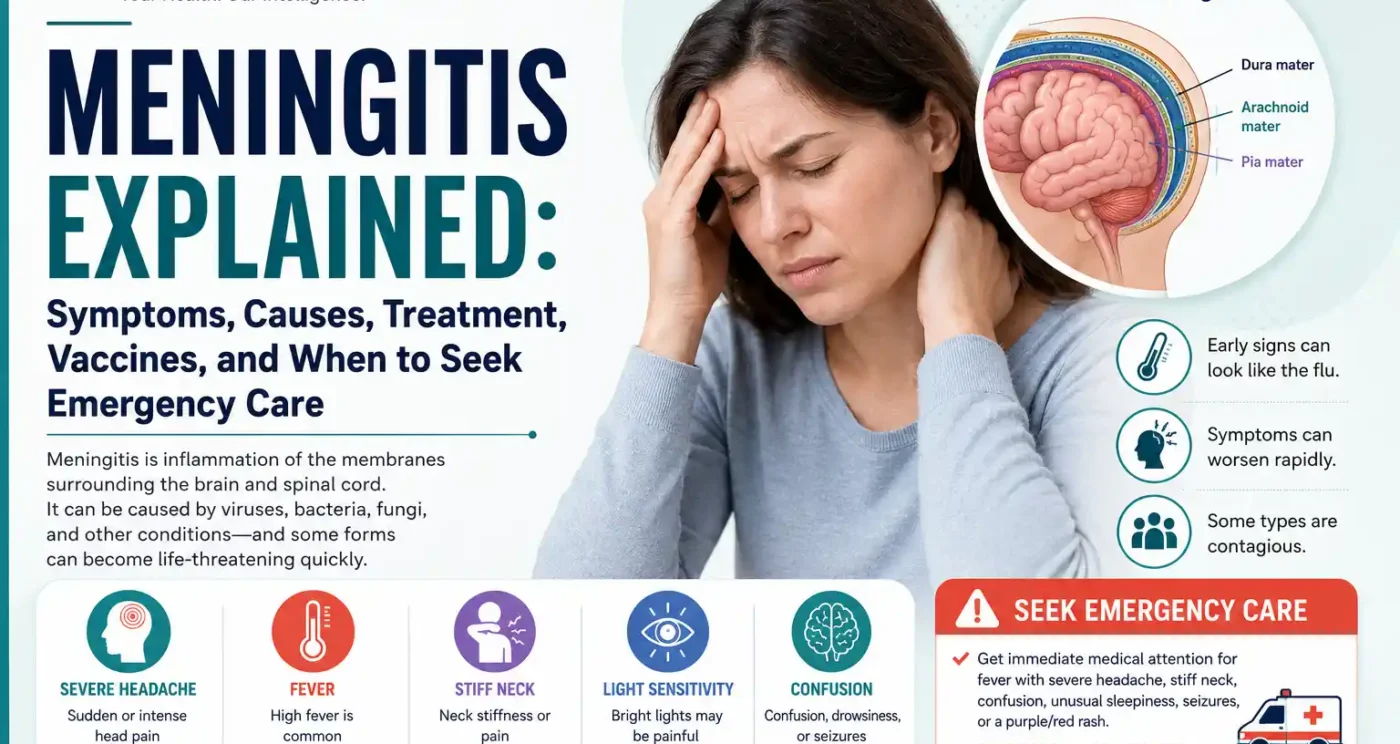
Meningitis can begin with symptoms that resemble a severe viral illness—fever, headache, nausea, tiredness, or body aches—but some forms can become life-threatening within hours.
Meningitis is inflammation of the protective membranes surrounding the brain and spinal cord, called the meninges. Viruses and bacteria are the most common infectious causes, although fungi, parasites, amebae, injuries, certain medications, cancer, and other conditions can also cause meningitis.
The distinction between causes matters enormously.
Bacterial meningitis is a medical emergency and requires treatment as soon as possible. Viral meningitis is more common and is often less severe, although serious cases can occur. Symptoms alone usually cannot reliably tell someone whether meningitis is bacterial, viral, or caused by something else.
Anyone who develops a severe headache with fever and neck stiffness—particularly with confusion, unusual sleepiness, vomiting, seizures, or a rapidly worsening illness—should receive prompt medical evaluation rather than waiting for every “classic” meningitis symptom to appear.
What Is Meningitis?
The brain and spinal cord are covered by thin protective membranes known as the meninges.
When those membranes become inflamed, the condition is called meningitis.
The inflammation may result from:
- Viral infection
- Bacterial infection
- Fungal infection
- Parasitic infection
- Amebic infection
- Certain medications
- Cancer
- Injury
- Other noninfectious inflammatory processes
CDC identifies bacterial and viral meningitis as the most common major categories.
The severity depends largely on the cause.
Some viral cases resolve with supportive care. Bacterial meningitis, in contrast, can progress rapidly and can cause permanent neurological injury or death despite treatment.
What Are the Most Common Symptoms of Meningitis?
The three symptoms most strongly associated with meningitis are:
- Fever
- Severe headache
- Stiff neck
Other symptoms may include:
- Nausea
- Vomiting
- Sensitivity to light, called photophobia
- Confusion or altered mental status
- Unusual sleepiness
- Reduced alertness
- Irritability
- Seizures in severe cases
CDC lists fever, headache, and stiff neck as common symptoms while emphasizing that additional neurological and gastrointestinal symptoms frequently occur.
A person does not need to have every symptom for meningitis to be possible.
What Are the Early Signs of Meningitis?
Early meningitis can be difficult to recognize because symptoms may initially resemble influenza, another viral infection, migraine, or another common illness.
Possible early symptoms include:
- Fever
- Headache
- Feeling unusually unwell
- Nausea
- Vomiting
- Increasing neck discomfort
- Light sensitivity
- Fatigue
With meningococcal disease in particular, CDC warns that symptoms can initially appear flu-like and then deteriorate rapidly.
The development of confusion, significant neck stiffness, severe headache, unusual difficulty waking, seizures, or rapidly worsening illness should raise concern.
Does Meningitis Always Cause a Stiff Neck?
No.
Neck stiffness is one of the classic symptoms, but its absence does not safely rule out meningitis.
Symptoms can differ according to:
- Age
- Cause of meningitis
- Immune status
- Severity
- Stage of illness
Infants in particular may not show the classic combination of headache and stiff neck. Older adults and people with weakened immune systems can also present differently.
That is why clinicians evaluate the overall clinical picture rather than relying on one symptom.
What Does a Meningitis Headache Feel Like?
Meningitis often causes a severe, persistent headache, but there is no single headache sensation that confirms the diagnosis.
A person may experience headache together with:
- Fever
- Neck stiffness
- Light sensitivity
- Vomiting
- Confusion
- Unusual sleepiness
Migraine can also cause severe headache, nausea, neck discomfort, and light sensitivity, which can make self-diagnosis unreliable.
A new severe headache combined with fever, altered mental status, significant neck stiffness, or other neurological symptoms requires medical assessment.
Can Meningitis Cause Sensitivity to Light?
Yes.
Photophobia, or increased sensitivity to light, is a recognized meningitis symptom.
Someone may find normal indoor lighting uncomfortable or experience worsening headache in bright environments.
CDC includes photophobia among common additional symptoms of meningococcal meningitis.
Photophobia also occurs with migraine and other conditions, so it does not diagnose meningitis by itself.
Can Meningitis Cause a Rash?
Sometimes—but this needs careful explanation.
A rash is particularly associated with meningococcal bloodstream infection, also called meningococcemia or meningococcal septicemia.
CDC notes that bloodstream infection caused by Neisseria meningitidis can eventually produce a dark-purple rash, particularly later in the illness. Other symptoms can include fever, chills, rapid breathing, severe muscle or joint pain, nausea, vomiting, fatigue, and cold hands or feet.
However:
Not everyone with meningitis develops a rash.
And not everyone with meningococcal disease develops the rash early.
Do not wait for a rash before seeking medical attention when other serious meningitis symptoms are present.
What Does a Meningococcal Rash Look Like?
A meningococcal bloodstream infection can produce small areas of bleeding beneath the skin that may progress to larger purple or dark-colored patches.
You may hear these described medically as:
- Petechiae
- Purpura
Skin appearance can also differ depending on skin tone.
A rapidly developing unexplained purple, red, or dark rash combined with fever or severe illness warrants emergency evaluation.
But the absence of a rash does not make meningococcal disease safe to rule out. CDC describes the dark-purple rash as a feature that may appear in later stages of bloodstream infection.
What Are Meningitis Symptoms in Babies?
Babies may not develop obvious headache or neck stiffness.
CDC notes that newborns and infants may instead:
- Become slow or unusually inactive
- Become irritable
- Feed poorly
- Vomit
- Develop a bulging fontanelle, or “soft spot”
- Have abnormal reflexes
Other concerning signs can include unusual sleepiness, reduced responsiveness, persistent fever, or a child who simply appears seriously unwell.
Because babies can deteriorate rapidly and symptoms may be subtle, suspected meningitis requires urgent medical evaluation.
What Are Meningitis Symptoms in Children and Teenagers?
Older children and teenagers are more likely to develop the classic symptoms seen in adults.
These can include:
- Fever
- Severe headache
- Stiff neck
- Vomiting
- Light sensitivity
- Confusion
- Excessive sleepiness
- Seizures
Teenagers and young adults are also among the age groups in which meningococcal disease is an important bacterial cause of meningitis.
A rapidly worsening illness in this age group should never be dismissed simply because it initially resembles flu.
What Are Meningitis Symptoms in Adults?
Adults may experience:
- Sudden or high fever
- Severe headache
- Neck stiffness
- Nausea
- Vomiting
- Photophobia
- Confusion
- Difficulty staying awake
MedlinePlus advises immediate medical evaluation when meningitis is suspected because bacterial and viral meningitis cannot reliably be distinguished based only on how a person feels.
What Causes Bacterial Meningitis?
Several different bacteria can cause meningitis.
Leading causes in the United States vary by age and medical risk factors and include:
- Streptococcus pneumoniae
- Group B Streptococcus
- Escherichia coli
- Haemophilus influenzae
- Neisseria meningitidis
- Listeria monocytogenes
Tuberculosis can also cause meningitis, although it is less common in the United States.
The likely bacteria differ considerably by age.
For example, group B strep and E. coli are particularly important in newborns, while pneumococcal and meningococcal disease are important causes in older children, teenagers, and adults.
Viral meningitis is the most common type.
CDC lists several possible viral causes, including:
- Non-polio enteroviruses
- Herpes simplex viruses
- Varicella-zoster virus
- Epstein-Barr virus
- Influenza virus
- Mumps virus
- Measles virus
- West Nile virus and other arboviruses
- Lymphocytic choriomeningitis virus
Non-polio enteroviruses are among the most common causes in the United States.
Most people with mild viral meningitis recover without specific antiviral treatment, but infants, immunocompromised people, and patients with severe illness may require hospitalization.
Both can inflame the same protective tissues around the brain and spinal cord, and the symptoms can overlap.
| Feature | Bacterial Meningitis | Viral Meningitis |
|---|---|---|
| Cause | Bacteria | Viruses |
| Severity | Can become life-threatening within hours | Often milder, but severe illness can occur |
| Antibiotics | Required | Do not treat viral meningitis |
| Antivirals | Generally not the primary treatment | May help certain viral causes |
| Hospital treatment | Usually required | Depends on severity and risk |
| Recovery | Variable; complications can occur | Many mild cases improve within 7–10 days |
CDC states that bacterial meningitis must be treated promptly with antibiotics, while most mild viral meningitis resolves without specific treatment.
You cannot safely determine which type you have from symptoms alone.
What Is Meningococcal Meningitis?
Meningococcal meningitis is meningitis caused by the bacterium Neisseria meningitidis.
The same bacteria can also invade the bloodstream and cause meningococcal septicemia.
Together, these illnesses are known as meningococcal disease.
Meningococcal disease is uncommon but especially dangerous because it can progress rapidly.
CDC reports that even with antibiotic treatment, approximately 10% to 15% of people with meningococcal disease die, and about 1 in 5 survivors experiences a long-term disability such as hearing loss, brain injury, nervous-system problems, loss of a limb, or reduced kidney function.
Are Meningitis and Meningococcal Disease the Same Thing?
No.
This is one of the most important terminology distinctions.
Meningitis means inflammation of the meninges and has many possible causes.
Meningococcal disease refers specifically to invasive infection caused by Neisseria meningitidis.
Meningococcal disease can cause meningitis, bloodstream infection, or both.
Conversely, someone can have meningitis caused by pneumococcus, enterovirus, herpesvirus, fungi, or another cause and have no meningococcal infection at all. CDC specifically cautions against treating these terms as interchangeable.
Is Meningitis Contagious?
There is no single answer because meningitis has many causes.
Some infections capable of causing meningitis spread between people, while others do not.
For example, meningococcal bacteria can spread through close or prolonged contact with respiratory or throat secretions.
Viruses that cause meningitis spread in different ways depending on the virus.
A close contact of someone with viral meningitis might become infected with the virus but is unlikely to develop meningitis themselves.
Fungal meningitis is generally not transmitted from person to person.
Therefore, saying “meningitis is contagious” without identifying the cause is too broad.
How Does Meningococcal Disease Spread?
Neisseria meningitidis spreads through close or lengthy contact involving respiratory and throat secretions.
Examples can include:
- Living in the same household
- Kissing
- Other prolonged close contact
- Certain direct exposures to respiratory secretions
Casual brief contact usually presents much less risk.
CDC notes that both people with meningococcal disease and some asymptomatic people carrying the bacteria in their nose and throat can transmit the organism.
Who Is at Higher Risk for Meningitis?
Risk depends partly on the specific cause.
Factors that can increase the likelihood of some forms of bacterial meningitis include:
- Very young age
- Older age
- Weakened immune system
- Certain immune-system disorders
- Absence of a functioning spleen
- Cerebrospinal fluid leaks
- Certain medications
- Living or spending time in crowded group settings
- Certain travel destinations
College campuses have experienced meningococcal outbreaks, and certain travelers can have increased risk.
Why Are College Students Mentioned With Meningococcal Disease?
Close living environments can facilitate transmission.
College students living in residence halls may have more prolonged close contact with many people, which is one reason meningococcal vaccination is an important part of adolescent and young-adult preventive care.
CDC recommends MenACWY vaccination routinely for adolescents, beginning at age 11–12 with a booster at age 16.
Certain first-year college students living in residence halls may also require catch-up MenACWY vaccination if they have not been appropriately vaccinated.
How Is Meningitis Diagnosed?
Diagnosis begins with urgent clinical evaluation.
Healthcare professionals may assess:
- Symptoms
- Mental status
- Neck mobility
- Heart rate
- Blood pressure
- Neurological function
- Rash
- Medical history
- Recent illnesses or exposures
Laboratory testing often includes:
- Blood tests
- Blood cultures
- Cerebrospinal-fluid testing
A lumbar puncture is one of the most important diagnostic tests when meningitis is suspected.
What Is a Lumbar Puncture?
A lumbar puncture, commonly called a spinal tap, collects a small sample of cerebrospinal fluid, or CSF.
CSF surrounds the brain and spinal cord.
The sample can be analyzed for features such as:
- White blood cells
- Glucose
- Protein
- Bacteria
- Viral genetic material
- Other microorganisms
The results can help determine whether meningitis is present and what may be causing it.
Knowing the cause is critical because bacterial, viral, fungal, and other forms of meningitis require different treatment.
Does Everyone With Suspected Meningitis Need a CT Scan?
No.
Imaging such as CT or MRI may be used in selected patients, but imaging does not replace testing of cerebrospinal fluid when a lumbar puncture is appropriate.
A clinician may order brain imaging when there are specific concerns about increased pressure, focal neurological findings, another structural problem, or safety before lumbar puncture.
The decision depends on the individual clinical situation.
How Is Bacterial Meningitis Treated?
Bacterial meningitis requires urgent antibiotic treatment, usually in a hospital.
Treatment may begin before the exact organism is known because waiting for every test result can be dangerous.
CDC emphasizes that bacterial meningitis should be treated as soon as possible.
For suspected meningococcal disease specifically, current CDC clinical guidance recommends initial treatment with an extended-spectrum cephalosporin such as ceftriaxone or cefotaxime while susceptibility results are being determined.
Additional hospital treatment can include:
- IV fluids
- Management of seizures
- Monitoring blood pressure and breathing
- Treatment of shock
- Treatment of brain swelling or other complications
The exact antibiotic combination depends on age, likely organism, immune status, medical history, and local clinical guidance.
Why Does Bacterial Meningitis Need Treatment So Quickly?
Because neurological injury and sepsis can develop rapidly.
CDC warns that death from bacterial meningitis can occur in only a few hours.
Early treatment can:
- Kill the bacteria sooner
- Reduce progression of infection
- Reduce the risk of complications
- Improve the chance of survival
This is why suspected bacterial meningitis is treated as an emergency rather than an illness to monitor at home overnight.
Most cases of mild viral meningitis do not have a specific antiviral treatment.
Care commonly focuses on:
- Rest
- Fluids
- Pain relief
- Fever management
- Monitoring
CDC reports that many people with mild viral meningitis improve on their own within approximately 7 to 10 days.
Hospitalization may be necessary when illness is severe or when the patient is at increased risk.
Antiviral medicines may help when meningitis is caused by certain viruses, including some herpesviruses and influenza.
How Is Fungal Meningitis Treated?
Fungal meningitis is much less common than bacterial or viral meningitis.
Treatment generally involves prescription antifungal medicines, often given intravenously initially.
For example, cryptococcal meningitis may require medications such as amphotericin B and flucytosine, followed by additional antifungal therapy. Treatment can be prolonged, particularly in people with weakened immune systems.
The treatment regimen depends entirely on the fungus and the patient’s health.
Can Meningitis Cause Permanent Problems?
Yes.
Potential complications of severe meningitis include:
- Hearing loss
- Seizures
- Brain or neurological injury
- Hydrocephalus
- Problems with memory or cognition
- Coma
- Death
Meningococcal disease can also damage other organs and, in severe bloodstream infection, may lead to limb loss.
People recovering from severe meningitis may therefore require follow-up testing and rehabilitation.
Can Meningitis Cause Hearing Loss?
Yes.
Hearing loss is a recognized long-term complication, particularly after bacterial meningitis.
Depending on the case, follow-up may include:
- Hearing testing
- Neurological assessment
- Developmental evaluation in children
- Rehabilitation
- Physical or occupational therapy
- Speech or language therapy
People recovering from serious meningitis may benefit from preparing their symptom history and questions before specialist follow-up.
MedIntelHub: How to Prepare Questions Before a Specialist Appointment
Can Meningitis Cause Seizures?
Yes.
Seizures can occur when inflammation or infection significantly affects the brain and surrounding tissues.
CDC lists seizures and coma among recognized complications of bacterial meningitis.
A seizure occurring with fever, severe headache, confusion, or suspected meningitis requires emergency assessment.
Can Meningitis Be Prevented?
Not every case can be prevented.
However, vaccines can protect against several important infections capable of causing meningitis.
CDC specifically identifies vaccines against:
- Neisseria meningitidis
- Streptococcus pneumoniae
- Haemophilus influenzae type b
as important methods of preventing forms of bacterial meningitis.
Vaccines against diseases such as measles, mumps, chickenpox, influenza, and shingles can also prevent infections that occasionally cause viral meningitis.
There is no single vaccine that prevents all meningitis.
What Is the Meningococcal Vaccine?
Meningococcal vaccines protect against specific groups of Neisseria meningitidis.
Three categories are currently used in the United States:
- MenACWY
- MenB
- MenABCWY
Different vaccines protect against different meningococcal serogroups.
MenACWY
CDC currently recommends:
- A MenACWY dose at age 11–12
- A booster at age 16
People at increased risk may require other schedules and ongoing boosters.
MenB
For adolescents and young adults ages 16–23 who are not otherwise at increased risk, MenB vaccination is based on shared decision-making between the patient, family when appropriate, and healthcare professional.
The preferred age is 16–18 years. Current CDC guidance uses a 2-dose series six months apart for those choosing vaccination, with alternate scheduling when rapid protection is needed.
Certain high-risk people should receive MenB vaccination according to risk-based recommendations.
Who Is at Increased Risk for Meningococcal Disease?
CDC recommends risk-based meningococcal vaccination for people in certain situations.
Examples include:
- Functional or anatomical asplenia
- Certain complement deficiencies
- Use of complement-inhibiting medications
- HIV for MenACWY
- Certain microbiologists exposed occupationally to meningococcal bacteria
- Travel or residence in areas where specific meningococcal serogroups are common
- Exposure during an outbreak
The exact vaccine and booster schedule depends on the specific risk.
What Is the Hib Vaccine?
Hib stands for Haemophilus influenzae type b.
Before widespread vaccination, Hib was an important cause of severe bacterial infections in young children, including meningitis.
Current CDC guidance recommends Hib vaccination for all children younger than 5 years in the United States. Most people age 5 and older do not routinely need Hib vaccination unless special medical circumstances apply.
Certain people who have undergone hematopoietic stem-cell transplantation or have particular risk conditions may need vaccination outside the routine childhood schedule.
What Is the Pneumococcal Vaccine?
Pneumococcal vaccines protect against Streptococcus pneumoniae, another major cause of bacterial meningitis.
As of 2026, CDC recommends routine pneumococcal vaccination for:
- Children younger than 5
- Adults age 50 years and older
- Children and adults with certain risk conditions
Adult recommendations depend partly on which pneumococcal vaccines someone has already received.
Because schedules can change and individual vaccination histories can become complicated, it is best to review eligibility with a healthcare professional.
A routine preventive visit can be a good opportunity to review whether vaccines are current.
MedIntelHub: Understanding Your Annual Physical — What Actually Gets Checked
Can Vaccination Prevent Every Case of Meningitis?
No.
This is an important limitation.
Vaccines prevent specific infections, not every possible cause of meningitis.
A fully vaccinated person can still develop meningitis from:
- A different bacterial strain
- A virus
- A fungus
- A parasite
- Another noninfectious cause
Vaccination substantially reduces the risk of several important preventable infections, but meningitis symptoms still require medical evaluation regardless of vaccination history.
Can Someone Need Antibiotics After Exposure to Meningitis?
Sometimes.
Preventive antibiotics are particularly important after close exposure to invasive meningococcal disease.
CDC recommends antibiotic prophylaxis for close contacts of patients with meningococcal disease regardless of vaccination status.
Those contacts can include certain:
- Household members
- Childcare contacts
- People with direct exposure to the patient’s oral or respiratory secretions
The goal is to eliminate meningococcal bacteria that may be carried in the nose or throat and prevent secondary disease.
How Quickly Should Preventive Antibiotics Be Given After Meningococcal Exposure?
As soon as possible.
The risk of secondary infection is greatest soon after the original patient’s illness begins.
CDC notes that prophylaxis should ideally be started quickly; prophylaxis given more than approximately 14 days after illness onset in the original patient is likely to provide little benefit.
The specific medication should be selected by a healthcare professional or public-health authority.
Common options include rifampin, ceftriaxone, or ciprofloxacin, although local antibiotic resistance can influence the choice.
People who believe they were exposed should contact their healthcare professional or local health department rather than taking leftover antibiotics.
Does Everyone Who Was Near Someone With Meningitis Need Antibiotics?
No.
The need for preventive medication depends on:
- What caused the meningitis
- How close the exposure was
- Whether respiratory secretions were exchanged
- Timing
- Public-health guidance
Someone sitting briefly in the same room may not have the same risk as a household member.
And preventive antibiotics used for meningococcal exposure are not automatically appropriate for every viral or bacterial cause of meningitis.
Healthcare providers and public-health departments determine which contacts need prophylaxis.
Can You Get Meningitis More Than Once?
Yes.
There are many different causes of meningitis, so having one episode does not provide universal immunity.
Someone who previously had viral meningitis, for example, could later develop meningitis from a different virus or bacterium.
Recurrent meningitis can sometimes raise concern for underlying medical issues such as:
- Immune-system disorders
- Cerebrospinal-fluid leaks
- Certain anatomical abnormalities
Repeated episodes deserve specialist evaluation.
When Should You Seek Medical Care for Possible Meningitis?
Meningitis is different from many of the conditions where it is reasonable to watch symptoms for several days.
CDC states that anyone with symptoms suggesting meningitis should seek medical care right away.
Particularly concerning combinations include:
- Severe headache + fever
- Fever + stiff neck
- Severe headache + confusion
- Fever + unusual difficulty waking
- Stiff neck + vomiting or light sensitivity
- Rapidly worsening severe illness
- Seizures
- New neurological symptoms
- A concerning purple or dark rash with fever or severe illness
You do not need to wait until every classic symptom appears.
When Is Meningitis an Emergency?
Seek emergency medical care for symptoms such as:
- Severe or rapidly worsening headache with fever
- Significant neck stiffness
- Confusion
- Inability or unusual difficulty staying awake
- Seizures
- Reduced consciousness
- Severe weakness or neurological changes
- A rapidly developing purple or dark rash with systemic illness
- Serious meningitis symptoms in an infant
Bacterial meningitis can become fatal within hours, making rapid assessment essential.
If a person appears severely ill or becomes confused, unconscious, or has a seizure, use emergency medical services rather than attempting to manage the condition at home.
Frequently Asked Questions
What are the first symptoms of meningitis?
Common early symptoms include fever, headache, nausea, vomiting, and increasing neck stiffness.
Photophobia and confusion may also develop.
The illness can begin differently depending on the cause and age of the patient.
What are the three classic signs of meningitis?
The classic combination is:
- Fever
- Headache
- Stiff neck
However, not everyone develops all three, and waiting for the full combination can delay care.
Can you have meningitis without a fever?
It is possible.
Fever is common, but illness can present atypically, especially in infants, older adults, or people with weakened immune systems.
The absence of fever alone does not safely exclude meningitis when serious neurological symptoms are present.
Can you have meningitis without neck stiffness?
Yes.
Neck stiffness is common but not universal.
Babies, older adults, and immunocompromised people may have less typical symptoms.
Does meningitis always cause a rash?
No.
Many cases cause no rash whatsoever.
A dark-purple rash is particularly associated with meningococcal bloodstream infection and may appear later in the illness.
Do not wait for a rash before seeking help.
Generally, yes.
Bacterial meningitis can progress rapidly and cause permanent disability or death.
Most mild viral meningitis improves without specific treatment, although severe viral meningitis can still occur.
Doctors may analyze blood and cerebrospinal fluid collected through a lumbar puncture.
Laboratory testing can identify patterns and organisms that help determine the cause.
Does a spinal tap hurt?
A lumbar puncture involves inserting a needle into the lower back after the area is prepared and usually numbed with local anesthetic.
Patients may feel pressure or brief discomfort.
The procedure provides information that can be crucial when meningitis is suspected.
How quickly does bacterial meningitis develop?
It can progress very quickly.
CDC warns that death from bacterial meningitis can occur in a matter of hours, which is why treatment should not be delayed.
CDC states that many people with mild viral meningitis recover on their own within approximately 7 to 10 days.
Recovery may take longer in severe illness or in people with other health problems.
No.
Antibiotics treat bacteria, not viruses.
However, physicians may initially begin antibiotics when bacterial meningitis cannot yet be safely excluded.
Certain viral causes may respond to antiviral medications.
Is meningococcal meningitis contagious?
The bacteria that cause meningococcal meningitis can spread between people through close or lengthy contact involving respiratory or throat secretions.
Close contacts may need preventive antibiotics.
Does everyone exposed to meningococcal meningitis need antibiotics?
Not everyone who was merely nearby qualifies.
CDC recommends prophylaxis for close contacts, and public-health authorities or clinicians determine who meets the exposure criteria.
Can vaccinated people still get meningitis?
Yes.
No vaccine protects against every bacterial strain, virus, fungus, parasite, or noninfectious cause of meningitis.
Vaccination still provides important protection against several major preventable causes.
What meningitis vaccines do teenagers need?
Current CDC guidance routinely recommends MenACWY at age 11–12 and a booster at age 16.
MenB vaccination for healthy adolescents and young adults ages 16–23 is based on shared clinical decision-making, with ages 16–18 preferred.
Individual risk factors can change the recommended schedule.
Are there meningitis vaccines for adults?
There is no single adult “meningitis vaccine.”
Some adults need meningococcal vaccination because of particular medical, occupational, travel, or exposure risks.
Pneumococcal vaccination is also routinely recommended for adults age 50 and older under current CDC guidance and for younger adults with certain risk conditions.
Is meningitis always fatal?
No.
Many people recover, particularly with prompt diagnosis and appropriate treatment.
However, bacterial and meningococcal meningitis can be fatal and may cause permanent disability even in survivors.
Conclusion
Meningitis is not one single infection.
It is inflammation of the membranes surrounding the brain and spinal cord, and it can result from viruses, bacteria, fungi, parasites, amebae, medications, injuries, and other conditions.
The symptoms often associated with meningitis are fever, severe headache, and stiff neck, with additional symptoms such as vomiting, light sensitivity, confusion, and abnormal sleepiness.
But the illness does not always follow the textbook pattern.
Babies may instead become irritable, feed poorly, vomit, become unusually inactive, or develop a bulging soft spot. And a meningococcal rash may not appear at all—or may appear only after serious illness has already developed.
The distinction between bacterial and viral meningitis is particularly important.
Many mild viral cases improve within 7 to 10 days with supportive care, while bacterial meningitis is a medical emergency that requires immediate antibiotic treatment. Symptoms alone generally cannot reliably determine the cause.
Vaccination can prevent several important causes of meningitis. Current U.S. recommendations include meningococcal vaccination for adolescents and people at increased risk, routine Hib vaccination during early childhood, and pneumococcal vaccination based on age and risk.
But vaccines cannot prevent every form of meningitis.
The most important practical message is therefore simple:
If meningitis is genuinely suspected, do not wait for the illness to “declare itself,” for a rash to appear, or for every classic symptom to develop. Seek medical care promptly.
Resources
Centers for Disease Control and Prevention — About Meningitis
CDC explains meningitis symptoms, causes, diagnosis, and the distinction between meningitis and meningococcal disease.
CDC — Bacterial Meningitis
This resource covers bacterial causes, risk factors, complications, prevention, and the importance of immediate antibiotic treatment.
CDC: About Bacterial Meningitis
CDC provides information about common viral causes, expected recovery, risk factors, prevention, and when antivirals may be used.
CDC — Meningococcal Symptoms and Complications
This resource explains meningococcal meningitis, bloodstream infection, rash, infant symptoms, and potentially serious complications.
CDC: Meningococcal Disease Symptoms and Complications
CDC — Meningococcal Vaccination
CDC provides current information about MenACWY, MenB, and MenABCWY vaccines.
CDC: Meningococcal Vaccination
CDC — Hib Vaccination
This resource provides current childhood and risk-based recommendations for vaccination against Haemophilus influenzae type b.
CDC — Pneumococcal Vaccination
CDC explains current pneumococcal vaccination recommendations based on age, medical risk, and previous vaccination.
CDC: Pneumococcal Vaccines for Adults
MedlinePlus — Meningitis
MedlinePlus provides patient-focused information about symptoms, testing, lumbar puncture, treatment, and complications.
MedIntelHub — Understanding Your Annual Physical
This MedIntelHub preventive-care guide explains how vaccination history and preventive screening can be reviewed during routine healthcare visits.
Understanding Your Annual Physical: What Actually Gets Checked
MedIntelHub — Preparing for a Specialist Appointment
People recovering from severe meningitis may require neurological, hearing, rehabilitation, or other specialist follow-up. This guide can help organize questions and medical information before those visits.
How to Prepare Questions Before a Specialist Appointment
MedIntelHub — Editorial Policy
For information about MedIntelHub’s approach to healthcare sourcing, accuracy, transparency, and medical-content updates:
Editorial Disclaimer
This article is provided for general educational and informational purposes only. It does not diagnose meningitis, determine whether an infection is bacterial or viral, identify the organism causing an illness, or recommend an individual treatment plan.
Meningitis symptoms overlap with influenza, migraine, other viral illnesses, sepsis, encephalitis, and many other conditions. Diagnosis may require urgent physical examination, blood testing, cerebrospinal-fluid testing, imaging, and other investigations.
Bacterial meningitis is a medical emergency. Do not delay emergency evaluation because a rash is absent, the neck does not feel especially stiff, or a person has been vaccinated against some meningitis-causing infections.
Antibiotic selection, antiviral or antifungal treatment, lumbar-puncture decisions, vaccination schedules, and post-exposure preventive antibiotics depend on age, medical history, pregnancy status, immune function, exposure circumstances, local antibiotic resistance, and other individual factors.
Seek urgent or emergency medical care for severe headache with fever or neck stiffness, confusion, unusual difficulty waking, seizures, rapidly worsening illness, concerning meningitis symptoms in an infant, or a dark or purple rash accompanied by severe illness.

David Bennett
David Bennett is an author at MedIntelHub, where he creates clear, practical, and well-researched content about healthcare, medical billing, insurance, and patient education. His goal is to make complex healthcare topics easier for readers to understand and use in everyday situations. David emphasizes accuracy, transparency, and reliable sourcing, using information from trusted organizations and official healthcare resources whenever possible. Content published by David is intended for educational purposes and should not replace advice from qualified medical, legal, or healthcare professionals.