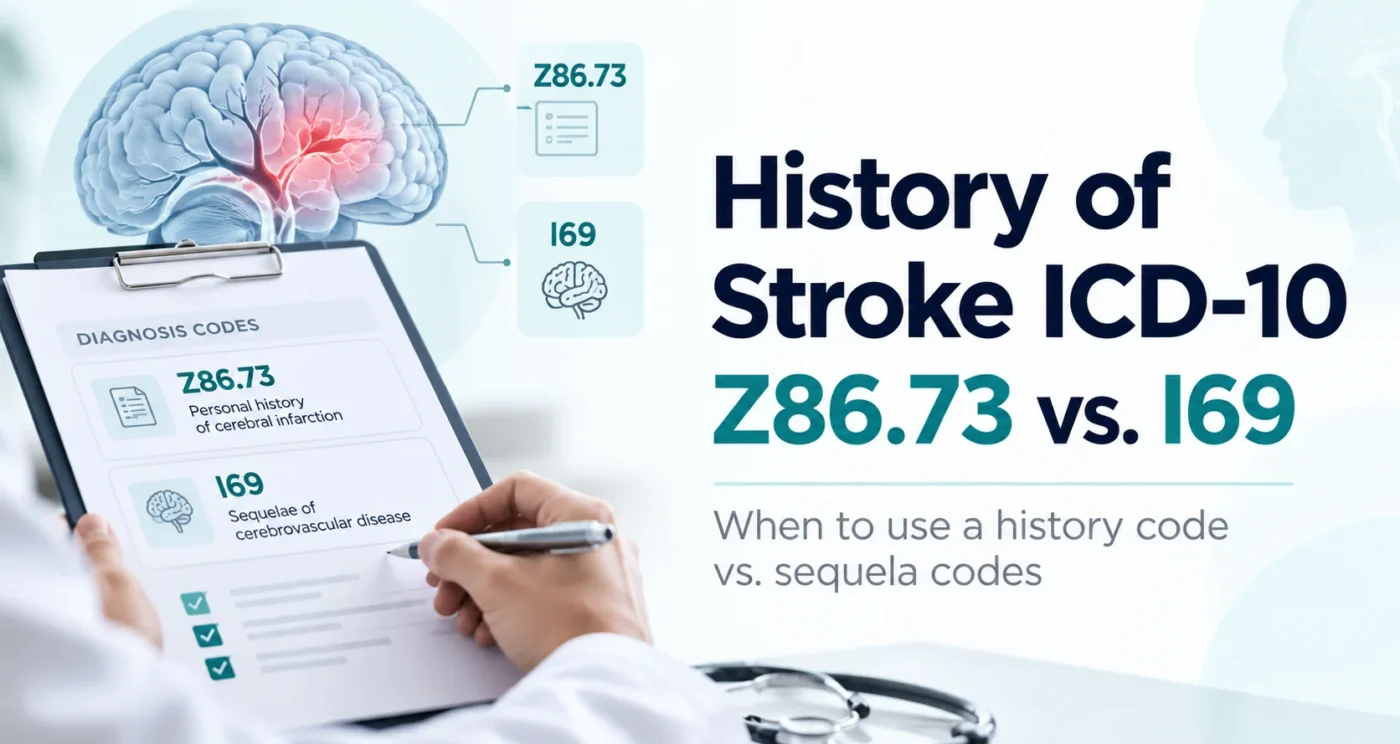
A chart may say “stroke in 2019” and leave the coder with a deceptively simple question: does that history belong under Z86.73, or is an I69 code more appropriate? The answer does not depend on how many years have passed. It depends mainly on what happened, what remains, and what the treating clinician has documented today.
For an earlier cerebral infarction without residual neurological deficits, the ICD-10-CM history code is Z86.73. The same code includes a personal history of transient ischemic attack (TIA). If a previous cerebrovascular event has left an ongoing neurologic deficit, coding generally moves to the appropriate I69 sequela code instead. Those codes are not interchangeable. The FY 2027 ICD-10-CM Official Guidelines explain the distinction in Chapter 9.
This guide is written for encounters using the FY 2027 ICD-10-CM code set, effective October 1, 2026, through September 30, 2027. It explains the code families, the documentation behind them, and the judgment calls that commonly produce claims corrections.
Quick Answer: What Is the History of Stroke ICD-10 Code?
| Clinical documentation | Coding direction | Why |
| Previous cerebral infarction, fully recovered, no residual deficit | Z86.73 | Personal history of cerebral infarction without residual deficits |
| Previous TIA, no current event | Z86.73 | Personal history of TIA is included |
| Previous cerebral infarction with persistent weakness attributable to it | I69.3- family; choose complete specific code | Ongoing sequela of cerebral infarction |
| Previous nontraumatic intracerebral hemorrhage with lasting neurologic deficit | I69.1- family; choose complete specific code | Sequela follows the documented hemorrhage type |
| Current acute cerebral infarction | Appropriate I63.- code | Acute disease, not merely personal history |
| Previous stroke mentioned, type and residual status unclear | Clarify documentation; do not guess | A vague chart phrase does not establish the correct branch |
Coding reminder: Codes such as I69.3- and I63.- above are category or subcategory references, not complete claim-ready diagnosis codes. Choose the full billable code after checking the Alphabetic Index, Tabular List, laterality, and applicable instructional notes.
What Does ICD-10-CM Code Z86.73 Mean?
Z86.73 is the code for personal history of transient ischemic attack (TIA), and cerebral infarction without residual deficits. It sits in Chapter 21, which covers factors influencing health status and contact with health services. It is a personal-history code, not an assertion that a stroke is occurring now.
Two different past events are therefore brought together under the same code: a TIA and a cerebral infarction from which the patient has recovered without a remaining neurological deficit. That wording is narrower than “any history of stroke.” For example, do not assume a documented previous hemorrhagic stroke belongs under Z86.73 simply because the event is old.
A personal-history diagnosis can matter to care. Clinicians may consider a previous TIA or ischemic stroke when reviewing vascular risk, medications, relevant symptoms, and long-term prevention. But a historical entry in the chart is not, by itself, a reason to report the diagnosis on every possible claim. Reporting depends on encounter setting, applicable coding rules, and the history’s relevance to the care being provided.
What “Without Residual Deficits” Actually Means
“Residual deficit” refers to a persisting neurological effect attributed to the earlier cerebrovascular event. Examples include weakness on one side of the body, persistent language impairment, swallowing difficulty, or certain cognitive problems. A stroke may be years old while those effects remain clinically present.
A patient who walks independently or has improved after rehabilitation is not necessarily deficit-free. Mild weakness, altered speech, or another residual condition may still be documented. Conversely, a diagnosis such as hypertension or hyperlipidemia does not automatically count as a residual neurologic deficit from the stroke. Those conditions have their own clinical significance and coding rules.
What Are I69 Codes for Stroke Sequelae?
Category I69, Sequelae of cerebrovascular disease, identifies neurological residual effects caused by earlier cerebrovascular conditions. The FY 2027 guidelines say such effects may have persisted since the initial event or appeared after it. There is no arbitrary expiration date at which an I69 code becomes a Z86.73 code.
The I69 code family is organized in part by the underlying cerebrovascular event:
| I69 subcategory | Earlier condition represented |
| I69.0- | Sequelae of nontraumatic subarachnoid hemorrhage |
| I69.1- | Sequelae of nontraumatic intracerebral hemorrhage |
| I69.2- | Sequelae of other nontraumatic intracranial hemorrhage |
| I69.3- | Sequelae of cerebral infarction |
| I69.8- | Sequelae of other cerebrovascular diseases |
| I69.9- | Sequelae of unspecified cerebrovascular disease |
These are families, not instructions to select an unspecified code as a shortcut. The full code reflects details such as the type of deficit, its relationship to the old event, and, for some motor deficits, the side affected and dominance. The CDC ICD-10-CM files and tabular resources are the appropriate place to check the complete current descriptors and notes.
Common Residual Conditions
A clinician might document hemiparesis (partial weakness on one side), hemiplegia (paralysis affecting one side), aphasia (impairment of language), dysphagia (difficulty swallowing), or another neurological deficit attributable to the previous cerebrovascular event.
The documentation should establish the relationship. “Difficulty walking” and “old stroke” appearing separately in a problem list do not always prove that one caused the other. A query may be necessary when the link is clinically relevant but unclear. Do not convert a symptom into a stroke sequela based on the coder’s inference alone.
Dominant and Nondominant Side
Some I69 codes for hemiplegia, hemiparesis, and monoplegia distinguish the dominant from the nondominant side. The official FY 2027 rules contain defaults when the affected side is known but dominance is not documented and the code does not supply its own default: left defaults to nondominant, right to dominant, and ambidextrous to dominant. These coding defaults are not clinical conclusions about an individual patient’s handedness. Use actual documented dominance when present.
Z86.73 vs. I69: The Decision That Matters
The quickest way to reason through a stroke-history diagnosis is to ask three questions.
First: Is the patient experiencing a new or current cerebrovascular event? New symptoms and a newly diagnosed infarction or hemorrhage are evaluated under the applicable current-disease code family, not coded only as historical disease. Confirmed diagnoses and uncertain diagnoses are handled differently depending on whether the encounter is inpatient or outpatient.
Second: What type of earlier event is documented? TIA, cerebral infarction, subarachnoid hemorrhage, and intracerebral hemorrhage are not interchangeable terms. A generic “CVA” note may be insufficient to support the most specific diagnosis.
Third: Is a neurologic residual currently documented and attributed to that older event? For an old cerebral infarction without deficits, Z86.73 is the familiar answer. With a documented sequela, the relevant I69 code family provides the more appropriate direction. If the record conflicts—for instance, “no residual deficits” alongside “chronic stroke-related hemiparesis”—seek clarification.
An I69 code should not be assigned when no neurological deficits exist. This is explicit in the FY 2027 official guidance. An I69 code can, however, appear on the same record as a code from I60–I67 when the patient has a current cerebrovascular disease and a separate deficit from an old cerebrovascular event. That exception should not be mistaken for permission to label one event both acute and chronic without support.
Ischemic Stroke, Hemorrhagic Stroke, and TIA Are Different
An ischemic stroke results from interruption of blood supply, commonly involving cerebral infarction. A hemorrhagic stroke involves bleeding, including intracerebral or subarachnoid hemorrhage. A TIA causes transient neurological symptoms without an acute infarction; urgent clinical assessment is still necessary because a TIA can signal future stroke risk. The National Institute of Neurological Disorders and Stroke provides patient-friendly information on stroke types and consequences.
These clinical differences affect ICD-10-CM assignment. For a current cerebral infarction, coding generally looks within category I63. Current nontraumatic subarachnoid hemorrhage, nontraumatic intracerebral hemorrhage, and other nontraumatic intracranial hemorrhage are represented in I60, I61, and I62 respectively, subject to documentation and applicable instructions. A current TIA may be represented by G45.9 when supported and when no more specific classification applies.
For later effects, the I69 category separates infarction sequelae from sequelae of particular hemorrhage types. It is therefore risky to map every mention of “old stroke” to I69.3- or Z86.73 without checking the event type and residual condition.
Six Practical ICD-10-CM Coding Examples
The following situations are simplified educational illustrations, not complete coded claims. Full code assignment depends on the actual record, billable descriptor, and setting.
Example 1: Previous Ischemic Stroke, No Lasting Deficit
A patient attends a primary care follow-up for hypertension. The physician documents a cerebral infarction six years earlier, complete recovery, and no residual neurological deficit. The history influences risk assessment and medication review.
Likely history code: Z86.73. The provider has established a prior cerebral infarction without residual deficits. Whether the history is reported as an additional diagnosis depends on the encounter’s reporting rules and relevance.
Example 2: Past TIA, No New Symptoms
A cardiology note documents a TIA in 2022. At today’s visit there is no new TIA and no persistent neurological deficit. The previous event affects the assessment of vascular risk.
Likely history code: Z86.73. Do not assign a current TIA code just because the historic condition appears in the chart.
Example 3: Old Infarction With Persistent Right-Sided Weakness
A rehabilitation physician documents chronic right-sided hemiparesis due to a previous cerebral infarction. The deficit continues to affect mobility.
Coding direction: a specific I69.3- code for hemiparesis following cerebral infarction. Select the complete code based on the supported documentation and the dominance rules. Z86.73 is not a substitute for the documented sequela.
Example 4: Persistent Aphasia After Cerebral Infarction
A speech-language follow-up concerns aphasia that the treating physician has linked to a previous ischemic stroke. The event happened several years earlier, but communication impairment remains.
Coding direction: an applicable I69.3- sequela code reflecting aphasia following cerebral infarction. The year of the original infarction does not change the residual nature of the condition.
Example 5: Old Intracerebral Hemorrhage With Residual Weakness
A neurologist attributes ongoing left-sided weakness to an old nontraumatic intracerebral hemorrhage. The patient is not being treated for new bleeding.
Coding direction: an applicable I69.1- code, with the complete descriptor chosen for the specific deficit and documented side/dominance. Do not automatically select the ischemic-stroke history code Z86.73 or the infarction-sequela family I69.3-.
Example 6: “History of CVA” With Conflicting Notes
The problem list states “CVA—resolved,” while a current examination describes persistent weakness and a separate note calls it “post-stroke.” No clinician has clearly reconciled the history or specified the earlier stroke type.
Best next step: documentation clarification. The coder should not assume that the patient has no residual deficits, nor infer the original event type from a vague abbreviation. Use an appropriate compliant provider query when needed.
Documentation Checklist for Accurate Stroke-History Coding
Good coding begins before the claim reaches the billing system. In a useful progress note, the clinician distinguishes the past event from current neurological status and describes any ongoing relationship.
Review the following points:
- Original event: Was it TIA, cerebral infarction, a specified nontraumatic hemorrhage, or another cerebrovascular condition?
- Current status: Is the event historic, actively occurring, or still under acute treatment?
- Residual deficits: Are weakness, aphasia, dysphagia, cognitive impairment, or other deficits still present?
- Causal connection: Has the clinician attributed the persistent deficit to the earlier event?
- Laterality and dominance: Is the side documented for relevant motor deficits? Is hand dominance known?
- Encounter relevance: Is the historical condition evaluated, monitored, treated, or otherwise relevant under the applicable setting’s reporting rules?
- Conflicting entries: Does a carried-forward problem list disagree with the current assessment?
A documentation example such as “remote left MCA cerebral infarction with persistent right-sided hemiparesis” is more informative than “h/o stroke.” It states the old event and explicitly links a present deficit to it. Exact I69 selection still requires a check of the current tabular classification.
What If Imaging Shows an Old Infarct?
A radiology report may describe chronic infarct changes or an incidental old lesion. That description does not automatically establish a reportable personal history of clinically recognized stroke or an I69 sequela for every encounter. In outpatient coding especially, clinicians and coding staff should follow the applicable rules for assigning diagnoses from provider documentation and clarify whether the finding represents a clinically established condition relevant to the visit.
What If the Patient Says They Had a Stroke?
Patient-reported history is useful information for the clinical interview. The diagnosis code should nevertheless be supported by documentation consistent with the ICD-10-CM rules for the setting. If the physician’s assessment is unclear, verification or clarification is preferable to inferring a specific stroke type or sequela from the patient’s description alone.
Acute Stroke vs. Historical Stroke: Why the Date Alone Is Not Enough
An old event and a current event cannot be distinguished reliably using a simple number of days. The question is whether the documentation supports an acute cerebrovascular diagnosis, an established personal history without residual deficits, or a neurological sequela of an older event.
For example, the same patient can have chronic weakness attributable to a cerebral infarction years ago and later develop a new cerebral infarction. The official guidelines permit I69 with a current I60–I67 code when the old deficits and current disease are distinct and documented. The new event requires its own accurate acute coding and clinical assessment.
Do not apply rules borrowed from the coding of myocardial infarction to stroke. The correct code follows cerebrovascular documentation and the governing instructions, not a generic “after 30 days” rule.
Billing, Sequencing, and Reimbursement Considerations
A valid diagnosis code is only one element of a defensible claim. The record must support the condition; the code must apply to the date of service; the diagnosis must meet the reporting criteria for the setting; and the payer may have separate coverage or medical-necessity requirements.
First-Listed vs. Additional Diagnosis
On an outpatient claim, the diagnosis chiefly responsible for the service is generally first-listed under the outpatient guidelines. A stroke-history code may be appropriate as an additional diagnosis when it is relevant and reportable, but should not automatically be placed first just because the prior stroke is medically significant. In inpatient care, principal diagnosis selection follows separate rules established after study of the admission.
A physical examination or preventive follow-up may include review of vascular history. For a broader explanation of how clinicians review prior conditions during routine care, see MedIntelHub’s guide to what gets checked at an annual physical. The encounter type and payer rules determine what the actual claim should reflect.
Does Z86.73 Guarantee Coverage?
No. Z86.73 identifies the documented personal history under ICD-10-CM. It does not by itself make a test, office visit, imaging study, therapy session, or preventive service covered. Coverage decisions may consider the service, medical necessity, benefits, authorization, and payer policy.
Nor does an I69 code automatically establish eligibility for rehabilitation, home services, or risk-adjusted payment. Those outcomes depend on the program’s own rules and clinical support. Avoid using a more severe diagnosis code simply to satisfy a payer edit or to increase expected reimbursement.
Diagnosis Codes Are Not Procedure Codes
ICD-10-CM describes diagnoses and relevant health-status information. CPT and HCPCS generally describe services, procedures, and supplies in applicable billing contexts. Updating one coding system does not replace checking the other. For readers comparing these code-set changes, MedIntelHub’s 2026 CPT code update overview explains why code availability and payer payment policies are separate questions.
Common History-of-Stroke Coding Errors
Using Z86.73 when the physician documents chronic hemiparesis. A residual neurological condition calls for a sequela evaluation instead of treating the past event as deficit-free.
Using I69 because a person once had a stroke. The FY 2027 guidelines specifically say not to assign I69 in the absence of neurological deficits. A personal history is not itself a sequela.
Assuming the old stroke was ischemic. “History of CVA” may not establish whether the event involved infarction or hemorrhage. Query when greater specificity is needed and the existing documentation cannot support it.
Coding a current event as history. Acute stroke symptoms require prompt medical assessment. A confirmed new stroke belongs in the appropriate current-disease classification, not merely a history code.
Inferring cause from proximity in the record. A patient can have chronic dizziness or weakness for reasons unrelated to a remote cerebrovascular event. The attribution must be appropriately documented.
Guessing dominance or ignoring defaults. Apply current tabular instructions and the official dominance defaults when relevant; do not assume everyone is right-handed in clinical reality.
Copying last year’s claim without checking the visit. The patient’s neurological status and current documentation may change. Always use the code set effective for the service date and verify current encounter relevance.
FY 2027 ICD-10-CM Guidance: What to Verify Before Submission
For claims with dates of service from October 1, 2026, through September 30, 2027, use the FY 2027 ICD-10-CM materials. The official FY 2027 guidelines contain the dedicated cerebrovascular sequela section, including I69 assignment, dominance defaults, co-reporting with current cerebrovascular disease, and the rule against I69 in patients without neurologic deficits.
The guidelines do not replace the Alphabetic Index and Tabular List. Check inclusion terms, exclusions, additional-code directions, laterality, and whether a code is complete and billable. For claims outside the FY 2027 dates, consult the release appropriate to that date of service rather than retroactively using later code edits.
Frequently Asked Questions
1. What is the ICD-10 code for history of stroke without deficits?
Z86.73 is appropriate for a personal history of cerebral infarction without residual deficits. It also includes a history of TIA. Confirm that the provider’s documentation supports the history and absence of neurological sequelae.
2. Is Z86.73 a billable ICD-10-CM code?
Yes. Z86.73 is a complete ICD-10-CM diagnosis code. Its presence on a claim does not independently establish medical necessity or guarantee payment.
3. Is the ICD-10 code for history of CVA always Z86.73?
No. “CVA” is often used broadly. A documented previous cerebral infarction without deficits can support Z86.73, but residual deficits and the specific stroke type may direct coding elsewhere.
4. What code describes a previous stroke with right-sided weakness?
If the clinician links persistent right-sided weakness or hemiparesis to a prior cerebral infarction, an appropriate complete I69.3- code may apply. Verify the actual deficit and dominance details rather than choosing a code from laterality alone.
5. Can Z86.73 and I69 be reported together?
Do not routinely report both for the same past cerebral infarction as if the patient simultaneously had no residual deficits and documented sequelae. Review exclusions and documentation. Separate cerebrovascular histories or events require individualized review of official tabular instructions.
6. Does I69 have a time limit after stroke?
No fixed time limit governs I69 sequelae. Relevant neurological effects can persist for years or appear later, provided their relationship to the earlier cerebrovascular disease is appropriately documented.
7. What is the ICD-10 code for history of TIA?
Z86.73 is used for personal history of TIA. A patient with a currently diagnosed TIA is a different coding situation and may require an applicable current TIA code.
8. Does an old hemorrhagic stroke use Z86.73?
Not automatically. Z86.73 specifically refers to TIA and cerebral infarction without residual deficits. A previous hemorrhagic stroke requires review of the documented hemorrhage type, present deficits, and applicable history or sequela classification.
9. Which I69 family follows a cerebral infarction?
The I69.3- family addresses sequelae of cerebral infarction. The full code depends on which neurological deficits remain and any applicable details such as dominance or laterality.
10. What if the chart says “old CVA” but not whether deficits remain?
Review the current provider documentation and relevant record. If the lack of specificity affects coding and cannot be resolved from compliant sources, send a nonleading clarification query rather than assuming the answer.
11. Is chronic weakness automatically a stroke sequela?
No. Weakness can have multiple causes. A clinician should establish the relationship between the deficit and the earlier cerebrovascular event before the coder assigns an I69 code on that basis.
12. Can a patient have an acute stroke and an I69 code?
Yes, when a current cerebrovascular disease and residual deficits from a separate old cerebrovascular event are both documented. This is explicitly allowed under the official guidelines.
13. What if an MRI mentions a chronic infarct but the clinician does not discuss it?
A radiology finding should not automatically become a reportable stroke-history or sequela diagnosis. Apply the provider-documentation and encounter-reporting rules for the setting, and clarify its clinical significance when necessary.
14. Does a history of stroke justify brain imaging or rehabilitation coverage?
Not by itself. Coverage and medical necessity must be supported for the service billed. A history code or an I69 code cannot independently guarantee authorization, coverage, or reimbursement.
15. Which ICD-10-CM release applies in October 2026?
FY 2027 applies to services dated October 1, 2026, through September 30, 2027. Use the date-of-service code release and check for any official corrections or updates.
A Reliable Way to Make the Coding Decision
When a note says “history of stroke,” resist the temptation to reach for a single code. First identify the documented earlier event. Then determine whether the patient has a current neurological deficit attributed to it. For a resolved cerebral infarction or a past TIA, Z86.73 may be the correct history code. For continuing effects of earlier cerebrovascular disease, the applicable I69 code tells a more accurate clinical story.
The strongest claim is not the one with the most diagnosis codes. It is the one that reflects the patient’s present condition, the clinician’s assessment, the relevant coding instructions, and the circumstances of the encounter.
Resources
CDC and CMS — FY 2027 ICD-10-CM Official Guidelines for Coding and Reporting
Primary federal instructions for cerebrovascular sequelae, personal-history coding, code selection, and diagnosis reporting from October 1, 2026, through September 30, 2027.
Read the FY 2027 ICD-10-CM guidelines
CDC National Center for Health Statistics — ICD-10-CM Files
Official code-set resources for checking the appropriate tabular entries, Index, and effective annual release.
Centers for Medicare & Medicaid Services — ICD-10 Resources
Federal coding and billing resources that help identify applicable implementation materials and claims-related requirements.
National Institute of Neurological Disorders and Stroke — Stroke
Background information about ischemic stroke, hemorrhagic stroke, stroke symptoms, and longer-term effects.
American Stroke Association — Stroke Symptoms
Public education on recognizing warning signs and seeking emergency treatment for possible acute stroke.
Editorial Guidelines & Medical Disclaimer
This MedIntelHub article is for educational and informational purposes, not individual diagnosis, treatment, insurance authorization, or professional coding advice. It cannot determine whether a reader has experienced a stroke, TIA, or residual neurological impairment. A qualified healthcare professional should assess clinical symptoms, review medical history, and make medication decisions; never stop or change prescribed treatments solely because of an online article. New facial drooping, arm weakness, speech trouble, sudden severe neurological symptoms, or another possible stroke warning sign warrants emergency medical attention rather than relying on a coding guide.
Coding and reimbursement rules can change. Always verify the current ICD-10-CM Tabular List, Alphabetic Index, official guidelines, applicable payer policies, medical necessity requirements, and date-of-service instructions before submitting a claim. Medicare, Medicaid programs, and commercial insurers may have different coverage and billing requirements. This article relies on authoritative federal coding and public-health resources. Review MedIntelHub’s editorial policy for information about our approach to sources and updates.

David Bennett
David Bennett is an author at MedIntelHub, where he creates clear, practical, and well-researched content about healthcare, medical billing, insurance, and patient education. His goal is to make complex healthcare topics easier for readers to understand and use in everyday situations. David emphasizes accuracy, transparency, and reliable sourcing, using information from trusted organizations and official healthcare resources whenever possible. Content published by David is intended for educational purposes and should not replace advice from qualified medical, legal, or healthcare professionals.