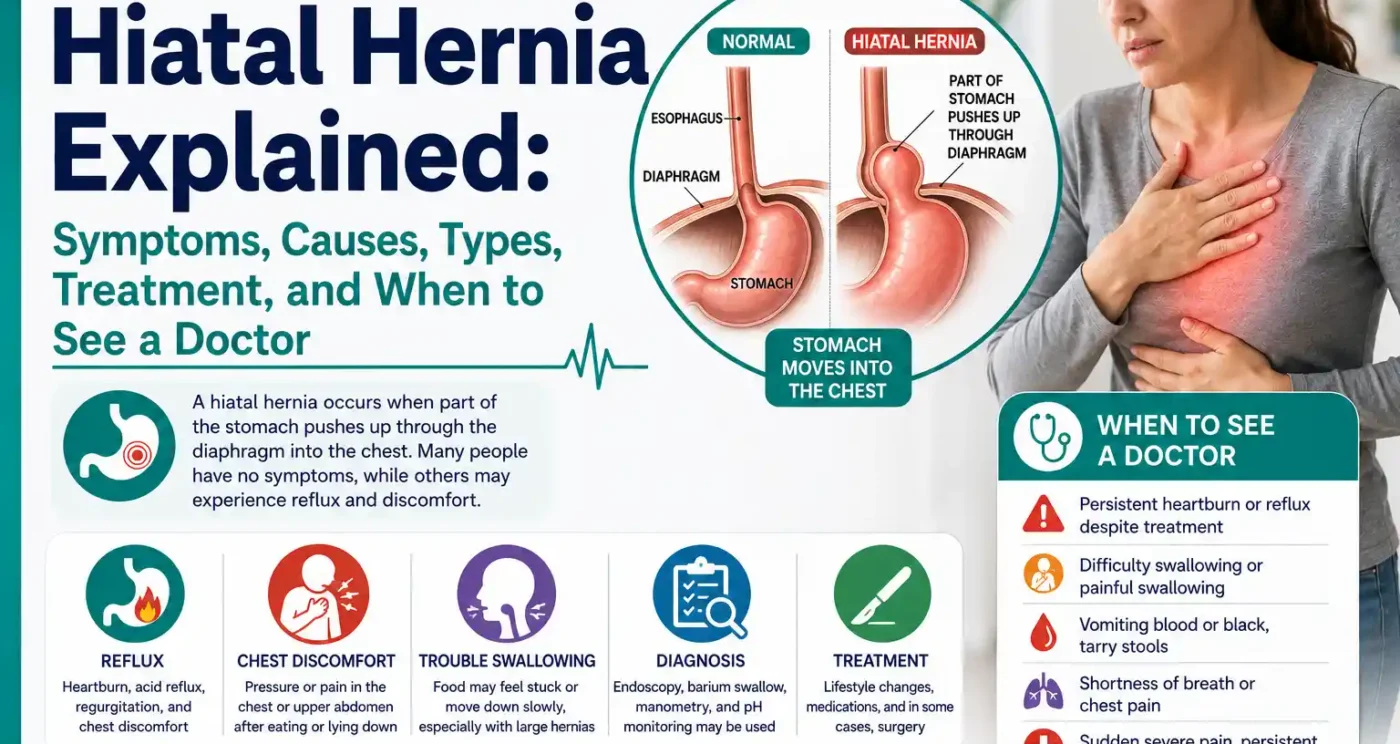
A hiatal hernia can exist for years without causing a single noticeable problem. Some people only learn they have one after an X-ray, endoscopy, or scan done for something else.
For others, the first clue is much more familiar: heartburn that keeps coming back, acid or food rising into the throat, pressure after meals, trouble swallowing, or discomfort in the lower chest.
A hiatal hernia happens when the upper part of the stomach moves upward through an opening in the diaphragm and into the chest. That opening normally allows the esophagus to pass through before it connects with the stomach.
Most hiatal hernias are the sliding type, and many never need treatment. Symptoms are commonly related to acid reflux rather than to the hernia itself. Larger paraesophageal hernias are less common but deserve closer attention because they can occasionally cause obstruction, bleeding, or other complications.
The most important practical distinction is this: a hiatal hernia is not the same thing as GERD, and new chest pain should never automatically be blamed on a known hernia.
What Is a Hiatal Hernia?
The diaphragm is a broad sheet of muscle separating the chest from the abdomen. Besides playing an important role in breathing, it contains several natural openings.
One of these is the esophageal hiatus.
The esophagus travels from the mouth through the chest, passes through this opening, and then joins the stomach in the abdomen.
With a hiatal hernia, the opening becomes wide or loose enough for part of the stomach to move upward into the chest.
You usually cannot see or feel a hiatal hernia from the outside. This makes it different from many abdominal-wall or groin hernias.
A person may have no idea the anatomical change is there until imaging or an endoscopy reveals it.
What Are the Main Types of Hiatal Hernia?
Doctors classify hiatal hernias according to which parts of the stomach and gastroesophageal junction have moved through the diaphragm.
There are four anatomical types, although they are often grouped into sliding and paraesophageal hernias.
Type 1: Sliding Hiatal Hernia
A sliding hiatal hernia is by far the most common form.
The gastroesophageal junction—the point where the esophagus meets the stomach—moves above the diaphragm. It may slide upward and downward through the hiatus.
Cleveland Clinic estimates that type 1 accounts for about 95% of hiatal hernias.
Because the normal relationship between the diaphragm and lower esophagus has changed, this type may make acid reflux easier to develop.
Still, plenty of people with a sliding hiatal hernia have no reflux symptoms at all.
Type 2: Paraesophageal Hernia
With a type 2 paraesophageal hernia, the gastroesophageal junction remains in its more normal position, but part of the stomach pushes upward alongside the esophagus.
This is sometimes called a rolling hiatal hernia.
It is much less common than a sliding hernia.
Type 3: Mixed Hiatal Hernia
Type 3 combines features of types 1 and 2.
Both the gastroesophageal junction and another portion of the stomach move above the diaphragm.
Type 4: Complex Paraesophageal Hernia
Type 4 is rare.
The opening becomes large enough that the stomach and another abdominal organ—such as part of the intestine, pancreas, or spleen—may move into the chest.
These larger and more complex hernias require individualized surgical evaluation.
What Are the Most Common Hiatal Hernia Symptoms?
A small hiatal hernia frequently causes no symptoms at all.
When symptoms do occur, many are related to gastroesophageal reflux rather than the stomach simply being above the diaphragm.
Common complaints include:
- Heartburn
- Acid reflux
- Regurgitation of food or liquid
- Burping
- Upper abdominal discomfort
- Lower chest discomfort
- Feeling full sooner than expected
- Difficulty swallowing
- Nausea
- Hoarseness or throat irritation
- Shortness of breath in some larger hernias
Large hiatal hernias may also occasionally cause gastrointestinal bleeding.
There is no single symptom that confirms a hiatal hernia.
Heartburn, for example, is extremely common in people who do not have a hernia.
Can You Have a Hiatal Hernia Without Symptoms?
Yes.
In fact, that is common.
A person may have a small sliding hiatal hernia for years without heartburn, pain, swallowing problems, or any other obvious symptoms.
Mayo Clinic notes that most small hiatal hernias cause no problems and may only be discovered while investigating another condition.
Finding a hiatal hernia on imaging therefore does not automatically mean it explains every digestive symptom a person has.
What Does Hiatal Hernia Pain Feel Like?
There is no one characteristic hiatal-hernia pain.
Some people describe:
- Burning behind the breastbone
- Pressure in the lower chest
- Aching in the upper abdomen
- Discomfort after eating
- Pain when bending over
- Fullness beneath the ribs
Much of what people call “hiatal hernia pain” may actually come from acid irritating the esophagus.
Larger paraesophageal hernias can also cause pressure or discomfort when the stomach becomes compressed in the chest.
The difficulty is that the same region contains the heart, esophagus, stomach, lungs, ribs, and muscles. Chest or upper-abdominal pain therefore should not automatically be attributed to a hernia simply because someone already knows they have one.
Can a Hiatal Hernia Cause Heartburn?
Yes.
The diaphragm normally works together with the lower esophageal sphincter, a muscular barrier at the bottom of the esophagus, to help keep stomach contents where they belong.
When the gastroesophageal junction slides above the diaphragm, that anti-reflux barrier may work less effectively.
Acid and other stomach contents can then move upward into the esophagus more easily.
That can produce the familiar burning sensation known as heartburn.
Hiatal Hernia vs. GERD: Are They the Same Thing?
No.
This distinction is important.
A hiatal hernia is an anatomical condition. Part of the stomach has moved through the opening in the diaphragm.
GERD—gastroesophageal reflux disease—is a reflux disorder. Stomach contents repeatedly move back into the esophagus and cause bothersome symptoms or complications.
The two often overlap because a hiatal hernia can make reflux easier.
But:
You can have GERD without a hiatal hernia.
And:
You can have a hiatal hernia without GERD.
NIDDK specifically identifies hiatal hernia as one factor that can increase the likelihood or severity of GERD rather than defining the two conditions as the same disease.
Hiatal Hernia vs. Heartburn
Heartburn is a symptom.
A hiatal hernia is a structural change.
Heartburn can be caused by GERD regardless of whether a hiatal hernia is present.
So experiencing heartburn does not mean that your stomach has moved through the diaphragm.
Likewise, someone may have a visible hiatal hernia on endoscopy but never experience heartburn.
Hiatal Hernia vs. Heart Attack
This is one of the most important safety distinctions.
Acid reflux and a hiatal hernia can cause burning, pressure, or pain in the chest. In some cases, that discomfort can feel similar to heart-related pain.
But a known history of reflux does not make new chest symptoms safe to ignore.
Seek emergency evaluation for new or concerning chest discomfort, especially when it comes with:
- Shortness of breath
- Cold sweating
- Nausea
- Dizziness or faintness
- Pressure or squeezing
- Pain spreading into an arm, shoulder, jaw, neck, or back
- Symptoms triggered by exertion
It is safer to have possible heart symptoms evaluated than to assume they are coming from the stomach.
Can a Hiatal Hernia Cause Regurgitation?
Yes.
Regurgitation means stomach contents move back into the esophagus and sometimes into the throat or mouth.
It may taste sour, bitter, or simply like recently swallowed food.
Unlike vomiting, regurgitation may happen without forceful abdominal contractions.
Mayo Clinic includes the backward flow of food, liquid, and stomach acid among common symptoms associated with larger hiatal hernias.
Can a Hiatal Hernia Cause Trouble Swallowing?
It can.
Difficulty swallowing is called dysphagia.
Someone may feel that food:
- Moves down slowly
- Gets stuck behind the breastbone
- Hangs up near the lower chest
- Requires extra liquid to pass
Hiatal hernia and reflux can contribute to swallowing symptoms, but dysphagia should not simply be assumed to be harmless reflux.
Persistent or worsening difficulty swallowing can also occur with esophageal inflammation, scar-related narrowing, movement disorders, or other conditions.
NIDDK recommends medical assessment for swallowing problems, particularly when they persist or accompany weight loss, vomiting, bleeding, or other concerning symptoms.
Can a Hiatal Hernia Make You Feel Full Quickly?
Yes, particularly when the hernia is large.
Part of the stomach may sit within the chest or become compressed, leaving less room for comfortable expansion after eating.
Mayo Clinic lists feeling full soon after eating among symptoms that can occur with larger hiatal hernias.
Early fullness is not specific to hiatal hernia, however.
Ulcers, delayed stomach emptying, medications, other digestive disorders, and more serious conditions can cause similar symptoms.
Can a Hiatal Hernia Cause Shortness of Breath?
A large paraesophageal hernia sometimes can.
If a significant portion of the stomach occupies space in the chest, it may contribute to pressure, reduced exercise tolerance, or breathlessness in some people.
Shortness of breath has many other possible causes—including heart and lung disease.
Do not assume that new or severe breathing difficulty comes from a known hiatal hernia.
SAGES also notes that symptoms outside the digestive tract, including shortness of breath or exercise intolerance, may be relevant when clinicians evaluate whether a larger paraesophageal hernia is truly asymptomatic and whether repair should be considered.
What Causes a Hiatal Hernia?
Often, there is no single event that explains exactly why the hernia developed.
The tissues around the hiatus can gradually weaken or stretch over time.
Possible contributors include:
- Age-related changes in the diaphragm
- Repeated increased pressure inside the abdomen
- Chronic coughing
- Chronic constipation and straining
- Recurrent vomiting
- Pregnancy and childbirth
- Obesity
- Heavy lifting or intense exertion
- Injury
- Previous surgery
- Being born with a larger-than-usual hiatus
It would be too simplistic to say that lifting one heavy object “causes” a hiatal hernia in every case.
Most likely, tissue susceptibility and repeated pressure interact over time.
Who Is More Likely to Develop a Hiatal Hernia?
Hiatal hernias become more common with age.
Mayo Clinic identifies people 50 and older and people with obesity as groups at higher risk. MedlinePlus also lists increasing age, obesity, and smoking among associated factors.
Risk factors do not guarantee that someone will develop a hernia.
They simply make it more likely.
Can Pregnancy Cause a Hiatal Hernia?
Pregnancy can contribute.
As the uterus grows, pressure inside the abdomen increases. Hormonal and mechanical changes may also influence reflux.
Pregnancy and childbirth are among factors associated with increased pressure around the diaphragm and development or worsening of hiatal hernia in susceptible people.
However, heartburn during pregnancy is very common even without a hiatal hernia.
Can Heavy Lifting Cause a Hiatal Hernia?
Heavy lifting increases pressure inside the abdomen, so repeated or intense straining may contribute to development or enlargement of a hernia in someone whose tissues are already susceptible.
That is different from saying that every episode of heavy lifting produces a hiatal hernia.
Usually, the condition develops from a combination of tissue weakness and pressure over time.
Can a Hiatal Hernia Get Bigger?
It can.
A small sliding hernia may remain stable or minimally symptomatic for a long time.
In other people, widening of the hiatus or continued pressure may allow more of the stomach to move upward.
Larger paraesophageal hernias are more likely than small sliding hernias to produce symptoms related to stomach compression, early fullness, chest pressure, breathlessness, or obstruction.
Increasing symptoms deserve reevaluation rather than assuming that a previously documented hernia has remained unchanged.
Can a Hiatal Hernia Heal on Its Own?
The anatomical hernia itself generally does not simply disappear because heartburn improves.
Symptoms can improve dramatically with lifestyle changes or medication, but that does not necessarily mean the stomach has returned permanently to its normal anatomical position.
This distinction matters when someone says:
“My hiatal hernia went away after taking acid medicine.”
The reflux may have improved.
The hernia may still be present.
Cleveland Clinic notes that hiatal hernias themselves typically do not resolve spontaneously, although many require no treatment if they cause no problems.
How Is a Hiatal Hernia Diagnosed?
A hiatal hernia is often discovered while doctors are investigating:
- Heartburn
- Reflux
- Chest discomfort
- Upper-abdominal pain
- Trouble swallowing
- Anemia
- Another finding on imaging
Several tests can provide different kinds of information.
Not every patient needs every test.
Upper GI X-Ray or Barium Swallow
During an upper gastrointestinal X-ray study, the patient drinks a contrast material containing barium.
The contrast outlines the esophagus and stomach on X-rays and can show their position relative to the diaphragm.
It can be particularly useful for defining anatomy and evaluating swallowing.
Upper Endoscopy
An upper endoscopy, also called EGD, uses a thin flexible camera passed through the mouth to examine the esophagus, stomach, and first portion of the small intestine.
It may reveal:
- A hiatal hernia
- Esophagitis
- Ulcers
- Bleeding
- Narrowing
- Barrett’s esophagus
- Other possible explanations for symptoms
Endoscopy is particularly useful when someone has persistent reflux, difficulty swallowing, bleeding, anemia, or other warning features.
Esophageal Manometry
Esophageal manometry measures the pressure and coordination of the muscles used during swallowing.
It does not simply answer “yes or no” to whether a hernia is present.
Instead, it can help clinicians understand how the esophagus and lower esophageal sphincter function, particularly before certain surgical procedures or when swallowing problems are present.
Esophageal pH Monitoring
pH monitoring is primarily used to measure acid reflux, not to diagnose the anatomical hernia itself.
It can document how often stomach acid reaches the esophagus and whether episodes correlate with symptoms.
NIDDK describes esophageal pH monitoring as the most accurate way to detect acid within the esophagus.
This can be useful when reflux symptoms are unclear or before certain anti-reflux procedures.
Do All Hiatal Hernias Need Treatment?
No.
A small hiatal hernia that causes no symptoms usually needs no specific treatment.
Mayo Clinic and MedlinePlus both state that people without symptoms or complications generally do not require therapy simply because a hernia was found.
Treatment becomes more relevant when the hernia is associated with:
- Persistent reflux
- Troublesome regurgitation
- Dysphagia
- Pain or pressure
- Bleeding or anemia
- Obstruction
- Large paraesophageal anatomy
- Other complications
Treatment should be aimed at the actual problem rather than the imaging finding alone.
How Is a Hiatal Hernia Treated?
For many people, treatment is really treatment of the reflux symptoms associated with the hernia.
The plan can include lifestyle measures, acid-reducing medication, or surgery.
Lifestyle Changes
People with reflux related to a hiatal hernia may benefit from measures such as:
- Eating smaller meals
- Avoiding lying down soon after eating
- Finishing meals several hours before bedtime
- Managing weight when appropriate
- Stopping smoking
- Raising the head of the bed for nighttime reflux
- Identifying foods or drinks that repeatedly trigger personal symptoms
These strategies may reduce reflux.
They do not physically “push the stomach back into place.”
Antacids
Antacids neutralize stomach acid and can provide fairly quick relief from occasional mild heartburn.
They do not repair a hiatal hernia.
Regular or heavy use should be discussed with a healthcare professional because some antacids can cause side effects or interact with medications.
H2 Blockers
H2-receptor blockers decrease stomach-acid production.
They may help people with mild to moderate reflux symptoms.
Again, the goal is controlling reflux rather than eliminating the hernia.
Proton Pump Inhibitors
Proton pump inhibitors, or PPIs, reduce acid production more strongly than H2 blockers and can help heal acid-related inflammation of the esophagus.
Some are available over the counter and others by prescription.
Persistent symptoms despite treatment deserve medical review rather than simply increasing medication indefinitely without understanding the cause.
Is There a Special Hiatal Hernia Diet?
There is no universal diet that repairs a hiatal hernia.
Food recommendations are mostly intended to reduce reflux symptoms.
People commonly notice problems after large meals. Individual reflux triggers may also include fatty foods, chocolate, mint, alcohol, caffeinated beverages, tomato-based foods, onions, or other foods. Mayo Clinic includes several of these among possible triggers.
But the important word is individual.
If coffee never causes symptoms for you, there is little value in removing it simply because it appears on a generic online “hiatal hernia diet” list.
A better approach is to notice what reliably makes your own symptoms worse.
Should You Avoid Large Meals?
For someone who develops reflux, pressure, or early fullness after eating, smaller meals may be easier to tolerate.
A large meal stretches the stomach and can increase pressure around the gastroesophageal junction.
Mayo Clinic specifically recommends several smaller meals rather than a few very large ones as one lifestyle strategy for symptomatic hiatal hernia.
Can Weight Loss Help?
When overweight or obesity contributes to increased abdominal pressure and GERD, weight reduction may improve reflux symptoms.
NIDDK includes weight loss for people with overweight or obesity among lifestyle approaches used to manage GERD.
That does not mean weight is the cause of every hiatal hernia, and it does not mean everyone with a hernia needs to lose weight.
Treatment should be individualized.
When Is Surgery Used for a Hiatal Hernia?
Most small, uncomplicated sliding hernias never require an operation.
Surgery may be considered when:
- Significant reflux remains poorly controlled
- Complications such as severe esophagitis or narrowing develop
- A paraesophageal hernia produces symptoms
- The stomach is obstructed or twisted
- Bleeding is recurrent
- The anatomy creates concern for future complications
Mayo Clinic notes that surgery may be used when medication does not adequately control reflux or when complications develop.
For types II, III, and IV hernias, the 2024 SAGES guideline emphasizes shared decision-making rather than a one-size-fits-all rule. Evidence is limited for automatically repairing every asymptomatic paraesophageal hernia, so size, symptoms, objective reflux, health status, operative risk, and patient preferences all matter.
What Happens During Hiatal Hernia Surgery?
The exact operation depends on the anatomy and symptoms.
In general, surgery may involve:
- Moving the stomach back into the abdomen.
- Reducing the size of the widened diaphragmatic opening.
- Repairing or reinforcing the area around the hiatus when appropriate.
- Adding an anti-reflux procedure in selected patients.
Many repairs are performed laparoscopically through several small abdominal incisions.
Larger or more complex cases can require a different surgical approach.
What Is Fundoplication?
Fundoplication is an anti-reflux procedure often performed with hiatal hernia repair when appropriate.
The surgeon uses the upper part of the stomach—the fundus—to strengthen the barrier at the lower end of the esophagus.
In a traditional fundoplication, the stomach is wrapped partly or fully around the lower esophagus. The goal is to help prevent stomach contents from flowing upward.
The exact type of wrap varies according to the patient’s anatomy, swallowing function, surgeon preference, and other clinical considerations.
The 2024 SAGES guideline conditionally suggests fundoplication during repair of type II, III, or IV hiatal hernias, but notes that the supporting evidence is of low certainty.
That nuance is important: surgical decisions are individualized.
Is Mesh Always Used in Hiatal Hernia Surgery?
No.
Mesh may sometimes be considered to reinforce the repair, particularly around a large hiatal opening.
But evidence about routine mesh use remains mixed.
The 2024 SAGES guideline did not make a recommendation either for or against routine mesh use because the available evidence was equivocal.
So patients should not assume that surgery without mesh is incomplete—or that mesh is automatically better.
Can a Hiatal Hernia Come Back After Surgery?
Yes.
Recurrence can occur after repair.
A recurrent hiatal hernia may be visible on imaging without causing significant symptoms, or it may produce recurrent reflux, swallowing problems, or other complaints.
Management depends on the size of the recurrence, symptoms, previous surgery, and overall health.
SAGES notes that repeat surgery for recurrent hiatal hernia can be complex and may require individualized consideration of another repair versus alternative surgical strategies.
Can You Live Normally With a Hiatal Hernia?
For most people, yes.
Many never need treatment at all.
Others control reflux with relatively simple measures such as smaller meals, medication, avoiding late-night eating, and weight management when appropriate.
A hiatal hernia does not automatically mean:
- You need surgery
- You need a highly restricted diet
- You cannot exercise
- You will develop complications
The plan depends on symptoms and anatomy.
Can You Exercise With a Hiatal Hernia?
Many people can remain physically active.
Exercise can support overall cardiovascular health and weight management, both of which may be useful for people with reflux.
However, certain movements that sharply increase abdominal pressure may aggravate symptoms in some individuals.
A person with a large paraesophageal hernia, recent surgery, severe reflux, pain during exertion, or another complication should ask the treating clinician what activities are appropriate.
New chest pain or breathlessness during exercise should not automatically be attributed to the hernia.
Can a Hiatal Hernia Cause Anemia?
Occasionally, particularly when the hernia is large.
One possible mechanism involves Cameron lesions—small linear erosions or ulcers that can develop where the stomach rubs against or is compressed by the diaphragm.
These lesions can bleed slowly and contribute to iron-deficiency anemia.
MedlinePlus also lists slow gastrointestinal bleeding and iron-deficiency anemia among possible complications of a large hiatal hernia.
This is not a reason to assume that every case of anemia in someone with a hiatal hernia is caused by the hernia.
Iron deficiency still requires appropriate evaluation for other gastrointestinal and non-gastrointestinal sources of blood loss.
What Are Cameron Lesions?
Cameron lesions are erosions or ulcers found in folds of the stomach where a large hiatal hernia passes through the diaphragm.
They can be difficult to identify because they may be small, intermittently visible, and located within the hernia sac.
A 2026 clinical review notes that Cameron lesions are an uncommon but important cause of occult gastrointestinal bleeding and iron-deficiency anemia in people with large hiatal hernias.
They are diagnosed by upper endoscopy.
Can a Hiatal Hernia Cause Gastrointestinal Bleeding?
It can, although this is not typical of an uncomplicated small hernia.
Bleeding may arise from severe esophagitis, an ulcer, Cameron lesions, or another gastrointestinal problem.
Warning signs include:
- Vomiting blood
- Vomit resembling coffee grounds
- Black, tarry stools
- Unexplained iron-deficiency anemia
- Weakness or fainting associated with bleeding
Mayo Clinic specifically lists vomiting blood and black stools as symptoms that can occur with a large hiatal hernia and indicate gastrointestinal bleeding.
These symptoms deserve prompt medical evaluation.
What Is a Strangulated Hiatal Hernia?
Strangulation is a rare but serious complication.
It means part of the herniated stomach becomes trapped and its blood supply is compromised.
MedlinePlus lists strangulation as a very uncommon complication of hiatal hernia.
Loss of blood flow can damage tissue, making urgent surgery necessary.
This is primarily a concern with larger paraesophageal hernias rather than the typical small sliding hernia.
What Is Gastric Volvulus?
A large paraesophageal hernia can occasionally allow the stomach to rotate abnormally.
This is known as gastric volvulus.
If the twist obstructs the stomach or compromises its blood supply, the situation can become an emergency.
Someone may develop sudden severe chest or upper-abdominal pain, retching or vomiting, inability to tolerate food or liquids, or rapid deterioration.
This complication is uncommon, but it is one reason severe new symptoms in a person with a large paraesophageal hernia deserve urgent evaluation.
Can Hiatal Hernia Cause Barrett’s Esophagus?
A hiatal hernia itself does not directly equal Barrett’s esophagus.
However, a hiatal hernia can promote GERD, and long-standing GERD is associated with complications that include esophagitis, esophageal stricture, and Barrett’s esophagus.
Barrett’s esophagus occurs when the lining of the lower esophagus changes after long-term exposure to reflux.
Whether someone needs endoscopy for Barrett’s screening depends on GERD history and other risk factors—not simply on the presence of a hiatal hernia.
When Should You See a Doctor for Hiatal Hernia Symptoms?
Arrange medical evaluation if symptoms are recurring, persistent, or becoming harder to control.
Examples include:
- Frequent heartburn
- Regular regurgitation
- Persistent chest or upper-abdominal discomfort
- Difficulty swallowing
- Pain when swallowing
- Feeling full unusually quickly
- Ongoing nausea or vomiting
- Persistent cough or hoarseness associated with reflux
- Symptoms despite appropriate over-the-counter reflux treatment
- Unexplained weight loss
- Unexplained anemia
Mayo Clinic recommends evaluation for persistent symptoms that cause concern, while NIDDK specifically identifies swallowing problems, persistent vomiting, weight loss, chest pain, and signs of gastrointestinal bleeding as symptoms that should prompt medical assessment.
A new medical problem also does not need to wait until your next preventive visit. MedIntelHub’s guide to routine checkups explains why an annual physical and an appointment for a specific new symptom serve different purposes.
Understanding Your Annual Physical: What Actually Gets Checked
When Is a Hiatal Hernia an Emergency?
Most hiatal hernias are not emergencies.
Certain symptoms, however, should not be monitored at home.
Seek urgent or emergency care for:
- Sudden severe chest or upper-abdominal pain
- Chest pain that could be heart-related
- Severe or persistent vomiting
- Inability to swallow or keep liquids down
- Vomiting blood
- Black, tarry stools
- Fainting or severe weakness associated with possible bleeding
- Severe shortness of breath
- Rapidly worsening pain in someone with a known large paraesophageal hernia
Rare complications can include obstruction or strangulation, while gastrointestinal bleeding can also require urgent treatment.
Do not spend time trying to decide whether severe chest pain is “heartburn” or “the hernia” before getting help.
Can a Hiatal Hernia Be Evaluated Through Telehealth?
Some stable symptoms can begin with a virtual visit.
For example, a clinician may be able to discuss:
- How often heartburn occurs
- Whether medication is helping
- What foods or positions trigger symptoms
- Whether regurgitation is occurring
- Previous endoscopy findings
- Medication side effects
But diagnosing a hiatal hernia itself may require imaging, endoscopy, or other testing.
An in-person examination is also more appropriate when symptoms involve significant abdominal or chest pain, repeated vomiting, swallowing difficulty, bleeding, or unexplained weight loss.
MedIntelHub’s telehealth guide explains the broader difference between concerns that can reasonably start virtually and those requiring hands-on evaluation.
Telehealth in 2026: How Virtual Visits Are Changing Primary Care
When Might You Need a Gastroenterologist or Surgeon?
A gastroenterologist may become involved when:
- GERD remains difficult to control
- Dysphagia is present
- Endoscopy is needed
- pH monitoring or manometry is being considered
- Bleeding or anemia needs evaluation
- Another esophageal disorder is possible
A surgeon may be consulted when:
- A paraesophageal hernia is large or symptomatic
- Reflux remains poorly controlled despite appropriate treatment
- Obstruction is suspected
- Bleeding is recurrent
- Other complications develop
- Surgery is being considered
If you are preparing for a gastroenterology or surgical appointment, bring previous endoscopy reports, imaging, current medications, and a short description of what happens during your typical symptom episode.
MedIntelHub’s specialist guide can help organize those questions beforehand.
How to Prepare Questions Before a Specialist Appointment
Frequently Asked Questions
What does a hiatal hernia feel like?
Many people feel nothing.
When symptoms occur, they often involve heartburn, regurgitation, pressure in the lower chest or upper abdomen, early fullness, trouble swallowing, or nausea.
Where does a hiatal hernia hurt?
Discomfort may occur in the lower chest or upper abdomen.
Much of the pain associated with a small sliding hiatal hernia is actually caused by acid reflux irritating the esophagus.
Is a hiatal hernia dangerous?
Most are not.
Small sliding hernias frequently cause no symptoms.
Larger paraesophageal hernias have a greater potential for problems such as obstruction, bleeding, or—in rare cases—strangulation.
Is a sliding hiatal hernia serious?
Usually not.
Sliding hiatal hernias are the most common type and are often asymptomatic. When they do cause problems, reflux is usually the main issue.
What is the difference between a sliding and paraesophageal hernia?
In a sliding hernia, the gastroesophageal junction moves upward through the diaphragm.
In a paraesophageal hernia, part of the stomach herniates alongside the esophagus. Types 2, 3, and 4 fall within the paraesophageal group.
Does a hiatal hernia always cause acid reflux?
No.
A hiatal hernia can increase the likelihood of reflux, but many people with one never develop GERD. And plenty of people with GERD do not have a hiatal hernia.
Can a hiatal hernia cause chest pain?
Yes.
Reflux or pressure from a larger hernia may produce chest discomfort.
But new chest pain should not automatically be blamed on the hernia because heart and other serious conditions can cause similar symptoms.
Can a hiatal hernia cause difficulty breathing?
A larger paraesophageal hernia can sometimes contribute to breathlessness or exercise intolerance, particularly if it occupies substantial space in the chest.
New or severe shortness of breath needs appropriate medical evaluation.
Can a hiatal hernia cause trouble swallowing?
Yes.
Dysphagia can occur with hiatal hernia, reflux-related inflammation, or esophageal narrowing.
Persistent or progressive swallowing problems should be evaluated rather than managed indefinitely at home.
Does a hiatal hernia cause bloating?
Some people report fullness, burping, indigestion, or abdominal pressure.
Bloating itself has many possible digestive causes and is not specific enough to diagnose a hiatal hernia.
Can a hiatal hernia cause nausea?
Yes.
Nausea can occur, particularly with reflux or compression from a larger hernia.
Persistent vomiting deserves closer evaluation.
Can a hiatal hernia cause anemia?
A large hiatal hernia can occasionally cause chronic gastrointestinal blood loss, including through Cameron lesions, leading to iron-deficiency anemia.
Other causes of anemia still need to be considered.
Can hiatal hernia symptoms get worse after eating?
Yes.
A full stomach can increase pressure and worsen reflux, regurgitation, or early fullness.
Smaller meals may improve symptoms in some people.
Can a hiatal hernia heal without surgery?
Symptoms may improve without surgery, but the anatomical hernia itself generally does not simply heal shut.
People without symptoms may never need surgery in the first place.
Does every paraesophageal hernia need surgery?
No universal rule applies to every patient.
The 2024 SAGES guideline notes insufficient evidence to recommend automatic repair of every asymptomatic type II, III, or IV hiatal hernia and emphasizes individualized discussion of symptoms, anatomy, risks, and patient preferences.
Does a hiatal hernia require surgery if acid medicine works?
Often not.
If symptoms are controlled and there are no significant complications, medical treatment may be sufficient.
Surgery is more likely to be discussed when symptoms remain troublesome, complications occur, or the anatomy of a larger paraesophageal hernia creates additional concern.
Can a hiatal hernia come back after surgery?
Yes.
Recurrence is possible, which is one reason the decision to operate should weigh expected benefits against surgical risks.
What foods should you avoid with a hiatal hernia?
There is no mandatory universal food list.
If certain foods consistently trigger reflux, avoiding or limiting those particular foods may help. Large meals and eating immediately before lying down are common issues.
Can a hiatal hernia turn into cancer?
A hiatal hernia itself is not cancer and does not simply transform into cancer.
However, a hernia can be associated with chronic GERD, and long-standing GERD can lead to complications such as Barrett’s esophagus in some people.
How do doctors confirm a hiatal hernia?
Common diagnostic methods include an upper GI X-ray with barium and upper endoscopy. Esophageal manometry may provide additional functional information in selected cases.
When should I worry about a hiatal hernia?
Persistent swallowing trouble, unexplained weight loss, repeated vomiting, gastrointestinal bleeding, significant anemia, worsening chest or abdominal discomfort, or symptoms from a large paraesophageal hernia deserve medical evaluation.
Sudden severe chest or abdominal pain, major bleeding, inability to swallow, or severe breathing difficulty requires urgent assessment.
Conclusion
A hiatal hernia simply means that part of the stomach has moved upward through the opening in the diaphragm where the esophagus normally passes.
That definition is straightforward. The way the condition affects people is not.
Many small sliding hiatal hernias never cause symptoms and never require treatment. Type 1 sliding hernias make up the large majority of cases. Types 2 through 4 are paraesophageal hernias and can involve more of the stomach—or, rarely, another abdominal organ—moving into the chest.
When symptoms develop, acid reflux is often responsible.
Heartburn, regurgitation, chest discomfort, upper-abdominal pressure, early fullness, and trouble swallowing can all occur. A hiatal hernia can increase the likelihood of GERD, but the two conditions are not interchangeable.
Treatment should therefore match the problem.
Someone whose small hernia causes no symptoms may need nothing more than observation. Reflux can often be managed with smaller meals, avoiding lying down soon after eating, appropriate acid-reducing medication, smoking cessation, and weight management when relevant.
Surgery is reserved for selected situations.
It may be appropriate when symptoms remain difficult to control, complications develop, or a larger paraesophageal hernia produces obstruction, bleeding, or other significant problems. Current surgical guidance emphasizes individualized decision-making rather than assuming that every hiatal hernia needs repair.
And one point deserves repeating: do not automatically blame new chest pain on a hiatal hernia or reflux.
If chest discomfort is severe, new, unexplained, or accompanied by breathlessness, sweating, faintness, or other potentially cardiac symptoms, seek urgent medical care.
Likewise, vomiting blood, black stools, inability to swallow, repeated vomiting, sudden severe upper-abdominal pain, or rapidly worsening symptoms need prompt evaluation.
A hiatal hernia is usually manageable. Knowing which symptoms are ordinary reflux—and which deserve a closer look—is what matters most.
Resources
Mayo Clinic — Hiatal Hernia
Overview of hiatal hernia symptoms, causes, risk factors, diagnosis, medication, lifestyle management, and surgery.
MedlinePlus — Hiatal Hernia
Patient information from the U.S. National Library of Medicine covering symptoms, testing, treatment, and possible complications.
Cleveland Clinic — Hiatal Hernia
Detailed explanation of sliding and paraesophageal hernia types, reflux symptoms, causes, complications, and management.
Cleveland Clinic: Hiatal Hernia
NIDDK — Acid Reflux and GERD
NIDDK explains how GERD differs from occasional reflux, how hiatal hernia can contribute to GERD, and how reflux is diagnosed and treated.
NIDDK: Acid Reflux and GERD in Adults
Society of American Gastrointestinal and Endoscopic Surgeons — Hiatal Hernia Surgical Guidelines
The 2024 SAGES guideline discusses surgical management of types II, III, and IV hiatal hernias, fundoplication, mesh, asymptomatic hernias, and recurrent hernas.
SAGES: Guidelines for the Surgical Treatment of Hiatal Hernias
MedIntelHub — Understanding Your Annual Physical
A guide to routine preventive care and why a new or worsening symptom may require a separate problem-focused evaluation.
Understanding Your Annual Physical: What Actually Gets Checked
MedIntelHub — Telehealth in 2026
A guide to where virtual care can work well and when symptoms or testing needs make an in-person visit more appropriate.
Telehealth in 2026: How Virtual Visits Are Changing Primary Care
MedIntelHub — Preparing for a Specialist Appointment
Useful for organizing symptoms, medication lists, previous endoscopy or imaging results, and questions before gastroenterology or surgical consultation.
How to Prepare Questions Before a Specialist Appointment
MedIntelHub — Editorial Policy
Information about MedIntelHub’s approach to sourcing, accuracy, transparency, and healthcare education.
Editorial Disclaimer
This article is provided for general educational and informational purposes only. It does not diagnose a hiatal hernia, GERD, gastrointestinal bleeding, anemia, esophageal disease, or another cause of chest or abdominal symptoms.
Heartburn, regurgitation, swallowing difficulty, nausea, chest pain, shortness of breath, and upper-abdominal discomfort can have many possible causes. A known hiatal hernia does not prove that a new symptom is coming from the hernia.
Do not use online information to rule out a heart attack or another medical emergency. Seek emergency care for severe or unexplained chest pain, severe shortness of breath, fainting, sudden severe upper-abdominal pain, persistent vomiting, vomiting blood, black tarry stools, or inability to swallow or keep liquids down.
Treatment depends on the hernia type and size, reflux severity, swallowing function, bleeding, anemia, other complications, age, medical history, medications, surgical risk, and individual preferences.
Do not start, stop, or change long-term reflux medication solely on the basis of this article without discussing your situation with a healthcare professional.

David Bennett
David Bennett is an author at MedIntelHub, where he creates clear, practical, and well-researched content about healthcare, medical billing, insurance, and patient education. His goal is to make complex healthcare topics easier for readers to understand and use in everyday situations. David emphasizes accuracy, transparency, and reliable sourcing, using information from trusted organizations and official healthcare resources whenever possible. Content published by David is intended for educational purposes and should not replace advice from qualified medical, legal, or healthcare professionals.