Gallbladder problems can be surprisingly easy to dismiss at first.
A person might feel a deep ache under the right ribs after dinner, become nauseated, wait an hour or two, and then feel better. Because the pain disappears, it can be tempting to blame indigestion and move on.
Sometimes that is exactly what it is. But repeated upper-right abdominal pain—especially when it becomes intense or follows larger meals—can also be a sign that a gallstone is temporarily blocking the flow of bile.
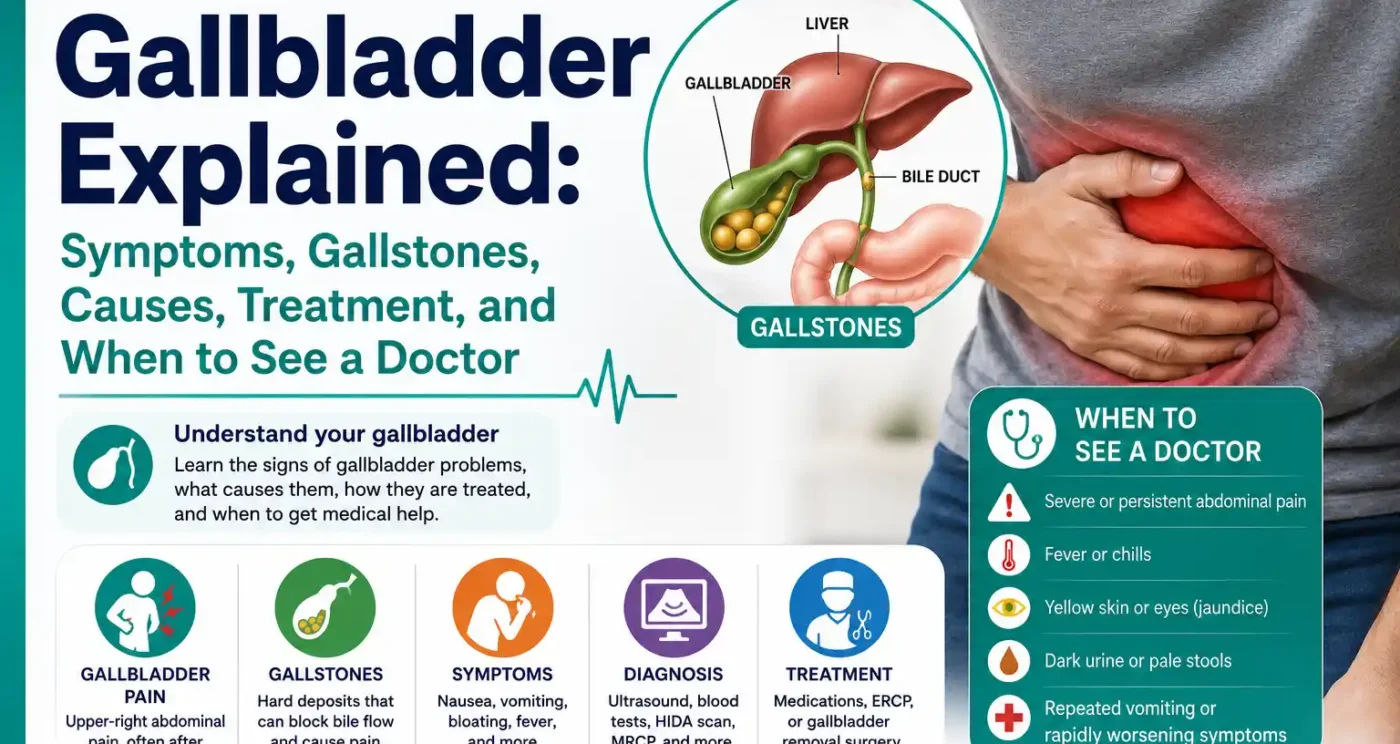
The gallbladder is a small organ beneath the liver that stores bile, a digestive fluid made by the liver. Gallstones form when substances in bile harden into pebble-like deposits. Most gallstones never cause trouble. Problems usually begin when a stone moves into a duct and creates a blockage.
That blockage can lead to a simple gallbladder attack, but it can also cause more serious complications such as acute cholecystitis, bile-duct infection, jaundice, or pancreatitis. Persistent pain, fever, repeated vomiting, jaundice, or rapidly worsening illness deserves prompt medical attention.
What Is the Gallbladder?
The gallbladder is a small, pear-shaped organ located in the upper-right abdomen, directly beneath the liver.
The liver continuously makes bile. Bile contains substances that help the body digest and absorb fats.
Instead of sending all of that bile directly into the intestine, the body stores some of it in the gallbladder. When you eat, the gallbladder contracts and releases bile through a system of ducts into the first part of the small intestine, called the duodenum.
The gallbladder is useful, but it is not essential for survival.
If it is removed, the liver continues producing bile. The difference is that bile flows directly from the liver through the bile ducts into the intestine rather than being stored between meals.
What Are the Most Common Gallbladder Symptoms?
Gallbladder disease does not produce one universal symptom pattern.
Someone with silent gallstones may feel completely normal. Another person may experience occasional pain after eating. A complication such as cholecystitis or cholangitis can cause a much more intense illness.
Possible symptoms associated with gallstones and related gallbladder problems include:
- Pain in the upper-right abdomen
- Pain in the upper-middle abdomen below the breastbone
- Pain that spreads into the right shoulder or back
- Nausea
- Vomiting
- Abdominal tenderness
- Fever or chills when inflammation or infection develops
- Yellowing of the skin or eyes
- Dark urine
- Pale or clay-colored stools
Sudden upper-right abdominal pain and nausea are among the most recognizable symptoms when gallstones begin causing a blockage.
Symptoms such as fever, jaundice, dark urine, or pale stools are more concerning because they can suggest inflammation, infection, or obstruction of the bile ducts.
Where Is Gallbladder Pain Usually Felt?
Gallbladder pain most often begins in the upper-right portion of the abdomen, underneath the ribs.
Some people feel it more centrally, in the upper abdomen just below the breastbone.
The pain may also travel.
Common locations include:
- Right shoulder
- Area below the right shoulder blade
- Upper back
- Between the shoulder blades
Mayo Clinic describes gallstone pain as sudden and rapidly intensifying and notes that it may spread to the right shoulder or back.
Because several other conditions can produce pain in these areas, location alone cannot diagnose a gallbladder problem.
What Does Gallbladder Pain Feel Like?
A gallbladder attack is usually more than a vague awareness that your stomach feels “off.”
The pain may feel deep, steady, squeezing, cramping, or intensely aching. For some people, it builds quickly and becomes difficult to ignore.
Unlike gas pain, changing position or passing gas may not provide much relief.
A typical gallstone attack can last from several minutes to a few hours.
If pain persists for several hours, becomes progressively worse, or occurs with fever, vomiting, or jaundice, the concern shifts from uncomplicated biliary colic toward a possible complication.
What Is a Gallbladder Attack?
A gallbladder attack, also called biliary colic, usually happens when a gallstone temporarily blocks the normal flow of bile.
Imagine the gallbladder contracting against a blocked outlet.
Pressure builds, and pain develops.
If the stone moves and the obstruction resolves, the pressure drops and the attack may end. That is why someone can have severe pain for a few hours and later feel almost normal.
NIDDK notes that gallbladder attacks often occur after heavy meals and may happen during the evening or night. Once someone has experienced one attack, additional attacks are more likely.
The fact that the pain stopped does not necessarily mean the gallstone disappeared.
Can Gallbladder Pain Start After Eating?
Yes.
The gallbladder normally contracts when food enters the digestive tract so that stored bile can be released.
If a gallstone is positioned where it obstructs bile flow, gallbladder contraction can increase pressure behind that obstruction.
This is why symptoms are sometimes noticed after a larger meal, particularly one containing more fat. NIDDK notes that gallbladder attacks often follow heavy meals, while Mayo Clinic notes that cholecystitis symptoms frequently develop after eating and may be more noticeable after large or fatty meals.
Not every attack is meal-related, however.
Someone should not rule out gallstones simply because pain occurs at another time.
What Are Gallstones?
Gallstones, medically called cholelithiasis, are hardened deposits that form from substances within bile.
They can be tiny, like grains of sand, or much larger. A person may have one stone or many.
There are two major types.
Cholesterol Gallstones
These are the most common type in many populations.
They form largely from cholesterol that has crystallized and hardened within bile.
Pigment Gallstones
Pigment stones contain more bilirubin.
Bilirubin is produced when the body breaks down red blood cells.
Certain liver conditions, biliary infections, and blood disorders can increase bilirubin and contribute to pigment-stone formation.
Having gallstones does not automatically mean someone has gallbladder disease requiring treatment.
The important question is whether they are causing symptoms or complications.
How Common Are Gallstones?
Gallstones are very common.
NIDDK estimates that they affect roughly 10% to 15% of the U.S. population, representing millions of people.
Many of those people never know they have them.
Gallstones are frequently discovered accidentally when an ultrasound, CT scan, or another test is performed for an unrelated reason.
Can You Have Gallstones Without Symptoms?
Yes—and this is actually very common.
Gallstones that cause no pain or other problems are often called silent gallstones.
NIDDK states that most people with gallstones have no symptoms, and silent gallstones generally do not interfere with normal gallbladder, liver, or pancreatic function. They usually do not require treatment.
That distinction is important.
An ultrasound report saying “gallstones present” does not automatically mean surgery is necessary.
Treatment decisions depend heavily on whether the stones are causing attacks, inflammation, obstruction, infection, pancreatitis, or another complication.
What Causes Gallstones?
Researchers do not have one explanation that accounts for every gallstone.
Stones appear to form when the balance of substances within bile changes or when the gallbladder does not empty properly.
Possible mechanisms include:
Too Much Cholesterol in Bile
If bile contains more cholesterol than it can keep dissolved, the excess can begin forming crystals.
Those crystals can gradually grow into cholesterol gallstones.
Too Much Bilirubin
Certain conditions increase bilirubin production.
The excess bilirubin can contribute to formation of pigment stones.
Poor Gallbladder Emptying
If the gallbladder does not empty fully or frequently enough, bile can become concentrated and allow stone formation more easily.
Usually, more than one factor is involved.
Who Is More Likely to Develop Gallstones?
Gallstone risk increases in several situations.
Risk factors include:
- Increasing age
- Female sex
- Pregnancy
- Overweight or obesity
- Family history of gallstones
- Diabetes
- Certain blood disorders
- Liver disease
- Some estrogen-containing medications
- Rapid weight loss
Rapid weight loss deserves special attention.
When someone loses weight very quickly, the liver may release additional cholesterol into bile while the gallbladder may also empty less effectively. NIDDK notes that very-low-calorie diets and weight-loss surgery can increase gallstone risk partly because of rapid weight loss.
This does not mean people should avoid medically appropriate weight loss. It means gradual, sustainable weight management is generally preferable when possible.
What Is Cholecystitis?
Gallstones and cholecystitis are not the same thing.
Gallstones are the stones themselves.
Cholecystitis means inflammation of the gallbladder.
The most common scenario begins when a gallstone becomes lodged in the cystic duct—the tube that allows bile to leave the gallbladder.
Instead of moving freely, bile becomes trapped. Pressure rises, the gallbladder becomes irritated and swollen, and infection may eventually develop.
Acute cholecystitis is a more serious problem than an uncomplicated, short-lived gallbladder attack.
What Are the Symptoms of Acute Cholecystitis?
Symptoms can include:
- Persistent or severe pain in the upper-right or upper-middle abdomen
- Pain spreading into the right shoulder or back
- Significant tenderness when the abdomen is touched
- Nausea
- Vomiting
- Fever
The pain tends to be more persistent than simple biliary colic.
Untreated cholecystitis can lead to complications such as infection, tissue damage, or gallbladder rupture.
That is why severe abdominal pain with fever should not simply be watched at home.
What Is Choledocholithiasis?
Gallstones normally form inside the gallbladder.
Sometimes a stone leaves the gallbladder and enters the common bile duct, the main channel carrying bile toward the small intestine.
A gallstone located in the common bile duct is called choledocholithiasis.
The blockage can interfere with bile drainage from the liver and may cause:
- Upper abdominal pain
- Jaundice
- Dark urine
- Pale stools
- Abnormal liver blood tests
A common bile duct stone can also create conditions for infection or pancreatitis.
Why Can Gallstones Cause Jaundice?
Bile contains bilirubin.
Normally, bilirubin moves through the bile ducts into the intestine.
If a gallstone blocks the common bile duct, bilirubin can begin accumulating in the bloodstream instead.
The result may be jaundice, which appears as yellowing of the skin or whites of the eyes.
Someone may also notice dark or tea-colored urine and unusually light-colored stools.
Jaundice with abdominal pain is not something to treat as ordinary indigestion.
It deserves prompt medical evaluation.
What Is Cholangitis?
Cholangitis is an infection of the bile ducts.
It commonly develops when normal bile drainage is blocked and bacteria are able to infect the obstructed biliary system.
Gallstones are a common cause of that blockage.
Symptoms can include:
- Upper-right abdominal pain
- Fever
- Chills
- Jaundice
- Dark urine
- Pale stools
- Nausea
- Vomiting
Not every person develops every symptom.
Cholangitis can progress to sepsis, making rapid diagnosis and treatment important. Treatment commonly involves antibiotics plus relief of the obstruction, often with an endoscopic procedure such as ERCP.
Can Gallstones Cause Pancreatitis?
Yes.
The pancreas releases digestive enzymes through a duct that empties into the intestine near the bile duct.
A gallstone traveling from the gallbladder can become stuck near this shared drainage area and interfere with pancreatic drainage.
The result can be acute gallstone pancreatitis.
Gallstones are among the most common causes of acute pancreatitis.
Pancreatitis typically causes more persistent upper-abdominal pain and may include:
- Severe upper-abdominal pain
- Pain that travels toward the back
- Nausea
- Vomiting
Acute pancreatitis often requires hospital treatment.
Gallbladder Pain vs. Gas or Indigestion
Gallbladder attacks are sometimes mistaken for indigestion.
Both can follow eating and both can cause upper-abdominal discomfort.
Gas and indigestion, however, more commonly cause bloating, belching, generalized discomfort, or symptoms that shift around.
Typical gallstone pain tends to be more focused in the upper-right or upper-middle abdomen and may radiate toward the right shoulder or back. It can become intense and persist for a significant period.
Symptoms alone still cannot reliably distinguish every digestive condition.
Recurring severe upper-abdominal pain deserves medical evaluation even when it eventually disappears.
Gallbladder Pain vs. Acid Reflux
Acid reflux is more likely to cause:
- Burning behind the breastbone
- Acid or bitter taste in the mouth
- Symptoms after lying down
- Regurgitation
Gallbladder pain more often involves deeper upper-right abdominal pain and may radiate toward the right shoulder or back.
But there can be overlap.
NIDDK specifically notes that gallstone symptoms may resemble conditions such as ulcers, pancreatitis, and gastroesophageal reflux disease.
Repeatedly treating unexplained upper-abdominal pain as “heartburn” without evaluation may therefore delay the correct diagnosis.
Gallbladder Pain vs. Kidney Stones
Kidney stones generally cause pain farther toward the side or back and may produce urinary symptoms.
Possible clues include:
- Flank pain
- Pain traveling toward the groin
- Blood in urine
- Painful urination
- Urinary urgency
Gallbladder pain is usually located higher, beneath the right ribs or in the upper-middle abdomen.
Both conditions can cause severe pain, nausea, and vomiting, so testing may be needed when the diagnosis is uncertain.
Gallbladder Pain vs. a Heart Problem
Upper-abdominal discomfort can sometimes be confused with heart-related pain.
Likewise, gallstone discomfort can occasionally be felt in the chest, shoulder, or back. Cleveland Clinic notes that some people mistake gallstone pain for heartburn or even a heart attack.
Do not assume chest pressure, breathlessness, sweating, faintness, or unexplained chest and upper-abdominal pain is “just the gallbladder.”
When a heart problem is possible, emergency evaluation is safer than trying to distinguish the conditions at home.
How Is a Gallbladder Problem Diagnosed?
Diagnosis usually starts with a conversation.
A healthcare professional may ask:
- Where does the pain occur?
- How long does it last?
- Does it happen after meals?
- Has it happened before?
- Is there fever?
- Have you vomited?
- Is there jaundice?
- Have urine or stool colors changed?
The abdomen is also examined for tenderness.
From there, clinicians may use blood tests and imaging.
What Tests Are Used for Gallstones?
Abdominal Ultrasound
For suspected gallstones, abdominal ultrasound is usually the key first imaging test.
It uses sound waves rather than radiation and can show stones inside the gallbladder.
NIDDK describes ultrasound as the best imaging test for finding gallstones, while Mayo Clinic identifies it as the most commonly used test for detecting them.
Blood Tests
Blood tests do not usually diagnose gallstones directly.
Instead, they can reveal clues about complications.
Depending on the situation, clinicians may look for evidence of:
- Infection
- Inflammation
- Bile-duct obstruction
- Liver involvement
- Pancreatitis
HIDA Scan
A HIDA scan, also called cholescintigraphy or hepatobiliary scanning, follows the movement of a small amount of radioactive tracer through the biliary system.
It can help doctors assess whether the gallbladder is emptying normally or whether there is an obstruction.
This test is not necessary for everyone with suspected gallstones.
MRCP
Magnetic resonance cholangiopancreatography, or MRCP, uses MRI technology to provide detailed images of the bile ducts.
It can be particularly useful when doctors are concerned that a stone may have moved into the common bile duct.
CT Scan
CT scanning can show complications involving the gallbladder, bile ducts, liver, or pancreas.
But CT can miss some gallstones, so a normal CT does not necessarily replace a targeted ultrasound when gallstones remain strongly suspected.
ERCP
Endoscopic retrograde cholangiopancreatography, or ERCP, is different from a routine imaging test.
An endoscope is passed through the mouth into the upper digestive tract, allowing instruments to reach the opening of the bile ducts.
Because ERCP is invasive, doctors increasingly use noninvasive imaging such as ultrasound, MRCP, or endoscopic ultrasound when they only need diagnostic information.
ERCP is especially valuable when treatment is expected—for example, when a gallstone needs to be removed from the common bile duct.
Do Gallstones Always Need Treatment?
No.
If gallstones are discovered accidentally and have never caused symptoms, treatment is usually unnecessary.
Both NIDDK and Mayo Clinic state that most people with asymptomatic gallstones do not need treatment.
That changes when stones begin causing problems.
Repeated attacks, cholecystitis, common bile duct stones, pancreatitis, or other complications can shift the balance toward treatment.
How Are Symptomatic Gallstones Treated?
For gallstones that repeatedly produce symptoms, the usual definitive treatment is removal of the gallbladder, called cholecystectomy.
The reason is straightforward: leaving the gallbladder in place also leaves the environment in which stones formed.
Symptoms may disappear between attacks, but stones often remain and future episodes can occur.
Treatment decisions still depend on the patient’s overall health, symptoms, imaging, complications, and surgical risk.
What Is Gallbladder Removal Surgery?
Gallbladder removal is medically called cholecystectomy.
Laparoscopic Cholecystectomy
Most gallbladder removals are performed laparoscopically.
Instead of making one large abdominal incision, the surgeon works through several small openings using a camera and specialized instruments.
NIDDK notes that many laparoscopic cholecystectomies can be performed on an outpatient basis, although the exact recovery period varies from person to person.
Open Cholecystectomy
An open operation requires a larger incision.
It may be necessary when the gallbladder is severely inflamed, infected, scarred, or when another issue prevents safe completion of laparoscopic surgery.
Open surgery generally requires a longer recovery.
Can You Live Normally Without a Gallbladder?
Yes.
The gallbladder stores bile. It does not make it.
The liver continues producing bile after the gallbladder is removed.
Instead of being stored and released in concentrated amounts at mealtimes, bile flows more continuously from the liver through the bile ducts into the small intestine.
Most people can return to a normal diet and lifestyle after recovery.
Does Gallbladder Removal Affect Digestion?
It can temporarily change bowel habits for some people.
NIDDK notes that a small number of people develop softer or more frequent stools after gallbladder removal because bile reaches the intestine more continuously. These changes are usually temporary.
Persistent diarrhea after surgery should be discussed with a healthcare professional because it may need additional evaluation or treatment.
What Is ERCP Used for in Gallstone Disease?
Gallbladder removal treats stones in the gallbladder.
But a stone that has already traveled into the common bile duct may need separate treatment.
That is where ERCP can be useful.
During the procedure, clinicians can access the bile duct and remove an obstructing stone.
ERCP is therefore not the same thing as gallbladder surgery.
In some situations, a patient may need both: ERCP to clear the duct and cholecystectomy to prevent future gallbladder stones from creating another blockage.
Can Medicine Dissolve Gallstones?
Sometimes, but only in selected situations.
Bile-acid medicines such as ursodiol can gradually dissolve certain small cholesterol stones.
There are several limitations.
Treatment can take months or even years, it does not work for every type of gallstone, and stones can recur. For these reasons, NIDDK notes that nonsurgical treatment is generally reserved for special situations, such as when surgery is not a good option.
Medication is not an easy replacement for surgery in most people with recurrent symptomatic stones.
Can Gallstones Go Away on Their Own?
A stone can move out of a temporary blockage, which is why gallbladder-attack pain sometimes disappears.
That is different from saying the gallstones themselves have all dissolved.
Many stones remain inside the gallbladder after an attack ends.
Once a person has experienced one gallbladder attack, future attacks become more likely.
A symptom-free period after an attack should therefore not automatically be interpreted as proof that the problem has resolved permanently.
Is There a Gallbladder Diet?
There is no single medically proven diet that removes established gallstones.
People who notice that large or high-fat meals repeatedly trigger symptoms may find that smaller or less fatty meals are easier to tolerate while waiting for medical evaluation. But dietary changes do not substitute for treatment when a stone is causing repeated obstruction or complications.
For long-term gallstone prevention and overall digestive health, NIDDK recommends an eating pattern that includes:
- Fruits and vegetables
- Beans and peas
- Whole grains
- Fiber-rich foods
- Healthy fats
while limiting excessive refined carbohydrates, added sugars, and unhealthy fats.
It is better to think in terms of an overall eating pattern than a rigid list of “gallbladder foods.”
Does Eating Fat Cause Gallstones?
It is more complicated than that.
Eating one fatty meal does not suddenly create a gallstone.
Gallstones generally develop over time.
A higher-fat meal can, however, make an existing gallbladder contract more strongly and may trigger symptoms if a stone interferes with bile flow.
Healthy dietary fats also play normal physiological roles. NIDDK actually includes healthy fats such as those found in fish and olive oil as part of a balanced eating pattern that supports regular gallbladder emptying.
So “avoid all fat” is not an accurate general recommendation.
Does Losing Weight Help Prevent Gallstones?
Maintaining a healthy weight can reduce gallstone risk, but how weight is lost matters.
Obesity is associated with higher gallstone risk, yet very rapid weight loss can also promote stone formation.
NIDDK explains that rapid weight loss can increase cholesterol release into bile and reduce normal gallbladder emptying.
Crash diets are therefore not a good gallstone-prevention strategy.
Gradual, sustainable weight management is generally preferable.
Can Gallbladder Problems Cause Back or Shoulder Pain?
Yes.
Pain does not have to remain directly over the gallbladder.
Gallstone and cholecystitis pain can be referred to the:
- Right shoulder
- Area below the right shoulder blade
- Upper back
- Region between the shoulder blades
Back or shoulder pain by itself, however, has many other causes.
The connection becomes more suggestive when the pain occurs together with characteristic upper-abdominal symptoms.
Can Gallstones Cause Nausea and Vomiting?
Yes.
Both biliary colic and complications of gallstones can cause nausea or vomiting.
Repeated vomiting becomes more concerning when it occurs with persistent abdominal pain, fever, jaundice, or inability to keep fluids down.
That combination warrants medical evaluation rather than continued home treatment.
Can Gallbladder Problems Cause Bloating?
People with gallbladder disease sometimes report fullness, bloating, or digestive discomfort after meals.
The problem is that bloating is extremely nonspecific.
Gas, constipation, food intolerances, reflux, irritable bowel syndrome, and many other conditions can produce exactly the same complaint.
Bloating without characteristic gallbladder pain is not enough to conclude that the gallbladder is responsible.
Can Gallstones Cause Diarrhea?
Diarrhea is not the classic symptom that identifies a gallstone attack.
Gallstones are more strongly associated with pain, nausea, vomiting, and complications of bile-duct obstruction.
Some people experience bowel changes after their gallbladder has been removed. NIDDK notes that softer or more frequent stools can occur after cholecystectomy, although they are usually temporary.
Persistent diarrhea requires evaluation for other possible causes.
When Should You See a Doctor for Gallbladder Symptoms?
Arrange medical evaluation for recurring or unexplained upper-right abdominal pain, particularly when attacks are becoming more frequent.
You should also seek assessment if pain repeatedly follows meals, radiates to the shoulder or back, or comes with nausea or vomiting.
NIDDK specifically advises prompt medical attention for abdominal pain lasting several hours and for attacks associated with vomiting, fever, chills, jaundice, dark urine, or pale stools.
A new episode of abdominal pain does not have to wait until a routine preventive visit.
MedIntelHub’s preventive-care guide explains why a regular physical and a problem-focused visit for a new symptom can serve different purposes.
MedIntelHub: Understanding Your Annual Physical—What Actually Gets Checked
When Is Gallbladder Pain an Emergency?
Seek urgent or emergency medical care when gallbladder-type pain occurs with symptoms such as:
- Severe pain that does not settle
- Pain lasting for several hours
- Fever or shaking chills
- Yellow skin or eyes
- Dark urine or pale stools
- Repeated vomiting
- Severe abdominal tenderness
- Confusion, fainting, or rapidly worsening illness
These symptoms can indicate complications involving the gallbladder, bile ducts, liver, or pancreas.
Pain so severe that you cannot sit still or find a comfortable position also warrants immediate evaluation.
Can Gallbladder Problems Be Evaluated Through Telehealth?
A virtual visit can sometimes help with mild, stable, or recurring symptoms.
A clinician can ask where the pain occurs, how long it lasts, whether it follows meals, and whether there are associated symptoms such as nausea.
But suspected gallstones often require an abdominal examination, blood work, or ultrasound.
That makes in-person assessment important when symptoms are significant or the diagnosis remains uncertain.
MedIntelHub’s telehealth guide discusses the broader distinction between conditions that can reasonably begin with virtual care and those requiring hands-on assessment.
MedIntelHub: Telehealth in 2026—How Virtual Visits Are Changing Primary Care
Severe abdominal pain, jaundice, fever with chills, persistent vomiting, fainting, or rapidly worsening illness should not be handled through an ordinary telehealth appointment.
When Might You Need a Gastroenterologist or Surgeon?
Primary care or emergency clinicians may make the initial diagnosis.
Further care can involve a:
- Gastroenterologist
- General surgeon
- Hepatobiliary specialist
A gastroenterologist may become involved when there is concern for a common bile duct stone or a procedure such as ERCP.
A surgeon may evaluate someone for cholecystectomy when symptomatic gallstones, recurrent attacks, or complications make gallbladder removal appropriate. NIDDK notes that patients with symptomatic gallstones may be referred to either a gastroenterologist or surgeon.
If you are preparing for that visit, bringing a list of previous attacks, ultrasound findings, medications, and questions can make the consultation more useful.
MedIntelHub: How to Prepare Questions Before a Specialist Appointment
Frequently Asked Questions
What side is the gallbladder on?
The gallbladder is on the right side of the upper abdomen, underneath the liver.
What are the first signs of gallbladder trouble?
For symptomatic gallstones, one of the earliest recognizable patterns is recurring upper-right abdominal pain, sometimes occurring after a heavy meal.
Nausea or pain radiating toward the right shoulder or back may occur as well.
What does a gallbladder attack feel like?
It commonly causes sudden, intensifying pain in the upper-right or upper-middle abdomen.
The pain may spread toward the back or right shoulder and can last from minutes to several hours.
How long does a gallbladder attack last?
Gallstone pain may last several minutes to a few hours.
Pain lasting several hours—especially with fever, vomiting, or jaundice—raises concern for a complication and deserves prompt medical attention.
Do gallstones always hurt?
No.
Most gallstones are silent and never produce symptoms.
Do silent gallstones need surgery?
Usually not.
Gallstones discovered incidentally in someone without symptoms generally do not require treatment.
Can gallstones disappear naturally?
Gallstones do not reliably disappear on their own.
A stone can move out of a blocked position and end an attack, but other stones may remain inside the gallbladder.
Medication can dissolve selected cholesterol stones in special circumstances, but treatment can take months or years and recurrence is possible.
Can you live without your gallbladder?
Yes.
The gallbladder stores bile but is not essential. After surgery, bile flows directly from the liver into the small intestine.
Is gallbladder removal a common operation?
Yes.
NIDDK describes cholecystectomy as one of the common operations performed in adults in the United States. Most are performed laparoscopically.
Can gallstones cause jaundice?
Yes.
A gallstone lodged in the common bile duct can obstruct bile flow and cause bilirubin to accumulate, producing yellowing of the skin or eyes, dark urine, and pale stools.
Can gallstones cause infection?
Yes.
Persistent obstruction can contribute to infection of the gallbladder or bile ducts.
Cholangitis is an infection of the bile ducts and can progress to sepsis if not treated promptly.
Can gallstones cause pancreatitis?
Yes.
A stone can block the area where the bile and pancreatic ducts drain, triggering acute pancreatitis. Gallstones are among the leading causes of acute pancreatitis.
Can a gallbladder attack happen at night?
Yes.
NIDDK notes that gallbladder attacks often occur during the evening or at night and may follow heavy meals.
Can gallbladder pain go away and come back?
Yes.
A temporary blockage may resolve when a stone moves, causing the pain to stop.
Another attack can occur later, and NIDDK notes that people who have already experienced one attack are more likely to have another.
Does gallbladder pain always happen after fatty food?
No.
Larger or higher-fat meals can trigger gallbladder contraction and may provoke symptoms in some people, but attacks do not have to follow a particular food.
Can diet dissolve gallstones?
A normal diet cannot reliably dissolve established gallstones.
Specific bile-acid medications can dissolve certain cholesterol stones in selected patients, but treatment is slow and stones can return.
Is ultrasound the best test for gallstones?
Abdominal ultrasound is generally the main imaging test used to look for gallstones.
NIDDK describes ultrasound as the best imaging test for detecting them.
What is the difference between gallstones and cholecystitis?
Gallstones are hardened deposits of bile.
Cholecystitis is inflammation of the gallbladder, most commonly caused when a gallstone blocks the cystic duct.
When should I worry about gallbladder pain?
Seek prompt medical care if pain lasts for hours or is accompanied by fever, chills, repeated vomiting, jaundice, dark urine, or light-colored stools.
Severe, persistent pain or rapidly worsening illness warrants urgent evaluation.
Conclusion
The gallbladder is small, but problems involving it can cause surprisingly intense symptoms.
Its job is to store bile produced by the liver and release that bile into the small intestine during digestion. Gallstones develop when substances in bile harden, but most stones remain silent and never require treatment.
Problems begin when a stone moves.
A temporary blockage may cause a gallbladder attack, with sudden pain in the upper-right or upper-middle abdomen that can travel toward the right shoulder or back.
If the blockage persists, the situation can become more serious.
A stone blocking the gallbladder outlet can cause acute cholecystitis. A stone traveling into the common bile duct can produce jaundice or lead to cholangitis. A stone blocking pancreatic drainage can trigger acute pancreatitis.
Fortunately, gallstones are usually straightforward to identify.
Abdominal ultrasound is the main imaging test. Blood tests can look for signs of infection, liver or bile-duct problems, or pancreatitis, while MRCP, HIDA scanning, CT, or endoscopic testing may be used when the situation requires additional information.
Treatment depends on whether stones are actually causing trouble.
Silent gallstones usually do not need treatment. Repeated symptomatic gallstones are commonly treated with laparoscopic cholecystectomy, and people can live normally without a gallbladder. Stones lodged in the common bile duct may instead need to be removed through ERCP.
The main thing not to ignore is a change in the pattern.
Pain that becomes persistent, lasts for hours, or appears with fever, chills, jaundice, repeated vomiting, dark urine, pale stools, or rapidly worsening illness is no longer something to simply blame on a heavy meal.
Those symptoms deserve medical attention.
Resources
National Institute of Diabetes and Digestive and Kidney Diseases — Gallstones
NIDDK provides an overview of gallstones, symptoms, complications, diagnosis, and treatment.
NIDDK — Gallstone Symptoms and Causes
This resource explains biliary colic, silent gallstones, risk factors, and warning symptoms that can suggest a complication.
NIDDK: Symptoms and Causes of Gallstones
NIDDK — Diagnosis of Gallstones
NIDDK explains ultrasound, blood testing, CT, MRI/MRCP, HIDA scanning, and ERCP.
NIDDK: Diagnosis of Gallstones
NIDDK — Treatment for Gallstones
This resource covers cholecystectomy, life after gallbladder removal, ERCP, and selected nonsurgical treatments.
NIDDK: Treatment for Gallstones
Mayo Clinic — Gallstones
Mayo Clinic provides information about gallstone symptoms, risk factors, complications, diagnosis, and treatment.
MedlinePlus — Cholangitis
MedlinePlus explains how bile-duct obstruction can lead to infection, the symptoms of cholangitis, and why prompt treatment is important.
NIDDK — ERCP
This resource explains how ERCP is used to treat blocked bile or pancreatic ducts, including removal of common bile duct stones.
NIDDK: Endoscopic Retrograde Cholangiopancreatography (ERCP)
MedIntelHub — Understanding Your Annual Physical
This guide explains how preventive appointments differ from visits for new or worsening symptoms.
Understanding Your Annual Physical: What Actually Gets Checked
MedIntelHub — Preparing for a Specialist Appointment
Useful for organizing symptoms, imaging reports, medications, and questions before seeing a gastroenterologist or surgeon.
How to Prepare Questions Before a Specialist Appointment
MedIntelHub — Editorial Policy
Editorial Disclaimer
This article is provided for general educational and informational purposes only. It does not diagnose gallstones, cholecystitis, bile-duct obstruction, cholangitis, pancreatitis, or another cause of abdominal pain.
Upper abdominal pain can result from many conditions, including reflux, ulcers, liver disease, pancreatitis, kidney stones, appendicitis, heart disease, and other disorders. The location of pain alone cannot establish the diagnosis.
Treatment for gallstones depends on symptoms, imaging findings, infection, inflammation, bile-duct involvement, pancreatic involvement, surgical risk, pregnancy status, other medical conditions, medications, and individual circumstances.
Do not attempt to treat severe or recurring gallbladder-type pain solely through dietary restriction or leftover medication.
Seek urgent medical care for severe or persistent abdominal pain, fever or shaking chills, jaundice, repeated vomiting, dark urine with pale stools, fainting, confusion, or rapidly worsening illness.

David Bennett
David Bennett is an author at MedIntelHub, where he creates clear, practical, and well-researched content about healthcare, medical billing, insurance, and patient education. His goal is to make complex healthcare topics easier for readers to understand and use in everyday situations. David emphasizes accuracy, transparency, and reliable sourcing, using information from trusted organizations and official healthcare resources whenever possible. Content published by David is intended for educational purposes and should not replace advice from qualified medical, legal, or healthcare professionals.