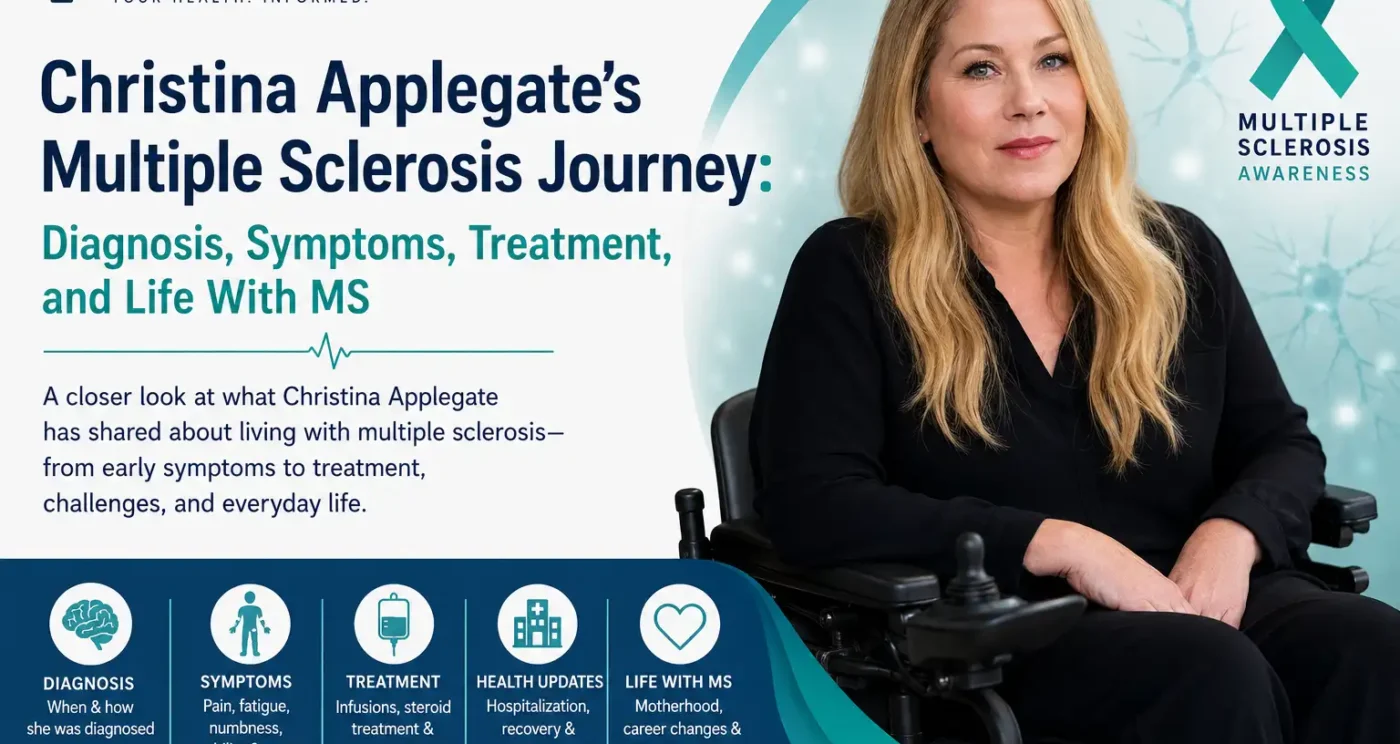
Christina Applegate has spoken about multiple sclerosis in a way that is often uncomfortable, funny, angry, and deeply personal—all at once.
She announced her diagnosis in 2021. Since then, she has described losing some of the independence she once took for granted, struggling with pain and exhaustion, needing help with walking, and adjusting to a body that does not always cooperate with what she wants to do.
Her descriptions became even more detailed in 2026.
In her memoir You With the Sad Eyes, Applegate wrote about mornings when moving an arm far enough to reach something beside her bed can be difficult. She described walking across a room as an enormous effort and said that even after sleeping, the fatigue can feel overwhelming. She also disclosed that she receives an infusion about every six months intended to slow her disease and that the treatment depletes B cells, which can make infections a greater concern.
She has not tried to make that experience sound inspirational.
In a March 2026 interview with Good Morning America, Applegate said she had not reached a place where she accepted MS and described it as a lifelong illness without a cure.
Her experience is important, but it is also just one person’s experience with multiple sclerosis. MS can look remarkably different from one patient to another. Some people remain independently mobile for many years. Others deal with substantial pain, fatigue, weakness, vision problems, or difficulty walking.
The details Applegate has chosen not to make public—including her exact MS subtype, complete treatment regimen, disability score, and long-term prognosis—should remain separate from what can reasonably be explained from her interviews and writing.
When Was Christina Applegate Diagnosed With Multiple Sclerosis?
Applegate publicly announced her multiple sclerosis diagnosis on August 10, 2021.
She said doctors had diagnosed her several months earlier and described the experience as a difficult road.
The timing was especially complicated because Applegate was working on the third and final season of Netflix’s Dead to Me.
Looking back, however, she has said there were clues before she understood what was happening.
She has recalled episodes involving balance problems, leg weakness or buckling, numbness, and tingling. Some of those symptoms appeared years before the formal diagnosis.
That does not mean every episode of tingling, weakness, or poor balance should be interpreted as multiple sclerosis. These symptoms overlap with many neurological, orthopedic, metabolic, vascular, and other medical conditions.
For Applegate, their significance only became clear after a neurological workup.
What Symptoms Did Christina Applegate Notice Before Her Diagnosis?
One symptom Applegate has spoken about retrospectively is trouble with balance.
She recalled losing her balance during the early years of Dead to Me and later wondering whether it was an early manifestation of the disease. She has also discussed leg problems, numbness, and tingling that became harder to ignore as time went on.
By the time she was being evaluated in 2021, the problem was no longer something she could easily explain away.
Her experience reflects one reason MS can take time to identify: early symptoms may be vague, intermittent, or easily attributed to something else.
A person might initially blame numbness on sitting awkwardly, weakness on fatigue, dizziness on dehydration, or balance trouble on an injury.
That is why the pattern and persistence of neurological symptoms can be more useful than any one symptom in isolation.
How Was Christina Applegate’s MS Diagnosed?
Applegate has said MRI imaging was a memorable part of learning that she had MS.
In her memoir, she described speaking with her neurologist while production on Dead to Me was underway. She recalled being shown images of her brain and being told there were about 30 lesions.
That number is part of her personal account. It does not, by itself, tell the public how severe her MS is, which subtype she has, or what her prognosis might be.
Doctors do not diagnose MS by simply counting spots on an MRI.
A neurological workup may include medical history, neurological examination, MRI of the brain or spinal cord, cerebrospinal-fluid testing, and blood tests used partly to rule out other explanations. There is no single blood test that confirms MS.
MRI
MRI is one of the most important tools used when MS is suspected.
It can reveal areas of inflammation, demyelination, and scarring in the brain or spinal cord. Doctors consider where lesions are located, what they look like, and whether there is evidence of disease affecting different parts of the central nervous system.
Neurological Examination
A neurologist may test strength, reflexes, sensation, coordination, balance, walking, vision, and several other functions.
Those findings can help determine which areas of the nervous system may be affected.
Spinal-Fluid Testing
Some people undergo a lumbar puncture.
Cerebrospinal fluid can be examined for evidence of immune activity within the central nervous system that supports an MS diagnosis when interpreted with the rest of the clinical picture.
Blood Tests
Blood work is often useful for a different reason: ruling out illnesses that can resemble MS.
Vitamin deficiencies, infections, autoimmune disorders, and other neurological conditions can produce overlapping symptoms.
What Is Multiple Sclerosis?
Multiple sclerosis is a chronic disease affecting the central nervous system, which includes the brain and spinal cord.
In MS, immune activity damages myelin, the protective covering around nerve fibers. Damage can also affect the nerve fibers themselves.
When these pathways are injured, signals between the brain and the rest of the body may slow down, become distorted, or fail to travel normally.
That is why MS can cause such different symptoms.
A lesion affecting a pathway involved in vision may produce a very different problem from one affecting coordination, sensation, bladder control, or walking.
Is Multiple Sclerosis an Autoimmune Disease?
MS is generally described as an immune-mediated autoimmune disease.
The immune system becomes involved in attacking structures within the central nervous system rather than limiting its activity to outside threats such as infections.
Researchers still do not have one simple explanation for why an individual develops MS.
Genetics, environmental exposures, immune-system biology, and infectious factors are all areas of research.
It is not considered the result of a person’s attitude, stress level, diet, or a single lifestyle decision.
How Did MS Affect Christina Applegate While Filming Dead to Me?
Finishing Dead to Me became physically different after Applegate’s diagnosis.
Production paused, and when filming continued, she needed considerably more help than she had earlier in her career.
In her memoir, Applegate wrote that by the end of production she needed several people to help her get down the stairs of her trailer and into a wheelchair so she could reach the set.
She still chose to complete the season.
That required accommodations and support behind the scenes.
Long workdays, getting to and from the set, standing, moving between locations, sitting through hair and makeup, and repeating scenes all became more physically demanding.
Her account also makes an important point about disability: being able to complete a job does not necessarily mean the task has become easy or that the illness has stopped affecting the person.
What Symptoms Has Christina Applegate Described?
Applegate has discussed several symptoms publicly.
They include significant pain, extreme fatigue, numbness, trouble walking, weakness, and difficulty carrying out activities that previously required little thought.
Not everyone with MS experiences those symptoms at the same intensity.
Pain
Pain has become a major part of how Applegate describes her daily life.
In her memoir, she said some people with MS experience a great deal of pain while others do not, and made clear that pain is a serious problem for her.
By February 2026, she said movement could be painful enough that she spent much of her time in bed.
MS-related pain can arise in different ways.
Some pain is neurological, meaning damaged nerve pathways generate painful or abnormal sensations. Muscle stiffness, spasms, weakness, altered walking patterns, and prolonged immobility may also contribute to discomfort.
The exact source of Applegate’s pain is something only her treating clinicians could determine.
Fatigue
Applegate has also described an exhaustion that does not behave like ordinary tiredness.
In her memoir, she described waking after sleep and still feeling profoundly depleted.
Fatigue is among the most commonly reported symptoms of MS and can interfere with work, household activities, social life, and basic daily tasks. The National MS Society notes that it can appear even after adequate sleep and may feel much more severe than typical tiredness.
Fatigue can also be made worse by pain, poor sleep, medication effects, infection, depression, heat, or other medical problems.
Difficulty Walking
Applegate has spoken repeatedly about changes in her ability to walk.
She has used a wheelchair and has described even crossing a room as requiring enormous effort.
MS may interfere with walking through several mechanisms, including:
- Muscle weakness
- Balance problems
- Spasticity
- Poor coordination
- Numbness or altered sensation
- Pain
- Fatigue
One person may primarily struggle with balance while another deals more with weakness or stiffness.
Numbness and Tingling
Numbness and tingling were among the symptoms Applegate noticed before she knew she had MS.
These sensations are common in MS because damage to nerve pathways changes how sensory information travels.
A person may notice pins and needles, burning, numbness, altered temperature sensation, or an unusual electrical feeling.
Those symptoms are not unique to MS, which is one reason diagnosis requires more than symptom matching.
Arm and Hand Problems
Applegate has written about mornings when simply moving an arm far enough to reach something beside her bed can be difficult.
MS can affect upper-body strength, sensation, coordination, and fine motor control depending on which neurological pathways are involved.
Bowel and Digestive Problems
Applegate has also described significant gastrointestinal problems and trips to the emergency department.
She has connected those experiences with the broader impact MS and its treatment have had on her life.
MS can affect bowel and bladder function because neurological pathways help coordinate these systems. Constipation and bowel-control problems are among recognized MS symptoms.
That does not mean every stomach or bowel problem experienced by someone with MS is caused by MS.
Medications, infection, gastrointestinal disease, diet, and many other conditions remain possible explanations.
Applegate has revealed some information about her treatment but has not published a complete medication list.
In her 2026 memoir, she said she receives an infusion about every six months intended to slow the disease. She also explained that the treatment depletes B cells and leaves her more susceptible to infections.
She did not name the medication in the source reviewed here.
That means it would be inappropriate to identify a drug by comparing her description with medications that happen to have a similar schedule.
She has also described receiving a lengthy course of steroid infusions during a period when her symptoms became particularly severe.
Those two kinds of treatment serve different purposes.
What Are Disease-Modifying Therapies for MS?
Disease-modifying therapies, commonly called DMTs, are medications intended to change the course of multiple sclerosis.
Depending on the form of MS and the medication used, treatment may reduce relapses, reduce inflammatory activity seen on MRI, or slow disability progression.
Some DMTs are taken as pills.
Others are injected at home.
Still others are given by infusion.
They are not cures.
A person may be receiving an effective disease-modifying treatment and still experience persistent symptoms caused by neurological damage that has already occurred.
Why Do Some MS Treatments Target B Cells?
B cells are part of the immune system.
Certain MS therapies reduce specific B-cell populations because B cells are involved in the immune activity that contributes to the disease.
Reducing that immune activity can help control MS, but suppressing part of the immune system can also increase susceptibility to some infections.
Applegate has specifically discussed this tradeoff when describing her own treatment.
The appropriate monitoring depends on the particular medication and patient’s health history.
What Are Steroids Used for in MS?
Corticosteroids may be prescribed during certain acute MS relapses.
Their purpose is usually to reduce inflammation and shorten or lessen the severity of the attack.
They are different from disease-modifying therapies that are intended to influence the longer-term course of MS.
Steroids do not permanently cure MS.
They are also not required for every symptom change or relapse.
Can Multiple Sclerosis Be Cured?
There is currently no cure for MS.
Treatment instead focuses on several goals:
- Reducing disease activity
- Reducing relapses
- Slowing disability when possible
- Managing individual symptoms
- Preserving mobility and independence
- Supporting emotional and cognitive health
- Preventing complications
Applegate addressed this directly in her March 2026 Good Morning America interview, where she described MS as a lifelong disease and said she had not reached a place of acceptance about having it.
What Are the Most Common Symptoms of Multiple Sclerosis?
There is no standard MS symptom list that every patient follows.
Possible symptoms include:
- Fatigue
- Numbness or tingling
- Muscle weakness
- Problems with balance
- Difficulty walking
- Stiffness or muscle spasms
- Pain
- Dizziness
- Blurred or double vision
- Optic neuritis
- Coordination problems
- Bladder problems
- Bowel problems
- Cognitive changes
- Speech or swallowing difficulties
Symptoms may appear in different combinations and may change over time.
Why Does MS Affect People So Differently?
The location of neurological injury matters.
If MS damages pathways involved in vision, a person’s experience may revolve around visual symptoms.
Another person’s lesions may affect walking, sensation, bladder control, or coordination.
Some people experience relapses followed by partial recovery. Others have a more gradually progressive pattern.
There is also wide variation in how much neurological function returns after an episode and how well disease-modifying therapy controls future disease activity.
For that reason, Applegate’s current level of disability should never be presented as the expected destination for another person diagnosed with MS.
What Are the Main Types of Multiple Sclerosis?
Several terms are used to describe MS disease courses.
Applegate’s specific disease course should not be assigned based on interviews alone.
Relapsing-Remitting MS
Relapsing-remitting MS involves episodes of new or worsening neurological symptoms followed by periods of improvement or relative stability.
This has historically been the most common disease course at diagnosis.
Secondary Progressive MS
Some people who initially have relapsing MS later begin to experience more gradual neurological worsening, even when obvious relapses become less prominent.
That transition is known as secondary progressive MS.
Primary Progressive MS
Primary progressive MS involves gradual worsening of neurological function from early in the course of the illness rather than a classic pattern of distinct attacks followed by remissions.
Again, increasing difficulty walking does not allow an outside observer to determine which of these categories describes Applegate.
Does Everyone With MS Eventually Need a Wheelchair?
No.
The course of MS is too variable for that prediction.
Some people remain independently mobile for decades. Others eventually use a cane, walker, wheelchair, or another mobility aid.
Assistive devices can also be used selectively.
Someone might walk inside the home but use a wheelchair for a long trip, airport, event, or workday because it conserves energy and reduces fall risk.
A wheelchair should not be viewed as evidence that treatment has “failed.”
It can be a tool that helps someone remain independent.
Is Christina Applegate Bedridden?
“Bedridden” is too absolute to describe what Applegate has said.
She told People in early 2026 that she spends much of her time in bed because movement can be painful. She has also continued to describe activities outside bed, including taking her daughter to school when she is able.
A more accurate description is that her illness has substantially limited her mobility and daily activity, and that she spends significant periods resting in bed.
Can MS Cause Severe Pain?
Yes, but pain is highly variable.
Some people experience neuropathic pain caused directly by abnormal nerve signaling.
Others may experience painful muscle spasms, stiffness, or musculoskeletal pain related to altered movement patterns.
Applegate has made it clear that pain is a major feature of her own illness.
That does not mean severe pain occurs in everyone with MS.
Why Is MS Fatigue Different From Ordinary Tiredness?
MS fatigue can appear out of proportion to what a person has done.
Someone may wake up exhausted after sleeping through the night or find that a task that once required little thought suddenly uses most of their available energy.
The National MS Society describes MS fatigue as potentially severe, sudden, and disruptive to daily responsibilities.
Other problems can add to it.
Pain, insomnia, bladder symptoms during the night, infection, depression, medication effects, anemia, thyroid disease, and the additional effort required for walking may all increase fatigue.
Applegate’s description of profound exhaustion despite sleep is consistent with what some people with MS report.
Can MS Cause Bowel or Bladder Problems?
Yes.
The brain and spinal cord help coordinate bowel and bladder function, so disruption of neurological signaling can cause problems.
Possible symptoms include urinary urgency, frequent urination, difficulty emptying the bladder, incontinence, constipation, and problems with bowel control.
These symptoms should still be evaluated rather than automatically blamed on MS.
Urinary infections, medications, gastrointestinal diseases, pelvic-floor problems, and other conditions may produce similar complaints.
Can Infection Make MS Symptoms Worse?
Yes.
Fever or infection can temporarily make existing MS symptoms more noticeable.
People taking immune-modifying medications may also have an increased risk of certain infections, depending on the treatment.
Applegate has specifically said that her own infusion therapy depletes B cells and makes infection more of a concern for her.
That does not mean every period of worsening symptoms represents a new MS lesion or relapse.
Doctors may need to distinguish a true relapse from temporary worsening caused by infection, fever, heat, or another stress on the body.
What Happened With Christina Applegate’s 2026 Hospitalization?
Reports circulated in April 2026 that Applegate had been hospitalized in Los Angeles.
The reason was not publicly established at the time.
Applegate later posted an update saying health problems were a constant part of her life but that she was getting stronger and taking time to focus on her health.
In May, her MeSsy co-host Jamie-Lynn Sigler said Applegate was doing better and becoming stronger.
In August, People reported that Applegate had returned home following a lengthy hospital stay and was doing very well.
It would be a mistake to label the hospitalization an MS relapse unless Applegate or her medical team confirms that diagnosis.
A person with MS can be hospitalized for many reasons, including infection, gastrointestinal problems, medication complications, or conditions unrelated to MS.
How Has MS Changed Christina Applegate’s Career?
Traditional television production has become much more difficult for Applegate.
In her memoir, she described how demanding even the basic routine of filming had become: traveling to set, getting through hair and makeup, moving around the location, and sustaining the energy needed for a long production day.
Still, she has not disappeared creatively.
She co-hosts the MeSsy podcast with actor Jamie-Lynn Sigler, who also lives with MS.
She also published You With the Sad Eyes in 2026 and has discussed remaining open to acting work if the circumstances are physically manageable. In her March GMA interview, she said she would like to act again, but joked about avoiding early mornings and having people touch her hair and face.
That distinction is more accurate than simply saying she “retired.”
Her relationship with acting has changed because her physical capacity has changed.
What Has Christina Applegate Said About Accepting Her Diagnosis?
She has resisted the idea that illness has to be presented as a gift.
In March 2026, Applegate said she had not accepted MS and described living with better days and worse days rather than pretending everything was fine.
Her memoir takes a similarly unsentimental approach.
She writes about pain, fear, anger, changes in her appearance, lost independence, and the emotional strain of living with a body that no longer behaves the way it once did.
There is value in that perspective.
Adapting to chronic illness does not require someone to call it a blessing.
Acceptance can mean learning how to live within a changed reality without pretending to enjoy what caused the change.
How Has MS Affected Christina Applegate as a Parent?
Applegate has repeatedly described her daughter Sadie as central to her life.
In February 2026, she said taking her daughter to school remained one activity she tried to continue even though she often needed substantial rest afterward.
During her Good Morning America interview, she also described her role as Sadie’s mother as one of the things that continues to give her a sense of purpose.
Those comments highlight an aspect of chronic illness that medical descriptions often overlook.
A neurological disorder does not only change walking, strength, or fatigue.
It can reshape family routines, work roles, independence, relationships, and the amount of energy someone has available for the people they care about.
What Can Christina Applegate’s Experience Teach Us About MS?
There are useful lessons in her public story, but they need to be separated from predictions about another person’s illness.
Early Neurological Symptoms Can Be Easy to Ignore
Numbness, tingling, weakness, or occasional balance problems have many possible explanations.
But symptoms that persist, recur, or become progressively harder to explain deserve evaluation.
Treatment Does Not Necessarily Remove Existing Disability
Disease-modifying treatment may reduce future disease activity without reversing all neurological damage that has already occurred.
A patient can therefore be receiving appropriate treatment while still living with significant pain, fatigue, or mobility limitations.
MS Can Change Over Time
The disease a person experiences in one year may not look the same several years later.
Symptoms, disability, relapses, treatment response, and other illnesses can all influence daily function.
Mobility Aids Can Preserve Independence
A cane, walker, wheelchair, or other device can make it possible to continue activities that would otherwise be exhausting or unsafe.
Patients Do Not Have to Perform Optimism
Applegate’s refusal to describe MS as a blessing is part of what makes her public discussion unusual.
Chronic illness can involve gratitude, humor, anger, grief, love, and frustration at the same time.
What Can’t We Know From Christina Applegate’s Interviews?
Public statements provide only part of a person’s medical history.
Reliable information reviewed for this article does not establish:
- Her exact MS subtype
- Her complete medication list
- The name of her six-month infusion
- Her current MRI lesion burden
- Her formal disability score
- The exact cause of each hospitalization
- Whether every gastrointestinal problem is caused by MS
- Her individual long-term prognosis
Trying to fill those gaps by matching her symptoms or treatment schedule to a particular diagnosis would cross the line from reporting into speculation.
When Should Possible MS Symptoms Be Evaluated?
Most episodes of tiredness, tingling, dizziness, or headache are not multiple sclerosis.
Still, neurological symptoms that persist, recur, or noticeably affect function deserve attention.
Examples include new unexplained:
- Vision loss or persistent visual change
- Numbness
- Muscle weakness
- Balance problems
- Repeated falls
- Difficulty walking
- Coordination problems
- Double vision
- Bladder changes occurring with other neurological symptoms
A primary-care clinician can often begin the evaluation and decide whether neurology referral or imaging is appropriate.
A new neurological problem should not simply be saved for the next annual checkup. MedIntelHub explains why preventive visits and appointments for new symptoms serve different purposes.
Understanding Your Annual Physical: What Actually Gets Checked
When Should Someone See a Neurologist?
A neurologist may be needed when symptoms suggest an ongoing problem involving the brain, spinal cord, nerves, or muscles.
The visit may involve a detailed neurological examination followed by MRI or other testing when appropriate.
Before the appointment, it can help to write down when symptoms started, how long they last, whether they come and go, and how they affect walking, vision, sleep, work, or other activities.
Bringing previous scans, reports, hospital records, and a current medication list may also make the visit more useful.
MedIntelHub’s specialist-appointment guide offers a practical framework for preparing those questions and records.
How to Prepare Questions Before a Specialist Appointment
When Are Neurological Symptoms an Emergency?
A person who already has MS should not automatically assume every new neurological symptom is another episode of MS.
Sudden neurological changes can be caused by stroke or another emergency.
Call 911 or seek immediate emergency care for sudden:
- Facial drooping
- Weakness or numbness on one side
- Difficulty speaking
- Severe confusion
- Sudden loss of coordination
- Sudden vision loss
- Loss of consciousness
- A major new neurological deficit
Severe breathing problems, serious infection symptoms in someone taking immune-suppressing medication, or rapidly worsening neurological function also require urgent evaluation.
Telehealth can be useful for some chronic follow-up conversations, but severe new neurological deficits need in-person or emergency assessment. MedIntelHub’s telehealth guide explains this distinction in more detail.
Telehealth in 2026: How Virtual Visits Are Changing Primary Care
Frequently Asked Questions
What neurological condition does Christina Applegate have?
Christina Applegate has multiple sclerosis.
She publicly announced the diagnosis in August 2021 after doctors had diagnosed her several months earlier.
When was Christina Applegate diagnosed with MS?
Her public announcement came on August 10, 2021.
She said at the time that she had received the diagnosis months earlier.
What were Christina Applegate’s early MS symptoms?
Applegate has retrospectively discussed balance problems, leg weakness or buckling, numbness, and tingling before her diagnosis.
Those symptoms are not specific to MS and require medical evaluation when persistent or unexplained.
Can Christina Applegate still walk?
Her mobility is significantly limited, but a simple yes-or-no answer does not accurately describe what she has said.
She has used a wheelchair, has spoken about severe difficulty walking, and spends considerable time resting in bed. She has also described continuing some activities outside the home when she is able.
Is Christina Applegate permanently bedridden?
That is not what she has said.
She has described spending much of her time in bed because movement can be painful and exhausting, but she has also discussed continuing activities such as driving her daughter to school.
What medication does Christina Applegate take for MS?
Applegate has said she receives an infusion about every six months that affects B cells and is intended to slow her MS.
She did not identify the drug by name in the memoir material reviewed here, so the medication should not be guessed from that description.
Does Christina Applegate have progressive MS?
Her specific MS subtype has not been publicly established in the reliable sources reviewed for this article.
Increasing disability cannot, by itself, determine whether someone has relapsing-remitting, secondary progressive, or primary progressive MS.
How many brain lesions did Christina Applegate have?
Applegate recalled being shown MRI images at diagnosis and being told there were approximately 30 lesions.
Lesion count alone does not determine MS subtype, disability level, or prognosis.
Does MS always cause severe disability?
No.
The illness varies greatly. Some people remain relatively independent for many years, while others develop substantial neurological disability.
Does everyone with MS need a wheelchair eventually?
No.
Some people never need one. Others use mobility aids intermittently or more consistently depending on weakness, balance, pain, fatigue, and other symptoms.
Can multiple sclerosis cause severe pain?
Yes.
Neuropathic pain, painful muscle spasms, stiffness, and musculoskeletal discomfort can occur in MS.
Not everyone experiences severe pain.
Can MS make someone extremely tired?
Yes.
MS-related fatigue can be intense and may occur even after a normal night’s sleep. It is one of the most commonly reported MS symptoms.
Can MS affect the bladder and bowel?
Yes.
Neurological damage can interfere with bowel and bladder control, although other medical causes should still be considered.
Can MS weaken the immune system?
MS itself involves abnormal immune activity, but some MS treatments intentionally reduce or modify parts of the immune system.
Those treatments can increase susceptibility to certain infections.
Applegate has said her infusion therapy depletes B cells and makes infection more of a concern for her.
Is there a cure for multiple sclerosis?
No cure currently exists.
Disease-modifying therapies can help reduce disease activity or slow progression in appropriate patients, while other treatments address relapses and individual symptoms.
Can a blood test diagnose MS?
No.
Blood tests are useful for ruling out conditions that can mimic MS, but the diagnosis relies on clinical evaluation, neurological examination, imaging, and sometimes cerebrospinal-fluid testing.
What was Christina Applegate’s latest health update?
After reports of hospitalization in spring 2026, Applegate said she was getting stronger and focusing on her health. Jamie-Lynn Sigler later said she was doing much better, and an August People report said Applegate had returned home following a lengthy hospital stay and was doing very well. The precise reason for that hospitalization has not been publicly established.
Conclusion
Christina Applegate’s experience with multiple sclerosis has unfolded publicly for more than five years, but she has never presented it as a neat recovery story.
She announced her diagnosis in 2021 after neurological symptoms had become difficult to ignore.
She went on to finish the final season of Dead to Me while dealing with significant mobility problems and relying on a wheelchair and help from people around her.
By 2026, she was describing a much smaller physical world.
Pain could make movement difficult. Fatigue persisted despite sleep. Walking across a room could require substantial effort, and she often spent long periods resting in bed.
She has also continued treatment. Applegate says she receives six-monthly infusions intended to slow the disease, although she has not publicly named the medication in the material reviewed here.
None of that tells us what will happen to another person diagnosed with MS.
Multiple sclerosis is unpredictable. Symptoms, disease activity, disability, and treatment response vary widely. Some people remain highly mobile. Others develop substantial limitations. There is no cure at present, but disease-modifying therapies and symptom-focused treatment can change the course of the illness and improve function for many patients.
Applegate has also challenged another expectation: that a public figure living with chronic illness should eventually turn it into a positive story.
She has said she hates having MS. She has discussed grief, anger, humor, motherhood, lost independence, and moments of connection without insisting that one cancels out the others.
Her experience can help people understand what severe MS may look like.
It should not be used to predict anyone else’s future.
Resources
National Library of Medicine — Multiple Sclerosis
Patient-friendly information covering MS symptoms, diagnosis, treatment, and living with the condition.
MedlinePlus: Multiple Sclerosis
National Institute of Neurological Disorders and Stroke
NINDS explains neurological examinations, MRI, cerebrospinal-fluid testing, and other diagnostic tools used in neurological care.
NINDS: Neurological Diagnostic Tests and Procedures
National Multiple Sclerosis Society — Diagnostic Workup
Professional information on the evidence and testing used when clinicians evaluate possible MS.
National MS Society: Diagnostic Workup
National Multiple Sclerosis Society — Disease-Modifying Therapy
Information about treatments intended to reduce MS disease activity and slow progression in appropriate patients.
National MS Society: Injectable and Disease-Modifying Therapies
Good Morning America — Christina Applegate on Living With MS
Applegate’s March 2026 interview covers her memoir, illness, acceptance, motherhood, and whether she would consider acting again.
GMA: Christina Applegate Talks About Her MS Journey
The Guardian — Christina Applegate’s Memoir Extract
Applegate’s first-person account includes her diagnosis, MRI experience, mobility problems, fatigue, pain, infusion treatment, and experience finishing Dead to Me.
The Guardian: Christina Applegate on Life With Multiple Sclerosis
MedIntelHub — Understanding Your Annual Physical
Useful for understanding why a new neurological symptom may require a separate problem-focused visit rather than waiting for a routine physical.
Understanding Your Annual Physical: What Actually Gets Checked
MedIntelHub — Preparing for a Specialist Appointment
A practical guide for organizing symptoms, medications, test results, and questions before seeing a neurologist.
How to Prepare Questions Before a Specialist Appointment
MedIntelHub — Telehealth in 2026
Explains where virtual care may fit into chronic follow-up and why some symptoms still require in-person or emergency evaluation.
Telehealth in 2026: How Virtual Visits Are Changing Primary Care
MedIntelHub — Editorial Policy
For information about MedIntelHub’s approach to sourcing, accuracy, transparency, and healthcare education.
Editorial Disclaimer
This article discusses Christina Applegate’s multiple sclerosis only to the extent that information has been publicly disclosed by Applegate herself, her representatives, or reputable news organizations.
It does not attempt to determine her MS subtype, identify an undisclosed medication, interpret private medical records, determine the cause of individual hospitalizations, or predict her prognosis.
Clinical information about multiple sclerosis is provided for general education only. It should not be used to diagnose MS or determine treatment for an individual.
Symptoms such as numbness, weakness, fatigue, dizziness, vision changes, pain, and trouble walking can occur with many neurological and non-neurological conditions.
Sudden facial drooping, one-sided weakness or numbness, difficulty speaking, sudden severe loss of coordination, abrupt vision loss, loss of consciousness, or another major new neurological deficit should be treated as a possible medical emergency rather than assumed to be multiple sclerosis.
Meta Title
Meta Description

David Bennett
David Bennett is an author at MedIntelHub, where he creates clear, practical, and well-researched content about healthcare, medical billing, insurance, and patient education. His goal is to make complex healthcare topics easier for readers to understand and use in everyday situations. David emphasizes accuracy, transparency, and reliable sourcing, using information from trusted organizations and official healthcare resources whenever possible. Content published by David is intended for educational purposes and should not replace advice from qualified medical, legal, or healthcare professionals.