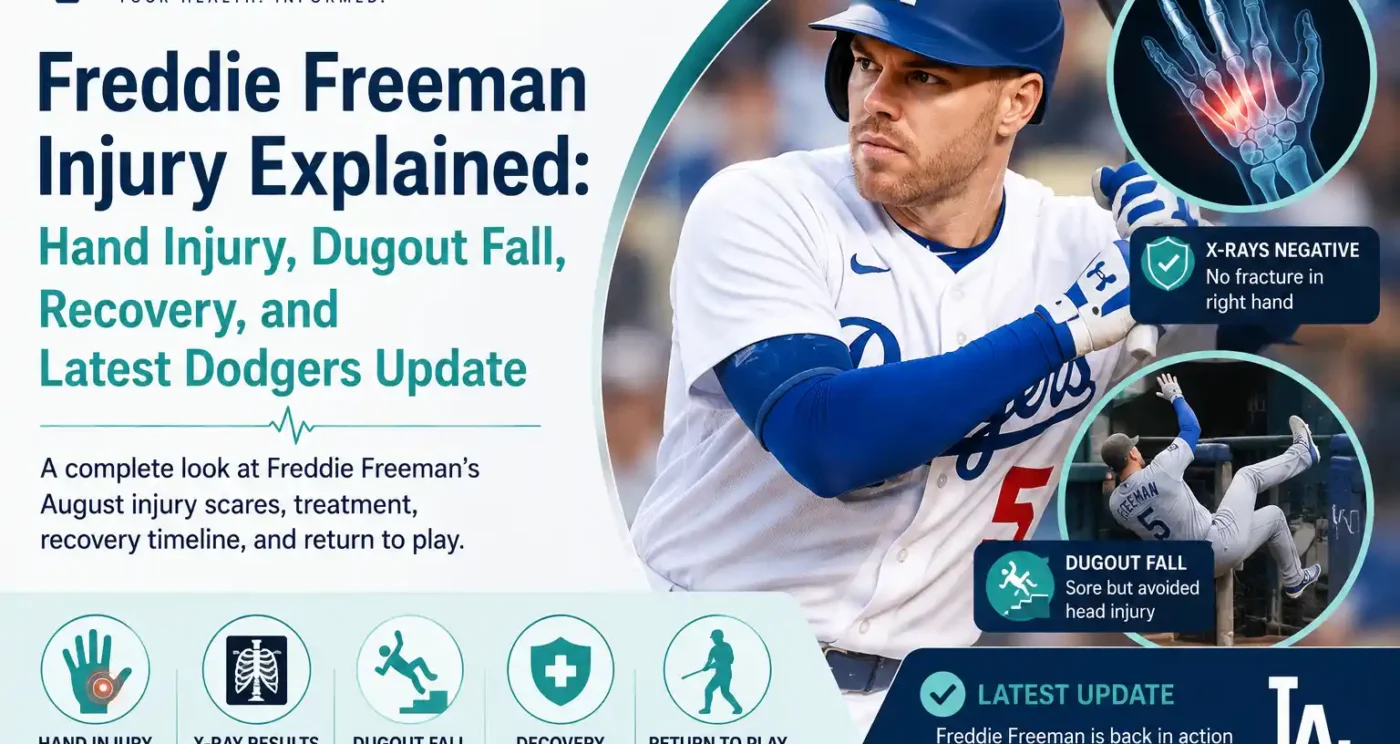
Freddie Freeman gave the Los Angeles Dodgers two injury scares within the span of a week in August 2026.
The first involved his right hand. On August 5 at Wrigley Field, a high fastball caught the outside of Freeman’s hand as he tried to foul it off, squeezing the hand against the bat. He finished the plate appearance but was removed before the next defensive inning. X-rays came back negative for a fracture.
Seven days later, Freeman was hurt again—this time in a much more dramatic-looking play.
While chasing a foul popup against Kansas City on August 12, he approached the visiting dugout expecting to brace himself against a railing. There was no railing where he reached. Freeman lost his balance and tumbled down the dugout steps, taking much of the impact on his side. He later described soreness involving his shoulder, hand, wrist, knees and foot, but said he had not hit his head.
Despite how alarming the fall looked, neither incident developed into a prolonged injury absence. Freeman was back in the lineup two days after the hand injury and returned to the starting lineup shortly after the dugout fall. By late August and early September he was again producing for Los Angeles, including a game-winning RBI against Detroit and a home run against St. Louis.
That makes the current picture fairly straightforward: Freeman’s August injuries appear to have been short-term setbacks rather than season-altering injuries, based on his return to regular game action.
What Happened to Freddie Freeman’s Hand?
The first incident happened on August 5, 2026, during a Dodgers-Cubs game at Wrigley Field.
Freeman was facing Cubs left-hander Shota Imanaga in the fifth inning when he swung at a high fastball. Freeman later explained that the ball caught the outside of his right hand and squeezed the hand against the bat as he fouled the pitch.
He did not immediately leave.
Freeman stayed in the at-bat and eventually hit a deep fly ball to left-center field. But the hand remained painful enough that Dodgers manager Dave Roberts removed him before the next half-inning.
Kiké Hernández replaced him at first base.
Roberts characterized the move as precautionary, saying Freeman was experiencing pain and that the club wanted imaging rather than allowing him to play through an injury that had not yet been evaluated.
Did Freddie Freeman Break His Hand?
The initial X-rays were negative for a fracture.
That was the most reassuring piece of medical information to come from the August 5 incident. Both Freeman and the Dodgers expected the injury to be short-lived after the imaging showed no obvious broken bone.
A negative X-ray does not mean an athlete cannot still have pain, swelling, bruising or another soft-tissue injury.
In sports medicine generally, hand and wrist injuries can involve bones, ligaments, tendons, muscles and joints. The American Orthopaedic Society for Sports Medicine notes that acute athletic hand injuries can include fractures, sprains, strains, dislocations and ligament injuries.
For Freeman specifically, however, no more serious hand diagnosis was publicly announced after the negative X-rays.
Why Was an X-Ray Used?
A direct blow to the hand raises an obvious question: is a bone broken?
Plain X-rays are one of the standard ways clinicians evaluate suspected fractures because they can show whether a bone is intact or broken and identify the location and pattern of many fractures.
That made imaging a reasonable precaution in Freeman’s case given the force involved and the importance of his right hand to hitting and fielding.
The result was reassuring: no fracture was seen.
What an X-ray does not do is rule out every possible injury to the soft tissues around the hand and wrist.
How Quickly Did Freeman Return After the Hand Injury?
Very quickly.
The Dodgers had an off-day on August 6, and Freeman was back in the starting lineup on August 7 against the Arizona Diamondbacks. MLB’s lineup record shows him batting third and playing first base.
That meant the hand problem cost him little playing time.
It also supports the Dodgers’ initial assessment that he had avoided a major injury.
Still, returning to the lineup does not necessarily mean an athlete feels absolutely no soreness. Teams and players often make return-to-play decisions based on function, pain, medical findings and the risk of making an injury worse.
What Happened When Freddie Freeman Fell Into the Dugout?
The second incident happened on August 12, one week after the hand scare.
The Dodgers were playing the Kansas City Royals in Los Angeles.
In the eighth inning, Royals hitter Isaac Collins sent a high foul popup toward first-base territory. Freeman tracked the ball toward the dugout and attempted to position himself for the catch.
He thought he would be able to lean against a railing.
There was no railing at that spot.
Freeman shifted his weight and suddenly found himself falling into open space. He plunged down the stairs into the visitors’ dugout.
The Los Angeles Times reported that he essentially cleared the first group of steps and landed farther down, bracing himself on his side.
He initially stayed in the game.
After the adrenaline began wearing off, though, Freeman signaled that he might not be able to take his next plate appearance. Tommy Edman pinch-hit for him, and Kiké Hernández later took over at first base.
Where Was Freddie Freeman Hurt After the Fall?
Freeman described being sore in several places.
The publicly reported areas included his:
- Shoulder
- Hand
- Wrist
- Knees
- Foot
- General right side/body
He jokingly described himself as having “total body soreness.” Reuters similarly reported that he was listed as day-to-day after the fall rather than being diagnosed with one major structural injury.
Considering the nature of the fall, the number of sore areas was not surprising.
The reassuring part was what Freeman said didn’t happen.
Did Freddie Freeman Hit His Head?
Freeman said he did not hit his head during the fall.
That was something he specifically expressed relief about afterward. The shape and angle of the dugout steps apparently allowed him to avoid striking his head even though the rest of his body took a significant impact.
This distinction matters because a fall does not have to produce only orthopedic injuries.
A blow or jolt to the head—or even a forceful hit to the body that causes rapid head movement—can cause a concussion. CDC describes concussion as a form of traumatic brain injury that can follow a bump, blow or jolt to the head or body.
Freeman’s report that his head did not strike anything was therefore encouraging.
Did Freddie Freeman Have a Concussion?
There was no publicly reported concussion diagnosis from the August 12 fall.
Freeman said he did not hit his head, and reports from the Dodgers focused on musculoskeletal soreness rather than neurological symptoms.
It is better to phrase that carefully than to say he was officially “cleared of a concussion.”
A formal concussion diagnosis or clearance involves medical evaluation. Public reporting available after Freeman’s fall did not document a concussion diagnosis.
In sports generally, possible concussion symptoms can include headache, dizziness, balance problems, nausea, vision problems, feeling slowed down, memory or concentration difficulty and unusual fatigue. Some symptoms may also appear hours after an injury rather than immediately.
Why Is Avoiding a Head Injury Important After a Fall?
Falls into dugouts, over railings or onto hard surfaces can produce more than bruises.
CDC says athletes with a suspected concussion should be removed from sports participation and assessed by a healthcare professional rather than making their own return-to-play decision.
More serious warning signs after a head injury include worsening headache, repeated vomiting, seizures, increasing confusion, unusual behavior, severe drowsiness, slurred speech, weakness or numbness, impaired coordination or loss of consciousness.
Those are general concussion guidelines.
They should not be interpreted as symptoms Freeman experienced. His public comments emphasized that his head had avoided impact.
Did Freeman Need X-Rays or an MRI After the Dugout Fall?
Not immediately, according to the reports that followed the game.
Freeman said Dodgers head athletic trainer Thomas Albert asked whether he thought imaging was necessary. Freeman joked about having a whole-body X-ray but ultimately said he felt okay without additional imaging at that point.
The team continued to evaluate his soreness.
Roberts described the incident as one where the Dodgers appeared to have avoided a significant injury and listed Freeman as day-to-day.
That is different from saying medical imaging would never have been needed.
Athletes are reassessed as swelling, pain and function change in the hours after an injury. Imaging decisions depend on the clinical examination and which injuries are suspected.
What Did Dave Roberts Say About Freeman’s Fall?
Roberts’ reaction was largely one of relief.
After watching Freeman disappear into the dugout, there was an obvious possibility that something much worse had happened.
Instead, the immediate medical picture was soreness without a publicly identified serious injury.
Roberts said the Dodgers appeared to have “dodged the bullet” and categorized Freeman as day-to-day.
That assessment proved fairly accurate.
Freeman did need some time out of the lineup, but the absence was brief.
How Long Was Freddie Freeman Out After the Dugout Fall?
The fall occurred on August 12.
Freeman was not in the Dodgers’ starting lineup on August 14 as Los Angeles opened its series against Milwaukee. Reuters noted that the Dodgers played that game without him.
By August 15, however, Freeman was back.
MLB’s official starting lineup for the Dodgers-Brewers game lists Freeman at first base, confirming his return to the starting lineup.
So the scary-looking fall did not result in a lengthy injured-list absence.
Was Freddie Freeman Put on the Injured List?
The August dugout fall was handled as a day-to-day injury, not as a prolonged injured-list situation.
His return to the lineup within days made an extended IL stint unnecessary for that episode based on the public record.
The same was true of the August 5 hand problem.
He underwent X-rays, had an off-day, and returned immediately afterward.
What Injuries Can Happen From a Fall Like Freeman’s?
A fall down stairs or into a dugout can produce very different injuries depending on how the athlete lands.
Possible sports injuries in such a fall can include:
- Bruising or contusions
- Hand or wrist sprains
- Shoulder injuries
- Knee injuries
- Muscle strains
- Ligament injuries
- Fractures
- Head injury or concussion
The American Orthopaedic Society for Sports Medicine notes that traumatic sports injuries to the hand and wrist alone can include sprains, strains, fractures, dislocations and ligament tears.
The list above describes possible injuries from falls in general.
It is not a list of diagnoses Freeman received.
Public reporting after his fall described soreness rather than identifying one of these more serious structural injuries.
Why Does a Hand Injury Matter So Much to a Baseball Hitter?
A hitter relies on the hands and wrists throughout the swing.
They help control:
- Grip on the bat
- Bat speed
- Barrel direction
- Timing
- Ability to adjust to different pitch locations
- Force transfer through contact
Even without a fracture, bruising or soreness can therefore matter to a hitter.
A baseball player also needs the hands defensively to catch throws, tag runners and control the glove.
That is why a negative X-ray is reassuring but does not automatically make every symptom irrelevant.
Teams also need to know whether an athlete can grip, swing, throw and field without creating unacceptable pain or compromising performance.
Did Freeman’s Hand Injury Affect His Hitting?
There is not enough evidence to say that it did.
Freeman later went through a long stretch without hitting a home run, but it would be speculative to blame that stretch on his hand injury without evidence from Freeman, Roberts, the Dodgers’ medical staff or another reliable source.
On September 2, Freeman hit a three-run homer against St. Louis, ending a 47-game home-run drought.
That drought overlaps chronologically with the August injuries, but timing alone does not prove cause.
A player’s offensive performance can vary because of:
- Pitch selection
- Opposing pitching
- Swing mechanics
- Timing
- Normal statistical variation
- Fatigue
- Numerous other factors
Unless the player or team links a performance change to a particular injury, the safer conclusion is simply that both occurred during the same period.
What Was Freeman Doing After His Return?
He did more than simply appear in the lineup.
On August 29, Freeman delivered an eighth-inning RBI single that gave Los Angeles the lead in a 2-1 win over Detroit.
Then, against the Cardinals on September 2, he hit a three-run home run in the first inning. The homer ended his career-long 47-game stretch without one.
Those performances provide useful context when discussing his current injury status.
They show that Freeman returned to active competition and was capable of producing meaningful offensive results after both August incidents.
What Is Freddie Freeman’s Latest Injury Status?
As of September 3, 2026, Freeman is playing for the Dodgers rather than being sidelined by either of the August injuries.
He played and homered against St. Louis on September 2, and Los Angeles was continuing its series with the Cardinals on September 3.
There has been no new public report indicating that the right-hand injury or dugout fall has developed into a fresh long-term absence.
That does not justify saying he is medically “100% healthy.” Only Freeman and the Dodgers’ medical staff would know every detail of how he feels.
It does mean the available evidence supports describing him as back in regular game action.
| Date | What happened | Outcome |
|---|---|---|
| August 5 | Right hand struck/compressed against the bat during an at-bat vs. Cubs | Removed as a precaution; X-rays negative |
| August 6 | Dodgers scheduled off-day | Time to monitor hand |
| August 7 | Returned vs. Diamondbacks | Started at first base |
| August 12 | Fell down visitors’ dugout steps while chasing foul ball vs. Royals | Multiple areas sore; said he did not hit his head |
| August 13 | Dodgers evaluated soreness | Listed day-to-day |
| August 14 | Did not start against Milwaukee | Brief recovery period |
| August 15 | Returned to starting lineup | Started at first base |
| August 29 | Active vs. Detroit | Delivered game-winning RBI single |
| September 2 | Active vs. St. Louis | Hit three-run homer |
| September 3 | Current status | Back in regular Dodgers action |
The timeline shows why calling this a recovery story is more accurate than presenting Freeman as currently sidelined.
What Does “Day-to-Day” Mean in Baseball?
When a club describes a player as day-to-day, it generally means the injury is being reassessed over a short period rather than immediately requiring an extended absence.
It does not mean the injury is imaginary or that the player is guaranteed to appear the next day.
The team may want to see:
- How swelling changes overnight
- Whether pain improves
- Whether the player can run or throw
- Whether grip strength is adequate
- Whether normal baseball movements worsen symptoms
In Freeman’s case, the term fit what happened after the dugout fall.
He was sore enough to miss time but recovered quickly enough to return to the starting lineup without a prolonged absence.
Does Returning Quickly Mean an Injury Was Minor?
Not always.
Professional athletes sometimes compete through soreness that would cause a recreational athlete to rest longer.
Return-to-play decisions may also be based on whether the injury is considered structurally stable and whether an athlete can safely perform the movements required by the sport.
For Freeman, the strongest public evidence of a favorable recovery was not simply that he wanted to play.
His hand X-rays were negative after the first incident, no major injury was announced after the second, and the Dodgers subsequently returned him to regular game action.
When Should a Hand or Wrist Injury Be Checked?
Freeman’s case involved immediate access to a Major League medical and athletic-training staff.
Most people do not have that setup.
The American Orthopaedic Society for Sports Medicine recommends urgent medical evaluation after a sports-related hand or wrist injury when symptoms include severe pain, severe swelling, numbness, abnormal positioning or deformity, coldness or discoloration of the hand, or persistent bleeding.
Even less dramatic injuries deserve follow-up if pain, bruising, swelling or loss of function does not improve as expected.
A normal-looking hand can still have an injury that affects ligaments, tendons or other tissues.
If an orthopedic or sports-medicine visit becomes necessary, preparing a timeline of the injury, previous X-rays, symptoms and activities that worsen the pain can make the consultation more useful.
MedIntelHub: How to Prepare Questions Before a Specialist Appointment
When Is a Sports Fall an Emergency?
Most falls do not cause a serious head injury, but certain symptoms need urgent attention.
Following a blow or jolt to the head or body, CDC advises emergency evaluation for signs including:
- A headache that worsens and does not go away
- Repeated vomiting
- Seizures
- Increasing confusion or unusual behavior
- Severe drowsiness or inability to wake
- Slurred speech
- Weakness or numbness
- Reduced coordination
- One pupil becoming larger than the other
- Loss of consciousness
An athlete suspected of having a concussion should also be removed from play and evaluated before returning to sports.
Again, Freeman did not report those symptoms after the dugout fall. He said his head did not strike the steps.
Frequently Asked Questions
What injury did Freddie Freeman have?
Freeman dealt with two separate injury scares in August 2026.
On August 5, his right hand was struck and compressed against his bat during an at-bat against the Cubs. X-rays were negative.
On August 12, he fell down the visiting dugout steps while chasing a foul ball against the Royals and experienced soreness in several areas.
Did Freddie Freeman break his hand?
No fracture was seen on the X-rays taken after the August 5 injury.
How did Freddie Freeman hurt his hand?
He swung at a high fastball, and the ball caught the outside of his right hand while being fouled off, squeezing the hand against the bat.
Why did Freddie Freeman leave the Cubs game?
The Dodgers removed him as a precaution because his right hand was painful after the impact. Roberts wanted the hand evaluated and imaged.
When did Freddie Freeman return after the hand injury?
He was back in the starting lineup on August 7, two days after the incident.
What happened when Freddie Freeman fell into the dugout?
He chased a foul popup toward the visiting dugout, expected to brace against a railing that was not there, lost his balance and fell down the steps.
What part of his body did Freddie Freeman hurt in the fall?
He reported soreness involving areas including his shoulder, hand, wrist, knees and foot, along with more general body soreness.
Did Freddie Freeman hit his head?
He said he did not hit his head.
Did Freddie Freeman suffer a concussion?
No concussion was publicly reported after the fall.
Because no formal concussion diagnosis was announced, it is more accurate to say there was no publicly reported concussion than to claim he underwent and passed a specific concussion protocol.
Did Freddie Freeman need an MRI after the dugout fall?
No MRI or other imaging was publicly reported immediately after the fall. Freeman said the training staff discussed whether imaging was needed, but he did not believe it was necessary at that time.
Was Freddie Freeman placed on the injured list?
The August 12 fall was treated as a day-to-day issue rather than becoming a prolonged injured-list absence.
He returned to the starting lineup on August 15.
How many games did Freddie Freeman miss?
His absences from these incidents were brief.
The hand problem did not prevent him from starting on August 7, two days after the injury. Following the August 12 dugout fall, he was back in the starting lineup by August 15.
Did Freddie Freeman need surgery?
There has been no public indication that either August 2026 injury required surgery.
Is Freddie Freeman playing now?
Yes.
As of September 3, Freeman has returned to regular Dodgers action. He hit a three-run home run against St. Louis on September 2.
Did Freddie Freeman’s injury cause his home-run drought?
There is no reliable evidence establishing that connection.
Freeman’s home run against St. Louis ended a 47-game drought, but the fact that the drought overlapped with his August injuries does not prove the injuries caused it.
Is Freddie Freeman fully healthy?
That is not something that can be determined from game participation alone.
The public evidence shows that he has returned to playing regularly. Whether he has any remaining soreness is something only Freeman and the Dodgers’ medical staff can reliably assess.
Conclusion
Freddie Freeman’s August 2026 injury story looked much worse at several moments than it ultimately became.
First came the right-hand scare on August 5.
A high fastball caught the outside of Freeman’s hand as he fouled it off, squeezing the hand against his bat. He finished the plate appearance but left the game soon afterward. The Dodgers sent him for X-rays, which were negative for a fracture.
He returned two days later.
Then came the dugout fall.
On August 12, Freeman chased a foul popup, reached a section where he expected a railing and tumbled down the steps into the visitors’ dugout. His shoulder, hand, wrist, knees and other areas were sore afterward, but he said he avoided hitting his head.
That injury also proved relatively short-lived.
The Dodgers treated Freeman as day-to-day, he avoided a prolonged IL stint and was back in the starting lineup by August 15.
His subsequent play provides the clearest update on his recovery.
Freeman delivered a game-winning hit against Detroit on August 29 and homered against St. Louis on September 2.
So, as of September 3, the most accurate description is not that Freddie Freeman is waiting for a return.
He has already returned.
The August incidents were legitimate injury scares, particularly given the direct hand impact and the nature of the dugout fall, but neither has developed into a currently reported long-term absence.
And while his performance can be tracked after the injuries, it is important not to turn coincidence into diagnosis. A slump, home-run drought or change in batting results should not automatically be attributed to an injury unless Freeman or the Dodgers makes that connection.
Resources
MLB — Freddie Freeman Right-Hand Injury
MLB’s report explains how Freeman injured his right hand on August 5, why he left the game and the results of his X-rays.
MLB: Freeman pulled after right-hand injury; X-rays negative
MLB — Freddie Freeman’s Dugout Fall
MLB reported Freeman’s fall into the opposing dugout, the areas where he was sore and his comments about avoiding a head impact.
MLB: Freeman on soreness after dugout fall
Los Angeles Times — Dugout Fall and Medical Update
The Los Angeles Times reported details of how Freeman fell, the soreness he experienced afterward, his decision not to undergo immediate additional imaging and Dave Roberts’ day-to-day assessment.
Los Angeles Times: Freddie Freeman appears to avoid serious injury
American Orthopaedic Society for Sports Medicine — Hand and Wrist Injuries
AOSSM provides general information about traumatic and overuse injuries involving the hands and wrists in athletes.
AOSSM: Hand and Wrist Injuries
CDC — Concussion Signs and Symptoms
CDC explains symptoms and emergency warning signs that can follow a mild traumatic brain injury or concussion.
CDC: Mild TBI and Concussion Symptoms
MedIntelHub — Preparing for a Specialist Appointment
For readers who need orthopedic, sports-medicine or another specialist evaluation after an injury:
How to Prepare Questions Before a Specialist Appointment
MedIntelHub — Editorial Policy
For more information about MedIntelHub’s standards for sourcing, accuracy and transparency:
Editorial Disclaimer
This article discusses Freddie Freeman’s injuries only to the extent that information has been publicly reported by Freeman, the Los Angeles Dodgers, MLB or reputable news organizations.
It does not diagnose a fracture, ligament injury, concussion, soft-tissue injury or another medical condition beyond what has been publicly confirmed.
General information about sports injuries, X-rays, hand and wrist trauma, and concussion is provided for educational purposes only. It should not be used to diagnose or treat an individual injury.
A professional athlete’s return-to-play timeline should also not be used as a recovery expectation for another person. Injury severity, age, medical history, imaging findings, sport, functional demands and treatment all affect recovery.
Seek medical care after an injury when severe pain, significant swelling, numbness, deformity, loss of function or worsening symptoms occur. Following a head injury, worsening headache, repeated vomiting, confusion, seizures, severe drowsiness, weakness, slurred speech or loss of consciousness requires urgent medical evaluation.

David Bennett
David Bennett is an author at MedIntelHub, where he creates clear, practical, and well-researched content about healthcare, medical billing, insurance, and patient education. His goal is to make complex healthcare topics easier for readers to understand and use in everyday situations. David emphasizes accuracy, transparency, and reliable sourcing, using information from trusted organizations and official healthcare resources whenever possible. Content published by David is intended for educational purposes and should not replace advice from qualified medical, legal, or healthcare professionals.