A telehealth claim can look almost identical to an in-person claim.
That does not mean the billing rules are identical.
Before a telehealth claim is filed, the billing team may need to know where the patient was located, what technology was used, whether the service is covered through telehealth, whether the provider was permitted to treat the patient in that state, which place-of-service code applies, and whether the payer requires a telehealth modifier.
Missing one of those details can lead to a rejection, denial, underpayment, or incorrect patient balance.
For Medicare in 2026, several temporary telehealth flexibilities remain in place through December 31, 2027. But commercial insurance and Medicaid rules still vary by payer and state.
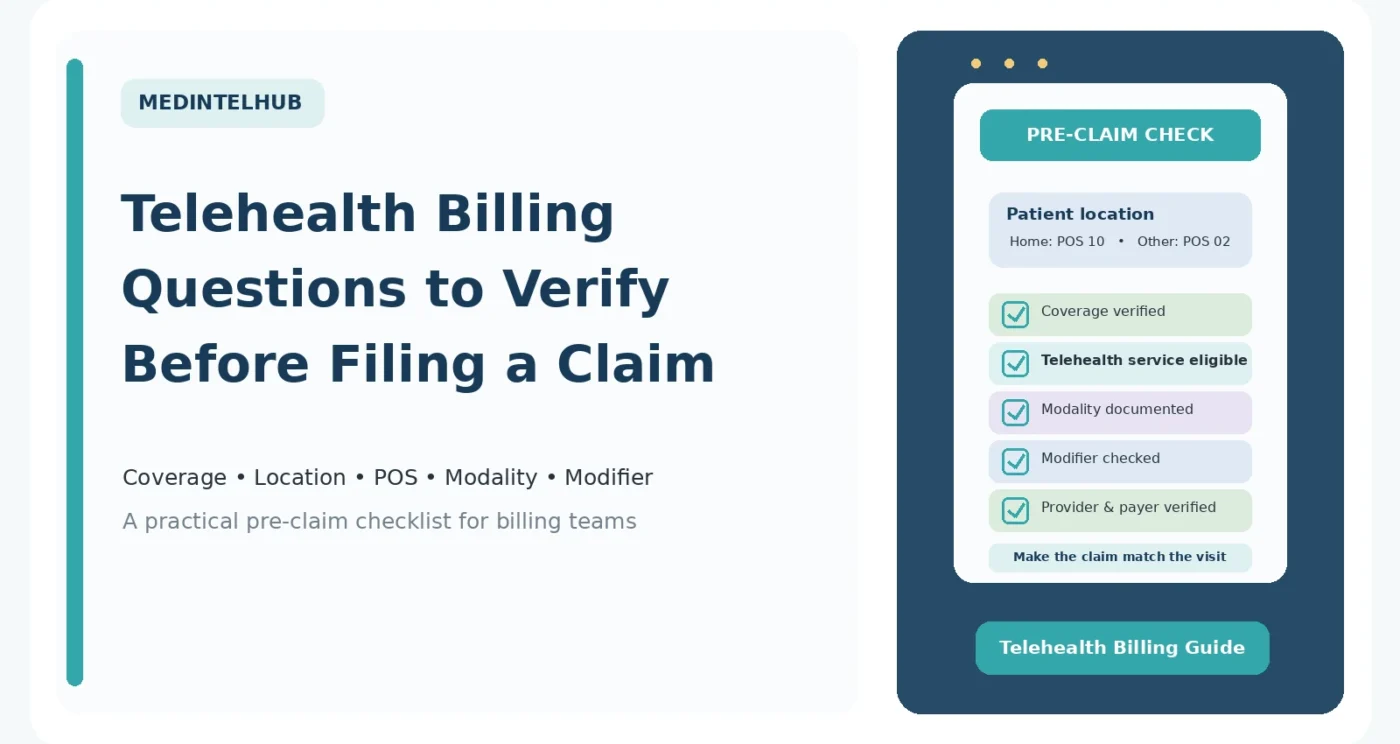
That makes a pre-claim checklist useful.
Before filing, ask:
Who is the payer? Is the service covered through telehealth? Where was the patient? What modality was used? Which code, POS, and modifier apply? Was the provider eligible and properly licensed? Does the documentation support the claim?
Important: Telehealth coverage and billing requirements vary by payer, state, provider type, service, setting, and date of service. This article is for educational purposes only. Practices should verify current rules with the applicable payer, Medicare Administrative Contractor, state Medicaid program, provider contract, licensing board, and current coding guidance before filing a claim.
Question 1: Which Payer Are You Billing?
This should be the first question because there is no single telehealth billing rule that applies to every health plan.
The patient may have:
- Original Medicare
- Medicare Advantage
- Medicaid
- A Medicaid managed-care plan
- Commercial insurance
- Another health benefit program
A telehealth service payable by Original Medicare may be processed differently by a Medicare Advantage plan.
Medicaid telehealth policies vary by state.
Commercial insurers may have their own covered-code lists, modifier rules, network requirements, and reimbursement policies.
The federal Telehealth.HHS.gov guidance specifically advises practices to contact private insurers they accept to determine what telehealth services those plans reimburse.
Do not build one billing rule in the EHR and assume every payer follows it.
Question 2: Was the Patient’s Coverage Active on the Date of Service?
Telehealth does not remove the need for normal eligibility verification.
Before filing the claim, confirm:
- Coverage was active
- The correct plan is being billed
- Coordination of benefits is current
- The provider is participating when network status matters
- Any telehealth-specific benefit limitations have been checked
Coverage can change between the date an appointment is scheduled and the date it occurs.
If the patient has more than one insurer, confirm which payer should receive the claim first.
Question 3: Is the Service Covered When Furnished Through Telehealth?
A code being valid for an in-person service does not automatically mean the payer covers that same service through telehealth.
For Original Medicare, CMS maintains a List of Telehealth Services showing services payable under the Medicare Physician Fee Schedule when furnished via telehealth.
CMS states that additions and deletions to the Medicare telehealth services list generally take effect January 1.
For 2026, CMS also removed the earlier distinction between “provisional” and “permanent” services on the Medicare telehealth list.
Before filing a Medicare claim, verify that the service is actually on the current-year telehealth list or otherwise payable under the applicable Medicare rules.
For Medicaid and commercial plans, check the payer’s current policy instead of assuming it follows Medicare.
Question 4: Where Was the Patient Physically Located During the Visit?
This matters for both billing and licensure.
The billing team should know the patient’s actual location at the time of the telehealth encounter.
Do not use the patient’s mailing address automatically.
A patient who normally lives in one state may be visiting another state during the appointment.
Telehealth.HHS.gov explains that a telehealth appointment is generally considered to occur in the state where the patient is physically located at the time of the appointment.
Practices should therefore have a workflow for documenting patient location at the beginning of the visit.
Question 5: Was the Provider Legally Permitted to Treat the Patient in That Location?
Billing and licensure are connected.
Telehealth.HHS.gov states that health professionals generally must meet the licensure requirements of the state where the patient is located, in addition to applicable requirements where the provider practices.
Depending on the state and profession, a provider may practice through:
- A full state license
- An interstate compact
- Licensure reciprocity
- A temporary-practice rule
- A telehealth registration
- Another state-authorized pathway
Before providing interstate telehealth, verify the applicable state licensing rules.
For Medicare, CMS also requires covered telehealth practitioners to be properly licensed under applicable state law.
For more detail, see the federal Licensing Across State Lines guidance.
Question 6: For Medicare, Does a Geographic Restriction Apply Right Now?
As of August 2026, Medicare beneficiaries continue to have broad access to telehealth because Congress extended major geographic and originating-site flexibilities.
CMS’s February 2026 Telehealth FAQ states that through December 31, 2027, Medicare beneficiaries can receive covered Medicare telehealth services anywhere in the United States and U.S. territories.
That includes the patient’s home for covered services under the current extension.
CMS states that beginning January 1, 2028, absent another change in law, many non-behavioral telehealth services would generally return to rural-area and medical-facility originating-site requirements.
Behavioral health has separate permanent geographic and originating-site provisions.
Because Congress has changed these deadlines several times, practices should recheck the CMS Telehealth page before relying on an old policy document.
Question 7: Was the Patient at Home or Somewhere Else?
This is especially important on Medicare professional claims because it affects the place-of-service code.
CMS currently uses:
- POS 10 — Telehealth Provided in Patient’s Home
- POS 02 — Telehealth Provided Other than in Patient’s Home
The CMS Place of Service Code Set defines POS 10 for telehealth received while the patient is in a private residence that qualifies as the patient’s home.
POS 02 is used when the patient receives telehealth somewhere other than the patient’s home.
For Medicare telehealth services furnished to a patient in the home, CMS pays the professional service at the Physician Fee Schedule non-facility rate.
Do Not Choose POS Based on Where the Clinician Is Sitting
This is a common source of confusion.
For Medicare professional telehealth billing, POS 02 and POS 10 describe the patient’s telehealth location, not whether the physician happened to conduct the visit from an office, home office, or another distant site.
The patient’s location should therefore be available to the billing team.
Question 8: What Technology Was Actually Used?
Was the visit:
- Two-way real-time audio and video?
- Audio-only?
- Asynchronous or store-and-forward?
- Remote monitoring rather than a telehealth visit?
These are not interchangeable billing categories.
A claim should match what actually happened.
For ordinary Medicare telehealth, two-way real-time audio-video technology remains a core telehealth pathway.
Audio-only can also be allowed in specific circumstances.
Question 9: Is Audio-Only Allowed for This Service and Payer?
Do not assume that a telephone visit can be billed exactly like a video visit.
For Medicare, CMS’s February 2026 FAQ states that beneficiaries can continue to receive covered audio-only telehealth services in their homes through December 31, 2027 under the current statutory extension.
After that date, unless the law changes again, the permanent audio-only Medicare telehealth pathway is narrower and is particularly important for behavioral health services in the patient’s home when applicable requirements are met.
For commercial insurance and Medicaid, audio-only coverage varies.
Before filing an audio-only claim, verify:
- The payer covers the service by audio-only
- The patient’s location meets the rule
- The service code is eligible for that modality
- The required modifier is present
- The documentation states that the service was audio-only
Question 10: Does the Claim Need a Telehealth Modifier?
This question requires payer-specific verification.
Do not automatically append modifier 95 to every telehealth claim.
For Medicare Fee-for-Service, current federal billing guidance identifies modifier 93 for applicable audio-only telehealth reporting.
Other telehealth modifiers can apply in particular settings and circumstances.
Examples include:
- Modifier 93 for applicable synchronous audio-only services
- Modifier 95 for certain synchronous audio-video reporting requirements, including specified institutional and RHC/FQHC situations
- Modifier GQ for qualifying asynchronous telehealth in certain federal Alaska or Hawaii demonstration situations
- Modifier GT in certain Critical Access Hospital optional Method II telehealth billing circumstances
The correct modifier depends on the payer, service, modality, and setting.
Use the payer’s current billing instructions rather than a generic telehealth modifier cheat sheet.
Question 11: Is the CPT or HCPCS Code Correct for the Service Actually Performed?
Telehealth does not change the basic coding rule:
The code must match the documented service.
Verify:
- Current CPT or HCPCS code
- Correct level of service
- Time requirements if the code is time based
- Required modifiers
- Diagnosis relationship
- Units when applicable
Do not increase or decrease an E/M level simply because the visit was performed remotely.
The code selection should follow the applicable code-set rules and documentation.
For a broader explanation of the code systems used on claims, see our MedIntelHub guide ICD-10, CPT, and HCPCS: What Each Code Set Does.
Question 12: Is the Diagnosis Supported by the Documentation?
A telehealth visit still needs appropriate diagnosis reporting.
Do not select a diagnosis only because it makes a telehealth code payable.
The ICD-10-CM diagnosis should reflect the condition, symptom, reason for encounter, or other information supported by the medical record and applicable coding guidelines.
The payer may use the diagnosis as part of its medical-necessity or coverage review.
Question 13: Does the Documentation Show That This Was a Telehealth Encounter?
The note should make the nature of the encounter clear.
Depending on the payer and organization, useful documentation may include:
- Date of service
- Patient identity
- Patient location
- Provider location when required
- Type of technology used
- Audio-video or audio-only modality
- Participants in the visit
- Clinical history
- Assessment
- Plan
- Time when required for code selection
- Consent when required
CMS and Telehealth.HHS.gov emphasize that telehealth documentation should support the billed service just as documentation supports an in-person claim.
Question 14: Was Telehealth Consent Required?
Consent rules are not identical nationwide.
State law, payer requirements, provider type, and the specific service can affect whether and how consent must be obtained and documented.
Telehealth.HHS.gov recommends verifying patient location and obtaining consent before an interstate telehealth appointment.
Some Medicare services outside ordinary telehealth also have their own consent requirements.
Before building a standard consent statement into every note, verify:
- State telehealth law
- Payer requirements
- Service-specific Medicare rules
- Your organization’s compliance policy
Question 15: Was the Technology Used in a HIPAA-Compliant Manner?
Coverage and privacy are separate issues.
A payer may cover a telehealth service, but the provider must still follow applicable HIPAA requirements.
HHS updated its audio-only telehealth guidance in June 2026 and confirms that covered healthcare providers may use remote communication technologies for audio-only telehealth when they comply with applicable HIPAA Privacy, Security, and Breach Notification Rules.
The temporary pandemic-era HIPAA enforcement discretion is no longer the general rule.
Practices should consider:
- Privacy during the encounter
- Reasonable safeguards
- Identity verification when the patient is not known to the organization
- Security of electronic communication systems
- Business associate agreements when required
- Recordings or transcripts created by telehealth platforms
See the current HHS Guidance on HIPAA and Audio-Only Telehealth.
A service being available through telehealth does not remove a payer’s prior authorization requirement.
If authorization applies, verify:
- The service was authorized
- The authorization covers the telehealth modality if the payer distinguishes modality
- The provider is correct
- The date range is correct
- The number of visits or units is sufficient
For a complete checklist, see our MedIntelHub guide Prior Authorization: A Clear Guide for Patients and Practices.
Question 17: Is the Provider Type Eligible to Bill the Service Through Telehealth?
Do not assume that every provider who can perform a service in person can bill it through telehealth under every payer.
For Medicare, the current extension allows an expanded range of practitioners to furnish Medicare telehealth services through December 31, 2027.
CMS’s February 2026 FAQ specifically notes that physical therapists, occupational therapists, speech-language pathologists, and audiologists remain within the extended Medicare telehealth practitioner group through that date.
Provider eligibility can also depend on:
- State scope of practice
- Medicare enrollment
- Payer credentialing
- Provider contract
- Service-specific rules
Question 18: Is This a Standard Professional Claim, an RHC/FQHC Claim, or Another Special Setting?
The answer can change the billing method.
Rural Health Clinics and Federally Qualified Health Centers have special Medicare telehealth rules.
CMS’s current February 2026 FAQ states that through December 31, 2027, RHCs and FQHCs may continue billing non-behavioral telehealth services using HCPCS G2025.
Behavioral health telecommunication visits are handled differently and can be paid under the RHC All-Inclusive Rate or FQHC Prospective Payment System when applicable.
RHC/FQHC mental-health claims also have specific modality modifier instructions, including 95 for applicable audio-video visits and 93 for applicable audio-only visits.
Hospitals, Critical Access Hospitals, home health agencies, opioid treatment programs, and other institutional settings can have their own telehealth reporting rules as well.
Do not copy the physician-office billing workflow into every facility setting.
Question 19: Is This Actually Telehealth, or Is It Remote Monitoring?
Telehealth visits and remote monitoring are different services.
Remote physiologic monitoring and remote therapeutic monitoring use different codes and have their own requirements.
A patient sending blood pressure or other device data does not automatically create a billable telehealth visit.
Likewise, a video visit does not automatically satisfy the requirements of a remote monitoring service.
Identify which service was actually provided before selecting the billing pathway.
Question 20: Is the Claim Being Filed to the Correct Payer With the Correct Claim Type?
After all the telehealth-specific checks, normal claim-routing rules still apply.
Confirm:
- Correct payer ID
- Professional versus institutional claim
- Billing provider
- Rendering provider
- NPI information
- Place of service
- Procedure code
- Diagnosis code
- Modifier
- Date of service
A perfectly documented telehealth visit can still reject if the payer ID or subscriber information is wrong.
For the full claim cycle, see our MedIntelHub guide Medical Billing Workflow: From Patient Visit to Payment.
A Simple Medicare Professional Telehealth Example
Imagine a Medicare patient receives a covered real-time telehealth service while sitting at home.
Before filing, the practice would verify:
- The patient’s Medicare coverage is active.
- The service is payable through Medicare telehealth for the date of service.
- The practitioner is eligible to furnish the service.
- The practitioner is legally permitted to treat the patient in the state where the patient is located.
- The patient was physically located at home.
- POS 10 is appropriate.
- The CPT or HCPCS code is supported by the documentation.
- The modality and any required modifier are correctly reported.
- The diagnosis is supported.
- The claim contains the correct provider and beneficiary information.
If the same patient received the telehealth service from a qualifying location that was not the patient’s home, the POS question would need to be reviewed for POS 02 instead.
Audio-Only Example
Suppose the service was performed by telephone with no video.
The billing team should not simply change the word “video” to “phone” in the note and submit the same claim.
Verify:
- Audio-only is allowed by that payer for the service
- The patient’s location qualifies
- The code is payable using audio-only
- Modifier 93 or another required payer-specific indicator is present when applicable
- The documentation accurately states that the encounter was audio-only
Commercial Insurance: Do Not Assume Medicare Rules Apply
A commercial plan may use POS 02 and POS 10, but its reimbursement policy may differ from Medicare.
It may also require:
- A particular modifier
- A payer-specific telehealth code
- A specific platform or network arrangement
- Prior authorization
- Different audio-only rules
Telehealth.HHS.gov recommends contacting private plans for their current telehealth reimbursement policies.
If your practice contracts with several major payers, create a payer-specific telehealth billing matrix rather than relying on memory.
Medicaid: Check the State Program
Medicaid telehealth reimbursement is state specific.
Federal Telehealth.HHS.gov guidance notes that Medicaid policies vary from state to state, including coverage of:
- Audio-video telehealth
- Audio-only services
- Remote patient monitoring
- Asynchronous services
- The patient’s home as an originating site
Practices should also check Medicaid managed-care plan rules because they may add operational requirements.
Common Telehealth Claim Mistakes
Frequent problems include:
- Using an in-person-only service code for a telehealth claim
- Using the wrong POS
- Failing to document the patient’s location
- Using an audio-video billing pathway for an audio-only encounter
- Missing a required modifier
- Adding a modifier the payer does not require
- Billing a service that is not on the payer’s telehealth list
- Using the wrong provider NPI
- Ignoring state licensure requirements
- Missing prior authorization
- Inadequate documentation
- Assuming Medicare Advantage follows Original Medicare exactly
- Assuming Medicaid rules are the same in every state
If the claim is later denied, start with the payer’s actual denial reason. Our Claim Denials: A Practical Prevention and Follow-Up Checklist explains what to review before correcting or appealing the claim.
Create a Telehealth Billing Matrix
A simple internal reference can prevent repeated errors.
For each major payer, track:
- Payer name
- Plan or product
- Covered telehealth services
- Audio-video rules
- Audio-only rules
- POS requirements
- Modifier requirements
- Eligible provider types
- Prior authorization
- Patient-location restrictions
- Documentation requirements
- Effective date
- Official source link
- Date last verified
Because telehealth policies continue to change, include a “last verified” date.
Our MedIntelHub article How to Track Healthcare Policy and Payer Updates explains how to maintain a practical payer-policy change log.
Pre-Claim Telehealth Checklist
Before clicking submit, verify:
- Which payer are we billing?
- Was coverage active?
- Is this service covered through telehealth?
- Where was the patient physically located?
- Was the provider permitted to practice in that state?
- Does a Medicare geographic or originating-site rule apply?
- Is POS 02, POS 10, or another setting-specific billing method correct?
- Was the encounter audio-video, audio-only, asynchronous, or remote monitoring?
- Is that modality allowed for the service?
- Is a telehealth modifier required?
- Is the CPT or HCPCS code current and supported?
- Is the diagnosis supported?
- Does the note identify the telehealth modality and patient location?
- Was consent obtained when required?
- Were HIPAA requirements followed?
- Was prior authorization required?
- Is the provider type eligible?
- Does the setting have special billing rules?
- Are billing and rendering provider details correct?
- Is the claim being sent to the correct payer?
The Bottom Line
Telehealth billing should not begin with the question, “Which modifier do we use?”
Start earlier.
First identify the payer.
Then verify that the service is covered through telehealth, where the patient was located, whether the provider could legally furnish care in that location, and what technology was actually used.
After that, verify the code, place of service, modifier, documentation, authorization, and claim details.
For Original Medicare in 2026, POS 10 is used for professional telehealth when the patient is at home, while POS 02 identifies telehealth provided somewhere other than the patient’s home. Major Medicare telehealth geographic flexibilities and broad audio-only access currently continue through December 31, 2027.
But Medicare is only one payer.
Medicare Advantage, Medicaid, and commercial insurance can have different billing requirements.
The safest workflow is simple:
Verify the payer rule before the visit when possible, document what actually happened, and make the claim match the service.
Sources and References
- Centers for Medicare & Medicaid Services — Telehealth. Current Medicare telehealth policy page and February 2026 Telehealth FAQ.
- Centers for Medicare & Medicaid Services — Telehealth FAQ, Updated February 26, 2026. Current guidance on geographic flexibilities, practitioner eligibility, audio-only services, behavioral health, RHC/FQHC telehealth, and POS 02/POS 10.
- Centers for Medicare & Medicaid Services — List of Telehealth Services for Calendar Year 2026. Current list of services payable under the Medicare Physician Fee Schedule when furnished via telehealth.
- Centers for Medicare & Medicaid Services — Telehealth & Remote Monitoring MLN Booklet. Medicare telehealth billing, provider eligibility, POS codes, special modifiers, originating-site fee, and remote-monitoring guidance.
- Centers for Medicare & Medicaid Services — Place of Service Code Set. Official definitions of POS 02 and POS 10.
- Telehealth.HHS.gov — Billing and Coding Medicare Fee-for-Service Claims. Federal guidance on eligible telehealth services, audio-only reporting, POS, modality, documentation, and common billing mistakes.
- Telehealth.HHS.gov — Private Insurance Coverage for Telehealth. Guidance on verifying commercial payer reimbursement policies.
- Telehealth.HHS.gov — State Medicaid Telehealth Coverage. Overview of state variation in Medicaid telehealth reimbursement.
- Telehealth.HHS.gov — Licensing Across State Lines. Federal overview of state licensure, telehealth registration, reciprocity, and interstate practice.
- U.S. Department of Health and Human Services — HIPAA and Audio-Only Telehealth. Updated 2026 privacy and security guidance for remote communication technologies.
- Centers for Medicare & Medicaid Services — CY 2026 Medicare Physician Fee Schedule Final Rule. Final 2026 telehealth-list, supervision, teaching-physician, and RHC/FQHC policy changes.
Editorial Disclaimer
MedIntelHub provides healthcare, insurance, medical billing, and patient-education information for educational purposes only.
This article does not provide legal, medical, coding, reimbursement, compliance, or payer-contract advice. Telehealth coverage, eligible services, modifier requirements, place-of-service reporting, licensure rules, authorization requirements, and payment policies vary by payer, state, healthcare setting, provider type, and date of service.
Healthcare organizations should verify current requirements using official payer guidance, Medicare Administrative Contractor instructions, applicable state licensing rules, current coding resources, provider contracts, and qualified billing or compliance professionals when appropriate.
CPT is a registered trademark of the American Medical Association.
For more information about our publication, visit About MedIntelHub.

David Bennett
David Bennett is an author at MedIntelHub, where he creates clear, practical, and well-researched content about healthcare, medical billing, insurance, and patient education. His goal is to make complex healthcare topics easier for readers to understand and use in everyday situations. David emphasizes accuracy, transparency, and reliable sourcing, using information from trusted organizations and official healthcare resources whenever possible. Content published by David is intended for educational purposes and should not replace advice from qualified medical, legal, or healthcare professionals.