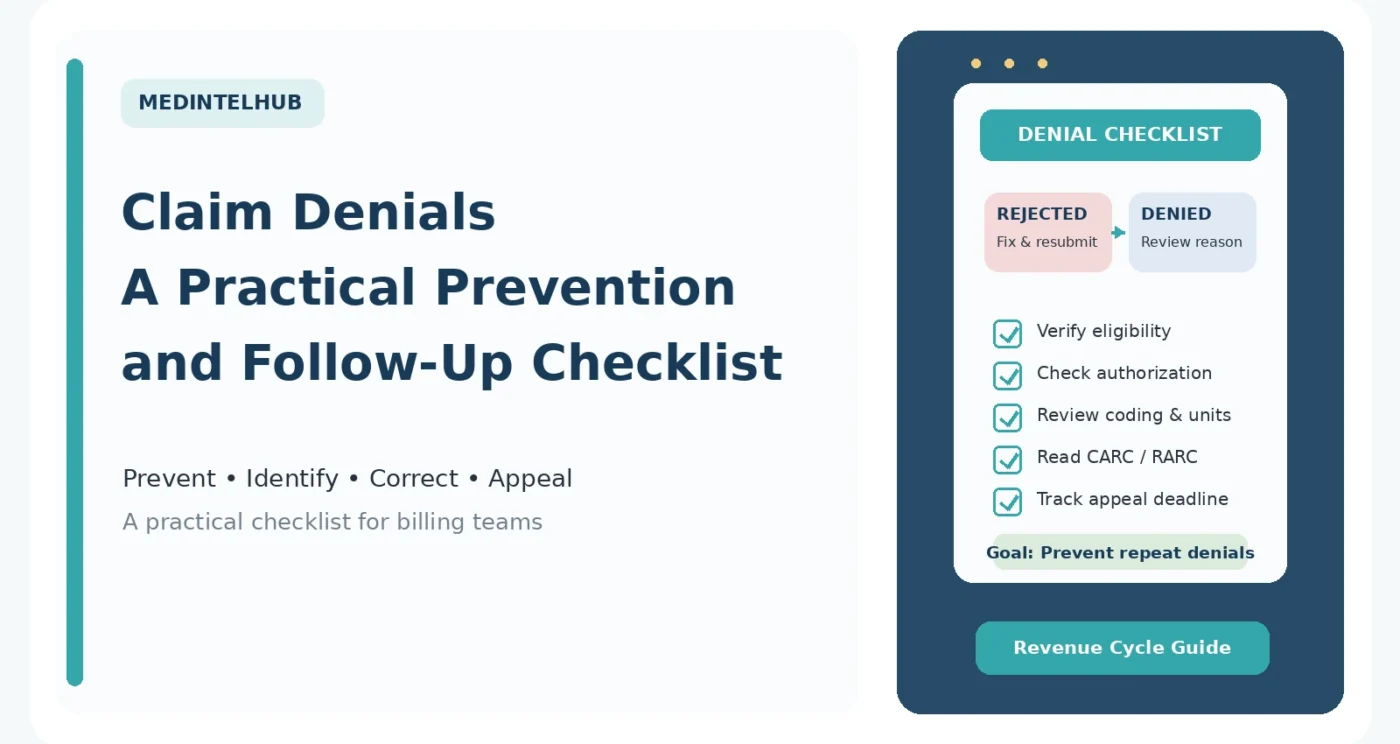
A denied medical claim creates more work for everyone.
The billing team has to investigate it. The provider may need to correct documentation or submit records. The payer may require a reconsideration or appeal. And the patient may receive a confusing bill while the claim is still being worked.
Some denials cannot be prevented.
But many problems begin earlier in the billing process with incorrect registration information, missed authorization requirements, incomplete documentation, outdated codes, coding edits, or failure to follow payer rules.
That is why denial management should not begin only after a denial arrives.
A good process has two parts:
- Prevent avoidable denials before the claim is submitted.
- Work denials quickly and consistently when they still occur.
This checklist follows the claim from registration through final follow-up.
Important: Payer rules, filing limits, authorization requirements, coding edits, appeal deadlines, and documentation requirements vary. This article is for educational purposes and does not replace payer-specific guidance, contracts, current coding resources, or compliance advice.
First: Make Sure It Is Actually a Denial
One of the first mistakes in denial management is treating every unpaid claim the same way.
A rejected claim and a denied claim are not necessarily the same thing.
CMS explains that electronic claims first pass through front-end edits. Claims that fail basic electronic or implementation-guide requirements can be rejected for correction and resubmission. Claims that make it further into processing can then be evaluated against coverage and payment policies, where an individual claim may be rejected or denied depending on the issue.
You can review the process on the CMS Electronic Health Care Claims page.
Rejected claim
A rejection usually means the claim did not successfully complete normal adjudication because something was wrong with the submission.
Examples can include:
- Missing required claim information
- Invalid patient or subscriber information
- Incorrect payer identification
- Invalid electronic format
- Invalid code format
- Missing provider identifiers
The normal response is usually to identify the error, correct it, and resubmit the claim.
Denied claim
A denial generally means the payer processed the claim far enough to make a payment or coverage decision and refused payment for all or part of it.
Examples can include:
- Medical-necessity issues
- Non-covered services
- Missing prior authorization
- Timely-filing problems
- Duplicate billing
- Bundling or coding edits
- Invalid units
- Network issues
- Coordination-of-benefits problems
The correct next step may be a corrected claim, additional documentation, reconsideration, or formal appeal.
For the broader claim process, see our MedIntelHub guide Medical Billing Workflow: From Patient Visit to Payment.
Denial Prevention Checklist: Before the Visit
Some of the most expensive denials begin before any healthcare service is performed.
1. Confirm patient demographics
Verify:
- Patient name
- Date of birth
- Address when required
- Insurance member ID
- Group number when applicable
- Relationship to subscriber
- Primary and secondary coverage
A simple typo can cause a claim to reject before payment rules are even considered.
2. Verify active coverage
Check whether the insurance policy is active for the date of service.
Eligibility information can also help identify:
- Deductible status
- Copayment
- Coinsurance
- Network restrictions
- Coverage for certain categories of service
Eligibility verification is useful, but it is not a guarantee of payment.
The payer may still apply authorization, coverage, documentation, coding, or medical-necessity rules during adjudication.
3. Check coordination of benefits
If the patient has more than one health plan, identify which payer is primary.
A claim sent to the wrong payer first can lead to delays or denials.
Do not assume the coordination-of-benefits information on file is current.
4. Check referral requirements
Some managed-care plans require a referral before specialist care.
A referral should not automatically be treated as the same thing as prior authorization.
The two processes can have different requirements.
For services that commonly require authorization, verify:
- Whether authorization is required
- Which service or code was authorized
- Approved number of visits or units
- Authorized dates
- Approved facility or rendering provider
- Authorization number
Keep the authorization information where billing staff can retrieve it later.
An authorization that cannot be found when the claim is denied is difficult to use.
Denial Prevention Checklist: During Documentation
The claim can only be as strong as the documentation supporting it.
6. Document the service actually performed
The record should clearly support the services reported on the claim.
Depending on the setting, documentation may need to support:
- Reason for the encounter
- Relevant history
- Assessment or diagnosis
- Procedures or services performed
- Medical decision-making
- Time when time-based coding rules apply
- Units of service
- Treatment plan
- Orders and results
Do not select codes simply because a similar code was used at the last visit.
The current claim should be supported by the current documentation.
7. Make sure the diagnosis supports the service
A valid diagnosis code does not automatically make a service payable.
The payer may evaluate whether the diagnosis, service, and coverage policy fit together.
When a payer has a medical-necessity policy or coverage determination, check whether the documentation supports the required criteria.
8. Complete documentation before billing when required
Incomplete notes create problems when a payer asks for records.
If the documentation is unsigned, missing key information, or inconsistent with the claim, the billing team may have little ability to defend the original submission.
Denial Prevention Checklist: Coding
9. Use current diagnosis and procedure codes
Code sets change.
Using deleted, revised, or outdated codes can create rejections or payment problems.
For CPT-related changes this year, see our MedIntelHub article New CPT Code Changes for 2026: What Providers Need to Know.
10. Review modifiers carefully
A modifier can affect how a payer interprets a service.
Missing a required modifier can create a denial.
Using a modifier that is not supported by the documentation can create a different compliance problem.
Modifiers should be used because the circumstances support them, not simply to bypass an edit.
11. Check units of service
Units are an easy place for errors to occur.
An incorrect quantity can cause an overpayment, underpayment, or denial.
For Medicare, CMS uses Medically Unlikely Edits, or MUEs, to address certain units-of-service situations.
CMS describes an MUE as the maximum units of service reported for a HCPCS/CPT code by the same provider for the same beneficiary on the same date of service on the vast majority of correctly reported claims.
CMS updated the published Medicare MUE files for practitioner, outpatient hospital, and DME services effective July 1, 2026. See the current Medicare MUE page.
12. Check code combinations
Two individually valid codes may still create a denial when reported together.
Medicare’s National Correct Coding Initiative includes Procedure-to-Procedure, or PTP, edits designed to prevent inappropriate payment of code combinations that generally should not be reported together.
CMS explains that when a PTP edit applies, the Column Two code may be denied unless an appropriate NCCI-associated modifier is allowed and clinically supported.
The current Medicare PTP files include updates effective July 1, 2026. Review them on the CMS PTP Edits page.
The full 2026 Medicare NCCI Policy Manual is effective January 1, 2026.
Denial Prevention Checklist: Before Claim Submission
13. Run claim edits before sending
A claim scrubber or billing-system edit can catch common problems such as:
- Missing fields
- Invalid codes
- Missing modifiers
- Invalid dates
- Incorrect place of service
- Missing provider identifiers
- Invalid patient information
Do not assume a claim is clean simply because the billing software allowed someone to save it.
14. Confirm the correct payer
Insurance companies can have several payer IDs depending on product, network, claim type, or clearinghouse routing.
Sending the claim to the wrong destination can create rejection or unnecessary delay.
15. Confirm billing and rendering provider information
Check the information required for the claim type, including:
- Billing provider
- Rendering provider
- National Provider Identifier
- Tax information where applicable
- Referring or ordering provider when required
- Place of service
16. Submit before the filing deadline
Timely-filing limits vary by payer and contract.
Do not wait until the deadline is close.
Build follow-up reports that identify claims that have not been accepted or adjudicated while there is still time to correct them.
After Submission: Do Not Assume the Claim Was Accepted
17. Review clearinghouse and payer acknowledgments
A submitted claim is not necessarily an accepted claim.
Review acknowledgment reports for rejected batches and rejected individual claims.
CMS explains that Medicare electronic claims are checked at several front-end levels before coverage and payment edits occur.
If the claim is rejected, correct the actual error rather than sending the same claim again unchanged.
18. Monitor claim status
Do not allow claims to disappear into the billing system.
For Medicare, providers can check status through contractor portals and other methods. CMS also supports the electronic 276 claim-status request and 277 claim-status response.
See the CMS Claim Status Request and Response page.
Regular status checks can identify claims that are pending, rejected, or waiting for information before they become old accounts receivable.
When a Denial Arrives: Start With the Remittance
Do not guess why a claim was denied.
Start with the payer’s actual denial information.
For electronic remittance, payers use standardized adjustment codes.
CMS explains that an ERA can use:
- Claim Adjustment Group Codes
- Claim Adjustment Reason Codes, or CARCs
- Remittance Advice Remark Codes, or RARCs
The Group Code helps identify financial responsibility. The CARC gives the general adjustment reason, and a RARC can add more detail.
See the CMS Health Care Payment and Remittance Advice guide.
CMS also implemented updated CARCs and RARCs for Medicare in July 2026, which is another reason billing teams should not rely indefinitely on old denial-code lists.
Denial Follow-Up Checklist
19. Identify the exact denied claim line
Do not assume the entire claim was denied.
Review whether the problem applies to:
- The entire claim
- One procedure line
- One unit
- One diagnosis relationship
- One provider or service date
20. Read the CARC and RARC together
A CARC alone may not explain enough.
Look for accompanying remark codes and payer-specific instructions.
Also review the payer portal or provider manual if the remittance refers to a policy.
21. Check whether the denial is correct
Ask:
- Was the patient’s coverage active?
- Was authorization actually required?
- Was authorization obtained?
- Is the code correct?
- Is the modifier supported?
- Are the units correct?
- Does the documentation support the service?
- Was the claim filed on time?
- Was another insurer primary?
- Did the payer apply an incorrect network status?
22. Decide whether the claim needs correction or appeal
This is an important decision.
If the original claim contains an actual error, the appropriate action may be a corrected claim.
If the original claim was correct and the payer’s decision is being challenged, the correct action may be reconsideration or appeal.
Do not change a valid code or diagnosis simply to obtain payment.
The correction should reflect the actual service and documentation.
23. Gather supporting documentation
Depending on the denial, you may need:
- Clinical notes
- Procedure reports
- Orders
- Test results
- Authorization records
- Referral information
- Proof of timely filing
- Eligibility records
- Payer correspondence
- Relevant coverage policy
Send only what the payer requires, but make sure the information clearly supports the issue being disputed.
24. Verify the payer’s appeal deadline
Appeal and reconsideration deadlines are not universal.
They can vary significantly by payer and contract.
For Medicare Fee-for-Service, a party dissatisfied with an initial determination generally has 120 days from receipt of the initial determination to request a first-level redetermination.
That Medicare deadline should not be assumed to apply to commercial insurance, Medicaid plans, or Medicare Advantage.
See the current CMS Medicare redetermination guidance.
25. Document every follow-up action
The billing record should show:
- Date denial was received
- Denial reason
- Person who reviewed it
- Action taken
- Date corrected claim or appeal was sent
- Reference or confirmation number
- Payer representative contacted
- Next follow-up date
- Final result
Without notes, staff may repeat the same work or miss a deadline.
26. Set a specific follow-up date
“Appeal sent” should not be the final status.
The account needs a date for the next review.
If the payer says it will respond within a certain period, place the account back into a follow-up queue shortly after that period ends.
Common Denial Categories and What to Check
Eligibility denial
Check:
- Was coverage active on the date of service?
- Was the correct member ID used?
- Was the correct insurance billed?
- Was another plan primary?
Check:
- Was authorization required?
- Was it obtained before the service?
- Did it cover the exact date, provider, location, code, units, or service?
- Is the authorization number on file?
Medical-necessity denial
Check:
- Which coverage policy was used?
- Does the diagnosis support the service?
- Does the documentation support the payer’s criteria?
- Does the payer need medical records?
Bundling or NCCI denial
Check:
- Is there a current PTP edit?
- Were the services actually distinct?
- Would an NCCI-associated modifier be clinically appropriate?
- Does the documentation support separate reporting?
Do not add a modifier only because the claim denied.
Units denial
Check:
- Were the units entered correctly?
- Was the quantity converted correctly?
- Does an MUE apply?
- Does documentation support the number of units?
Duplicate denial
Check whether the original claim was already paid, is still pending, or was resubmitted unnecessarily.
A duplicate denial should not automatically lead to another submission.
Timely-filing denial
Look for:
- Original electronic acceptance report
- Clearinghouse confirmation
- Payer claim-status history
- Proof that the claim was submitted within the deadline
If the claim was genuinely filed late, review the payer’s rules before deciding whether an appeal is available.
Coordination-of-benefits denial
Check:
- Which insurer should be primary?
- Has the patient updated COB information?
- Was the primary payer’s remittance sent to the secondary payer?
Do Not Bill the Patient Automatically After a Denial
A denied insurer payment does not automatically mean the patient owes the denied amount.
The denial may be:
- A provider contractual responsibility
- A billing error
- A correctable claim issue
- An authorization problem
- A claim that should be appealed
- A legitimate patient responsibility
The remittance information and payer contract matter.
For Medicare, CMS explains that Group Codes on the remittance help assign financial responsibility. For example, a contractual-obligation adjustment is not treated the same way as patient responsibility.
If the patient receives an insurer statement, our MedIntelHub article Understanding Your Explanation of Benefits (EOB) Statement explains how to compare the payer’s processing with the provider bill.
Create a Denial Work Queue
Denials are easier to manage when they are organized.
A useful work queue might include:
- Claim number
- Patient account
- Payer
- Date of service
- Denied amount
- Denial category
- CARC/RARC
- Appeal or corrected-claim deadline
- Assigned staff member
- Last action
- Next follow-up date
High-dollar denials and accounts approaching deadlines may deserve priority.
But small denials should not be ignored if they reveal a repeated process problem.
Track Denials by Root Cause
Working the individual claim solves one account.
Finding the root cause can prevent the next hundred.
Track categories such as:
- Registration
- Eligibility
- Authorization
- Documentation
- Coding
- Medical necessity
- Timely filing
- Duplicate claims
- Coordination of benefits
- Payer processing error
If one denial category suddenly increases, investigate what changed.
For example:
- Was a new payer rule introduced?
- Did a CPT code change?
- Did the practice change clearinghouses?
- Is one location missing authorizations?
- Is one code being billed with the wrong units?
- Did a payer change its edit logic?
Use Current Rules, Not an Old Denial Cheat Sheet
Denial-management tools are useful, but they become outdated.
In 2026 alone, CMS has updated NCCI PTP files, MUE files, Add-on Code edits, and CARC/RARC information.
A denial spreadsheet created several years ago should not be treated as the final authority.
When a claim involves Medicare coding edits, use the current CMS files and the current NCCI Policy Manual.
For other payers, check the payer’s current provider manual and policy.
Quick Prevention Checklist
Before submitting a claim, ask:
- Is the patient’s demographic information correct?
- Was eligibility checked?
- Is coordination of benefits correct?
- Was a referral required?
- Was authorization required and obtained?
- Is the documentation complete?
- Are diagnosis and procedure codes current?
- Are modifiers supported?
- Are units correct?
- Were coding edits reviewed?
- Is the correct payer being billed?
- Are provider identifiers correct?
- Is the claim being filed within the deadline?
Quick Denial Follow-Up Checklist
When a denial arrives:
- Confirm whether it is a rejection or a denial.
- Identify the exact claim or line affected.
- Read the Group Code, CARC, and RARC.
- Review payer-specific instructions.
- Check eligibility and coordination of benefits.
- Check authorization and referral records.
- Review documentation and coding.
- Check current NCCI or payer edits when relevant.
- Decide whether the issue needs correction, documentation, reconsideration, or appeal.
- Verify the deadline.
- Submit the appropriate response.
- Document what was sent and when.
- Set the next follow-up date.
- Track the root cause so the same denial can be prevented.
The Bottom Line
Claim denial management should begin before the denial exists.
Accurate patient information, eligibility verification, authorization checks, complete documentation, current coding, proper modifiers, correct units, and claim edits can prevent many avoidable problems.
When a denial still occurs, do not immediately rebill the patient or send the same claim again.
Start with the payer’s actual reason.
Determine whether the claim was rejected, denied, underpaid, or still pending.
Review the remittance codes, payer policy, documentation, authorization, coding, and filing history.
Then choose the correct response: correction, resubmission, documentation, reconsideration, or appeal.
Finally, track the reason.
The goal is not only to get one claim paid.
The goal is to stop the same preventable denial from happening again.
Sources and References
- Centers for Medicare & Medicaid Services — Electronic Health Care Claims. Official explanation of front-end claim edits, claim rejection, correction and resubmission, and later coverage/payment edits.
- Centers for Medicare & Medicaid Services — Health Care Payment and Remittance Advice. Guidance on ERA/SPR processing, Group Codes, CARCs, RARCs, financial responsibility, and payment adjustments.
- Centers for Medicare & Medicaid Services — Health Care Payment, Remittance Advice and EFT. Information about standardized ERA, EFT, CARC, and RARC transactions.
- Centers for Medicare & Medicaid Services — 2026 Medicare NCCI Policy Manual. Current Medicare NCCI coding policies effective January 1, 2026.
- Centers for Medicare & Medicaid Services — Medicare NCCI Procedure-to-Procedure Edits. Current PTP files and quarterly changes, including updates effective July 1, 2026.
- Centers for Medicare & Medicaid Services — Medicare Medically Unlikely Edits. Current MUE information and files, including July 2026 updates.
- Centers for Medicare & Medicaid Services — Claim Status Request and Response. Guidance on Medicare claim-status methods and 276/277 electronic claim-status transactions.
- Centers for Medicare & Medicaid Services — First Level of Medicare Fee-for-Service Appeal: Redetermination. Current guidance on first-level Medicare claim appeals and the 120-day redetermination filing period.
Editorial Disclaimer
MedIntelHub provides healthcare, insurance, medical billing, and patient-education information for educational purposes only.
This article does not provide legal, coding, reimbursement, compliance, accounting, or payer-contract advice. Claim rules, authorization requirements, coding policies, edit files, filing limits, appeal deadlines, and patient-responsibility rules vary by payer and healthcare setting and can change over time.
Providers should verify current requirements with the applicable payer, official coding resources, contracts, and qualified billing or compliance professionals when appropriate.
CPT is a registered trademark of the American Medical Association.
For more information about our publication, visit About MedIntelHub.

David Bennett
David Bennett is an author at MedIntelHub, where he creates clear, practical, and well-researched content about healthcare, medical billing, insurance, and patient education. His goal is to make complex healthcare topics easier for readers to understand and use in everyday situations. David emphasizes accuracy, transparency, and reliable sourcing, using information from trusted organizations and official healthcare resources whenever possible. Content published by David is intended for educational purposes and should not replace advice from qualified medical, legal, or healthcare professionals.