Medical billing can be confusing even when the claim is correct.
A patient may receive an insurance statement before the provider’s bill. A deductible may make a routine visit cost more than expected. A prior authorization may have been approved, but the final claim can still be processed differently. A denial may be under review while the patient is already receiving account notices.
For billing teams, these situations are part of everyday work.
For patients, they may be unfamiliar and stressful.
Good billing communication does not mean promising that insurance will pay or that every balance can be reduced. It means explaining what is known, what is still pending, what the patient may owe, and what should happen next.
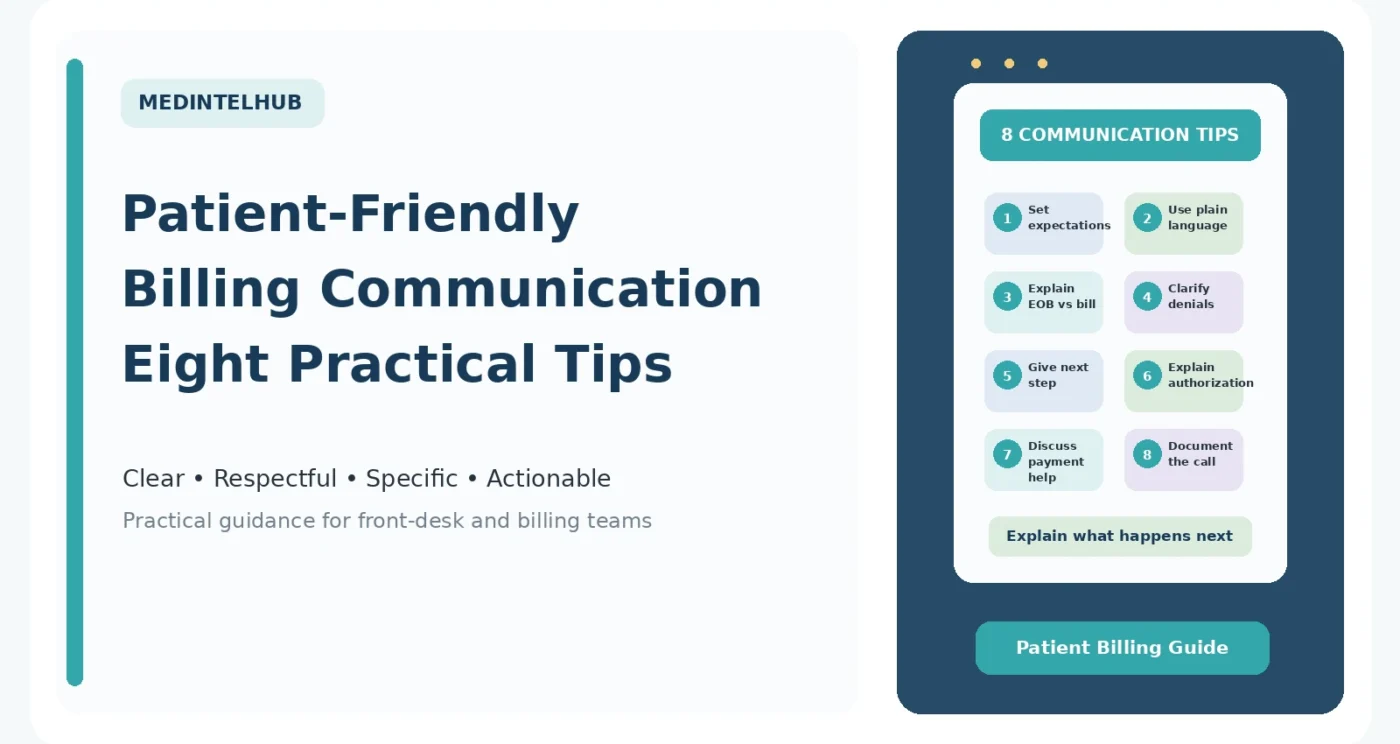
Here are eight practical ways healthcare practices can make billing conversations clearer and more useful.
Important: Insurance benefits, billing rules, patient-responsibility requirements, financial-assistance policies, communication requirements, and payer contracts vary. This article is for educational purposes and does not replace legal, compliance, reimbursement, payer-specific, or financial advice.
Tip 1: Explain the Cost Before Care When Possible
The easiest billing question to answer is often the one discussed before the service happens.
When possible, tell the patient what the practice currently knows about:
- Insurance eligibility
- Network status
- Copayment
- Remaining deductible
- Coinsurance
- Prior authorization
- Expected self-pay charge
But be careful with the wording.
Insurance verification is not the same as a guarantee of payment.
Instead of saying:
“Insurance will cover this.”
A more accurate explanation is:
“Your plan currently shows this service as eligible for benefits, but the final amount depends on how the insurer processes the claim.”
This distinction can prevent a lot of frustration later.
For uninsured or self-pay patients
Federal rules under the No Surprises Act give important protections to people who do not have insurance or who choose not to use insurance for their care.
CMS explains that providers and facilities generally must provide a Good Faith Estimate of expected charges when an uninsured or self-pay patient requests one or schedules care at least three business days in advance.
The estimate should be provided in writing.
If a bill from a provider or facility is at least $400 higher than that provider’s Good Faith Estimate, the patient may qualify for the federal patient-provider dispute resolution process.
See the current CMS Good Faith Estimate guidance.
For staff, the practical lesson is simple:
If you are giving an estimate, identify it clearly as an estimate and explain what could cause the final bill to change.
Tip 2: Use Everyday Language Before Billing Language
Billing staff use words such as:
- Allowed amount
- Deductible
- Coinsurance
- Adjustment
- Adjudication
- Patient responsibility
- Prior authorization
Patients may not use those words every day.
You do not have to remove accurate terminology. Just explain it.
For example:
Deductible: “This is the amount your plan says you pay toward certain covered services before the plan begins paying its share.”
Coinsurance: “This is the percentage of the allowed cost that your plan assigned to you.”
Allowed amount: “This is the amount your health plan recognized for this covered service. It may be lower than the original amount we billed.”
Contractual adjustment: “This portion was adjusted under the insurance agreement and is not being billed to you.”
Clear language can be accurate without becoming technical.
Tip 3: Separate the EOB From the Actual Bill
Patients frequently call a practice after receiving an Explanation of Benefits because the document looks like a bill.
Start by identifying which document they have.
An Explanation of Benefits, or EOB, comes from the health plan and explains how the claim was processed.
It is generally not a request for payment.
The provider bill is the statement requesting payment from the patient.
CMS advises patients to compare their medical bill with the EOB and make sure the services and amounts match before paying.
You can see the federal guidance in the CMS Explanation of Benefits guide.
For a patient-friendly walkthrough, see our MedIntelHub guide How to Read an Explanation of Benefits.
A simple way to explain it
You might tell the patient:
“The EOB shows how your insurance processed the claim. Our bill shows the amount currently due to the practice. Let’s compare the two.”
That one explanation can turn a confusing conversation into a specific problem that can be reviewed.
Tip 4: Do Not Say “Insurance Denied It” and Stop There
A denial explanation should tell the patient what the practice knows and what happens next.
Instead of:
“Insurance denied your claim. You owe $600.”
First determine whether the amount is actually the patient’s responsibility.
A payer denial might be caused by:
- Incorrect insurance information
- Missing prior authorization
- Coordination-of-benefits issues
- Missing documentation
- A coding or claim-submission error
- Medical-necessity rules
- Network processing
- A non-covered benefit
Some denials need provider correction or appeal rather than immediate patient billing.
A better explanation might be:
“The insurer denied this claim because it says authorization information is missing. Our billing team is reviewing whether the authorization was already obtained before we determine the final balance.”
That is more useful and more accurate.
For a detailed denial workflow, see Claim Denials: A Practical Prevention and Follow-Up Checklist.
Tip 5: Give the Patient One Clear Next Step
A billing explanation can be technically correct and still leave the patient wondering what to do.
End the conversation with a specific next action.
Examples include:
- “You do not need to do anything while we send the corrected claim.”
- “Please call your insurance plan to update your coordination-of-benefits information.”
- “Please send us a copy of your current insurance card.”
- “We are appealing the denial. Check back with us after the date shown here.”
- “This balance has finished insurance processing and is currently your responsibility under the plan.”
- “I can send you our financial-assistance information.”
If there is a deadline, state the deadline clearly.
If the practice is handling the issue, tell the patient that too.
Patients should not have to call the insurer, provider, and billing company simply because no one explained who owns the next step.
Prior authorization can be especially difficult to explain because patients naturally hear the word approved and expect that payment is guaranteed.
That is not necessarily how claims work.
HealthCare.gov states that prior authorization or preauthorization may be required before care is covered, but it does not guarantee that the health plan will ultimately pay the claim.
A patient-friendly explanation is:
“The health plan approved the service for authorization purposes. The final claim is still subject to your benefits and the plan’s claim-processing rules.”
If the authorization has limits, explain them when possible:
- Approved service
- Approved provider or facility
- Date range
- Number of visits
- Number of units
Our MedIntelHub guide Prior Authorization: A Clear Guide for Patients and Practices explains the process in more detail.
Tip 7: Make It Easy to Ask About Payment Options and Financial Assistance
Do not wait for a patient to know the exact phrase “financial assistance.”
If a patient says:
- “I cannot pay this all at once.”
- “Is there any way to lower this?”
- “I cannot afford this bill.”
That is a reasonable point to explain whatever options the organization actually offers.
Depending on the provider or facility, options may include:
- Payment plans
- Financial-assistance programs
- Charity-care policies
- Review for billing errors
- Other organization-specific arrangements
CMS advises patients who cannot afford a medical bill to ask whether the provider offers a payment plan, bill reduction, or financial assistance.
See the CMS guide to talking with a provider about a medical bill.
CMS also provides a separate financial-assistance guide.
Practices should communicate only the programs they actually offer and should follow their written policies consistently.
Tip 8: Document the Conversation and Make Communication Accessible
Billing conversations are easier to manage when the next staff member can see what happened.
Document useful details such as:
- Date and time
- Who spoke with the patient
- What the patient asked
- What was explained
- Whether the claim is pending, denied, corrected, or appealed
- Any reference number
- Payment arrangement if applicable
- Documents sent to the patient
- Next follow-up date
If you tell the patient, “We are resubmitting this claim,” the account note should say that too.
If possible, follow complicated conversations with a written portal message, letter, or statement note so the patient does not have to remember every detail from a phone call.
Communication should also be accessible
Organizations subject to federal civil-rights requirements may have obligations to provide language assistance and effective communication for people with limited English proficiency or disabilities.
HHS explains that certain federally covered health programs must provide language-access services free of charge to individuals with limited English proficiency.
Federal disability protections can also require appropriate auxiliary aids or services when needed for effective communication.
Current federal resources are available through the HHS Limited English Proficiency resource center and HHS effective-communication guidance.
Practices should follow the communication and accessibility requirements that apply to their organization.
What Patients Usually Want to Know
Most billing conversations come down to a small group of questions:
- Why did I receive this bill?
- Has my insurance processed the claim?
- Why did insurance pay less than expected?
- Why did insurance pay nothing?
- Is this amount my deductible?
- Did you receive the copay I already paid?
- Was the service denied?
- Is your office appealing it?
- Do I need to call my insurance company?
- Can I make payments?
A good billing system should make those questions relatively easy for staff to answer.
What Staff Should See Before Answering a Billing Call
When possible, review the account before giving an explanation.
Useful information includes:
- Date of service
- Original charge
- Payer billed
- Allowed amount
- Insurance payment
- Contractual adjustment
- Deductible
- Copayment
- Coinsurance
- Denial or remark information
- Patient payments already received
- Current patient balance
- Open claim follow-up
If you cannot see enough information to answer safely, tell the patient you need to research the account rather than guessing.
Avoid These Common Billing Phrases
“Your insurance doesn’t cover anything.”
That may be wrong.
The claim may have been applied to the deductible, which is different from a non-covered service.
“You have to call your insurance.”
Sometimes the practice needs to correct the claim.
Identify which party actually needs to act first.
Authorization is not a guarantee of final claim payment.
“That’s just what you owe.”
Explain whether the amount represents deductible, copayment, coinsurance, non-covered care, or another adjustment.
“The computer says the claim was denied.”
Find the actual denial reason before explaining it to the patient.
Explain the Medical Billing Timeline
Patients sometimes think a medical bill should be final immediately after the visit.
A simple explanation of the workflow can help.
A claim typically moves through several stages:
Visit → documentation → coding → claim submission → payer processing → insurance payment or denial → payment posting → patient statement.
A patient statement sent while insurance is still processing can create unnecessary confusion.
For a complete overview, see our MedIntelHub guide Medical Billing Workflow: From Patient Visit to Payment.
If the Patient Says the Bill Does Not Match the EOB
Do not dismiss the concern.
Compare:
- Date of service
- Claim number
- Provider
- Allowed amount
- Insurance payment
- Contractual adjustment
- Patient responsibility
- Any payment already made by the patient
CMS tells patients that the provider bill should generally be compared with the EOB patient balance.
A mismatch may be caused by:
- A bill generated before insurance completed processing
- A payment that has not yet posted
- Secondary insurance still pending
- A reprocessed claim
- A billing error
Find out which one applies before asking for payment.
If the Patient Is Angry
You do not have to agree that the bill is wrong.
Focus on the account.
Useful questions include:
- “Which amount on the bill are you questioning?”
- “Do you have the EOB from your health plan?”
- “Did you already make a payment at the visit?”
- “Did the insurer give you a denial reason?”
Then explain the specific facts you can verify.
If further research is needed, give the patient a follow-up plan rather than an immediate guess.
A Patient-Friendly Billing Checklist
Before ending a billing conversation, ask:
- Did I explain whether insurance has finished processing the claim?
- Did I explain what the balance represents?
- Did I distinguish the EOB from the provider bill?
- Did I avoid promising coverage or payment?
- If there is a denial, did I explain the actual reason we currently have?
- Did I tell the patient who needs to take the next action?
- Did I explain available payment or financial-assistance options when relevant?
- Did I document the conversation and next follow-up date?
The Bottom Line
Patient-friendly billing communication is not about making every bill simple.
Healthcare claims can be complicated.
The goal is to make the explanation clear.
Tell patients what is known before care when possible.
Use plain language for deductibles, coinsurance, allowed amounts, and adjustments.
Separate the EOB from the actual bill.
Do not turn every denial into an immediate patient balance.
Explain prior authorization without promising payment.
Make payment and financial-assistance information easy to ask about.
Give the patient one clear next step.
And document what was discussed.
A patient does not need to understand the entire revenue cycle.
They need to understand what happened to their claim, what they currently owe, and what happens next.
Sources and References
- Centers for Medicare & Medicaid Services — How to Read an Explanation of Benefits. Federal guidance on EOBs, allowed charges, insurer payments, patient balances, and remark codes.
- Centers for Medicare & Medicaid Services — How to Read Your Medical Bill. Guidance on checking provider bills against EOBs and reviewing patient responsibility.
- Centers for Medicare & Medicaid Services — Good Faith Estimate. Current federal information for uninsured and self-pay patients about expected-charge estimates.
- Centers for Medicare & Medicaid Services — Medical Billing Rights When Not Using Insurance. Information about Good Faith Estimates and the federal patient-provider dispute process.
- Centers for Medicare & Medicaid Services — Talk to Your Provider About Your Medical Bill. Federal tips on asking about bill errors, payment plans, reductions, and financial assistance.
- Centers for Medicare & Medicaid Services — Apply for Medical Bill Financial Assistance. Guidance on financial-assistance programs and patient options.
- U.S. Department of Health and Human Services — Limited English Proficiency. Current federal language-access information for covered health programs and activities.
- U.S. Department of Health and Human Services — Effective Communication and Accessibility. Federal guidance concerning communication with individuals with disabilities.
Editorial Disclaimer
MedIntelHub provides healthcare, medical billing, insurance, and patient-education information for educational purposes only.
This article does not provide legal, reimbursement, coding, debt-collection, compliance, insurance-contract, or financial advice. Billing practices, financial-assistance programs, communication requirements, patient-responsibility rules, and payer policies vary by organization, insurer, jurisdiction, and individual circumstances.
Healthcare organizations should follow applicable federal and state law, payer contracts, written financial policies, civil-rights requirements, and current compliance guidance.
For more information about our publication, visit About MedIntelHub.

David Bennett
David Bennett is an author at MedIntelHub, where he creates clear, practical, and well-researched content about healthcare, medical billing, insurance, and patient education. His goal is to make complex healthcare topics easier for readers to understand and use in everyday situations. David emphasizes accuracy, transparency, and reliable sourcing, using information from trusted organizations and official healthcare resources whenever possible. Content published by David is intended for educational purposes and should not replace advice from qualified medical, legal, or healthcare professionals.