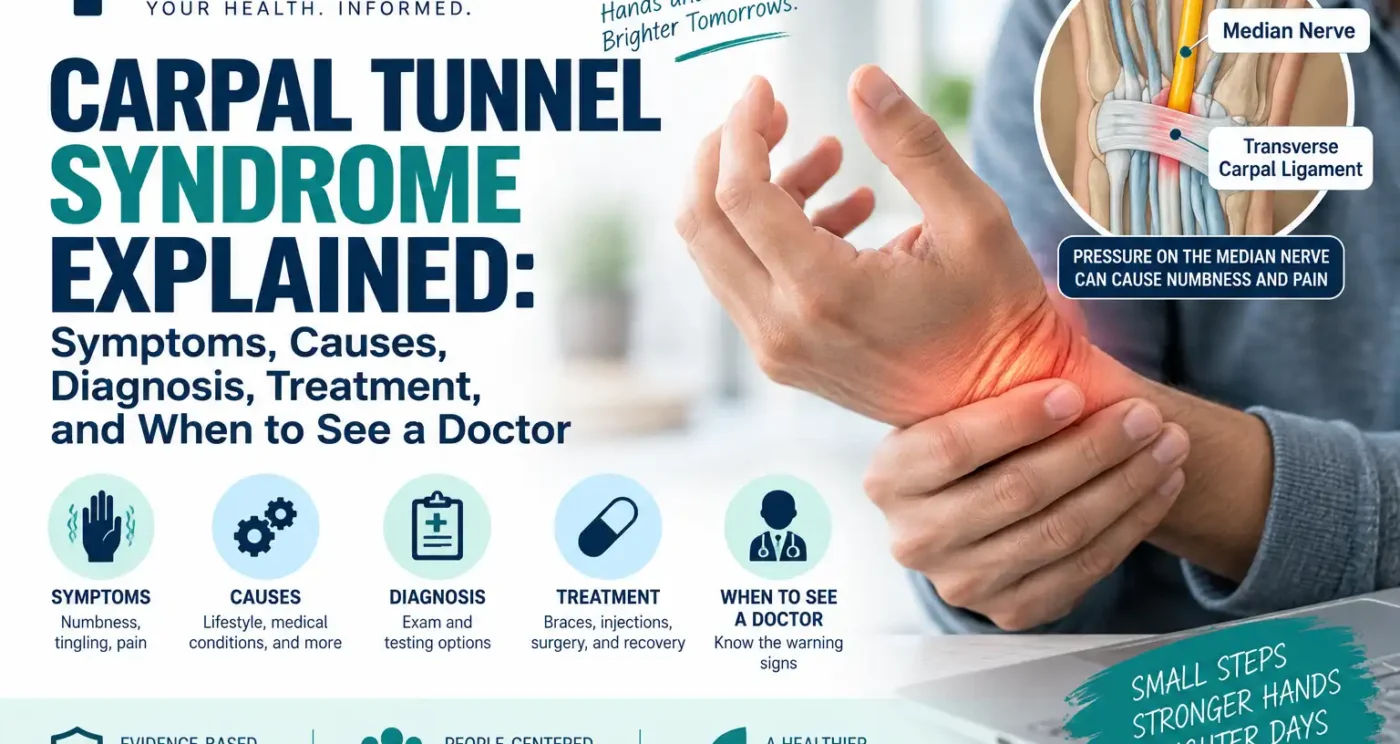
You wake up in the middle of the night because your hand feels numb. You shake it a few times, the tingling settles down, and you go back to sleep.
At first, it may not seem like much.
Then it starts happening while you drive, hold your phone, read a book, or work with your hands. Maybe the thumb and first few fingers feel strange. Maybe your grip does not seem quite as dependable as it used to.
That pattern is common in carpal tunnel syndrome, a condition caused by pressure on the median nerve as it passes through the wrist.
The median nerve supplies feeling to the thumb, index finger, middle finger, and part of the ring finger. It also helps control several muscles involved in thumb movement. That is why carpal tunnel can eventually affect more than sensation. Some people begin dropping objects, struggling with buttons, or noticing that the muscles at the base of the thumb look smaller.
The good news is that treatment does not always mean surgery. Mild cases may improve with nighttime wrist splinting and changes to activities that aggravate symptoms. Other people benefit from an injection or, when nerve compression is more advanced, carpal tunnel release surgery.
What matters is recognizing when occasional tingling has turned into a problem that deserves medical attention.
Contents
- 1. What Is Carpal Tunnel Syndrome?
- 2. Which Nerve Is Affected in Carpal Tunnel Syndrome?
- 3. What Are the Early Symptoms of Carpal Tunnel?
- 4. Which Fingers Are Affected by Carpal Tunnel?
- 5. Why Is Carpal Tunnel Worse at Night?
- 6. Does Shaking Your Hand Help Carpal Tunnel?
- 7. Can Carpal Tunnel Cause Pain?
- 8. Can Carpal Tunnel Cause Weakness?
- 9. What Is Thenar Muscle Wasting?
- 10. What Causes Carpal Tunnel Syndrome?
- 11. Does Typing Cause Carpal Tunnel?
- 12. Can Repetitive Work Contribute to Carpal Tunnel?
- 13. Can Pregnancy Cause Carpal Tunnel?
- 14. Can Diabetes Cause Carpal Tunnel?
- 15. Can Arthritis Cause Carpal Tunnel?
- 16. Can Thyroid Disease Be Related to Carpal Tunnel?
- 17. Can Carpal Tunnel Affect Both Hands?
- 18. How Is Carpal Tunnel Syndrome Diagnosed?
- 19. What Happens During the Hand Examination?
- 20. What Is the Phalen Test?
- 21. What Is Tinel’s Sign?
- 22. What Are Nerve Conduction Studies?
- 23. What Is an EMG?
- 24. Do You Need a Nerve Test to Diagnose Carpal Tunnel?
- 25. Can Ultrasound Diagnose Carpal Tunnel?
- 26. Is an MRI Needed for Carpal Tunnel?
- 27. What Conditions Can Look Like Carpal Tunnel?
- 28. How Is Carpal Tunnel Syndrome Treated?
- 29. Do Wrist Braces Help Carpal Tunnel?
- 30. Should You Wear a Carpal Tunnel Brace During the Day?
- 31. Can Changing Your Workstation Help?
- 32. Do Pain Relievers Cure Carpal Tunnel?
- 33. Do Steroid Injections Help?
- 34. Can Carpal Tunnel Exercises Help?
- 35. When Is Carpal Tunnel Surgery Needed?
- 36. What Is Carpal Tunnel Release Surgery?
- 37. Does Carpal Tunnel Surgery Require General Anesthesia?
- 38. How Long Does Recovery Take After Carpal Tunnel Surgery?
- 39. Will Numbness Disappear Immediately After Surgery?
- 40. Do You Need a Brace After Carpal Tunnel Surgery?
- 41. Does Everyone Need Physical Therapy After Surgery?
- 42. Can Carpal Tunnel Come Back After Surgery?
- 43. What Happens If Carpal Tunnel Is Left Untreated?
- 44. Can Carpal Tunnel Go Away on Its Own?
- 45. When Should You See a Doctor for Carpal Tunnel Symptoms?
- 46. When Is Hand Numbness an Emergency?
- 47. Frequently Asked Questions
- 47.1. What does carpal tunnel feel like?
- 47.2. Which fingers go numb with carpal tunnel syndrome?
- 47.3. Does carpal tunnel affect the pinky?
- 47.4. Why does carpal tunnel wake me up at night?
- 47.5. Why does shaking my hand help?
- 47.6. Can carpal tunnel cause arm pain?
- 47.7. Can carpal tunnel cause shoulder pain?
- 47.8. Does typing cause carpal tunnel?
- 47.9. Can pregnancy cause carpal tunnel syndrome?
- 47.10. Can diabetes cause carpal tunnel?
- 47.11. Do I need an EMG to diagnose carpal tunnel?
- 47.12. Will a wrist brace help?
- 47.13. Can steroid injections cure carpal tunnel?
- 47.14. Do exercises cure carpal tunnel?
- 47.15. When is carpal tunnel surgery necessary?
- 47.16. Is endoscopic surgery better than open surgery?
- 47.17. How long does numbness last after surgery?
- 47.18. Can carpal tunnel cause permanent nerve damage?
- 48. Conclusion
- 49. Resources
- 50. Editorial Disclaimer
What Is Carpal Tunnel Syndrome?
The carpal tunnel is a narrow passage on the palm side of the wrist.
Wrist bones form the bottom and sides of the tunnel. A firm band of tissue called the transverse carpal ligament forms the roof.
Several finger tendons and the median nerve have to pass through this relatively small space.
When pressure inside the tunnel increases, the median nerve can become compressed. That pressure may produce numbness, tingling, burning, pain, and eventually weakness.
Carpal tunnel syndrome is therefore better thought of as a nerve problem at the wrist than simply a painful wrist condition.
Plenty of other problems can make the wrist hurt, including arthritis, tendon injuries, fractures, and sprains. Those conditions are not automatically carpal tunnel syndrome.
Which Nerve Is Affected in Carpal Tunnel Syndrome?
The nerve involved is the median nerve.
It travels down the arm, through the wrist, and into the hand.
The nerve carries sensation from much of the:
- Thumb
- Index finger
- Middle finger
- Thumb-side portion of the ring finger
It also supplies several muscles that help move the thumb.
That combination explains two of the main features of carpal tunnel syndrome: finger numbness and thumb weakness.
What Are the Early Symptoms of Carpal Tunnel?
Early symptoms often come and go.
Someone may have completely normal hands during part of the day and then wake at night with tingling.
Common symptoms include:
- Tingling
- Numbness
- Burning
- Pins-and-needles sensations
- An aching wrist or hand
- Symptoms that wake you from sleep
- Temporary relief after shaking the hand
For many people, nighttime symptoms appear before the numbness becomes noticeable throughout the day.
Later on, holding a steering wheel, phone, book, or other object for a while may bring the symptoms back.
Which Fingers Are Affected by Carpal Tunnel?
The pattern of numbness can offer a useful clue.
| Finger | Usually affected? |
|---|---|
| Thumb | Yes |
| Index finger | Yes |
| Middle finger | Yes |
| Ring finger | Often partly |
| Little finger | Usually not |
The little finger, or pinky, is usually spared because most of its sensation comes from the ulnar nerve rather than the median nerve.
That does not mean everyone describes the numbness perfectly. Someone who wakes with a tingling hand may simply say that “the whole hand” feels asleep.
Still, prominent little-finger numbness can make a clinician consider another nerve problem.
Why Is Carpal Tunnel Worse at Night?
A lot of people sleep with their wrists bent without realizing it.
Keeping the wrist flexed or extended for a long time can increase pressure on the median nerve.
That helps explain why someone may sleep comfortably for several hours and then suddenly wake with tingling or numbness.
It also explains the logic behind a nighttime wrist brace.
A carpal tunnel splint is generally intended to keep the wrist closer to a neutral position while you sleep instead of letting it remain sharply bent.
Does Shaking Your Hand Help Carpal Tunnel?
Sometimes, temporarily.
Many people with carpal tunnel instinctively shake or flick the hand when they wake with numbness. The sensation may settle down for a while afterward.
That pattern is so common that clinicians often ask about it.
But shaking the hand does not fix the underlying compression.
If you have to do it every night—or if the numbness starts remaining during the day—it is worth having the problem evaluated.
Can Carpal Tunnel Cause Pain?
Yes.
Some people mainly notice numbness. Others describe aching, burning, or sharp discomfort.
Pain may be felt around the:
- Wrist
- Palm
- Fingers
- Forearm
It can occasionally travel farther up the arm.
Pain alone, however, is not enough to identify carpal tunnel syndrome. Tendon problems, arthritis, injuries, and other conditions can cause wrist or hand pain without compressing the median nerve.
The combination of pain or tingling with a typical finger pattern is more suggestive.
Can Carpal Tunnel Cause Weakness?
It can, particularly when compression has been present for a while.
You may notice that you:
- Drop cups, keys, or other objects
- Have trouble opening containers
- Struggle with buttons or zippers
- Have less pinch strength
- Find fine hand movements harder than before
Sometimes people drop things because they cannot feel the object properly.
In more advanced cases, the muscles controlled by the median nerve actually become weaker.
That is a more concerning change.
What Is Thenar Muscle Wasting?
Look at the fleshy area at the base of your thumb.
That is the thenar eminence.
Some of those muscles depend on the median nerve. If the nerve remains severely compressed, the muscles can become weaker and eventually lose bulk.
The area may begin to look flatter than it does on the other hand.
Visible thenar muscle wasting is not an early symptom that should simply be watched indefinitely. It can be a sign that the median nerve has already lost some motor function.
What Causes Carpal Tunnel Syndrome?
Often there is not one single cause.
Anything that reduces space in the carpal tunnel or makes the median nerve more vulnerable can contribute.
Possible factors include:
- Wrist anatomy
- Previous wrist fracture or injury
- Pregnancy
- Diabetes
- Rheumatoid arthritis
- Thyroid disease
- Obesity
- Fluid retention
- Repetitive or forceful hand activity
- Exposure to vibrating tools
Two people can develop the same symptoms for very different reasons.
That is also why treating the underlying contributor can sometimes be part of managing the wrist problem.
Does Typing Cause Carpal Tunnel?
Typing gets blamed for carpal tunnel much more often than the evidence supports.
The current American Academy of Orthopaedic Surgeons guidance does not establish heavy keyboard use by itself as a proven cause of carpal tunnel syndrome.
That does not mean computer work can never bother the wrist.
Typing with the wrist bent, using a poorly positioned mouse, or spending hours in one posture can make symptoms more noticeable in someone whose median nerve is already irritated.
An ergonomic setup may therefore help with comfort.
But the statement “I type all day, so typing caused my carpal tunnel” is often too simple.
Can Repetitive Work Contribute to Carpal Tunnel?
Certain kinds of work may be more relevant than ordinary keyboard use.
Jobs involving repeated:
- Forceful gripping
- Wrist bending
- Hand-intensive tasks
- Vibrating machinery
- High-force repetitive movements
may place additional stress on the wrist.
Work history is therefore worth discussing during an evaluation.
Still, simply having a manual occupation does not prove that work caused an individual case.
Can Pregnancy Cause Carpal Tunnel?
Yes.
Fluid retention during pregnancy can create extra pressure inside the wrist.
Some pregnant people develop numbness and tingling in one or both hands, particularly at night.
A nighttime splint is often attractive during pregnancy because it does not involve taking medication.
Symptoms frequently improve after delivery as swelling settles.
If numbness or weakness continues, however, it should not simply be assumed that pregnancy-related carpal tunnel will eventually disappear.
Can Diabetes Cause Carpal Tunnel?
Diabetes is associated with a higher risk of carpal tunnel syndrome.
It can also cause another form of nerve damage called diabetic peripheral neuropathy.
The distinction matters.
Diabetic neuropathy may affect both hands or feet in a broader pattern, while carpal tunnel specifically involves compression of the median nerve at the wrist.
A person with diabetes can have either condition—or both at the same time.
Can Arthritis Cause Carpal Tunnel?
Inflammatory arthritis can contribute.
Rheumatoid arthritis, for example, can cause swelling around the tissues and tendons passing through the wrist. In such a small space, swelling may increase pressure on the median nerve.
Arthritis can also hurt the wrist independently of carpal tunnel syndrome.
That is another reason wrist pain by itself does not establish the diagnosis.
Can Thyroid Disease Be Related to Carpal Tunnel?
Certain thyroid disorders have been associated with carpal tunnel syndrome.
That does not mean everyone with numb fingers needs thyroid testing.
A clinician usually decides whether additional blood tests make sense based on symptoms, medical history, examination, and other health concerns.
Can Carpal Tunnel Affect Both Hands?
Yes.
Some people have symptoms in only one hand.
Others eventually have both hands involved, although one side may be noticeably worse.
Carpal tunnel affecting both hands may be seen with conditions that influence the whole body, including diabetes, pregnancy, and inflammatory disorders.
Even when both wrists are affected, they do not necessarily progress at the same rate.
How Is Carpal Tunnel Syndrome Diagnosed?
Doctors usually begin with something much simpler than an MRI: the story of what is happening.
They may ask:
- Which fingers become numb?
- Do symptoms wake you at night?
- Does shaking your hand help?
- Do certain activities bring the tingling on?
- Have you started dropping things?
- How long has this been happening?
- Do you have neck or shoulder symptoms too?
The hand and wrist are then examined for changes in sensation, strength, and muscle size.
Current AAOS guidance also supports use of a clinical scoring system called CTS-6 in appropriate patients. A straightforward case may therefore be diagnosed without automatically ordering a nerve study or imaging test.
What Happens During the Hand Examination?
The clinician may compare both hands and check:
- Finger sensation
- Thumb strength
- Grip
- Pinch strength
- Muscle bulk
- Reflexes or other neurological findings
The neck, shoulder, elbow, and forearm may also be examined.
That may seem surprising if the symptoms are in the hand, but nerves supplying the hand begin much higher up. A problem in the neck can sometimes imitate a wrist nerve problem.
What Is the Phalen Test?
The Phalen test involves placing the wrist in a flexed position for a period of time.
If that position reproduces tingling in the thumb, index finger, middle finger, or part of the ring finger, it can support a carpal tunnel diagnosis.
It is not a perfect test.
Doing it at home and feeling tingling does not prove that you have carpal tunnel syndrome.
Likewise, a negative result does not completely rule it out.
What Is Tinel’s Sign?
For Tinel’s sign, a clinician taps over the median nerve at the wrist.
A person with carpal tunnel may feel a tingling or electric sensation traveling into the fingers.
As with Phalen’s test, Tinel’s sign is only one clue.
Modern diagnosis relies more on the whole symptom pattern and examination than on one bedside maneuver.
What Are Nerve Conduction Studies?
A nerve conduction study measures how quickly electrical signals move through a nerve.
Small electrodes are placed on the skin, and the nerve is stimulated.
When the median nerve is compressed at the wrist, the signal may travel more slowly through that area.
The test can help confirm median-nerve dysfunction and give clinicians more information about severity.
It may also help separate carpal tunnel syndrome from other nerve disorders.
What Is an EMG?
Electromyography, usually called EMG, evaluates electrical activity in muscles.
A small needle electrode is placed into selected muscles.
The test can reveal whether nerve dysfunction is affecting those muscles and can help determine where the problem may be occurring.
EMG and nerve conduction studies are often performed together, although not everyone with straightforward carpal tunnel symptoms needs them.
Do You Need a Nerve Test to Diagnose Carpal Tunnel?
Not always.
The 2024 AAOS guideline supports diagnosing many typical cases using clinical evaluation and the CTS-6 tool without routinely performing nerve conduction studies or EMG.
A nerve study becomes more useful when:
- The diagnosis is unclear
- Symptoms are unusual
- Another nerve problem is suspected
- Severity needs clarification
- Significant weakness is present
- Surgery is being considered in a more complicated case
This is different from saying the tests have no value.
They simply are not mandatory in every person with classic symptoms.
Can Ultrasound Diagnose Carpal Tunnel?
Ultrasound can show the median nerve and nearby wrist structures.
It may reveal an enlarged or compressed nerve and can be useful in certain cases.
It is not required for every patient.
Current AAOS guidance allows many typical cases to be diagnosed clinically without routine ultrasound.
Is an MRI Needed for Carpal Tunnel?
Usually not.
MRI provides detailed images, but uncomplicated carpal tunnel syndrome generally does not require it.
MRI may become more useful if the clinician suspects something unusual, such as:
- A mass
- Previous complicated wrist injury
- Abnormal anatomy
- Another structural problem
For an otherwise classic case of nighttime median-nerve symptoms, it is often unnecessary.
What Conditions Can Look Like Carpal Tunnel?
Not every numb hand is carpal tunnel syndrome.
Possible alternatives include:
- Cervical radiculopathy
- Ulnar nerve compression
- Peripheral neuropathy
- Diabetic neuropathy
- Arthritis
- Tendon disorders
- Previous wrist injuries
- Other nerve-entrapment syndromes
A pinched nerve in the neck is an especially important mimic because it can produce tingling, pain, or weakness farther down the arm.
That is why clinicians sometimes examine much more than the wrist.
How Is Carpal Tunnel Syndrome Treated?
Treatment depends on how much the median nerve is being affected.
Someone who gets occasional nighttime tingling has a very different situation from someone with constant numbness and visible thumb-muscle wasting.
In milder cases, treatment usually begins without surgery.
Options may include:
- Nighttime wrist splinting
- Changing activities that repeatedly trigger symptoms
- Treating contributing medical conditions
- Corticosteroid injection in selected patients
Surgery becomes more important when symptoms remain significant or the nerve is starting to lose function.
Do Wrist Braces Help Carpal Tunnel?
They can.
A neutral-position wrist splint worn at night is one of the most common early treatments.
Its job is simple: prevent the wrist from spending hours in a bent position while you sleep.
People with intermittent nighttime symptoms may notice meaningful improvement.
A brace should not be wrapped so tightly that it causes additional numbness or circulation problems.
And wearing one forever is not a substitute for evaluation when symptoms continue to worsen.
Should You Wear a Carpal Tunnel Brace During the Day?
Sometimes, depending on which activities provoke symptoms.
A person who repeatedly bends the wrist during a certain task may find short-term bracing useful.
But constant immobilization is not automatically better.
Long periods of unnecessary restriction can become uncomfortable and may interfere with normal hand use.
A clinician or therapist can help determine when a brace makes sense.
Can Changing Your Workstation Help?
It may help reduce symptoms, even though typing itself is not established as the sole cause of carpal tunnel syndrome.
Useful changes can include:
- Keeping the wrist closer to neutral
- Adjusting keyboard height
- Changing mouse position
- Avoiding sustained wrist bending
- Taking brief breaks from repetitive tasks
- Alternating hand-intensive activities
Ergonomics is best understood as a way to reduce aggravation rather than a guaranteed cure.
Do Pain Relievers Cure Carpal Tunnel?
No.
Over-the-counter pain medicines can sometimes make an aching wrist feel better.
They do not create more room inside the carpal tunnel or directly remove pressure from the median nerve.
Current AAOS guidance does not show oral anti-inflammatory medication producing meaningful long-term improvement in the nerve-compression disorder itself.
Pain relief and treatment of the underlying compression are therefore not necessarily the same thing.
Do Steroid Injections Help?
A corticosteroid injection into the carpal tunnel can improve symptoms for some people.
The benefit is usually most useful in the short term.
Current AAOS evidence does not support steroid injection as a reliably permanent treatment for carpal tunnel syndrome.
That does not make injections pointless.
Temporary improvement may provide useful symptom relief, particularly in someone trying to avoid or postpone surgery for a period of time.
The decision depends on the individual situation.
Can Carpal Tunnel Exercises Help?
You may see nerve-gliding or tendon-gliding exercises recommended online.
Some clinicians use them in selected patients.
The evidence for lasting improvement is mixed, however, and exercises should not be sold as a way to “release” a severely compressed nerve at home.
A person with mild intermittent symptoms may use movement exercises as part of conservative management.
Someone developing constant numbness or weakness needs a different conversation.
When Is Carpal Tunnel Surgery Needed?
There is no rule that everyone with carpal tunnel eventually needs surgery.
Surgery becomes more likely when:
- Numbness becomes persistent
- Weakness develops
- Objects are frequently dropped
- Thenar muscles begin to waste
- Symptoms remain severe despite conservative treatment
- Nerve testing shows significant dysfunction
- Sleep and daily function are being repeatedly disrupted
The goal of surgery is to remove pressure from the median nerve before additional damage occurs.
What Is Carpal Tunnel Release Surgery?
Carpal tunnel release involves cutting the transverse carpal ligament that forms the roof of the carpal tunnel.
Once the ligament is divided, the tunnel has more room and pressure on the median nerve decreases.
There are two widely used approaches.
Open Carpal Tunnel Release
The surgeon makes an incision in the palm and releases the ligament while directly viewing the area.
Modern versions may use relatively small incisions.
Endoscopic Carpal Tunnel Release
The surgeon uses a small camera and instruments introduced through one or more small incisions.
The ligament is divided while the surgeon views the structures on a screen.
Current AAOS evidence suggests that mini-open and endoscopic surgery produce similar long-term patient-reported results.
Some people may return to certain activities slightly sooner after endoscopic surgery, but one technique is not automatically superior for everyone.
Does Carpal Tunnel Surgery Require General Anesthesia?
Not necessarily.
Carpal tunnel release can often be performed using local anesthesia.
Some procedures use sedation as well.
The choice depends on the surgical approach, medical history, patient preference, facility, and surgeon.
A person should discuss the exact anesthesia plan before the day of surgery rather than assuming they will automatically be put fully to sleep.
How Long Does Recovery Take After Carpal Tunnel Surgery?
Recovery depends partly on what you mean by “recovered.”
The incision may heal long before grip strength and hand comfort feel completely normal.
Someone doing computer work may return sooner than someone whose job requires:
- Heavy lifting
- Forceful gripping
- Construction work
- Repetitive tool use
Nighttime tingling may improve fairly quickly in some patients.
Long-standing numbness can be different.
If the median nerve was severely compressed for months or years, sensation may return slowly over many months, and complete recovery cannot always be guaranteed.
Will Numbness Disappear Immediately After Surgery?
Not always.
Some people notice rapid improvement.
Others have gradual recovery because the nerve needs time to heal after prolonged compression.
The longer severe numbness or weakness existed before surgery, the greater the chance that recovery may take longer or remain incomplete.
That is one reason waiting for visible muscle wasting before seeking care is not ideal.
Do You Need a Brace After Carpal Tunnel Surgery?
Not routinely in every case.
The current AAOS guideline does not find a consistent benefit from automatically immobilizing the wrist in a postoperative splint after carpal tunnel release.
Individual surgeons may still recommend temporary protection depending on the operation and patient.
Follow the instructions given for your specific surgery.
Does Everyone Need Physical Therapy After Surgery?
No.
Most people do not automatically need a formal rehabilitation program after uncomplicated carpal tunnel release.
Some patients may benefit from therapy if they develop:
- Stiffness
- Scar sensitivity
- Persistent weakness
- Difficulty returning to work
- Other functional problems
Postoperative therapy should be based on what the person actually needs rather than prescribed as a routine package for everyone.
Can Carpal Tunnel Come Back After Surgery?
True recurrence can happen, but it is relatively uncommon.
Persistent symptoms after surgery do not always mean carpal tunnel has “come back.”
Other possibilities include:
- Severe nerve damage that has not yet recovered
- Scar tissue
- Incomplete release
- Another nerve disorder
- A different original diagnosis
Persistent or returning symptoms deserve reassessment rather than assuming another operation is automatically required.
What Happens If Carpal Tunnel Is Left Untreated?
Mild cases can remain intermittent for a long time.
The main concern is a case that keeps progressing.
Long-term median nerve compression may lead to:
- Constant numbness
- Reduced sensation
- Weak thumb movement
- Poor grip or pinch
- Thenar muscle wasting
- Permanent nerve damage
Surgery can relieve the pressure even in a severe case, but it cannot promise that nerve function already lost will return completely.
That is why weakness matters more than occasional tingling.
Can Carpal Tunnel Go Away on Its Own?
Sometimes.
If the trigger is temporary, symptoms may improve when the underlying problem resolves.
Pregnancy-related carpal tunnel is a good example.
Other cases may improve with splinting and activity changes.
Some do not.
If symptoms are becoming more frequent rather than less frequent, or weakness has appeared, waiting indefinitely for the problem to disappear becomes less reasonable.
When Should You See a Doctor for Carpal Tunnel Symptoms?
Consider an evaluation when:
- Tingling keeps returning
- Numbness regularly wakes you from sleep
- Symptoms interfere with work
- You are dropping objects
- Grip feels weaker
- Numbness has become persistent
- Symptoms continue despite nighttime splinting
More urgent evaluation is appropriate when you notice thumb weakness or muscle wasting at the base of the thumb.
A new hand problem also does not need to wait until your next preventive appointment. MedIntelHub’s guide to understanding your annual physical explains why routine preventive care and evaluation of a new symptom serve different purposes.
When Is Hand Numbness an Emergency?
Carpal tunnel syndrome usually develops gradually.
A hand that suddenly becomes numb or weak may be something else entirely.
Seek emergency care for sudden hand or arm symptoms accompanied by:
- Facial drooping
- Difficulty speaking
- Confusion
- Sudden severe weakness
- Loss of coordination
- Sudden vision changes
Those can be signs of a stroke.
Urgent assessment is also appropriate when the hand becomes suddenly:
- Cold
- Pale or blue
- Severely swollen
- Extremely painful
- Difficult or impossible to move after an injury
Do not assume a sudden neurological or circulation problem is “just carpal tunnel.”
Frequently Asked Questions
What does carpal tunnel feel like?
Many people describe numbness, tingling, burning, or pins and needles in the thumb, index finger, middle finger, and part of the ring finger.
Symptoms often wake people at night.
Which fingers go numb with carpal tunnel syndrome?
The thumb, index, middle, and part of the ring finger are commonly affected.
The little finger usually is not.
Does carpal tunnel affect the pinky?
Usually no.
The little finger is mainly supplied by the ulnar nerve.
Prominent numbness there can suggest another nerve problem.
Why does carpal tunnel wake me up at night?
Sleeping with the wrist bent can increase pressure on the median nerve.
That is one reason symptoms frequently become worse during sleep.
Why does shaking my hand help?
Changing wrist position and moving the hand may temporarily reduce the sensation.
It does not permanently relieve the underlying nerve compression.
Can carpal tunnel cause arm pain?
Yes.
Pain and abnormal sensations can sometimes extend into the forearm.
Can carpal tunnel cause shoulder pain?
Shoulder pain is not a typical defining symptom.
If hand numbness occurs together with neck or shoulder pain, a clinician may consider whether a nerve problem higher in the neck or arm is contributing.
Does typing cause carpal tunnel?
Current AAOS evidence does not establish high keyboard use alone as a proven cause.
Typing posture may still aggravate symptoms in some people.
Can pregnancy cause carpal tunnel syndrome?
Yes.
Pregnancy-related swelling can increase pressure inside the carpal tunnel.
Many cases improve after delivery, although persistent symptoms should still be evaluated.
Can diabetes cause carpal tunnel?
Diabetes is associated with an increased risk.
It can also cause other types of peripheral neuropathy, so the cause of numbness should be properly evaluated.
Do I need an EMG to diagnose carpal tunnel?
Not always.
Many typical cases can be diagnosed clinically.
EMG and nerve conduction studies are especially useful when the diagnosis is uncertain or more information about nerve function is needed.
Will a wrist brace help?
A neutral-position nighttime splint can reduce symptoms in some people with mild or moderate disease.
Can steroid injections cure carpal tunnel?
They can relieve symptoms temporarily, but current evidence does not support them as a consistently permanent cure.
Do exercises cure carpal tunnel?
Exercises may be included in conservative care, but they cannot reliably reverse significant nerve compression.
When is carpal tunnel surgery necessary?
Surgery becomes more likely when symptoms persist despite conservative care or when numbness, weakness, muscle wasting, or significant nerve dysfunction has developed.
Is endoscopic surgery better than open surgery?
Neither has clearly superior long-term results overall.
Both are established methods of releasing the median nerve.
How long does numbness last after surgery?
It varies.
Mild symptoms may improve quickly. Numbness caused by longstanding severe nerve compression can take months to improve and may not disappear completely.
Can carpal tunnel cause permanent nerve damage?
Yes.
Severe or prolonged compression can lead to lasting sensory loss, weakness, and muscle wasting.
Conclusion
Carpal tunnel syndrome is not simply a sore wrist.
It is a problem involving pressure on the median nerve, and that nerve pattern explains much of what people experience.
The classic early clues are tingling or numbness in the thumb, index finger, middle finger, and part of the ring finger—often at night. The little finger is usually spared.
Early symptoms may come and go for months. A nighttime wrist splint and changes to activities that aggravate the wrist may be enough for some people.
The picture changes when the nerve begins losing function.
Persistent numbness, reduced grip, frequent dropping of objects, thumb weakness, or visible muscle wasting at the base of the thumb deserves medical attention. Waiting too long can allow nerve damage to become harder to reverse.
Diagnosis also does not always require an MRI, EMG, or nerve conduction study. Current AAOS guidance supports careful clinical evaluation for many straightforward cases, with additional tests used when the diagnosis or severity is less clear.
And if surgery becomes necessary, both open and endoscopic carpal tunnel release are established options with similar long-term outcomes for many patients.
The practical takeaway is straightforward:
Occasional tingling may be manageable. Progressive numbness or weakness should not be ignored.
Resources
American Academy of Orthopaedic Surgeons — Carpal Tunnel Syndrome
AAOS provides current evidence-based guidance on diagnosis, splinting, injections, surgery, and postoperative care.
https://www.aaos.org/quality/quality-programs/carpal-tunnel-syndrome/
National Institute of Arthritis and Musculoskeletal and Skin Diseases
NIAMS explains median nerve compression, symptoms, risk factors, diagnosis, and treatment.
https://www.niams.nih.gov/health-topics/carpal-tunnel-syndrome
Mayo Clinic — Carpal Tunnel Syndrome
Mayo Clinic provides patient-focused information on symptoms, diagnosis, braces, injections, nerve testing, and surgery.
https://www.mayoclinic.org/diseases-conditions/carpal-tunnel-syndrome/symptoms-causes/syc-20355603
MedIntelHub — Understanding Your Annual Physical
Persistent hand numbness or weakness may need its own problem-focused visit instead of waiting for a routine checkup.
https://medintelhub.com/understanding-your-annual-physical-what-actually-gets-checked/
MedIntelHub — Editorial Policy
For more about MedIntelHub’s standards for medical sourcing, accuracy, transparency, and healthcare education:
https://medintelhub.com/editorial-policy/
Editorial Disclaimer
This article is for general educational purposes only. It cannot determine whether an individual’s hand numbness, wrist pain, tingling, or weakness is caused by carpal tunnel syndrome.
Similar symptoms can occur with cervical radiculopathy, ulnar nerve compression, peripheral neuropathy, diabetes-related nerve disease, arthritis, tendon disorders, circulatory problems, trauma, and other conditions.
Treatment depends on symptom severity, duration, examination findings, underlying health conditions, pregnancy status, occupation, nerve function, and response to previous care.
Sudden arm or hand weakness, facial drooping, speech difficulty, severe confusion, abrupt loss of coordination, or other sudden neurological symptoms should be treated as a possible medical emergency rather than assumed to be carpal tunnel syndrome.

David Bennett
David Bennett is an author at MedIntelHub, where he creates clear, practical, and well-researched content about healthcare, medical billing, insurance, and patient education. His goal is to make complex healthcare topics easier for readers to understand and use in everyday situations. David emphasizes accuracy, transparency, and reliable sourcing, using information from trusted organizations and official healthcare resources whenever possible. Content published by David is intended for educational purposes and should not replace advice from qualified medical, legal, or healthcare professionals.