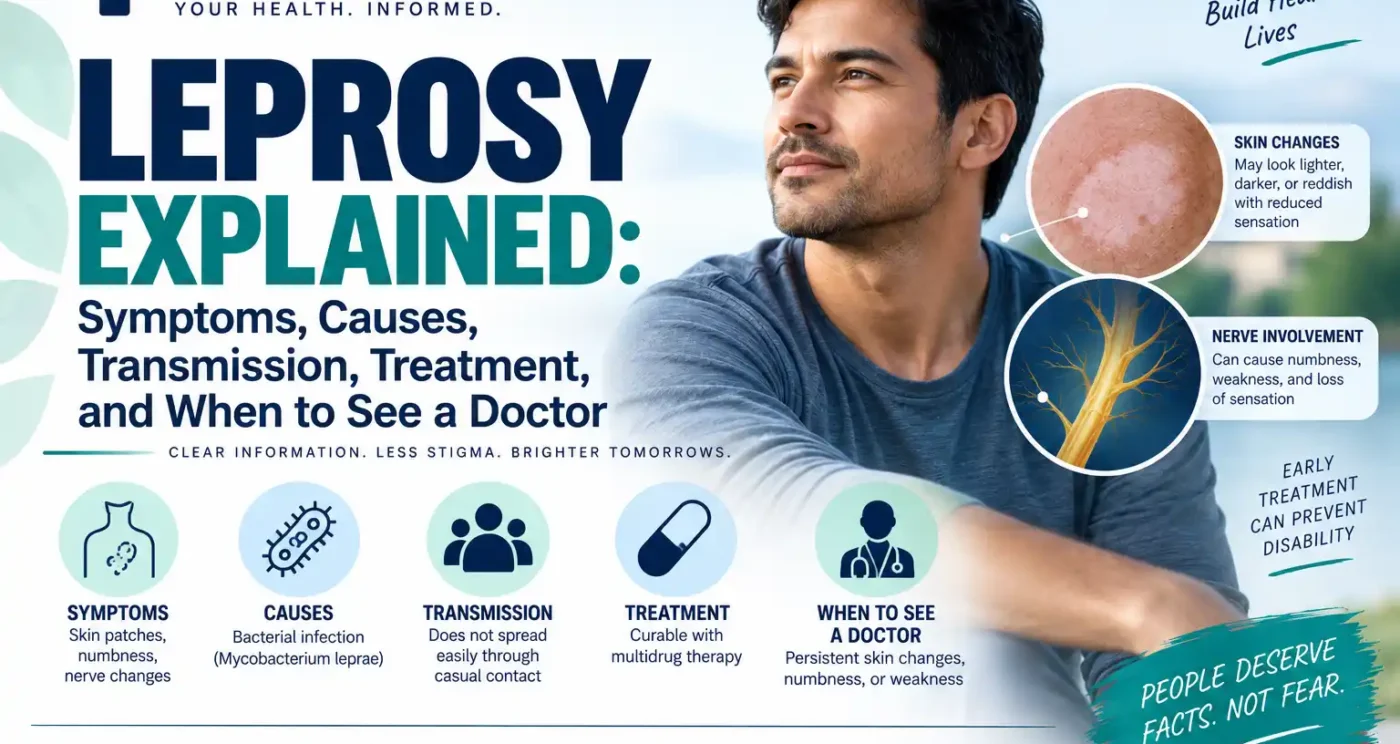
Leprosy has carried centuries of fear and stigma, but much of what people still believe about it is outdated.
Today, doctors know that leprosy—also called Hansen’s disease—is a curable bacterial infection. It does not spread easily from person to person, and ordinary contact such as shaking hands, sitting beside someone, sharing a meal, or hugging is not considered a typical way to catch it.
What makes the disease medically important is not extreme contagiousness. It is the damage that can occur when diagnosis is delayed.
Hansen’s disease primarily affects the skin and peripheral nerves. A skin patch may look lighter, darker, or reddish compared with surrounding skin, but the more important clue can be what the person cannot feel. Loss of touch, pain, or temperature sensation can allow burns, cuts, pressure injuries, and ulcers to go unnoticed. Untreated nerve damage may eventually cause weakness and permanent disability.
Treatment changes that outlook dramatically. The World Health Organization considers leprosy curable with multidrug antibiotic therapy, and starting treatment early can prevent much of the disability historically associated with the disease.
What Is Leprosy?
Leprosy is a chronic infectious disease caused by very slow-growing bacteria.
The main organism is Mycobacterium leprae. The CDC also recognizes Mycobacterium lepromatosis as a cause of Hansen’s disease in some cases.
The bacteria have a particular tendency to affect:
- Skin
- Peripheral nerves
- Eyes
- Lining of the nose and upper respiratory tract
Peripheral nerves are the nerves outside the brain and spinal cord that carry information about touch, temperature, pain, movement, and other functions.
That explains why a disease that may first look like a skin condition can eventually cause numbness, weakness, injuries that are not felt, or eye problems.
Why Is Leprosy Also Called Hansen’s Disease?
The terms refer to the same disease.
Hansen’s disease is widely used in modern medical practice, particularly in the United States. “Leprosy” remains the better-known public term and is still used by organizations including WHO and CDC.
Using Hansen’s disease can help separate the modern medical condition from centuries of stigma surrounding the word “leprosy.”
That stigma remains a real public-health issue. WHO’s theme for World Leprosy Day 2026 was “Leprosy is curable, the real challenge is stigma,” emphasizing that fear and discrimination can discourage people from coming forward for diagnosis and treatment.
What Causes Leprosy?
Leprosy is caused by bacterial infection—not by poor hygiene, a curse, personal behavior, or moral failure.
Mycobacterium leprae multiplies extraordinarily slowly. CDC’s clinical information notes that the organism divides roughly once every 13 days, far more slowly than many familiar bacteria.
That slow growth helps explain why Hansen’s disease can remain unnoticed for years after exposure.
Not everyone exposed becomes ill, either.
CDC estimates that around 95% of people have enough natural immunity that they will not develop Hansen’s disease after exposure to the bacteria.
How Does Leprosy Spread?
Researchers believe transmission usually occurs through droplets from the nose or mouth of a person with untreated Hansen’s disease.
But exposure generally needs to be much more substantial than being in the same room once.
WHO and CDC describe transmission as requiring close, repeated, prolonged contact with an untreated person. CDC says this exposure may occur over many months.
A likely scenario involves repeatedly breathing droplets released when an untreated person coughs or sneezes.
This is very different from the way highly contagious respiratory infections can spread after short encounters.
Is Leprosy Highly Contagious?
No.
That is one of the biggest misconceptions surrounding the disease.
CDC describes Hansen’s disease as difficult to spread, and most people exposed to the bacteria never develop the infection because their immune systems are naturally able to resist it.
Being diagnosed with Hansen’s disease therefore does not mean someone needs to be permanently isolated from family, work, or society.
Once effective treatment begins, WHO considers the patient no longer infectious.
Can You Catch Leprosy by Touching Someone?
Ordinary casual contact is not considered a route of transmission.
WHO specifically states that leprosy is not spread through activities such as:
- Shaking hands
- Hugging
- Sharing meals
- Sitting next to someone
CDC similarly says talking with or sitting next to someone with Hansen’s disease does not normally transmit the infection.
That is why avoiding or socially isolating someone who is being treated has no medical justification.
Is Leprosy Spread Through Sex?
CDC says Hansen’s disease is not considered sexually transmitted.
The same source states that it is not passed from a pregnant person to the fetus during pregnancy.
Close household exposure to an untreated case is more relevant to transmission risk than sexual contact itself.
Can Armadillos Carry Leprosy?
Yes.
This is one of the unusual aspects of Hansen’s disease in the United States.
Some armadillos in the southern U.S. naturally carry bacteria that cause Hansen’s disease, and transmission from infected armadillos to humans appears possible.
The risk is considered low.
CDC stresses that most people who encounter armadillos will not develop leprosy.
Armadillos should therefore not be presented as the explanation for every U.S. case. Many people diagnosed in the United States were exposed in countries where Hansen’s disease occurs more frequently.
How Long Does It Take for Leprosy Symptoms to Appear?
The incubation period can be remarkably long.
WHO says symptoms may appear within a year in some cases but can take 20 years or longer to develop. CDC similarly notes that signs can take up to about 20 years after exposure to become apparent.
That makes tracing the original exposure difficult.
Someone diagnosed today may have encountered the bacteria many years earlier and may not remember the event at all.
What Are the Early Symptoms of Leprosy?
Hansen’s disease usually develops gradually.
One of the earliest clues may be a persistent area of skin that looks different from surrounding skin and has reduced sensation.
Possible findings include:
- Pale or lighter skin patches
- Reddish or differently pigmented patches
- Numbness
- Reduced ability to feel pain
- Tingling or abnormal sensation
- Dry or stiff skin
- Muscle weakness
- Enlarged peripheral nerves
Loss of sensation is especially important because many common skin conditions change skin color without damaging nerves.
What Does a Leprosy Skin Patch Look Like?
There is no single appearance.
CDC says lesions may look lighter, darker, or redder than the person’s usual skin tone. They may be flat or raised. Some people develop firm bumps or nodules instead of simple flat patches.
Other skin findings can include:
- Thickened skin
- Dry skin
- Painless ulcers on the feet
- Lumps around the face or ears
- Loss of eyebrows or eyelashes
A pale patch by itself does not mean leprosy.
Conditions such as vitiligo, fungal infections, eczema, post-inflammatory pigment changes, and many other skin disorders can alter skin color.
The unusual finding in Hansen’s disease is often the combination of the skin change and sensory loss.
Why Does Leprosy Cause Numbness?
The bacteria have a strong affinity for peripheral nerves.
As inflammation and damage develop around those nerves, signals involving pain, touch, temperature, and movement may become impaired.
Early sensory changes may be subtle.
HRSA’s National Hansen’s Disease Program notes that sensory function is often affected before muscle function, which means reduced feeling may appear before obvious weakness or deformity.
This gives clinicians an important window for treatment.
Nerve damage caught early may sometimes be interrupted before permanent loss of function develops.
Why Can Someone With Leprosy Get Injured Without Feeling It?
Pain is protective.
If you touch something hot, step on a sharp object, or develop a blister, pain usually tells you to stop putting pressure on that area.
Nerve damage from Hansen’s disease can weaken that warning system.
A person may not notice:
- Burns
- Cuts
- Blisters
- Pressure injuries
- Foot ulcers
- Repeated trauma
CDC specifically warns that loss of pain and touch sensation can allow injuries such as cuts and burns to go unnoticed.
Repeated unnoticed injury—not the bacteria somehow “eating” a limb—is one reason untreated disease historically produced severe disability.
What Other Symptoms Can Leprosy Cause?
Beyond numb skin patches, Hansen’s disease can affect several parts of the body.
Skin and Face
Possible findings include:
- Discolored skin patches
- Nodules
- Thick or stiff skin
- Dry skin
- Painless ulcers
- Facial or earlobe swelling
- Loss of eyebrows or eyelashes
Nerves and Muscles
Possible neurological findings include:
- Numbness
- Enlarged nerves
- Muscle weakness
- Paralysis in advanced disease
- Painful or tender nerves during inflammatory reactions
Nose
The nasal lining may also be affected.
CDC lists symptoms including:
- Chronic stuffiness
- Nosebleeds
Eyes
Nerve and inflammatory involvement can interfere with eye protection or directly affect ocular structures, potentially threatening vision when disease is advanced or inflammatory reactions are not controlled.
Can Leprosy Cause Blindness?
It can if eye involvement becomes severe.
CDC lists eye problems and blindness among possible complications of advanced untreated Hansen’s disease.
Several mechanisms can contribute.
Nerve damage may interfere with blinking or eyelid closure, leaving the eye more vulnerable to dryness and injury. Inflammatory reactions can also involve eye structures.
Eye pain, redness, inability to close an eyelid normally, or new changes in vision in someone with suspected or diagnosed Hansen’s disease deserve prompt medical attention.
Does Leprosy Make Fingers and Toes “Fall Off”?
No.
This common historical image is misleading.
Hansen’s disease does not cause fingers or toes to suddenly detach.
Advanced untreated nerve damage can remove protective sensation. Repeated injuries, ulcers, infection, and damage to bone and soft tissue can then occur over years.
CDC notes that advanced disease can lead to shortening of fingers and toes as the body reabsorbs damaged tissue.
That is very different from the idea that a body part simply “falls off” because of leprosy.
Modern early diagnosis and antibiotic treatment greatly reduce the chance of reaching this stage.
How Common Is Leprosy Today?
Leprosy has not disappeared.
WHO reported 172,717 new cases worldwide in 2024, based on data submitted by 188 countries, areas, and territories.
The global burden is far lower than it was several decades ago, but transmission continues.
WHO reports that Brazil, India, and Indonesia each recorded more than 10,000 new cases in 2024, while a number of other countries reported between 1,000 and 10,000.
The disease is reported in all six WHO regions.
Is Leprosy Common in the United States?
No.
Hansen’s disease is rare in the United States.
CDC says up to about 225 cases are identified in the U.S. each year.
Many U.S. patients were exposed in places where Hansen’s disease is more common.
The rarity of the condition creates another problem: clinicians who rarely encounter it may not immediately recognize the combination of a persistent skin lesion and altered sensation.
HRSA specifically warns that delayed diagnosis in the United States can have serious neurological consequences.
Who Is at Higher Risk of Leprosy?
The greatest person-to-person risk generally involves prolonged close contact with someone who has untreated Hansen’s disease.
Household members of untreated patients may therefore have greater exposure than casual contacts.
Risk can also be higher for someone who:
- Lives in or previously lived in an area where Hansen’s disease remains endemic
- Has prolonged close exposure to an untreated patient
- Has certain individual susceptibility to the infection
- Has particular exposure to infected armadillos in parts of the southern U.S.
Still, exposure does not mean disease is inevitable.
Around 95% of people are believed to have natural immunity.
How Is Leprosy Diagnosed?
Diagnosis begins with recognizing a characteristic pattern.
WHO lists three cardinal signs clinicians use when diagnosing Hansen’s disease:
- Definite loss of sensation in a pale or reddish skin lesion.
- A thickened or enlarged peripheral nerve associated with sensory loss and/or weakness in muscles supplied by that nerve.
- Microscopic identification of the bacteria in a slit-skin smear.
Finding at least one of these can establish the diagnosis in appropriate clinical settings.
The diagnostic approach in the United States may include additional laboratory confirmation.
Skin Examination
A clinician examines the number, color, shape, and distribution of skin lesions.
The key question is not just what the lesion looks like.
It is also:
Does the skin feel normally?
Sensory Testing
The clinician may test light touch, pain, or other sensation within suspicious skin patches.
A persistent lesion that has clearly lost sensation is more concerning than pigment change alone.
Peripheral Nerve Examination
Certain nerves may feel enlarged or tender.
The clinician may also assess:
- Hand strength
- Foot strength
- Sensation
- Eyelid function
- Muscle weakness
Skin or Nerve Biopsy
In the United States, CDC says diagnosis can be confirmed by examining a skin or nerve biopsy for the bacteria.
HRSA says skin biopsy is particularly important for definitive U.S. diagnosis, and its National Hansen’s Disease Program can perform molecular testing for M. leprae and M. lepromatosis DNA when appropriate.
There is no simple routine blood test that proves someone has Hansen’s disease.
What Are Paucibacillary and Multibacillary Leprosy?
WHO groups cases into two broad categories for treatment planning.
Paucibacillary Leprosy
Paucibacillary, or PB, disease generally refers to a patient with one to five skin lesions and no bacteria demonstrated on a slit-skin smear.
Multibacillary Leprosy
Multibacillary, or MB, disease includes cases with:
- More than five lesions
- Nerve involvement
- Bacteria demonstrated on slit-skin smear
These categories help determine treatment length.
They should not be used by someone looking at their own skin at home to decide which treatment they need.
Is Leprosy Curable?
Yes.
This is perhaps the most important fact in the entire article.
Hansen’s disease can be cured with appropriate multidrug antibiotic therapy.
Antibiotics eliminate the infection.
What treatment cannot always do is reverse severe nerve damage that has already become permanent.
That is why early diagnosis matters so much.
How Is Leprosy Treated?
Leprosy is treated with more than one antibiotic.
WHO’s current multidrug therapy contains:
- Rifampicin
- Dapsone
- Clofazimine
WHO recommends this three-drug combination for both major treatment classifications, generally for:
- 6 months for paucibacillary disease
- 12 months for multibacillary disease
WHO has also continued providing multidrug therapy free of charge internationally through its global program.
Is Treatment the Same in the United States?
Not necessarily.
This is an important detail because online articles often present the WHO schedule as though it were the only regimen used everywhere.
The U.S. National Hansen’s Disease Program (NHDP) recognizes multiple treatment options.
Its current guidance, reviewed in July 2026, includes a monthly three-antibiotic regimen using rifampin, moxifloxacin, and minocycline (RMM) as one treatment option. The NHDP regimen generally runs for 12 months in paucibacillary disease and 24 months in multibacillary disease.
CDC broadly notes that U.S. treatment often lasts one to two years.
The difference is exactly why patients should not copy an antibiotic schedule from an international website and attempt to apply it themselves.
Treatment should be arranged through clinicians familiar with Hansen’s disease and local guidelines.
Why Are Several Antibiotics Needed?
Using several active drugs helps reliably eliminate the bacteria and limits the problem of antibiotic resistance.
WHO’s recommended approach has therefore been multidrug therapy rather than treatment with a single antibiotic.
Completing the prescribed treatment is important even if the skin begins to look better before the course is finished.
When Does Someone With Leprosy Stop Being Contagious?
Very soon after effective treatment begins.
WHO states that a patient stops transmitting Hansen’s disease once treatment is initiated.
CDC likewise considers treated patients noninfectious and says people receiving therapy can continue normal life with family and friends and attend work or school.
This is another reason old practices of permanent isolation have no place in modern Hansen’s disease care.
What Are Leprosy Reactions?
Treatment can cure the bacterial infection, but another problem can occur before, during, or even after antibiotic therapy: an immune reaction.
The immune system sometimes mounts an intense inflammatory response to Hansen’s disease bacteria or their remnants.
A reaction may cause:
- Existing lesions to become red or swollen
- New inflammatory skin lesions
- Painful nerves
- New numbness
- New muscle weakness
- Swelling of the hands or feet
- Fever
- Eye inflammation in some cases
These reactions are medically important because inflammation around nerves can rapidly cause permanent damage.
Does a Leprosy Reaction Mean the Antibiotics Failed?
No.
That is a common misunderstanding.
HRSA explains that Hansen’s disease reactions are immune responses and are not evidence that the antibacterial treatment has failed. Reactions may occur while treatment is underway or even well after antibiotics have been completed.
Someone who develops new weakness, painful nerves, swelling, or worsening skin inflammation should contact the treating clinician rather than stopping antibiotics on their own.
What Are Type 1 and Type 2 Leprosy Reactions?
Two major inflammatory patterns are commonly discussed.
Type 1 Reaction
Also called a reversal reaction, this may cause existing lesions to become swollen and red.
More serious cases can involve nerve inflammation, new sensory loss, or weakness.
Type 2 Reaction
Also called erythema nodosum leprosum (ENL), this can cause painful red nodules and fever.
More extensive inflammation can involve the nerves, eyes, joints, kidneys, testes, and other tissues.
Treatment of these reactions is specialized and may involve immune-modifying or anti-inflammatory medicines in addition to management of the underlying infection.
Why Is Early Treatment So Important?
Antibiotics can kill the bacteria.
They cannot guarantee restoration of nerves that have already been severely damaged for a long time.
HRSA emphasizes that subtle sensory loss can occur before major muscle weakness and that early treatment of nerve involvement offers the best opportunity to prevent permanent disability.
This makes symptoms such as a numb skin patch more medically important than they may initially appear.
Waiting until the hand or foot becomes weak can mean valuable time has been lost.
Can Leprosy Be Prevented?
The most effective prevention strategy starts with finding and treating cases.
A person who begins effective treatment stops transmitting the bacteria, which protects people around them as well.
WHO also recommends:
- Screening household contacts
- Screening other close social contacts in appropriate settings
- Post-exposure prophylaxis for eligible contacts
What Is Post-Exposure Prophylaxis for Leprosy?
WHO recommends single-dose rifampicin post-exposure prophylaxis, often abbreviated SDR-PEP, for eligible contacts in programs where appropriate screening and implementation are available.
That does not mean everyone who briefly meets someone with Hansen’s disease needs antibiotics.
Contact evaluation should be guided by public-health or infectious-disease professionals.
Should Household Members of Someone With Leprosy Be Examined?
Often, yes.
Family members living with a person who has untreated Hansen’s disease have greater exposure than casual contacts, and HRSA identifies household contacts among the people at greatest risk.
Contact screening can identify early disease before nerve damage develops.
Once the affected person is on effective treatment, transmission risk changes substantially.
Can Someone With Leprosy Go to Work or School?
Yes.
CDC states that people receiving treatment can continue normal life, including work or school.
A diagnosis of Hansen’s disease is not a medical reason for lifelong separation from society.
That old model was based on historical fear, limited treatment options, and misunderstanding of transmission.
Can Leprosy Return After Treatment?
Someone who has completed treatment and later develops new symptoms should be evaluated.
Not every new lesion or episode of inflammation represents a new bacterial infection.
Hansen’s disease reactions can occur even after antibiotics are finished, sometimes because the immune system continues reacting to bacterial material for a long period.
That makes specialist follow-up important when new nerve pain, skin inflammation, weakness, or sensory changes develop after treatment.
When Should You See a Doctor for Possible Leprosy?
Most skin discoloration is not Hansen’s disease.
But certain combinations of symptoms deserve evaluation, particularly when they persist.
Consider seeing a healthcare professional for:
- A persistent pale, reddish, or differently colored skin patch with reduced sensation
- Numbness that does not have an obvious explanation
- Loss of pain or temperature sensation in part of the skin
- New weakness in a hand or foot
- An enlarged or tender peripheral nerve
- Chronic painless foot ulcers
- Loss of eyebrows or eyelashes with other suspicious symptoms
- Persistent nasal symptoms along with characteristic skin or nerve findings
- Long-term close exposure to someone with untreated Hansen’s disease
CDC and HRSA both emphasize sensory loss within a persistent skin lesion as an especially valuable diagnostic clue.
A new skin or neurological problem also does not need to wait for the next routine preventive visit. MedIntelHub explains why a problem-focused appointment and an annual physical serve different purposes.
Understanding Your Annual Physical: What Actually Gets Checked
When Does Leprosy Need Urgent Medical Attention?
Hansen’s disease usually progresses slowly rather than creating a sudden emergency.
Complications can be more urgent.
Prompt medical assessment is particularly important for:
- New or rapidly worsening muscle weakness
- New loss of sensation
- Severe or newly painful nerves
- Inability to close an eyelid normally
- Eye pain or redness
- New vision changes
- Rapid swelling of hands, feet, or face
- High fever with painful inflammatory skin lesions
- An infected ulcer
- Rapid worsening during a suspected Hansen’s disease reaction
Severe inflammatory reactions can threaten nerve or eye function and may need specialist treatment quickly.
Frequently Asked Questions
Is leprosy still around?
Yes.
WHO recorded 172,717 new cases worldwide in 2024, so Hansen’s disease has not disappeared.
It is much less common in many countries than it was historically.
Is leprosy curable?
Yes.
Leprosy can be cured with multidrug antibiotic treatment. Early therapy is particularly important because it can help prevent permanent nerve damage and disability.
Is leprosy contagious?
It is infectious, but it is not highly contagious.
Transmission generally requires prolonged, repeated close contact with someone whose Hansen’s disease has not yet been treated.
Can I get leprosy by shaking someone’s hand?
Ordinary handshaking is not considered a typical route of transmission.
WHO says leprosy does not spread through casual activities such as shaking hands, hugging, sharing meals, or sitting next to someone.
Can I catch leprosy from someone already taking treatment?
Effective treatment rapidly changes infectiousness.
WHO says patients stop transmitting Hansen’s disease when treatment begins.
What is usually the first sign of leprosy?
A common early clue is a persistent patch of differently colored skin with decreased sensation.
Numbness in the hands or feet can also be an early sign.
Does leprosy itch?
Itching is not one of the classic diagnostic features.
Loss of sensation is more characteristic.
A skin patch that cannot feel light touch, pain, or temperature normally is more concerning than itching alone.
Does leprosy hurt?
Sometimes it does, but loss of pain sensation is actually one of its hallmark neurological problems.
Nerves may become painful or tender, particularly during inflammatory reactions, while other areas become numb.
Symptoms may take years to appear.
WHO says the interval can occasionally exceed 20 years.
Can leprosy make fingers fall off?
No.
Advanced untreated nerve damage can result in repeated injury, infection, tissue destruction, and eventual shortening of fingers or toes. CDC describes tissue reabsorption in severe disease rather than spontaneous loss of body parts.
Can leprosy cause blindness?
Yes, advanced disease or severe inflammatory reactions can affect the eyes and lead to vision loss.
Can armadillos give people leprosy?
Some armadillos in the southern United States carry the bacteria, and animal-to-human transmission appears possible.
CDC says the overall risk is low.
Is leprosy sexually transmitted?
No.
CDC does not consider Hansen’s disease a sexually transmitted infection.
Can leprosy be passed to a fetus during pregnancy?
CDC says Hansen’s disease is not passed from a pregnant person to a fetus during pregnancy.
Pregnancy in someone with diagnosed Hansen’s disease still requires individualized medical management.
How is leprosy confirmed in the United States?
Evaluation generally includes clinical examination and a skin or nerve biopsy.
HRSA says skin biopsy is central to definitive diagnosis in the U.S., and molecular PCR testing for M. leprae and M. lepromatosis is available through the National Hansen’s Disease Program.
Is there a blood test for leprosy?
There is no routine blood test that reliably confirms Hansen’s disease in U.S. clinical practice.
HRSA specifically notes that reliable diagnostic blood tests are not used for this purpose in the United States.
How long does leprosy treatment take?
It depends on the treatment system and disease classification.
WHO generally recommends six months of its three-drug multidrug therapy for paucibacillary disease and 12 months for multibacillary disease.
U.S. NHDP regimens can differ and may extend to one or two years depending on the form of disease and selected regimen.
Do people with leprosy have to be isolated?
No.
People who have started effective treatment are no longer considered infectious and can generally continue normal work, school, and family life.
Can leprosy cause permanent nerve damage?
Yes.
Untreated disease can cause progressive peripheral nerve injury resulting in loss of sensation, weakness, ulcers, deformity, or disability.
Early identification offers the best opportunity to prevent permanent damage.
What should I do if I think I have leprosy?
Do not try to diagnose the condition from photographs alone.
A clinician needs to assess the skin and sensation, examine peripheral nerves, and decide whether biopsy or other testing is appropriate.
In the United States, difficult or confirmed cases can be referred to the federally supported National Hansen’s Disease Program.
Conclusion
Leprosy is very different from the disease many people imagine when they hear the word.
It is not easily spread through casual contact. Most people are naturally resistant to infection. And modern antibiotic treatment can cure it.
The part that still deserves serious attention is nerve damage.
A persistent patch of skin that has lost normal sensation can be an early warning sign. If nerve injury progresses, a person may stop feeling burns, cuts, or pressure injuries. Weakness may eventually develop, and advanced untreated disease can lead to chronic ulcers, eye complications, and permanent disability.
Those outcomes are not inevitable.
Early diagnosis and multidrug treatment can stop the infection and greatly reduce the risk of disability.
Treatment also changes the public-health picture quickly. Once effective therapy starts, WHO considers the person no longer infectious. There is no medical basis for excluding a treated patient from family life, school, work, or ordinary social contact.
The disease nevertheless remains present worldwide. WHO recorded 172,717 new cases in 2024, even after decades of dramatic progress in treatment and control.
For readers, the practical message is simple:
Do not fear ordinary contact with someone who has Hansen’s disease. Do pay attention to persistent skin changes that have lost sensation, unexplained numbness, or new nerve weakness.
Those are the kinds of symptoms where early evaluation can make a lasting difference.
Resources
World Health Organization — Leprosy Fact Sheet
WHO provides current information on transmission, diagnosis, classification, multidrug therapy, contact screening, and prevention.
CDC — About Hansen’s Disease
CDC explains how leprosy spreads, U.S. risk, armadillo exposure, immunity, diagnosis, treatment, and common misconceptions.
CDC: About Leprosy (Hansen’s Disease)
CDC — Signs and Symptoms of Leprosy
This resource covers characteristic skin findings, sensory loss, enlarged nerves, weakness, eye complications, nasal symptoms, and long-term disability.
CDC: Signs and Symptoms of Leprosy
HRSA — National Hansen’s Disease Program
HRSA’s National Hansen’s Disease Program provides specialized U.S. diagnostic and treatment guidance, including current antibiotic options and management of inflammatory reactions.
HRSA: Hansen’s Disease Diagnosis and Treatment
WHO — Global Leprosy Data
WHO’s latest global data show 172,717 new cases reported for 2024.
MedIntelHub — Understanding Your Annual Physical
A routine preventive visit is not a substitute for evaluation of a new skin or neurological symptom.
Understanding Your Annual Physical: What Actually Gets Checked
MedIntelHub — Editorial Policy
For more information about MedIntelHub’s approach to medical sourcing, accuracy, transparency, and healthcare education:
Editorial Disclaimer
This article is provided for general educational and informational purposes only. It does not diagnose Hansen’s disease, determine whether a skin lesion is leprosy, or recommend a specific antibiotic regimen for an individual.
Skin discoloration, numbness, weakness, chronic ulcers, nerve pain, and eye symptoms can have many possible causes. A photograph or symptom list cannot reliably distinguish Hansen’s disease from other dermatologic, neurological, infectious, or autoimmune conditions.
Treatment recommendations also differ by country and clinical circumstances. WHO multidrug regimens and U.S. National Hansen’s Disease Program regimens are not identical. Patients should follow the treatment plan recommended by clinicians experienced in Hansen’s disease rather than self-selecting antibiotics or treatment duration.
Do not stop antibiotics because skin inflammation, nerve pain, or other symptoms worsen during treatment. Hansen’s disease reactions can occur before, during, or after antibiotic therapy and may require separate treatment.
Prompt medical care is especially important for new weakness, rapidly worsening loss of sensation, painful or swollen nerves, eye pain, inability to close an eyelid, changes in vision, severe inflammatory skin reactions, or infected ulcers.

David Bennett
David Bennett is an author at MedIntelHub, where he creates clear, practical, and well-researched content about healthcare, medical billing, insurance, and patient education. His goal is to make complex healthcare topics easier for readers to understand and use in everyday situations. David emphasizes accuracy, transparency, and reliable sourcing, using information from trusted organizations and official healthcare resources whenever possible. Content published by David is intended for educational purposes and should not replace advice from qualified medical, legal, or healthcare professionals.