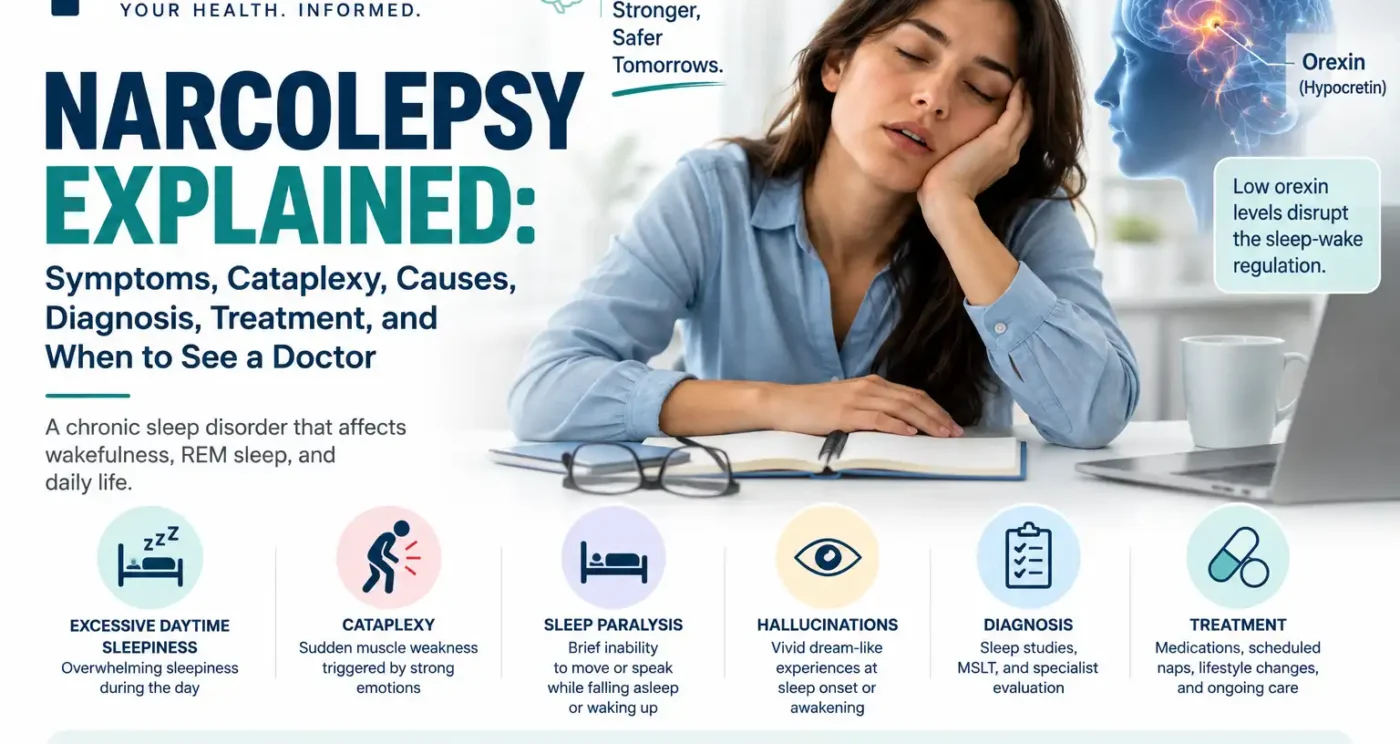
Someone with narcolepsy may get a full night’s sleep and still spend the next day fighting an overpowering urge to doze off.
It can happen during a lecture, in the middle of a conversation, while eating, at a work desk, or behind the wheel. For some people, strong laughter or surprise brings another unusual symptom: their knees suddenly buckle, their jaw goes slack, or their head drops even though they remain awake and aware.
Those experiences are very different from simply feeling tired after a late night.
Narcolepsy is a chronic neurological sleep disorder that disrupts the brain’s ability to regulate sleep and wakefulness. Excessive daytime sleepiness is its central symptom. Some people also experience cataplexy, sleep paralysis, vivid dream-like hallucinations around sleep, and broken nighttime sleep.
Narcolepsy can begin at almost any age, although symptoms often first appear during adolescence or young adulthood. Diagnosis is frequently delayed because daytime sleepiness can be blamed on school schedules, shift work, depression, poor sleep habits, medication effects, or other sleep disorders. NHLBI notes that many people with narcolepsy remain undiagnosed for years.
Treatment cannot currently erase the disorder, but it can make a substantial difference. Medication, scheduled naps, regular sleep routines, safety planning, and treatment of other sleep problems can help people stay more alert and function more safely.
The treatment landscape also changed in August 2026, when the FDA approved the first medicine that directly targets deficient orexin signaling in adults with narcolepsy type 1.
What Is Narcolepsy?
Narcolepsy is a disorder of the nervous system and sleep-wake cycle.
In a healthy sleep-wake system, the brain generally keeps wakefulness, non-REM sleep, and REM sleep in reasonably organized states.
Narcolepsy makes those boundaries less stable.
Features normally associated with REM sleep can intrude into wakefulness. Muscle tone may suddenly disappear during cataplexy. Dream-like imagery can appear while a person is only just falling asleep or waking. Sleep paralysis can briefly leave someone conscious but unable to move.
At the same time, wakefulness itself becomes difficult to sustain.
NHLBI describes narcolepsy as a chronic disorder that causes marked daytime sleepiness while also disrupting nighttime sleep.
What Are the Main Symptoms of Narcolepsy?
Not everyone experiences the same combination of symptoms.
The major features include:
- Excessive daytime sleepiness
- Unintended daytime sleep episodes or “sleep attacks”
- Cataplexy
- Sleep paralysis
- Vivid hallucinations when falling asleep or waking
- Fragmented nighttime sleep
- Automatic behavior during periods of extreme sleepiness
- Problems with concentration, school, work, or driving
Excessive daytime sleepiness is the feature shared across narcolepsy types. Cataplexy, by contrast, is primarily associated with narcolepsy type 1.
What Does Excessive Daytime Sleepiness Feel Like?
Ordinary tiredness often has an obvious explanation.
Maybe you stayed up until 2 a.m. Maybe a child kept waking you. Maybe you worked a night shift.
Narcolepsy-related sleepiness can feel different.
A person may have had what seemed like enough time in bed yet still encounter periods during the day when remaining awake becomes extremely difficult.
There may be:
- Heavy eyelids
- Reduced concentration
- Repeated yawning
- Brief lapses in attention
- An overpowering urge to sleep
- Unplanned naps
Some people wake from a short nap feeling surprisingly refreshed, although the improvement may not last very long. MedlinePlus describes sleep episodes lasting from seconds to minutes and notes that people commonly feel refreshed afterward.
Persistent daytime sleepiness is also different from fatigue. Fatigue can mean feeling drained or lacking energy without actually being able to fall asleep easily.
The distinction helps doctors narrow down what might be happening.
What Is a Narcolepsy “Sleep Attack”?
“Sleep attack” is an informal term for an episode in which the urge to sleep becomes difficult or impossible to resist.
It may occur during:
- A meal
- A conversation
- Reading
- A meeting
- Schoolwork
- Watching television
- Driving
MedlinePlus notes that episodes can happen during ordinary activities and can become particularly dangerous when they occur while driving or doing work that requires constant alertness.
The phrase can create a misleading picture, though.
Not everyone with narcolepsy instantly drops asleep without any warning. Some people first notice steadily increasing sleepiness and then lose the ability to fight it.
Others may have very brief microsleeps that are hardly obvious to the people around them.
What Is Cataplexy?
Cataplexy is one of the most distinctive symptoms associated with narcolepsy.
It is a sudden temporary loss of muscle tone triggered by emotion, generally while the person remains conscious.
Common triggers include:
- Laughter
- Excitement
- Surprise
- Anger
- Fear
- Stress
An episode can be subtle.
The jaw may loosen. The head may droop. Speech may become temporarily slurred. The knees may feel weak.
More dramatic cataplexy can cause someone to collapse to the floor.
MedlinePlus reports that cataplexy episodes often last seconds to a couple of minutes and that awareness is preserved during the event.
Does Someone Faint During Cataplexy?
Usually not.
That difference matters.
A person experiencing typical cataplexy remains aware of what is happening even though part or all of the body temporarily loses muscle strength.
Someone who faints usually loses consciousness.
A seizure may also produce loss of awareness or abnormal movements, depending on the type.
Because collapsing can have many causes, a person’s first unexplained collapse should not simply be assumed to be cataplexy.
Medical evaluation may be needed to distinguish among fainting, seizures, heart rhythm problems, cataplexy, and other conditions.
Can Laughing Make Someone With Narcolepsy Collapse?
It can trigger cataplexy in someone who has narcolepsy type 1.
Laughter itself does not cause narcolepsy.
The emotional response can trigger a short-lived loss of muscle tone in a person whose sleep-wake control system is already affected.
Someone may laugh and notice only their face or knees becoming weak.
Another person may fall completely.
The range is wide.
What Is Narcolepsy Type 1?
Narcolepsy is divided into type 1 and type 2.
Narcolepsy type 1 is associated with cataplexy and/or marked deficiency of the brain chemical hypocretin-1, also called orexin.
Current ICSD-3-TR diagnostic criteria reflected in the AASM’s 2025 quality update recognize type 1 when characteristic daytime sleepiness occurs with either appropriately documented cataplexy plus objective sleep-test findings, or sufficiently low cerebrospinal-fluid hypocretin.
Orexin is important for maintaining wakefulness and stabilizing the boundary between sleep and waking.
In most people with narcolepsy type 1, the brain cells responsible for producing orexin have been lost.
What Is Narcolepsy Type 2?
Narcolepsy type 2 also causes persistent excessive daytime sleepiness, but cataplexy is absent.
Diagnosis usually relies more heavily on the sleep history and objective sleep testing.
Under ICSD-3-TR criteria, type 2 includes daily irresistible sleepiness for at least three months, characteristic MSLT findings, absence of cataplexy, and no evidence of the marked hypocretin deficiency that defines type 1 when hypocretin is measured. Other causes must also be excluded.
Type 2 should not automatically be described as “mild narcolepsy.”
Someone can have serious daytime impairment without cataplexy.
What Is Orexin or Hypocretin?
They are two names for the same wake-regulating brain signaling system.
Orexin is produced by a relatively small population of neurons in the hypothalamus.
Its job is not simply to prevent sleep.
It helps stabilize wakefulness, sleep states, and muscle tone.
In narcolepsy type 1, loss of orexin-producing neurons leaves the brain less able to maintain those boundaries. That helps explain the unusual combination of severe daytime sleepiness, cataplexy, REM-related hallucinations, and disrupted nighttime sleep.
What Causes Narcolepsy?
There is no single explanation for every case.
For narcolepsy type 1, evidence increasingly points toward an abnormal immune process that destroys orexin-producing neurons in genetically susceptible people.
MedlinePlus Genetics notes that immune-system abnormalities are believed to contribute to the loss of these neurons, although the precise trigger is still not fully understood.
Genetics also influence susceptibility.
A variation called HLA-DQB1*06:02 has a particularly strong association with narcolepsy type 1. But carrying the variant does not mean someone will develop narcolepsy. Many people carry it and never become ill.
Environmental factors may help trigger the disease in susceptible people. Research has investigated associations with certain infections and immune responses, but there is not one infectious cause that explains every case.
Is Narcolepsy an Autoimmune Disease?
For narcolepsy type 1, an autoimmune mechanism is considered the leading explanation in many patients.
The idea is that an abnormal immune response selectively damages the neurons responsible for making orexin.
Researchers have strong biological and genetic evidence supporting that model, but the exact chain of events is not completely established in every individual.
It is therefore more accurate to say that narcolepsy type 1 is strongly believed to involve autoimmunity than to suggest that a single antibody test can prove the cause.
There is no routine autoimmune blood test used to diagnose narcolepsy.
Is Narcolepsy Genetic?
There is a genetic component, but narcolepsy is not usually inherited in a simple parent-to-child pattern.
Most cases occur in people without an affected family member.
MedlinePlus Genetics reports that a small percentage of cases cluster in families and that close relatives of people with narcolepsy type 1 have a higher risk than the general population.
Even so, genetics appears to create susceptibility, not certainty.
At What Age Does Narcolepsy Start?
Symptoms commonly become noticeable during adolescence or early adulthood.
MedlinePlus notes that symptoms often first occur between roughly 15 and 30 years of age, while NHLBI reports that about half of people with narcolepsy develop symptoms before age 18.
Narcolepsy can still begin in children or later adulthood.
Age alone cannot rule it in or out.
Can Children Have Narcolepsy?
Yes.
Recognition can be especially difficult in children.
A sleepy child may not simply fall asleep at a desk. Sleepiness can appear as:
- Irritability
- Hyperactivity
- Difficulty concentrating
- Poor school performance
- Behavioral changes
- Unusual napping
Cataplexy may look different as well.
NHLBI describes “cataplectic facies” in some children, with facial slackness, drooping eyelids, or tongue protrusion. These features may lead to confusion with seizures or fainting disorders.
A sudden decline in school performance combined with irresistible daytime sleepiness deserves a broader sleep evaluation rather than automatically being labeled laziness or poor motivation.
Can Narcolepsy Cause Sleep Paralysis?
Yes.
Sleep paralysis occurs when a person is awake or partly awake but temporarily cannot move or speak.
It often happens:
- While falling asleep
- Immediately after waking
The experience can be frightening, especially when it is accompanied by vivid dream imagery.
MedlinePlus lists sleep paralysis as a common narcolepsy feature.
There is an important limitation, though:
Sleep paralysis can occur without narcolepsy.
Someone who has an occasional episode but no meaningful daytime sleepiness does not automatically have a sleep disorder.
Can Narcolepsy Cause Hallucinations?
It can.
These hallucinations tend to occur near the boundary between sleep and waking.
Hypnagogic Hallucinations
These occur while falling asleep.
Hypnopompic Hallucinations
These occur while waking.
The experiences may involve seeing, hearing, or sensing something that feels very real even though it is part of dream-related activity intruding into wakefulness.
MedlinePlus notes that these hallucinations can be vivid and frightening.
Because they occur specifically around sleep transitions, they are not automatically evidence of a primary psychotic disorder.
Why Can Someone With Narcolepsy Sleep Poorly at Night?
This surprises many people.
If narcolepsy makes someone sleepy during the day, it might seem logical that the person would sleep deeply through the night.
Often, the opposite happens.
Narcolepsy can produce fragmented nighttime sleep, with frequent awakenings and difficulty maintaining uninterrupted sleep.
So the disorder is not best described as “sleeping too much.”
It is a problem with when and how sleep and wakefulness are regulated.
What Are Automatic Behaviors?
When someone becomes extremely sleepy, they may sometimes continue a familiar activity with reduced awareness.
They might keep:
- Typing
- Writing
- Walking
- Performing a repetitive task
Later, they may remember little of what happened or discover that what they wrote or typed makes no sense.
Automatic behavior is another example of why severe sleepiness is not harmless.
A task does not have to involve driving to create a safety problem.
Can Narcolepsy Cause Memory or Concentration Problems?
Severe sleepiness can make it difficult to maintain attention.
That can look like:
- Forgetfulness
- Poor concentration
- Slower work
- Missed parts of conversations
- Difficulty studying
- Reduced productivity
Often the problem is not that narcolepsy is damaging memory structures in the brain.
The person may simply be too sleepy to consistently encode new information in the first place.
Treating daytime sleepiness can therefore improve functional concentration for some patients.
Can Narcolepsy Be Mistaken for ADHD?
Yes, particularly in children and adolescents.
Both conditions can involve:
- Poor concentration
- Difficulty completing work
- Restlessness
- Academic problems
- Apparent inattention
The underlying mechanism is different.
Someone who is chronically sleepy may appear inattentive because they are struggling to remain awake, not because they have ADHD.
Both conditions can also coexist.
A sleep history is therefore valuable when attention problems occur alongside frequent napping, sleep attacks, cataplexy, sleep paralysis, or severe daytime sleepiness.
Can Narcolepsy Be Mistaken for Depression?
It can.
Sleepiness, low motivation, reduced social activity, poor concentration, and changes in school or work performance can overlap with depression.
Narcolepsy can also create emotional strain of its own.
MedlinePlus notes that the condition can interfere with work and social life, while NHLBI highlights its effect on quality of life and safety.
A careful evaluation should consider both sleep and mental health rather than assuming one diagnosis explains everything.
How Is Narcolepsy Diagnosed?
Narcolepsy diagnosis usually requires more than telling a clinician, “I’m tired all the time.”
The AASM’s updated 2025 quality measures emphasize a detailed history, assessment of sleep-wake patterns and sleep deprivation, symptom questionnaires or sleep diaries, and objective testing.
The evaluation may include:
- Medical history
- Medication review
- Sleep history
- Sleep diary
- Assessment of sleep duration
- Overnight polysomnography
- Multiple Sleep Latency Test
- Hypocretin testing in selected cases
Doctors also look for competing explanations such as insufficient sleep, sleep apnea, circadian rhythm disorders, medication effects, substance use, or another neurological or psychiatric condition.
Why Might You Need a Sleep Diary Before Testing?
A sleep diary can help show whether someone is actually getting enough sleep.
That sounds simple, but it matters.
A person regularly sleeping four or five hours a night can become profoundly sleepy during the day without having narcolepsy.
The AASM’s 2025 quality measures say adequate sleep should be documented, typically with a sleep diary and, when available, actigraphy for about two weeks before formal testing.
This reduces the chance of mistaking chronic sleep deprivation for a central hypersomnolence disorder.
What Happens During an Overnight Sleep Study?
A polysomnogram records sleep in a laboratory or sleep center.
Sensors can track:
- Brain waves
- Eye movements
- Muscle activity
- Breathing
- Heart rate
- Oxygen levels
The overnight study helps doctors examine sleep architecture and look for other conditions that might explain the person’s daytime sleepiness.
Sleep apnea is particularly important.
NHLBI notes that sleep apnea can coexist with narcolepsy, so severe sleepiness should not automatically be attributed to one disorder without considering the other.
What Is the Multiple Sleep Latency Test?
The Multiple Sleep Latency Test, or MSLT, usually takes place the day after an overnight sleep study.
Rather than testing how long someone can stay awake, it measures how readily the person falls asleep during several scheduled nap opportunities.
It also looks at whether REM sleep appears unusually quickly.
Under current ICSD-3-TR criteria, a typical narcolepsy pattern involves an average sleep latency of 8 minutes or less and at least two sleep-onset REM periods, with a qualifying REM period from the preceding overnight study sometimes counting toward that total.
Those numbers are diagnostic criteria for trained clinicians—not a home screening test.
Medication effects, insufficient sleep, shift work, and other conditions can alter the result.
What Is a Sleep-Onset REM Period?
REM sleep usually appears after someone has been asleep for a while.
In narcolepsy, REM sleep can appear abnormally early.
A sleep-onset REM period, often shortened to SOREMP, means REM begins very soon after sleep starts.
That tendency helps explain several narcolepsy symptoms.
Dream imagery may spill into the transition between waking and sleeping. REM-related muscle paralysis can appear during sleep paralysis. And in type 1, emotion-triggered loss of muscle tone resembles part of the REM muscle-control system appearing while a person is awake.
What Is a Hypocretin Test?
Orexin, or hypocretin, can be measured in cerebrospinal fluid.
Obtaining cerebrospinal fluid requires a lumbar puncture, commonly called a spinal tap.
Very low hypocretin-1 can establish narcolepsy type 1 in the appropriate clinical setting.
Current ICSD-3-TR criteria use a threshold of 110 pg/mL or less with a standardized assay, or less than one-third of normal mean values, depending on the laboratory method.
Not everyone with suspected narcolepsy needs a lumbar puncture.
It is generally used selectively when it can clarify the diagnosis.
Can a Blood Test Diagnose Narcolepsy?
No routine blood test can confirm it.
Blood work may instead help doctors look for other causes of sleepiness, such as thyroid disease or anemia.
Genetic testing for HLA variants can show susceptibility, but it is not specific enough to prove someone has narcolepsy.
That is because many people carry associated HLA variants without developing the disorder.
What Conditions Can Look Like Narcolepsy?
Excessive daytime sleepiness has many possible causes.
Conditions that may need consideration include:
- Chronic sleep deprivation
- Obstructive sleep apnea
- Idiopathic hypersomnia
- Circadian rhythm sleep disorders
- Sedating medications
- Alcohol or substance effects
- Depression
- Thyroid disorders
- Restless legs syndrome
- Certain neurological disorders
- Seizure disorders
MedlinePlus specifically notes that sleep apnea, insomnia, restless legs syndrome, seizures, and other medical or psychiatric disorders may need to be considered during evaluation.
Narcolepsy vs. Idiopathic Hypersomnia: What Is the Difference?
Both can cause severe daytime sleepiness.
Narcolepsy has a stronger association with REM-related features such as:
- Cataplexy
- Sleep-onset REM periods
- Sleep paralysis
- Hypnagogic or hypnopompic hallucinations
People with idiopathic hypersomnia may instead have very long sleep times, pronounced sleep inertia, and difficulty feeling refreshed even after substantial sleep.
There can be overlap, and distinguishing these conditions depends on specialist evaluation rather than symptom matching alone.
Is Narcolepsy Curable?
There is currently no established cure.
Narcolepsy is generally a lifelong condition.
That does not mean symptoms remain equally severe throughout life.
Treatment can improve alertness, reduce cataplexy, improve nighttime sleep, and make daily activities safer.
Cataplexy may also become less frequent in some people over time.
How Is Narcolepsy Treated?
Treatment is built around the symptoms that create the greatest problems for the individual.
A person with severe excessive daytime sleepiness but no cataplexy may need a different plan from someone who has frequent falls from cataplexy.
Broadly, treatment can involve:
| Treatment area | Main purpose |
|---|---|
| Wake-promoting medication | Improve daytime alertness |
| Cataplexy-directed medication | Reduce episodes of muscle weakness |
| Oxybate therapy | May improve cataplexy, daytime sleepiness, and nighttime sleep |
| Scheduled naps | Temporarily improve alertness |
| Consistent sleep schedule | Reduce avoidable sleep disruption |
| Safety planning | Reduce driving and workplace injury risk |
| Treatment of other sleep disorders | Address additional causes of sleepiness |
The AASM’s evidence-based treatment guideline strongly supports several established medications for adults, including modafinil, pitolisant, sodium oxybate, and solriamfetol. Treatment still needs to be individualized according to symptoms, health conditions, side effects, and patient preferences.
What Changed in Narcolepsy Treatment in 2026?
A major change occurred on August 5, 2026.
The FDA approved Orzeyful (oveporexton) for adults with narcolepsy type 1. It is the first approved therapy designed to directly activate the orexin-2 receptor and compensate for the missing orexin signaling that underlies narcolepsy type 1.
Earlier narcolepsy medications primarily addressed individual symptoms such as sleepiness or cataplexy.
Oveporexton was studied across a broader collection of type 1 symptoms. In two 12-week trials involving 273 adults, FDA reported improvements in daytime wakefulness, self-reported sleepiness, cataplexy, and additional symptoms such as sleep paralysis and disrupted nighttime sleep.
The FDA also noted common adverse effects including insomnia, increased urinary frequency or urgency, and increased saliva production. Its safety and effectiveness have not been established in patients younger than 18.
Because this approval is extremely recent, patients should use current prescribing information and discuss availability, suitability, interactions, and regulatory requirements with their sleep specialist rather than assuming it replaces every existing treatment.
What Are Wake-Promoting Medicines?
These medications are intended to improve alertness during the day.
Current AASM treatment guidance includes options such as:
- Modafinil
- Pitolisant
- Solriamfetol
- Certain stimulant medications
- Other therapies selected according to individual circumstances
The right medication depends on much more than which one sounds strongest.
Doctors may consider blood pressure, heart history, other medications, pregnancy plans, psychiatric symptoms, occupation, response to previous therapy, and the particular narcolepsy symptoms that remain uncontrolled.
What Is Oxybate Treatment?
Oxybate medicines are taken to help manage narcolepsy symptoms and can be particularly useful for cataplexy and excessive daytime sleepiness.
Some formulations also improve disrupted nighttime sleep.
Sodium oxybate has long been used for narcolepsy, and AASM guidance strongly recommends it as an evidence-based option for appropriate adults.
Oxybate treatment requires careful prescribing because it depresses the central nervous system.
It should not be casually combined with alcohol, sedative-hypnotic medicines, or certain other CNS depressants. FDA labeling warns that those combinations can intensify CNS and respiratory depression.
This is one area where medication instructions need to come from the prescriber rather than from general online advice.
Are Antidepressants Used for Cataplexy?
Sometimes.
Certain antidepressants alter REM-related signaling and can reduce cataplexy, sleep paralysis, or sleep-related hallucinations in selected patients.
Using one for cataplexy does not mean the clinician believes cataplexy is caused by depression.
The medication is being used because of its effect on the neurological systems involved in REM sleep and muscle tone.
Do Scheduled Naps Help Narcolepsy?
They often do.
A brief planned nap can provide a period of improved alertness for some people.
NHLBI and MedlinePlus both include scheduled daytime naps as part of practical narcolepsy management.
The word scheduled matters.
A planned nap before a predictable period of sleepiness is safer and more useful than repeatedly falling asleep unintentionally.
Naps usually complement treatment rather than replacing it when daytime sleepiness is severe.
What Lifestyle Changes Can Help?
Lifestyle measures cannot replace orexin or cure narcolepsy, but they can make treatment work better.
Helpful habits may include:
- Keeping a consistent bedtime
- Waking at a similar time every day
- Planning short naps
- Getting regular exercise
- Avoiding chronic sleep deprivation
- Reviewing sedating medications with a clinician
- Avoiding alcohol when it worsens sleepiness or conflicts with treatment
- Creating a safer routine around predictable periods of sleepiness
NHLBI recommends regular sleep timing, scheduled daytime naps, and avoiding substances or medicines that worsen sleepiness.
Can People With Narcolepsy Drive?
Some can.
Others should not drive until symptoms are better controlled.
The issue is not the diagnosis alone; it is whether the person can reliably remain awake and alert enough to operate a vehicle safely.
MedlinePlus notes that driving restrictions vary by jurisdiction and that clinicians may recommend avoiding driving based on symptom control.
A person who repeatedly becomes drowsy or falls asleep while driving should stop driving and seek medical evaluation rather than trying to overcome the problem with music, open windows, energy drinks, or willpower.
Those strategies do not reliably neutralize severe sleepiness.
What About Long Drives?
Even someone whose symptoms are reasonably controlled may need a specific driving plan.
Depending on medical advice, that could involve:
- Avoiding driving during known sleepy periods
- Taking a planned nap before travel
- Limiting continuous driving time
- Sharing driving
- Stopping immediately when sleepiness appears
Rules governing driver’s licenses and narcolepsy vary by location, so legal requirements should also be checked locally.
Can Narcolepsy Affect Work or School?
Yes, often substantially.
A student who falls asleep in class may be interpreted as uninterested.
An employee may appear inattentive during meetings.
Someone working with machinery may face a genuine safety problem.
Narcolepsy can affect:
- Attendance
- Academic performance
- Concentration
- Productivity
- Driving
- Shift-work tolerance
- Workplace safety
- Social life
AASM’s updated quality measures emphasize assessing function, not simply counting symptoms.
Appropriate accommodations may include scheduled rest breaks, a safe place for planned naps, or changes to work or school schedules depending on individual needs and applicable law.
Can Narcolepsy Cause Weight Gain?
Weight problems are relatively common, particularly in narcolepsy type 1.
NHLBI notes that obesity occurs frequently among people with narcolepsy.
Orexin is involved in more than sleep. It interacts with metabolism, activity, and energy regulation.
Still, narcolepsy does not mean weight gain is inevitable.
Weight can also be influenced by medication, activity, diet, other health conditions, and individual metabolism.
Can Narcolepsy Get Worse?
Symptoms can change over time.
Cataplexy may become more or less frequent. Treatment response can change. Weight, other sleep disorders, medications, work schedules, or aging can alter how daytime sleepiness is experienced.
AASM’s current quality measures recommend reassessing symptoms and daily function after pharmacologic treatment begins and continuing follow-up over time.
A medication that worked several years ago does not automatically remain the best plan forever.
When Should You See a Doctor for Possible Narcolepsy?
Consider medical evaluation when daytime sleepiness has become difficult to explain or difficult to control.
Particularly useful clues include:
- Falling asleep unintentionally during the day
- Regularly struggling to stay awake despite adequate opportunity for nighttime sleep
- Sleepiness interfering with work or school
- Emotion-triggered episodes of muscle weakness
- Frequent sleep paralysis together with severe daytime sleepiness
- Vivid hallucinations around falling asleep or waking
- Repeated near-misses while driving because of sleepiness
- Needing frequent naps just to function normally
One isolated episode of sleep paralysis is not enough to diagnose narcolepsy.
Neither is feeling tired during a week of poor sleep.
What deserves attention is a persistent pattern.
Which Doctor Treats Narcolepsy?
A sleep-medicine specialist commonly leads the evaluation.
Sleep physicians may originally train in fields such as:
- Neurology
- Pulmonary medicine
- Internal medicine
- Psychiatry
- Pediatrics
A specialist can determine whether formal overnight testing, MSLT, medication changes, or additional evaluation is appropriate.
If you’re preparing for a sleep-specialist visit, bringing a timeline of symptoms, medication list, work or school schedule, and notes about naps or episodes can make the appointment more useful. MedIntelHub’s specialist-visit guide offers a framework for organizing those questions. How to Prepare Questions Before a Specialist Appointment
Can Narcolepsy Be Diagnosed During an Annual Physical?
A primary-care visit can be a good place to start the conversation, especially if daytime sleepiness has been affecting daily life.
But confirming narcolepsy usually requires more specialized evaluation and objective sleep testing.
Persistent sleep attacks or dangerous daytime sleepiness therefore should not simply wait months for the next routine preventive checkup.
MedIntelHub’s annual physical guide explains how a preventive visit differs from evaluation of a new medical problem. Understanding Your Annual Physical: What Actually Gets Checked
When Is Narcolepsy an Emergency?
Narcolepsy itself usually develops chronically rather than creating a sudden medical emergency.
The situations surrounding it can be dangerous.
Seek urgent help when:
- Someone has fallen asleep while driving or cannot stay awake enough to drive safely
- A collapse causes a serious injury
- A person loses consciousness during an episode that was assumed to be cataplexy
- A first seizure occurs
- New one-sided weakness or speech difficulty develops
- Severe breathing difficulty occurs
- A medication reaction appears serious
- A sudden neurological episode does not resemble the person’s usual symptoms
A new unexplained collapse deserves evaluation.
Not every fall in someone with narcolepsy is cataplexy.
Narcolepsy Symptoms at a Glance
| Symptom | How It May Appear |
|---|---|
| Excessive daytime sleepiness | Persistent difficulty staying awake |
| Sleep attacks | Unintended sleep during daytime activities |
| Cataplexy | Emotion-triggered temporary muscle weakness with preserved awareness |
| Sleep paralysis | Temporary inability to move while falling asleep or waking |
| Sleep-related hallucinations | Vivid perceptions at sleep onset or awakening |
| Fragmented nighttime sleep | Frequent awakenings despite daytime sleepiness |
| Concentration difficulties | Problems staying attentive because of sleepiness |
| Automatic behavior | Continuing familiar tasks while partly asleep or poorly aware |
Not everyone experiences every feature.
Frequently Asked Questions
What Are the First Signs of Narcolepsy?
Excessive daytime sleepiness is often the earliest and most persistent symptom.
Someone may begin taking unplanned naps, struggling to stay awake during passive activities, or feeling refreshed briefly after short periods of sleep.
Cataplexy can develop around the same time or later in people with type 1 narcolepsy.
What Does Narcolepsy Feel Like?
Many people describe a powerful need to sleep that is difficult to resist.
They may also experience fragmented nighttime sleep, sleep paralysis, vivid dreams or hallucinations near sleep, and, in type 1, cataplexy.
Do People With Narcolepsy Suddenly Fall Asleep?
Some do have unexpected sleep episodes.
Others experience warning sleepiness before falling asleep.
Narcolepsy does not always look like a person suddenly collapsing asleep mid-sentence.
What Is Cataplexy?
Cataplexy is sudden muscle weakness triggered by emotion, usually with consciousness preserved.
It can range from mild facial or knee weakness to complete collapse.
Can Laughter Trigger Cataplexy?
Yes.
Laughter is a well-known emotional trigger in people who experience cataplexy.
Are You Conscious During Cataplexy?
Usually, yes.
Preserved awareness is one of the features that helps distinguish typical cataplexy from fainting.
Can You Have Narcolepsy Without Cataplexy?
Yes.
Narcolepsy type 2 occurs without cataplexy.
Does Sleep Paralysis Mean You Have Narcolepsy?
No.
Sleep paralysis is more common in narcolepsy, but people without narcolepsy can experience it too.
Can Narcolepsy Cause Hallucinations?
Yes.
Vivid hallucinations can appear while falling asleep or waking because dream-related REM activity intrudes into the sleep-wake transition.
Do People With Narcolepsy Sleep All Day?
No.
They may have severe daytime sleepiness but also fragmented nighttime sleep.
Narcolepsy is better understood as unstable sleep-wake regulation rather than simply excessive total sleep.
How Is Narcolepsy Tested?
Evaluation often includes a detailed sleep history, documentation of adequate sleep, an overnight polysomnogram, and a daytime Multiple Sleep Latency Test.
CSF hypocretin testing may be used in selected cases.
What Is an MSLT?
The Multiple Sleep Latency Test measures how quickly someone falls asleep across several daytime nap opportunities and whether REM sleep begins unusually soon.
Can a Blood Test Diagnose Narcolepsy?
No routine blood test confirms narcolepsy.
Blood tests may help exclude other causes of sleepiness, while genetic testing shows susceptibility rather than proving the diagnosis.
Is Narcolepsy an Autoimmune Disease?
Narcolepsy type 1 is strongly believed to involve autoimmune destruction of orexin-producing neurons in many patients, although the exact initiating event is not completely understood.
Is Narcolepsy Inherited?
Usually not in a simple inheritance pattern.
Genetic susceptibility contributes, but most cases occur sporadically.
Is Narcolepsy Curable?
There is currently no established cure.
Treatment can substantially improve symptoms and everyday function.
What Medicines Are Used for Narcolepsy?
Treatment options can include wake-promoting medicines, stimulants, pitolisant, solriamfetol, oxybate therapies, and other medications selected according to symptoms.
In August 2026, the FDA also approved oveporexton for adults with narcolepsy type 1.
What Is Oveporexton?
Oveporexton, marketed as Orzeyful, is an orexin-2 receptor agonist approved by the FDA in August 2026 for adults with narcolepsy type 1.
Unlike older treatments that primarily target individual symptoms, it directly addresses the deficient orexin signaling underlying type 1 narcolepsy.
Do Naps Help Narcolepsy?
Scheduled short naps can improve alertness for many people.
They are commonly used alongside medication and a regular nighttime sleep schedule.
Can People With Narcolepsy Drive?
Some people can drive when their symptoms are adequately controlled.
Others may need restrictions.
Driving laws vary, and someone who cannot reliably stay awake should not drive until the situation has been medically addressed.
Is Narcolepsy a Disability?
Narcolepsy can substantially interfere with school, employment, transportation, and daily activities.
Whether it meets a legal definition of disability depends on symptom severity, functional limitations, occupation, and the applicable laws or benefits program.
Conclusion
Narcolepsy is easy to misunderstand because its most recognizable symptom—sleepiness—is something everyone experiences.
The difference is intensity and control.
Someone with narcolepsy may struggle to maintain wakefulness despite giving themselves a reasonable opportunity to sleep. Short unintended naps may interrupt ordinary activities. Nighttime sleep can be broken rather than restorative.
Then there are the symptoms that make narcolepsy particularly distinctive.
A person with type 1 disease may remain fully conscious while laughter causes their knees to buckle. Dream-like hallucinations can appear before sleep has fully begun. Sleep paralysis can leave someone awake but unable to move for a short period.
These symptoms arise because the normal boundary between waking and REM sleep has become unstable. In narcolepsy type 1, that instability is closely tied to loss of the brain’s orexin-producing neurons.
Diagnosis requires more than a questionnaire or symptom search.
AASM’s current quality standards emphasize reviewing sleep patterns and possible alternative explanations and obtaining appropriate objective testing. For many patients, that means an overnight sleep study followed by an MSLT.
Treatment has also moved forward.
Established medications can improve daytime alertness, cataplexy, or nighttime sleep. Scheduled naps and consistent sleep habits remain useful parts of care. And in August 2026, FDA approval of oveporexton introduced the first treatment designed to directly restore missing orexin signaling in adults with narcolepsy type 1.
The condition is still lifelong, but lifelong does not mean untreatable.
For someone who repeatedly falls asleep unintentionally, struggles to stay awake despite adequate sleep, or experiences emotion-triggered muscle weakness, evaluation by a sleep specialist can answer a much more useful question than “Why am I always tired?”
It can determine whether the brain’s sleep-wake system itself is the problem.
Resources
National Heart, Lung, and Blood Institute — Narcolepsy
NHLBI covers symptoms, narcolepsy types, causes, diagnostic testing, lifestyle management, and safety considerations.
MedlinePlus — Narcolepsy
The National Library of Medicine provides patient-focused information about sleep attacks, cataplexy, sleep paralysis, diagnosis, treatment, and driving concerns.
MedlinePlus Genetics — Narcolepsy
This resource explains the relationship among orexin loss, immune mechanisms, genetic susceptibility, and the two major narcolepsy types.
MedlinePlus Genetics: Narcolepsy
American Academy of Sleep Medicine — 2025 Narcolepsy Quality Measures
AASM’s updated quality measures cover diagnosis, objective sleep assessment, treatment, symptom monitoring, functional outcomes, and follow-up.
AASM: Quality Measures for Narcolepsy, 2025 Update
American Academy of Sleep Medicine — Treatment Guideline
The AASM treatment guideline addresses evidence-based pharmacologic options for central disorders of hypersomnolence, including narcolepsy.
AASM: Treatment of Central Disorders of Hypersomnolence
FDA — 2026 Oveporexton Approval
FDA’s August 2026 announcement explains the approval of oveporexton for adults with narcolepsy type 1 and its novel orexin-targeting mechanism.
FDA: Oveporexton Approval for Narcolepsy Type 1
MedIntelHub — Preparing for a Specialist Appointment
A practical guide for organizing symptoms, medications, previous testing, and questions before a sleep-medicine consultation.
How to Prepare Questions Before a Specialist Appointment
MedIntelHub — Understanding Your Annual Physical
Explains why persistent daytime sleepiness may need a problem-focused evaluation instead of waiting for the next routine preventive visit.
Understanding Your Annual Physical: What Actually Gets Checked
MedIntelHub — Editorial Policy
For more information about MedIntelHub’s approach to medical sourcing, accuracy, transparency, and healthcare education:
Editorial Disclaimer
This article is intended for general education and information only. It does not diagnose narcolepsy, cataplexy, idiopathic hypersomnia, sleep apnea, seizures, or another neurological or sleep disorder.
Excessive daytime sleepiness can result from insufficient sleep, medications, sleep apnea, depression, circadian rhythm disorders, medical illness, and many other causes. Sleep paralysis or vivid sleep-related hallucinations alone do not establish a diagnosis of narcolepsy.
Narcolepsy treatment must be individualized. Prescription medicines can have important side effects, drug interactions, cardiovascular considerations, sedating effects, or other safety requirements. Do not start, stop, combine, or change narcolepsy medication based on this article.
Driving and workplace safety require particular attention. Anyone who cannot reliably remain awake while driving should stop driving and seek medical advice rather than trying to compensate with caffeine, music, open windows, or similar strategies.
A new unexplained collapse, loss of consciousness, first seizure, severe breathing problem, major injury, or sudden neurological deficit should receive urgent medical evaluation rather than automatically being attributed to narcolepsy or cataplexy.

David Bennett
David Bennett is an author at MedIntelHub, where he creates clear, practical, and well-researched content about healthcare, medical billing, insurance, and patient education. His goal is to make complex healthcare topics easier for readers to understand and use in everyday situations. David emphasizes accuracy, transparency, and reliable sourcing, using information from trusted organizations and official healthcare resources whenever possible. Content published by David is intended for educational purposes and should not replace advice from qualified medical, legal, or healthcare professionals.