Ben Affleck has spoken publicly about alcohol addiction, treatment, relapse, and recovery for more than two decades.
His experience has included residential treatment, outpatient care, periods of sobriety, and a publicly acknowledged setback. More recently, he has described recovery as part of his life rather than something he wants to define his entire public identity.
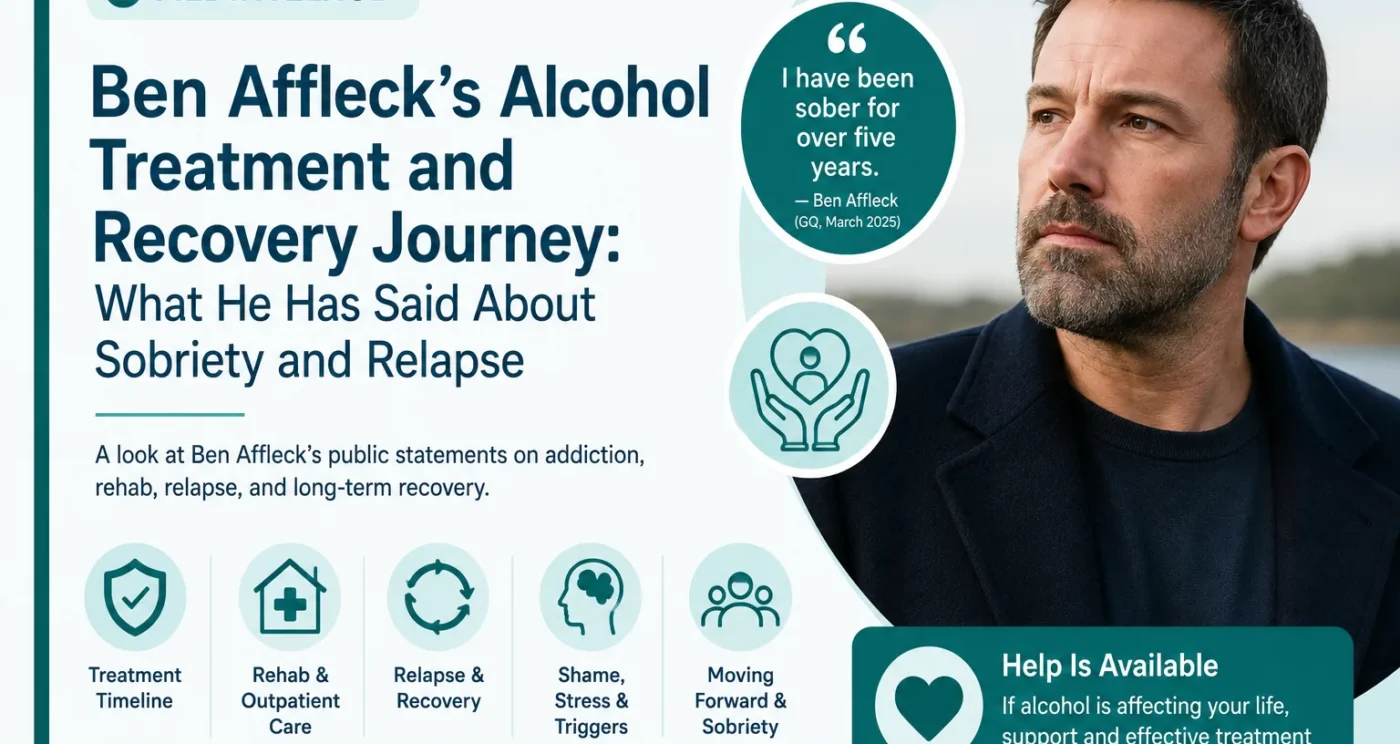
In a March 2025 interview with GQ, Affleck said he had been sober for more than five years. He also explained that his own experience with alcohol recovery helped him bring something personal to his performance in The Way Back, but that sobriety was no longer the central focus of his life.
His experience is personal and should not be treated as a blueprint for everyone dealing with alcohol-related problems. Still, several themes in his public comments reflect what addiction specialists recognize about alcohol use disorder, or AUD: treatment may happen more than once, setbacks can occur, care may continue after residential treatment, and recovery can extend far beyond leaving a rehabilitation facility.
Ben Affleck’s Public History With Alcohol Treatment
Affleck’s publicly documented history of seeking help for alcohol problems goes back to 2001.
That year, the Associated Press, in a report published by CBS News, said Affleck voluntarily entered a live-in rehabilitation facility in Malibu for alcohol abuse. His representative said at the time that Affleck had chosen to seek professional help and wanted to move toward a healthier life without alcohol.
Over the years, he has discussed alcohol treatment and recovery publicly on several occasions.
| Year | Publicly Reported Development |
|---|---|
| 2001 | Affleck entered a residential treatment facility for alcohol-related problems. |
| 2017 | He publicly announced that he had completed treatment for alcohol addiction. |
| 2018 | He returned to residential treatment and later said he had completed a 40-day stay and was continuing outpatient care. |
| 2019 | A widely reported drinking episode occurred after a period of sobriety; he later discussed the setback publicly. |
| 2020 | In interviews connected with The Way Back, he spoke about addiction, relapse, shame, and recovery. |
| 2025 | Affleck told GQ that he had been sober for more than five years. |
These dates come from Affleck’s own public statements and reporting by established news organizations. They should not be interpreted as a complete medical history.
Ben Affleck’s First Publicly Reported Rehab Stay in 2001
Affleck entered a live-in rehabilitation facility in August 2001 for alcohol abuse.
The decision was described as voluntary. His representative said Affleck had chosen professional assistance and wanted to pursue a healthier life without alcohol.
In a 2003 interview, Affleck later described residential treatment as something he believed would give him a better chance of changing his drinking than trying to do it on his own.
This early treatment episode matters because his later treatment in 2017 and 2018 was not his first experience seeking help.
Completing Alcohol Treatment in 2017
In March 2017, Affleck publicly announced that he had completed treatment for alcohol addiction.
He described it as an issue he had dealt with before and expected to continue addressing. He also characterized completing treatment as one step in a broader recovery process and said he wanted his children to understand that seeking help was not something to be ashamed of.
That idea is consistent with the way alcohol use disorder is treated medically today.
The National Institute on Alcohol Abuse and Alcoholism, or NIAAA, defines AUD as a medical condition involving difficulty stopping or controlling alcohol use despite harmful social, occupational, or health consequences. AUD can range from mild to severe.
NIAAA: Understanding Alcohol Use Disorder
Returning to Treatment in 2018
Affleck returned to residential treatment in August 2018.
In October, he said he had completed a 40-day stay at a treatment center and was continuing outpatient care. He also described addiction treatment as an ongoing commitment rather than something a person simply finishes once.
That distinction is important.
A residential stay can be one stage of alcohol treatment, but leaving a facility does not necessarily mean that treatment or recovery is complete.
NIAAA describes AUD recovery as an individualized process that may involve continuing treatment, changes in care intensity, and improvements in physical health, mental health, relationships, and overall well-being.
Residential Treatment vs. Outpatient Alcohol Treatment
Celebrity coverage can create the impression that “rehab” is the standard treatment for every alcohol problem.
It is not.
NIAAA describes several levels and settings of care, including outpatient treatment, intensive outpatient or partial hospitalization, residential care, and intensive inpatient treatment. Many people can receive effective care while continuing to live at home.
Treatment may involve:
- Primary care
- Addiction medicine
- Individual counseling
- Group or family therapy
- Intensive outpatient programs
- Residential treatment
- Hospital-based care when needed
- Medication
- Telehealth treatment
- Mutual-support programs
Which level is appropriate depends on the person’s alcohol use, withdrawal risk, physical and mental health, home environment, previous treatment, and other individual circumstances.
Residential care is one treatment option. It is not the definition of alcohol treatment.
What Ben Affleck Has Said About Relapse
Recovery does not always follow a straight line.
Affleck has spoken publicly about setbacks in his sobriety. A widely reported drinking episode occurred in 2019, and he later discussed relapse and the embarrassment associated with it in interviews surrounding The Way Back.
In 2020, he also spoke about the harm of becoming consumed by shame and self-criticism after mistakes.
The broader idea is consistent with current addiction medicine.
NIAAA defines relapse as a return to drinking after a period of abstinence and notes that relapse is common during recovery. Stress and exposure to people, places, or situations associated with past drinking can increase vulnerability.
Does Relapse Mean Alcohol Treatment Failed?
Not necessarily.
NIAAA describes relapse as a potential setback rather than automatic proof that treatment has failed. A return to drinking can indicate that the treatment plan needs to be reassessed or strengthened.
Depending on the circumstances, a treatment professional may reconsider:
- Counseling frequency
- Medication
- Level of care
- Recovery supports
- Strategies for managing triggers
- Family or social support
- Treatment of other mental health conditions
Some people may need more intensive treatment after a relapse. Others may need relatively small adjustments to an existing plan.
The important point is that a setback does not erase all previous progress.
What Affleck Has Said About Shame and Recovery
Shame is another theme Affleck has discussed publicly.
During interviews around The Way Back, he spoke about regret and the emotional consequences of addiction while also emphasizing the importance of learning from mistakes rather than remaining trapped in self-loathing.
That distinction can be useful in understanding treatment.
Accountability and shame are not the same thing.
Evidence-based care can help a person understand the consequences of alcohol use, recognize triggers, build coping strategies, improve relationships, and prepare for situations that increase relapse risk.
Treatment does not mean pretending harmful behavior never happened. It focuses on making meaningful changes and reducing the likelihood that those patterns continue.
Alcohol, Stress, and Relapse
Affleck has discussed periods of his life in which his drinking became worse while he was experiencing significant personal difficulties.
That does not establish one single cause for his alcohol problems, and it would be inappropriate to diagnose the reasons for another person’s addiction from interviews.
More generally, however, stress is a recognized relapse trigger.
NIAAA notes that people recovering from alcohol problems may be particularly vulnerable during stressful periods or when exposed to people or situations connected with previous drinking.
Behavioral treatment can help people identify those triggers and develop other ways to respond.
Ben Affleck and The Way Back
Affleck’s recovery became particularly visible around the release of the 2020 film The Way Back.
He plays a former basketball player whose life has been heavily affected by alcohol.
The film is fictional, and the character’s story is not Affleck’s biography. Affleck has nevertheless said that his own experience with alcohol and recovery helped him understand part of the character’s emotional life.
In his 2025 GQ interview, he also explained that taking the role meant knowing he would have to discuss his recovery publicly, even though he had no desire to become a public spokesperson for people in recovery.
What Ben Affleck Has Said About Sobriety More Recently
The clearest recent public statement located for this article comes directly from Affleck.
In the March 25, 2025 GQ profile, he said he had been sober for more than five years. He added that sobriety was no longer at the forefront of his mind or the central preoccupation of his life.
GQ: Inside Ben Affleck’s Plan to Remake Hollywood
That wording matters.
The accurate statement is:
In March 2025, Ben Affleck told GQ that he had been sober for more than five years.
It would be inappropriate to turn that dated public statement into speculation about his private health or alcohol use afterward.
What Is Alcohol Use Disorder?
Alcohol use disorder is the medical term used for a pattern of alcohol use in which a person has difficulty controlling drinking despite negative consequences.
Clinicians consider a set of symptoms that can include drinking more than intended, repeated unsuccessful attempts to cut down, strong cravings, continuing to drink despite problems, giving up important activities, tolerance, and withdrawal. The severity of AUD is classified according to how many diagnostic criteria are present during a 12-month period.
Only a qualified healthcare professional can diagnose AUD in an individual.
How Is Alcohol Use Disorder Treated?
There is no single treatment plan that is right for everyone.
Evidence-based AUD care can include behavioral treatment, medications, mutual-support groups, and different levels of outpatient or residential care. Treatment can also change over time as a person’s needs change.
The goal is to develop a plan that fits the person’s drinking pattern, health, withdrawal risk, treatment goals, support system, and other circumstances.
Behavioral Therapy for Alcohol Use Disorder
Behavioral treatments help people change drinking patterns and develop skills that support recovery.
Evidence-based approaches described by NIAAA include:
- Cognitive behavioral therapy
- Motivational enhancement therapy
- Acceptance- and mindfulness-based approaches
- Contingency management
- Couples or family counseling
- Twelve-step facilitation
Therapy may help someone recognize triggers, respond to cravings, manage stress, improve communication, and develop alternatives to drinking.
Treatment can be provided individually, in groups, with family members, or through a combination of approaches.
Are There Medications for Alcohol Use Disorder?
Yes.
Three medications are currently FDA-approved for AUD:
| Medication | General Role |
|---|---|
| Naltrexone | Can reduce the rewarding effects of alcohol and help reduce heavy drinking or cravings |
| Acamprosate | Can help support abstinence after a person stops drinking |
| Disulfiram | Produces an unpleasant reaction if alcohol is consumed, helping discourage drinking |
NIAAA identifies acamprosate, naltrexone, and disulfiram as the three FDA-approved medications for AUD and notes that approved AUD medications are nonaddictive.
Medication is not appropriate for every person.
A clinician should consider factors such as current drinking, liver or kidney health, other medications, medical history, and treatment goals.
Does Everyone With Alcohol Problems Need Rehab?
No.
This is one of the biggest misconceptions about alcohol treatment.
NIAAA notes that most people who receive AUD treatment do not necessarily need residential rehab. Many begin with outpatient counseling, medication, or care from a therapist, addiction specialist, or primary care clinician.
Residential treatment can be valuable when someone needs more structure, has an unstable living environment, has a more severe disorder, or requires closer clinical support.
The appropriate setting should come from an individualized professional assessment rather than from assumptions based on celebrity treatment stories.
Detox Is Not the Same as Long-Term Treatment
People who drink heavily over a prolonged period can become physically dependent on alcohol.
Abruptly stopping can then produce alcohol withdrawal.
Possible withdrawal symptoms include tremors, sweating, anxiety, nausea, sleep problems, elevated heart rate and blood pressure, seizures, and, in severe cases, delirium tremens.
Severe alcohol withdrawal can be life-threatening. NIAAA specifically advises that people with severe AUD may need medical help when stopping alcohol.
Some people therefore need medically supervised withdrawal management, sometimes called detoxification.
But detox is only the initial management of withdrawal. It is not, by itself, long-term treatment for AUD. NIAAA notes that people who complete detox without additional treatment are much more likely to return to drinking.
Anyone who may be physically dependent on alcohol should seek medical advice before abruptly stopping.
Why Continuing Care Matters
Affleck’s 2018 statement that he was continuing outpatient treatment after completing residential care reflects an important principle in addiction medicine: treatment often continues after someone leaves a facility.
Ongoing care can involve counseling, medication, follow-up appointments, mutual-support groups, family involvement, relapse-prevention planning, and treatment of co-occurring conditions.
NIAAA describes AUD recovery as dynamic and individualized rather than as a single event.
Recovery therefore should not be measured only by whether someone has completed a specific program.
Mental Health and Alcohol Treatment Can Overlap
Alcohol problems do not occur in isolation for every patient.
Depression, anxiety, trauma-related symptoms, sleep problems, and other mental health concerns can occur alongside AUD. NIAAA notes that treatment plans may need to address both alcohol use and co-occurring psychiatric conditions.
Primary care can also be an important place to identify these concerns.
MedIntelHub’s guide to mental health screening in primary care explains why clinicians may ask about mood, anxiety, stress, sleep, alcohol, and substance use during routine healthcare encounters.
MedIntelHub: Mental Health Screenings in Primary Care
What Can Ben Affleck’s Experience Tell Us About Recovery?
Celebrity experiences have limits.
Affleck has access to resources and treatment options that may not be available to everyone, so his history should not be used as a template for how another person’s recovery ought to look.
Still, several themes in his public comments overlap with evidence-based addiction care.
Getting Help May Happen More Than Once
Affleck sought treatment on multiple occasions.
Similarly, AUD treatment may need to be adjusted, restarted, or intensified when circumstances change. NIAAA describes recovery as an ongoing process that can include setbacks.
A Setback Does Not Erase Previous Progress
Affleck has publicly discussed relapse.
NIAAA likewise notes that relapse can be an opportunity to reevaluate a treatment plan rather than a reason to conclude that recovery has failed.
Treatment Can Continue After Residential Care
Affleck continued outpatient treatment after his 2018 residential stay.
This reflects the broader role of continuing care in AUD treatment.
Recovery Does Not Have to Become Someone’s Entire Identity
In 2025, Affleck said that sobriety was no longer the central preoccupation of his life.
Recovery can involve improvement in health, relationships, work, purpose, and quality of life—not only tracking the time since a person’s last drink. NIAAA similarly describes recovery as extending beyond alcohol use alone.
When Should Someone Seek Help for Alcohol Use?
It may be time to talk with a healthcare professional when alcohol begins interfering with health, relationships, work, school, finances, safety, sleep, or responsibilities.
Other warning signs can include repeatedly drinking more than intended, strong cravings, difficulty cutting down, needing more alcohol to get the same effect, or developing withdrawal symptoms.
People do not need to wait until alcohol-related problems become a crisis before seeking help.
A primary care appointment can be one place to start. MedIntelHub’s annual physical guide notes that preventive care may include conversations about alcohol and other substance use.
MedIntelHub: Understanding Your Annual Physical
How Can Someone Find Alcohol Treatment?
NIAAA provides a free Alcohol Treatment Navigator designed to help people compare evidence-based care options.
It includes treatment programs, therapists, addiction physicians, outpatient services, residential programs, telehealth options, and programs that provide AUD medications.
NIAAA Alcohol Treatment Navigator
SAMHSA also operates a free, confidential, 24/7 treatment-referral helpline at 1-800-662-HELP (4357) for people and families looking for mental health or substance-use treatment information.
SAMHSA: Mental Health and Substance Use Helplines
Frequently Asked Questions
When Did Ben Affleck First Enter Rehab for Alcohol?
Affleck’s first publicly reported residential treatment for alcohol-related problems occurred in 2001. CBS News, citing the Associated Press, reported that he voluntarily entered a live-in rehabilitation facility that August.
Did Ben Affleck Return to Alcohol Treatment?
Yes.
He publicly announced completing treatment for alcohol addiction in 2017 and returned to residential treatment in 2018. After the 2018 stay, he said he had completed 40 days in a treatment center and was continuing outpatient care.
Has Ben Affleck Talked About Relapse?
Yes.
Affleck has publicly discussed setbacks in his recovery, including a widely reported 2019 drinking episode. In later interviews, he spoke about embarrassment, shame, and the importance of continuing forward rather than remaining consumed by mistakes.
Is Ben Affleck Sober Now?
The most accurate answer is to use his most recent clear public statement rather than speculate.
In a March 2025 GQ interview, Affleck said he had been sober for more than five years.
That statement should not be extended into claims about his private alcohol use after the interview.
Does Relapse Mean Alcohol Treatment Failed?
No.
NIAAA explains that relapse can occur during recovery and may signal a need to modify or intensify treatment rather than abandon it.
Is Alcohol Use Disorder a Medical Condition?
Yes.
NIAAA defines AUD as a medical condition involving impaired ability to stop or control alcohol use despite harmful consequences. It can be mild, moderate, or severe.
What Treatments Are Available for Alcohol Use Disorder?
Evidence-based care may include behavioral therapy, medication, outpatient treatment, residential care, mutual-support programs, or combinations of these approaches.
Are There Medications for Alcohol Use Disorder?
Yes.
Naltrexone, acamprosate, and disulfiram are FDA-approved medications used to treat AUD.
Does Everyone With AUD Need Inpatient Rehab?
No.
Many people receive effective treatment through outpatient programs, primary care, addiction specialists, therapy, medication, telehealth, or combinations of these services. Residential treatment is useful for some people but is not required for everyone.
Is It Safe for Someone Who Drinks Heavily to Stop Suddenly?
Not always.
Alcohol withdrawal can cause seizures, delirium tremens, and other potentially life-threatening complications. Someone who may be physically dependent on alcohol should seek medical guidance about stopping safely.
Conclusion
Ben Affleck has publicly discussed alcohol treatment and recovery for more than two decades.
His documented history includes residential treatment in 2001, completion of alcohol-addiction treatment in 2017, another residential stay followed by outpatient care in 2018, and later public discussion of relapse and recovery.
In interviews around The Way Back, he spoke about shame, setbacks, and learning to move forward. In March 2025, he told GQ that he had been sober for more than five years and that sobriety was no longer the central preoccupation of his life.
His experience should not be treated as a template for everyone with alcohol-related problems.
AUD varies considerably from one person to another. Some people may benefit from outpatient counseling or medication, while others need medically supervised withdrawal management, intensive outpatient treatment, residential care, or a combination of services.
What current evidence does show is that effective treatments are available, relapse does not automatically mean treatment has failed, and care can be adjusted as a person’s needs change.
Professional help is not reserved for people who have already reached a crisis. Speaking with a primary care clinician, addiction specialist, therapist, or evidence-based treatment program can be an appropriate first step whenever drinking becomes difficult to control or begins causing problems.
Resources
GQ — Ben Affleck on Sobriety and The Way Back
Affleck’s March 2025 profile includes his discussion of recovery, sobriety, and how his own experience informed part of his performance in The Way Back.
GQ: Inside Ben Affleck’s Plan to Remake Hollywood
CBS News — Ben Affleck’s 2001 Treatment
CBS News and the Associated Press reported Affleck’s voluntary entry into residential treatment for alcohol abuse in 2001.
CBS News: Ben Affleck In Rehab
CBS News — Affleck’s 2017 Alcohol Treatment Statement
This report covers Affleck’s announcement that he had completed treatment for alcohol addiction and viewed it as part of an ongoing recovery process.
CBS News: Ben Affleck Completes Alcohol Addiction Treatment
CBS News — Affleck’s 2018 Residential and Outpatient Care
The report covers Affleck’s statement that he had completed a 40-day treatment-center stay and was continuing outpatient care.
CBS News: Ben Affleck Out of Rehab, Opens Up About Alcohol Addiction
National Institute on Alcohol Abuse and Alcoholism — Understanding AUD
NIAAA provides evidence-based information about alcohol use disorder, diagnosis, withdrawal, treatment, relapse, and recovery.
NIAAA: Understanding Alcohol Use Disorder
NIAAA — Treatment for Alcohol Problems
This resource covers behavioral treatments, medications, continuing care, and evidence-based options for AUD.
NIAAA: Treatment for Alcohol Problems
The Navigator helps people compare treatment programs, addiction specialists, therapists, outpatient and residential services, and telehealth care.
NIAAA Alcohol Treatment Navigator
MedIntelHub — Mental Health Screenings in Primary Care
This MedIntelHub guide explains why primary care clinicians may screen for mental health, alcohol, substance-use, sleep, and related concerns.
Mental Health Screenings in Primary Care
MedIntelHub — Understanding Your Annual Physical
This guide discusses preventive care, including conversations about alcohol and other health risks.
Understanding Your Annual Physical: What Actually Gets Checked
MedIntelHub — Editorial Policy
MedIntelHub’s Editorial Policy explains its approach to authoritative sourcing, accuracy, transparency, and healthcare education.
Editorial Disclaimer
This article discusses Ben Affleck’s alcohol treatment and recovery only to the extent that he has spoken publicly about those subjects or they have been reported by reputable news organizations. It does not diagnose him, speculate about his current health, or attempt to disclose private medical information.
The clinical information in this article is provided for general educational and informational purposes only. It is not intended to diagnose alcohol use disorder or recommend an individual treatment plan.
Alcohol withdrawal can become medically dangerous. People who drink heavily or may be physically dependent on alcohol should seek medical advice before abruptly stopping.
Treatment options vary according to drinking patterns, withdrawal risk, physical and mental health, medications, previous treatment, personal preferences, and individual circumstances.
For more information about MedIntelHub’s sourcing and editorial standards, review the MedIntelHub Editorial Policy.

David Bennett
David Bennett is an author at MedIntelHub, where he creates clear, practical, and well-researched content about healthcare, medical billing, insurance, and patient education. His goal is to make complex healthcare topics easier for readers to understand and use in everyday situations. David emphasizes accuracy, transparency, and reliable sourcing, using information from trusted organizations and official healthcare resources whenever possible. Content published by David is intended for educational purposes and should not replace advice from qualified medical, legal, or healthcare professionals.