An annual physical sounds simple.
You go to the doctor’s office, get checked from head to toe, have some blood drawn, and leave knowing whether everything is normal.
In reality, a routine checkup is usually more individualized than that.
There is no single physical-exam checklist that every healthcare professional performs on every adult every year.
Your age, medical history, medications, family history, symptoms, previous test results, and risk factors can all affect what gets checked.
According to MedlinePlus, regular health checkups combine physical examination with preventive care. That preventive care can include screening tests, vaccinations, and counseling about issues such as diet, exercise, tobacco, alcohol, and other health risks.
So what should you actually expect?
Important: A routine physical, preventive visit, Medicare Annual Wellness Visit, and appointment for a specific medical problem are not always the same service. What is included and what insurance covers can vary. Ask the healthcare provider and health plan if you are unsure what type of visit has been scheduled.
First, What Is an Annual Physical?
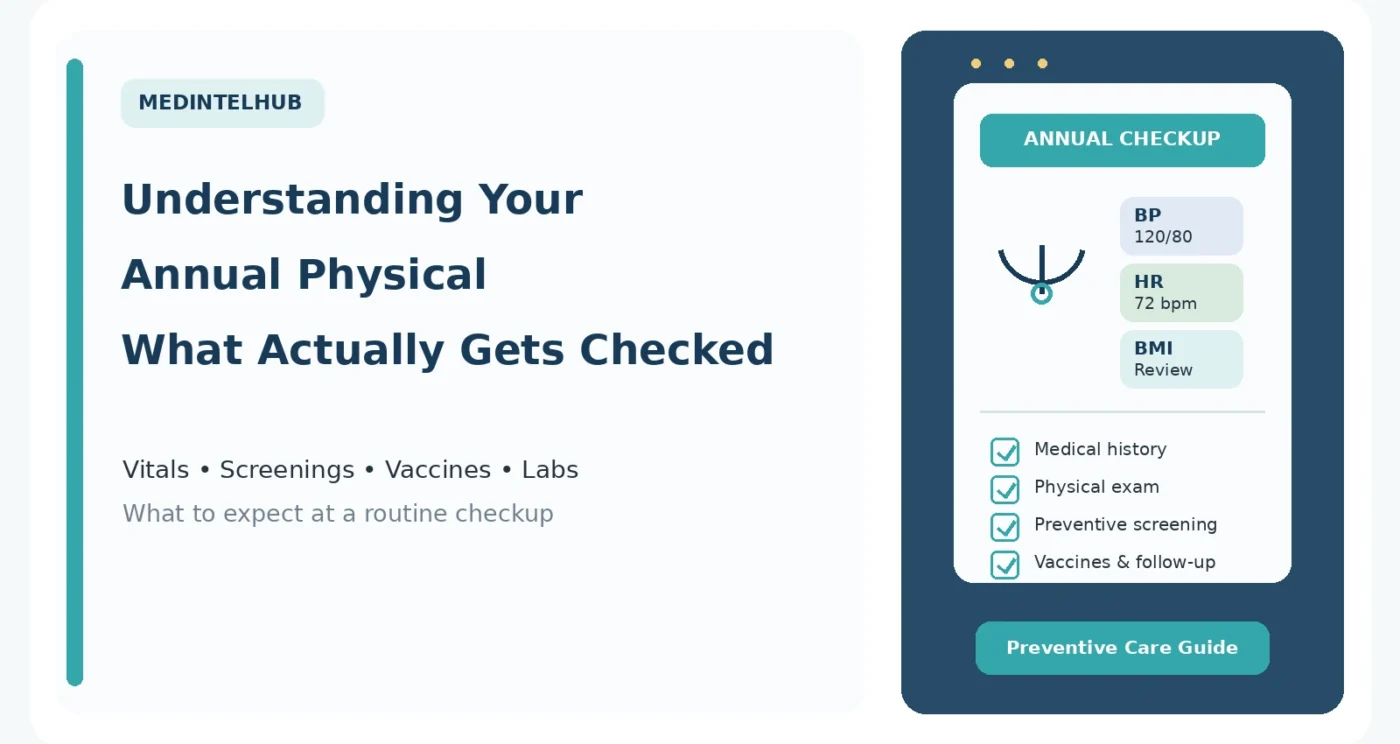
An annual physical is a general health visit intended to review your current health, identify possible problems, and determine whether preventive care is up to date.
It is different from an appointment made because you have a specific new problem such as chest pain, a fever, an injury, or worsening symptoms.
A routine checkup may include:
- Reviewing your medical history
- Reviewing medications and allergies
- Checking vital signs and measurements
- Performing parts of a physical examination
- Reviewing lifestyle and health risks
- Checking whether screenings are due
- Reviewing vaccines
- Ordering laboratory tests when appropriate
- Discussing new concerns
- Planning follow-up care
The exact combination is different from person to person.
Your Medical History Is Part of the Exam
A physical does not begin when the stethoscope comes out.
The conversation itself is a major part of the visit.
Your healthcare professional may review changes since your last appointment, including:
- New diagnoses
- Hospital visits
- Surgeries or procedures
- New symptoms
- Changes in medications
- Medication side effects
- Allergies
- Family health history
- Specialist care
This information helps determine what the physical exam and preventive plan should focus on.
For example, a new family history of colon cancer may change the conversation about screening. A new medication may lead to a discussion about side effects or laboratory monitoring.
Your Medication List May Be Reviewed
Bring an up-to-date list of what you take.
That can include:
- Prescription medicines
- Over-the-counter medicines
- Vitamins
- Herbal products
- Dietary supplements
The clinician may check for duplicate medicines, possible interactions, side effects, and whether you still need each medication.
Do not assume that the medication list in the electronic record is completely current.
If you see multiple doctors or use more than one pharmacy, outdated information can remain in the chart.
Blood Pressure Is One of the Most Common Checks
Blood pressure is one of the most routine measurements in preventive care.
High blood pressure often causes no obvious symptoms.
If an office reading is high, one reading alone may not be enough to diagnose hypertension.
The USPSTF recommends confirming a diagnosis with blood-pressure measurements outside the clinical setting before starting treatment when appropriate. This can include home blood-pressure monitoring or ambulatory monitoring.
Height, Weight, and BMI May Be Recorded
A routine visit often includes measurements such as height and weight.
The medical team may calculate body mass index, or BMI.
BMI is a screening measurement based on height and weight. It is not a complete measure of a person’s health or body composition.
The clinician may use weight trends and other information to discuss nutrition, physical activity, medications, or conditions that can affect weight.
Other Vital Signs May Be Checked
Depending on the office and your health needs, staff may also measure:
- Heart rate or pulse
- Temperature
- Respiratory rate
- Oxygen saturation
Not every measurement is necessary at every preventive visit.
The clinical setting and your medical history influence what is recorded.
What Happens During the Physical Examination?
The hands-on portion of an annual physical can vary significantly.
In simpler terms, the clinician may:
- Look at parts of the body
- Feel certain areas with the hands
- Listen with a stethoscope
- Tap certain areas when clinically useful
What gets examined depends on your history and the reason for the visit.
Heart and Lungs
A clinician will often listen to the heart and lungs with a stethoscope.
They may listen for things such as:
- Heart rate and rhythm
- Unusual heart sounds
- Breath sounds
- Wheezing or other abnormalities
This is a screening examination.
Listening with a stethoscope cannot rule out every heart or lung problem, and further testing may be needed if symptoms or findings raise concern.
Abdomen
The clinician may examine the abdomen by looking, listening, and gently pressing on different areas.
They may be checking for:
- Tenderness
- Swelling
- Abnormal masses
- Changes in bowel sounds
- Other findings related to your history or symptoms
If you have a new abdominal symptom, tell the clinician rather than assuming the routine exam will discover it automatically.
Eyes, Ears, Nose, Mouth, and Throat
Some routine physicals include a basic look at the eyes, ears, mouth, or throat.
Others may focus on these areas only when the patient’s age, medical history, or symptoms make it useful.
A basic office check is also different from a complete examination by an eye doctor, dentist, audiologist, or another specialist.
Skin
The clinician may notice or examine skin changes during a physical, especially when you point out a new or changing spot.
But a complete skin-cancer screening examination is not automatically part of every annual physical.
The USPSTF currently says there is not enough evidence to recommend for or against routine visual skin-cancer screening by a clinician in adolescents and adults without symptoms.
If you notice a mole or skin growth that has changed in size, shape, color, or appearance, bring it up directly rather than waiting for the clinician to notice it.
Neurologic, Musculoskeletal, and Balance Checks
Depending on age, symptoms, and health history, a clinician may check:
- Strength
- Reflexes
- Walking or gait
- Balance
- Joint movement
- Areas of pain or weakness
An extensive neurologic or orthopedic examination is not necessarily part of every routine physical.
If you have weakness, numbness, repeated falls, joint pain, or another concern, mention it during the visit.
Does an Annual Physical Include Blood Tests?
Sometimes.
But a physical does not automatically require the same panel of blood tests every year for every healthy adult.
Laboratory testing should be based on your health history, age, risk factors, medications, previous results, and current symptoms.
Common tests that may be considered include:
- Cholesterol or lipid testing
- Blood glucose
- Hemoglobin A1c
- Other tests needed to monitor a condition or medication
The important point is that “annual physical” does not automatically mean “every possible blood test.”
Diabetes Screening May Be Recommended for Some Adults
One example of risk-based laboratory screening is diabetes.
Tests can include fasting blood glucose, hemoglobin A1c, or an oral glucose-tolerance test.
Other people may also be tested based on symptoms, medical history, pregnancy, medications, or other risk factors.
Mental Health Questions May Be Part of the Visit
A physical may include questions that do not sound “physical” at all.
You may be asked about:
- Mood
- Depression
- Anxiety
- Stress
- Sleep
- Alcohol use
- Tobacco use
- Other substance use
Mental and physical health affect each other, and primary care is a common place to identify concerns that might otherwise go unnoticed.
For more detail about screening and insurance coverage, see our related MedIntelHub article: Mental Health Screenings at Primary Care Visits: How Billing and Coverage Work.
Sleep May Come Up Too
Your clinician may ask how well you sleep.
That can include questions about:
- Difficulty falling asleep
- Waking frequently
- Snoring
- Daytime sleepiness
- Shift work
- Sleep schedules
If sleep has become a problem, do not assume it is too minor to mention.
You can also read our MedIntelHub guide 7 Small Habits That Actually Improve Sleep Quality.
Your Lifestyle Is Part of Preventive Care
Healthcare professionals may ask about everyday habits because they can affect long-term health.
Questions may cover:
- Physical activity
- Nutrition
- Tobacco or nicotine use
- Alcohol
- Other substances
- Sexual health
- Work or home safety
- Stress
These questions are not necessarily a judgment about your choices.
They can help the clinician identify risks and determine whether counseling, testing, vaccination, or other preventive care could be useful.
Your Vaccines Should Be Reviewed
An annual checkup is a useful time to see whether vaccinations are up to date.
Adult vaccine recommendations vary by age, pregnancy, health conditions, previous vaccination history, occupation, travel, and other risk factors.
The CDC adult immunization schedule provides the current recommendations.
Depending on the person, the discussion may include vaccines for influenza, COVID-19, tetanus/diphtheria/pertussis, shingles, pneumococcal disease, RSV, hepatitis, HPV, or other infections.
You may not need a vaccine at every annual physical.
The point is to check whether anything is due.
Cancer Screening Is Based on Age and Risk
A routine physical is also an opportunity to check whether you are due for recommended cancer screening.
That does not mean every cancer screening test is performed in the exam room that day.
The clinician may instead order a test, provide a referral, or help you schedule it.
Examples of current USPSTF recommendations for average-risk adults include:
- Colorectal cancer: screening from ages 45 through 75 using one of several recommended strategies.
- Breast cancer: mammography every other year for women ages 40 through 74.
- Cervical cancer: screening for women ages 21 through 65 using recommended age-appropriate testing strategies.
- Lung cancer: annual low-dose CT for certain adults ages 50 through 80 with a qualifying smoking history.
You can review the current list on the USPSTF A and B Recommendations page.
Your personal screening schedule can be different if you have symptoms, a strong family history, previous abnormal results, or another high-risk condition.
Not Every Screening Test Is Automatically Recommended
More testing does not always mean better preventive care.
Some tests have potential harms, including false-positive results, unnecessary procedures, overdiagnosis, anxiety, and cost.
That is why preventive recommendations differ by age and risk.
For example, PSA screening for prostate cancer is not simply an automatic annual test for every man. Current USPSTF guidance says the decision for men ages 55 to 69 should be individualized after discussing potential benefits and harms with a clinician.
Similarly, a full-body skin examination is not universally recommended as routine screening for every person without symptoms or risk factors.
Does a Physical Include a Pelvic, Breast, Prostate, or Testicular Exam?
Not automatically.
These exams may be performed when they are clinically appropriate, but they are not universal requirements for every annual physical.
Whether one is needed can depend on:
- Symptoms
- Age
- Personal history
- Family history
- Previous findings
- Current preventive recommendations
If you have a breast lump, pelvic pain, testicular change, urinary symptom, or another concern, mention it directly rather than assuming it will be included in the routine exam.
Will You Get an EKG?
Not necessarily.
An electrocardiogram, or EKG/ECG, is not an automatic part of every annual physical for a healthy person without symptoms.
A clinician may order one when there is a reason, such as symptoms, medical history, medication considerations, or an abnormal finding.
The same principle applies to many other tests.
The purpose of preventive care is not to perform every available test once a year.
It is to choose testing that makes sense for the person.
What Should You Bring to the Appointment?
A little preparation can make the visit more useful.
Consider bringing:
- An updated medication and supplement list
- Vaccination information if the office does not already have it
- Important family-history updates
- Home blood-pressure readings if you monitor at home
- A list of specialists you see
- Questions you want answered
- Any new symptoms or health changes you want to discuss
If your physical leads to a referral, our MedIntelHub guide How to Prepare Questions Before a Specialist Appointment can help you get ready for the next visit.
Do Not Save Your Biggest Concern Until the End
A preventive appointment has limited time.
If you have something important to discuss, mention it early.
For example:
“I know this is my physical, but I’ve also been having chest discomfort when I climb stairs.”
or:
“Before we finish, I want to make sure we discuss the headaches I’ve been getting.”
The clinician may be able to address the problem during the same appointment, or the office may need to schedule a separate problem-focused visit.
That can also affect insurance billing.
Preventive Does Not Always Mean Every Service Is Free
Many health plans cover certain recommended preventive services without copayments or coinsurance when coverage requirements are met.
However, coverage can vary.
A separate diagnostic test, treatment, procedure, or discussion of a new medical problem may be billed differently from the preventive portion of the visit.
If you receive an insurance statement afterward, our MedIntelHub guide Understanding Your Explanation of Benefits (EOB) Statement can help you understand what the insurer processed.
Medicare’s Annual Wellness Visit Is Not a Routine Physical
This is an especially important distinction for people with Medicare.
Original Medicare Part B covers a yearly Annual Wellness Visit, but Medicare specifically states that this visit is not a routine physical exam.
The purpose of the Annual Wellness Visit is to create or update a personalized prevention plan.
According to Medicare.gov, it can include:
- A Health Risk Assessment
- Review of medical and family history
- Review of medications
- Routine measurements such as blood pressure and weight
- Assessment for possible cognitive impairment
- A personalized screening schedule
- Health advice
- Review of certain substance-use risks
CMS provides more detailed requirements on its Annual Wellness Visit provider page.
A routine comprehensive physical is different and may not be covered by Original Medicare as part of the Annual Wellness Visit benefit.
What Is the “Welcome to Medicare” Visit?
Medicare also covers a one-time “Welcome to Medicare” preventive visit during the first 12 months a person has Medicare Part B.
Despite the formal name “Initial Preventive Physical Examination,” Medicare states that this is not a comprehensive physical exam.
It includes preventive review, measurements, medical and social history, and education about recommended preventive services.
You can review the details on Medicare.gov’s Welcome to Medicare page.
Why Could a “Free” Preventive Visit Produce a Bill?
Sometimes a patient schedules a preventive visit and then receives a bill for part of the appointment.
That can happen when additional services are provided that are not included in the preventive benefit.
For Medicare, the agency specifically warns that additional tests or services performed during the Annual Wellness Visit may be subject to the Part B deductible or coinsurance, and non-covered services can result in additional costs.
Private insurance can also distinguish between preventive and diagnostic care.
If cost is a concern, ask the office:
- What type of visit am I scheduled for?
- Is this considered preventive under my plan?
- Could discussing a separate medical problem create another charge?
- Are the laboratory tests being ordered preventive or diagnostic?
- Should I confirm coverage with my insurer?
A Simple Annual Physical Checklist
Your visit will not necessarily include every item below, but this gives you a practical way to think about the appointment.
Health history
- New diagnoses or symptoms
- Family-history changes
- Hospitalizations or procedures
- Medication and allergy review
Measurements
- Blood pressure
- Weight
- Height or BMI when appropriate
- Other vital signs as needed
Physical examination
- Heart and lungs
- Abdomen
- Other body systems based on history, symptoms, age, and risk
Preventive health
- Vaccines
- Cancer screenings
- Diabetes and cardiovascular risk
- Mental health
- Tobacco, alcohol, and substance use
- Nutrition and physical activity
- Other age- and risk-appropriate screenings
Before leaving
- Ask what tests are being ordered
- Ask how you will receive results
- Confirm medication changes
- Ask when you should return
- Make sure referrals are clear
The Bottom Line
An annual physical is not one standardized head-to-toe exam that looks exactly the same for everyone.
The visit usually combines your medical history, vital signs, a physical examination, preventive screening, vaccine review, and discussion of health risks.
What actually gets checked depends on your age, symptoms, medications, medical history, family history, previous results, and individual risk factors.
Blood tests may be ordered, but there is no single laboratory panel that every healthy person automatically needs every year.
Cancer screening, diabetes testing, mental health screening, vaccines, and other preventive services also follow different schedules.
And if you have Medicare, remember one important distinction:
The Medicare Annual Wellness Visit is not the same thing as a routine physical exam.
Before the appointment, know what kind of visit you scheduled, bring your medication list and questions, and mention important concerns early.
A useful physical is not about checking every possible box.
It is about checking the things that matter for you.
Sources and References
- MedlinePlus — Health Checkup. Overview of routine checkups, preventive screening, vaccines, counseling, and appointment preparation.
- MedlinePlus — Physical Examination. Explanation of inspection, palpation, auscultation, and percussion during physical examination.
- U.S. Preventive Services Task Force — Hypertension in Adults: Screening. Recommendation for blood-pressure screening in adults.
- U.S. Preventive Services Task Force — Prediabetes and Type 2 Diabetes: Screening. Current risk-based diabetes-screening recommendation.
- U.S. Preventive Services Task Force — A and B Recommendations. Current preventive-care recommendations.
- Centers for Disease Control and Prevention — Adult Immunization Schedule. Current age- and risk-based vaccination guidance.
- HealthCare.gov — Preventive Care Benefits for Adults. Information about preventive services covered by Marketplace plans and many other health plans.
- Medicare.gov — Yearly Wellness Visits. Explanation of Medicare’s Annual Wellness Visit and how it differs from a routine physical.
- Centers for Medicare & Medicaid Services — Annual Wellness Visit. Detailed components of the Medicare Annual Wellness Visit.
- Medicare.gov — Welcome to Medicare Preventive Visit. Coverage and components of the one-time preventive visit during the first 12 months of Part B enrollment.
Editorial Disclaimer
MedIntelHub provides healthcare, insurance, and patient-education information for educational purposes only. This article does not provide individualized medical advice or recommend a specific screening schedule for any individual.
Preventive services, laboratory testing, physical-exam components, screening intervals, and insurance coverage vary according to age, medical history, symptoms, risk factors, health plan, and clinician judgment.
If you have a new or concerning symptom, do not wait for a routine annual physical to seek appropriate medical evaluation.
For more information about our publication, visit About MedIntelHub.

David Bennett
David Bennett is an author at MedIntelHub, where he creates clear, practical, and well-researched content about healthcare, medical billing, insurance, and patient education. His goal is to make complex healthcare topics easier for readers to understand and use in everyday situations. David emphasizes accuracy, transparency, and reliable sourcing, using information from trusted organizations and official healthcare resources whenever possible. Content published by David is intended for educational purposes and should not replace advice from qualified medical, legal, or healthcare professionals.