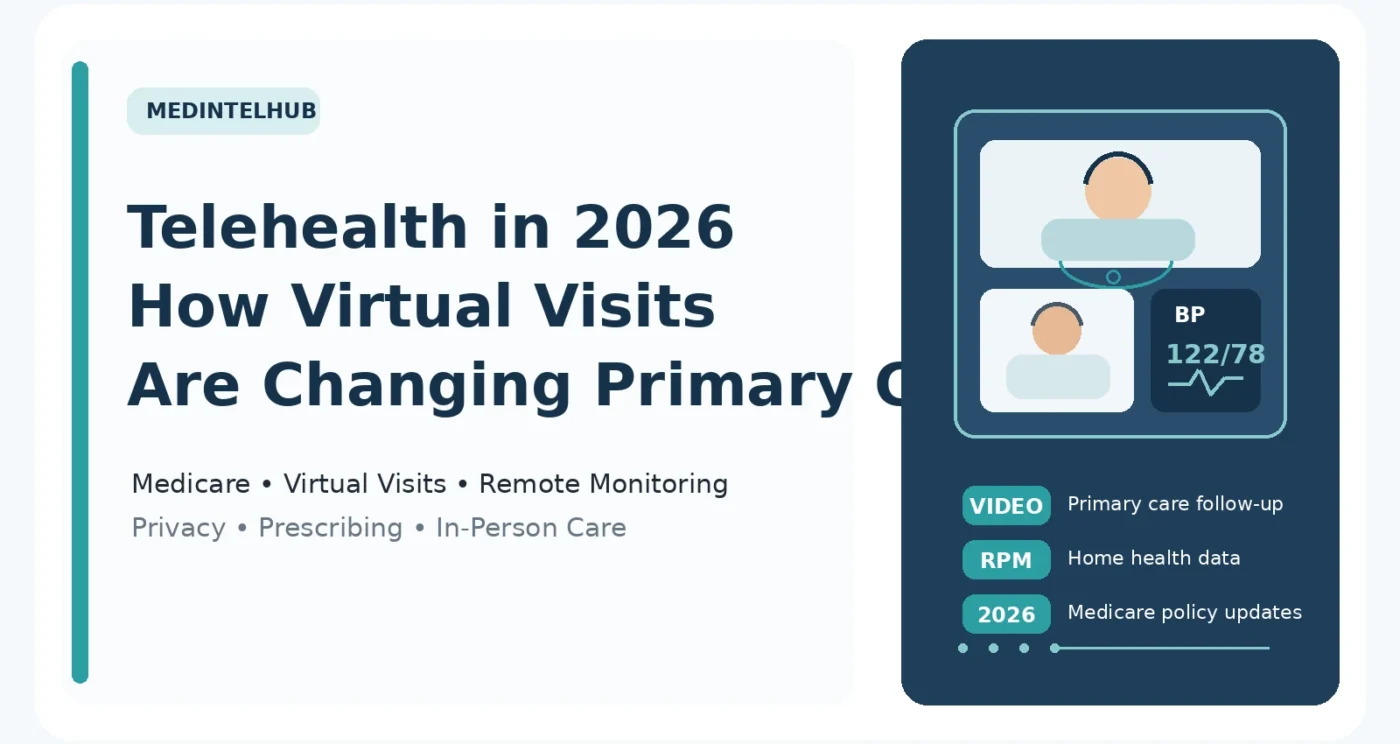
Many primary care appointments no longer start in a waiting room.
For some patients, an appointment may start by clicking a link on a phone, opening a patient portal, or answering a video call from a healthcare provider.
Telehealth became much more familiar during the COVID-19 pandemic, but by 2026 it is no longer viewed only as a temporary substitute for office visits. Virtual care is increasingly being used alongside traditional primary care for follow-up visits, medication reviews, chronic-condition management, behavioral health care, and other services that do not always require the patient and clinician to be in the same room.
But not every appointment needs to be virtual.
A video visit cannot replace every physical examination, test, procedure, or face-to-face assessment. The more useful question for primary care practices is now: Which parts of care work well through telehealth, and which still require an office visit?
There is another important question for patients: Will insurance pay for it?
In 2026, the answer can vary by service, health plan, provider, and sometimes where the patient is physically located during the appointment.
Important: Telehealth coverage, billing, prescribing, privacy, and licensing rules may differ by payer and state and can change over time. This article provides general educational information and should not replace guidance from Medicare, Medicaid, an insurer, a state licensing board, the DEA, or a qualified healthcare or billing professional.
What Does Telehealth Mean in Primary Care?
Telehealth is broader than the typical video visit.
Depending on the practice and the service, virtual care may include:
- Real-time video appointments
- Telephone visits when permitted
- Secure patient-portal messages
- Online evaluation and management
- Remote review of patient information
- Remote patient monitoring
- Digital communication between healthcare professionals
- Follow-up after an in-person visit
For example, a patient with stable high blood pressure may be able to discuss home blood-pressure readings during a virtual follow-up.
Someone who recently started a medication may use telehealth to discuss side effects or whether symptoms have improved.
If symptoms require listening to the lungs, examining the abdomen, collecting a specimen, or performing another hands-on assessment, the patient may still need to visit the office.
The goal does not have to be replacing the primary care office.
It is to give practices another way to provide the appropriate type of care when an in-person visit is not necessary.
Medicare Telehealth Remains Broadly Available in 2026
One of the biggest questions for Medicare patients in 2026 is whether they can continue receiving covered telehealth services from home.
For now, they can.
According to the CMS Telehealth FAQ updated in 2026, Medicare beneficiaries can receive covered Medicare telehealth services from anywhere in the United States and its territories through December 31, 2027.
During this period, beneficiaries generally do not have to live in a rural area or travel to an approved medical facility in order to receive covered Medicare telehealth services.
This is important for primary care.
Before the broader telehealth flexibilities introduced during the pandemic, Medicare telehealth was much more closely tied to rural location and approved originating sites.
The current extension allows eligible patients to continue receiving covered telehealth services from home while policymakers decide what the longer-term Medicare system should look like.
Coverage of a particular service still depends on whether that service is included under Medicare telehealth rules and whether the applicable billing and documentation requirements are met.
Providers can review the current CMS List of Telehealth Services for 2026.
Who Can Provide Medicare Telehealth Services?
The expanded list of eligible telehealth practitioners also remains in place through the end of 2027.
Under current Medicare rules, physicians and several types of non-physician practitioners may furnish eligible telehealth services when the applicable requirements are met.
The temporary expansion also continues to include:
- Physical therapists
- Occupational therapists
- Speech-language pathologists
- Audiologists
CMS states that this broader practitioner flexibility continues through December 31, 2027.
These professions could face different Medicare telehealth rules beginning in 2028 unless the policy is changed again.
Primary care physicians, nurse practitioners, physician assistants, and other eligible practitioners should still confirm that both the service and the individual practitioner meet current Medicare requirements before billing.
CMS Revised the Telehealth Review Process for 2026
Medicare telehealth policy is not simply a continuation of pandemic-era rules.
CMS also made permanent changes to the way it manages the Medicare Telehealth Services List.
For 2026, CMS streamlined the process used to determine whether services should be added to the list.
In the past, services could be categorized differently depending on whether their telehealth status was considered provisional or permanent.
CMS removed that distinction for 2026.
Its review now focuses more directly on whether a service can appropriately be furnished using an interactive, two-way audio-video telecommunications system.
The CY 2026 Medicare Physician Fee Schedule Final Rule also permanently removed certain telehealth frequency limitations and made some forms of real-time audio-video virtual supervision permanent.
The practical lesson for primary care practices is simple:
Do not rely on an outdated telehealth code list.
CMS updates the Medicare Telehealth Services List through annual Physician Fee Schedule rulemaking.
Virtual Visits Are Becoming Part of Routine Primary Care
Telehealth can be particularly useful when primary care involves repeated follow-up rather than a one-time diagnosis.
Take a patient with high blood pressure, for example.
An office visit may initially be needed for a more complete evaluation, examination, laboratory work, or other testing. After that, some follow-up discussions may be possible remotely if the patient has reliable home blood-pressure readings.
The same idea can apply to other areas of care.
Virtual visits may sometimes be useful for:
- Reviewing test results
- Reviewing a patient’s response to medication
- Discussing side effects
- Chronic-condition follow-up
- Nutrition or lifestyle counseling
- Behavioral health follow-up
- Reviewing home-monitoring results
- Some post-discharge follow-up
- Deciding whether an in-person assessment is needed
This is one reason telehealth is becoming less of a separate field of medicine and more of another tool in the primary care toolbox.
Telehealth and Remote Monitoring Can Work Together
A virtual appointment can become more useful when the clinician also has reliable information collected outside the clinic.
That information might include:
- Blood-pressure measurements
- Blood-glucose readings
- Weight
- Heart-rate information
- Pulse-oximetry measurements
- Other data collected through an eligible monitoring device
Remote patient monitoring can allow certain health measurements to be reviewed between appointments rather than relying only on information collected during occasional office visits.
CMS also introduced new remote-monitoring coding options for 2026, including shorter-duration monitoring and new treatment-management options.
For a broader explanation of those coding changes, read our related MedIntelHub article: New CPT Code Changes for 2026: What Providers Need to Know.
The combination of virtual appointments and remotely collected health information can be useful in chronic-condition management.
Remote monitoring, however, is a separate service category with its own coding, documentation, device, and payer requirements. A virtual visit does not automatically allow a practice to bill for remote-monitoring services.
Medicare Is Testing a Bigger Role for Technology-Supported Chronic Care
Another development began during 2026.
On July 5, 2026, CMS launched the ACCESS Model — Advancing Chronic Care with Effective, Scalable Solutions.
ACCESS is a voluntary 10-year CMS Innovation Center model designed to test technology-supported approaches to managing common chronic conditions in Original Medicare.
It includes tools and services such as:
- Telehealth
- Remote monitoring
- Wearable devices
- Digital health applications
- Lifestyle coaching
- Medication-management support
The model focuses on conditions including high blood pressure, diabetes, chronic musculoskeletal pain, and depression.
Instead of paying only for individual activities, ACCESS uses an outcome-aligned approach intended to connect payment more closely with whether patients’ health actually improves.
This does not mean every Medicare primary care practice is moving into a new payment system.
ACCESS is a voluntary Innovation Center model.
It does, however, show one possible direction for primary care: more care taking place between office visits, more use of patient-generated health information, and more focus on measurable outcomes.
Behavioral Health Is Still an Important Part of Telehealth
Behavioral health is one area where Medicare telehealth rules deserve special attention.
Medicare’s geographic and originating-site restrictions for qualifying behavioral and mental health telehealth services were permanently removed.
This means eligible Medicare beneficiaries can receive qualifying behavioral health telehealth services from home regardless of whether they live in a rural or urban area.
Audio-only technology also remains important in Medicare telehealth policy. CMS states that beneficiaries may continue receiving audio-only telehealth services in their homes through December 31, 2027, when applicable requirements are met.
Primary care practices providing behavioral-health services should still review the specific rules for the service being furnished.
For more information on how screening, diagnosis, coverage, and follow-up care can be billed differently, read our related MedIntelHub article: Mental Health Screenings at Primary Care Visits: How Billing and Coverage Work.
Can a Primary Care Provider Prescribe Medication Through Telehealth?
Sometimes, but prescribing rules should be considered separately from ordinary telehealth coverage.
For many non-controlled prescription medications, providers still need to follow the clinical, licensing, and state-law requirements that apply to their practice.
Controlled substances involve additional federal requirements.
In January 2026, the U.S. Department of Health and Human Services and the Drug Enforcement Administration extended certain telemedicine prescribing flexibilities for controlled medications through December 31, 2026.
Under the temporary extension, a DEA-registered practitioner may prescribe certain Schedule II-V controlled medications through telemedicine without first conducting an in-person medical evaluation when the applicable federal and state requirements are satisfied.
More information is available from HHS and DEA’s 2026 telemedicine prescribing announcement and the Telehealth.HHS.gov controlled-substance prescribing guidance.
This does not mean controlled medications can be prescribed without restrictions.
Providers still need to comply with:
- Federal controlled-substance law
- DEA requirements
- State prescribing laws
- State licensure requirements
- Applicable professional standards
- Organizational and payer policies
Because the current federal temporary extension is scheduled to end on December 31, 2026, practices that prescribe controlled substances through telehealth should monitor DEA and HHS updates closely.
Knowing the Patient’s Location Is Still Important
One common telehealth misunderstanding is that the appointment legally occurs wherever the clinician is sitting.
For professional licensing purposes, a telehealth appointment is generally considered to occur in the state where the patient is physically located at the time of the visit.
Telehealth.HHS.gov advises providers to verify the patient’s location before the appointment.
A doctor licensed in one state does not automatically have authority to provide telehealth services to patients in every other state.
Depending on state law, a clinician may need:
- A full license in the patient’s state
- Authority through an interstate licensing compact
- Telehealth registration
- Licensure reciprocity
- Another state-specific exception
Providers can review HHS guidance on licensing across state lines and telehealth licensure compacts.
This can be especially important for patients who travel frequently, college students, seasonal residents, or people who split their time between different states.
Interstate licensing compacts can make cross-state practice easier for some professions, but they do not remove the need to understand the rules in the state where the patient is located.
Telehealth Does Not Remove Privacy Responsibilities
A virtual visit may take place in a patient’s living room rather than an examination room, but privacy still matters.
Healthcare providers and health plans covered by HIPAA must use remote communication technology in a way that complies with applicable HIPAA Privacy, Security, and Breach Notification requirements.
HHS updated its guidance on audio-only telehealth and HIPAA in June 2026.
Among other things, healthcare organizations should think about:
- Secure transmission of health information
- Who can access the telehealth platform
- Patient identity verification
- Electronic storage of recordings or transcripts
- Security protections for electronic health information
- Privacy in the provider’s environment
- Whether a technology vendor is acting as a business associate
Patients have a role too.
A virtual appointment about a sensitive health problem may not be very private if the patient is sitting in a crowded café with the speakerphone turned on.
Simple steps can help, such as finding a private location, using headphones, and making sure other devices are not unintentionally listening or recording.
Not Every Patient Has the Same Technology
Telehealth is convenient only when the technology works for the patient.
Some patients may have:
- Limited broadband access
- Older phones or computers
- Difficulty using apps
- Hearing or vision limitations
- Language barriers
- Limited digital literacy
- No private place for an appointment
A virtual-care program that works well for one patient may be frustrating or inaccessible for another.
Telehealth.HHS.gov recommends preparing patients before their virtual visits, explaining how they will connect, providing technology instructions, and offering troubleshooting support when possible.
This could include sending a test link before the appointment or having office staff help the patient learn how to connect.
Primary care practices also need a backup plan:
What happens if the video stops working?
A backup phone number or clear rescheduling process can help prevent a technical problem from turning into a missed visit.
Audio-Only Care Still Has a Role
Video receives much of the attention in telehealth, but telephone-based care continues to matter.
Not every patient has a smartphone, reliable broadband, or confidence using video technology.
CMS currently allows Medicare beneficiaries to receive qualifying audio-only telehealth services in their homes through December 31, 2027.
Behavioral-health telehealth also has important long-term audio-only provisions.
Rural Health Clinics and Federally Qualified Health Centers have extended telecommunication flexibilities as well. CMS states that qualifying non-behavioral health visits may continue to be furnished using telecommunication technology, including audio-only communication, through December 31, 2027.
CMS provides current information through its RHC/FQHC telehealth updates.
This can be especially important for rural communities and patients who face technology barriers.
Once again, the fact that a telephone conversation occurred does not automatically mean it is separately billable. The service, documentation, code, payer policy, and other requirements still need to support the claim.
When Is an In-Person Primary Care Visit Still Better?
Telehealth can be useful precisely because it does not have to be all things to all people.
Some problems are difficult or unsafe to evaluate without a physical examination, testing, or immediate treatment.
An in-person visit may be more appropriate when the clinician needs to:
- Perform a detailed physical examination
- Listen directly to the heart or lungs
- Examine a new lump, wound, rash, or injury in detail
- Collect blood, urine, or another specimen
- Give an injection or perform a procedure
- Obtain imaging
- Evaluate symptoms that could represent an emergency
- Assess a condition that cannot be adequately evaluated remotely
A telehealth consultation may begin online and end with the clinician saying, “I need to examine this in person.”
That is not a failure of telehealth.
It is appropriate triage.
A useful virtual-care system should make it easy to move a patient from remote care to an office, urgent care center, emergency department, or another appropriate setting when necessary.
Will Insurance Cover a Telehealth Primary Care Visit?
Coverage varies.
Original Medicare covers services that are included under current Medicare telehealth rules when the applicable requirements are met.
Medicare Advantage plans may have their own networks and benefit structures.
Medicaid telehealth policies vary by state.
Commercial insurance coverage can also differ by plan and state requirements.
Patients should not assume that a virtual appointment will always cost the same as an office appointment.
They may want to ask:
- Does my plan cover telehealth?
- Is this provider in network?
- Will I owe a copayment or coinsurance?
- Is video required?
- Is telephone-only care covered?
- Does the service require prior authorization?
- Would an in-person follow-up create another charge?
Healthcare practices should also verify payer policies, particularly when a telehealth service or billing code has recently changed.
Telehealth Is Changing the Primary Care Workflow Too
Virtual visits affect more than the conversation between patient and clinician.
They can change the way a practice handles:
- Scheduling
- Patient identification
- Location verification
- Consent
- Insurance verification
- Check-in
- Technology support
- Documentation
- Billing
- Prescriptions
- Follow-up
- Emergency planning
HHS recommends creating a specific telehealth workflow rather than treating a virtual appointment as an ordinary office visit performed through a webcam.
Front-desk staff may need to confirm the patient’s physical location.
Clinical staff may need to collect home measurements before the clinician joins the visit.
The practice may need a process for sending laboratory orders or prescriptions to a location near the patient.
Billing staff need to know whether the service qualifies for telehealth under the patient’s plan.
These pieces work best when they are designed together.
What Patients Can Do Before a Virtual Appointment
A little preparation can make a virtual visit much more useful.
Before the appointment, patients can:
- Test the camera and microphone
- Charge the phone, tablet, or computer
- Find a reasonably private place
- Have medications nearby
- Write down current symptoms
- Gather home measurements if requested
- Keep pharmacy information available
- Prepare questions
- Know the address where they are physically located
- Have a backup phone number available
HHS provides additional advice in its guide to preparing patients for a telehealth appointment.
If blood-pressure readings, glucose measurements, weight, temperature, or another home measurement will be discussed, it can help to have that information ready before the visit begins.
What Primary Care Practices Should Review in 2026
Practices offering telehealth should periodically review more than their video software.
A useful checklist includes:
- Current Medicare telehealth service lists
- Commercial payer policies
- State Medicaid requirements
- Provider licensure in the patient’s location
- Patient-consent requirements
- HIPAA and privacy procedures
- Documentation templates
- Place-of-service and modifier requirements
- Audio-only rules
- Prescribing requirements
- Emergency protocols
- Technology backup procedures
- Remote-monitoring workflows
- Changes to CMS, HHS, and DEA rules
Telehealth policy has changed repeatedly over the past several years.
A workflow developed in 2021 or 2022 should not automatically be assumed to meet 2026 requirements.
The Bottom Line
Telehealth is no longer just an alternative to primary care. It is becoming one of the ways primary care can be delivered.
In 2026, Medicare beneficiaries continue to have broad access to covered telehealth services from home, with major geographic and originating-site flexibilities extended through December 31, 2027.
CMS has also streamlined the process for adding services to the Medicare Telehealth Services List, permanently adopted some forms of virtual supervision, and continued developing policies that support remote and technology-enabled care.
Important boundaries still remain.
Licensure depends on where the patient is located. Insurance coverage varies. Privacy requirements still apply. Controlled-substance prescribing has additional rules. And many medical problems are still better handled face-to-face.
For primary care, the future is unlikely to be simply virtual medicine versus office medicine.
It is likely to be a combination of both.
The most useful telehealth programs will probably be the ones that help patients and clinicians decide which type of visit makes the most sense at that particular moment.
Sources and References
- Centers for Medicare & Medicaid Services — Telehealth FAQ, updated February 2026. Current information on Medicare telehealth locations, eligible practitioners, audio-only services, behavioral-health telehealth, and flexibilities through December 31, 2027.
- Centers for Medicare & Medicaid Services — List of Telehealth Services for Calendar Year 2026. Current Medicare telehealth services payable under the Physician Fee Schedule.
- Centers for Medicare & Medicaid Services — CY 2026 Medicare Physician Fee Schedule Final Rule. 2026 Medicare telehealth-list review, virtual supervision, frequency-limit, remote-monitoring, and related payment policies.
- Centers for Medicare & Medicaid Services — ACCESS Model. Information on the voluntary technology-supported chronic-care model that began July 5, 2026.
- U.S. Department of Health and Human Services and Drug Enforcement Administration — Telemedicine Prescribing Flexibilities Through 2026. Federal information on the temporary extension for prescribing controlled medications through December 31, 2026.
- Telehealth.HHS.gov — Prescribing Controlled Substances via Telehealth. Current guidance on federal telemedicine prescribing flexibilities.
- Telehealth.HHS.gov — Licensing Across State Lines. Guidance on state licensing requirements, telehealth registration, reciprocity, and interstate practice.
- Telehealth.HHS.gov — Licensure Compacts. Information on multistate licensing compacts and the importance of the patient’s physical location during telehealth.
- U.S. Department of Health and Human Services — HIPAA Guidance for Audio-Only Telehealth. Privacy and security guidance for remote communication technologies.
- Telehealth.HHS.gov — Preparing Patients for Telehealth. Guidance on patient preparation, consent, technology setup, and emergency planning.
- Telehealth.HHS.gov — Planning Your Telehealth Workflow. Guidance on scheduling, check-in, documentation, billing, triage, and follow-up.
- Centers for Medicare & Medicaid Services — RHC/FQHC News and Announcements. Current Medicare telecommunications policies for Rural Health Clinics and Federally Qualified Health Centers.
Editorial Disclaimer
MedIntelHub provides healthcare, billing, and insurance information for educational purposes only. Telehealth coverage, licensing, prescribing, documentation, reimbursement, and privacy requirements can change and may vary by state, payer, provider type, and individual circumstances.
Healthcare organizations should verify current requirements with CMS, the applicable insurer, state licensing authorities, the DEA where appropriate, or another qualified professional before providing or billing telehealth services.
This article does not provide medical advice. Whether a virtual or in-person appointment is appropriate depends on the patient’s symptoms and circumstances. Patients with urgent or potentially life-threatening symptoms should seek appropriate emergency medical care.
For information about our publication, visit About MedIntelHub.

David Bennett
David Bennett is an author at MedIntelHub, where he creates clear, practical, and well-researched content about healthcare, medical billing, insurance, and patient education. His goal is to make complex healthcare topics easier for readers to understand and use in everyday situations. David emphasizes accuracy, transparency, and reliable sourcing, using information from trusted organizations and official healthcare resources whenever possible. Content published by David is intended for educational purposes and should not replace advice from qualified medical, legal, or healthcare professionals.