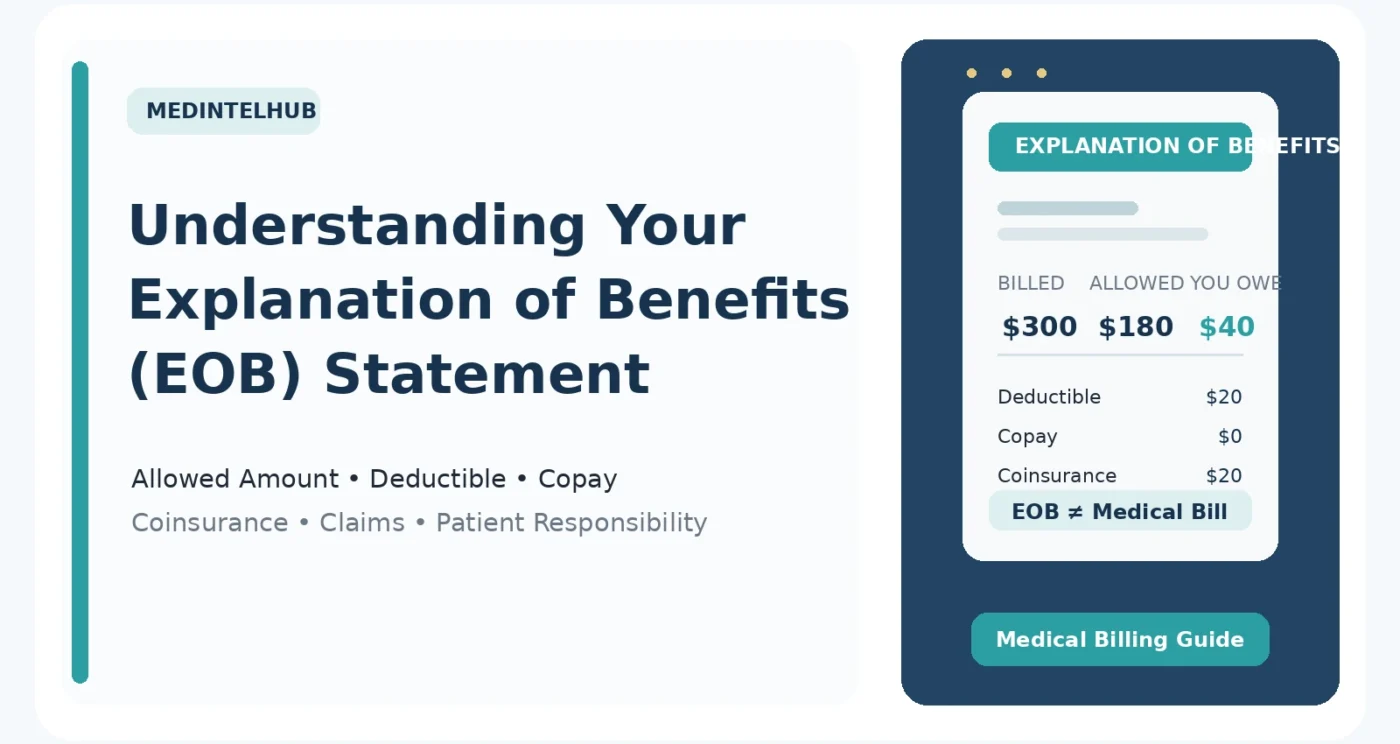
An Explanation of Benefits can look like a bill.
It may list a doctor or hospital, several dollar amounts, insurance adjustments, and a number labeled “patient responsibility.” That is enough to make many people wonder whether they need to pay it immediately.
Usually, the answer is no.
An Explanation of Benefits, or EOB, is not a bill. It is a statement from your health plan showing how it processed a healthcare claim.
According to the Centers for Medicare & Medicaid Services’ guide to reading an EOB, the statement helps explain the total charges for your care, the amount your health plan allows, what the insurer paid, and the amount you may be responsible for.
The EOB can also help you spot mistakes before you pay a medical bill.
Important: Health plans do not all use the same EOB format. Names for individual columns and amounts can vary. If a charge, denial, or patient-responsibility amount is unclear, contact your health plan and healthcare provider before assuming the amount is correct.
What Is an Explanation of Benefits?
An EOB is a summary of how your insurance company processed a healthcare claim.
After you receive a covered service, the doctor, hospital, laboratory, or another healthcare provider may submit a claim to your health plan.
The insurer reviews that claim under the terms of your coverage.
The EOB then shows information such as:
- Who received the healthcare service
- Which provider submitted the claim
- The date of service
- The service or type of care billed
- How much the provider charged
- The amount the health plan recognizes or allows
- How much the health plan paid
- How much was applied to your deductible, copayment, or coinsurance
- How much you may owe
- Why a claim or part of a claim was not paid
Some EOBs are mailed on paper. Others are available electronically through an insurance company’s website or mobile app.
An EOB Is Not the Same as a Medical Bill
This is the first thing to remember.
The EOB comes from the health plan.
The medical bill usually comes from the doctor, hospital, laboratory, or other provider.
The EOB explains how insurance processed the claim. The provider bill asks you to pay a balance.
CMS recommends comparing the two documents. Its guide to reading a medical bill explains that the patient-responsibility amount on the bill should be compared with what the EOB says you owe.
If the provider’s bill is unexpectedly higher than the amount shown as your responsibility on the EOB, do not automatically pay the difference.
Contact the provider and the health plan and ask them to explain the mismatch.
Start With the Basic Claim Information
Before looking at the dollar amounts, make sure the basic information is correct.
Check:
- Your name
- The patient’s name, if a family member received the care
- The provider or facility
- The date of service
- The claim number
- The type of service
A wrong provider, unfamiliar date, or service you do not remember receiving deserves a closer look.
Sometimes there is an innocent explanation. For example, a laboratory, radiologist, anesthesiologist, or other professional may submit a separate claim connected with one medical visit.
But an unfamiliar claim can also be a billing mistake.
If you do not recognize the service, contact the health plan or provider before paying anything related to it.
Provider Charge: What the Provider Billed
The provider charge, sometimes called the billed amount, is the amount the healthcare provider submitted to the insurance company.
For example, a provider might bill:
$300 for an office visit.
That does not necessarily mean $300 is the amount the provider will ultimately receive or the amount you will owe.
The next number is often much more important.
Allowed Amount: The Number That Often Matters More
The allowed amount is the maximum amount the health plan recognizes for a covered healthcare service under the applicable plan rules.
HealthCare.gov also describes it as an eligible expense, payment allowance, or negotiated rate.
For example:
- Provider charge: $300
- Health plan’s allowed amount: $180
If the provider is in network, the difference between the provider’s billed charge and the contracted allowed amount is generally written off rather than charged to the patient for a covered service.
You can read the federal definition on HealthCare.gov’s allowed amount glossary.
Out-of-network billing can work differently, so check the plan’s rules carefully.
What Does “Plan Discount” or “Adjustment” Mean?
You may see an amount described as:
- Discount
- Network discount
- Contractual adjustment
- Provider adjustment
- Amount not allowed
This often represents the difference between what the provider originally billed and the amount the insurer recognizes under its contract with an in-network provider.
Using the earlier example:
- Provider billed: $300
- Allowed amount: $180
- Network adjustment: $120
That $120 adjustment is not automatically a bill to the patient.
The amount you may owe is usually shown separately as patient responsibility.
Understanding Your Deductible
A deductible is the amount you generally pay for certain covered healthcare services before the health plan begins paying its share.
Suppose your plan has a $2,000 deductible and you have not yet met it.
If an in-network service has an allowed amount of $180 and the service is subject to the deductible, some or all of that $180 may be assigned to you.
Not every service necessarily applies to the deductible in the same way.
For example, some health plans cover certain preventive services before the deductible is met. Plans may also have separate deductibles for certain types of benefits.
For a current definition, see HealthCare.gov’s deductible guide.
What Is a Copayment?
A copayment, or copay, is usually a fixed amount you pay for a covered service under the terms of your plan.
For example:
$30 for a specialist office visit.
Different services can have different copays.
A primary care visit, specialist visit, urgent care visit, prescription drug, or emergency department visit may each have a different amount.
See HealthCare.gov’s copayment definition for more information.
What Is Coinsurance?
Coinsurance is usually a percentage of the allowed cost of a covered service that you pay after meeting any applicable deductible.
For example, suppose:
- The allowed amount is $200
- Your coinsurance is 20%
- Your applicable deductible has already been met
Your coinsurance would generally be:
20% of $200 = $40.
The health plan would generally pay the remaining covered amount, subject to the terms of the plan.
HealthCare.gov provides additional examples in its coinsurance glossary.
What Does “Plan Paid” Mean?
This is the amount your health plan paid toward the claim.
It may be labeled:
- Plan paid
- Insurer paid
- Benefit paid
- Insurance payment
A plan-payment amount of $0 does not always mean the claim was denied.
For example, if the allowed amount was entirely applied to your deductible, the health plan may pay $0 while still treating the service as covered.
That is why it is important to look at the entire EOB rather than only one number.
Patient Responsibility: What You May Owe
The section labeled patient responsibility, what you owe, or patient balance is usually the number people care about most.
It may include amounts assigned to:
- Your deductible
- A copayment
- Coinsurance
- Non-covered services
- Certain out-of-network costs
But even this number requires context.
CMS notes that an EOB may not know whether you already paid part of the patient balance directly to the provider.
For example, you may have paid a $30 copay when you checked in. The EOB can still show $30 as your responsibility because it is explaining the claim, not maintaining the provider’s payment ledger.
Before paying a bill, subtract any amount you have already paid and compare the provider’s statement with the EOB.
A Simple EOB Example
Imagine an in-network office visit with the following numbers:
- Provider charge: $300
- Allowed amount: $180
- Network adjustment: $120
- Amount applied to deductible: $100
- Remaining allowed amount: $80
- Coinsurance: 20% of $80 = $16
- Health plan pays: $64
- Total patient responsibility: $116
In this example, the patient is not responsible for the original $300 charge.
The patient’s share is based on the plan’s allowed amount and cost-sharing rules.
This example is only for illustration. Actual health plans can calculate benefits differently depending on the service, network status, deductible, copayment, coinsurance, benefit limits, and other plan rules.
What Does “Not Covered” Mean?
A claim can show an amount as not covered for several reasons.
Examples may include:
- The service is excluded under the plan
- The insurer says the service did not meet coverage requirements
- Prior authorization was required
- The provider was out of network
- The claim contained missing or incorrect information
- The claim was submitted more than once
- The insurer needs more information before processing the claim
Do not assume every denial means you definitely owe the full provider charge.
Read the explanation or remark code first.
In some situations, the provider may need to correct and resubmit the claim.
In others, you or the provider may need to supply more information.
Read the Remark Codes and Claim Notes
Many EOBs use short codes to explain how the claim was processed.
A remark code may explain why:
- A service was denied
- An amount was reduced
- A claim was sent back for more information
- A service was considered out of network
- Prior authorization was missing
- A charge was bundled with another service
CMS explains that EOB remark codes are usually accompanied by descriptions elsewhere on the statement.
Do not stop at a code such as “PR,” “CO,” or another abbreviation without reading the EOB’s own explanation.
If the explanation still does not make sense, call the customer-service number listed on the EOB.
What if Your Claim Was Denied?
A denied claim deserves attention, but it is not always the end of the process.
Start by identifying exactly why the claim was denied.
Then ask:
- Was information missing?
- Was the service coded incorrectly?
- Was prior authorization required?
- Does the insurer consider the service not medically necessary?
- Was the provider treated as out of network?
- Was the claim filed incorrectly?
- Can the provider correct and resubmit it?
- Do I have appeal rights?
Many health plans must provide an internal appeals process for certain coverage decisions. CMS explains the basic process in its guide to appealing health plan decisions.
Your EOB or denial notice should explain the reason for the decision and provide instructions for disputing it when appeal rights apply.
Compare the EOB With the Provider’s Bill
When a medical bill arrives, place it next to the EOB.
Compare:
- Patient name
- Provider
- Date of service
- Type of service
- Amount insurance paid
- Adjustments or discounts
- Patient responsibility
- Any payment you already made
If the EOB says your responsibility is $75 but the provider sends a bill for $250, ask why before paying.
CMS specifically recommends comparing the “what you owe” amount on the EOB with the amount on the bill.
The provider may have sent the bill before insurance finished processing the claim, the bill may not reflect an insurance adjustment yet, or there may be an error.
Be Careful With Out-of-Network and Balance Billing
Out-of-network claims can be more complicated.
In some situations, a provider may charge more than the health plan’s allowed amount. This is called balance billing.
However, federal law prohibits many types of surprise balance bills.
Under the No Surprises Act protections explained by CMS, people with most private health insurance have protections against many unexpected out-of-network bills involving emergency care and certain services received at in-network facilities.
Those protections have important details and exceptions.
If an out-of-network bill seems unexpectedly high, do not assume that balance billing is automatically permitted.
Review your EOB and contact your health plan or the provider.
What Is the Out-of-Pocket Maximum?
Your EOB may also show progress toward your plan’s annual out-of-pocket maximum.
The out-of-pocket maximum is generally the most you must pay in a plan year for covered in-network services that count toward the limit.
After reaching the applicable maximum, the health plan generally pays 100% of covered in-network benefits for the remainder of the plan year.
Not every healthcare expense counts toward that limit.
For example, HealthCare.gov explains that premiums, services the plan does not cover, and some out-of-network costs generally do not count.
See the HealthCare.gov out-of-pocket maximum guide for more information.
Preventive Care Can Look Different on an EOB
Some preventive services may be covered without the same cost-sharing that applies to diagnostic or treatment services.
That can create confusing EOBs.
For example, a preventive screening may have $0 patient responsibility, while a separate diagnostic evaluation, follow-up service, or treatment may involve a deductible, copayment, or coinsurance.
This distinction can matter in areas such as behavioral health screening.
For an example, read our related MedIntelHub guide: Mental Health Screenings at Primary Care Visits: How Billing and Coverage Work.
Telehealth Visits Can Generate EOBs Too
A virtual visit can produce an insurance claim just like an in-person visit.
Your EOB may show the provider, date, service, allowed amount, plan payment, and your cost-sharing responsibility.
If a telehealth claim looks different from what you expected, check whether the provider was in network, whether the service was covered, and what cost-sharing your health plan applies to virtual care.
For more information about current virtual-care rules, see our MedIntelHub article: Telehealth in 2026: How Virtual Visits Are Changing Primary Care.
Original Medicare Uses a Medicare Summary Notice for Part A and Part B
If you have Original Medicare, you may not receive a document called an EOB for your Part A and Part B claims.
Instead, Original Medicare uses a Medicare Summary Notice, or MSN.
The MSN lists services or supplies billed to Medicare, what Medicare paid, and the maximum amount you may owe the provider.
Like an EOB, the MSN is not a bill.
You can learn more from Medicare.gov’s claims information and the CMS Medicare Summary Notice page.
Medicare Advantage and Medicare drug plans can issue EOBs summarizing claims and costs.
Medicare.gov also provides information about Medicare prescription drug plan EOBs.
Questions to Ask When an EOB Does Not Make Sense
Before calling your health plan, write down the claim number and the part of the EOB you do not understand.
Useful questions include:
- Why was this amount applied to my deductible?
- Why was this service denied?
- Why is the provider listed as out of network?
- What does this remark code mean?
- Was prior authorization required?
- Does the provider need to resubmit the claim?
- Why does my provider’s bill not match the EOB?
- Do I have a right to appeal this decision?
- How much have I met toward my deductible?
- How much have I met toward my out-of-pocket maximum?
If you are preparing for a visit where insurance, testing, treatment, or costs may come up, our MedIntelHub guide How to Prepare Questions Before a Specialist Appointment may also help.
Keep Your EOBs for Reference
You do not necessarily need to keep every paper EOB forever, but it can be useful to keep access to them while claims and bills are being resolved.
EOBs can help you:
- Compare insurance processing with provider bills
- Track deductible spending
- Track out-of-pocket spending
- Check whether a claim was processed
- Identify duplicate or unfamiliar claims
- Document a claim if you need to ask questions or appeal
If your health plan provides electronic EOBs, you may be able to download copies through your member account.
Because EOBs contain personal health and insurance information, store or dispose of them securely.
A Quick EOB Checklist
When an EOB arrives, you can work through it in this order:
- Confirm the patient, provider, and date of service.
- Make sure you recognize the service.
- Look at the provider’s original charge.
- Find the allowed amount.
- Check any insurance adjustment or network discount.
- See what the health plan paid.
- Review deductible, copay, and coinsurance amounts.
- Read any denial or remark codes.
- Find the patient-responsibility amount.
- Compare the EOB with the provider’s actual bill before paying.
If something does not match, ask questions.
The Bottom Line
An Explanation of Benefits is not a demand for payment.
It is a record of how your health plan processed a healthcare claim.
Start by checking the provider, patient, and date of service. Then look at the provider charge, allowed amount, insurance adjustment, plan payment, deductible, copayment, coinsurance, and patient responsibility.
Most importantly, compare the EOB with the medical bill you eventually receive.
If the numbers do not match, a service is unfamiliar, or a claim was denied, do not assume you simply have to pay whatever appears on the page.
Contact the health plan and provider, find out what happened, and ask about correction or appeal options when appropriate.
Understanding the EOB does not make healthcare billing simple, but it can make it much easier to see how the insurer arrived at the amount it says you may owe.
Sources and References
- Centers for Medicare & Medicaid Services — How to Read an Explanation of Benefits. Official guide explaining provider charges, allowed charges, insurer payments, patient balance, and remark codes.
- Centers for Medicare & Medicaid Services — How to Read Your Medical Bill. Guidance on comparing a provider bill with an EOB and understanding patient responsibility.
- HealthCare.gov — Allowed Amount. Definition of the amount a health plan recognizes for a covered healthcare service.
- HealthCare.gov — Deductible. Explanation of how deductibles generally work.
- HealthCare.gov — Copayment. Definition and examples of fixed cost-sharing amounts.
- HealthCare.gov — Coinsurance. Definition and examples of percentage-based cost sharing.
- HealthCare.gov — Out-of-Pocket Maximum. Guidance on annual out-of-pocket limits and expenses that may or may not count toward them.
- Centers for Medicare & Medicaid Services — Appealing Health Plan Decisions. Information about internal appeals and external review rights for applicable health plans.
- Centers for Medicare & Medicaid Services — Know Your Rights When Using Health Insurance. Information about federal protections against many types of surprise out-of-network bills.
- Centers for Medicare & Medicaid Services — Medicare Summary Notice. Information about notices used for Original Medicare claims.
- Medicare.gov — Checking the Status of a Claim. Explanation of Medicare Summary Notices for Original Medicare and EOBs for Medicare health and drug plans.
Editorial Disclaimer
MedIntelHub provides healthcare, insurance, and billing information for educational purposes only. Insurance benefits, networks, deductibles, copayments, coinsurance, claim-processing rules, appeal rights, and patient responsibility vary by health plan and individual circumstances.
An EOB is not a guarantee that a particular amount is correct or that a claim cannot be reconsidered. If you have questions about a claim, denial, or medical bill, contact your health plan and healthcare provider for information specific to your coverage.
This article does not provide medical, legal, or financial advice.
For more information about our publication, visit About MedIntelHub.

David Bennett
David Bennett is an author at MedIntelHub, where he creates clear, practical, and well-researched content about healthcare, medical billing, insurance, and patient education. His goal is to make complex healthcare topics easier for readers to understand and use in everyday situations. David emphasizes accuracy, transparency, and reliable sourcing, using information from trusted organizations and official healthcare resources whenever possible. Content published by David is intended for educational purposes and should not replace advice from qualified medical, legal, or healthcare professionals.