Protein, carbohydrates, and fat appear on nearly every Nutrition Facts label.
They are also the three nutrients people usually mean when they talk about “macros.”
But macronutrients are more than numbers to track in an app.
They provide energy, supply building materials for the body, help support normal body processes, and come packaged with many other nutrients depending on the foods you choose.
Understanding the basics can make food labels and nutrition advice much easier to follow.
According to MedlinePlus, protein, carbohydrates, and fats are among the nutrients the body needs as part of an overall healthy eating pattern. The current Dietary Guidelines for Americans, 2025–2030 also emphasizes whole, nutrient-dense foods rather than focusing on a single nutrient in isolation.
Important: Individual nutrition needs vary with age, body size, activity level, pregnancy, health conditions, medications, and other factors. This article provides general educational information and is not a personalized diet plan.
What Are Macronutrients?
The word macronutrient refers to nutrients the body needs in relatively large amounts.
The three main macronutrients are:
- Protein
- Carbohydrates
- Fat
All three can contribute energy to the diet.
As a general nutrition calculation:
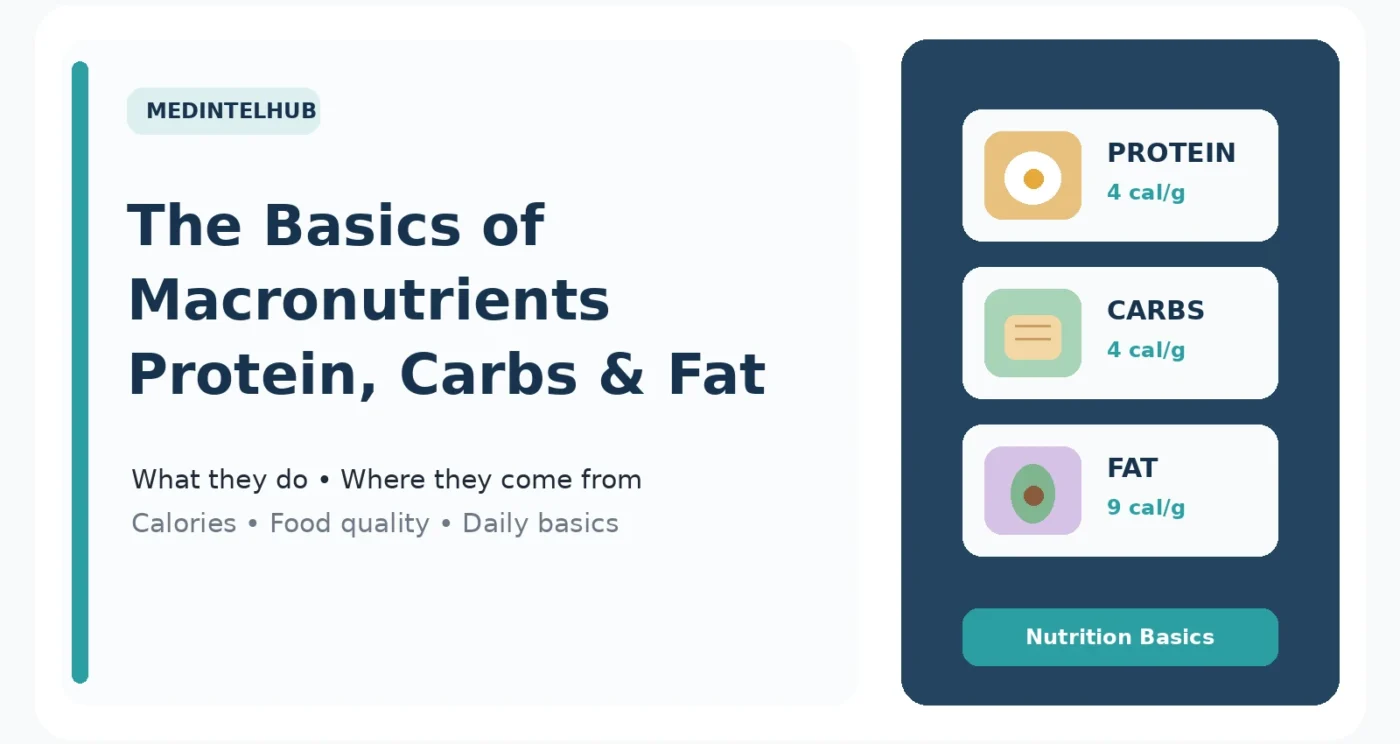
- 1 gram of protein provides about 4 calories
- 1 gram of carbohydrate provides about 4 calories
- 1 gram of fat provides about 9 calories
FDA educational materials use these values when explaining how calories in food relate to macronutrients.
That does not mean calories are the only thing that matters.
A food’s vitamins, minerals, fiber, type of fat, amount of added sugar, sodium, and overall level of processing can also matter.
Protein: More Than a Muscle Nutrient
Protein is often associated with gyms and muscle building, but its role in the body is much broader.
According to MedlinePlus, protein is found throughout the body and is needed to build and maintain tissues such as muscle, bone, and skin.
The body also uses proteins in many processes involving enzymes, hormones, antibodies, blood clotting, fluid balance, and immune function.
Protein Is Made of Amino Acids
During digestion, dietary protein is broken down into smaller units called amino acids.
The body can make some amino acids on its own.
Others are called essential amino acids because they must come from food.
The FDA’s protein nutrition resource explains that nine amino acids are considered essential for humans.
Where Does Protein Come From?
Protein can come from both animal and plant foods.
Common sources include:
- Fish and seafood
- Poultry
- Meat
- Eggs
- Milk, yogurt, and cheese
- Beans
- Peas
- Lentils
- Soy foods such as tofu and tempeh
- Nuts and seeds
- Some whole grains
You do not have to eat animal products to get enough protein. A varied plant-based diet can provide the essential amino acids the body needs.
How Much Protein Do You Need?
There is no single protein number that is right for everyone.
Needs can vary based on factors such as age, body size, health, pregnancy, and physical activity.
The FDA currently uses a Daily Value of 50 grams of protein on Nutrition Facts labels for adults and children age 4 and older, based on a 2,000-calorie reference diet.
That number is designed for food labeling and is not a personalized protein prescription.
You can review the FDA’s current values in its Daily Value reference guide.
People with certain medical conditions, older adults, athletes, pregnant people, or others with special nutrition needs may benefit from individualized guidance.
Carbohydrates: An Important Source of Energy
Carbohydrates sometimes get described simply as “sugar,” but the category is much broader.
According to MedlinePlus, the body breaks down many carbohydrates into glucose, which can be used as energy by cells, tissues, and organs.
Carbohydrates are found in foods such as:
- Fruit
- Vegetables
- Grains
- Beans and lentils
- Milk and yogurt
- Sweets
- Sweetened drinks
The Three Main Types of Carbohydrate
Carbohydrates are commonly divided into:
- Sugars
- Starches
- Fiber
Sugars and starches can be broken down into glucose.
Fiber works differently. The body does not fully digest most dietary fiber, but fiber can support normal digestion and is an important part of many nutrient-dense foods.
Not All Carbohydrates Are the Same
A cup of beans and a bottle of soda both contain carbohydrates.
That does not make them nutritionally equivalent.
Beans can provide carbohydrates along with fiber, protein, vitamins, and minerals.
A sugar-sweetened drink can provide a large amount of added sugar with relatively few other nutrients.
This is why looking only at the total grams of carbohydrates can miss important information.
Current federal nutrition guidance emphasizes foods such as vegetables, fruits, whole grains, beans, peas, and lentils while recommending less reliance on highly processed foods with refined carbohydrates and added sugars.
What About Fiber?
Fiber is listed under total carbohydrate on the Nutrition Facts label.
Foods naturally rich in fiber include:
- Beans and lentils
- Whole grains
- Vegetables
- Fruit
- Nuts and seeds
The FDA’s current Daily Value for dietary fiber is 28 grams per day for the standard 2,000-calorie reference diet.
Again, Daily Values are labeling tools rather than individualized nutrition prescriptions.
Fat: Essential, Concentrated Energy
Dietary fat is sometimes discussed as something to avoid.
But the body needs fat.
According to MedlinePlus, dietary fats provide essential fatty acids that the body cannot make on its own.
Fat also helps the body absorb fat-soluble vitamins and provides a concentrated source of energy.
Because fat contains about 9 calories per gram, it provides more than twice as much energy per gram as protein or carbohydrates.
Different Types of Fat Matter
The word “fat” describes several different types of fatty acids.
They are commonly grouped into:
- Unsaturated fats
- Saturated fats
- Trans fats
Unsaturated Fats
Unsaturated fats include monounsaturated and polyunsaturated fats.
Common food sources include:
- Olive and other vegetable oils
- Nuts
- Seeds
- Avocados
- Fish
Nutrition guidance generally favors choosing foods containing unsaturated fats in place of foods higher in saturated fat rather than simply adding more fat to the diet.
Saturated Fat
Saturated fat is found in varying amounts in foods including:
- Fatty meats
- Butter
- Full-fat dairy products
- Coconut oil
- Palm oil
- Many processed foods
The FDA Nutrition Facts label lists saturated fat separately from total fat so consumers can see how much a serving contains.
Trans Fat
Trans fat also appears on the Nutrition Facts label.
Some trans fat occurs naturally in small amounts in foods from ruminant animals.
Industrially produced partially hydrogenated oils were previously a major source of trans fat in processed foods. The FDA removed partially hydrogenated oils from the category of ingredients generally recognized as safe, greatly reducing their use in the U.S. food supply.
How Much Fat Do You Need?
The FDA uses a Daily Value of 78 grams of total fat on Nutrition Facts labels for a 2,000-calorie reference diet.
As with protein, this is not a personalized recommendation for every person.
The type of fat also matters.
A diet containing fat from fish, nuts, seeds, and olive oil is not nutritionally identical to one containing the same number of fat grams mostly from foods high in saturated fat.
How Much Carbohydrate Do You Need?
The FDA’s current Nutrition Facts labeling Daily Value for total carbohydrate is 275 grams per day based on a 2,000-calorie reference diet.
This number should not be interpreted as a requirement that every adult eat exactly 275 grams of carbohydrates.
Energy and nutrient needs differ substantially between people.
For packaged foods, the Daily Value mainly helps you compare how much of a nutrient one serving contributes to the standard reference diet.
What Does % Daily Value Mean?
The Nutrition Facts label includes a % Daily Value, or %DV, for many nutrients.
According to the FDA’s Daily Value guidance:
- 5% DV or less per serving is considered low
- 20% DV or more per serving is considered high
This can be useful when comparing packaged foods.
For example, you might compare two breads and see which has more fiber per serving or compare saturated fat between two products.
Serving size matters too.
If you eat two servings, you generally consume roughly twice the listed calories and nutrient amounts.
The FDA provides more information in its guide to understanding the Nutrition Facts label.
Do You Need to Track Your Macros?
Not necessarily.
Some people track protein, carbohydrate, and fat for sports performance, weight management, diabetes care, or another specific reason.
But a person does not have to calculate every gram of food to eat a nutritious diet.
For many people, focusing on overall food patterns may be more practical.
That can mean regularly choosing foods such as:
- Vegetables
- Fruit
- Whole grains
- Beans, peas, and lentils
- Nuts and seeds
- Fish and other protein foods
- Dairy or appropriate alternatives
- Foods containing unsaturated fats
Current federal dietary guidance emphasizes whole, nutrient-dense foods and reducing heavy reliance on highly processed foods.
Is One Macronutrient More Important Than the Others?
For most people, this is the wrong way to look at it.
Protein, carbohydrates, and fats have different roles.
Protein contributes amino acids.
Carbohydrates can provide glucose and fiber-containing foods.
Fats provide essential fatty acids and help with several normal body functions.
Eliminating an entire macronutrient category is not automatically healthier.
What matters is the overall eating pattern, the sources of those macronutrients, and the person’s individual needs.
Food Quality Matters More Than the Macro Label Alone
Imagine two meals with the same total calories and similar percentages of protein, carbohydrates, and fat.
One could contain vegetables, beans, whole grains, fish, fruit, and nuts.
The other could come mostly from highly processed snack foods and sweetened drinks.
The macro totals might look similar.
The meals would still differ in fiber, vitamins, minerals, added sugars, sodium, types of fat, and overall nutrient density.
Macro numbers can be useful information.
They are not the whole story.
Macronutrients and Weight
Protein, carbohydrates, and fat all contribute calories.
Body weight over time is influenced in part by the relationship between energy consumed and energy used.
But hunger, food choices, portion sizes, physical activity, sleep, medications, health conditions, and many other factors can also influence weight and eating behavior.
The FDA notes that calorie needs vary based on factors such as age, sex, height, weight, and physical activity.
For another part of everyday health that can influence how people feel and function, see our related MedIntelHub guide: 7 Small Habits That Actually Improve Sleep Quality.
Do You Need Protein Powder or Other Supplements?
Not everyone needs a protein supplement.
Many people can meet their protein needs through ordinary foods.
A protein powder may be convenient for some people, but convenience does not automatically make it necessary.
The same principle applies to products marketed as “macro-friendly.”
A marketing claim on the front of the package does not replace the ingredient list, Nutrition Facts label, or the quality of the overall diet.
When Individual Nutrition Advice May Be Helpful
General nutrition information is useful, but some situations deserve individualized advice.
Consider discussing your diet with an appropriate healthcare professional or registered dietitian nutritionist if you have:
- Diabetes or difficulty managing blood sugar
- Kidney disease
- Liver disease
- Digestive conditions affecting food intake or absorption
- Food allergies
- Unexplained weight loss
- Difficulty eating enough
- Pregnancy
- Special athletic or performance goals
- A history of disordered eating
- A medical condition requiring a specific diet
If you are planning to discuss nutrition or another health concern with a specialist, our MedIntelHub guide How to Prepare Questions Before a Specialist Appointment can help you organize your questions beforehand.
A Simple Way to Think About Macronutrients
You do not need to memorize dozens of nutrition numbers.
A simple summary is:
- Protein: Supplies amino acids and helps build, maintain, and repair body tissues.
- Carbohydrates: Include sugars, starches, and fiber; many are broken down into glucose for energy.
- Fat: Provides essential fatty acids, supports several body functions, and is the most calorie-dense macronutrient.
Then look beyond the macro itself.
Ask where it comes from.
Beans provide protein and carbohydrate along with fiber.
Salmon provides protein along with unsaturated fats.
Whole grains provide carbohydrates with fiber and micronutrients.
Nuts provide fat, protein, fiber, vitamins, and minerals.
Foods are usually more than one nutrient.
The Bottom Line
Protein, carbohydrates, and fat are the three main macronutrients.
They all play useful roles in the body, and all three can be part of a healthy eating pattern.
Protein provides amino acids needed for tissues and many body processes.
Carbohydrates include sugars, starches, and fiber and are an important source of energy.
Fat provides essential fatty acids, supports normal body functions, and supplies more calories per gram than protein or carbohydrate.
There is no single macronutrient ratio that is right for everyone.
Instead of judging food only by whether it is “high protein,” “low carb,” or “low fat,” look at the bigger picture.
Consider the food source, fiber, added sugars, type of fat, vitamins and minerals, portion size, and how the food fits into your overall eating pattern.
Macronutrients are useful to understand.
They are not the only thing that makes a diet healthy.
Sources and References
- U.S. Department of Health and Human Services / U.S. Department of Agriculture — Dietary Guidelines for Americans, 2025–2030. Current federal nutrition guidance emphasizing nutrient-dense foods and healthy eating patterns.
- MedlinePlus — Nutrition. Overview of nutrients, healthy eating, food variety, fiber, added sugars, saturated fat, and other nutrition topics.
- MedlinePlus — Dietary Proteins. Information about protein functions, food sources, and individual protein needs.
- MedlinePlus — Carbohydrates. Information about sugars, starches, fiber, glucose, and common carbohydrate sources.
- MedlinePlus — Dietary Fats Explained. Information about essential fatty acids, types of fat, and calories provided by dietary fat.
- U.S. Food and Drug Administration — Daily Value on the Nutrition and Supplement Facts Labels. Current Daily Values for total carbohydrate, dietary fiber, protein, total fat, saturated fat, and other nutrients.
- U.S. Food and Drug Administration — How to Understand and Use the Nutrition Facts Label. Guidance on serving size, % Daily Value, calories, and comparing nutrients in packaged foods.
- U.S. Food and Drug Administration — Protein. Information about amino acids, protein functions, food sources, and energy provided by protein.
Editorial Disclaimer
MedIntelHub provides health and nutrition information for educational purposes only. This article is not intended to diagnose, treat, cure, or prevent a medical condition and does not provide an individualized nutrition plan.
Nutrition needs vary according to age, health, activity level, pregnancy status, medications, medical conditions, and other factors. People who need individualized dietary advice should speak with an appropriate healthcare professional or registered dietitian nutritionist.
For more information about our publication, visit About MedIntelHub.

David Bennett
David Bennett is an author at MedIntelHub, where he creates clear, practical, and well-researched content about healthcare, medical billing, insurance, and patient education. His goal is to make complex healthcare topics easier for readers to understand and use in everyday situations. David emphasizes accuracy, transparency, and reliable sourcing, using information from trusted organizations and official healthcare resources whenever possible. Content published by David is intended for educational purposes and should not replace advice from qualified medical, legal, or healthcare professionals.