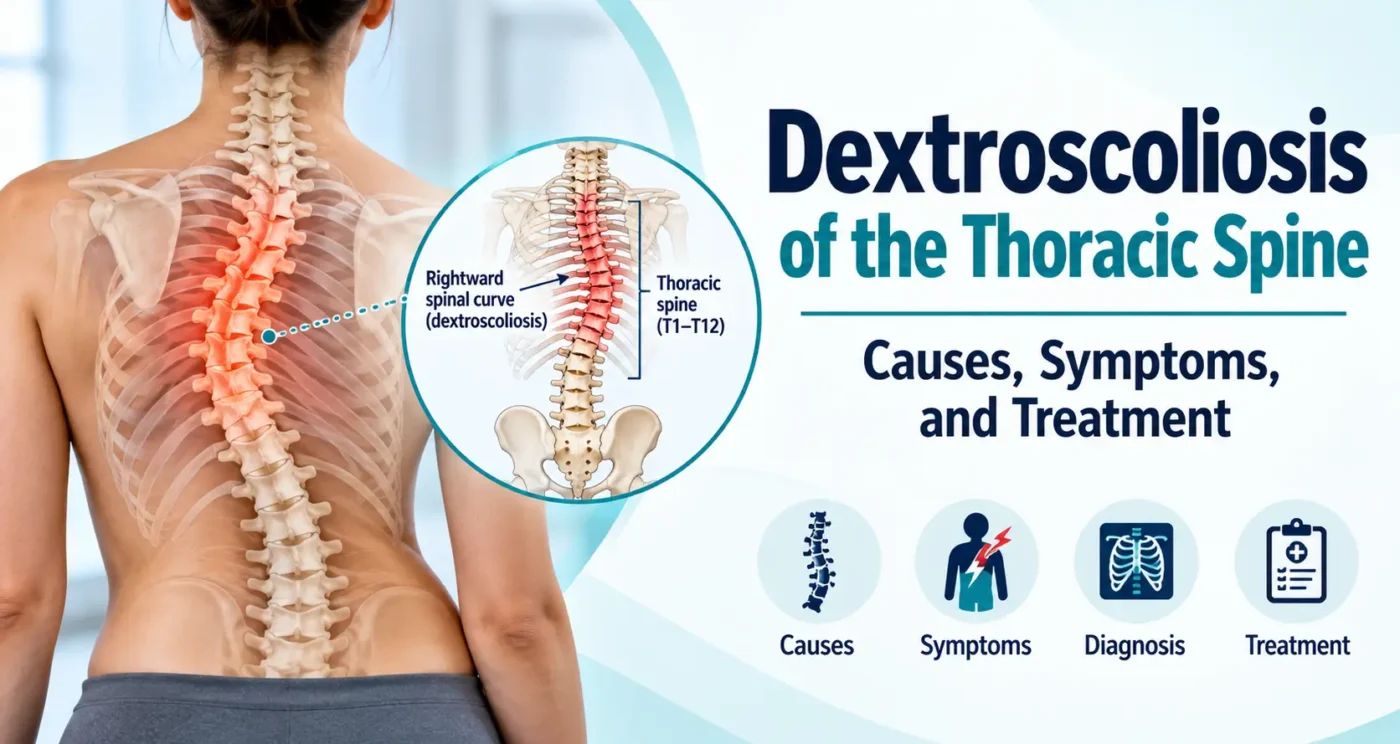
A radiology report that mentions “dextroscoliosis of the thoracic spine” can be unsettling, particularly when no one has yet explained the finding. The phrase describes a sideways spinal curve that bends to the right in the chest-level portion of the back. It does not automatically mean the spine is severely deformed, that surgery is necessary, or even that the curve is responsible for any pain.
To understand what the result means, it helps to look at the Cobb angle, age, growth remaining, symptoms, and whether the curve has changed over time. A clinician can interpret these details alongside the examination and images. The following guide explains the term, related thoracolumbar findings, treatment options, and warning signs without treating a report phrase as a diagnosis by itself.
What Is Dextroscoliosis of the Thoracic Spine?
Dextroscoliosis is a type of scoliosis with a curve convex toward the person’s right side. “Dextro” means right; “scoliosis” refers to a structural, three-dimensional curvature of the spine. In scoliosis, vertebrae may rotate as well as shift sideways. Looking only at the visible curve does not capture the full condition.
The thoracic spine consists of twelve vertebrae, T1 through T12, that connect with the rib cage. Thoracic dextroscoliosis therefore describes a right-convex curve whose main region is the upper or middle back. Some people have one curve; others have compensatory curves elsewhere that help keep the head and trunk balanced over the pelvis.
A rightward curve is not inherently more severe than a leftward one. Size, location, flexibility, growth status, and associated findings are more useful than direction alone for deciding what happens next.
What Does “Dextroscoliosis” Mean on an X-Ray Report?
Imaging reports may use expressions such as “mild dextroscoliosis of thoracic spine,” “right-convex thoracic curvature,” or “dextroscoliosis centered at T7.” Each indicates a direction or location, not necessarily a complete clinical assessment. If the report does not include a Cobb angle, ask whether a standing full-spine radiograph and formal measurement are appropriate.
The Cobb angle measures the inclination of vertebrae at the upper and lower ends of a curve on a spinal radiograph. A coronal curve greater than 10 degrees is the usual diagnostic threshold for scoliosis, although a small apparent curve may be called spinal asymmetry. Measurements can vary somewhat between readers and films, so a small numerical difference between reports may not signify true progression.
Reports may also mention vertebral rotation, pelvic tilt, sagittal alignment, or degenerative changes. These describe other aspects of the spine and cannot be inferred solely from the word “dextroscoliosis.”
Thoracic Dextroscoliosis vs. Thoracolumbar Dextroscoliosis
The words sound similar but identify different curve regions. A thoracic curve is primarily in the rib-bearing section of the spine. A thoracolumbar curve is centered near the transition between the thoracic and lumbar regions, around the lower thoracic and upper lumbar vertebrae.
| Term | Location | Typical implications |
| Thoracic dextroscoliosis | Right-convex curve in chest-level spine | May produce shoulder or rib-cage asymmetry |
| Thoracolumbar dextroscoliosis | Right-convex curve near thoracic-lumbar junction | May affect waistline and trunk balance |
| Lumbar dextroscoliosis | Right-convex curve mainly in lower back | May be accompanied by low-back or pelvic asymmetry |
A person can have two or more curves, so a single label may not describe the whole spinal pattern. The presence of rib prominence may be especially noticeable in thoracic curves because the ribs rotate with the vertebrae.
What Causes Dextroscoliosis of the Thoracic Spine?
Idiopathic scoliosis
Idiopathic means that no single cause is identified. It is the most frequent category of scoliosis, particularly in children and teenagers. Genetic factors contribute to susceptibility, but it is not accurately described as being caused simply by bad posture, carrying a backpack, or sleeping in a certain position. It may first be noticed during growth spurts.
Congenital scoliosis
Some children are born with vertebrae that formed or separated differently before birth. These structural differences can produce a curve early in life and may need specialist evaluation, especially when the curve progresses during growth.
Neuromuscular scoliosis
Conditions affecting muscle strength or nerve control, including some forms of cerebral palsy or muscular dystrophy, can affect spinal alignment. Management differs substantially from typical adolescent idiopathic scoliosis because mobility, sitting balance, respiratory health, and the underlying condition matter.
Degenerative scoliosis in adults
With age, asymmetric disc degeneration and facet joint changes may contribute to a spinal curve. Degenerative changes often involve the lumbar region, although thoracic alignment can also be affected. Adults may have an old adolescent curve that persists into later life or develop a new degenerative curve.
Other, less common causes
Prior injury or surgery, certain connective tissue disorders, and other structural conditions may be relevant in selected patients. A clinician looks for unusual pain, rapid onset, neurological changes, or atypical curve patterns rather than assuming that every curve has the same origin.
What Are the Symptoms of Thoracic Dextroscoliosis?
Mild curves may cause no symptoms and may be found incidentally when imaging is obtained for another reason. Others are noticed because clothing sits unevenly, one shoulder seems higher, or one side of the rib cage looks more prominent.
- Uneven shoulder height or one shoulder blade protruding more than the other
- A visible lean or asymmetry of the waist and trunk
- A rib prominence that appears on bending forward
- Muscle fatigue or discomfort after prolonged sitting or standing
- Back stiffness or pain, particularly in adults with additional spinal conditions
These findings are not specific to scoliosis. Shoulder differences can occur without a structural curve, and pain may arise from muscle strain, disc disease, or a separate problem. The Scoliosis Research Society notes that adolescent scoliosis often does not cause pain, even in some patients whose curves require bracing.
Can Thoracic Dextroscoliosis Cause Back or Chest Pain?
It can coexist with discomfort, but a curve seen on imaging should not automatically be blamed for pain. Adolescents with scoliosis commonly report no pain; adults are more likely to report back discomfort, sometimes in association with degeneration, muscle imbalance, or arthritis. Pain severity does not reliably indicate Cobb angle severity.
Chest-wall tension and rib asymmetry can be uncomfortable, particularly with larger curves. Sudden severe chest pain, breathing difficulty, or a new neurological symptom needs evaluation for causes other than scoliosis. Scoliosis should not become a catch-all explanation that delays assessment of another condition.
Is Mild Dextroscoliosis Serious?
Often it is not. A small stable curve in an adult with minimal symptoms may require little or no intervention. A similarly sized curve in a child who has substantial growth remaining may merit periodic monitoring because progression risk changes during growth. The term “mild” in a report is a description, not a prediction of what the spine will do in the future.
Another factor is whether the patient is balanced. A relatively modest curve with marked trunk imbalance or symptoms may merit a different evaluation than a larger but well-compensated curve. Clinical decisions should not be made from an isolated adjective on a report.
How Is Dextroscoliosis Severity Measured?
Clinicians use Cobb angle measurements together with skeletal maturity and progression over time. The table summarizes common adolescent idiopathic scoliosis decision points; it is not a universal algorithm for adults or children with congenital or neuromuscular scoliosis.
| Situation | Common consideration | Important qualification |
| Curve under 10° | Often described as spinal asymmetry | Not ordinarily classified as structural scoliosis on Cobb angle alone |
| About 10° to 25° | Observation may be appropriate | Growth and progression risk determine follow-up |
| Over 25° to below 45°–50° during growth | Bracing often considered | Brace type and duration are individualized |
| About 45°–50° or more | Surgical discussion may be appropriate | Decision incorporates progression, function, and patient circumstances |
A curve that was measured on different radiographic techniques or by different observers may show small variation. Comparing like-for-like standing images and reviewing the full pattern is more informative than relying on a single numerical change.
How Do Clinicians Diagnose Thoracic Dextroscoliosis?
History and physical examination
A clinician asks when the curve was noticed, whether it is changing, about pain and neurological symptoms, and whether family members have scoliosis. The examination includes shoulder and waist alignment, trunk balance, gait, and often the Adams forward-bend test to look for rotational prominence.
Standing spinal radiographs
When appropriate, standing front and side spinal X-rays show the spinal alignment under normal weight-bearing conditions. They allow Cobb angle measurement and evaluation of multiple curves. Repeat imaging is based on the likelihood of progression, symptoms, and prior findings; unnecessary scans should be avoided.
MRI or other imaging in selected cases
MRI is not routinely needed for every person with idiopathic scoliosis. It may be recommended when symptoms or examination findings suggest a neurological problem, when pain is unusual, or when the curve pattern raises concern about an underlying condition. CT is reserved for particular anatomical or surgical questions because it exposes patients to ionizing radiation.
Treatment for Dextroscoliosis of the Thoracic Spine
There is no single treatment that applies to everyone with a right-convex curve. The aim might be to prevent worsening during growth, reduce symptoms, preserve function, or correct a severe progressive deformity. Plans differ between a growing child and an adult with degenerative change.
Observation and follow-up
A stable small curve, especially in someone who has stopped growing, may only need occasional review. For a growing adolescent at risk of progression, the Scoliosis Research Society describes monitoring intervals that can be every four to six months during some phases of growth. The actual interval should follow specialist advice rather than a fixed universal schedule.
Physical therapy and scoliosis-specific exercise
Exercises may help mobility, muscular endurance, balance, and pain management. Physiotherapists may use scoliosis-specific approaches in selected patients. Evidence that exercise alone reliably prevents structural progression remains limited and varies by program and patient group. General physical activity is usually encouraged; people should not avoid movement simply because their radiograph mentions scoliosis.
Bracing during growth
A brace is primarily used for selected children or adolescents who are still growing and have curves at risk of progression. The goal is usually to prevent further curvature, not to permanently straighten the spine immediately. The Scoliosis Research Society generally discusses bracing for curves above 25 degrees and below approximately 45–50 degrees in growing patients. Wear time matters, and a specialist should determine brace type and schedule.
Pain management in adults
Adults with pain may benefit from individualized exercise, physical therapy, suitable pain medicines, and sometimes injections for an identified pain source. These approaches generally treat symptoms rather than reshape an established bony curve. Medication decisions must account for other health conditions and be made with an appropriate clinician.
Surgery
Surgical treatment may be discussed for large or progressing curves, substantial imbalance, or functional problems that have not improved with appropriate conservative treatment. Spinal fusion is a common option in significant structural scoliosis; in selected patients, other procedures may be considered. Surgery has meaningful risks, recovery demands, and permanent effects on motion at fused levels. Not every adult or adolescent with a curve near a numerical threshold needs an operation.
Can Dextroscoliosis Get Worse With Age?
Progression depends on several factors. Children and teenagers undergoing a growth spurt have a different risk profile from fully grown adults. Larger curves that remain after skeletal maturity may continue to progress over time, whereas many small stable curves do not. Adults may also develop additional changes from disc and joint degeneration.
Symptoms deserve attention even if the last Cobb angle was modest. New pain, reduced walking tolerance, nerve symptoms, or obvious changes in balance may reflect associated spinal conditions requiring evaluation. A clinician can determine whether new imaging is needed rather than assuming the old report explains everything.
Can Thoracic Dextroscoliosis Affect Breathing?
Very large thoracic curves can change the chest wall and reduce the space available for lung expansion. Breathing limitations are not expected from every mild thoracic curve, and respiratory symptoms should not automatically be attributed to scoliosis. When a curve is substantial or breathing issues are present, a clinician may consider pulmonary assessment and evaluate other possible causes.
Living With Thoracic Dextroscoliosis
Many people with scoliosis remain active, participate in sports, and go about work or school without major restrictions. Activity can be adapted to comfort and individual medical advice. Physical conditioning, adequate sleep, and movement breaks may help manage general back discomfort, although none should be promoted as a proven cure for the underlying spinal shape.
If a brace is prescribed, fitting, skin comfort, school or work routines, and emotional effects deserve attention. Adolescents may need support with body image and adherence. Adults may benefit from discussing ergonomic adjustments and goals for activity rather than focusing exclusively on radiographic appearance.
A report is easier to interpret when you know four things: the Cobb angle, the curve location, whether skeletal growth is complete, and whether prior imaging shows meaningful change.
When to See a Doctor—and When Symptoms Are Urgent
Arrange a medical assessment if you or a child has newly noticed shoulder or rib asymmetry, a report showing scoliosis without a clear follow-up plan, worsening posture, or persistent back pain. A spine specialist may be appropriate when a curve is progressing or treatment decisions are complex.
Seek prompt care for new or worsening weakness, numbness, unexplained severe pain, fever with back pain, or changes in walking. Sudden significant leg weakness, loss of bladder or bowel control, or numbness around the groin or saddle area can indicate a spinal emergency and requires immediate assessment. New severe breathing difficulty or chest pain also warrants urgent evaluation for causes beyond scoliosis.
Frequently Asked Questions
What is dextroscoliosis?
Dextroscoliosis means a scoliosis curve whose convex side points toward the person’s right. It describes direction, not severity.
What is dextroscoliosis of the thoracic spine?
It is a right-convex structural spinal curve centered in the rib-bearing region of the back.
Is thoracic dextroscoliosis the same as thoracolumbar dextroscoliosis?
No. Thoracic curves are centered higher in the rib-bearing spine; thoracolumbar curves center near the junction of the thoracic and lumbar regions.
What does mild dextroscoliosis of the thoracic spine mean?
It generally describes a relatively small right-convex curve, but the Cobb angle and clinical context are needed to interpret it.
Is dextroscoliosis of thoracic spine dangerous?
Many mild curves are not dangerous. Risk depends on curve size, progression, symptoms, and associated conditions.
Can dextroscoliosis cause shoulder blade pain?
It may coexist with muscle discomfort, but pain has many potential causes and should not automatically be attributed to the curve.
Does dextroscoliosis affect the heart?
Mild curves usually do not impair heart function. Severe chest-wall deformity can affect cardiopulmonary mechanics in selected cases, requiring specialist evaluation.
Can thoracic dextroscoliosis cause breathing problems?
Large thoracic curves can restrict chest expansion; mild scoliosis generally does not cause clinically significant breathing impairment.
Can exercises straighten thoracic dextroscoliosis?
Exercises can support comfort and function. A predictable permanent correction of structural curvature from exercises alone is not established.
Can adults wear braces for scoliosis?
Some adults use supportive bracing for particular symptoms, but the progression-prevention evidence and aims differ from bracing a growing adolescent.
Does dextroscoliosis always get worse?
No. Many mild curves stay stable; larger curves, growth, and degenerative changes can increase progression risk.
Does a 10-degree Cobb angle require treatment?
A curve around the diagnostic threshold often needs assessment or observation rather than active correction, depending on age and growth.
Is surgery required for 40-degree thoracic dextroscoliosis?
Not automatically. Age, growth, progression, balance, symptoms, and patient preferences shape treatment decisions.
Can I exercise or play sports with thoracic dextroscoliosis?
Most people can remain active. Specific restrictions should come from the treating clinician based on symptoms or treatment.
What should I ask after an X-ray shows dextroscoliosis?
Ask for the measured Cobb angle, curve region, whether earlier images show progression, and whether follow-up or specialist review is recommended.
A Practical Perspective
The phrase dextroscoliosis of the thoracic spine tells you where the spine curves and in which direction. It does not tell you everything about prognosis. A measured angle, examination, growth status, and comparison with earlier images help establish whether the finding calls for reassurance, monitoring, a brace, treatment for symptoms, or a surgical conversation. If the report is new or unexplained, ask the ordering clinician to review it with you rather than attempting to interpret the term alone.
Resources
Scoliosis Research Society — Diagnosis and Treatment
Overview of observation, bracing, and surgery thresholds for scoliosis.
Scoliosis Research Society — Diagnosis and Treatment
Scoliosis Research Society — Diagnosing Scoliosis
Explains clinical examination, standing radiographs, and Cobb-angle measurement.
Scoliosis Research Society — Diagnosing Scoliosis
Scoliosis Research Society — Bracing
Outlines bracing indications and the role of wear time during growth.
Scoliosis Research Society — Bracing
American Academy of Orthopaedic Surgeons — Surgical Treatment for Scoliosis
Describes when surgery is considered and what recovery entails.
American Academy of Orthopaedic Surgeons — Surgical Treatment for Scoliosis
NHS — Scoliosis
Patient-oriented overview of causes, symptoms, and common treatment approaches.
NHS — Scoliosis Treatment in Adults
Explains symptom management and selected surgical options in adults.
NHS — Scoliosis Treatment in Adults
American Association of Neurological Surgeons — Scoliosis
Reviews types, evaluation, severity, and neurological considerations.
American Association of Neurological Surgeons — Scoliosis
Editorial Guidelines & Medical Disclaimer
This article is for general educational information and does not diagnose scoliosis or replace evaluation by a qualified healthcare professional. Curve direction alone does not determine severity or treatment. Clinical recommendations, imaging needs, exercise plans, bracing, and surgery decisions vary with age, growth, symptoms, and other conditions. New neurological symptoms or severe breathing problems may require urgent care. Information is based on professional and public-health sources; recommendations may evolve. Medical billing, coding, coverage, and reimbursement policies can also change and differ across payers when relevant to treatment decisions.
Read MedIntelHub’s Editorial Policy
For information about routine health assessments versus focused evaluation, see MedIntelHub’s guide below:
Understanding Your Annual Physical: What Actually Gets Checked

David Bennett
David Bennett is an author at MedIntelHub, where he creates clear, practical, and well-researched content about healthcare, medical billing, insurance, and patient education. His goal is to make complex healthcare topics easier for readers to understand and use in everyday situations. David emphasizes accuracy, transparency, and reliable sourcing, using information from trusted organizations and official healthcare resources whenever possible. Content published by David is intended for educational purposes and should not replace advice from qualified medical, legal, or healthcare professionals.