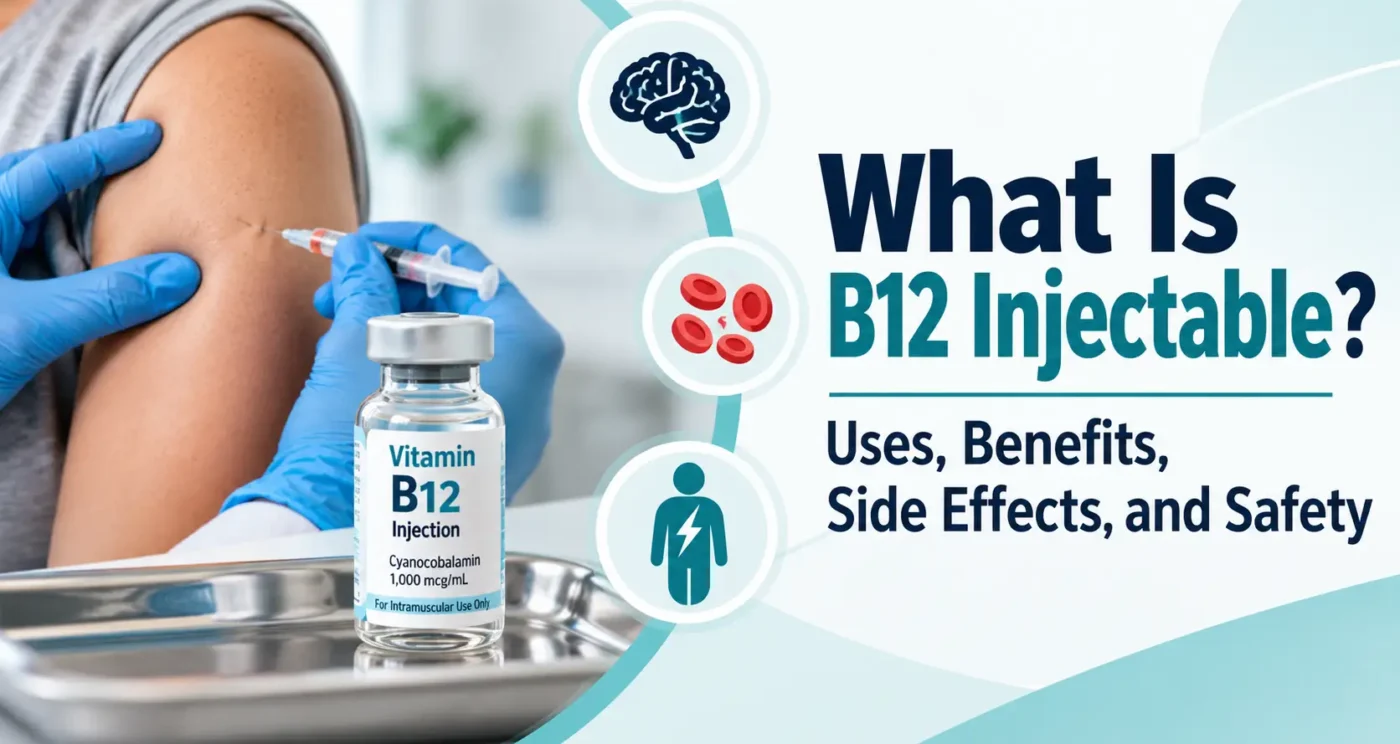
A vitamin B12 shot is often promoted as a quick fix for exhaustion. But whether an injection is useful depends less on how tired someone feels and more on why their vitamin B12 level might be low. For a person with confirmed deficiency, appropriate replacement can correct anemia and help prevent further nerve injury. For someone whose B12 status is adequate, there is little evidence that injections create extra energy or speed weight loss.
B12 injectable is a prescription form of vitamin B12 given into a muscle or, for some products, beneath the skin. This guide explains what B12 injections are good for, why clinicians choose injections instead of tablets, possible adverse effects, and how treatment is monitored. It reflects U.S. medication information and relevant international clinical guidance available in October 2026.
What Is B12 Injectable?
Vitamin B12, also called cobalamin, is a water-soluble nutrient needed to make healthy red blood cells, maintain normal neurological function, and support DNA synthesis. Food sources include fish, meat, eggs, and dairy foods; fortified foods and supplements offer alternatives for people who eat few or no animal products.
An injectable B12 product delivers the vitamin without relying on the usual digestive process. This can be helpful for people whose stomach or small intestine cannot absorb enough B12 from food. “Injectable” describes the route of administration, not a special vitamin with superior energy-enhancing properties.
Prescription injections may contain cyanocobalamin or hydroxocobalamin. Available products and usual treatment approaches vary by country and clinical indication. In the United States, cyanocobalamin injection is commonly described in patient medication references; hydroxocobalamin is used widely for deficiency replacement in some other health systems. The exact product, route, and schedule should come from a clinician or pharmacist.
What Is a B12 Shot Good For?
Correcting vitamin B12 deficiency
The primary evidence-based purpose of a B12 injection is to replace vitamin B12 when someone lacks enough of it. Deficiency can result from inadequate intake, impaired absorption, certain medications, or a combination of factors. If untreated, it can affect red blood cells and the nervous system. Replacement can restore the vitamin supply, but a clinician still needs to identify why deficiency developed.
Treating vitamin B12 deficiency anemia
When a lack of B12 disrupts red blood cell production, anemia can cause weakness, fatigue, breathlessness, and reduced exercise tolerance. Blood counts typically improve after effective treatment. Not every person with low B12 has anemia, however, and the absence of anemia does not rule out neurological problems.
Preventing further nerve problems
Vitamin B12 deficiency can cause tingling, numbness, balance difficulty, altered sensation, and sometimes cognitive or mood changes. Prompt treatment is particularly important if neurological symptoms are present. Some problems improve gradually; symptoms present for a long time may not resolve completely. An injection is not a treatment for every cause of neuropathy or memory trouble.
Replacing B12 when absorption is impaired
People with autoimmune gastritis (sometimes called pernicious anemia in the appropriate clinical context), certain gastrointestinal surgeries, or removal of part of the terminal ileum may need long-term replacement. NICE recommends lifelong intramuscular replacement for certain irreversible malabsorption causes. That does not mean every person with stomach symptoms needs injections; the diagnosis and cause guide treatment.
What B12 shots do not reliably do
Marketing sometimes links B12 shots with weight loss, better athletic performance, or an immediate “energy boost.” Research has not established those benefits for people with sufficient vitamin B12. If fatigue persists despite normal B12 results, conditions such as sleep disorders, thyroid disease, iron deficiency, depression, or medication effects may deserve evaluation instead of repeated wellness injections.
Who Might Need Vitamin B12 Injections?
A healthcare professional may consider injectable treatment when deficiency is confirmed or strongly suspected and there is concern about severe symptoms, impaired absorption, or difficulty taking oral replacement. People who may be evaluated for B12 deficiency include:
- People with autoimmune gastritis or a history of pernicious anemia.
- People who have undergone certain stomach, bariatric, or intestinal operations.
- People with conditions involving the terminal ileum or other causes of malabsorption.
- People following strict vegan diets without reliable fortified foods or supplementation.
- Older adults with risk factors for reduced B12 absorption.
- People taking medicines associated with low B12, including metformin or prolonged acid-suppressing therapy.
- People with unexplained anemia, tingling, gait changes, or other suggestive symptoms.
These are reasons to assess vitamin status, not automatic indications for injections. Someone whose deficiency arises mainly from dietary intake may do well with oral supplementation. Clinicians consider symptoms, test results, the underlying cause, patient preference, and treatment reliability.
Symptoms of Low Vitamin B12
Symptoms may develop slowly, and several overlap with unrelated conditions. People sometimes report exhaustion long before anemia is recognized. Others have neurological symptoms even when their blood count is not markedly abnormal.
- Persistent tiredness, weakness, or reduced stamina.
- Pale skin, breathlessness, or palpitations when anemia is present.
- Pins-and-needles sensations, numbness, or altered touch sensation.
- Trouble with walking or balance.
- Sore or smooth-looking tongue and mouth discomfort.
- Concentration, memory, or mood changes.
A sudden new neurological deficit, severe breathlessness, chest pain, or fainting requires prompt assessment rather than assuming B12 deficiency is responsible. Symptoms alone cannot confirm a low level.
How Is Vitamin B12 Deficiency Diagnosed?
Assessment begins with the symptom history, diet, medical conditions, medications, and physical examination. Clinicians may order a complete blood count and a serum B12 test; interpretation depends on the laboratory method and clinical picture. In borderline or uncertain cases, methylmalonic acid (MMA) may help, although kidney function and other circumstances can affect results.
Additional investigations may include testing related to autoimmune gastritis, iron or folate status, and selected tests for other causes of anemia or neuropathy. A low B12 reading does not by itself explain every symptom; conversely, a normal-sized red blood cell count does not always exclude B12 deficiency. Recent supplementation can complicate interpretation.
Where feasible, blood sampling is often performed before starting replacement. However, when potentially significant neurological injury is suspected, clinicians may begin treatment without delaying for every result. NICE makes this distinction in its diagnostic recommendations.
If you are discussing testing at a checkup, MedIntelHub’s article on what actually gets checked during an annual physical explains why laboratory testing is tailored to symptoms and history rather than automatically ordered for everyone.
Understanding Your Annual Physical: What Actually Gets Checked
Types of Injectable Vitamin B12
| Form | Typical context | What patients should know |
| Cyanocobalamin | Common prescription replacement form in U.S. references | Product-specific instructions determine route and dosing. |
| Hydroxocobalamin | Widely used for deficiency replacement in some health systems | Schedules and availability differ by country and product. |
Methylcobalamin is also sold in various preparations, including compounded or wellness products, but its marketing claims should not be confused with evidence of clinical superiority. The active form is less important than an appropriate replacement plan, reliable product quality, and follow-up for the underlying problem.
How Are B12 Injections Given?
A trained professional may administer a B12 injection into a muscle. Some cyanocobalamin products also allow a subcutaneous injection, depending on the label and clinician instructions. The dose is measured in micrograms, not milligrams, and a large number on a vial is not an indication that a higher dose provides more energy.
In some settings people learn to self-administer prescribed injections after formal training. They need instructions for the correct product, syringe, injection technique, storage, sharps disposal, missed doses, and signs of an adverse reaction. Never copy an injection schedule from a friend or a wellness clinic advertising generic “B12 boosters.”
How Often Are B12 Shots Needed?
There is no universal schedule. Some regimens use frequent initial doses followed by less frequent maintenance injections. The U.S. MedlinePlus cyanocobalamin monograph describes an example of more frequent injections at the beginning, transitioning to approximately monthly maintenance in some patients. Other preparations and clinical protocols follow different intervals.
The cause of deficiency also matters. A reversible dietary deficiency may not require lifelong injections. Someone with an irreversible absorption problem may need continuing treatment. A clinician should set the course and decide when reassessment is appropriate; patients should not stop replacement simply because they feel better.
How Long Does a B12 Injection Take to Work?
Vitamin B12 begins entering the body with the injection, but symptoms rarely disappear immediately. A person with deficiency-related anemia may notice improvement as blood counts recover over the following weeks. Nerve symptoms can take longer and may improve incompletely.
NICE advises that symptoms may start to improve within about two weeks, although improvement can take up to three months and some symptoms take considerably longer to disappear. This is a general counseling range, not a promise about an individual outcome. New, worsening, or persistent symptoms should be reviewed rather than automatically answered with more injections.
B12 Injections vs. Oral B12 Tablets
| Question | Injections | Oral replacement |
| How taken? | By a trained professional or trained patient | By mouth at home |
| Absorption | Bypasses gastrointestinal absorption | Some absorption remains possible even when intrinsic-factor absorption is impaired |
| Convenience | Requires supplies or appointments | Usually easier to take consistently |
| Best suited for | Some severe or malabsorption-related deficiencies; individual clinical needs | Many dietary deficiencies and selected other cases |
| Monitoring | Symptoms and response reviewed | Symptoms, adherence, and response reviewed |
High-dose oral B12 can treat many cases of deficiency, including selected malabsorption settings, but the evidence and guidance require attention to clinical context. For someone with severe neurological symptoms, autoimmune gastritis, or certain surgeries, clinicians may favor injections. Neither method should be called universally better.
B12 Shots for Fatigue, Energy, and Weight Loss
Someone whose fatigue genuinely results from B12 deficiency may feel more energetic after replacement improves anemia or related symptoms. That does not mean B12 acts like a stimulant. It restores a missing nutrient; it does not provide the same benefit when a person already has enough.
Likewise, B12 is involved in normal metabolism, but being involved in energy metabolism does not show that extra injections accelerate fat loss. Mayo Clinic reports that there is no solid proof B12 shots help people lose weight. Promotional before-and-after stories are not a substitute for controlled evidence.
An unexplained loss of weight, persistent fatigue, or marked weakness warrants a medical evaluation rather than assuming that a vitamin shot is the appropriate remedy.
Side Effects and Risks of B12 Injections
Common or less serious effects
An injection may cause brief discomfort, tenderness, or a small bruise at the site. Depending on the product, gastrointestinal upset or other symptoms may occur. A persistent rash, unusual swelling, or symptoms that are difficult to explain should be discussed with the prescribing team.
Allergic reactions and serious symptoms
Rarely, someone can develop an allergic reaction. Hives, swelling of the lips or tongue, wheezing, difficulty breathing, or difficulty swallowing after an injection require emergency medical care. The U.S. cyanocobalamin medication information also lists several symptoms needing urgent clinician attention, including significant swelling, fast heartbeat, and new leg pain or swelling.
Other precautions
Tell the prescriber about an allergy to cobalt or a previous reaction to a B12 product; kidney conditions; Leber hereditary optic neuropathy; pregnancy or breastfeeding; and all medications or supplements. Individual products have specific precautions. Severe anemia can also require laboratory monitoring during early replacement, based on clinician judgment.
A person who develops new neurological symptoms, chest pain, severe breathlessness, or fainting should not attribute them automatically to a benign vitamin reaction.
Can You Get Too Much Vitamin B12?
Vitamin B12 has a low toxicity potential and no established tolerable upper intake level for healthy people. That fact does not make repeated injections medically necessary or risk-free. A needle introduces injection-related risks, products may have additional ingredients, and excessive treatment can distract from finding the actual cause of symptoms.
Testing and ongoing treatment should target a clinical problem, not an arbitrary goal of keeping blood B12 concentrations as high as possible. Levels measured soon after an injection can be high without meaning that symptoms are fully treated or that additional dosing is warranted.
Pregnancy, Breastfeeding, and Other Special Situations
B12 is essential during pregnancy and breastfeeding, and deficiency deserves attention. Replacement may be appropriate when a clinician identifies deficiency or high risk. The formulation, route, and dosing should be discussed with the relevant obstetric or primary care team, particularly when anemia, neurological symptoms, or malabsorption is present.
Vegetarians and vegans can prevent dietary deficiency through reliable fortified foods or supplements. People with gastrointestinal surgery, autoimmune gastritis, or medication-associated deficiency may need longer follow-up than someone whose low intake is corrected.
What to Ask Before Getting a B12 Shot
- What evidence suggests that I have B12 deficiency?
- Which test results and symptoms are being used to guide treatment?
- Why is an injection preferable to oral replacement in my case?
- Which exact product, dose, and route are prescribed?
- How frequently will I receive treatment, and for how long?
- When should symptoms or laboratory results be reassessed?
- What adverse symptoms should prompt a call or urgent care?
- Is there an underlying cause, such as autoimmune gastritis or a medication effect, that still needs attention?
Frequently Asked Questions
What is B12 injectable used for?
It is used mainly to prevent or treat vitamin B12 deficiency, particularly when absorption is poor or when clinical circumstances favor injections over tablets.
What is a B12 shot good for?
A medically indicated B12 shot can correct deficiency and support recovery from deficiency-related anemia or neurological symptoms. It is not a proven general energy enhancer.
Will B12 injections give me energy right away?
Not reliably. When fatigue is caused by deficiency, improvement may take days to weeks. Someone with normal B12 levels may notice no medical benefit.
Are B12 injections better than pills?
Not always. High-dose oral replacement works for many patients, while injections are favored in some severe or malabsorption-related cases.
Do B12 injections help with weight loss?
There is no solid evidence that B12 injections themselves produce weight loss in people without deficiency.
How long does a B12 shot last?
The interval between doses depends on the product, diagnosis, and maintenance plan. It cannot be determined from a single generic rule.
How quickly do B12 shots help tingling?
Nerve-related improvement may begin over weeks but can take months, and some longstanding problems may not fully reverse.
Can you have low B12 without anemia?
Yes. Neurological or other symptoms may occur without obvious anemia or enlarged red blood cells.
Can I receive B12 injections without a blood test?
A clinician may sometimes start treatment before all tests return, particularly with concerning neurological symptoms, but evaluation for the cause is still important.
Are B12 injections safe during pregnancy?
Replacement may be appropriate for deficiency during pregnancy; the prescribing team should choose the formulation and treatment plan.
What are the most serious B12 injection side effects?
Severe allergic reactions are rare but require emergency care. Other significant symptoms should be assessed under product-specific prescribing guidance.
Who should avoid B12 injections?
A previous serious reaction to a B12 product or relevant ingredient warrants clinician review. Other precautions depend on the formulation and medical history.
Can I give myself a B12 injection at home?
Only when the prescription permits it and a qualified professional has provided injection, storage, and sharps-disposal training.
Do I need B12 shots for life?
Some irreversible absorption problems require lifelong replacement, while others may be treated for a limited time or managed with oral supplements.
What if I feel tired despite taking B12?
Persistent fatigue has many potential causes. Ask a clinician to review the diagnosis, response, and other possible explanations rather than increasing doses independently.
What Readers Should Remember
B12 injections are a treatment for a defined nutritional or absorption problem, not a universal remedy for tiredness. People with significant deficiency, particularly those with neurological symptoms or certain gastrointestinal conditions, may benefit from prompt replacement. Others may do equally well with oral B12. The safest approach is to establish the likely cause, choose an appropriate formulation and schedule, and monitor whether treatment is helping.
Resources
NIH Office of Dietary Supplements — Vitamin B12: Health Professional Fact Sheet
Explains vitamin B12 biology, deficiency risk, available preparations, and the evidence comparing oral and injectable treatment.
Vitamin B12: Health Professional Fact Sheet
NIH Office of Dietary Supplements — Vitamin B12: Consumer Fact Sheet
Provides accessible information about dietary sources, supplements, and prescription B12.
Vitamin B12: Consumer Fact Sheet
MedlinePlus — Cyanocobalamin Injection
Describes U.S. medication uses, administration, precautions, side effects, and practical safety advice.
NICE — Vitamin B12 Deficiency in Over 16s: Diagnosis and Management
Offers recommendations on testing, replacement choices, follow-up, and selected indications for long-term injections.
Vitamin B12 Deficiency in Over 16s: Diagnosis and Management
Mayo Clinic — Vitamin B12 Injections for Weight Loss
Addresses unproven claims about weight loss and routine energy boosting.
Vitamin B12 Injections for Weight Loss
Editorial Guidelines & Medical Disclaimer
This MedIntelHub article provides general educational information, not a diagnosis or a personalized treatment plan. B12 deficiency, anemia, fatigue, and neurological symptoms may have several causes. Testing, injection selection, dosing, and treatment duration should be decided with a qualified healthcare professional. Do not start, stop, or change prescribed injections or other medication without clinical advice. Seek emergency care for difficulty breathing, throat swelling, chest pain, or other severe symptoms. Medical guidance and product information can change; consult current prescribing information and relevant clinical guidance. MedIntelHub uses authoritative medical and public-health sources and explains its editorial approach here:

David Bennett
David Bennett is an author at MedIntelHub, where he creates clear, practical, and well-researched content about healthcare, medical billing, insurance, and patient education. His goal is to make complex healthcare topics easier for readers to understand and use in everyday situations. David emphasizes accuracy, transparency, and reliable sourcing, using information from trusted organizations and official healthcare resources whenever possible. Content published by David is intended for educational purposes and should not replace advice from qualified medical, legal, or healthcare professionals.