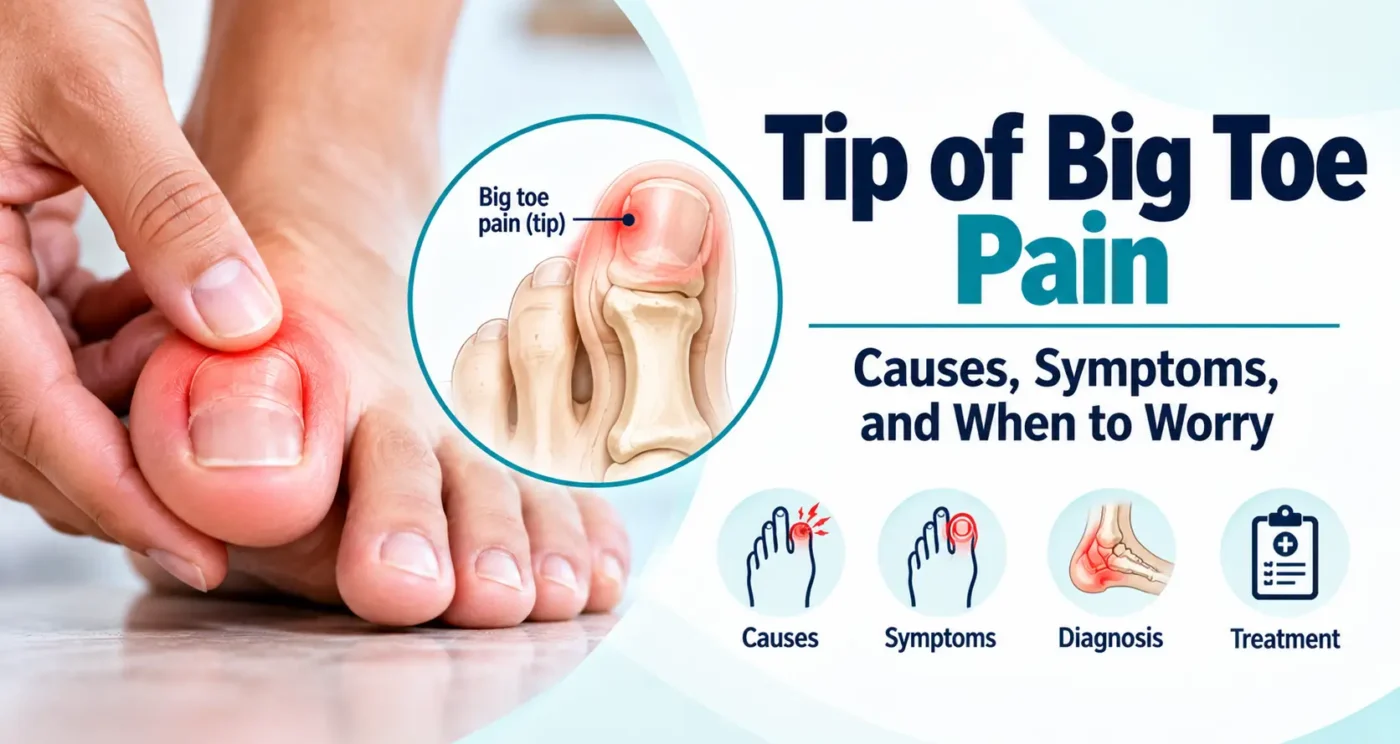
A sharp sting at the end of your big toe when you pull on a shoe can be surprisingly distracting. Sometimes the discomfort sits beside the nail; sometimes the entire toe throbs, or the pain seems to come from underneath. Those patterns do not all point to the same diagnosis. The tip of the big toe contains skin, a nail and nail bed, nerves, small blood vessels, and bone. A problem affecting any of these structures can hurt even when the joint closer to the foot is normal.
Tip of big toe pain often comes from shoe pressure, an ingrown nail, irritation of the skin, or a minor injury. Less commonly, infection, nerve disease, poor circulation, or a fracture needs attention. Gout is a well-known cause of big toe pain, but it more typically affects the joint at the base of the toe rather than its far end. The precise location, onset, and accompanying changes offer useful clues—not a diagnosis.
Why Does the Tip of My Big Toe Hurt?
A toe can hurt at its tip even if there is no obvious wound. A shoe with a shallow toe box can press the nail against the upper, while a shoe that is too short pushes the tip against its front. Repeated downhill walking, running, or long periods on your feet may create friction, thickened skin, or a bruised nail. A small tear beside the nail may become inflamed. A fracture can follow a stubbed toe or a dropped object; pain may also persist after the original event seems minor.
The distinction between a painful nail edge, a tender pad at the end of the toe, and a swollen joint matters. It helps the clinician decide whether to examine the nail fold, assess sensation and circulation, or order imaging. A person with diabetes, neuropathy, or circulation problems should arrange assessment earlier because an apparently small injury can become serious.
Common Causes of Pain at the Tip of the Big Toe
Ingrown toenail and inflamed nail folds
An ingrown toenail develops when an edge of the nail presses into or penetrates the surrounding skin. The corner can become tender, puffy, red, and painful when shoes touch it. Drainage or pus may suggest infection. Tight shoes, trimming the nail too short, rounding its corners, and toe trauma can contribute. Pain on the side of the big toe near the nail is particularly suggestive, although only an examination can confirm it. The American Academy of Orthopaedic Surgeons recommends roomy footwear and appropriate straight-across nail trimming to prevent recurrence.
Callus, corn, blister, or pressure injury
Localized thick skin forms where the foot repeatedly meets pressure or friction. A corn at the tip may create a hard, focused painful spot. A blister produces a more superficial, sometimes burning discomfort, and a bruised nail may look dark after repetitive pressure. Inspect the inside of shoes for seams and check whether the toe touches the front when standing or walking downhill. Do not cut a corn with a blade or use chemical corn removers on a numb or poorly perfused foot.
Minor injury, sprain, or fracture
Stubbing the toe can injure skin, the nail bed, the tip bone (distal phalanx), or a joint. A fracture may cause focal tenderness, swelling, bruising, and painful weight-bearing, but not every fracture looks dramatically deformed. Severe pain after trauma, an abnormal toe angle, or difficulty walking deserves prompt evaluation. The big toe plays an important role in balance and push-off, so an injury may need more specific care than a lesser-toe injury.
Nail or skin infection
An infection around the nail (paronychia) can cause increasing tenderness, warmth, swelling, and sometimes pus. A puncture or cracked skin can also allow bacteria to enter. Infection should not be assumed merely because the skin looks red: injury and irritation can also produce inflammation. Fever, spreading redness, or rapidly worsening swelling makes medical assessment more urgent.
Nerve irritation and neuropathy
Burning, tingling, electric-like or stabbing pain in the big toe may reflect irritated peripheral nerves. Causes include local compression from footwear, injury, and some forms of peripheral neuropathy. Diabetes is one possible contributor, but many people with toe tingling do not have diabetes. Persistent numbness, altered sensitivity, or pain affecting both feet warrants evaluation for an underlying problem.
Cold toes with changing color and numbness may occur during temporary blood-vessel spasm, as in Raynaud phenomenon. More serious circulation problems can cause persistent pain, a cold or pale toe, wounds that heal poorly, or skin discoloration. Sudden severe pain combined with a cold, pale or blue toe is an emergency; it must not be dismissed as an ordinary nail problem.
Big Toe Pain by Location
When someone says “pain in my big toe,” asking exactly where it hurts often clarifies the next step. Pain near the nail is different from pain under the ball of the foot. Conditions can overlap, and pain sometimes spreads beyond its source.
| Location | Possible explanations | Typical clues |
| Tip or nail edge | Ingrown nail, pressure, bruised nail, skin infection | Tenderness when touching nail or wearing closed shoes |
| Outer or inner side | Nail-fold irritation, corn, shoe pressure, bunion nearby | Friction or redness at a specific edge |
| Between big and second toes | Moisture irritation, blister, friction, local nerve symptoms | Pain with narrow shoes or contact between toes |
| Base joint | Gout, hallux rigidus, bunion, osteoarthritis | Joint swelling, stiffness, pain on bending |
| Under big-toe joint | Sesamoiditis or sesamoid injury | Pain during push-off or on ball of foot |
| Across both big toes | Footwear pressure, skin disease, joint problems, neuropathy | Similar symptoms in both feet |
Pain on the Side or Outside of the Big Toe
Pain on the outside of the big toe may refer to the side beside the second toe or the side toward the inside edge of the foot. Nail-edge tenderness often points toward an ingrown nail or irritated nail fold. A corn or blister can occur along either side where skin rubs footwear or another toe. A bunion causes a prominence at the base joint, not at the tip, though it may shift the toe and create secondary rubbing. Do not assume that a painful side is a particular diagnosis without examining the exact spot.
Pain Between the Big Toe and Second Toe
Skin between the first two toes can become irritated from moisture, rubbing, or a tight toe box. Look for a blister, soft whitened skin, cracked skin, or a tender pressure point. Fungal irritation is possible when the skin is itchy and scaly; bacterial infection may be a concern when inflammation spreads. Nerve-related discomfort is another possibility when burning or tingling predominates. Keep the area clean and dry, and seek care for persistent breaks in the skin or swelling.
Pain Under the Big Toe
Discomfort under the ball of the foot near the big-toe joint can come from two small sesamoid bones embedded in tendons. Repetitive loading may inflame the surrounding tissues, a condition called sesamoiditis. It often develops gradually and hurts with push-off, dancing, running, or wearing elevated heels. Sesamoid fractures may cause similar pain and should be considered after acute injury. This is different anatomically from pain at the nail or distal tip.
What Do Stabbing, Throbbing, or Random Big Toe Pain Mean?
Words such as “stabbing” and “throbbing” describe the sensation but rarely identify its cause. A stabbing pain may come from a nail corner, a damaged skin spot, or nerve irritation. Throbbing can develop with swelling after injury, inflammation, or infection. Random big toe pain that appears at night or during rest may reflect a pressure point, a nerve symptom, or a joint flare; the presence of warmth, swelling, or numbness helps determine the urgency.
Keep track of when pain begins, whether it is triggered by shoes or walking, and any color or temperature change. If the toe is visibly swollen, a photo taken for your clinician may help show how it changed over time; it cannot replace an examination.
Why Do I Have Left Big Toe Pain—or Pain in Both Big Toes?
Left big toe pain and right big toe pain have largely the same possible causes. One-sided pain after a knock or in a specific pair of shoes may favor local mechanical irritation. Pain in both big toes can occur when both toes experience the same shoe pressure, but it can also be related to a systemic or nerve problem. The number of toes involved is a clue, not a diagnosis. A clinician may compare both feet for pulses, skin temperature, movement, sensation, and nail changes.
Could Gout Cause Pain at the Tip of the Big Toe?
Gout is inflammatory arthritis caused by monosodium urate crystals. A classic flare arrives suddenly, often overnight, with intense pain, warmth, and swelling at the first metatarsophalangeal joint—the joint connecting the big toe to the foot. Pain at the far tip, especially along the nail margin, is less typical of gout. Nevertheless, gout can involve other joints, and advanced disease can produce deposits called tophi. Location and appearance alone do not prove or exclude gout.
A first episode of a hot, red, very painful toe joint warrants clinical assessment. Infection in a joint, known as septic arthritis, can resemble gout and requires urgent treatment. The NICE gout guideline recommends evaluating for septic arthritis when a joint is painful, red, and swollen. A uric acid blood test can be misleadingly low during an acute flare; clinicians may repeat it after symptoms settle when gout remains suspected.
How to Relieve Gout Pain in the Big Toe
For a diagnosed gout flare, treatments often include an NSAID, colchicine, or a short corticosteroid course, selected according to medical history, kidney function, other medicines, and contraindications. A clinician should help determine which is appropriate. Resting the joint, elevating the foot, avoiding pressure from footwear, and applying ice wrapped in a cloth for short periods may ease discomfort. Do not abruptly change prescribed urate-lowering treatment or take someone else’s gout medicine. Recurrent flares require a longer-term urate-management discussion, not just repeated pain relief.
How Is Big Toe Pain Diagnosed?
A clinician typically starts by asking how the pain began, whether there was injury, where the tenderness is strongest, and whether shoes or movement trigger it. Examination may include the nail and skin, joint movement, circulation, sensation, and whether the toe can bear weight. An X-ray may be appropriate after suspected fracture or when a joint problem is considered. Blood tests are not routine for every painful toe, though they can help investigate selected causes such as suspected gout or systemic disease.
If an infected joint is a concern, prompt assessment may require joint-fluid testing. A clinician may also consider imaging for a persistent sesamoid problem or a subtle fracture. Tests are chosen based on the clinical findings, not simply because pain is severe.
What Can You Do at Home for Mild Big Toe Pain?
When discomfort is mild and there is no concerning injury, infection sign, or circulation change, reduce pressure on the toe for a short period. Choose shoes with sufficient length and a roomy toe box; avoid running or activities that reproduce pain. For a minor bruise or sore area, a cold pack wrapped in cloth may help for 10–20 minutes at a time. If a nail edge is mildly irritated, gentle warm-water soaks may be useful, followed by thoroughly drying the foot. Do not dig under an ingrown nail or puncture swelling yourself.
Over-the-counter pain relievers may help some people, but they are not suitable for everyone. NSAIDs may be unsafe with certain kidney, gastrointestinal, cardiovascular, or medication-related risks. Check with a clinician or pharmacist if you have other health conditions or take regular medicines. If you have diabetes, poor circulation, or reduced feeling in your feet, avoid experimenting with chemicals, blades, or prolonged heat and arrange an early examination.
Treatment Depends on the Cause
An ingrown toenail may improve with footwear changes and gentle care when caught early; recurrent or infected cases sometimes need a procedure performed under local anesthesia. Pain from pressure responds best when the rubbing source is corrected. Fractures and significant sprains may need a protective shoe, activity restriction, and follow-up depending on the injury. Joint arthritis is managed according to symptoms and structure, while nerve pain requires attention to possible compression or a systemic cause. Treating the cause is more effective than repeatedly masking the pain.
When to See a Doctor or Podiatrist
Arrange assessment if pain persists, recurs, or interferes with walking, if a toe injury may be a fracture, or if an ingrown nail is becoming more inflamed. Contact a healthcare professional promptly for increasing warmth or swelling, drainage, numbness, or a wound that is not healing. People with diabetes or poor circulation should have new foot pain or skin damage evaluated early. The NHS advises medical assessment for persistent toe pain and urgent help for severe injury, marked sensory change, or inability to walk.
When Is Big Toe Pain an Emergency?
Seek emergency care for a suddenly cold, pale or blue and severely painful toe, rapidly progressing infection with serious illness, or serious injury with obvious deformity or loss of circulation. A hot, swollen joint with fever or feeling very unwell needs urgent same-day evaluation because a joint infection can damage the joint quickly. Do not wait for home remedies to work when these signs occur.
Frequently Asked Questions
Why does the tip of my big toe hurt when I walk?
Pressure from shoes, a callus, an ingrown nail, or an injury are possibilities. If pain is under the base joint, sesamoid irritation should also be considered.
Can an ingrown toenail hurt before it looks infected?
Yes. Nail-edge pressure can cause tenderness before pus or obvious swelling develops.
What causes pain in my big toe without an injury?
Footwear friction, nail problems, arthritis, nerve irritation, and other conditions can cause pain without a remembered injury.
Does stabbing pain in the big toe mean nerve damage?
Not necessarily. A sharp nail edge or localized injury can also cause stabbing pain.
Why does my big toe throb at night?
Inflammation, pressure, nail problems, or a joint flare may feel more noticeable during rest. Sudden warmth and marked joint swelling require assessment.
Can gout cause pain in the tip of the big toe?
It can affect the toe, but gout more commonly causes pain at the joint at its base. Isolated nail-tip pain points to other possibilities.
What causes pain on the side of my big toe?
An ingrown nail, corn, blister, shoe pressure, or a nearby structural foot problem may be responsible.
Why is there pain between my big toe and second toe?
Repeated friction, moist or cracked skin, local irritation, and occasionally nerve-related conditions are possibilities.
Is left big toe pain different from right big toe pain?
The same conditions can affect either side. The location within the toe and associated symptoms matter more than left versus right.
What can cause pain in both big toes?
Shoes that are too short, repeated activity, skin disorders, joint disease, or neuropathy can affect both toes.
What if the toe next to my big toe hurts too?
Shared footwear pressure, an injury, inflammatory joint disease, or skin irritation may involve more than one toe.
Can a fractured big toe still move?
Sometimes. Ability to move the toe does not rule out a fracture, especially with focal pain after trauma.
Should I pop a painful blister on my toe?
Generally avoid puncturing it yourself, especially if circulation or sensation is impaired. Protect it from further rubbing and watch for infection.
How quickly should big toe pain improve?
Mild pressure irritation may improve after removing the cause. Persistent, worsening, or recurrent symptoms deserve assessment rather than waiting indefinitely.
When is a painful big toe urgent?
Severe new swelling with fever, signs of impaired circulation, rapidly spreading redness, major trauma, or inability to bear weight warrant urgent medical attention.
A Practical Final Word
Before assuming a painful big toe is gout, locate the discomfort: nail corner, tip pad, side, underside, or base joint. Look for swelling, color changes, wounds, and a clear shoe-pressure pattern. Mild irritation may improve with space and rest, but new neurological symptoms, infection signs, or significant injury warrant an examination. A precise description of the pain often helps a clinician choose the right next step.
Resources
NHS — Toe Pain
General causes of toe pain, home-care limits, and when urgent assessment is needed.
AAOS — Ingrown Toenail
Clinical explanation of ingrown nails, prevention, and treatment options.
AAOS — Sesamoiditis and Sesamoid Fracture
Anatomy and management of pain under the big-toe joint.
Sesamoiditis and Sesamoid Fracture
NICE — Gout: Diagnosis and Management
Recommendations for recognizing gout, checking for septic arthritis, and treating flares.
Cleveland Clinic — Sesamoiditis
Additional clinical guidance on symptoms and treatment of sesamoid inflammation.
NHS — Gout
Patient-friendly information on common gout symptoms and warning signs.
Editorial Guidelines & Medical Disclaimer
This article provides educational information about causes of big toe pain and is not a personal diagnosis or a substitute for examination by a qualified medical professional. Symptoms can overlap, and pain at the tip, nail, or joint does not identify a condition by itself. Medication choice, especially for gout or infection, should be discussed with a healthcare professional. New or worsening pain, fever, severe swelling, loss of sensation, or circulation changes may require urgent evaluation. The discussion draws on recognized medical and professional guidance; recommendations can change. MedIntelHub’s editorial standards are available below.

David Bennett
David Bennett is an author at MedIntelHub, where he creates clear, practical, and well-researched content about healthcare, medical billing, insurance, and patient education. His goal is to make complex healthcare topics easier for readers to understand and use in everyday situations. David emphasizes accuracy, transparency, and reliable sourcing, using information from trusted organizations and official healthcare resources whenever possible. Content published by David is intended for educational purposes and should not replace advice from qualified medical, legal, or healthcare professionals.