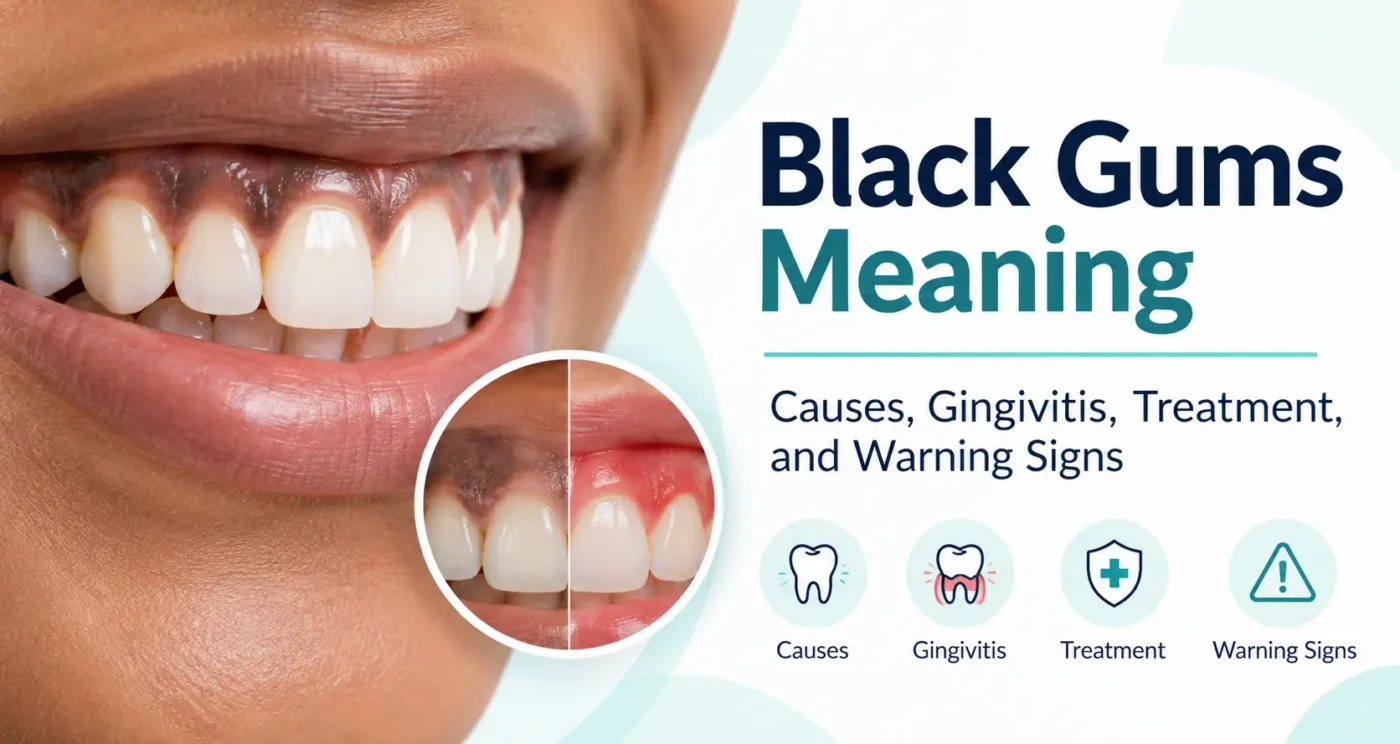
Noticing dark gums while brushing can be unsettling, especially if the color seems new. But black or brown gum tissue does not automatically indicate infection or poor oral hygiene. Some people have naturally dark gums because of melanin, the pigment also responsible for much of the variation in skin and hair color. For others, the apparent darkening comes from hardened deposits on teeth, tobacco exposure, a dental restoration, or an underlying condition that needs examination.
The most useful questions are whether the color has always been present, whether it is actually on the gum or on the tooth surface, and whether there are other changes such as pain, bleeding, ulcers, or growth. Ordinary gingivitis typically causes inflammation and bleeding—not a uniform black color. A dentist can distinguish harmless pigmentation from deposits and unusual lesions that cannot be diagnosed from a photograph.
What Does It Mean When Your Gums Are Black?
“Black gums” is a description, not a diagnosis. Healthy gum tissue may be pale pink, coral, brown, purple-brown, or deeply pigmented. The appearance depends partly on how much melanin is present and how it is distributed in the gum tissue. Uniform pigmentation that has been stable for years, without symptoms or tissue changes, is often physiological.
A newly appearing dark area deserves a different approach. It might be discoloration associated with smoking, a small benign pigmented spot, a bruise, a medication effect, or a blue-gray amalgam tattoo near an old filling. More rarely, unusual pigmented lesions need specialist assessment to exclude malignancy. No single color reliably separates these possibilities.
Are Black Gums Normal or Unhealthy?
Natural pigmentation is not an oral hygiene failure. In people whose gums have always been dark, the color may be a normal characteristic rather than evidence of disease. Good gum health is judged using several findings, including whether the tissue is comfortable, free from concerning lesions, and generally does not bleed with gentle cleaning.
Color becomes more concerning when it changes without an obvious explanation. A single growing spot, an irregularly shaped patch, persistent ulcer, or area that starts bleeding should not be dismissed because the rest of the gums look healthy. Conversely, pale pink gums can still have periodontal disease. Appearance is only one part of a dental examination.
What Causes Black Gums?
Natural Melanin Pigmentation
Melanin is produced by specialized cells called melanocytes. Normal melanin in gum tissue can give it a brown to almost black appearance. Pigmentation may affect broad areas or create a mottled pattern. It is not infectious and does not need to be “cleaned off.” Some individuals notice their pigmentation more when photographs, lighting, or gum exposure change, although the pigmentation itself has been present for a long time.
People with naturally pigmented gums should still attend routine dental visits. Natural pigmentation and gum disease can coexist; one does not protect against the other.
Smoking can stimulate increased melanin pigmentation in the oral tissues, sometimes called smoker’s melanosis. It can affect the gums and may become more noticeable over time. The appearance is often diffuse rather than a single sharply defined spot. However, tobacco use also raises the risk of gum disease and oral cancer, so a new or changing pigmented lesion should be examined rather than automatically attributed to smoking.
Tobacco cessation benefits oral and overall health. Pigmentation associated with smoking may gradually fade after cessation, but improvement is variable and may take time.
Dark Tartar Along the Gumline
What looks like black gum tissue may actually be calculus, also called tartar, on the teeth at or below the gumline. Plaque hardens into calculus when it is not adequately removed. Some deposits become very dark. Unlike natural melanin within gum tissue, tartar is material attached to the tooth surface.
Brushing and flossing help prevent plaque accumulation but cannot reliably remove existing hardened tartar. The National Institute of Dental and Craniofacial Research advises that professional cleaning is needed for calculus removal. Aggressive scraping at home may injure teeth or gums.
Medications and Pigment Changes
Certain medicines can produce blue-gray, brown, or dark pigmentation in the mouth, although such effects are uncommon and vary among medications. Examples in the medical literature include some antimalarials and minocycline. A clinician should review the actual medication, duration, other symptoms, and distribution before considering it a likely cause.
Do not stop a prescribed medication because gum color has changed. Bring an updated medication list and photographs showing when the change first appeared to a dentist or prescribing clinician.
Amalgam Tattoos Near Dental Fillings
Tiny particles from an amalgam restoration may become embedded in nearby soft tissue, causing a persistent blue, gray, or black patch. These “amalgam tattoos” are commonly benign and may appear next to a treated tooth. A dentist may use the restoration history, clinical appearance, and sometimes radiographs to assess the area. Not every dark mark near a filling is an amalgam tattoo, so unexplained lesions still warrant evaluation.
Injury, Bruising, and Blood Blisters
A recent bite, dental procedure, hard-food injury, or other trauma can lead to a localized dark red, purple, or nearly black area. A blood blister tends to arise suddenly and may be tender. It should generally improve as the tissue heals. If it persists, recurs, enlarges, or occurred without an identifiable injury, a dentist should examine it.
Other Pigmented Lesions and Medical Conditions
A benign melanotic macule or other localized pigment lesion may appear as a small flat brown or dark patch. Some systemic disorders, including Addison disease, can cause increased oral pigmentation, usually alongside additional symptoms and findings elsewhere. These are possibilities to evaluate in context, not diagnoses to infer from gum color alone.
Rarely, oral melanoma or another serious lesion can appear as a new or changing pigmented patch. Oral melanoma is uncommon, but its rarity is not a reason to ignore an enlarging, irregular, bleeding, or otherwise unexplained lesion. Depending on the examination, a dental or oral medicine specialist may recommend biopsy.
Can Gingivitis Cause Black Gums?
Ordinary plaque-associated gingivitis usually makes gums red or inflamed and more likely to bleed during brushing or flossing. Tenderness, swelling, and persistent bad breath may also occur. It does not typically turn the whole gum tissue black. This matters for searches such as “gingivitis black gums”: seeing dark gums does not by itself prove gingivitis.
A different and much more serious condition—necrotizing ulcerative gingivitis—can cause intense pain, bleeding, foul breath, and tissue ulceration covered by a grayish layer. This is not the same as normal dark pigmentation or routine gingivitis. It requires prompt professional care.
Periodontitis, which involves deeper tooth-supporting tissues, may develop after untreated plaque-related inflammation, although its signs and severity vary. Dentists examine bleeding, gum pockets, recession, calculus, and bone support rather than making a diagnosis from color alone.
What Causes Black Gums Around Teeth?
Discoloration that appears only around particular teeth raises questions about location. Is the dark material attached to the tooth near the gumline, or is it a patch within the gum itself? Dark calculus can accumulate around the neck of a tooth. A dark spot beside an old restoration could be an amalgam tattoo. A localized bruise or inflammatory change is another possibility.
Sometimes normal gum pigmentation is simply more conspicuous near the teeth. A dentist can clean away deposits, examine the gum margin, assess for recession and inflammation, and determine whether a persistent patch needs further assessment.
Black Spots Versus Completely Dark Gums
| Pattern | Possible interpretation | Reason for assessment |
| Even dark color present for years | Physiological melanin pigmentation | Routine oral care if unchanged and healthy |
| Dark crust or deposits on teeth | Stained calculus | Professional cleaning and periodontal assessment |
| Flat blue-gray patch near a filling | Possible amalgam tattoo | Confirm diagnosis if uncertain |
| Sudden purple swelling after trauma | Possible bruise or blood blister | Assess if persistent, recurrent, or worsening |
| Red swollen gums with bleeding | Gingivitis or another inflammatory cause | Dental examination and cleaning |
| Painful ulcers with gray tissue | Possible necrotizing gum infection | Prompt dental treatment |
| New, enlarging, irregular pigmented patch | Several benign or serious possibilities | Professional evaluation; biopsy in selected cases |
This table describes patterns, not a method of self-diagnosis. Similar appearances can have different causes, particularly when lighting, skin pigmentation, and oral hygiene conditions vary.
Why Are My Gums Turning Black Suddenly?
A sudden change should be discussed with a dentist, especially if it cannot be linked to an obvious recent injury. Think about when the change started, whether it is limited to one area, whether any teeth or fillings were recently treated, and whether medications or tobacco use have changed. Photographs taken under consistent lighting can help show progression.
Rapidly spreading discoloration accompanied by marked pain, swelling, fever, tissue breakdown, or an unpleasant taste deserves prompt assessment. An isolated painless new patch is not necessarily an emergency, but persistent or changing lesions should not be ignored.
Black Gums With Pain, Swelling, or Bleeding
Symptoms help guide urgency. Bleeding during gentle cleaning, gum puffiness, and persistent breath odor may suggest inflammatory gum disease. A localized painful swelling near a tooth may reflect a dental or periodontal problem. Severe pain, ulcers, and gray damaged tissue raise greater concern for necrotizing infection. These patterns overlap, and only an examination can establish the cause.
Bleeding that continues, swelling extending into the face or neck, difficulty opening the mouth, or fever with worsening dental pain should be assessed quickly. Difficulty breathing or swallowing with expanding swelling requires emergency care.
Although a general medical checkup may include a brief mouth examination, it does not replace a dental assessment. MedIntelHub explains the difference in its guide to what actually gets checked during an annual physical.
How Dentists Diagnose Dark Gum Tissue
A dentist begins with the history: how long the discoloration has been present, whether it has changed, recent dental procedures, tobacco exposure, medications, symptoms, and family history. The exam then identifies whether pigment is within the gum tissue or deposited on adjacent tooth surfaces.
When gum disease is suspected, the clinician may measure periodontal pockets, assess bleeding and recession, examine teeth, and obtain radiographs when indicated. An oral medicine specialist, periodontist, or oral surgeon may help investigate an atypical lesion. Some lesions are assessed by imaging or biopsy, especially when their appearance or progression cannot be confidently explained.
A photograph alone is insufficient for reliable diagnosis. A uniform lifelong brown hue and a new solitary dark patch should not be evaluated as if they were the same finding.
How Are Black Gums Treated?
No Treatment for Normal Pigmentation
Healthy, naturally pigmented gums need no medical treatment. Color correction is a cosmetic preference, not a prerequisite for oral health. Attempts to bleach or abrade the gums at home can cause injury.
Professional Cleaning for Dark Tartar
Dentists or hygienists remove calculus using appropriate instruments. If gum inflammation or periodontitis is present, treatment may include improvements in daily cleaning, periodontal debridement, and follow-up monitoring. Stains or deposits may be removable, but removal will not change natural pigment within the gum tissue.
Managing Gum Disease
Plaque-related gingivitis can often improve with professional cleaning and consistent brushing and cleaning between teeth. More advanced periodontal disease may require deeper treatment and continuing maintenance. Antimicrobial products or antibiotics are not universal solutions; they are chosen only when clinically appropriate.
Addressing Medication or Tobacco-Associated Changes
If a drug is suspected, the prescribing clinician and dentist can review whether the connection is plausible and whether any medication change is appropriate. Tobacco cessation is beneficial regardless of whether the pigmentation fades. Sudden medication discontinuation is not recommended.
Evaluating Localized or Suspicious Lesions
An amalgam tattoo may need only documentation once confidently diagnosed. An unexplained, changing, or clinically atypical pigmented lesion may need specialist evaluation or biopsy. Treatment follows the confirmed diagnosis rather than the color alone.
Can Black Gums Become Pink Again?
That depends entirely on why the gums look dark. Removing tartar changes the appearance of the tooth-gum boundary. Some tobacco-related pigmentation may lessen after cessation. Bruising often resolves with healing. Normal melanin pigmentation is part of the tissue and does not need to become pink.
Cosmetic gingival depigmentation procedures exist, including selected laser or surgical approaches, but they can cause discomfort, require healing time, and may not prevent pigment from returning. Such procedures should be discussed with a qualified dental professional after confirming that the pigmentation is benign.
How to Keep Your Gums Healthy
- Brush twice daily using fluoride toothpaste and a soft-bristled toothbrush; avoid injuring the gumline with excessive pressure.
- Clean between teeth every day using floss or appropriately sized interdental brushes.
- Attend dental examinations and professional cleanings at intervals based on individual risk and gum health.
- Avoid tobacco and discuss cessation support when needed.
- Mention any persistent gum bleeding, new patches, sores, or changes in medications at dental appointments.
These measures help prevent plaque-related disease, but they are not intended to remove natural gum pigmentation.
When Should You See a Dentist?
Arrange a dental appointment for any newly appearing or changing dark spot, unexplained gum discoloration, frequent bleeding, persistent tenderness, unusual tissue growth, or a sore that does not heal. A painless patch can still need assessment if its cause is uncertain.
Seek more prompt attention for very painful or swollen gums, ulcers, pus, a newly loose tooth, or fever with worsening oral symptoms. Emergency care is appropriate for serious facial or neck swelling with difficulty swallowing or breathing.
Frequently Asked Questions
What do black gums mean?
They may reflect normal melanin pigmentation, dark deposits on teeth, tobacco-related changes, trauma, a dental restoration, or another condition. Duration, location, associated symptoms, and examination determine the significance.
Are black gums always unhealthy?
No. Naturally dark gums can be completely healthy. A new or changing patch deserves professional assessment even if it causes no pain.
Can gingivitis cause black gums?
Typical gingivitis causes redness, swelling, and bleeding rather than black pigmentation. Uncommon severe necrotizing gum infections can produce damaged grayish tissue and marked pain.
What causes black gums around teeth?
Possibilities include dark tartar on the tooth surface, natural pigment near the gumline, a bruise, or a localized lesion such as an amalgam tattoo. A dentist can distinguish them.
Why have my gums suddenly turned dark?
Sudden changes may relate to injury, staining, medication effects, or a new lesion. Persistent or unexplained changes should be examined.
Can smoking turn gums black?
Smoking can contribute to increased oral melanin pigmentation. Tobacco also harms gum health and increases other oral disease risks.
What is a black spot next to an old filling?
A blue-gray amalgam tattoo is one possibility, but it should not be assumed without appropriate clinical assessment.
Can black tartar be removed at home?
Hardened tartar generally requires professional removal. Scraping it yourself risks damaging teeth and gums.
Are dark gums a sign of oral cancer?
Most dark gum pigmentation is not cancer. However, a new, irregular, enlarging, bleeding, or unexplained lesion requires dental or specialist evaluation.
Can medicines cause dark gum pigmentation?
Certain medications can cause oral pigment changes. A clinician should review medication history and other possible causes before making that connection.
Is black gum tissue contagious?
Natural pigmentation is not contagious. Certain infections can affect gum tissue, but color alone does not determine whether an infection is present.
Can a gum infection cause gray or black areas?
Severe necrotizing infections may produce grayish damaged tissue alongside pain, bleeding, and ulceration. This requires prompt dental care.
Will my gums turn pink after a cleaning?
If dark material is tartar or staining, cleaning may improve its appearance. Cleaning does not remove normal melanin within healthy tissue.
Does gum depigmentation permanently remove dark color?
Cosmetic procedures can alter appearance in selected patients, but pigment can recur and procedures have risks. They are not necessary for healthy pigmentation.
When should I seek urgent help for dark gums?
Seek prompt care for painful ulcers, rapid swelling, fever, or tissue damage. Get emergency care for facial or neck swelling that interferes with breathing or swallowing.
The Bottom Line
The meaning of black gums depends on the pattern and the story behind it. Longstanding, comfortable brown or dark gum tissue is often normal melanin pigmentation. Dark deposits against the teeth, swollen bleeding gums, sudden bruising, and new pigmented spots are different findings and should not be lumped together.
If you have noticed a new change, let a dentist examine the area rather than trying harsh whitening products, picking at it, or assuming it is gingivitis. The most appropriate treatment, when treatment is needed at all, follows the underlying cause.
Resources
National Institute of Dental and Craniofacial Research — Periodontal (Gum) Disease
Explains plaque, tartar, gingivitis, and clinical signs of periodontal disease.
National Institute of Dental and Craniofacial Research — Oral Hygiene
Provides evidence-based guidance on routine brushing, interdental cleaning, and oral care.
NHS — Gum Disease
Patient guidance on gingivitis symptoms, dental evaluation, and treatment; reviewed in April 2026.
MSD Manual Professional Edition — Acute Necrotizing Ulcerative Gingivitis
Describes a serious gingival infection with pain, bleeding, ulceration, and gray damaged tissue.
Acute Necrotizing Ulcerative Gingivitis
MSD Manual Professional Edition — Dental Anatomy and Development
Discusses oral anatomy and benign pigmentation from material such as amalgam tattoos.
Dental Anatomy and Development
DermNet — Drug-Induced Skin Pigmentation
Reviews medication-related pigment changes, including oral mucosal discoloration.
Drug-Induced Skin Pigmentation
DermNet — Laugier–Hunziker Syndrome
Illustrates why oral pigmented lesions may have noninfectious causes and require contextual assessment.
Editorial Guidelines & Medical Disclaimer
This article is educational and informational. It cannot diagnose the cause of dark gums or replace an examination by a dentist, oral medicine specialist, or other qualified healthcare professional. Natural pigmentation is often harmless, while new or changing spots, ulceration, persistent bleeding, or worsening symptoms may require evaluation. Do not discontinue prescribed medications without consulting the prescribing clinician. Dental treatment, medication recommendations, and insurance coverage may change or vary by individual circumstances. This article draws on public-health, dental, and clinical resources. Review MedIntelHub’s editorial standards for information about our approach to medical content.

David Bennett
David Bennett is an author at MedIntelHub, where he creates clear, practical, and well-researched content about healthcare, medical billing, insurance, and patient education. His goal is to make complex healthcare topics easier for readers to understand and use in everyday situations. David emphasizes accuracy, transparency, and reliable sourcing, using information from trusted organizations and official healthcare resources whenever possible. Content published by David is intended for educational purposes and should not replace advice from qualified medical, legal, or healthcare professionals.