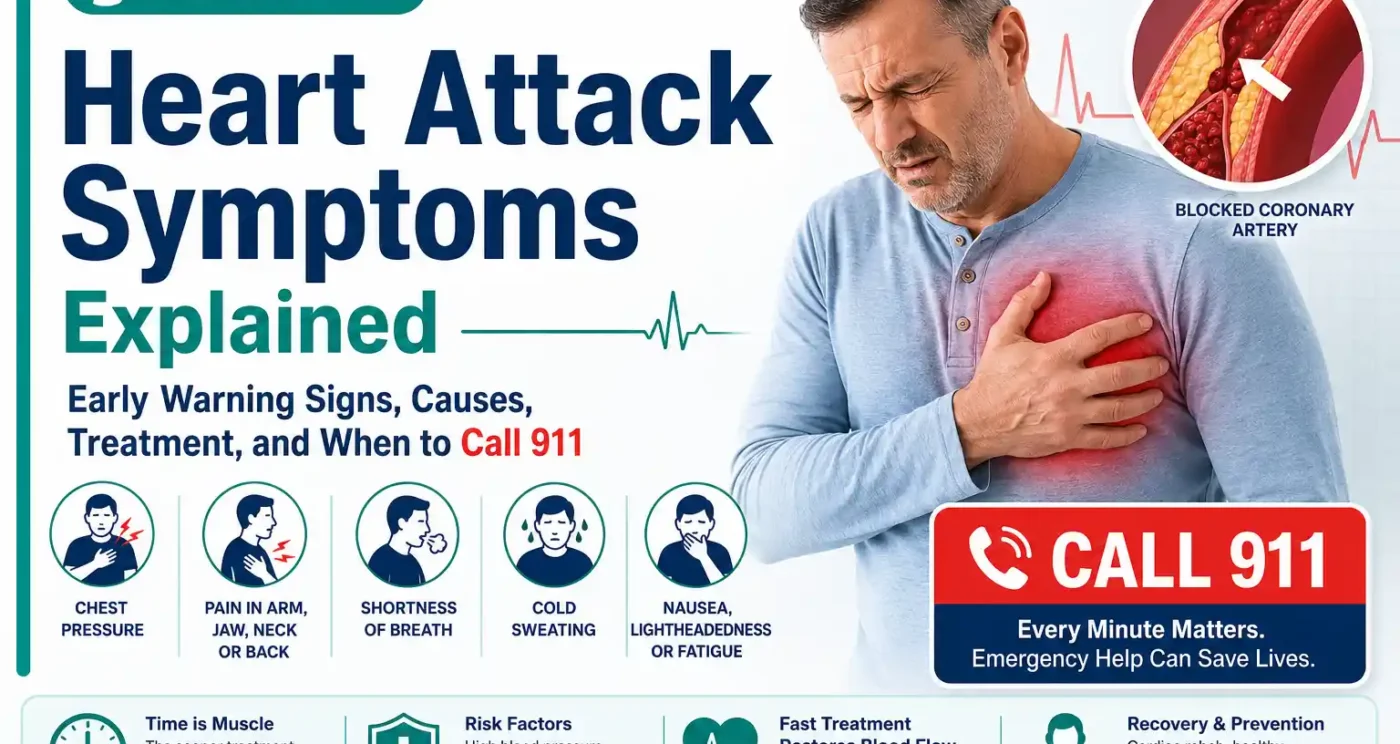
A heart attack does not always begin with dramatic, crushing chest pain.
Some people feel pressure or squeezing in the center of the chest. Others notice shortness of breath, nausea, unusual sweating, pain in the jaw or back, or an unexplained feeling that something is seriously wrong. Symptoms can start suddenly, but they can also begin slowly and come and go.
A heart attack, medically called a myocardial infarction (MI), happens when blood flow carrying oxygen to part of the heart muscle becomes severely reduced or blocked. If blood flow is not restored quickly, heart muscle begins to suffer permanent damage.
That is why the response to possible heart attack symptoms is different from the response to most everyday aches and pains:
If you think you or someone else may be having a heart attack, call 911 immediately—even if you are not certain. Do not wait for the symptoms to become severe.
What Is a Heart Attack?
Your heart is a muscle, and like every other muscle it needs a continuous supply of oxygen-rich blood.
That blood arrives through the coronary arteries.
Most heart attacks happen because coronary artery disease has caused plaque to build up inside one of those arteries over many years. If a plaque suddenly ruptures, a blood clot can form on its surface and partially or completely block blood flow.
When part of the heart no longer receives enough oxygen, heart muscle begins to become injured and can eventually die.
Treatment is aimed at restoring blood flow as quickly as possible and limiting the amount of permanent heart damage.
What Are the Most Common Heart Attack Symptoms?
Chest discomfort remains the most common heart attack symptom.
The American Heart Association and CDC describe several warning signs that may occur alone or together:
- Pressure, squeezing, fullness, heaviness, or pain in the center or left side of the chest
- Pain or discomfort in one or both arms, shoulders, back, neck, jaw, or upper abdomen
- Shortness of breath
- Cold sweating
- Nausea or vomiting
- Lightheadedness, dizziness, or faintness
- Unusual fatigue or weakness
- A rapid or irregular heartbeat
Symptoms can be severe, but they do not have to be. A person can have a heart attack with relatively mild discomfort.
What Are the Early Warning Signs of a Heart Attack?
There is no single “first symptom.”
Some heart attacks begin abruptly. Others develop gradually with symptoms that seem mild enough to ignore.
Early signs may include chest pressure, unusual tiredness, breathlessness with little activity, discomfort in the jaw or arm, nausea, or episodes of chest discomfort that disappear and return.
NHLBI specifically notes that heart attack symptoms can start slowly and may come and go over several hours.
That unpredictability is important.
Waiting until the pain becomes unbearable can waste valuable time.
What Does Heart Attack Chest Pain Feel Like?
People often expect heart attack pain to feel sharp.
It may not.
Heart-related chest discomfort is frequently described as:
pressure, squeezing, tightness, fullness, heaviness, burning, or an uncomfortable ache.
It most often occurs in the center or left side of the chest and may last more than a few minutes or disappear and return.
Some people mistake it for indigestion or heartburn.
That does not mean every episode of chest pressure is a heart attack, but unexplained chest pressure should be taken seriously—especially when it occurs with breathlessness, sweating, nausea, dizziness, or pain spreading elsewhere.
Can a Heart Attack Happen Without Chest Pain?
Yes.
Although chest discomfort is the most common symptom, a heart attack can occur with very little chest pain—or occasionally no noticeable chest pain at all.
NHLBI notes that silent heart attacks can occur with mild symptoms or no recognized symptoms and are more common in older adults and people with diabetes or high blood sugar.
Someone may instead experience breathlessness, fatigue, nausea, dizziness, weakness, or upper-body discomfort.
This is one reason heart attacks can sometimes be missed.
Heart Attack Symptoms in Women
Women can experience the same classic heart attack symptoms as men.
In fact, chest pain or chest discomfort remains the most common symptom in women. The difference is that women are somewhat more likely to experience additional symptoms that may not immediately be recognized as heart-related.
These can include unusual fatigue, shortness of breath, nausea or vomiting, anxiety, stomach discomfort, or pain involving the back, shoulder, arm, neck, or jaw.
A woman should not assume that a heart attack must involve dramatic chest pain before calling for emergency help.
Heart Attack Symptoms in Men
Men commonly experience central chest pressure or pain, often accompanied by discomfort spreading toward an arm, shoulder, neck, jaw, or back.
Shortness of breath, sweating, nausea, and lightheadedness can occur as well.
The important point is that there is substantial overlap between men and women. It is more accurate to recognize that heart attack presentation varies from person to person than to assume that one sex has a completely different set of symptoms.
Heart Attack Symptoms in Older Adults
Older adults may have less obvious symptoms.
Instead of severe chest pain, the main complaint may be:
breathlessness, weakness, dizziness, fatigue, confusion, or fainting.
NHLBI notes that shortness of breath during rest or light activity is particularly common among older adults experiencing a heart attack.
An older person who suddenly becomes unusually weak, breathless, clammy, or confused deserves prompt evaluation even if they do not complain of severe chest pain.
Heart Attack Symptoms in People With Diabetes
Diabetes can affect nerves, including the nerves involved in sensing pain.
As a result, some people with diabetes may experience a heart attack with less chest discomfort than expected.
NHLBI identifies diabetes and high blood sugar as factors associated with silent heart attacks.
Possible clues can include unexplained fatigue, breathlessness, sweating, nausea, dizziness, or a sudden decline in exercise tolerance.
Symptoms that seem mild should not automatically be dismissed because chest pain is absent.
Can Heart Attack Pain Spread to the Arm?
Yes.
Pain or discomfort may spread from the chest into one or both arms or shoulders.
Although left-arm pain is commonly associated with heart attack, symptoms are not limited to the left side. The right arm or both arms can be involved.
Arm pain becomes particularly concerning when it accompanies chest pressure, breathlessness, sweating, nausea, or dizziness.
Can a Heart Attack Cause Jaw, Neck, or Back Pain?
Yes.
Heart attack discomfort can occur in the jaw, neck, shoulders, or back, sometimes with relatively little chest discomfort.
This can make the symptoms easy to mistake for a dental problem, muscle strain, or neck problem.
New unexplained jaw or upper-back discomfort accompanied by breathlessness, sweating, nausea, chest pressure, or weakness should be treated cautiously.
Can a Heart Attack Cause Nausea or Vomiting?
Yes.
Nausea and vomiting are recognized heart attack symptoms.
They can occur alongside chest pressure or may be more noticeable than the chest symptoms themselves.
This is one reason a heart attack can sometimes be mistaken for food poisoning, indigestion, or another stomach problem.
Can a Heart Attack Cause Sweating?
Yes.
A cold sweat or sudden heavy sweating without an obvious reason can accompany a heart attack.
The sweating may occur with:
chest pressure, nausea, breathlessness, dizziness, or a sense of weakness.
Sudden clammy sweating in someone who also appears unwell deserves attention.
Can Shortness of Breath Be the Only Symptom?
It can.
Shortness of breath may occur before chest discomfort, at the same time, or without obvious chest pain.
MedlinePlus notes that breathlessness can sometimes be the only recognizable symptom.
New unexplained shortness of breath at rest or with very little activity should not be ignored, particularly in someone with cardiovascular risk factors.
Can Extreme Fatigue Be a Heart Attack Symptom?
Yes.
Unusual tiredness or weakness can occur during a heart attack.
NHLBI notes that unexplained fatigue can sometimes be present for days and is reported more frequently among women.
Fatigue is extremely common and usually has causes unrelated to the heart, so fatigue alone does not mean someone is having a heart attack.
What matters is the context.
Sudden or unusually severe fatigue accompanied by breathlessness, chest discomfort, sweating, nausea, jaw or back pain, or dizziness is more concerning.
What Is a Silent Heart Attack?
A silent heart attack causes either no noticeable symptoms or symptoms mild enough that the person does not recognize what happened.
Someone may interpret the episode as:
indigestion, fatigue, a strained muscle, stress, or simply “not feeling right.”
The heart muscle can still be damaged.
Silent heart attacks are particularly associated with older age and diabetes.
Sometimes evidence of a previous heart attack is discovered later through an ECG, imaging, or another cardiovascular evaluation.
What Causes a Heart Attack?
The most common underlying cause is coronary artery disease.
Over time, cholesterol, fat, calcium, and other materials can form plaque in coronary artery walls. This process is called atherosclerosis.
If plaque ruptures, a clot can develop and suddenly stop blood from reaching part of the heart.
Not every heart attack is caused by a typical plaque blockage.
Less common causes include a severe coronary artery spasm, a clot that travels into a coronary artery, and spontaneous coronary artery dissection (SCAD), in which a tear develops within the coronary artery wall.
What Is SCAD?
Spontaneous coronary artery dissection occurs when a tear forms inside the wall of a coronary artery.
Blood can collect within the artery wall and narrow or block blood flow, potentially triggering a heart attack.
SCAD differs from the usual cholesterol-plaque mechanism and is seen disproportionately in women.
A 2026 American Heart Association scientific statement also emphasized non-atherosclerotic causes of acute coronary syndromes—including SCAD and coronary artery spasm—in premenopausal women.
This matters because even a younger person without the classic cholesterol-related risk profile can experience a heart attack.
Who Is at Higher Risk for a Heart Attack?
Risk tends to rise when coronary artery disease risk factors accumulate.
Important factors include high blood pressure, high cholesterol, smoking, diabetes, older age, family history, and other cardiovascular conditions. CDC identifies high blood pressure, high cholesterol, and smoking as three particularly important modifiable heart-disease risk factors.
Risk assessment matters, but it should never be used to dismiss symptoms.
A person can have a heart attack without knowing that they had coronary disease beforehand.
Heart Attack vs. Heartburn
Heartburn can produce burning or discomfort behind the breastbone and can sometimes feel remarkably similar to heart pain.
Heart attack discomfort can also feel like indigestion or heartburn.
That makes symptoms alone an unreliable way to distinguish the two.
Heartburn may be more likely after eating or when lying down and may occur with an acidic taste in the mouth, but those clues are not enough to safely exclude a heart attack.
If chest discomfort is new, unusual, persistent, severe, or associated with breathlessness, sweating, nausea, dizziness, or pain spreading into the arm, jaw, or back, call 911 rather than testing whether an antacid makes it go away.
Heart Attack vs. Panic Attack
Panic attacks can cause chest pain, rapid heartbeat, breathlessness, sweating, dizziness, and intense fear.
Those symptoms overlap with heart attack.
A person may also feel anxious during an actual heart attack.
Because there is no safe home test that can reliably separate the two during a first or unusual episode, new concerning chest symptoms should not automatically be attributed to anxiety.
When the symptoms could represent a heart attack, emergency evaluation is the safer approach.
Heart Attack vs. Angina
Angina is chest discomfort caused by insufficient blood flow to heart muscle.
People with stable angina often develop symptoms during physical activity or stress. The discomfort typically improves with rest or prescribed medicine.
Heart attack symptoms may occur at rest, may feel more severe or different from usual angina, and may fail to improve with rest. NHLBI advises calling 911 whenever someone cannot tell whether chest pain represents angina or a heart attack.
A change in someone’s usual angina pattern also deserves urgent evaluation.
Heart Attack vs. Cardiac Arrest
These terms are often confused.
A heart attack is primarily a circulation problem: blood flow to the heart muscle becomes blocked.
Cardiac arrest is an electrical problem in which the heart suddenly stops pumping blood effectively.
A heart attack can trigger cardiac arrest, but they are not the same condition.
Someone in cardiac arrest typically becomes unresponsive and has no normal breathing or pulse. Immediate CPR and use of an automated external defibrillator, or AED, can be lifesaving while emergency services are on the way.
What Is a “Widowmaker” Heart Attack?
“Widowmaker” is an informal term rather than an official medical diagnosis.
It is commonly used to describe a severe blockage involving the left anterior descending coronary artery, particularly a blockage high in the artery.
Because that artery supplies a large portion of the heart muscle, a major blockage can be extremely dangerous.
However, other heart attacks can also be fatal.
The term should not be used to imply that one coronary artery is the only type of heart attack requiring immediate treatment.
How Is a Heart Attack Diagnosed?
Once a person reaches emergency care, clinicians move quickly to determine whether heart muscle is being injured and whether blood flow is blocked.
Two of the most important early tests are an electrocardiogram and cardiac troponin blood testing.
Electrocardiogram (ECG or EKG)
An ECG records the electrical activity of the heart.
NHLBI notes that this is commonly one of the first tests performed and may be completed within minutes of hospital arrival.
Certain ECG patterns can show that a coronary artery may be severely blocked and that immediate treatment to restore blood flow is necessary.
Troponin Blood Test
Troponin is a protein released into the bloodstream when heart muscle cells are damaged.
Elevated or rising troponin levels can provide evidence of myocardial injury.
Because the level may change over time, clinicians often repeat the test rather than relying on a single result.
Coronary Angiography
When doctors need to identify the location and severity of coronary blockages, they may perform coronary angiography as part of cardiac catheterization.
Contrast dye and X-ray imaging allow the cardiology team to see the arteries supplying the heart.
If a treatable blockage is found, angioplasty and stent placement may sometimes be performed during the same procedure.
What Are STEMI and NSTEMI?
You may hear these terms in the emergency department.
They describe two forms of myocardial infarction that are distinguished partly by ECG findings and the pattern of coronary obstruction.
A STEMI generally produces characteristic ST-segment changes on an ECG and commonly reflects an acutely blocked coronary artery requiring very rapid reperfusion.
An NSTEMI is also a heart attack, but it does not produce the same ST-elevation pattern.
Both fall within the broader group known as acute coronary syndromes, or ACS, and both require urgent medical evaluation and treatment.
The updated 2025 ACC/AHA acute coronary syndromes guideline addresses both STEMI and NSTEMI.
How Is a Heart Attack Treated?
Treatment depends on the type of heart attack, which artery is involved, how much heart muscle is at risk, and the person’s overall health.
The major goals are to restore blood flow, prevent additional clot formation, stabilize the heart rhythm, and reduce future cardiovascular risk.
Percutaneous Coronary Intervention and Stents
Percutaneous coronary intervention (PCI) is commonly called angioplasty.
A cardiologist guides a catheter into the coronary arteries, opens the blocked or narrowed area—often with a small balloon—and commonly places a stent to help keep the artery open.
PCI can rapidly restore blood flow to endangered heart muscle.
Medicines
Hospital treatment may involve antiplatelet medicines, anticoagulants, nitrates, cholesterol-lowering medicines, and other medications chosen according to the type of acute coronary syndrome and the patient’s condition.
The 2025 ACC/AHA guideline continues to recommend dual antiplatelet therapy, commonly involving aspirin plus a P2Y12 inhibitor, for many patients with acute coronary syndrome, with treatment adjusted according to bleeding risk and other factors.
Coronary Artery Bypass Surgery
Some patients have coronary disease that is better treated with coronary artery bypass grafting (CABG).
During CABG, surgeons use blood vessels from elsewhere in the body to create new routes for blood to flow around severely narrowed or blocked coronary arteries.
CABG is not necessary for every heart attack.
The cardiology and cardiac-surgery teams choose between PCI, surgery, and medication based on the pattern and complexity of disease.
Why Does Fast Treatment Matter?
Heart muscle cannot survive indefinitely without oxygen.
The longer a coronary artery remains severely blocked, the greater the potential damage.
That is why emergency cardiology often uses the idea that time is muscle.
Calling 911 early can shorten the time to treatment and reduce the amount of permanent damage.
Even if symptoms eventually turn out to be something else, getting checked is safer than losing valuable treatment time during an actual heart attack.
Should You Take Aspirin If You Think You Are Having a Heart Attack?
The first step is calling 911—not searching for aspirin.
The American Heart Association specifically advises against taking aspirin first and waiting to see whether symptoms improve.
A 911 dispatcher or healthcare professional may recommend aspirin when it is appropriate after considering factors such as allergy and bleeding risk.
Aspirin is not safe for everyone, and it should never be used as a reason to delay emergency care.
Should You Drive Yourself to the Hospital?
Generally, no.
NHLBI calls an ambulance the safest way to reach the hospital when a heart attack is suspected. EMS personnel can monitor the patient, start emergency treatment, communicate with the hospital, and respond if a dangerous heart rhythm develops.
People arriving by ambulance may also receive faster hospital treatment.
If you are experiencing possible heart attack symptoms, call 911 rather than driving yourself.
What Should You Do If Someone Becomes Unresponsive?
A heart attack can sometimes trigger cardiac arrest.
If someone suddenly collapses, is unresponsive, and is not breathing normally, call 911 and begin CPR according to dispatcher instructions if you are able.
Use an AED if one is available.
CDC notes that CPR and defibrillation can help maintain circulation while emergency personnel are arriving when cardiac arrest occurs.
When Should You Call 911?
Call 911 immediately when symptoms could represent a heart attack.
That includes new or unexplained chest pressure or squeezing, particularly when accompanied by breathlessness, sweating, nausea, dizziness, weakness, or discomfort spreading to the arms, shoulders, back, neck, or jaw.
Do not wait for all the symptoms to appear.
Do not wait to see whether the symptoms disappear.
And do not let the absence of severe chest pain convince you that a heart attack is impossible.
The American Heart Association advises calling 911 even when you are not sure that a heart attack is occurring.
Is Telehealth Appropriate for Possible Heart Attack Symptoms?
Not as the first step when an active heart attack is reasonably possible.
Telehealth can be useful for many routine or follow-up health concerns, but suspected heart attack symptoms require immediate access to an ECG, blood testing, emergency medications, monitoring, and potentially a cardiac catheterization laboratory.
If symptoms are active and concerning, call 911 rather than scheduling an ordinary virtual appointment.
For other situations, MedIntelHub’s guide to virtual care explains where telehealth can fit into primary care and where in-person treatment remains necessary.
Telehealth in 2026: How Virtual Visits Are Changing Primary Care
What Happens After a Heart Attack?
Leaving the hospital is not the end of heart attack treatment.
Recovery may include medication, cardiology follow-up, risk-factor management, gradual return to activity, and cardiac rehabilitation.
The 2025 ACC/AHA acute coronary syndromes guideline strongly recommends referral to cardiac rehabilitation after hospitalization because it can improve recovery and reduce future cardiovascular events and hospital readmission.
Cardiac rehabilitation commonly combines supervised or structured exercise with education about medications, nutrition, cardiovascular risk, and psychological recovery.
Can Another Heart Attack Be Prevented?
Not every future event can be prevented, but cardiovascular risk can often be lowered substantially.
After a heart attack, clinicians may focus on controlling blood pressure, cholesterol, diabetes, and smoking exposure while prescribing medications that reduce the likelihood of another clot or coronary event.
The 2025 ACS guideline emphasizes antiplatelet therapy, intensive cholesterol treatment, follow-up lipid testing, and cardiac rehabilitation as important parts of secondary prevention.
Regular preventive care is also an opportunity to review blood pressure, cholesterol, diabetes risk, smoking, medications, and family history before a first cardiovascular event occurs.
Understanding Your Annual Physical: What Actually Gets Checked
Preparing for Cardiology Follow-Up
People recovering from a heart attack may receive a large amount of information in a short period.
Before a cardiology appointment, it can help to organize your current medicines, discharge instructions, symptoms, blood-pressure readings, procedure reports, and questions about exercise or returning to work.
MedIntelHub’s specialist-appointment guide provides a practical framework for preparing those questions.
How to Prepare Questions Before a Specialist Appointment
Frequently Asked Questions
What is usually the first sign of a heart attack?
There is no universal first sign.
Chest pressure or discomfort is the most common symptom, but breathlessness, jaw or arm pain, sweating, nausea, dizziness, or unusual fatigue may also appear early. Symptoms can begin gradually rather than all at once.
Where is heart attack chest pain usually located?
It commonly occurs in the center or left side of the chest.
People may describe pressure, squeezing, heaviness, fullness, tightness, or pain rather than a sharp sensation.
How long does heart attack pain last?
Heart attack discomfort often persists for more than a few minutes or goes away and then returns.
You should not wait for a particular number of minutes before calling 911 when symptoms are concerning.
Can a heart attack feel like indigestion?
Yes.
Heart attack discomfort can sometimes feel like heartburn or indigestion, making self-diagnosis unreliable.
Can a heart attack cause back pain?
Yes.
Back discomfort, particularly upper-back pain, can occur during a heart attack. Women may be more likely to report symptoms such as upper-back or shoulder discomfort alongside other warning signs.
Can a heart attack cause jaw pain without chest pain?
It can.
Jaw discomfort is a recognized heart attack symptom, and some people have little obvious chest pain.
New jaw pain with shortness of breath, sweating, nausea, weakness, or other cardiovascular symptoms should not be ignored.
Can a heart attack happen while sleeping?
Yes.
Heart attacks can occur during rest or sleep as well as during activity.
Can younger people have heart attacks?
Yes.
Although heart attack risk increases with age, younger adults can experience myocardial infarction.
Some mechanisms, including SCAD, may occur in people without the typical profile of advanced coronary atherosclerosis.
Can anxiety cause symptoms similar to a heart attack?
Yes.
A panic attack can cause chest discomfort, racing heart, breathlessness, sweating, and dizziness.
Because those symptoms overlap with heart attack, a first or unusual episode should not simply be assumed to be anxiety when a cardiac cause is possible.
Is a heart attack the same as cardiac arrest?
No.
A heart attack is caused by inadequate blood flow to the heart muscle. Cardiac arrest occurs when the heart suddenly stops pumping effectively because of an electrical problem.
A heart attack can trigger cardiac arrest.
Can you survive a heart attack?
Yes.
Many people survive heart attacks and return to active lives.
The likelihood of limiting heart damage improves when treatment begins quickly.
Should I take aspirin before calling 911?
No.
Call 911 first. The dispatcher may recommend aspirin if it is appropriate for you. Do not take aspirin and wait to see whether chest discomfort improves.
Should someone with possible heart attack symptoms drive to the emergency room?
Calling an ambulance is generally safer.
EMS personnel can begin assessment and treatment and respond if a dangerous heart rhythm develops during transport.
Can a heart attack happen with a normal-looking ECG?
The diagnosis does not depend on one ECG alone.
Some heart attacks—particularly NSTEMI—may not produce the classic ST-elevation pattern. Doctors consider the ECG together with symptoms, repeated troponin testing, examination findings, and other cardiac testing.
Conclusion
Heart attack symptoms are not always dramatic.
The most common warning sign is chest pressure, squeezing, fullness, heaviness, or pain, but heart attacks can also cause shortness of breath, cold sweating, nausea, dizziness, unusual fatigue, and discomfort in the arms, shoulders, back, neck, jaw, or upper abdomen.
Some people experience mild symptoms. Others have symptoms that disappear and return.
And some—particularly older adults and people with diabetes—may have a silent heart attack with very little recognizable chest discomfort.
Most heart attacks result from coronary artery disease. Plaque inside a coronary artery ruptures, a blood clot forms, and blood flow to part of the heart becomes blocked. Less common mechanisms include coronary spasm, embolism, and spontaneous coronary artery dissection.
Doctors use an ECG, troponin blood tests, and other cardiac testing to determine whether heart muscle is being injured. Treatment may involve medications, angioplasty with stent placement, or coronary bypass surgery depending on the type and severity of the problem.
But none of that treatment can begin until the person gets help.
If symptoms could be a heart attack, call 911 immediately. Do not drive yourself, do not wait for the pain to become severe, and do not take aspirin instead of making the emergency call.
Minutes matter because restoring blood flow earlier can reduce permanent heart-muscle damage and improve survival.
Resources
American Heart Association — Heart Attack Warning Signs
AHA explains common and less typical heart attack symptoms and why emergency services should be contacted immediately.
AHA: Warning Signs of a Heart Attack
American Heart Association — 2025 Acute Coronary Syndromes Patient Guidance
This patient-focused resource summarizes current ACS symptoms, medications, procedures, and cardiac rehabilitation.
AHA: Key Patient Messages from the 2025 ACS Guideline
National Heart, Lung, and Blood Institute — Heart Attack Symptoms
NHLBI covers chest pain, silent heart attacks, atypical symptoms, emergency response, and the importance of ambulance transport.
NHLBI — Heart Attack Diagnosis
This resource explains ECG testing, troponin blood tests, and other diagnostic procedures used when a heart attack is suspected.
NHLBI — Heart Attack Treatment
NHLBI explains medicines, PCI and stent placement, CABG, and other hospital treatments.
CDC — Heart Attack Symptoms, Risk, and Recovery
CDC provides patient information about warning signs, emergency response, heart-attack risk factors, and recovery.
CDC: About Heart Attack Symptoms, Risk, and Recovery
MedIntelHub — Understanding Your Annual Physical
This preventive-care guide explains how routine primary care can include review of cardiovascular risk factors and other age-appropriate health concerns.
Understanding Your Annual Physical: What Actually Gets Checked
MedIntelHub — Preparing for a Specialist Appointment
Useful for organizing medication lists, test results, symptoms, and questions before cardiology follow-up.
How to Prepare Questions Before a Specialist Appointment
MedIntelHub — Editorial Policy
For information about MedIntelHub’s standards for medical sourcing, accuracy, transparency, and healthcare education:
Editorial Disclaimer
This article is provided for general educational and informational purposes only. It does not diagnose a heart attack, determine whether chest pain is cardiac or noncardiac, or replace emergency medical evaluation.
Heart attack symptoms can overlap with reflux, panic attacks, muscle or chest-wall pain, pulmonary embolism, aortic disease, pneumonia, and other serious or non-serious conditions. Symptoms alone cannot safely determine the cause.
If you think you or someone else may be having a heart attack, call 911 or your local emergency number immediately. Do not delay emergency care while searching online, waiting for symptoms to improve, taking an antacid, or trying another home treatment.
Aspirin is not appropriate for everyone because of allergy, bleeding, and other risks. Call 911 first and follow instructions from the emergency dispatcher or healthcare professional.
Treatment decisions—including antiplatelet medication, anticoagulation, PCI, coronary stenting, bypass surgery, and long-term cardiovascular medicines—depend on the type of heart attack, bleeding risk, coronary anatomy, kidney function, other medical conditions, and individual circumstances.

David Bennett
David Bennett is an author at MedIntelHub, where he creates clear, practical, and well-researched content about healthcare, medical billing, insurance, and patient education. His goal is to make complex healthcare topics easier for readers to understand and use in everyday situations. David emphasizes accuracy, transparency, and reliable sourcing, using information from trusted organizations and official healthcare resources whenever possible. Content published by David is intended for educational purposes and should not replace advice from qualified medical, legal, or healthcare professionals.