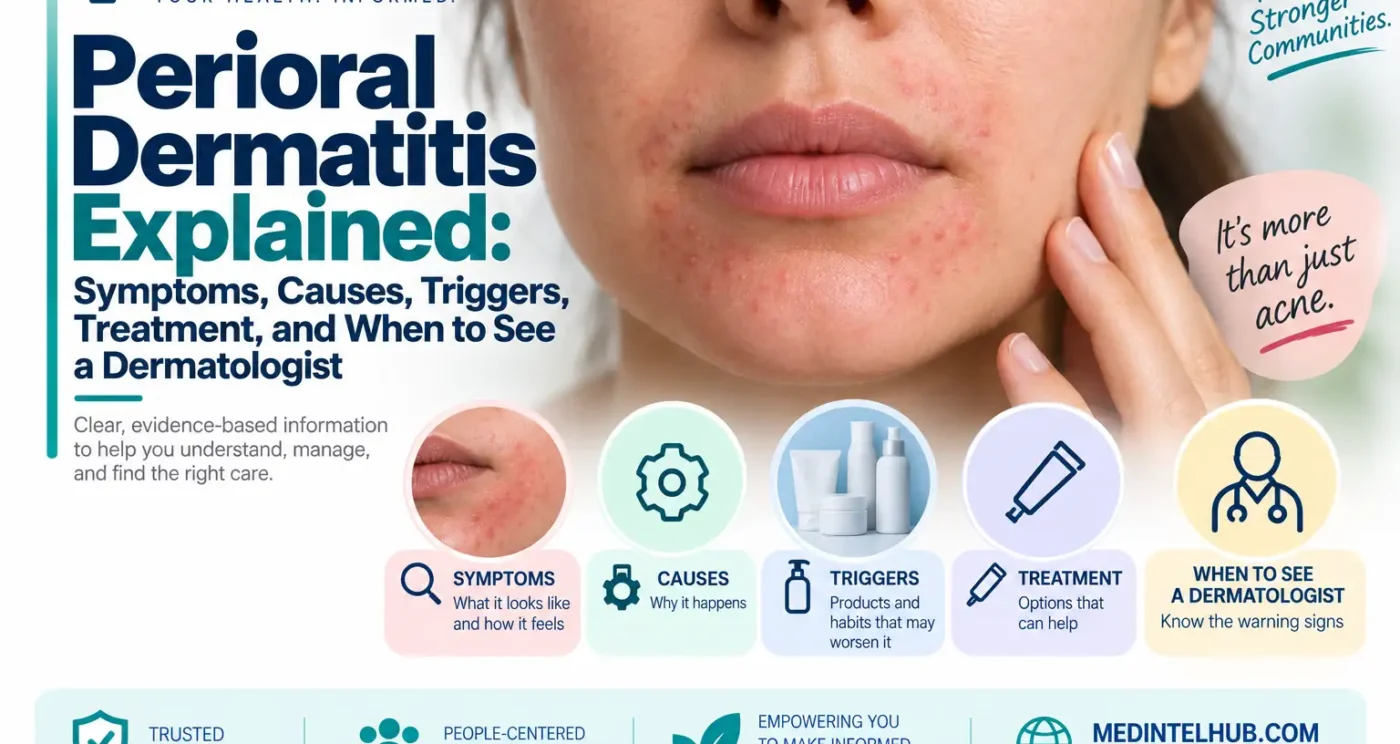
A rash around the mouth can be surprisingly difficult to figure out.
At first it may look like acne: a few small bumps on the chin or beside the nose. Then the skin becomes dry or flaky. It may sting after moisturizer, burn when washed, or spread toward the nose or eyes. A hydrocortisone cream might even seem to calm it for a few days—only for the rash to return more noticeably afterward.
That pattern can occur with perioral dermatitis, also called periorificial dermatitis.
Perioral dermatitis is an inflammatory skin condition that most often produces clusters of small bumps around the mouth. It can also involve the skin around the nose or eyes. Depending on skin tone, the bumps may appear red, pink, or closer to the person’s natural skin color. Dryness, flaking, burning, or itching can occur alongside them.
One of the most important clues is the relationship with corticosteroid creams. Facial steroids can temporarily suppress the rash, which makes them seem helpful at first. Continued use, however, can perpetuate or worsen perioral dermatitis, and a rebound flare may appear when the steroid is stopped.
That does not mean every rash near the mouth is perioral dermatitis—or that every prescribed steroid should suddenly be discontinued.
Acne, rosacea, eczema, contact dermatitis, infections, and several other skin conditions can resemble it. A dermatologist can usually recognize the pattern from the skin examination and history and recommend treatment that fits the actual diagnosis.
What Is Perioral Dermatitis?
Perioral dermatitis is a chronic inflammatory eruption that develops around facial openings.
The mouth is the classic location, which explains the name:
- Peri means around.
- Oral refers to the mouth.
The broader medical term, periorificial dermatitis, is increasingly useful because the rash may also appear around the nose or eyes. DermNet notes that it can affect one or several of these sites.
The condition is usually limited to the skin.
It does not ordinarily make a person feverish or systemically ill, and it is not considered contagious.
What Does Perioral Dermatitis Look Like?
Perioral dermatitis usually does not appear as one smooth patch of redness.
Instead, it tends to form many small bumps.
They may be:
- Red or pink
- Skin-colored
- Slightly raised
- Filled with a small amount of fluid or pus
- Grouped closely together
The surrounding skin often feels dry and may become flaky or scaly.
On lighter skin, redness may be obvious.
On darker skin, the bumps may look closer to the person’s normal skin color, brownish, or less visibly red. AAD specifically notes that perioral dermatitis may appear as red acne-like bumps in lighter skin and skin-colored bumps in skin of color.
That variation is important because relying on the phrase “red rash” can make the condition harder to recognize in deeper skin tones.
Where Does Perioral Dermatitis Usually Appear?
The mouth is the most familiar location, particularly the chin and the folds running from the nose toward the corners of the mouth.
The rash can also spread around the:
- Nostrils
- Lower cheeks
- Eyes
- Eyelids
- Forehead in more extensive cases
DermNet notes that more significant periorificial dermatitis may extend beyond the immediate mouth area to the cheeks, eyelids, forehead, and between the eyebrows.
Does Perioral Dermatitis Touch the Lips?
Often, a narrow strip of skin immediately beside the lips is relatively unaffected.
Dermatologists call this perivermilion sparing.
It can provide a useful clue, but it is not an absolute rule. Severe cases can involve skin closer to the lips as well.
So a rash does not have to display a perfectly clear border around the lips to be perioral dermatitis.
Can Perioral Dermatitis Affect the Eyes?
Yes.
When the skin around the eyes is involved, it may be described as periocular dermatitis or more generally as periorificial dermatitis.
Small bumps can occur around the lower or upper eyelids, sometimes alongside dryness, burning, or sensitivity.
A skin rash around the eyes is different from a problem involving the eye itself.
Eye pain, significant eyelid swelling, marked redness of the eye, light sensitivity, discharge, or a change in vision deserves medical evaluation rather than being assumed to be ordinary perioral dermatitis.
What Does Perioral Dermatitis Feel Like?
Appearance often gets most of the attention, but the rash can be uncomfortable.
People may describe:
- Burning
- Stinging
- Tightness
- Skin sensitivity
- Mild itching
DermNet notes that pain is uncommon, while burning, tightness, itching, dryness, and sensitivity can occur.
Others have almost no discomfort.
They notice the rash mainly because of how it looks.
Is Perioral Dermatitis Contagious?
No.
AAD explicitly states that perioral or periorificial dermatitis is not contagious.
It is not something you normally spread by:
- Kissing
- Sharing utensils
- Touching someone’s face
- Sleeping beside someone
- Sharing a bathroom
That distinction matters because some infectious facial rashes can look superficially similar.
What Causes Perioral Dermatitis?
There is no single proven cause that explains every case.
Researchers and dermatologists suspect that the condition involves disruption of the skin barrier combined with inflammation and exposure to certain triggers.
DermNet describes epidermal barrier dysfunction as one proposed mechanism. When the barrier becomes less effective, irritating substances can penetrate the skin more easily and water loss increases. The resulting dryness may lead people to apply more creams and products, which can sometimes create even more irritation.
Potential contributors include:
- Topical corticosteroids
- Inhaled or nasal corticosteroid exposure
- Cosmetics
- Heavy moisturizers
- Occlusive skin products
- Certain sunscreens
- Toothpaste or dental products in some people
- Hormonal factors
- Heat, wind, or ultraviolet exposure
- Individual skin-barrier susceptibility
Not everyone with perioral dermatitis has an obvious trigger.
Why Are Steroid Creams So Important in Perioral Dermatitis?
Because they can create a frustrating cycle.
Imagine someone develops a few irritated bumps around the mouth.
They apply hydrocortisone.
Within a short time the redness looks better.
When they stop using it, however, the rash returns. It may look worse than before, so the person applies hydrocortisone again.
The skin settles temporarily.
Then it returns again.
AAD specifically describes this pattern: corticosteroids can suppress the eruption temporarily, while repeated use can ultimately make the condition harder to clear. A flare may also occur when the steroid is withdrawn.
This can leave people believing that the steroid is the only thing controlling the rash when it may actually be helping maintain the cycle.
Can Hydrocortisone Make Perioral Dermatitis Worse?
Yes.
Hydrocortisone is a corticosteroid, even though low-strength formulations are widely available without a prescription.
AAD advises people using nonprescription hydrocortisone on suspected perioral dermatitis without medical direction to stop applying it. For a prescription corticosteroid, however, AAD recommends speaking with the doctor who prescribed it before stopping.
That distinction is important.
A prescription steroid may have been given for another condition that still needs treatment.
Why Can the Rash Flare After Stopping a Steroid?
Because the steroid may have been suppressing visible inflammation without resolving the underlying disorder.
When the drug is withdrawn, redness and bumps can rebound.
This temporary worsening sometimes convinces people to restart the steroid. AAD warns that doing so usually provides only another period of temporary relief and can restart the same pattern.
DermNet similarly notes that a flare can follow corticosteroid withdrawal and that management may sometimes involve a gradual reduction in topical steroid potency rather than abrupt cessation of a prescription regimen.
The appropriate approach depends on what steroid is being used, how strong it is, how long it has been used, and why it was originally prescribed.
Can a Steroid Inhaler Trigger Perioral Dermatitis?
Inhaled corticosteroids are associated with periorificial dermatitis in some patients, particularly when medication or mask residue repeatedly contacts the skin.
DermNet identifies inhaled and nasal steroid exposure among recognized associations.
This requires a very different response from casually stopping facial hydrocortisone.
Do not stop a medically necessary asthma inhaler because a rash appears.
Poorly controlled asthma can be dangerous.
Instead, discuss the rash with the clinician managing the inhaler. DermNet suggests continuing medically necessary inhaled steroids while minimizing skin exposure, including rinsing the mouth and facial skin after use when appropriate.
Can Nasal Steroid Sprays Contribute?
They may.
Medication can occasionally contact the skin around the nostrils or mouth, especially when technique is poor or liquid repeatedly runs onto the face.
Both MedlinePlus and DermNet identify nasal steroids among potential contributors to perioral dermatitis.
Again, that does not mean someone should automatically discontinue prescribed allergy treatment.
Technique, dose, necessity, and possible alternatives should be discussed with the treating clinician.
Can Skin-Care Products Trigger Perioral Dermatitis?
They can contribute in susceptible skin.
Heavy creams, facial oils, cosmetics, sunscreens, and other occlusive products have all been associated with periorificial dermatitis.
This does not mean moisturizer or sunscreen is inherently bad.
The issue is more often the combination of:
- Sensitive facial skin
- Too many products
- Occlusive formulations
- Fragrances or irritants
- Repeated experimentation during an active rash
Someone with an unexplained facial eruption may try one product after another—acids, acne washes, oils, scrubs, steroid creams, retinoids—until the skin barrier is even more irritated.
With perioral dermatitis, doing less for a while can sometimes be more helpful than adding another active ingredient.
Can Toothpaste Cause Perioral Dermatitis?
Toothpaste has been discussed as a possible irritant or trigger, but the relationship is not simple.
AAD notes that toothpaste or another product touching the skin may contribute in some cases. DermNet also lists toothpaste and dental materials among possible irritants or allergens.
That is different from saying:
“Fluoride causes perioral dermatitis.”
The evidence does not justify telling everyone with this rash to abandon fluoride toothpaste.
If the distribution strongly suggests an oral-care product is contributing, a dermatologist may recommend a temporary product simplification or a carefully chosen alternative.
Can Hormones Affect Perioral Dermatitis?
Possibly.
DermNet notes observations of periorificial dermatitis occurring with hormonal changes, including pregnancy, oral contraceptive use, and premenstrual flares.
That does not establish a simple hormone imbalance as the cause.
People should be cautious with online claims suggesting that perioral dermatitis can be cured by “balancing hormones” without a proper diagnosis.
Who Gets Perioral Dermatitis?
It can affect almost anyone.
The condition is particularly common among younger and middle-aged women, but it also occurs in:
- Children
- Adolescents
- Men
- Older adults
AAD and MedlinePlus both note that women are frequently affected while also emphasizing that children can develop the condition.
So age or sex alone should not rule the diagnosis in or out.
Can Children Get Perioral Dermatitis?
Yes.
Children can develop periorificial dermatitis around the mouth, nose, or eyes.
Steroid exposure may also be relevant, including steroid medications used for eczema, asthma, or nasal allergies.
Parents should avoid experimenting with adult acne medicines, strong exfoliants, or facial corticosteroids unless a healthcare professional recommends them.
A child’s facial rash may also have other causes, including eczema, impetigo, contact reactions, or infections.
Is Perioral Dermatitis the Same as Acne?
No.
The two conditions can look similar because both may produce small inflammatory bumps.
Acne, however, often includes comedones:
- Blackheads
- Whiteheads
Perioral dermatitis typically does not.
Acne may also involve broader areas such as the forehead, jawline, chest, shoulders, or back.
Perioral dermatitis has a stronger tendency to cluster around facial openings and may be accompanied by dryness, burning, or a history of steroid exposure. DermNet lists acne as an important differential diagnosis while noting that comedones distinguish typical acne from periorificial dermatitis.
That distinction matters because harsh acne treatments can irritate an active perioral dermatitis flare.
Perioral Dermatitis vs. Rosacea: What Is the Difference?
These two conditions overlap more than many people expect.
Both can cause facial bumps and inflammation.
Rosacea more commonly involves the central face and may include:
- Persistent facial redness
- Flushing
- Visible blood vessels
- Papules or pustules
- Eye symptoms in ocular rosacea
Perioral dermatitis tends to cluster more specifically around the mouth, nose, or eyes and often occurs alongside dryness or steroid exposure.
DermNet lists rosacea among the important conditions clinicians consider when evaluating periorificial dermatitis.
In real life, the distinction is not always obvious from a photo.
A dermatologist may need to examine the distribution and ask about flushing, skin products, steroid exposure, eye symptoms, and other features.
Perioral Dermatitis vs. Eczema: How Are They Different?
Eczema often causes:
- Intense itching
- Dry patches
- Scaling
- Cracking
- Chronic or recurrent inflammation
Corticosteroid creams are commonly used to treat many forms of eczema.
That creates an important problem when eczema and perioral dermatitis are confused.
A cream that improves ordinary eczema can aggravate perioral dermatitis.
If a facial rash repeatedly returns or worsens despite steroid use, the diagnosis deserves another look.
Perioral Dermatitis vs. Contact Dermatitis
Contact dermatitis happens when something touching the skin causes irritation or an allergic reaction.
It may produce:
- Intense itching
- Diffuse redness
- Swelling
- Scaling
- Dryness
- Sometimes blisters
Perioral dermatitis tends to have a more papular—small-bump—appearance around facial openings.
There can still be overlap, and a product may trigger both an irritant reaction and a perioral dermatitis-like eruption.
Can Perioral Dermatitis Be Mistaken for an Infection?
Yes.
Tiny pustules can make the rash look infected.
But perioral dermatitis is not generally considered a contagious bacterial disease.
This is also why oral antibiotics sometimes confuse patients.
When tetracycline-class medicines are prescribed, their anti-inflammatory effects are an important part of why they help; antibiotic treatment does not mean the condition is something you can spread to other people.
How Is Perioral Dermatitis Diagnosed?
Usually by examining the skin.
A dermatologist considers:
- Where the rash started
- What the bumps look like
- Whether the lip border is spared
- Whether the nose or eyes are involved
- How long it has been present
- What products are being used
- Whether corticosteroids have been applied
- Whether there is burning, itching, or flushing
AAD says dermatologists generally diagnose the condition by examining the rash and developing an individualized treatment plan.
There is no routine blood test that confirms perioral dermatitis.
Do You Need a Skin Biopsy?
Usually not.
Most typical cases can be diagnosed clinically.
Additional testing may be considered when the appearance is unusual or another condition needs to be ruled out.
DermNet notes that possible investigations can include skin scrapings, swabs, patch testing, or biopsy when the diagnosis is uncertain.
The test depends on what the dermatologist suspects.
Do You Need Allergy Testing?
Not routinely.
If the history suggests allergic contact dermatitis, patch testing may be useful.
Someone who develops a rash every time they use one particular cosmetic, toothpaste, sunscreen, fragrance, or skin-care ingredient may have a different problem—or more than one problem.
Routine allergy panels are not part of the standard diagnosis for every case of perioral dermatitis.
How Is Perioral Dermatitis Treated?
Treatment starts with removing factors that may be keeping the skin inflamed.
Depending on the case, that may involve:
- Stopping unnecessary facial corticosteroids
- Adjusting prescription topical steroids with medical guidance
- Simplifying facial skin care
- Reducing irritating cosmetics
- Using a gentle cleanser
- Using selected prescription topical medicines
- Taking an oral anti-inflammatory antibiotic when needed
AAD notes that some cases improve with changes in skin care and withdrawal of facial steroids, while others require an antibiotic or another prescription medication.
Treatment is rarely instant.
Patience matters.
What Is “Zero Therapy” for Perioral Dermatitis?
The name sounds more dramatic than the idea.
Zero therapy generally means temporarily stripping the skin-care routine down to the essentials.
DermNet recommends this approach broadly in periorificial dermatitis and suggests stopping unnecessary cosmetics and topical products while the skin settles.
For some people, that might mean temporarily avoiding:
- Makeup
- Facial oils
- Heavy creams
- Exfoliating acids
- Retinoids
- Scrubs
- Multiple serums
- Occlusive ointments
A mild case may improve substantially just from reducing irritation.
“Zero therapy” does not mean deliberately allowing the skin to become painfully dry or ignoring prescribed medications.
Should You Stop Moisturizer?
Not necessarily.
Heavy or very occlusive moisturizers may worsen the rash in some people.
But dry, tight skin can also be uncomfortable.
DermNet suggests that a bland, minimally formulated moisturizer can sometimes be used for dryness while highly occlusive creams and ointments are avoided.
This is one situation where a simple product may be preferable to a moisturizer containing:
- Fragrance
- Multiple botanical extracts
- Strong acids
- Retinoids
- Scrubbing particles
What Prescription Creams Are Used?
Several topical medications may be used depending on the dermatologist’s assessment.
Common options include:
- Metronidazole
- Erythromycin
- Pimecrolimus
DermNet lists these among commonly used topical treatments and notes that other agents, including azelaic acid and several additional therapies, have more limited supporting evidence.
Topical treatments can sting because the facial skin is already sensitive.
That does not mean every burning sensation should automatically be ignored. Severe irritation should be discussed with the prescriber.
Is Metronidazole Used for Perioral Dermatitis?
Yes.
Topical metronidazole is one commonly used prescription treatment.
It is also used for rosacea, which reflects some overlap in how these inflammatory facial conditions are managed.
The strength, formulation, frequency, and duration should come from the prescriber.
Is Pimecrolimus Used?
It can be.
Pimecrolimus is a nonsteroidal topical anti-inflammatory medicine that may be used in selected cases, particularly when clinicians are trying to transition away from facial corticosteroids.
It is not an over-the-counter replacement that everyone with a mouth rash needs.
Can Doxycycline Treat Perioral Dermatitis?
Yes.
For more extensive or stubborn cases, dermatologists commonly use an oral tetracycline-class antibiotic, which may include doxycycline depending on the patient.
DermNet identifies tetracycline therapy as a common systemic treatment for periorificial dermatitis.
The treatment is useful partly because of its anti-inflammatory effects.
That does not mean the rash is a contagious bacterial infection.
Doxycycline also is not suitable for every person. Pregnancy, age, medication interactions, allergies, and other medical considerations influence which treatment is appropriate.
Why Are Antibiotics Used if the Rash Is Not Contagious?
Because some antibiotics do more than kill bacteria.
Tetracycline-class medicines have important anti-inflammatory properties.
Dermatologists use that effect in several inflammatory skin disorders.
So when someone receives doxycycline or another antibiotic for perioral dermatitis, it does not mean they need to avoid kissing family members or disinfect everything they touch.
How Long Does Treatment Take?
Usually longer than people hope.
AAD says perioral dermatitis tends to clear gradually and may take several weeks or several months to disappear completely.
DermNet commonly describes treatment courses of several weeks, sometimes longer depending on response and recurrence.
The first week is therefore not a good time to decide that treatment has failed.
Can Perioral Dermatitis Get Worse Before It Gets Better?
Yes, particularly after facial corticosteroids are withdrawn.
This rebound can be discouraging.
Someone may stop hydrocortisone on Monday and see more bumps by Friday.
That does not necessarily mean the treatment plan is failing.
AAD specifically warns that the rash can flare when corticosteroids are stopped and that returning to the steroid may restart the cycle.
If the flare is severe or the steroid was prescribed, contact the treating clinician rather than trying to manage the withdrawal alone.
Does Perioral Dermatitis Come Back?
It can.
Recurrence may happen after treatment ends or when a contributing trigger returns.
DermNet notes that the condition can recur and that inadequate treatment duration may contribute in some cases.
Possible reasons include:
- Facial steroid use returns
- A problematic cosmetic is restarted
- Treatment stops too early
- Skin becomes irritated again
- The original diagnosis was incomplete
Recurring disease is a good reason to review the entire skin-care and medication routine with a dermatologist.
What Skin-Care Routine Is Best During a Flare?
Boring can be useful.
A simple routine often makes more sense than attacking every bump with a different product.
That may mean:
- Gentle washing
- No scrubbing
- Avoiding unnecessary acids
- Pausing strong acne products
- Avoiding fragranced products
- Using a simple moisturizer only if needed
- Avoiding unnecessary facial corticosteroids
AAD recommends gentle washing and fragrance-free products when skin care is reintroduced.
The aim is to make the skin less irritated, not to exfoliate the rash away.
Should You Use Salicylic Acid or Benzoyl Peroxide?
Not automatically.
These products are common acne treatments, which is exactly why people with perioral dermatitis often try them first.
The problem is that sensitive perioral skin may become drier or more irritated.
Because the condition is not simply ordinary acne, aggressive acne treatment can sometimes make the skin feel worse.
A dermatologist can decide whether any acne-directed ingredient has a role when the two conditions coexist.
Can You Use Retinol or Retinoids?
Strong retinoids can be irritating during an active flare.
Temporarily simplifying the routine may be more comfortable while inflammation settles.
That does not mean a person can never use a retinoid again.
Once the dermatitis is controlled, a dermatologist can advise whether and how to reintroduce other skin-care actives.
Should You Wear Sunscreen?
Sun protection remains important.
The challenge is finding a formulation that does not aggravate sensitive skin.
DermNet notes that some sunscreens have been associated with periorificial dermatitis and suggests lighter gel or liquid formulations when needed.
Someone should not deliberately expose inflamed skin to excessive ultraviolet light because they are afraid of sunscreen.
A dermatologist can help choose a tolerable formulation.
Can Makeup Make Perioral Dermatitis Worse?
It can in some people.
Makeup may:
- Occlude the skin
- Contain irritating ingredients
- Require stronger cleansing to remove
- Make it harder to identify a triggering product
Temporarily reducing cosmetics during an active flare can simplify the situation.
Once the skin settles, products can often be introduced individually rather than bringing the entire routine back at once.
Does Perioral Dermatitis Leave Scars?
Permanent scarring is not typical.
DermNet describes the prognosis as generally good and notes that the condition usually resolves without scarring.
Picking, scratching, squeezing, or repeatedly irritating the lesions can still make the skin look worse and prolong inflammation.
How Long Can Perioral Dermatitis Last Without Treatment?
Potentially a long time.
DermNet describes an untreated course that can fluctuate for months or even years in some people.
That does not mean every mild rash requires months of prescription medication.
Some cases settle after triggers are removed.
Persistent cases are worth diagnosing correctly rather than rotating through more over-the-counter products.
When Should You See a Dermatologist?
A dermatologist is worth considering when the rash:
- Persists for several weeks
- Keeps coming back
- Spreads around the nose or eyes
- Burns or stings significantly
- Worsens whenever steroid cream is stopped
- Has not responded to a simplified skin-care routine
- Becomes worse with acne treatment
- Has an uncertain diagnosis
- Is affecting confidence or daily life
AAD recommends dermatologist evaluation when the rash is difficult to clear, because treatment may require prescription medication and changes to skin care.
If you are preparing for that visit, bringing the actual skin-care products or a written list can be surprisingly useful. Include prescription creams, over-the-counter products, nasal sprays, inhalers, toothpaste, makeup, sunscreen, and anything else that regularly touches the affected area.
MedIntelHub’s specialist-appointment guide provides a broader checklist for organizing symptoms, treatments already tried, medications, and questions before the visit.
How to Prepare Questions Before a Specialist Appointment
When Is a Facial Rash Urgent?
Ordinary perioral dermatitis usually is not an emergency.
Seek more urgent medical attention when a facial rash occurs with:
- Difficulty breathing
- Swelling of the tongue or throat
- Rapidly worsening facial swelling
- Fainting after a possible allergic reaction
- Eye pain
- New visual changes
- Severe eyelid swelling
- High fever with a rapidly spreading rash
- Extensive painful blistering
- Significant pus, warmth, or rapidly spreading redness suggesting infection
These features are not typical of uncomplicated perioral dermatitis and may point to another condition.
A persistent new facial rash also does not necessarily need to wait until a routine annual physical. A problem-focused visit allows the clinician to concentrate specifically on the eruption, possible triggers, and treatment.
Understanding Your Annual Physical: What Actually Gets Checked
Perioral Dermatitis at a Glance
| Feature | Typical Pattern |
|---|---|
| Location | Around mouth; may involve nose or eyes |
| Appearance | Clusters of small red, pink, or skin-colored bumps |
| Skin texture | Dry, flaky, sensitive |
| Symptoms | Burning, stinging, tightness, mild itching |
| Lip border | Often relatively spared |
| Contagious? | No |
| Common association | Facial corticosteroid use |
| Can steroid creams help temporarily? | Yes, but they may perpetuate or worsen the disorder |
| Diagnosis | Usually clinical examination |
| Treatment | Trigger reduction, simplified skin care, topical or oral prescription therapy when needed |
| Recovery | Usually gradual over weeks to months |
Frequently Asked Questions
What Does Perioral Dermatitis Look Like?
It often appears as clusters of very small red, pink, or skin-colored bumps around the mouth.
The skin may also be dry, flaky, or irritated.
Some bumps can look pustular, which is one reason the condition is frequently mistaken for acne.
Is Perioral Dermatitis Contagious?
No.
AAD states that it cannot be caught from someone else.
Is Perioral Dermatitis Acne?
No.
Acne commonly includes blackheads and whiteheads, whereas these comedones are generally absent in perioral dermatitis.
Why Does My Rash Spare the Skin Next to My Lips?
Relative sparing of the narrow strip immediately beside the lips is a characteristic pattern in many cases.
It is useful diagnostically but is not present in every person.
Does Perioral Dermatitis Itch?
It can.
Some people notice itching, while others mainly experience burning, stinging, tightness, or no discomfort at all.
Can Hydrocortisone Cause Perioral Dermatitis?
Facial corticosteroid use, including hydrocortisone, is strongly associated with the condition and may worsen it over time.
Why Does Hydrocortisone Seem to Help at First?
Corticosteroids suppress inflammation temporarily.
When the cream is stopped, the eruption can rebound, which may lead someone to repeatedly restart it. AAD warns that this cycle can make the condition increasingly difficult to clear.
Should I Stop a Prescription Steroid Cream Immediately?
Not without checking why it was prescribed.
AAD recommends discussing prescription corticosteroid withdrawal with the prescribing clinician.
Can an Asthma Inhaler Cause Perioral Dermatitis?
Inhaled corticosteroids can be associated with periorificial dermatitis, particularly when medication repeatedly contacts the face.
Do not stop medically necessary asthma treatment on your own. DermNet advises continuing necessary inhaled steroids while minimizing facial exposure and rinsing appropriately.
Can Nasal Sprays Cause It?
Steroid nasal sprays have also been associated with periorificial dermatitis.
Does Toothpaste Cause Perioral Dermatitis?
Certain toothpaste or dental products may irritate the skin in some individuals, but toothpaste is not the universal cause of the condition.
Should I Stop Using Fluoride Toothpaste?
Not automatically.
The evidence does not support assuming fluoride is the cause in every case.
If toothpaste appears to be a trigger, discuss a reasonable alternative with a dermatologist or dental professional.
Can Moisturizer Make Perioral Dermatitis Worse?
Heavy, occlusive products can aggravate some cases.
A simpler, bland formulation may be easier for sensitive skin to tolerate.
Does Perioral Dermatitis Affect the Eyes?
It can involve the skin around the eyes.
Actual eye pain or vision changes are different and deserve medical evaluation.
What Is Periorificial Dermatitis?
It is the broader term for the same type of inflammatory eruption when it occurs around facial openings such as the mouth, nose, or eyes.
What Is the Best Treatment for Perioral Dermatitis?
There is no single best treatment for everyone.
Management often combines reducing triggers and facial corticosteroid exposure with simplified skin care. Prescription topical medications or oral tetracycline-class antibiotics may be used when needed.
Does Doxycycline Treat Perioral Dermatitis?
Doxycycline is one tetracycline-class medication clinicians may use for more extensive or persistent disease.
The choice of antibiotic depends on the patient’s age, pregnancy status, other medicines, and medical history.
Why Would a Dermatologist Prescribe an Antibiotic if It Is Not an Infection?
Tetracycline-class medications have anti-inflammatory effects in addition to antibacterial activity.
The prescription does not mean perioral dermatitis is contagious.
Does Metronidazole Help?
Topical metronidazole is among the medications used for periorificial dermatitis.
Can Perioral Dermatitis Get Worse Before It Gets Better?
Yes.
A temporary flare is particularly common after stopping a facial corticosteroid.
How Long Does Perioral Dermatitis Take to Clear?
AAD says improvement is gradual and complete clearing may take several weeks or a few months.
Can Perioral Dermatitis Last for Months?
Yes.
Untreated disease can fluctuate for months and sometimes considerably longer.
Can Perioral Dermatitis Come Back?
Yes.
It may recur, particularly when a trigger such as facial corticosteroid exposure returns.
Does Perioral Dermatitis Scar?
Usually not.
DermNet describes the condition as generally resolving without scarring.
Should I Use Acne Products on It?
Not automatically.
Because perioral dermatitis is not ordinary acne, strong acne treatments may irritate already-sensitive skin.
A dermatologist can help distinguish the two before multiple active ingredients are added.
Conclusion
Perioral dermatitis can look minor while being remarkably stubborn.
A few bumps around the chin may lead to acne medication. The skin gets irritated, so moisturizer is added. Hydrocortisone makes the redness disappear for a while, so that becomes part of the routine too.
Soon the skin is reacting to almost everything.
Recognizing the pattern can break that cycle.
Perioral dermatitis typically causes clusters of small bumps around the mouth and sometimes around the nose or eyes. The skin may burn, sting, itch, or become dry and flaky. The condition is not contagious, and permanent scarring is uncommon.
Corticosteroid exposure deserves special attention.
Steroid creams may make the eruption look better temporarily while worsening the long-term pattern. When they are withdrawn, the rash can flare, which makes restarting the cream tempting. AAD specifically cautions against repeatedly returning to facial hydrocortisone for this reason.
Prescription steroids and medically necessary inhaled or nasal corticosteroids are a different matter. Those should be reviewed with the clinician who prescribed them rather than stopped indiscriminately.
Treatment often starts by simplifying.
Fewer products. Less irritation. No unnecessary steroid cream. Then, if the rash needs more help, dermatologists may use topical medications or oral anti-inflammatory antibiotics.
And patience helps.
This condition rarely disappears overnight. Clearing often takes several weeks and sometimes a few months.
If the rash keeps returning, spreads around the eyes, repeatedly worsens after steroid use, or simply does not behave like ordinary acne, a dermatologist can usually provide more useful answers than another round of trial-and-error skin care.
Resources
American Academy of Dermatology — Perioral Dermatitis
AAD provides patient-focused information on the appearance of perioral dermatitis, steroid-related flares, skin-care changes, treatment, and expected recovery time.
AAD: Red Rash Around Your Mouth Could Be Perioral Dermatitis
DermNet — Periorificial Dermatitis
DermNet provides detailed clinical information on causes, appearance, differential diagnosis, zero therapy, steroid withdrawal, topical treatments, systemic treatment, and prognosis.
DermNet: Periorificial Dermatitis
MedlinePlus — Perioral Dermatitis
MedlinePlus reviews common triggers, symptoms, diagnostic evaluation, treatment options, and when to contact a healthcare professional.
MedlinePlus: Perioral Dermatitis
MedIntelHub — Preparing for a Dermatology Appointment
A practical framework for organizing symptoms, treatment history, medications, skin-care products, and questions before a specialist visit.
How to Prepare Questions Before a Specialist Appointment
MedIntelHub — Editorial Policy
For more information about MedIntelHub’s approach to medical sourcing, accuracy, transparency, and patient education:
Editorial Disclaimer
This article is intended for general educational and informational purposes only. It does not diagnose perioral dermatitis, acne, rosacea, eczema, contact dermatitis, infection, or another skin condition.
A facial rash can have many possible causes, and photographs alone may not reliably distinguish them.
Do not abruptly stop a prescription corticosteroid, asthma inhaler, nasal steroid, or systemic steroid solely because of information in this article. Discuss medically necessary corticosteroid treatment with the clinician who prescribed it.
Over-the-counter facial hydrocortisone can worsen perioral dermatitis in some people, but treatment decisions should still take the actual diagnosis and medication history into account.
Seek urgent medical care for difficulty breathing, tongue or throat swelling, severe facial swelling, eye pain, new vision changes, severe blistering, high fever with a rapidly spreading rash, or another rapidly worsening reaction.

David Bennett
David Bennett is an author at MedIntelHub, where he creates clear, practical, and well-researched content about healthcare, medical billing, insurance, and patient education. His goal is to make complex healthcare topics easier for readers to understand and use in everyday situations. David emphasizes accuracy, transparency, and reliable sourcing, using information from trusted organizations and official healthcare resources whenever possible. Content published by David is intended for educational purposes and should not replace advice from qualified medical, legal, or healthcare professionals.