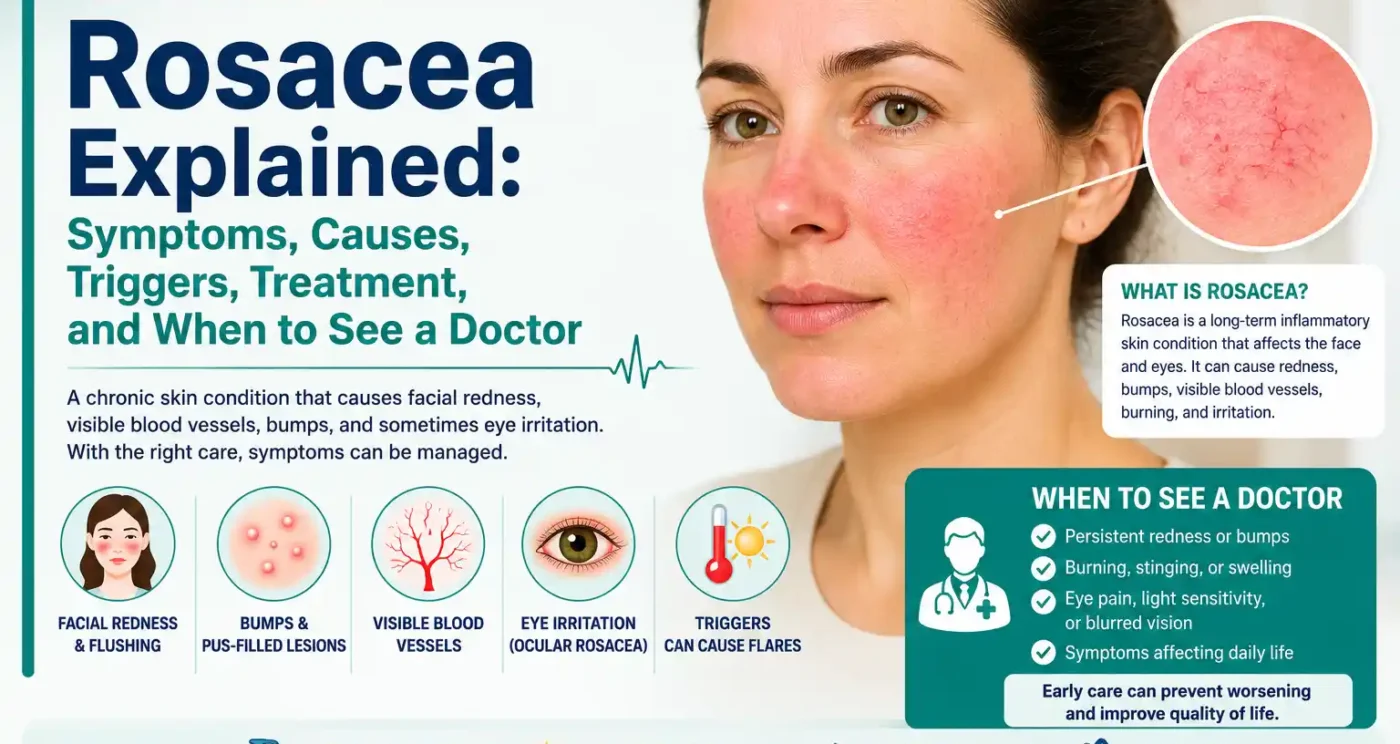
Rosacea can look like a stubborn sunburn, a patch of sensitive skin, or even acne that refuses to clear.
For some people, the first clue is frequent flushing across the cheeks and nose. Others notice small red bumps, visible facial blood vessels, burning or stinging, or irritation around the eyes. Symptoms may settle for a while and then return during a flare.
Rosacea is a chronic inflammatory skin condition that mainly affects the face. It can cause flushing, persistent color changes, acne-like bumps, visible blood vessels, skin thickening, and eye symptoms. The condition affects people of every skin tone, although redness may be harder to recognize on brown or Black skin.
Rosacea is not contagious, it is not caused by poor hygiene, and there is currently no permanent cure. Treatment can, however, make a substantial difference by reducing symptoms, limiting flare-ups, and helping prevent the condition from becoming harder to manage.
Contents
- 1. What Is Rosacea?
- 2. What Are the Most Common Symptoms of Rosacea?
- 3. What Does Rosacea Look Like?
- 4. Where Does Rosacea Usually Appear?
- 5. What Causes Rosacea?
- 6. What Are Rosacea Triggers?
- 7. What Are the Main Features of Rosacea?
- 8. Can Rosacea Affect the Eyes?
- 9. Rosacea in Darker Skin Tones
- 10. Rosacea vs. Acne
- 11. Rosacea vs. Eczema
- 12. Rosacea vs. a Lupus Rash
- 13. Can Rosacea Cause Burning or Stinging?
- 14. Who Is More Likely to Develop Rosacea?
- 15. How Is Rosacea Diagnosed?
- 16. Is Rosacea Classified Into Four Types?
- 17. How Is Rosacea Treated?
- 18. What Skin-Care Routine Helps Rosacea?
- 19. Should You Keep a Rosacea Trigger Diary?
- 20. Can Rosacea Be Cured?
- 21. How Long Does a Rosacea Flare Last?
- 22. Can Rosacea Get Worse Over Time?
- 23. Can Rosacea Be Prevented?
- 24. When Should You See a Doctor for Rosacea?
- 25. When Should You See a Dermatologist?
- 26. When Do Eye Symptoms Need Prompt Attention?
- 27. Frequently Asked Questions
- 27.1. What are the first signs of rosacea?
- 27.2. Is rosacea just facial redness?
- 27.3. Is rosacea contagious?
- 27.4. Is rosacea caused by poor hygiene?
- 27.5. Is rosacea a form of acne?
- 27.6. Can rosacea cause blackheads?
- 27.7. Does rosacea affect people with dark skin?
- 27.8. Does alcohol cause rosacea?
- 27.9. Does coffee cause rosacea?
- 27.10. Does spicy food make rosacea worse?
- 27.11. Can stress cause a rosacea flare?
- 27.12. Can rosacea affect the eyes before the face?
- 27.13. Is there a blood test for rosacea?
- 27.14. What is the best treatment for rosacea?
- 27.15. Can rosacea go away permanently?
- 27.16. Is laser treatment permanent?
- 27.17. What sunscreen is good for rosacea?
- 28. Conclusion
- 29. Resources
- 29.1. American Academy of Dermatology — Rosacea Overview
- 29.2. American Academy of Dermatology — Rosacea Signs and Symptoms
- 29.3. American Academy of Dermatology — Diagnosis and Treatment
- 29.4. American Academy of Dermatology — Rosacea Triggers
- 29.5. Mayo Clinic — Rosacea
- 29.6. National Rosacea Society — Classification of Rosacea
- 29.7. National Rosacea Society — Know Your Triggers
- 29.8. MedIntelHub — Understanding Your Annual Physical
- 29.9. MedIntelHub — Preparing for a Specialist Appointment
- 29.10. MedIntelHub — Editorial Policy
- 30. Editorial Disclaimer
What Is Rosacea?
Rosacea is a long-term condition that most often affects the central part of the face—especially the cheeks and nose.
It may begin with episodes of flushing that come and go. Over time, the color can linger longer, small facial blood vessels may become more noticeable, and some people develop inflammatory bumps that resemble acne. Others mainly experience sensitive, burning skin or problems involving the eyes.
One reason rosacea can be confusing is that it does not look the same in everyone. A person may have one dominant feature for years and later develop another.
Modern rosacea classification reflects that. Older medical descriptions divided rosacea into four “subtypes.” The updated approach focuses instead on the individual features, or phenotypes, that a person actually has, because several features can occur together or change over time.
What Are the Most Common Symptoms of Rosacea?
Rosacea can affect both the skin and the eyes.
Common signs and symptoms include:
- Frequent facial flushing
- Red, pink, violet, or brown discoloration across the central face
- Persistent facial redness or color change
- Small visible blood vessels
- Acne-like red bumps or pustules
- Burning, stinging, warmth, or tenderness
- Dry or easily irritated skin
- Facial swelling
- Thickened skin, particularly around the nose
- Dry, gritty, irritated, or bloodshot eyes
- Red or swollen eyelids
The exact appearance depends partly on skin tone and which rosacea features are present.
What Does Rosacea Look Like?
Many people picture bright red cheeks when they hear the word rosacea.
That can happen, particularly on lighter skin, but it is not the only appearance.
On lighter skin tones, rosacea may appear pink or red. On darker skin, persistent color can look violet, brown, dusky, or darker than the surrounding skin. Some people with darker skin primarily notice warmth, burning, swelling, acne-like bumps, or areas of hyperpigmentation rather than obvious redness.
Rosacea can also create small visible facial blood vessels, sometimes called telangiectasias.
Inflammatory rosacea may look more like acne, with small red bumps and pus-filled lesions clustered around the central face.
Where Does Rosacea Usually Appear?
The cheeks and nose are the most common areas.
Rosacea can also affect the:
- Forehead
- Chin
- Eyelids and eyes
- Ears
- Scalp
- Neck
- Upper chest
- Upper back
Spread beyond the central face is less common, but it can occur.
What Causes Rosacea?
The exact cause remains uncertain.
Researchers believe rosacea develops through a combination of factors rather than one single trigger or infection. Immune-system activity, inflammation, changes in blood-vessel and nerve regulation, genetics, environmental exposures, and microorganisms living on the skin may all contribute.
One area of research involves Demodex mites. These microscopic mites live naturally on human skin, but researchers have found higher numbers in some people with rosacea. That does not mean simply “having mites” causes rosacea; they may instead contribute to an inflammatory response in susceptible people.
Researchers have also studied immune proteins such as cathelicidin and abnormalities in the way the nervous and vascular systems respond to heat, sunlight, and other environmental signals.
The practical takeaway is that rosacea does not happen because someone failed to wash their face properly, and it cannot be passed from person to person.
What Are Rosacea Triggers?
A trigger is something that causes existing rosacea to flare. It is not necessarily what caused the condition in the first place.
Triggers vary considerably between people. One person may flush after a glass of wine, while another can drink wine without a problem but reacts strongly to sunlight or a particular moisturizer.
AAD lists sunlight, heat, stress, alcohol, spicy food, wind and cold, exercise, some medications, and certain skin or hair-care products among commonly reported triggers.
Sun Exposure
Sunlight is one of the most frequently reported rosacea triggers.
Even relatively brief sun exposure can increase flushing or irritation in susceptible people. Daily sun protection is therefore part of rosacea management rather than only a strategy for preventing sunburn.
Heat and Cold
Hot weather, overheated rooms, hot showers, saunas, and vigorous exercise can provoke flushing in some people.
Cold temperatures and wind can also irritate rosacea-prone skin.
This does not mean someone with rosacea must avoid exercise or outdoor activity. The goal is usually to find ways to reduce overheating and protect the skin from extreme conditions.
Spicy Foods and Hot Drinks
Spicy foods are a common trigger.
Hot beverages can also cause flushing, although the temperature of the drink may matter as much as the beverage itself.
Alcohol
Alcohol can trigger flushing in some people with rosacea.
Red wine is frequently mentioned, but triggers are individual. Having rosacea does not mean a person necessarily has to avoid all alcohol; the useful question is whether it reliably causes that person’s symptoms to flare.
Stress and Exercise
Emotional stress and exercise can raise body temperature and increase facial blood flow, which may trigger flushing.
People who notice an exercise connection may benefit from cooler environments, hydration, lower-intensity intervals, fans, or adjusting when they exercise rather than becoming inactive.
Skin-Care Products
Rosacea-prone skin can become surprisingly reactive.
A cleanser, toner, exfoliant, fragrance, hair spray, or cosmetic that previously seemed harmless may trigger burning, stinging, or redness.
AAD recommends keeping skin care gentle and avoiding products that repeatedly irritate the face.
What Are the Main Features of Rosacea?
Instead of thinking of rosacea as four completely separate diseases, current classification focuses on the features a person actually has.
Persistent Facial Redness or Color Change
Frequent flushing may gradually evolve into color that stays for longer periods.
On lighter skin, the change may be red or pink. On darker skin, it may appear violet, brown, dusky, or as increased pigmentation.
Persistent central facial color change is one of the key diagnostic features of rosacea in the current phenotype-based classification.
Acne-Like Bumps and Pustules
Rosacea can produce red inflammatory bumps called papules and pus-filled bumps called pustules.
This presentation is easily confused with acne.
Unlike typical acne, rosacea generally does not produce the same pattern of blackheads and whiteheads, and the surrounding skin often has flushing, persistent redness, visible vessels, or sensitivity.
Visible Blood Vessels
Small dilated blood vessels may become visible across the cheeks or nose.
They can become more noticeable as rosacea progresses, although they may be difficult to see on some skin tones.
Thickened Skin and Rhinophyma
Some people develop thickening and enlargement of the skin, a feature known as phyma.
When this occurs mainly on the nose, it is called rhinophyma.
Rhinophyma can make the nose appear larger, irregular, or more bulbous. It occurs more often in men than women.
Early evaluation matters because established thickened tissue can become more difficult to treat and may eventually require a procedure rather than medication alone.
Ocular Rosacea
Rosacea can involve the eyes and eyelids as well as the skin.
Possible symptoms include dry or watery eyes, redness, burning, itching, a gritty sensation, swollen eyelids, crusting around the eyelashes, and sensitivity to light. Eye symptoms can appear before, after, or at the same time as facial symptoms.
Can Rosacea Affect the Eyes?
Yes, and this part of rosacea deserves more attention than it often receives.
AAD notes that ocular rosacea can cause bloodshot eyes, swollen eyelids, dryness or tearing, burning, stinging, itching, light sensitivity, and a feeling that something is stuck in the eye.
Mild eye symptoms may be managed alongside the skin condition, while more significant ocular rosacea may require an ophthalmologist.
When the condition threatens vision, AAD recommends immediate ophthalmology evaluation.
Rosacea in Darker Skin Tones
Rosacea can occur in people of any skin color.
It may simply be harder to recognize when the textbook description focuses on “redness.”
In darker skin, clues can include persistent facial warmth, brown or violet discoloration, swelling, dry-looking skin, burning, stinging, acne-like bumps, thickening, or areas of darker pigmentation.
Because visible flushing and facial blood vessels can be subtle, diagnosis may be delayed or the condition may initially be mistaken for eczema, seborrheic dermatitis, acne, or another inflammatory skin problem.
Rosacea vs. Acne
These conditions can look similar, particularly when rosacea produces papules and pustules.
| Feature | Rosacea | Acne |
|---|---|---|
| Persistent facial flushing/color change | Common | Not typical |
| Visible facial blood vessels | Can occur | Not typical |
| Papules and pustules | Can occur | Common |
| Blackheads and whiteheads | Usually absent | Common |
| Burning/stinging sensitivity | Common in some people | Less characteristic |
| Eye involvement | Can occur | Not typical |
| Typical location | Central face | Face, chest, back, shoulders |
AAD specifically warns that acne-like rosacea breakouts can be mistaken for ordinary acne and recommends proper diagnosis because the treatment approaches differ.
Using harsh acne treatments on sensitive rosacea skin can sometimes worsen irritation.
Rosacea vs. Eczema
Both conditions can cause irritated or sensitive skin, but the pattern tends to differ.
Rosacea mainly favors the central face and commonly causes flushing, persistent color change, visible blood vessels, inflammatory bumps, or eye symptoms.
Eczema more typically causes itchy, dry, inflamed patches and can affect many parts of the body.
Because facial eczema, seborrheic dermatitis, contact dermatitis, and rosacea can overlap in appearance, persistent facial inflammation is worth having evaluated rather than repeatedly changing products at home. AAD notes that rosacea is sometimes mistaken for eczema or seborrheic dermatitis.
Rosacea vs. a Lupus Rash
Rosacea and certain lupus-related facial rashes can occasionally resemble each other.
A lupus “butterfly” rash often spreads across the cheeks and bridge of the nose, while rosacea more commonly produces flushing, visible vessels, papules or pustules, and skin sensitivity.
Appearance alone is not always enough to distinguish them.
Mayo Clinic notes that clinicians may perform additional testing when needed to rule out disorders such as lupus or psoriasis before settling on a rosacea diagnosis.
Can Rosacea Cause Burning or Stinging?
Yes.
Some people notice burning, stinging, warmth, tenderness, or tightness even when the visible skin changes seem relatively mild.
Water, sunscreen, cosmetics, cleansers, or other products may suddenly feel uncomfortable.
AAD notes that even applying ordinary skin-care products can trigger burning or stinging in rosacea-prone skin.
That sensitivity is one reason aggressive exfoliation and frequent product switching often backfire.
Who Is More Likely to Develop Rosacea?
Anyone can develop rosacea.
Mayo Clinic notes that it is more commonly recognized among people ages 30 to 50, people with skin that burns easily in the sun, those with a family history of rosacea, and people with a history of smoking.
Those are risk associations, not rules.
Rosacea also occurs in people with darker skin tones and outside the typical age range.
How Is Rosacea Diagnosed?
There is no single blood test or scan that confirms rosacea.
Diagnosis is usually based on:
- What the skin looks and feels like
- Where symptoms occur
- Flushing history
- Eye symptoms
- Trigger patterns
- How the condition has changed over time
A dermatologist may also consider other conditions that resemble rosacea.
Mayo Clinic notes that testing may occasionally be used to rule out another disorder, such as psoriasis or lupus, rather than to “test for rosacea” itself.
If eye symptoms are important, an ophthalmologist may also be involved.
Is Rosacea Classified Into Four Types?
You may still see websites discussing four rosacea subtypes: erythematotelangiectatic, papulopustular, phymatous, and ocular rosacea.
That terminology comes from an older classification system.
The current standard classification uses a phenotype-based approach, meaning doctors identify and treat the specific features present in each person instead of forcing every patient into one subtype.
This matters because one person can simultaneously have persistent redness, inflammatory bumps, eye symptoms, and visible vessels.
How Is Rosacea Treated?
There is no one treatment that works for every form of rosacea.
A dermatologist chooses treatment according to the symptoms that are actually causing problems. Someone whose main concern is persistent redness may need a different treatment from someone whose main problem is inflammatory bumps or eye irritation.
Treatment for Persistent Facial Redness
Prescription brimonidine gel and oxymetazoline cream can temporarily reduce persistent facial redness by narrowing small blood vessels beneath the skin.
AAD notes that both are FDA-approved for persistent facial redness associated with rosacea in adults. Their effect is temporary rather than curative.
Laser or intense pulsed light treatment can also be used for persistent redness and visible blood vessels in selected patients.
Treatment for Rosacea Bumps and Pustules
Prescription topical treatments may include:
- Azelaic acid
- Ivermectin
- Metronidazole
- Microencapsulated benzoyl peroxide
- Other medications selected by a dermatologist
AAD lists these among treatments used for inflammatory, acne-like rosacea lesions.
Rosacea treatment usually takes time. AAD notes that topical therapy may begin showing slight improvement within several weeks, with more noticeable improvement taking a few months.
Oral Medication
When topical therapy is not enough, clinicians may use oral medication.
One option is low-dose doxycycline, which can be prescribed at a dose intended primarily for its anti-inflammatory effect rather than for treating a bacterial infection.
Full antibiotic dosing may be used in selected cases, but rosacea itself should not simply be thought of as a bacterial infection.
Laser and Light Treatments
Laser and light-based treatments can reduce visible blood vessels and persistent facial discoloration.
These procedures require experience because burns, scarring, or long-lasting pigment changes can occur when treatment is poorly selected or performed incorrectly. AAD recommends using a dermatologist experienced in treating rosacea with these technologies.
Treatment for Thickened Skin
Early phymatous changes may sometimes respond to medication.
More established thickening—especially rhinophyma—may require procedures such as laser surgery, electrosurgery, radiofrequency treatment, or surgical removal of excess tissue.
Treatment for Ocular Rosacea
Treatment depends on how severely the eyes are involved.
AAD describes options that can include eyelid hygiene, warm compresses, artificial tears, prescription eye medication, selected oral therapy, and ophthalmology care when needed.
Do not use a skin antibiotic or other facial medication in the eyes unless specifically instructed. AAD notes that medicines formulated for skin can be harmful when applied to the eye.
What Skin-Care Routine Helps Rosacea?
Rosacea skin generally does better with consistency than experimentation.
A simple routine is often enough: gentle cleansing, moisturizer, sun protection, and prescribed treatment.
AAD recommends washing gently rather than scrubbing and avoiding products that repeatedly cause stinging or irritation. Ingredients that bother some rosacea-prone skin include fragrance, menthol, camphor, alcohol, glycolic acid, lactic acid, and certain harsh cleansing agents.
That does not mean everyone with rosacea reacts to every ingredient.
The useful approach is to simplify the routine and identify personal irritants.
Gentle Cleansing
Use a mild cleanser and lukewarm water.
Avoid facial scrubs, rough washcloths, cleansing brushes, and aggressive exfoliation when they trigger irritation.
AAD advises gently washing the face and patting it dry rather than rubbing.
Moisturizer
Rosacea can damage the skin barrier and leave the face dry or easily irritated.
A simple fragrance-free moisturizer made for sensitive skin can make prescribed treatments easier to tolerate.
Sunscreen
Sun protection is one of the most important parts of rosacea care.
AAD recommends broad-spectrum, water-resistant SPF 30 or higher. People whose skin reacts to chemical sunscreens may tolerate mineral formulas containing zinc oxide, titanium dioxide, or both more comfortably.
Tinted mineral sunscreen can also reduce the white cast that some mineral products leave on darker skin.
Should You Keep a Rosacea Trigger Diary?
It can be useful.
If your symptoms seem unpredictable, write down possible exposures around each flare—weather, exercise, alcohol, food, stress, skin-care products, medications, and other changes.
After a few weeks, patterns may become easier to see.
AAD and the National Rosacea Society both recommend identifying personal triggers rather than assuming every item on a generic trigger list applies to everyone.
Can Rosacea Be Cured?
There is currently no cure.
That does not mean rosacea will remain constantly active.
Many people have periods in which symptoms are controlled or barely noticeable, followed by occasional flare-ups.
Treatment, gentle skin care, sun protection, and trigger management can help keep the condition under control.
Once symptoms improve, a dermatologist may recommend a simpler maintenance plan rather than stopping everything at once.
How Long Does a Rosacea Flare Last?
There is no fixed timeline.
A flare may last hours, days, or longer depending on the feature involved and whether the trigger continues.
Mayo Clinic notes that rosacea symptoms can flare for weeks to months and then settle for a period before returning.
Frequent flushing may last only a short time early in the condition, while persistent color changes can remain far longer.
If a previously short-lived reaction begins lasting for days or weeks, it is worth discussing with a dermatologist.
Can Rosacea Get Worse Over Time?
It can.
Not everyone experiences progressive disease, but untreated rosacea may become more persistent in some people.
Flushing may last longer, visible vessels can become more noticeable, inflammatory bumps can recur, and skin thickening can eventually develop in some patients.
That is one reason early diagnosis can be useful even when symptoms seem mainly cosmetic.
Can Rosacea Be Prevented?
There is no proven way to guarantee that someone will never develop rosacea.
Once rosacea is present, however, flare frequency may be reduced by recognizing personal triggers, protecting the skin from sunlight, maintaining gentle skin care, and following an effective treatment plan.
When Should You See a Doctor for Rosacea?
Consider medical evaluation when facial flushing, color changes, bumps, or irritation are persistent or repeatedly returning.
It is particularly useful to see a clinician when:
- Facial redness or discoloration is lasting longer than before
- Acne-like bumps do not respond to ordinary acne treatment
- Skin frequently burns or stings
- Visible facial blood vessels are appearing
- The nose or another facial area is beginning to thicken
- Symptoms are affecting confidence or daily life
- Eye irritation occurs along with facial symptoms
- You are not sure whether the condition is rosacea, acne, eczema, or something else
AAD recommends diagnosis because appropriate treatment may reduce discomfort and help prevent progression.
A new skin problem does not have to wait for your next routine preventive appointment. MedIntelHub’s guide to annual physicals explains the difference between preventive care and an appointment for a new medical concern.
Understanding Your Annual Physical: What Actually Gets Checked
When Should You See a Dermatologist?
A dermatologist can be particularly helpful when rosacea is persistent, difficult to control, causing repeated inflammatory bumps, producing visible vessels, or leading to skin thickening.
Because rosacea can resemble several other skin disorders, a specialist can also help confirm that the diagnosis is correct.
If you’re preparing for a dermatology visit, keeping photographs of previous flares and a short record of products or triggers can be useful.
MedIntelHub also has a guide for organizing the questions and information you want to bring to a specialist appointment.
How to Prepare Questions Before a Specialist Appointment
When Do Eye Symptoms Need Prompt Attention?
Do not treat every eye symptom as something that can wait for the next dermatology visit.
Ocular rosacea should be evaluated when the eyes are persistently dry, red, gritty, irritated, or light-sensitive.
Seek prompt eye care if you develop more concerning symptoms such as:
- Eye pain
- Significant light sensitivity
- Blurred or reduced vision
- Increasing redness or swelling
- Symptoms that are rapidly worsening
AAD states that ocular rosacea threatening eyesight requires immediate ophthalmology referral.
Frequently Asked Questions
What are the first signs of rosacea?
Rosacea often begins with a tendency to flush more easily than before. The face may feel warm, and the color can gradually begin lasting longer.
Other early signs can include sensitive skin, burning, stinging, or acne-like bumps.
Is rosacea just facial redness?
No.
Rosacea can also produce bumps and pustules, visible blood vessels, burning, swelling, eye symptoms, and thickening of facial skin.
Is rosacea contagious?
No.
You cannot catch rosacea from another person.
Is rosacea caused by poor hygiene?
No.
Rosacea is not the result of a dirty face or inadequate washing. Overwashing or scrubbing can actually make sensitive rosacea-prone skin feel worse.
Is rosacea a form of acne?
No.
Rosacea and acne are separate conditions, although rosacea can create bumps and pustules that resemble acne.
Can rosacea cause blackheads?
Blackheads and whiteheads are much more characteristic of acne than rosacea.
Their presence can help a clinician distinguish acne from papulopustular rosacea, although both conditions can sometimes occur in the same person.
Does rosacea affect people with dark skin?
Yes.
Rosacea occurs across skin tones. On darker skin, redness may appear violet or brown or may be difficult to see, making symptoms such as warmth, swelling, burning, stinging, bumps, or hyperpigmentation particularly important.
Does alcohol cause rosacea?
Alcohol can trigger a flare in some people, but it is not accurate to say that drinking alcohol alone causes rosacea.
Triggers vary from one person to another.
Does coffee cause rosacea?
Hot beverages can trigger flushing in some people.
The temperature of a drink may be part of the problem, so not every person with rosacea needs to avoid coffee entirely. Individual patterns matter more than blanket restrictions.
Does spicy food make rosacea worse?
It can.
Spicy foods are a commonly reported trigger, but not everyone with rosacea reacts to them.
Can stress cause a rosacea flare?
Yes.
Emotional stress is commonly reported as a trigger.
Can rosacea affect the eyes before the face?
Yes.
Eye symptoms may develop before, after, or at the same time as facial rosacea.
Is there a blood test for rosacea?
No routine blood test confirms rosacea.
Diagnosis is usually made from the history and physical examination. Testing may sometimes be used to rule out another condition.
What is the best treatment for rosacea?
There is no single best treatment.
The appropriate approach depends on whether the main issue is redness, inflammatory bumps, visible blood vessels, skin thickening, eye involvement, or a combination.
Can rosacea go away permanently?
Rosacea is generally considered chronic.
Symptoms can be controlled for long periods, but flare-ups may return.
Is laser treatment permanent?
Laser or light treatment can reduce visible vessels and persistent color, but it does not cure the underlying tendency toward rosacea.
Maintenance treatment and trigger management may still be necessary.
What sunscreen is good for rosacea?
AAD recommends broad-spectrum, water-resistant SPF 30 or higher.
People with sensitive rosacea-prone skin may find mineral sunscreens containing zinc oxide or titanium dioxide easier to tolerate.
Conclusion
Rosacea is more complicated than simply having red cheeks.
It is a chronic inflammatory condition that can cause flushing, persistent facial color changes, visible blood vessels, acne-like bumps, burning or stinging, thickened skin, and problems involving the eyes. The appearance can vary significantly across different skin tones.
Scientists still do not know one exact cause. Current evidence points toward a combination of inflammation, immune activity, neurovascular changes, genetics, environmental influences, and possibly microorganisms such as Demodex mites.
Triggers are different from causes.
Sun exposure, heat, cold, exercise, stress, spicy foods, alcohol, and irritating skin products may provoke a flare in some people, but another person’s rosacea may respond to a completely different set of triggers. Keeping track of your own pattern is more useful than trying to avoid every trigger listed online.
There is no permanent cure at present, but rosacea can often be controlled effectively.
Treatment may include gentle skin care, daily sun protection, topical or oral medication, laser or light therapy, and specific treatment for eye involvement or thickened skin. Modern care focuses on treating the individual features present rather than assuming every person has one fixed “type” of rosacea.
Persistent facial symptoms deserve evaluation because rosacea can be mistaken for acne, eczema, seborrheic dermatitis, lupus-related skin disease, or other conditions.
And eye symptoms should not be overlooked. Persistent irritation warrants evaluation, while eye pain, significant light sensitivity, or changes in vision deserve prompt professional care.
Resources
American Academy of Dermatology — Rosacea Overview
AAD provides patient-focused information about rosacea symptoms, appearance, progression, diagnosis, and treatment.
American Academy of Dermatology: Rosacea Overview
American Academy of Dermatology — Rosacea Signs and Symptoms
This resource explains facial flushing, persistent color changes, acne-like breakouts, burning, skin thickening, and ocular symptoms across different skin tones.
AAD: Rosacea Signs and Symptoms
American Academy of Dermatology — Diagnosis and Treatment
AAD reviews topical medicines, oral therapy, laser and light treatments, skin care, and treatment of ocular and phymatous rosacea.
AAD: Rosacea Diagnosis and Treatment
American Academy of Dermatology — Rosacea Triggers
This guide can help people identify triggers that repeatedly coincide with their own flare-ups.
AAD: Finding Your Rosacea Triggers
Mayo Clinic — Rosacea
Mayo Clinic provides an overview of symptoms, possible causes, triggers, risk factors, diagnosis, and treatment.
National Rosacea Society — Classification of Rosacea
This resource explains the transition from the older subtype model to the current phenotype-based classification.
National Rosacea Society: Classification of Rosacea
National Rosacea Society — Know Your Triggers
The National Rosacea Society provides tools for tracking individual lifestyle and environmental factors associated with flare-ups.
National Rosacea Society: Know Your Rosacea Triggers
MedIntelHub — Understanding Your Annual Physical
This MedIntelHub guide explains how routine preventive care differs from evaluation of a new or persistent medical concern.
Understanding Your Annual Physical: What Actually Gets Checked
MedIntelHub — Preparing for a Specialist Appointment
Useful for organizing symptoms, photographs of flares, medications, previous treatments, and questions before seeing a dermatologist or ophthalmologist.
How to Prepare Questions Before a Specialist Appointment
MedIntelHub — Editorial Policy
For information about MedIntelHub’s standards for healthcare sourcing, accuracy, transparency, and educational content:
Editorial Disclaimer
This article is provided for general educational and informational purposes only. It does not diagnose rosacea, determine whether a facial rash is rosacea, or recommend a specific treatment for an individual.
Facial redness, discoloration, bumps, burning, swelling, and eye symptoms can occur with acne, eczema, seborrheic dermatitis, contact reactions, lupus-related skin disease, infections, medication reactions, and other conditions. A qualified healthcare professional may need to examine the skin or eyes before determining the cause.
Prescription treatment should be selected according to the specific rosacea features present, medical history, pregnancy status, allergies, other medications, skin type, eye involvement, and individual treatment goals.
Laser and light procedures can cause burns, scarring, or pigment changes when performed inappropriately and should be carried out by a suitably trained medical professional.
Seek prompt medical evaluation for significant eye pain, marked light sensitivity, blurred or reduced vision, rapidly worsening eye inflammation, or other symptoms suggesting that vision may be threatened.

David Bennett
David Bennett is an author at MedIntelHub, where he creates clear, practical, and well-researched content about healthcare, medical billing, insurance, and patient education. His goal is to make complex healthcare topics easier for readers to understand and use in everyday situations. David emphasizes accuracy, transparency, and reliable sourcing, using information from trusted organizations and official healthcare resources whenever possible. Content published by David is intended for educational purposes and should not replace advice from qualified medical, legal, or healthcare professionals.