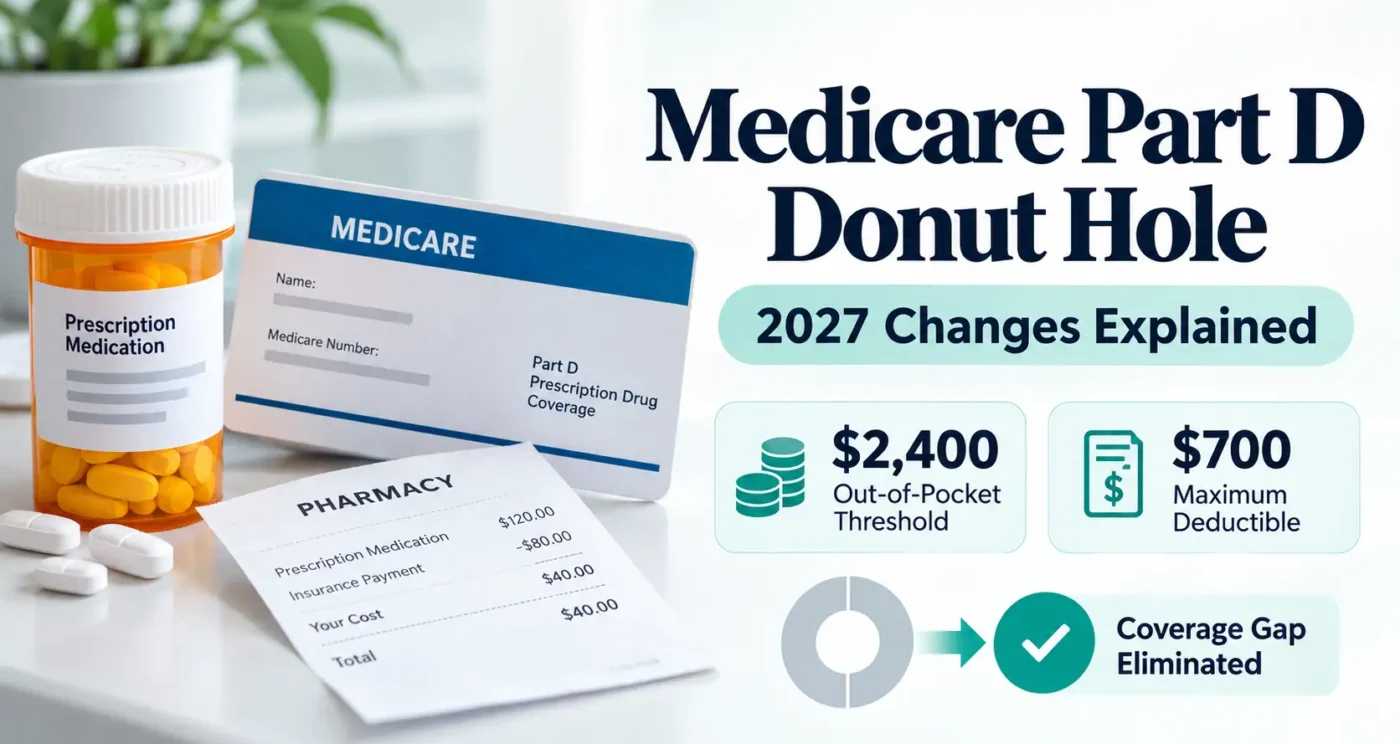
A prescription that cost $12 one month and much more later in the year used to raise an uncomfortable question: Did I fall into the Medicare donut hole? For years, the answer could have been yes. But that familiar coverage gap is no longer part of Medicare Part D. If a pharmacy bill rises in 2027, the reason is likely to involve a deductible, a plan’s drug tier, pharmacy pricing or another coverage rule—not a return of the old donut hole.
Under Medicare’s redesigned Part D benefit, the maximum deductible is $700 for 2027 and the annual out-of-pocket threshold for covered Part D drugs is $2,400. Once a person reaches the applicable threshold, they owe $0 in cost sharing for covered Part D drugs through the rest of that calendar year. The threshold is not an annual premium limit or a guarantee that everyone will personally pay $2,400.
The official Medicare drug-cost guide explains the stages and the confirmed 2027 figures.
What Was the Medicare Part D Donut Hole?
The “donut hole” was the nickname for the coverage gap in the older Medicare Part D benefit. Previously, beneficiaries could move through an initial coverage period and then enter a gap where their share of prescription drug costs changed. The name came from that gap between earlier coverage and the higher level of protection available once catastrophic coverage began.
The gap did not mean every drug was suddenly uncovered or every member faced identical charges. What it meant in practice depended on the benefit year, whether the drug was brand-name or generic, the applicable discounts and the particular plan. The term nevertheless became shorthand for unexpectedly high pharmacy costs later in the year.
Part D was substantially redesigned under the Inflation Reduction Act of 2022. Cost sharing in the catastrophic stage was removed beginning in 2024, and the coverage-gap stage was eliminated beginning January 1, 2025. The 2027 rules continue that redesign.
Does the Medicare Donut Hole Still Exist in 2027?
No. The Medicare Part D donut hole does not return in 2027. The 2027 benefit has three general stages: deductible, initial coverage and catastrophic coverage. There is no separate coverage-gap stage in between.
CMS reaffirmed the changes in its 2027 Medicare Advantage and Part D final-rule summary, published April 2, 2026. The agency codified the coverage-gap elimination and other redesign provisions for 2027 and later years.
This does not mean an individual’s drug costs stay the same every month. A plan may change tiers or formularies from one year to the next, and a person who has not yet met a deductible can face higher charges early in the calendar year. Those are separate issues from the discontinued donut hole.
Medicare Part D Costs in 2026 vs. 2027
| Part D benefit feature | 2026 | 2027 |
| Coverage gap / donut hole | Eliminated | Eliminated |
| Maximum annual plan deductible | $615 | $700 |
| Annual out-of-pocket threshold | $2,100 | $2,400 |
| Cost sharing for covered Part D drugs in catastrophic coverage | $0 | $0 |
| General benefit stages | Deductible; initial; catastrophic | Deductible; initial; catastrophic |
These are national benefit parameters, not a quote from an individual plan. A plan can have a deductible below the maximum or no deductible. Premiums, copayments, coinsurance, preferred pharmacies and covered drug lists vary.
The figures come from the 2027 Medicare Advantage and Part D Rate Announcement and Medicare’s current Part D cost information.
How Medicare Part D Works in 2027
Stage 1: The deductible
If a plan has a deductible, a member generally pays the applicable cost for deductible-subject covered prescriptions until the plan deductible has been met. The highest permitted annual Part D deductible is $700 in 2027. Some plans waive the deductible for selected tiers, while others offer a $0 deductible. Under Part D rules, the deductible does not apply to covered insulin products and recommended adult vaccines that qualify for the applicable protections.
Consider two members taking the same medicine. One may have a $700 deductible and the other may have no deductible. Even before comparing pharmacy networks, their January bills could differ sharply. That difference is determined by plan design, not by the donut hole.
Stage 2: Initial coverage
After any applicable deductible, the member generally pays copayments or coinsurance for covered medicines under their plan. The defined standard Part D benefit uses 25% cost sharing in this stage, but many plans instead use fixed copayments, tiers and other approved structures. Do not assume every enrolled person pays 25%.
During this stage, the plan tracks spending that qualifies toward the annual true out-of-pocket threshold, frequently abbreviated TrOOP. The 2027 threshold is $2,400. Once qualifying costs reach that amount, the member enters catastrophic coverage.
Stage 3: Catastrophic coverage
For the rest of the calendar year after the threshold is reached, the beneficiary pays $0 in cost sharing for covered Part D drugs. This protection applies to medicines covered under the Part D benefit; it does not erase premiums, charges for noncovered medications or every possible healthcare expense.
The benefit year generally resets January 1. Someone who reaches catastrophic coverage in 2027 starts a new benefit year in 2028, with parameters then in effect.
What Does the $2,400 Out-of-Pocket Threshold Really Mean?
The $2,400 figure is the 2027 Part D threshold used to determine when catastrophic coverage begins. It is often described as an “out-of-pocket cap,” but there is a technical distinction: qualifying amounts paid by certain people or programs on a beneficiary’s behalf can count toward this threshold. As a result, $2,400 is not necessarily the amount that must come directly from the beneficiary’s bank account.
For a person who uses only a few inexpensive generic medicines, qualifying spending may never approach the threshold. Someone taking high-cost covered medications may reach it much earlier. Extra Help recipients can also reach it based in part on eligible payments made for them.
Which costs generally count?
- Deductibles and cost sharing paid for covered Part D medicines, when recognized under the TrOOP rules.
- Qualifying payments made by certain assistance programs or other eligible third parties on the beneficiary’s behalf.
- Other amounts that federal Part D rules specifically designate as qualifying TrOOP costs.
Which costs generally do not count?
- Monthly Part D plan premiums and applicable income-related premium adjustments.
- Amounts paid for medicines that are not covered under Part D, absent a specific qualifying exception.
- Costs for drugs or services covered under other Medicare benefits, such as many Part B-administered medicines.
- Payments from sources excluded under the applicable TrOOP rules.
Calculations are more complicated than simply adding the retail price of every prescription. Check the plan’s Explanation of Benefits (EOB), particularly its running out-of-pocket totals, and ask the plan to investigate any discrepancy. Manufacturer discounts and plan payments should not automatically be counted as personal TrOOP spending.
An Example of Prescription Costs in 2027
Imagine a patient whose plan has a $700 deductible and tiered copayments after the deductible. In January, a covered prescription may be expensive because it is deductible-subject. Once the deductible is met, a later refill could have a smaller copayment. If the patient eventually accumulates $2,400 in qualifying Part D out-of-pocket costs, cost sharing for covered Part D medicines becomes $0 for the remainder of 2027.
A different patient, enrolled in a $0-deductible plan and using two low-cost generics, may pay modest copayments all year without entering catastrophic coverage. Both patients are operating under the same national three-stage framework; their plan terms and drug needs create very different bills.
These are illustrative situations, not individualized price estimates. Actual prescription costs depend on the covered drug, negotiated pharmacy price, days’ supply, formulary tier and plan contract.
No. The $2,400 threshold concerns qualifying covered-drug costs. Monthly plan premiums are separate and do not count toward it. Someone who reaches catastrophic coverage may have $0 cost sharing for covered Part D prescriptions but still owes their monthly plan premium, if applicable.
Higher-income beneficiaries may also owe a Part D income-related monthly adjustment amount (IRMAA). Late enrollment penalties can increase premiums for some beneficiaries. Those amounts are not made free by reaching catastrophic coverage.
The 2027 national base beneficiary premium is $41.33, according to CMS, but that is a calculation input—not the monthly premium every beneficiary pays. CMS separately projected the 2027 average premium for stand-alone Part D plans at approximately $36 per month; an individual plan may cost more or less.
See CMS’s 2027 Part D bid information for the base premium and its discussion of plan bidding.
Why Might Prescription Costs Still Rise Without a Donut Hole?
Removing a coverage stage does not remove every source of price variation. When a patient asks why a refill costs more, the useful starting point is the exact drug and claim, not the old donut-hole label.
- A deductible may apply at the start of a new calendar year.
- The drug may have moved to a different formulary tier or require a different type of cost sharing.
- A preferred pharmacy might charge less than another in-network pharmacy under the same plan.
- The dispensed quantity, dosage, brand/generic status or covered formulation may have changed.
- A prescription could be denied or processed outside the plan benefit because a coverage requirement was not met.
- A temporary supply or transition fill may have expired.
If the amount at the counter looks wrong, ask the pharmacist whether the prescription was adjudicated through the intended plan and whether a rejection or deductible explains the price. Then compare the pharmacy claim and your plan’s EOB. Do not skip or stop a prescribed medicine solely because of a new bill; discuss clinically suitable options with the prescriber.
What Is the Medicare Prescription Payment Plan?
The Medicare Prescription Payment Plan is an optional way to spread eligible out-of-pocket spending on covered Part D prescriptions across the remaining months of the calendar year. Instead of paying eligible cost sharing at the pharmacy, participants receive bills from their Part D plan. All Medicare drug plans offer the option, including Medicare Advantage plans with drug coverage.
This can make an expensive early-year prescription easier to budget, but it does not lower the total prescription cost. A person still pays their plan premium separately, if applicable. The payment amount may vary from month to month based on when enrollment starts and what eligible expenses arise.
Medicare’s Prescription Payment Plan overview explains the enrollment option and includes examples. Ask your own plan how enrollment and billing work before relying on the arrangement.
Can Extra Help Lower Medicare Part D Costs?
Yes. Extra Help, also called the Part D Low-Income Subsidy, assists qualifying people with Medicare prescription drug premiums and cost sharing. Eligibility generally depends on financial circumstances and certain program enrollment categories. Some people qualify automatically through Medicaid or Medicare Savings Program participation; others may apply.
For 2027, Medicare lists a $0 plan deductible and specified maximum copayments for people receiving Extra Help at participating pharmacies, with differences depending on eligibility and drug type. Eligible payments on a person’s behalf can help them reach the catastrophic threshold. Extra Help can therefore be more financially important than the headline $2,400 threshold for an eligible beneficiary.
See the current eligibility information and 2027 copayment amounts on Medicare’s Extra Help page.
Standalone Part D vs. Medicare Advantage Drug Coverage
People with Original Medicare can generally obtain prescription coverage through a standalone Medicare Part D plan. Many Medicare Advantage plans include Part D drug coverage. In either arrangement, the relevant Part D redesign and catastrophic cost-sharing protections apply, but the available plans, networks and formularies can differ.
Original Medicare alone does not automatically include a standalone Part D prescription plan. Likewise, not every Medicare Advantage product has identical prescription benefits. Before switching coverage, confirm how prescriptions, existing clinicians and any other benefits would be affected. Medigap policies generally do not function as modern stand-alone Part D drug plans.
How to Compare Medicare Part D Plans for 2027
A low monthly premium can look attractive until a regularly used medicine is placed on a costly tier. Conversely, a plan with a higher premium might have a better overall price for a specific medication list. The comparison is personal, and the Medicare Plan Finder is more useful than relying only on national averages.
- List every prescription, strength, dosage and expected refill frequency. Include preferred pharmacies.
- Check whether each medicine appears on the 2027 formulary and whether a prior authorization, step therapy or quantity limit applies.
- Compare the plan premium, deductible and projected annual prescription costs—not just the price of one refill.
- Review preferred versus standard pharmacy status and mail-order options, when available.
- Look at your Annual Notice of Change and check whether your current plan is still offered in your service area.
- For expensive specialty medicines, ask about clinically appropriate alternatives and legitimate assistance programs.
Medicare Open Enrollment for coverage starting January 1, 2027 runs from October 15 through December 7, 2026. Other enrollment periods may apply in certain circumstances. Medicare’s official tool is available at Medicare.gov/plan-compare.
The Medicare Open Enrollment page explains the dates and permitted changes.
A Medication Review Can Help Before You Choose a Plan
A medication review can be useful before comparing plans. Bring a complete list of prescription medicines, nonprescription drugs and supplements to a clinician or pharmacist, and ask about any uncertainty over dosage or duplicate treatment. MedIntelHub’s guide to what is checked during an annual physical discusses why an accurate medication list matters during routine healthcare visits. Plan-cost comparisons should never be a reason to independently change treatment.
Frequently Asked Questions
Is the Medicare donut hole gone in 2027?
Yes. The Part D coverage-gap stage was eliminated in 2025 and remains absent in 2027. Part D generally uses deductible, initial coverage and catastrophic stages.
What replaced the Medicare donut hole?
A redesigned three-stage Part D benefit replaced the older structure. After the 2027 annual out-of-pocket threshold is reached, cost sharing for covered Part D drugs is $0 for the rest of the year.
What is the Part D out-of-pocket limit for 2027?
The 2027 annual out-of-pocket threshold is $2,400 in qualifying covered Part D costs. Certain eligible payments on your behalf may count toward that threshold.
Will I personally have to pay $2,400?
Not necessarily. Some people spend much less, while certain qualifying payments by assistance programs can count toward the threshold. Check your plan’s EOB for actual progress.
What is the highest Medicare Part D deductible in 2027?
The maximum is $700. A specific plan may charge less or offer no deductible; some covered drug categories have special deductible protections.
Do I pay anything after reaching catastrophic coverage?
You owe $0 cost sharing for covered Part D drugs for the rest of that calendar year. Premiums and expenses outside covered Part D drugs can still apply.
No. Monthly plan premiums, income-related premium adjustments and late enrollment penalties do not count toward the Part D out-of-pocket threshold.
Does Medicare Part D cover every prescription medicine?
No. Coverage depends on Part D rules, the plan formulary, applicable exceptions and the type of medicine. Some drugs are covered under Medicare Part B instead.
Can my drug become more expensive even without a donut hole?
Yes. Deductibles, pharmacy networks, formulary placement and other benefit rules can affect the amount you owe before catastrophic coverage.
Does the Medicare Prescription Payment Plan save money?
No. It helps eligible members spread prescription costs into monthly plan bills, but does not reduce the total owed.
Does Extra Help still exist in 2027?
Yes. Eligible people may receive assistance with Part D premiums and drug cost sharing. Income, resources and certain public-program eligibility rules matter.
Do Medicare Advantage plans have the same $2,400 threshold?
Part D coverage in Medicare Advantage plans is subject to the applicable Part D threshold and catastrophic rules. Drug lists, premiums and other plan details can differ.
When can I switch my Part D plan for 2027?
The regular Open Enrollment Period is October 15–December 7, 2026, for changes effective January 1, 2027. Some people qualify for other enrollment periods.
What if a pharmacy says I am in the donut hole?
Ask for the actual claim explanation. The old coverage-gap stage no longer exists; the issue may involve a deductible, copayment, formulary, pharmacy network or claim-processing problem.
Will the $2,400 threshold reset in 2028?
The Part D benefit tracks qualifying costs on a calendar-year basis. A new benefit year starts in January 2028, with whatever official parameters apply for 2028.
What to Remember About the 2027 Donut Hole
The phrase “Medicare donut hole” remains familiar, but the coverage gap it described is history. In 2027, the practical numbers are the $700 maximum plan deductible and the $2,400 qualifying out-of-pocket threshold. Once the threshold is met, covered Part D prescriptions have $0 cost sharing for the rest of the calendar year.
Your own costs may be lower—and they depend heavily on the plan and the exact medicines you use. Before renewing coverage, check the formulary, pharmacies, projected total annual costs and any eligibility for Extra Help. If a prescription becomes unexpectedly expensive, request a claim explanation rather than assuming the donut hole has returned.
Resources
Medicare — How Much Does Medicare Drug Coverage Cost?
Explains Part D stages, premiums, deductibles and the confirmed 2027 threshold.
CMS — Contract Year 2027 Medicare Advantage and Part D Final Rule
Documents the formal continuation of the redesigned benefit and elimination of the coverage-gap stage.
CMS — 2027 Medicare Advantage and Part D Rate Announcement
Provides the updated 2027 defined standard benefit parameters.
Medicare — Medicare Prescription Payment Plan
Describes the voluntary payment-spreading option, participation and its financial limits.
Medicare — Help With Drug Costs
Explains Extra Help and current copayment protections for eligible people.
Medicare — Open Enrollment
Explains when and how to compare, join or switch Medicare drug coverage.
Editorial Guidelines & Medical Disclaimer
This MedIntelHub article provides educational information about U.S. Medicare prescription drug benefits using official Medicare and CMS materials available as of October 28, 2026. It does not diagnose medical conditions, replace individualized medical or pharmacy advice, establish eligibility or guarantee drug coverage, plan benefits or reimbursement. Formularies, plan contracts, coverage rules and Medicare policy can change. Verify current Medicare notices, plan documents and applicable payer requirements before making enrollment or billing decisions. CPT, HCPCS and ICD-10-CM codes, where relevant to healthcare claims, must be checked against current official code sets and payer requirements before claim submission. Do not stop or change prescribed medications without consulting an appropriate healthcare professional.
Readers can review MedIntelHub’s editorial standards for our approach to sources, accuracy, updates and medical-information limitations.
David Bennett
David Bennett is an author at MedIntelHub, where he creates clear, practical, and well-researched content about healthcare, medical billing, insurance, and patient education. His goal is to make complex healthcare topics easier for readers to understand and use in everyday situations. David emphasizes accuracy, transparency, and reliable sourcing, using information from trusted organizations and official healthcare resources whenever possible. Content published by David is intended for educational purposes and should not replace advice from qualified medical, legal, or healthcare professionals.