A medical bill does not begin when someone sends an invoice.
The billing process usually starts before the patient even walks into the examination room.
Insurance information may need to be verified. Referrals or prior authorizations may need to be checked. After the visit, the documentation must support the diagnoses and services reported. A claim is then created, transmitted, reviewed by the payer, and either paid, reduced, rejected, denied, or returned for more information.
Only after those steps does the practice know what the insurer will pay and what amount, if any, may remain for the patient.
This entire process is often described as the medical billing workflow or part of the broader revenue cycle.
The exact workflow differs among physician practices, hospitals, laboratories, therapy offices, and other healthcare organizations. Different insurers also have different rules.
But the basic path usually looks something like this:
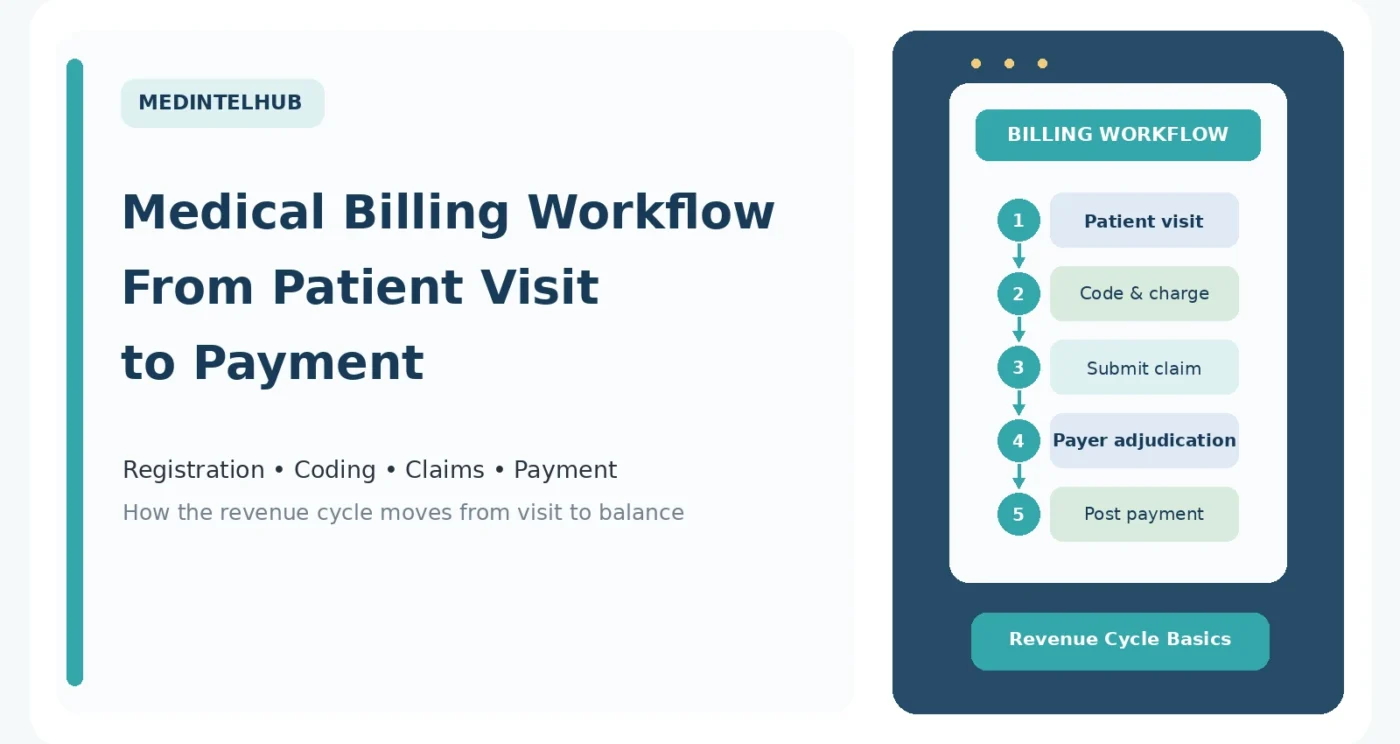
Patient registration → eligibility and authorization → visit and documentation → coding and charge capture → claim creation → claim submission → payer adjudication → payment/remittance → patient balance → follow-up and reconciliation.
Important: This article explains the medical billing process for educational purposes. Coding, coverage, payer policies, claim formats, authorization requirements, and payment rules vary by payer and setting. Providers should verify current requirements with the applicable payer, coding resources, contracts, and official guidance.
Step 1: Patient Registration
The billing workflow often begins when an appointment is scheduled or when the patient checks in.
The practice needs accurate information to create a claim.
This can include:
- Patient name
- Date of birth
- Address
- Insurance plan
- Member or subscriber identification number
- Relationship to the subscriber
- Coordination-of-benefits information
- Referring provider information when required
Even a small registration error can cause problems later.
A misspelled name, incorrect insurance identification number, wrong date of birth, or outdated insurance plan can prevent a claim from being accepted.
That is one reason practices often ask patients to confirm their information at each visit.
Step 2: Insurance Eligibility and Benefits Are Checked
Having an insurance card does not automatically mean the policy is active or that every service will be covered.
Before the visit, the provider may verify:
- Whether coverage is active
- Whether the provider is in network
- Deductible information
- Copayment or coinsurance information
- Coverage for the planned service
- Whether a referral is required
- Whether prior authorization may be required
Under HIPAA administrative standards, electronic eligibility inquiries commonly use the 270 transaction, while the health plan’s response is the 271 transaction.
Eligibility verification is useful, but it is not an absolute guarantee that the payer will ultimately pay a claim.
The final payment decision can depend on documentation, coding, medical-necessity rules, authorization, exclusions, benefits used, and other plan requirements.
Some services can require additional approval before they are performed.
A referral and a prior authorization are not necessarily the same thing.
A referral commonly involves one healthcare professional directing a patient to another provider or specialist.
Prior authorization generally means the health plan requires advance approval for a particular service, medication, test, or procedure under its coverage rules.
Failure to obtain required authorization can cause a later claim to be denied or can affect who is financially responsible.
Because these requirements differ by payer and plan, practices often check them before scheduled procedures, imaging, specialty services, and other higher-cost care.
Step 4: The Patient Receives the Service
Next comes the actual healthcare encounter.
That could be:
- An office visit
- A preventive visit
- A telehealth appointment
- A laboratory test
- An imaging service
- A procedure
- A therapy session
- An inpatient or outpatient hospital service
The medical record should document what happened during the encounter.
Documentation may include the patient’s symptoms, history, assessment, diagnoses, tests, procedures, medications, treatment plan, and other clinically relevant information.
The billing team does not simply choose codes based on what might pay more.
The codes reported on the claim must be supported by the documentation and applicable coding rules.
Step 5: Charges Are Captured
After the service is performed, the organization needs to make sure the billable services are captured.
This is often called charge capture.
Depending on the setting, the charge may originate from:
- The clinician’s documentation
- An electronic health record
- A procedure log
- A laboratory or imaging system
- A hospital department
- A charge ticket or electronic superbill
Missing a charge can mean the provider never bills for a service that was actually performed.
Adding a charge that is not supported can create the opposite problem.
Accurate charge capture therefore depends on both documentation and billing controls.
Step 6: Diagnoses and Services Are Coded
Medical coding translates information from the clinical record into standardized code sets used on healthcare claims.
Common code sets include:
- ICD-10-CM for diagnoses
- CPT for many physician and outpatient procedures and services
- HCPCS Level II for certain supplies, drugs, equipment, and services not represented by CPT alone
- ICD-10-PCS for procedures in certain hospital inpatient settings
CMS lists these among the standard code sets used in HIPAA administrative transactions.
Correct coding involves more than selecting a diagnosis and procedure code.
Depending on the claim, the billing team may also need:
- Modifiers
- Units of service
- Place-of-service information
- Rendering and billing provider information
- Dates of service
- Diagnosis-to-procedure relationships
For a look at changes that can affect coding operations this year, see our MedIntelHub guide New CPT Code Changes for 2026: What Providers Need to Know.
Step 7: Coding Edits May Be Checked Before Submission
Before sending the claim, many billing systems run it through edits or a process often called claim scrubbing.
The goal is to catch obvious errors before the payer sees them.
A scrubber may look for problems such as:
- Missing patient information
- Invalid diagnosis or procedure codes
- Incorrect dates
- Missing modifiers
- Invalid place-of-service information
- Incomplete provider identifiers
- Code combinations that may conflict with payer edits
For Medicare claims, the National Correct Coding Initiative, or NCCI, includes coding policies and edits intended to reduce improper coding and payment.
CMS’s NCCI Procedure-to-Procedure edits can prevent inappropriate payment of code combinations that generally should not be reported together, while Medically Unlikely Edits address certain units-of-service issues.
NCCI is important, but it is not the only set of edits a provider may encounter. Commercial insurers and other payers can use their own payment and coding policies as well.
Step 8: The Claim Is Created
Once the information is ready, the billing system creates the claim.
For electronic HIPAA claims, professional and institutional billing use different versions of the X12 837 transaction.
- 837P: professional claims
- 837I: institutional claims
For paper billing, the familiar equivalents include the CMS-1500 for many professional claims and the CMS-1450/UB-04 for institutional billing.
Electronic submission is the normal workflow for most claims.
Step 9: The Claim Goes to a Clearinghouse or Directly to the Payer
Some providers send electronic claims directly to a payer.
Others send them through a clearinghouse.
A clearinghouse acts as an intermediary between the provider and health plans.
It can check whether the electronic claim follows required formatting rules and route the claim to the correct payer.
A clearinghouse does not decide whether the healthcare service is covered.
The payer still performs the actual claim adjudication.
Step 10: The Claim Must First Pass Front-End Edits
Before a payer makes a payment decision, the claim generally has to pass basic electronic and formatting checks.
CMS describes several levels of front-end editing for Medicare electronic claims.
If a batch or claim fails required electronic standards, it can be rejected and sent back for correction.
This leads to one of the most important billing distinctions.
Rejected Claim vs. Denied Claim: They Are Not the Same
The terms rejection and denial are sometimes used as if they mean the same thing.
Operationally, they are different.
Rejected claim
A rejected claim generally failed before completing payer adjudication.
Examples can include:
- Invalid subscriber information
- Missing required claim data
- Invalid electronic formatting
- Incorrect payer information
- An invalid code format
The provider generally corrects the error and resubmits the claim.
Denied claim
A denied claim generally made it through the submission process and was adjudicated, but the payer decided not to pay all or part of it.
A denial might involve:
- Coverage rules
- Medical necessity
- Prior authorization
- Timely filing
- Duplicate billing
- Bundling or coding edits
- Non-covered services
- Network rules
The next step may be a corrected claim, reconsideration, appeal, documentation submission, or another action depending on the reason.
CMS notes that claims can be rejected for correction at earlier claim-processing stages or denied after later coverage and payment edits.
Step 11: The Payer Adjudicates the Claim
Adjudication is the payer’s process of determining how a claim should be handled.
The payer may evaluate:
- Whether the patient had active coverage
- Whether the service is a covered benefit
- Network status
- The plan’s allowed amount
- Deductible status
- Copayment and coinsurance
- Authorization requirements
- Coding edits
- Coverage and medical-necessity policies
- Coordination with another insurer
At the end of adjudication, a claim or claim line may be paid, reduced, denied, or assigned partly to patient responsibility.
The provider’s original charge is not necessarily the amount the payer recognizes.
Contracted or plan-specific allowed amounts often determine the starting point for payment calculations.
Step 12: The Payer Sends Payment and Remittance Information
Once the payer processes the claim, the provider needs details showing what happened.
For electronic remittance, the HIPAA-standard transaction is generally the 835.
The remittance can show:
- Which claims were processed
- What the payer allowed
- What the payer paid
- Adjustments
- Patient responsibility
- Reasons for reductions or denials
Electronic funds transfer, or EFT, may deliver the actual payment to the provider’s bank account, while the ERA provides the information needed to understand and post that payment.
Step 13: Adjustment Codes Explain Why Amounts Changed
An ERA can contain standardized adjustment information.
CMS identifies three important types of codes that may appear in remittance information:
- Claim Adjustment Group Codes
- Claim Adjustment Reason Codes, or CARCs
- Remittance Advice Remark Codes, or RARCs
These codes help explain why a billed amount was not paid exactly as submitted.
For example, the remittance may indicate that part of an amount is a contractual adjustment, part is deductible, or part is considered patient responsibility.
The billing team should not simply transfer every unpaid dollar to the patient.
The remittance and payer contract determine whether the provider, payer, or patient is responsible for the difference.
Step 14: The Payment Is Posted to the Patient Account
After the ERA and payment arrive, the practice posts the payment into its billing system.
This is called payment posting.
The account may be updated with:
- Insurance payment
- Contractual adjustment
- Deductible
- Copayment
- Coinsurance
- Denial amount
- Other payer adjustments
Accurate payment posting is important because the next step depends on these amounts.
If the posting is wrong, the patient may receive the wrong bill or the practice may fail to pursue money actually owed by the payer.
Step 15: The Patient Receives an EOB
While the provider receives remittance information, the insured patient will often receive an Explanation of Benefits, or EOB, from the health plan.
The EOB can show:
- Provider charge
- Allowed amount
- Plan payment
- Network adjustment
- Deductible
- Copay or coinsurance
- Amount the patient may owe
An EOB is generally not a bill.
It explains how the insurer processed the claim.
For a full patient-friendly explanation, see our MedIntelHub guide Understanding Your Explanation of Benefits (EOB) Statement.
Step 16: Secondary Insurance May Be Billed
Some patients have more than one health plan.
In that situation, coordination-of-benefits rules determine which payer processes the claim first.
After the primary insurer processes the claim, information may be sent to a secondary payer.
In some systems, this happens electronically through a crossover process.
CMS explains that the X12 837 standard can also support electronic coordination-of-benefits transactions.
Only after the applicable payers finish processing the claim can the provider accurately determine the remaining patient balance.
Step 17: The Patient Is Billed for the Appropriate Balance
If money remains that is legitimately the patient’s responsibility, the provider may send a statement.
That balance could include:
- Deductible
- Copayment
- Coinsurance
- Certain non-covered services
- Other patient responsibility permitted under the plan and applicable law
The provider’s patient statement should be compared with the payer’s adjudication.
A contractual write-off should not simply be converted into a patient charge.
Out-of-network billing can be more complicated, and federal or state surprise-billing protections may apply in certain circumstances.
Step 18: Denials and Underpayments Are Worked
Not every account is finished after the first payer response.
Billing staff may need to investigate:
- Denied claims
- Underpayments
- Requests for medical records
- Incorrect network processing
- Authorization problems
- Coding edits
- Coordination-of-benefits issues
- Claims that appear stuck or unpaid
Good denial management begins by identifying the reason rather than immediately resubmitting the same claim.
If the payer says information is missing, the provider may need to supply it.
If the claim contains an error, a corrected claim may be appropriate.
If the provider believes the payer’s decision is wrong, the next step may be a reconsideration or appeal.
Step 19: Claim Status Is Monitored
Providers should not assume that a claim is being processed simply because it was submitted.
Claims that remain unpaid need follow-up.
CMS allows Medicare providers to check claim status through contractor portals and other methods.
Under HIPAA electronic transactions, a provider can also send a 276 claim-status request and receive a 277 claim-status response.
Step 20: Accounts Receivable Is Followed Until the Balance Is Resolved
Money owed to the healthcare organization but not yet collected is part of accounts receivable, or A/R.
Billing teams often organize A/R by age, such as:
- 0–30 days
- 31–60 days
- 61–90 days
- More than 90 days
Older accounts generally deserve closer attention because payer filing and appeal deadlines can expire.
A/R follow-up may involve insurers, patients, secondary payers, workers’ compensation plans, or other responsible parties depending on the account.
Step 21: The Account Is Reconciled and Closed
The workflow ends when payments, contractual adjustments, denials, refunds, credits, and patient balances have been appropriately resolved.
Reconciliation may include confirming that:
- The payment deposited matches the remittance
- The remittance matches what was posted
- Patient payments were applied correctly
- Credit balances are addressed
- Refunds are processed when appropriate
- No unexplained balance remains
Without reconciliation, small errors can remain on accounts long after the original visit.
A Simple Example: From Office Visit to Payment
Imagine a patient schedules an in-network primary care appointment.
The simplified workflow might look like this:
- The office confirms the patient’s insurance information.
- Eligibility is checked before the appointment.
- The patient receives the service.
- The clinician documents the encounter.
- The diagnoses and services are coded.
- The billing system checks the claim for obvious errors.
- An electronic professional claim is created.
- The claim is transmitted to the payer.
- The payer adjudicates the claim.
- The payer applies the contracted allowed amount and the patient’s benefit rules.
- The insurer sends payment and remittance information to the practice.
- The practice posts the payment and adjustments.
- The patient receives an EOB.
- If a valid patient balance remains, the provider sends a statement.
- The account is reconciled when all appropriate balances are resolved.
A real claim can involve additional steps, but this example shows why there can be a delay between the day of the appointment and the day a final bill arrives.
Preventive Visits Can Add Another Layer
Preventive care can be confusing because the reason for the visit and the services provided can affect billing.
A routine preventive visit may be processed differently from a visit addressing a separate medical problem.
If additional diagnostic or problem-oriented services are provided, they may have different cost-sharing rules.
For more context, see our MedIntelHub guide Understanding Your Annual Physical: What Actually Gets Checked.
Mental Health Screening Is Another Good Example
A screening service, follow-up evaluation, and treatment do not necessarily use the same billing or coverage rules.
A preventive mental health screen may be covered differently from a diagnostic assessment or subsequent treatment.
Our related guide Mental Health Screenings at Primary Care Visits: How Billing and Coverage Work explains that distinction in more detail.
Common Places Where the Billing Workflow Breaks Down
Problems can occur at almost any point.
Common examples include:
- Incorrect patient demographics
- Inactive or outdated insurance information
- Missing referral or authorization
- Incomplete clinical documentation
- Incorrect or outdated codes
- Missing modifiers
- Incorrect units
- Wrong payer routing
- Claim-format errors
- Failure to monitor rejected claims
- Failure to appeal denials before deadlines
- Incorrect payment posting
- Billing patients for contractual adjustments
- Failure to follow secondary insurance
The earlier an error is found, the easier it usually is to fix.
Why the Workflow Matters
Medical billing is sometimes described as paperwork that happens after the clinical work is finished.
In reality, billing touches many parts of the healthcare encounter.
Registration affects claim accuracy.
Insurance verification affects financial expectations.
Documentation supports coding.
Coding affects claim submission.
Claim quality affects payment.
Remittance interpretation affects patient balances.
Denial follow-up affects whether the provider is ultimately paid.
A breakdown at one stage can create problems several steps later.
The Bottom Line
The medical billing workflow begins before the patient visit and can continue long after the appointment ends.
It starts with accurate registration and insurance verification.
After care is provided, documentation is translated into standardized diagnosis and service codes. Charges are captured, the claim is checked, and an electronic claim is sent to the payer.
The payer then adjudicates the claim and determines the allowed amount, plan payment, adjustments, and patient responsibility.
The provider receives remittance information, posts the payment, works any denials or underpayments, bills the appropriate patient balance, and follows the account until it is resolved.
Two distinctions are especially useful to remember:
A rejected claim usually needs correction before successful adjudication. A denied claim has generally reached adjudication but was not paid as submitted.
And:
An EOB explains how the payer processed the claim. It is not the provider’s bill.
Understanding those steps makes the journey from patient visit to final payment much easier to follow.
Sources and References
- Centers for Medicare & Medicaid Services — Electronic Health Care Claims. Information about electronic claim submission, front-end edits, claim standards, and Medicare processing.
- Centers for Medicare & Medicaid Services — Operating Rules for Eligibility and Claims Status. Information about 270/271 eligibility transactions and 276/277 claim-status transactions.
- U.S. Department of Health and Human Services — Adopted Standards and Operating Rules. HIPAA transaction and code-set standards for eligibility, claims, claim status, remittance, and related administrative transactions.
- Centers for Medicare & Medicaid Services — Medicare National Correct Coding Initiative. Current Medicare coding policies and edits intended to promote correct coding and reduce improper payments.
- Centers for Medicare & Medicaid Services — 2026 Medicare NCCI Policy Manual. Current Medicare NCCI coding-policy reference effective January 1, 2026.
- Centers for Medicare & Medicaid Services — Health Care Payment and Remittance Advice. Explanation of Electronic Remittance Advice, Standard Paper Remittance, CARCs, RARCs, adjustment groups, and claim payment information.
- Centers for Medicare & Medicaid Services — Claim Status Request and Response. Information about electronic 276 claim-status requests and 277 responses.
- Centers for Medicare & Medicaid Services — Medicare Claims Processing Manual. Official Medicare billing and claims-processing guidance.
Editorial Disclaimer
MedIntelHub provides healthcare, medical billing, insurance, and patient-education information for educational purposes only.
This article does not provide legal, coding, reimbursement, accounting, or payer-contract advice. Coding rules, authorization requirements, electronic transaction requirements, payer edits, coverage policies, filing limits, and payment rules can change and may differ by insurer and healthcare setting.
Healthcare organizations should verify current requirements using official payer guidance, applicable contracts, current coding resources, and qualified billing or compliance professionals when needed.
CPT is a registered trademark of the American Medical Association.
For more information about our publication, visit About MedIntelHub.

David Bennett
David Bennett is an author at MedIntelHub, where he creates clear, practical, and well-researched content about healthcare, medical billing, insurance, and patient education. His goal is to make complex healthcare topics easier for readers to understand and use in everyday situations. David emphasizes accuracy, transparency, and reliable sourcing, using information from trusted organizations and official healthcare resources whenever possible. Content published by David is intended for educational purposes and should not replace advice from qualified medical, legal, or healthcare professionals.