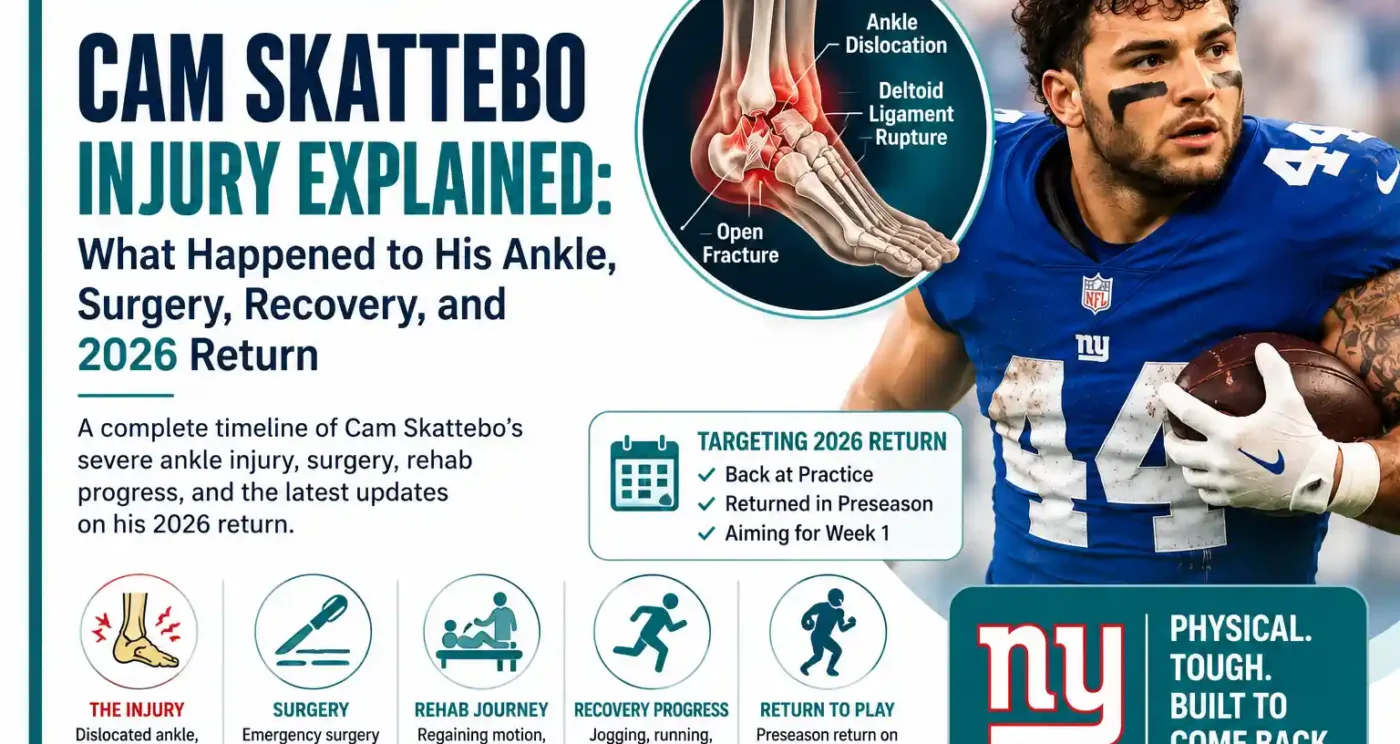
Cam Skattebo’s promising rookie season with the New York Giants ended suddenly in October 2025 after a severe right ankle injury against the Philadelphia Eagles.
The injury happened during the second quarter when Skattebo was brought down while trying to make a catch. His right leg became trapped underneath him, and his ankle twisted awkwardly. He was taken off the field on a cart and transported to a Philadelphia hospital, where he underwent surgery that night.
The Giants officially described the injury as a dislocated right ankle and later announced that the surgery had gone well. Subsequent reporting indicated that the injury also involved an open lower-leg fracture and a rupture of the ankle’s deltoid ligament, although reports differed on whether the associated fracture involved the tibia or fibula.
The injury ended Skattebo’s 2025 season, but his rehabilitation progressed steadily. By spring 2026, he was jogging, running, and jumping. By the start of training camp in late July, the Giants said he was “good to go” for full practice. Then, on August 15, he took his first game snaps since the injury, carrying the ball four times for 19 yards in the Giants’ preseason opener.
His recovery is encouraging, but a return to preseason football does not automatically mean every aspect of strength, mobility, explosiveness, and confidence has returned to its pre-injury level. Head coach John Harbaugh said after Skattebo’s preseason return that he was not yet completely back to his usual explosiveness, although he had made significant progress.
What Happened to Cam Skattebo?
Skattebo suffered the injury on October 26, 2025, during the Giants’ road game against the Philadelphia Eagles.
The injury occurred with a little more than eight minutes remaining in the second quarter. Skattebo was attempting to catch a pass over the middle when Eagles linebacker Zack Baun brought him down.
His right foot became caught underneath the play and the ankle was forced into an abnormal position.
The Giants immediately ruled Skattebo out with a dislocated ankle, and he was transported to a nearby hospital for additional evaluation.
He underwent surgery later that night at the University of Pennsylvania Hospital Presbyterian campus.
The following day, Giants coach Brian Daboll said the procedure had gone well and Skattebo was beginning his recovery.
What Injury Did Cam Skattebo Suffer?
The part that is officially confirmed by the Giants is straightforward:
Cam Skattebo suffered a dislocated right ankle.
Later media reports provided additional details.
ESPN reported that a source described an open fracture and a ruptured deltoid ligament in addition to the ankle dislocation. ESPN identified the fracture as involving the tibia, while NFL Network-based reporting carried by Reuters and NBC Sports identified a fibula fracture.
Because those reports differ on the precise bone involved, the most accurate way to describe the publicly available information is:
Skattebo had a severe right ankle dislocation accompanied by a reported open lower-leg fracture and deltoid-ligament rupture.
Unless the Giants or Skattebo’s treating physicians publicly release a more detailed medical report, it would be inappropriate to claim certainty about details that remain inconsistent across media sources.
What Is an Ankle Dislocation?
An ankle dislocation occurs when the bones forming the ankle joint are forced out of their normal alignment.
The ankle is formed mainly by:
- The tibia, or shinbone
- The fibula, the smaller bone on the outside of the lower leg
- The talus, which sits beneath the tibia and fibula
These bones are held together by strong ligaments.
A high-energy twisting injury can disrupt this alignment and damage both the bones and the ligaments that stabilize the ankle.
In severe injuries, fractures can occur at the same time as the dislocation.
That combination is considerably more serious than a routine ankle sprain.
What Does an Open Fracture Mean?
Some reports described Skattebo’s injury as involving an open fracture.
An open fracture, sometimes called a compound fracture, occurs when there is a wound that communicates with the broken bone.
The American Academy of Orthopaedic Surgeons explains that open fractures are particularly serious because breaking the skin creates an opportunity for bacteria to enter the wound and potentially infect the surrounding tissues or bone.
That helps explain why severe open injuries often require urgent surgical treatment rather than simply placing the ankle in a cast and waiting.
Open fractures may require:
- Thorough cleaning of the wound
- Antibiotics
- Stabilization of the broken bone
- Repair of damaged soft tissues
- Careful monitoring for infection
- Follow-up imaging
- Prolonged rehabilitation
The exact procedures Skattebo underwent have not been fully disclosed publicly.
Why Was Skattebo’s Injury Considered an Emergency?
A simple closed ankle injury does not always require immediate surgery.
An open injury is different.
ESPN reported that the open nature of Skattebo’s injury was the reason surgery was considered an emergency and performed the same night.
When the protective barrier of the skin has been disrupted, reducing contamination and stabilizing damaged structures becomes a priority.
AAOS notes that open fractures carry a greater infection risk than closed fractures.
That does not mean Skattebo developed an infection. It means infection would have been one of the complications his medical team needed to prevent and monitor for during early recovery.
What Is the Deltoid Ligament?
The deltoid ligament is a strong group of ligaments on the inside of the ankle.
It connects the tibia with several bones in the foot and helps keep the ankle stable, particularly against forces that push the ankle outward.
Reports indicated that Skattebo suffered a rupture of this ligament along with the ankle dislocation and fracture.
A complete ligament rupture can contribute to instability because the ligament can no longer provide its normal structural support.
For an NFL running back, ankle stability matters considerably.
Running backs repeatedly need to:
- Accelerate
- Decelerate
- Cut sharply
- Plant through one leg
- Change direction
- Absorb tackles
- Maintain balance through contact
That makes restoring stability, strength, and range of motion particularly important before returning to competition.
Why Did Cam Skattebo Need Surgery?
The Giants have not released a detailed surgical report, so it would be inappropriate to claim exactly what was repaired or what hardware was used.
What is known is that Skattebo underwent surgery within hours of the injury and that the procedure was successful according to the team.
In severe ankle injuries involving fracture and dislocation, surgery may be needed to restore alignment and stabilize injured structures.
AAOS explains that fractures requiring surgical fixation may be treated by repositioning bone fragments and stabilizing them with devices such as plates, screws, or rods.
Again, that is general orthopedic information and should not be interpreted as a description of Skattebo’s specific operation.
What Did Cam Skattebo Say After Surgery?
Skattebo publicly thanked the people who cared for him after the procedure.
The Giants reported that he said the surgery had gone well and thanked hospital physicians, surgeons, staff, family, friends, and supporters.
He was discharged from the hospital shortly afterward and began rehabilitation.
The Giants placed him on injured reserve, ending any realistic possibility of returning during the 2025 season.
Why Did the Injury End His Rookie Season?
The severity of the injury made a same-season comeback unrealistic.
A dislocation alone can damage ligaments, cartilage, tendons, and other structures around the joint.
Add a fracture and reported ligament rupture, and the rehabilitation demands become considerably greater.
Bone healing also follows its own biological timeline.
AAOS notes that fracture-healing time varies substantially according to:
- Injury severity
- Location
- Age
- Overall health
- Treatment
- Individual healing response
Some fractures heal within several weeks, while more complicated injuries can take several months or longer.
Pain disappearing is also not the same as the bone being strong enough for high-level athletic loading.
For an NFL running back, simply being able to walk or jog is far below the physical requirements for being ready to play football.
What Was Skattebo Doing Before the Injury?
Skattebo had become an important part of the Giants’ offense before his season ended.
Despite playing only eight games, he finished his rookie season with:
- 101 rushing attempts
- 410 rushing yards
- 5 rushing touchdowns
- 24 receptions
- 207 receiving yards
- 2 receiving touchdowns
Those figures gave him 617 yards from scrimmage and seven total touchdowns during his abbreviated rookie season.
He had also entered the Philadelphia game leading NFL rookies in scrimmage yards and touchdowns.
The injury therefore ended not only his season but what had been developing into a notable rookie campaign.
Cam Skattebo’s Recovery Timeline
Skattebo’s recovery can be followed through a series of public updates.
| Date | Recovery Update |
|---|---|
| Oct. 26, 2025 | Dislocated right ankle against Philadelphia and underwent surgery that night. |
| Oct. 27, 2025 | Surgery reported successful; discharged and beginning rehabilitation. |
| Jan. 2026 | Continuing ankle rehabilitation and targeting a return for training camp. |
| March 2026 | Giants GM Joe Schoen saw him jogging, running, and jumping; team planned to ease him back. |
| May 2026 | Skattebo said the mental challenge of trusting the ankle was the hardest part and expected to be ready for Week 1. |
| July 29, 2026 | Participated in team drills at the start of training camp after being declared “good to go.” |
| Aug. 15, 2026 | Returned to game action, rushing four times for 19 yards in the preseason opener. |
| Sept. 2026 | Has returned to football activity; regular-season Week 1 remains the next major benchmark. |
What Was the Main Focus Early in His Rehabilitation?
By January 2026, Skattebo had begun discussing some of the practical challenges of restoring his ankle.
ESPN reported that one of his biggest priorities was regaining dorsiflexion—the ability to bring the foot upward toward the shin. He had spent roughly eight weeks in a boot and was working on restoring movement and strength.
Dorsiflexion matters for many athletic movements, including:
- Walking
- Squatting
- Running
- Landing
- Decelerating
- Changing direction
Reduced ankle motion can also cause an athlete to compensate elsewhere.
For example, limited motion in one ankle can change loading patterns through the opposite leg, knee, hip, or lower back.
Why Does Immobilization Make Rehab Harder?
Immobilization helps protect healing tissue, but it has consequences.
When an ankle spends weeks in a cast or boot, the muscles around the joint are used less.
That can lead to:
- Muscle weakness
- Reduced ankle mobility
- Joint stiffness
- Loss of balance
- Reduced proprioception
- Reduced cardiovascular conditioning
AAOS notes that people recovering from fractures commonly lose strength and range of motion and may require targeted exercises to restore joint movement, flexibility, and muscle strength.
That is why rehabilitation continues long after the fracture itself has begun to heal.
What Is Dorsiflexion and Why Did Skattebo Mention It?
Dorsiflexion is the movement that brings the top of the foot toward the shin.
Try standing with your foot flat and moving your knee forward over your toes without allowing the heel to rise. That requires ankle dorsiflexion.
For a running back, adequate dorsiflexion helps with:
- Sprinting mechanics
- Cutting
- Squatting
- Loading the leg before acceleration
- Absorbing force
- Maintaining balance after contact
Skattebo specifically identified restoring dorsiflexion as a major rehabilitation goal in early 2026.
What Does Foot and Ankle Rehabilitation Usually Involve?
Rehabilitation after major ankle surgery is individualized.
General orthopedic rehabilitation often focuses on gradually restoring:
- Range of motion
- Strength
- Balance
- Flexibility
- Coordination
- Endurance
- Sport-specific movement
AAOS explains that structured foot and ankle conditioning after injury or surgery can help restore everyday function and assist an eventual return to sports.
For an NFL athlete, later-stage rehabilitation may additionally include increasingly demanding football movements such as acceleration, lateral cuts, contact preparation, and repeated high-force running.
Those activities should occur only as medically appropriate.
When Did Cam Skattebo Start Running Again?
By late March 2026, the Giants were already seeing encouraging signs.
General manager Joe Schoen said he had recently seen Skattebo at Arizona State’s pro day, where the running back was jogging, running, and jumping.
Schoen also said Skattebo was declaring himself ready, although the Giants intended to ease him back because the regular season was still months away.
Being able to run represented substantial progress, but it was not the final stage of rehabilitation.
NFL football demands much more than straight-line jogging.
When Did Skattebo Return to Full Practice?
By the beginning of 2026 training camp, the situation had progressed further.
On July 29, Giants general manager Joe Schoen said Skattebo was ready to participate and would be doing everything.
Skattebo then took part in team drills during the first training-camp practice.
Two days later, Skattebo said he felt good and that earlier rehabilitation-related issues were beginning to settle down.
He also explained that compensating for an injured right ankle could temporarily create discomfort elsewhere because the opposite leg was doing more work. By late July, he said his legs were beginning to feel more even and consistent.
Did Cam Skattebo Play in the 2026 Preseason?
Yes.
Skattebo returned to game action on August 15, 2026, against the Minnesota Vikings.
The Giants gave him the ball on their first offensive play.
He finished with:
- 4 carries
- 19 rushing yards
- 4.8 yards per carry
It was his first game action since the October 2025 injury.
That is one of the strongest indications yet that his rehabilitation has progressed from basic recovery into genuine football participation.
Was He Completely Back to Normal in the Preseason?
Not necessarily.
After Skattebo returned against Minnesota, Giants coach John Harbaugh said he saw signs of the player people remembered from the previous season.
However, Harbaugh also indicated that Skattebo was not yet completely back to his full twitchiness and explosiveness, while emphasizing how much progress he had made over the preceding few weeks.
That distinction is important.
A player can be medically cleared to participate while still working toward his maximum:
- Acceleration
- Explosiveness
- Conditioning
- Cutting ability
- Confidence
- Reaction speed
Returning to play is often a progression rather than a single moment.
What Has Skattebo Said About the Mental Side of Recovery?
Physical healing was not the only challenge.
During a May 2026 Giants event, Skattebo said the mental battle had been the hardest part of rehabilitation.
One of his biggest challenges was learning to fully trust the repaired ankle again.
That makes sense in high-level sports.
An athlete returning from a major traumatic injury has to perform movements similar to the ones involved when the injury occurred.
Even when a joint is structurally healed, confidence can influence whether an athlete is willing to:
- Plant aggressively
- Cut without hesitation
- Absorb contact
- Jump and land
- Run at full speed
Psychological readiness is therefore an important component of return to competition.
Is Cam Skattebo Expected to Play in Week 1 of 2026?
Skattebo has repeatedly expressed confidence that he will be ready.
In May 2026, he said he expected to be available for the Giants’ season opener against Dallas.
More importantly, he has since progressed beyond rehabilitation drills.
He participated in full training-camp work and returned to preseason game action on August 15.
As of September 2, 2026, those developments make his return outlook considerably stronger than it was earlier in the year.
However, Week 1 has not yet been played, so the most precise wording is:
Skattebo has returned to football practice and preseason game action and has been targeting Week 1, but his final regular-season status should still be confirmed through the Giants’ official injury reports closer to the game.
Can an NFL Running Back Fully Recover From This Type of Injury?
A severe ankle fracture-dislocation does not automatically end an athlete’s career.
But recovery depends on far more than simply waiting for the bone to heal.
Important factors can include:
- Bone healing
- Ligament stability
- Joint alignment
- Cartilage health
- Infection avoidance after an open injury
- Ankle range of motion
- Calf and lower-leg strength
- Balance
- Pain
- Swelling
- Conditioning
- Psychological confidence
AAOS notes that fracture recovery varies according to the extent and location of the injury and individual health factors. Even after immobilization ends, strength and range of motion may still require substantial rehabilitation.
For an NFL running back, medical clearance also does not guarantee immediate return to pre-injury performance.
Why Is Skattebo’s Position Especially Demanding on the Ankle?
Running back is one of football’s most physically demanding positions.
A running back may accelerate from a near standstill, plant one foot into the ground, change direction abruptly, absorb a tackle, and immediately repeat the sequence.
The ankle has to withstand:
- Linear acceleration
- Rotational forces
- Side-to-side loading
- Sudden stopping
- Direct contact
- Repeated impact
Skattebo is also known for a highly physical running style.
That makes restored ankle strength and stability especially important.
Will Skattebo Change His Running Style After the Injury?
Based on his public comments, he does not intend to.
In June 2026, Skattebo said the injury would not change the way he plays and indicated that he intended to return to the same physical running style for which he became known during his rookie season.
That represents his mindset, not a medical prediction.
Whether a particular running style affects future injury risk cannot be determined from one injury alone.
Football itself exposes players to unpredictable high-energy forces regardless of technique.
Does a Previous Ankle Injury Increase the Risk of Another Injury?
A major ankle injury can leave lingering issues in some patients, including stiffness, weakness, discomfort, or reduced stability.
That does not mean Skattebo will experience those problems.
Rehabilitation is intended to restore the strength, mobility, balance, and control needed for normal function and athletic activity.
AAOS notes that strengthening the muscles supporting the lower leg, foot, and ankle can help stabilize the joint, while flexibility work can help restore range of motion after injury or surgery.
Skattebo’s actual long-term risk depends on details of his injury and surgical recovery that are not publicly available.
What Does Returning to Play Actually Mean?
“Return to play” can describe several different stages.
An athlete might first:
- Walk normally.
- Begin jogging.
- Start straight-line running.
- Add strength training.
- Perform cutting and agility drills.
- Participate in individual football drills.
- Join team practice.
- Take contact.
- Play limited game snaps.
- Return to unrestricted competition.
Skattebo has already progressed into the later stages of that sequence.
His August preseason appearance means his recovery has moved beyond rehabilitation-only work and into game participation.
The remaining question is how close his football performance becomes to his pre-injury level as the regular season begins.
What Should Be Watched During Skattebo’s 2026 Return?
Several things will provide a better picture than simply asking whether he is “healthy.”
Workload
How many carries and total snaps does he receive?
The Giants may choose to manage his workload early even if he is medically cleared.
Explosiveness
Does his acceleration resemble what he showed as a rookie?
Harbaugh specifically identified explosiveness as an area still coming back during the preseason.
Cutting and Direction Changes
Straight-line running is only part of playing running back.
Lateral movement and cutting place additional demands on the ankle.
Post-Game Response
How the ankle reacts after games can be as important as how it feels during them.
Swelling, soreness, and recovery between games may affect workload decisions.
Confidence Through Contact
Skattebo’s running style relies heavily on physicality.
Watching whether he plays without visible hesitation will provide another sign of how much confidence he has regained.
What Can Skattebo’s Recovery Tell Us About Other Ankle Injuries?
Not as much as it may appear.
Professional athletes typically have access to:
- Immediate specialist care
- Advanced imaging
- Experienced orthopedic surgeons
- Daily rehabilitation
- Strength coaches
- Athletic trainers
- Nutrition support
- Frequent medical monitoring
An NFL player’s timeline therefore should not be used as a standard recovery schedule for someone else who breaks or dislocates an ankle.
Two people can have injuries that sound similar but differ significantly in:
- Fracture pattern
- Ligament damage
- Cartilage injury
- Soft-tissue damage
- Surgical procedure
- Infection risk
- Healing response
Anyone recovering from a severe ankle injury should follow an individualized plan from their orthopedic and rehabilitation team.
Frequently Asked Questions
What happened to Cam Skattebo?
Skattebo suffered a severe right ankle injury during the Giants’ October 26, 2025 game against Philadelphia. The Giants confirmed a dislocated ankle, and subsequent reports described an associated open lower-leg fracture and deltoid-ligament rupture.
Did Cam Skattebo break his ankle?
He sustained more than a simple dislocation.
Multiple reports said the injury included a fracture, although published accounts differed over whether the associated lower-leg fracture involved the tibia or fibula. The Giants publicly confirmed the ankle dislocation rather than releasing a full orthopedic diagnosis.
Did Cam Skattebo need surgery?
Yes.
He underwent surgery in Philadelphia on the same night as the injury. Giants coach Brian Daboll said afterward that the procedure went well.
Why was his ankle surgery done so quickly?
Reports described the injury as open, meaning the skin had been disrupted.
Open fractures carry an increased infection risk and often require urgent surgical management.
What ligament did Cam Skattebo tear?
Media reports said he ruptured the deltoid ligament, a major stabilizing ligament complex on the inside of the ankle.
How long was Cam Skattebo in a boot?
Skattebo said during his early rehabilitation that he had been in a boot for roughly eight weeks.
When did Cam Skattebo start running again?
By March 2026, Giants general manager Joe Schoen had seen him jogging, running, and jumping during a visit to Arizona State.
Did Cam Skattebo return to training camp?
Yes.
He participated in team drills at the start of Giants training camp in late July 2026 after the team declared him ready to participate.
Has Cam Skattebo played since the injury?
Yes.
He returned in the Giants’ August 15, 2026 preseason game against Minnesota and carried four times for 19 yards.
Is Cam Skattebo 100 percent healthy?
That is difficult to define from outside the team.
He has returned to practice and preseason competition. However, after his first preseason appearance, coach John Harbaugh said he was still working his way back to full explosiveness.
Will Cam Skattebo play Week 1 in 2026?
He has publicly targeted Week 1 and has already returned to preseason football.
As of September 2, 2026, the regular season has not started, so his final availability should still be confirmed through the Giants’ official injury reporting before the opener.
Will Skattebo change his physical running style?
He says he will not.
In June, Skattebo said he intended to return to the same physical approach he used before the injury.
Can an ankle dislocation fully heal?
Many people can regain substantial function after appropriately treated ankle injuries, but outcomes depend on the severity of the fracture, ligament and cartilage damage, surgical treatment, complications, and rehabilitation.
A professional athlete’s return timeline should not be used to predict another person’s recovery.
Conclusion
Cam Skattebo’s 2025 rookie season ended with one of the more severe injuries an NFL running back can sustain.
The Giants officially confirmed that he dislocated his right ankle against the Philadelphia Eagles on October 26. Subsequent reports described an accompanying open lower-leg fracture and deltoid-ligament rupture, although reports differed on the precise fracture location. Skattebo underwent surgery that night and began a lengthy rehabilitation process.
Early recovery focused on healing, restoring ankle movement, and rebuilding strength after weeks of immobilization.
By March, the Giants had seen him jogging, running, and jumping. By late July, he was participating in team drills. On August 15, he reached another major milestone by returning to preseason competition and rushing four times for 19 yards.
That does not necessarily mean every aspect of his pre-injury performance has returned.
After his preseason appearance, coach John Harbaugh said Skattebo was still progressing toward his full explosiveness. For a running back whose game depends heavily on acceleration, cutting, balance, and physical contact, those final stages of recovery matter.
Still, returning to an NFL game less than 10 months after such a serious injury represents significant progress.
Skattebo has said he expects to be ready for the 2026 season and does not intend to change the physical running style that helped make him one of the Giants’ most notable rookies.
The most meaningful next test will come when regular-season football begins.
Resources
New York Giants — Initial Injury and Surgery Update
The Giants’ official report covers Skattebo’s right ankle dislocation, hospitalization, surgery, and beginning of rehabilitation.
Giants: Cam Skattebo Injury and Surgery Update
New York Giants — Spring 2026 Recovery Update
Giants general manager Joe Schoen discussed Skattebo’s progress, including seeing him jogging, running, and jumping while the team prepared to ease him back into football activities.
Giants: Skattebo Spring Recovery Update
New York Giants — 2026 Training Camp Return
The Giants reported that Skattebo was cleared to participate fully at the opening of training camp and took part in team drills.
Giants: Skattebo Returns to Training Camp
New York Giants — Preseason Return
This report covers Skattebo’s first game since the ankle injury, including his four carries for 19 yards and the coaching staff’s assessment of his progress.
Giants: Skattebo Returns in Preseason Opener
American Academy of Orthopaedic Surgeons — Fractures
AAOS explains open fractures, surgical stabilization, complications, healing, and rehabilitation after broken bones.
AAOS: Fractures and Broken Bones
AAOS — Foot and Ankle Conditioning
AAOS provides general information about restoring strength, flexibility, motion, and stability after foot or ankle injury or surgery.
AAOS: Foot and Ankle Conditioning Program
MedIntelHub — Editorial Policy
For information about MedIntelHub’s standards for sourcing, medical accuracy, transparency, and educational content:
Editorial Disclaimer
This article is based on information Cam Skattebo, the New York Giants, the NFL, and established news organizations have made public. It does not have access to Skattebo’s private medical records and does not attempt to provide an independent diagnosis.
Some media reports have differed on the exact bone involved in the fracture accompanying his ankle dislocation. For that reason, the article distinguishes between the Giants’ officially confirmed diagnosis and additional details attributed to media sources.
The orthopedic information in this article is intended for general education only. A professional athlete’s injury, treatment, rehabilitation program, and return-to-play timeline should not be used to predict recovery from another person’s ankle fracture or dislocation.
Individual recovery depends on the fracture pattern, ligament and cartilage damage, surgical procedure, wound condition, infection risk, age, overall health, rehabilitation, and many other factors.
Anyone with a visibly deformed ankle, open wound over a suspected fracture, inability to bear weight after a serious injury, severe swelling, numbness, loss of circulation, or other concerning symptoms should seek prompt medical evaluation.

David Bennett
David Bennett is an author at MedIntelHub, where he creates clear, practical, and well-researched content about healthcare, medical billing, insurance, and patient education. His goal is to make complex healthcare topics easier for readers to understand and use in everyday situations. David emphasizes accuracy, transparency, and reliable sourcing, using information from trusted organizations and official healthcare resources whenever possible. Content published by David is intended for educational purposes and should not replace advice from qualified medical, legal, or healthcare professionals.