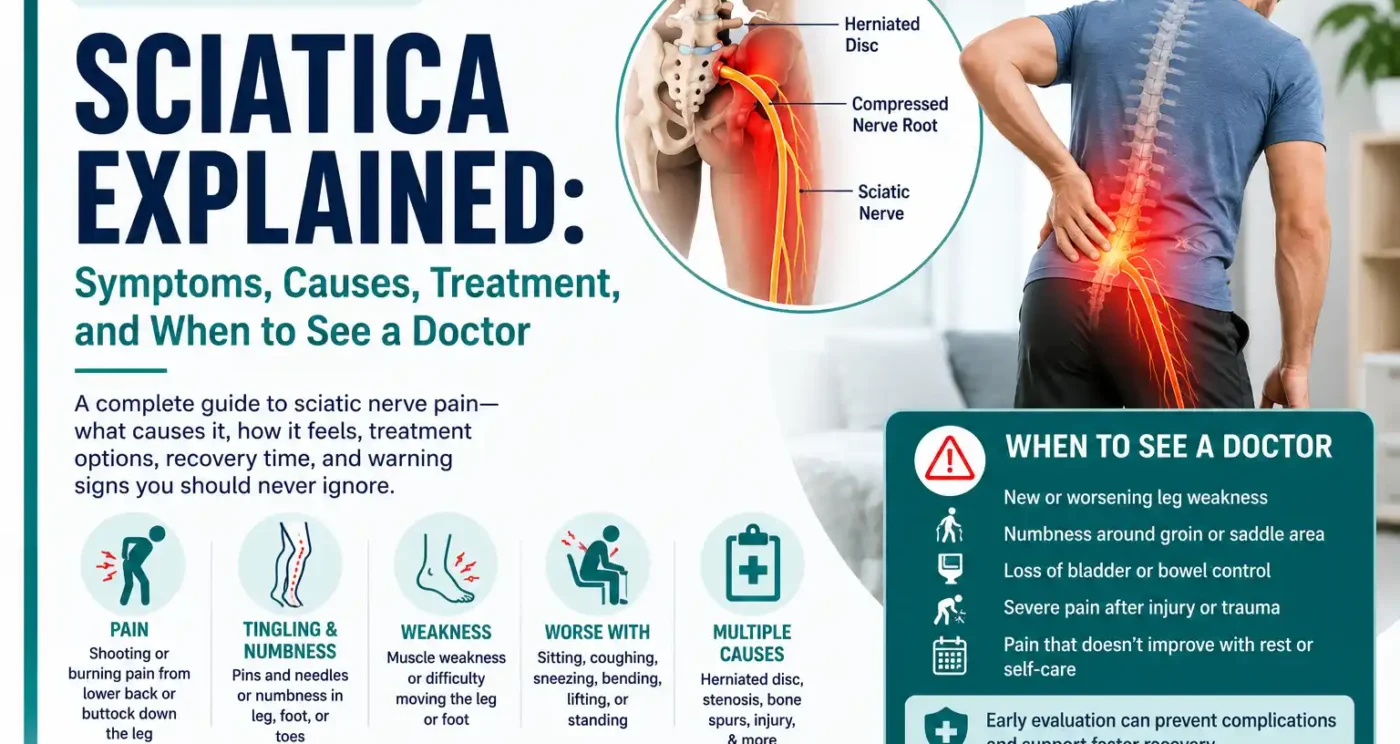
Sciatica can feel like much more than ordinary back pain.
For some people, it starts as a sharp or burning pain in the lower back or buttock and travels down one leg. Others notice tingling, numbness, an electric-shock sensation, or weakness extending into the calf, foot, or toes.
Sciatica is not a disease by itself. It describes a pattern of symptoms caused by irritation, compression, or injury involving the nerve roots that form the sciatic nerve—or, less commonly, the sciatic nerve itself. Herniated disks and narrowing around the spinal nerves are among the most common causes.
Many cases improve over time without surgery, particularly when a herniated disk is responsible. But new or worsening weakness, loss of bladder or bowel control, or numbness around the groin or saddle area can signal a much more serious nerve problem and requires immediate medical evaluation.
What Is Sciatica?
The sciatic nerve is the largest nerve in the body. It is formed from nerve roots in the lower spine and travels through the buttock before continuing down the leg.
Sciatica refers to symptoms that follow part of this nerve pathway.
These symptoms can include:
- Pain
- Burning
- Tingling
- Numbness
- Weakness
The discomfort commonly begins in the lower back or buttock and travels down the back or side of one leg. It may continue into the calf, foot, or toes.
Sciatica usually affects one side of the body, although the underlying spinal condition determines the exact pattern.
Is Sciatica a Disease?
No.
Sciatica is better understood as a symptom pattern.
Something is irritating or compressing a nerve root involved in the sciatic nerve pathway. The underlying problem might be a herniated disk, spinal stenosis, spondylolisthesis, an injury, or another condition.
That distinction matters because treatment should address not only the pain but also, when possible, the reason the nerve is being irritated.
What Does Sciatica Feel Like?
Sciatica does not feel exactly the same in every person.
The pain can be described as:
- Burning
- Shooting
- Sharp
- Aching
- Stabbing
- Electric
- Like a sudden jolt
Some people have severe pain but little numbness. Others may have less pain but significant tingling or weakness.
It is also possible for one part of the leg to hurt while another part feels numb.
The pain may become worse with certain movements or positions, including prolonged sitting, coughing, sneezing, or straining, particularly when a herniated disk is involved.
Where Does Sciatica Pain Usually Travel?
A common pattern begins in the:
Lower back → buttock → back of the thigh → calf → foot
Not everyone experiences the entire pathway.
For example, one person may mainly have buttock and thigh pain. Another may notice pain and tingling all the way into the foot or toes.
The exact area depends partly on which nerve root is affected.
MedlinePlus notes that sciatica can extend from the lower back into the calf, foot, and even the toes.
Can You Have Sciatica Without Back Pain?
Yes.
Although sciatica often begins around the lower back or buttock, leg symptoms may be much more noticeable than back pain.
Someone may primarily experience:
- Buttock pain
- Pain behind the thigh
- Calf pain
- Tingling in the foot
- Numbness
- Leg weakness
That can sometimes make the condition confusing because the underlying nerve irritation may originate in the lower spine even when the back itself does not hurt much.
What Causes Sciatica?
Several conditions can irritate or compress the nerve roots associated with the sciatic nerve.
Common or recognized causes include:
- Herniated disk
- Spinal stenosis
- Bone spurs or degenerative spinal changes
- Spondylolisthesis
- Pelvic injury or fracture
- Piriformis-related sciatic nerve irritation
- Less commonly, tumors or other masses affecting a nerve
In some cases, no single cause is clearly identified.
Herniated Disk and Sciatica
A herniated disk is one of the best-known causes of sciatica.
The bones of the spine are separated by disks that act as cushions. Each disk has a softer center surrounded by a tougher outer layer.
If part of the softer material pushes through a weakened or torn portion of the disk, it can irritate or compress a nearby spinal nerve root.
When this occurs in the lower spine, the result can be pain that radiates through the buttock and leg.
A herniated disk does not always cause symptoms, and having one on an MRI does not automatically prove it is responsible for someone’s pain. The imaging findings must be considered together with symptoms and the physical examination.
What Is Spinal Stenosis?
Spinal stenosis means that space within or around the spinal canal has narrowed.
When narrowing affects the lower spine, it can place pressure on nerve roots and produce leg pain, weakness, tingling, or numbness.
Symptoms related to lumbar spinal stenosis may become worse with standing or walking and may improve when sitting or bending forward.
Spinal stenosis is more commonly associated with age-related changes than the typical disk herniation seen in younger and middle-aged adults.
What Is Spondylolisthesis?
Spondylolisthesis occurs when one vertebra moves out of its normal position relative to another.
If that movement narrows the area available for a nerve root, sciatica-like symptoms can develop.
Spondylolisthesis is one of several structural spinal conditions recognized as a possible cause of sciatica.
The severity varies considerably. Some people have spondylolisthesis on imaging without major symptoms, while others develop back pain or nerve symptoms.
Can Piriformis Syndrome Cause Sciatica-Like Pain?
Yes.
The piriformis is a muscle deep within the buttock.
In piriformis syndrome, the sciatic nerve may become irritated around this region, producing buttock pain and symptoms that travel down the leg.
However, this is different from the more common form of sciatica caused by a spinal nerve-root problem.
Because piriformis syndrome and lumbar radiculopathy can feel similar, determining where the nerve is being irritated can require a clinical examination and, in selected cases, imaging or other testing.
Who Is More Likely to Develop Sciatica?
Several factors may make the underlying causes of sciatica more likely.
These include:
- Age-related changes in the spine
- Being overweight or having obesity
- Jobs involving repeated lifting, twisting, or heavy physical work
- Prolonged sitting
- Certain spinal conditions
- Diabetes, which increases susceptibility to nerve damage
These are risk factors rather than guarantees.
A person can develop sciatica without having any obvious risk factor.
What Are the Symptoms of Sciatica?
Typical sciatica symptoms can include:
- Pain beginning in the lower back or buttock
- Pain traveling down one leg
- Burning pain
- Shooting or electric-shock sensations
- Tingling or pins-and-needles
- Numbness
- Leg or foot weakness
Symptoms usually follow a recognizable nerve pathway rather than staying only in a small area of the back.
Can Sciatica Cause Numbness or Tingling?
Yes.
Numbness and tingling are common nerve-related symptoms.
Someone may notice:
- Pins and needles in the calf
- Numbness around the side or back of the leg
- Tingling in the foot
- Altered sensation in the toes
The painful area and numb area do not necessarily match exactly.
Persistent or worsening numbness deserves medical evaluation, particularly when it occurs with weakness.
Can Sciatica Cause Leg Weakness?
Yes.
Compression of a nerve affects more than sensation. It can also interfere with the nerve signals controlling muscles.
The affected leg may feel weak, and some people notice difficulty with movements such as standing on their toes or controlling the foot normally.
MedlinePlus notes that in some cases the foot may catch on the ground while walking because of weakness.
New, significant, or rapidly worsening muscle weakness should be evaluated promptly.
Pain alone can make someone reluctant to use a leg, but true neurological weakness can indicate more significant nerve involvement.
Can Sciatica Affect Both Legs?
Typical sciatica is usually one-sided.
Symptoms affecting both legs, particularly when combined with weakness, bladder or bowel changes, or numbness around the groin, can be more concerning.
One serious condition doctors consider in that situation is cauda equina syndrome, in which multiple nerve roots at the bottom of the spinal canal become compressed.
Bilateral symptoms do not automatically mean cauda equina syndrome, but significant new symptoms on both sides deserve medical assessment.
What Makes Sciatica Pain Worse?
The answer depends on the cause.
Pain may worsen with:
- Prolonged sitting
- Standing for long periods
- Coughing
- Sneezing
- Laughing
- Bending
- Certain lifting movements
- Straining
Sciatica caused by spinal stenosis can sometimes worsen during walking or standing, whereas disk-related symptoms may be aggravated by coughing, sneezing, or certain spinal movements.
That pattern can provide diagnostic clues, but it does not identify the cause with certainty.
Sciatica vs. Lower Back Pain
Lower back pain and sciatica can occur together, but they are not the same thing.
General Lower Back Pain
May remain primarily around the:
- Lower spine
- Muscles beside the spine
- Upper buttocks
It may feel stiff, sore, tight, or achy.
Sciatica
More characteristically travels:
- From the lower back or buttock
- Through the leg
- Sometimes into the foot or toes
It is also more likely to involve burning, shooting pain, tingling, numbness, or weakness.
Sciatica therefore has a stronger nerve-related component than ordinary muscular lower-back discomfort. NINDS classifies sciatica as an example of neuropathic pain.
Sciatica vs. Piriformis Syndrome
These terms are sometimes used interchangeably online, but they are not identical.
Lumbar sciatica commonly originates from irritation of spinal nerve roots caused by a disk or narrowing around the nerves.
Piriformis syndrome involves irritation of the sciatic nerve farther down, around the buttock.
Both may produce:
- Buttock pain
- Leg pain
- Tingling
- Numbness
A healthcare professional may use the history, physical examination, and sometimes imaging to distinguish them.
How Is Sciatica Diagnosed?
Diagnosis usually begins with a medical history and physical examination.
A clinician may ask:
- Where did the pain start?
- Where does it travel?
- When did it begin?
- What makes it better or worse?
- Is there tingling or numbness?
- Is one leg weak?
- Was there an injury?
- Are there bladder or bowel symptoms?
The examination may assess:
- Muscle strength
- Sensation
- Reflexes
- Walking
- Balance
- Leg movement
- Spinal movement
This helps determine whether the symptoms are consistent with nerve-root irritation and whether urgent testing is needed.
What Is the Straight-Leg Raise Test?
One common part of the examination involves raising the person’s straightened leg while they are lying down.
If this reproduces characteristic pain traveling down the leg, it may support the possibility of lumbar nerve-root irritation.
MedlinePlus notes that pain traveling down the leg during straight-leg raising—particularly when accompanied by numbness or tingling—can be consistent with sciatica.
No single examination maneuver proves the diagnosis by itself.
Do You Need an MRI for Sciatica?
Not everyone does.
For new low-back pain with or without radiculopathy and no warning signs, the American College of Radiology rates routine initial lumbar imaging—including MRI—as usually not appropriate.
This is because many uncomplicated cases improve without imaging, and scans frequently reveal age-related changes that may not actually be responsible for the symptoms.
MRI becomes more important when there are reasons to suspect a serious cause or when persistent symptoms may influence decisions about procedures or surgery.
When Might Imaging Be Needed?
Imaging may be considered when symptoms are:
- Severe
- Persistent
- Progressively worsening
- Associated with significant neurological weakness
- Related to significant trauma
- Accompanied by signs suggesting infection, cancer, or another serious condition
Urgent MRI may be necessary when symptoms suggest severe nerve compression, such as loss of bladder or bowel function.
MRI is particularly useful because it can show disks, nerve roots, the spinal canal, and other soft tissues.
How Is Sciatica Treated?
Treatment depends on:
- The cause
- Severity
- Duration
- Degree of nerve involvement
- Whether weakness is present
- The person’s overall health
Many cases do not require surgery.
Treatment may involve:
- Activity modification
- Staying mobile as tolerated
- Heat or cold
- Appropriate pain medication
- Physical therapy
- Exercise
- Selected spinal injections
- Surgery in more severe or persistent cases
The treatment approach should be individualized rather than based simply on how severe the pain feels on one particular day.
Can Sciatica Go Away on Its Own?
Yes.
Many cases improve with time, particularly those related to a herniated disk.
Mayo Clinic notes that sciatica caused by a herniated disk often improves over weeks to months, and MedlinePlus states that sciatica often gets better on its own.
That does not mean everyone should simply wait indefinitely.
Persistent pain, progressive numbness, weakness, or red-flag symptoms should be evaluated.
Should You Stay in Bed With Sciatica?
Usually not for prolonged periods.
It can be tempting to remain in bed when movement hurts, but extended bed rest is generally not recommended for uncomplicated sciatica.
MedlinePlus recommends gradually returning to usual activities and notes that bed rest is not generally advised.
Some short-term activity modification may be reasonable when pain is severe.
The goal is typically to avoid movements that clearly aggravate symptoms while maintaining as much safe activity as possible.
Can Ice or Heat Help Sciatica?
Some people find temporary relief from cold or heat.
MedlinePlus suggests cold during the early phase of pain and heat afterward as one possible self-care approach.
Neither ice nor heat removes a herniated disk or decompresses a nerve.
They are comfort measures.
Use temperature therapies carefully to avoid burns or skin injury, especially when numbness reduces the ability to sense temperature normally.
What Medicines Are Used for Sciatica?
Medication choices vary considerably.
Depending on someone’s medical history, a clinician may consider appropriate pain-relieving or anti-inflammatory medications.
MedlinePlus lists medicines such as acetaminophen or nonsteroidal anti-inflammatory drugs among options sometimes used for symptom relief.
However, these medicines are not appropriate for everyone.
Factors such as kidney disease, liver disease, gastrointestinal bleeding risk, pregnancy, heart conditions, anticoagulant use, allergies, and other medications can affect what is safe.
Avoid increasing doses or combining medicines without understanding the risks.
Do Sciatica Stretches Help?
Sometimes—but the correct exercise depends on what is causing the symptoms.
A movement that helps someone with one type of mechanical problem may aggravate another person’s nerve symptoms.
For that reason, online lists of “the five best sciatica stretches” can be misleading.
A rehabilitation program may include:
- Gentle mobility work
- Core strengthening
- Hip strengthening
- Flexibility work
- Posture or movement training
- Gradual return to normal activity
The goal is not simply to stretch the sciatic nerve as hard as possible.
If an exercise causes increasing pain farther down the leg, worsening numbness, or weakness, stop and seek professional guidance.
Is Walking Good for Sciatica?
For many people with uncomplicated sciatica, gentle movement is preferable to prolonged inactivity.
Walking can help maintain mobility and conditioning if it does not significantly worsen symptoms.
However, spinal stenosis is an example of a condition in which prolonged standing or walking can sometimes increase leg symptoms.
So “walk through the pain” is not a universal rule.
Activity should be adjusted according to symptoms and the underlying diagnosis.
How Does Physical Therapy Help Sciatica?
Physical therapy can be useful when symptoms persist, movement has become limited, or someone needs guidance returning to normal activity.
Treatment may focus on:
- Improving spinal and hip mobility
- Strengthening trunk muscles
- Restoring leg strength
- Correcting movement patterns
- Improving flexibility
- Gradually increasing activity tolerance
- Teaching safer lifting and positioning techniques
Physical therapy is not simply massage or stretching.
The program should be tailored to what the examination suggests is contributing to the person’s symptoms.
Do Epidural Steroid Injections Help Sciatica?
They can help some patients, particularly in the short term, but the benefits are limited and they are not appropriate for everyone.
A 2025 American Academy of Neurology systematic review found that epidural steroid injections probably reduce short-term pain and disability in people with cervical or lumbar radiculopathy. The evidence was insufficient to establish a meaningful long-term pain benefit.
This is important because injections should not be presented as a permanent cure.
They may be considered when symptoms are significant and other treatment has not provided enough relief, particularly when short-term pain reduction could help someone participate in rehabilitation.
The risks and expected benefit should be discussed with the treating clinician.
Does an Epidural Injection Fix a Herniated Disk?
No.
An epidural steroid injection does not physically put a disk back into place.
Its purpose is generally to reduce inflammation around irritated nerve tissue and potentially reduce pain for a period of time.
The 2025 AAN evidence review found the strongest evidence for short-term, rather than long-term, improvement in radicular pain.
The underlying disk problem may improve naturally over time or, in selected cases, require another treatment approach.
When Is Surgery Considered for Sciatica?
Most people do not need an operation.
Surgery may become an option when there is a clear structural problem compressing a nerve and the person has:
- Persistent disabling pain despite appropriate nonsurgical treatment
- Significant or progressive muscle weakness
- Severe neurological impairment
- Certain emergency nerve-compression syndromes
Mayo Clinic notes that severe sciatica accompanied by serious leg weakness or bowel or bladder changes can require surgery.
The type of operation depends on the cause.
For example, surgery for a disk herniation may involve removing the portion of disk pressing on a nerve, while spinal stenosis may require a decompression procedure.
Is Surgery an Emergency for Every Case of Sciatica?
No.
Most sciatica surgery, when needed, is planned after considering symptoms, imaging, neurological findings, and response to nonsurgical treatment.
One important exception is suspected cauda equina syndrome.
That condition involves serious compression of multiple nerve roots and can threaten permanent bladder, bowel, sexual, sensory, and leg function.
AANS states that cauda equina syndrome requires immediate medical attention and is usually treated with urgent surgical decompression once diagnosed.
What Is Cauda Equina Syndrome?
The cauda equina is a bundle of nerve roots at the lower end of the spinal canal.
Severe compression of these nerve roots can produce cauda equina syndrome.
Red-flag symptoms include:
- Difficulty starting urination or inability to urinate normally
- Loss of bladder control
- Loss of bowel control
- Numbness around the anus, genitals, or inner thighs
- Severe or progressive leg weakness
- Symptoms involving multiple nerve roots
- Sexual dysfunction
The characteristic loss of sensation around the groin, buttocks, and inner thighs is often called saddle anesthesia.
These symptoms should not be watched at home to see whether they improve.
Seek emergency medical care.
How Long Does Sciatica Last?
There is no universal timeline.
Some people improve noticeably within days or weeks.
Sciatica from a herniated disk often improves over several weeks to a few months, according to Mayo Clinic.
Other cases can last longer, particularly when:
- Spinal stenosis is present
- Significant nerve compression continues
- Weakness has developed
- Symptoms have become chronic
- The underlying problem does not improve
Recovery time should therefore be based on the cause rather than on a fixed number of days.
Can Sciatica Become Chronic?
Yes.
Sciatica can persist for months or recur over time.
Long-lasting nerve irritation can also be more difficult to manage than a brief acute episode.
Persistent symptoms may require reassessment to confirm that sciatica is actually the correct diagnosis and determine whether additional treatment, imaging, physical therapy, or specialist evaluation is appropriate.
Can Sciatica Come Back?
Yes.
Even after symptoms improve, another episode can occur.
MedlinePlus specifically notes that recurrence is common, and Mayo Clinic also states that sciatica can return.
Recurrence does not necessarily mean that treatment failed.
Underlying disk degeneration, spinal narrowing, lifting patterns, activity, and other factors may continue to influence the spine.
Can Sciatica Be Prevented?
Not every case is preventable.
However, habits that support spinal health may reduce some contributing risks.
Mayo Clinic recommends measures such as:
- Regular exercise
- Maintaining core strength
- Using supportive sitting posture
- Using appropriate lifting technique
- Avoiding lifting and twisting at the same time
These practices cannot guarantee that a disk will never herniate or that sciatica will never recur.
When Should You See a Doctor for Sciatica?
Consider seeing a healthcare professional if:
- Pain is severe
- Symptoms continue despite reasonable self-care
- Pain is worsening
- Numbness persists
- You develop noticeable leg or foot weakness
- Pain follows significant trauma
- Symptoms repeatedly return
- Pain is interfering substantially with walking, sleep, or daily activity
Mayo Clinic recommends medical assessment when self-care does not improve mild symptoms or when pain becomes severe or progressively worse.
You may also need specialist evaluation if neurological symptoms persist or imaging suggests a problem requiring orthopedic, neurosurgical, rehabilitation, or pain-management expertise.
If you are preparing for that type of consultation, MedIntelHub’s specialist-appointment guide offers a practical way to organize your symptom history and most important questions.
MedIntelHub: How to Prepare Questions Before a Specialist Appointment
When Is Sciatica an Emergency?
Seek immediate medical attention if sciatic-type pain occurs with:
- Loss of bladder control
- Inability to urinate normally
- Loss of bowel control
- Numbness around the genitals, anus, or saddle area
- Sudden or rapidly worsening significant leg weakness
- Severe symptoms after a major accident or traumatic injury
These symptoms can indicate serious nerve compression or spinal injury.
Do not wait for a routine appointment if they occur.
MedIntelHub’s annual-physical guide similarly explains that a routine preventive visit and evaluation of a new or concerning medical problem are not the same type of care.
Understanding Your Annual Physical: What Actually Gets Checked
Frequently Asked Questions
What are the first signs of sciatica?
Common early symptoms include pain in the lower back or buttock that travels into one leg, burning, tingling, pins-and-needles, or numbness.
The pain can be mild at first or begin suddenly.
Which side does sciatica affect?
Sciatica usually affects one side of the body.
Pain commonly travels through one buttock and one leg.
Symptoms involving both legs, particularly with bladder, bowel, or saddle-area sensory changes, deserve prompt medical attention.
Does sciatica always cause back pain?
No.
Some people mainly notice buttock or leg pain and have little noticeable back pain.
The source can still be a compressed nerve root in the lower spine.
Where does sciatica pain end?
It depends on which nerve fibers are involved.
Pain or abnormal sensation may end in the thigh, calf, foot, or toes.
Is sciatica a pinched nerve?
Often, yes in general terms.
Sciatica commonly results when one of the nerve roots contributing to the sciatic nerve becomes compressed or irritated by a herniated disk, bone spur, or narrowing around the spinal nerves.
What is the most common cause of sciatica?
A herniated disk is one of the most common causes.
Bone overgrowth and spinal stenosis can also compress nerve roots and produce similar symptoms.
Can sciatica cause numb toes?
Yes.
Sciatica can cause numbness or tingling extending into the foot or toes, depending on which nerve root is affected.
Can sciatica make your leg weak?
Yes.
Nerve compression can affect muscle control as well as sensation.
Significant new or progressively worsening weakness should be evaluated promptly.
Is walking good for sciatica?
Gentle walking may be reasonable for many people if it does not significantly worsen symptoms.
However, certain conditions such as lumbar spinal stenosis can cause leg symptoms to become worse during prolonged standing or walking.
Should you rest with sciatica?
Some temporary reduction in painful activity can help, but prolonged bed rest is generally not recommended.
Gradual movement and return to activity are usually preferred for uncomplicated sciatica.
Does sciatica need an MRI?
Not automatically.
Routine imaging is usually not recommended at the beginning of uncomplicated acute low-back pain with radicular symptoms when no red flags are present.
Imaging becomes more important when symptoms are severe, persistent, progressive, or accompanied by neurological warning signs.
How long does sciatica take to heal?
It varies.
Many disk-related cases improve over several weeks to a few months.
Some cases last longer because the underlying cause, degree of compression, and individual recovery differ.
Can sciatica go away permanently?
It can.
Many people recover fully, especially after disk-related sciatica.
However, recurrence is possible.
Do steroid injections cure sciatica?
No.
A 2025 AAN evidence review found that epidural steroid injections can provide modest short-term benefit for radicular pain and disability, but evidence for long-term pain relief is insufficient.
Does everyone with sciatica need surgery?
No.
Most cases are treated without surgery.
Surgery is generally reserved for selected patients with persistent disabling symptoms, significant neurological problems, or serious nerve compression.
What is the biggest warning sign with sciatica?
There is not only one.
Loss of bladder or bowel control, difficulty urinating, saddle-area numbness, or rapidly progressive leg weakness can suggest severe nerve compression and require immediate medical evaluation.
Conclusion
Sciatica is not simply another name for lower-back pain.
It describes pain and other neurological symptoms caused by irritation or compression involving the nerve roots that contribute to the sciatic nerve or, less commonly, the nerve itself.
The most recognizable symptom is pain traveling from the lower back or buttock down one leg. Burning, tingling, numbness, and muscle weakness can occur along the same pathway.
A herniated disk is one of the most common causes, but spinal stenosis, spondylolisthesis, injury, piriformis-related nerve irritation, and other conditions can produce similar symptoms.
Many cases improve over several weeks or months without surgery. Staying reasonably active, appropriate pain relief, physical therapy, and gradual rehabilitation may be enough for uncomplicated cases.
Imaging is not automatically necessary when symptoms first begin. In uncomplicated acute sciatica without warning signs, routine initial imaging is generally not recommended.
Persistent or severe symptoms deserve evaluation, especially when numbness or weakness develops.
And certain symptoms should never be treated as ordinary sciatica. New loss of bladder or bowel control, urinary retention, saddle-area numbness, or severe progressive leg weakness can indicate cauda equina syndrome or another serious neurological problem and require emergency medical attention.
Resources
MedlinePlus — Sciatica
MedlinePlus provides patient-focused information about sciatic nerve symptoms, common causes, diagnosis, treatment, and recovery.
MedlinePlus Medical Encyclopedia — Sciatica
This resource provides additional detail on symptoms, examination findings, treatment options, and situations in which medical evaluation is appropriate.
MedlinePlus: Sciatica Medical Encyclopedia
Mayo Clinic — Sciatica
Mayo Clinic explains sciatica symptoms, herniated disks, risk factors, expected recovery, and warning signs.
American College of Radiology — Low Back Pain Imaging
The ACR Appropriateness Criteria address when imaging such as lumbar MRI is and is not typically appropriate for low-back pain and radiculopathy.
ACR Appropriateness Criteria: Low Back Pain
American Association of Neurological Surgeons — Cauda Equina Syndrome
AANS explains the neurological warning signs associated with cauda equina syndrome and why immediate assessment is necessary.
American Academy of Neurology — Epidural Steroid Injection Evidence
The AAN’s 2025 systematic review evaluates short- and long-term evidence for epidural steroid injections in radiculopathy and spinal stenosis.
Neurology: 2025 Epidural Steroid Injection Systematic Review
MedIntelHub — Preparing for a Specialist Appointment
This guide can help patients organize symptoms, medication information, and questions before seeing a spine, orthopedic, neurological, rehabilitation, or pain specialist.
How to Prepare Questions Before a Specialist Appointment
MedIntelHub — Editorial Policy
MedIntelHub’s Editorial Policy explains its standards for sourcing, medical accuracy, transparency, updates, and educational healthcare content.
Editorial Disclaimer
This article is provided for general educational and informational purposes only. It does not diagnose sciatica, determine the cause of an individual’s back or leg pain, or recommend a specific treatment plan.
Symptoms resembling sciatica can result from several spinal, neurological, musculoskeletal, vascular, and other medical conditions. Diagnosis may require a physical examination and, in selected circumstances, imaging or additional testing.
Medication choice, exercise, physical therapy, injections, and surgery depend on the underlying cause, symptom severity, neurological findings, medical history, other medications, pregnancy status, kidney and liver function, and individual circumstances.
Seek immediate medical care for loss of bladder or bowel control, difficulty urinating, numbness around the groin or saddle area, rapidly worsening leg weakness, severe symptoms after major trauma, or other symptoms that appear serious or rapidly progressive.

David Bennett
David Bennett is an author at MedIntelHub, where he creates clear, practical, and well-researched content about healthcare, medical billing, insurance, and patient education. His goal is to make complex healthcare topics easier for readers to understand and use in everyday situations. David emphasizes accuracy, transparency, and reliable sourcing, using information from trusted organizations and official healthcare resources whenever possible. Content published by David is intended for educational purposes and should not replace advice from qualified medical, legal, or healthcare professionals.