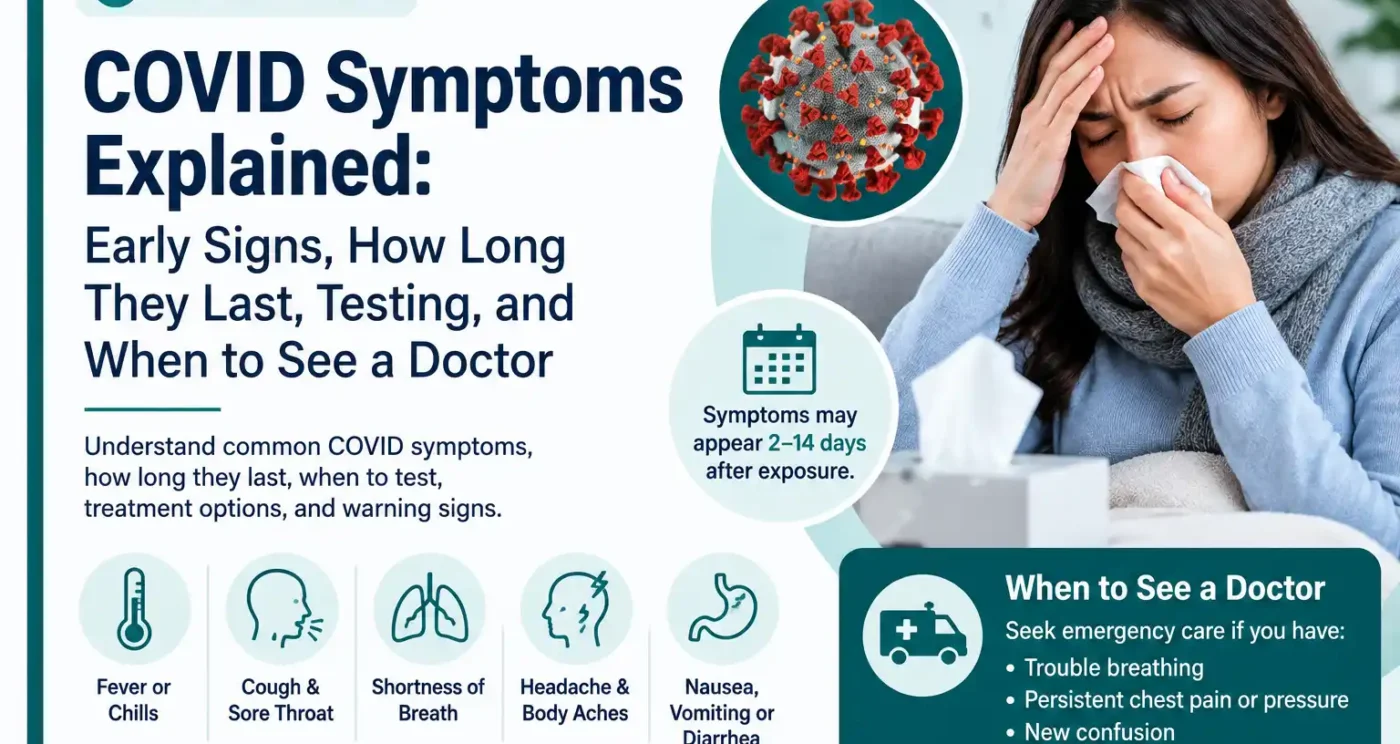
COVID-19 Symptoms does not look exactly the same in everyone.
For some people, it begins with a sore throat, congestion, fatigue, or headache. Others develop fever, cough, body aches, stomach symptoms, or shortness of breath. Some people have only mild symptoms, while others become seriously ill. An infection can also occur without noticeable symptoms at all.
COVID-19 is caused by SARS-CoV-2, a coronavirus that primarily affects the respiratory system but can also affect other parts of the body. CDC currently lists fever or chills, cough, shortness of breath, sore throat, congestion or runny nose, fatigue, muscle or body aches, headache, nausea or vomiting, diarrhea, and new loss of taste or smell among possible symptoms. The exact combination can vary with the virus variant, vaccination history, age, and individual health.
Symptoms alone cannot reliably tell you whether you have COVID-19, influenza, another respiratory virus, or a common cold. Testing can therefore be especially useful when symptoms develop, particularly for people who may qualify for early COVID-19 treatment.
What Is COVID-19?
COVID-19, short for coronavirus disease 2019, is the illness caused by infection with SARS-CoV-2.
The virus spreads mainly through respiratory droplets and smaller particles released when an infected person breathes, talks, coughs, sneezes, or sings. COVID-19 commonly causes respiratory symptoms resembling a cold, flu, or pneumonia, although it can also affect systems outside the lungs.
COVID-19 severity varies widely.
A person can have:
- No noticeable symptoms
- Mild illness
- Moderate illness
- Severe respiratory disease
- Critical illness
Most people experience asymptomatic, mild, or moderate illness that can be managed outside the hospital, but some people are at greater risk of hospitalization and other serious complications.
What Are the Symptoms of COVID-19?
Current CDC guidance lists the following as possible COVID symptoms:
- Fever or chills
- Cough
- Shortness of breath or difficulty breathing
- Sore throat
- Stuffy or runny nose
- Fatigue
- Muscle or body aches
- Headache
- New loss of taste or smell
- Nausea
- Vomiting
- Diarrhea
This is not a complete list. COVID symptoms can change as SARS-CoV-2 evolves, and different people may experience very different combinations of symptoms.
Having one of these symptoms does not confirm COVID-19.
Likewise, not having fever, cough, or loss of smell does not rule it out.
What Are the Early Signs of COVID?
There is no single symptom that always appears first.
COVID may begin gradually with relatively mild symptoms. Early symptoms can include:
- Sore throat
- Runny or stuffy nose
- Headache
- Fatigue
- Cough
- Fever or chills
- Body aches
Some people initially feel as if they are developing a common cold.
Others may first notice gastrointestinal symptoms such as nausea or diarrhea.
CDC specifically notes that COVID symptoms may start mild before progressing in some people.
Because the early symptoms overlap heavily with flu, colds, RSV, and other infections, the way the illness starts usually cannot identify the virus by itself.
Can COVID Start With a Sore Throat?
Yes.
A sore throat remains on CDC’s current list of possible COVID-19 symptoms.
A sore throat may occur with:
- Congestion
- Runny nose
- Cough
- Headache
- Fever
- Fatigue
However, a sore throat is also extremely common with other respiratory infections.
Strep throat, influenza, the common cold, allergies, and several other conditions can cause throat discomfort, so a sore throat by itself cannot tell you whether you have COVID.
Can COVID Start With a Runny or Stuffy Nose?
Yes.
Nasal congestion and a runny nose are recognized COVID symptoms and can occur early in an infection.
They are also common with ordinary colds and other respiratory viruses.
If cold-like symptoms develop and you are at higher risk of severe COVID or influenza, CDC recommends contacting a healthcare professional promptly because antiviral treatment for both illnesses works best when started early.
Is Loss of Taste or Smell Still a COVID Symptom?
Yes.
A new loss of taste or smell remains on CDC’s list of possible COVID-19 symptoms.
It is not necessary to have this symptom to have COVID, however.
Many people with COVID never lose their sense of smell or taste. Other illnesses affecting the nose and sinuses can also temporarily change smell or taste.
Persistent problems with smell or taste can also occur after the acute infection and are among symptoms reported with Long COVID.
Can COVID Cause Stomach Symptoms?
Yes.
COVID is primarily known as a respiratory illness, but gastrointestinal symptoms can occur.
These include:
- Nausea
- Vomiting
- Diarrhea
- Abdominal discomfort in some people
CDC currently lists nausea, vomiting, and diarrhea as possible symptoms of COVID-19.
Some people can experience gastrointestinal symptoms alongside respiratory symptoms, while others may notice stomach symptoms earlier in the illness.
Because many other infections and digestive conditions can cause similar problems, gastrointestinal symptoms by themselves do not establish a COVID diagnosis.
Can You Have COVID Without a Fever?
Yes.
Fever is a recognized COVID symptom, but not everyone with COVID develops a fever.
A person may instead experience symptoms such as:
- Sore throat
- Cough
- Congestion
- Fatigue
- Headache
- Body aches
Some people have very mild illness, while others have no noticeable symptoms at all.
For this reason, using the absence of fever to rule out COVID can be misleading.
Can You Have COVID Without Symptoms?
Yes.
SARS-CoV-2 infection can be asymptomatic, meaning a person tests positive but does not develop noticeable symptoms.
CDC’s clinical guidance describes COVID-19 as ranging from asymptomatic infection through critical illness.
A person who tests positive without symptoms may still be able to spread the virus.
Current CDC respiratory-virus guidance recommends taking added precautions for the next five days after an asymptomatic positive test, such as improving indoor air, practicing good hygiene, masking, distancing, or testing when around other people indoors—particularly people at higher risk of severe disease.
How Soon Do COVID Symptoms Start After Exposure?
Symptoms may appear 2 to 14 days after exposure to SARS-CoV-2, according to CDC.
The exact timing varies.
This means someone can feel completely well immediately after exposure but develop symptoms several days later.
It also explains why testing too soon after an exposure can sometimes produce a negative result even when an infection is developing.
COVID Symptoms vs. Flu Symptoms
COVID-19 and influenza are different infections.
COVID is caused by SARS-CoV-2, while flu is caused by influenza viruses.
Unfortunately, their symptoms overlap considerably.
| Symptom | COVID-19 | Flu |
|---|---|---|
| Fever/chills | Possible | Common |
| Cough | Possible | Common |
| Sore throat | Possible | Possible |
| Runny/stuffy nose | Possible | Possible |
| Fatigue | Possible | Common |
| Body aches | Possible | Common |
| Headache | Possible | Common |
| Shortness of breath | Possible | Can occur |
| Nausea/vomiting | Possible | Can occur |
| Diarrhea | Possible | Can occur |
| Loss of taste/smell | Possible | Less typical |
The overlap is substantial enough that you cannot reliably distinguish flu from COVID by symptoms alone. CDC notes that some nucleic acid amplification tests can test for influenza and SARS-CoV-2 at the same time.
Testing can be especially important for people at higher risk because both COVID and flu have antiviral treatments that work best when started early.
COVID Symptoms vs. the Common Cold
A cold and COVID can also look remarkably similar.
Both may cause:
- Sore throat
- Runny nose
- Nasal congestion
- Cough
- Headache
- Feeling generally unwell
COVID can additionally cause fever, body aches, significant fatigue, gastrointestinal symptoms, difficulty breathing, and changes in taste or smell, although none of these features is exclusive to COVID.
Rather than trying to identify an infection from symptoms alone, testing may provide a clearer answer.
How Long Do COVID Symptoms Last?
There is no single timeline that applies to everyone.
Some people have mild symptoms for only several days. Others need several weeks to fully recover.
The National Center for Complementary and Integrative Health notes that many people recover from the initial acute COVID illness within approximately four weeks, while some continue recovering for four to twelve weeks or longer.
Symptoms also do not necessarily disappear at the same time.
For example:
- Fever may resolve before fatigue.
- Nasal symptoms may improve while cough continues.
- Taste or smell changes may linger.
- Energy levels may take longer to return to normal.
A person’s recovery can be influenced by age, illness severity, underlying conditions, immune function, and other factors.
Persistent symptoms do not automatically mean someone is still contagious.
What If COVID Symptoms Go Away and Then Come Back?
Symptoms can occasionally improve and then return.
CDC describes COVID-19 rebound as the return of symptoms or a new positive test approximately 3 to 7 days after initial recovery or after testing negative.
Rebound can occur whether or not someone received antiviral medication. CDC says rebound symptoms are usually mild and tend to resolve within a few days.
People experiencing rebound should follow current precautions to reduce the chance of spreading the virus and contact a healthcare professional if symptoms are severe, worsening, or otherwise concerning.
When Should You Take a COVID Test?
Testing is particularly useful when COVID symptoms develop.
CDC recommends testing immediately when you have symptoms.
Testing can:
- Help determine whether COVID may be causing your symptoms
- Guide decisions about protecting other people
- Help people at higher risk access treatment quickly
- Help distinguish COVID from other illnesses when combined testing is available
People who may qualify for antiviral treatment should not delay contacting a healthcare professional while waiting several days to see how sick they become.
What Types of COVID Tests Are Available?
The two main types of viral testing are:
Antigen Tests
These include most at-home rapid COVID tests.
They detect viral proteins and usually return results within approximately 15 to 30 minutes.
They are convenient, but they are generally less sensitive than molecular tests—especially early in infection.
NAAT or Molecular Tests
Nucleic acid amplification tests, or NAATs, detect genetic material from SARS-CoV-2.
PCR is the best-known example.
These tests are generally more sensitive than antigen tests, and one NAAT can sometimes be used instead of repeated antigen testing when confirmation is needed.
What Does a Negative At-Home COVID Test Mean?
A negative rapid antigen test does not necessarily mean you do not have COVID.
Antigen tests can miss infections, particularly when testing takes place early and there is not yet enough virus in the sample to produce a positive result.
FDA currently recommends repeat testing after a negative antigen result.
If You Have COVID Symptoms
Take another antigen test 48 hours after the first negative test, for a total of at least two tests.
If You Do Not Have Symptoms
FDA recommends at least three antigen tests, each 48 hours apart, to increase confidence that infection was not missed.
A molecular test such as PCR can also be considered instead of serial antigen testing.
If repeated tests remain negative but symptoms continue, another illness such as influenza, RSV, strep throat, or another respiratory infection may need to be considered.
When Should You Test After Being Exposed to COVID?
If you were exposed to someone with COVID but have no symptoms, CDC advises waiting at least five full days after the exposure before testing with an at-home test.
Testing too early can miss an infection.
If the first antigen test is negative, repeat testing should follow the serial-testing recommendations because an infection may not yet be detectable.
If symptoms develop before day five, test when symptoms begin.
What Does a Positive COVID Test Mean?
A positive viral test in a person with compatible symptoms generally indicates COVID-19.
FDA advises treating a positive at-home antigen result as evidence that you likely have COVID.
The next steps depend on:
- Your symptoms
- Whether you have risk factors for severe disease
- Your age
- Your medical conditions
- Whether you might qualify for antiviral treatment
People at higher risk should contact a healthcare professional quickly, even when symptoms initially appear mild.
What Should You Do If You Have COVID Symptoms?
If you have respiratory symptoms that are not better explained by another cause, current CDC guidance recommends staying home and away from others while you are sick.
You can generally resume normal activities when, for at least 24 hours:
- Your symptoms are improving overall, and
- You have had no fever without taking fever-reducing medicine.
After returning to normal activities, CDC recommends additional precautions for the next five days, such as improved ventilation, good hand hygiene, wearing a well-fitting mask, distancing, or testing around others.
These precautions are especially important around people who are more vulnerable to severe respiratory illness.
If a fever returns or symptoms worsen after you resume normal activities, stay home again until you once more meet the improvement and fever-free criteria.
How Is Mild COVID Treated at Home?
Most people with mild COVID can recover at home.
Supportive care can include:
- Rest
- Adequate fluids
- Appropriate medication for fever or discomfort
- Monitoring for worsening symptoms
CDC notes that over-the-counter medicines such as acetaminophen or ibuprofen may be used for symptom relief when medically appropriate.
Medication choice depends on factors such as age, pregnancy, allergies, kidney or liver disease, other medications, and individual health conditions.
Antibiotics do not treat COVID because COVID-19 is caused by a virus rather than bacteria.
Who Is at Higher Risk for Severe COVID?
Anyone can develop serious COVID-19, but some people are more vulnerable.
Important risk factors include:
- Older age
- Certain chronic medical conditions
- A weakened immune system
- Multiple underlying medical conditions
- Being unvaccinated or not up to date with current COVID vaccination recommendations
Age remains one of the strongest predictors of severe COVID outcomes, and risk generally increases as people get older.
People with weakened immune systems can also be at increased risk of hospitalization, intensive-care admission, mechanical ventilation, or death.
Anyone unsure whether they are considered high risk should discuss their individual circumstances with a healthcare professional.
Antiviral treatment is mainly considered for people with mild or moderate COVID who are at increased risk of progressing to severe illness.
Timing is important.
CDC’s February 2026 outpatient treatment guidance says treatment needs to begin as soon as possible and within 5 to 7 days after symptoms start, depending on the medication.
Current outpatient options include:
| Treatment | When It Generally Must Begin |
|---|---|
| Nirmatrelvir/ritonavir (Paxlovid) | Within 5 days of symptom onset |
| Remdesivir (Veklury) | Within 7 days |
| Molnupiravir (Lagevrio) | Within 5 days for eligible adults when preferred options are not appropriate or available |
Treatment selection requires medical review because eligibility, age requirements, kidney or liver function, pregnancy, and drug interactions can affect which option is appropriate.
Why Does Early COVID Treatment Matter?
Antiviral medications work by interfering with the virus’s ability to multiply.
Their benefit is greatest when treatment starts early in the illness.
CDC specifically advises people who are more likely to become very sick to seek testing or treatment quickly—even when symptoms seem mild—because the treatment window is short.
Someone at higher risk should therefore not wait until day six or seven simply to see whether the illness becomes severe.
When Should You See a Doctor for COVID Symptoms?
Consider contacting a healthcare professional promptly if:
- You are older or have risk factors for severe COVID
- You have a weakened immune system
- Symptoms are worsening rather than improving
- You are having difficulty staying hydrated
- Fever persists
- A chronic medical condition becomes worse
- Symptoms improve and then become significantly worse
- You are unsure whether you qualify for antiviral medication
- Symptoms continue well beyond the expected acute illness
People at higher risk should seek advice early because COVID treatments must usually begin within several days of symptom onset.
A new respiratory illness also does not need to wait until your next routine checkup. MedIntelHub’s guide to annual physicals explains that a preventive visit and an appointment for a new or worsening medical problem serve different purposes.
Understanding Your Annual Physical: What Actually Gets Checked
When Is COVID an Emergency?
Most COVID infections do not require emergency treatment.
However, CDC identifies several warning signs that require immediate medical attention:
- Trouble breathing
- Persistent chest pain or pressure
- New confusion
- Inability to wake or stay awake
- Pale, gray, or blue-colored lips, nail beds, or skin, depending on skin tone
This is not an exhaustive list.
Call emergency services for severe breathing difficulty, loss of consciousness, or any symptom that appears life-threatening.
What Is Long COVID?
Most people improve after the acute infection, but some experience symptoms that persist or develop later.
Long COVID is an infection-associated chronic condition that occurs after SARS-CoV-2 infection and is present for at least three months. Symptoms can be continuous, come and go, or change over time.
Anyone who has had COVID can potentially develop Long COVID, including people whose original infection was mild and children.
What Are the Symptoms of Long COVID?
More than 200 symptoms have been associated with Long COVID.
Commonly reported problems include:
- Persistent fatigue
- Symptoms that worsen after physical or mental activity
- Difficulty thinking or concentrating, sometimes called “brain fog”
- Shortness of breath
- Persistent cough
- Chest pain
- Fast or pounding heartbeat
- Headaches
- Sleep problems
- Dizziness
- Muscle or joint pain
- Changes in smell or taste
- Gastrointestinal symptoms
Long COVID does not affect everyone in the same way.
Some people improve substantially after several months, while others experience symptoms for much longer. CDC notes that symptoms can sometimes persist for months or years and may interfere significantly with everyday activities.
Is There a Test for Long COVID?
There is currently no single laboratory test that can prove symptoms are caused by Long COVID.
A positive COVID test from the original illness is also not always required for a Long COVID diagnosis.
Healthcare professionals may consider:
- Previous symptoms
- Known or suspected COVID exposure
- Previous testing
- Current symptoms
- Medical history
- Physical examination
- Tests used to exclude other explanations
People with persistent or unexplained symptoms after COVID should discuss them with a healthcare professional rather than assuming they are automatically Long COVID.
Can COVID Symptoms Be Prevented?
It is not possible to eliminate all risk of infection, but measures that reduce respiratory-virus transmission can also reduce the likelihood of COVID.
Depending on individual circumstances and current public-health recommendations, prevention can include:
- Staying current with applicable COVID vaccination recommendations
- Improving indoor ventilation and air quality
- Practicing good hand hygiene
- Staying home when sick
- Using a well-fitting mask when additional protection is appropriate
- Testing when symptoms or exposure make COVID possible
- Taking extra precautions around people at high risk of severe illness
Current vaccine schedules and recommendations can change, so people should use up-to-date CDC guidance or discuss vaccination with their healthcare professional rather than relying on an old dose schedule.
Frequently Asked Questions
What are the first symptoms of COVID?
There is no universal first symptom.
COVID can begin with sore throat, congestion, runny nose, headache, cough, fatigue, fever, chills, or body aches. Some people develop gastrointestinal symptoms.
How soon after exposure do COVID symptoms appear?
CDC says symptoms may appear 2 to 14 days after exposure.
Can you have COVID without a fever?
Yes.
Fever is common but not required. Some people have COVID with congestion, sore throat, cough, headache, or fatigue and never develop a noticeable fever.
Can COVID cause a sore throat?
Yes.
Sore throat remains one of CDC’s recognized COVID symptoms.
Can COVID cause diarrhea?
Yes.
Diarrhea, nausea, and vomiting are among possible COVID symptoms.
Is loss of smell still a COVID symptom?
Yes.
CDC still lists new loss of taste or smell as a possible symptom, although it does not occur in everyone.
How long do COVID symptoms last?
There is no fixed duration.
Many people recover from acute illness within several weeks, and NCCIH notes that many recover within approximately four weeks. Others take longer. Long COVID involves symptoms or conditions that remain or occur at least three months after infection.
When should I take a COVID test after symptoms start?
Test when symptoms begin.
If an at-home antigen test is negative, repeat it 48 hours later because one negative rapid test cannot reliably rule out infection.
Can I have COVID even if my rapid test is negative?
Yes.
Antigen tests can miss early infection. FDA recommends repeat testing after 48 hours when the first antigen result is negative.
Is PCR more accurate than a home test?
Generally, yes.
NAATs such as PCR tests are more sensitive than rapid antigen tests.
How can I tell COVID from the flu?
Symptoms alone usually cannot reliably distinguish them.
Both can cause fever, cough, sore throat, fatigue, headache, and body aches. Testing may be necessary, and some molecular tests can detect both viruses.
Do antibiotics treat COVID?
No.
COVID is caused by a virus, so antibiotics do not treat SARS-CoV-2 infection. Antibiotics are used only when there is a separate bacterial infection that requires them.
Does everyone with COVID need Paxlovid?
No.
COVID antivirals are primarily used for people with mild or moderate disease who are at increased risk of severe illness. Eligibility and medication selection require consideration of age, medical conditions, medications, kidney or liver function, and other factors.
When should COVID treatment start?
People who are eligible need to start treatment quickly. Depending on the medication, CDC says treatment generally must begin within 5 to 7 days of symptom onset.
How long should you stay home with COVID?
Current CDC respiratory-virus guidance is based on symptoms rather than a fixed number of isolation days.
Stay home while sick. You can generally return to normal activities once your symptoms have been improving overall and you have been fever-free without fever-reducing medicine for at least 24 hours. Then use extra precautions for the next five days.
What symptoms mean COVID may be an emergency?
Emergency warning signs include trouble breathing, persistent chest pain or pressure, new confusion, inability to wake or stay awake, or pale, gray, or blue discoloration of the skin, lips, or nail beds depending on skin tone.
Conclusion
COVID symptoms can range from barely noticeable to severe.
A person may develop sore throat, congestion, cough, fever, fatigue, headache, body aches, breathing difficulty, gastrointestinal symptoms, or changes in taste or smell. Another person may have only one or two symptoms—or none at all.
That variability makes it difficult to identify COVID from symptoms alone.
A cold, influenza, COVID-19, and other respiratory infections can look very similar. Testing is therefore particularly useful when symptoms develop or when knowing the cause could influence treatment or decisions about protecting other people.
If an at-home antigen test is negative while symptoms continue, do not automatically rule out COVID. FDA recommends repeating a negative antigen test after 48 hours.
Most people with mild COVID can recover with supportive care at home. However, people at higher risk for severe disease should contact a healthcare professional promptly because antiviral treatment must generally begin within 5 to 7 days after symptoms start.
Seek emergency medical care for severe breathing difficulty, persistent chest pain or pressure, new confusion, inability to stay awake, or other life-threatening symptoms.
And if symptoms continue or new health problems emerge months after the initial infection, talk with a healthcare professional about possible Long COVID. The condition can affect many different parts of the body and may require individualized evaluation and symptom management.
Resources
Centers for Disease Control and Prevention — COVID-19 Symptoms
CDC’s primary patient resource covers current symptoms, the possible 2-to-14-day symptom window, emergency warning signs, and overlap with influenza.
CDC — COVID-19 Testing
This resource explains antigen testing, NAAT/PCR testing, and why a single negative rapid test may not rule out infection.
FDA — Understanding At-Home COVID Test Results
FDA provides detailed guidance on interpreting positive and negative at-home antigen tests and when repeat testing is needed.
FDA: Understanding At-Home COVID-19 Test Results
CDC — COVID-19 Treatment
CDC explains available outpatient antiviral options, eligibility considerations, and the importance of starting treatment within the appropriate time window.
CDC — Preventing Spread When You Are Sick
This page contains current respiratory-virus guidance on staying home, returning to normal activities, and using added precautions afterward.
CDC: Preventing the Spread of Respiratory Viruses When Sick
CDC — Long COVID
CDC provides current information about Long COVID, including its definition, symptoms, diagnosis, and longer-term effects.
MedIntelHub — Understanding Your Annual Physical
This guide explains why routine preventive appointments and visits for new or worsening symptoms may serve different purposes.
Understanding Your Annual Physical: What Actually Gets Checked
MedIntelHub — Editorial Policy
For information about MedIntelHub’s standards for sourcing, medical accuracy, transparency, updates, and educational content:
Editorial Disclaimer
This article is provided for general educational and informational purposes only. It is not intended to diagnose COVID-19, determine whether an individual needs antiviral treatment, or replace evaluation by a qualified healthcare professional.
COVID symptoms overlap with influenza, RSV, the common cold, bacterial infections, and other medical conditions. Testing and clinical evaluation may be needed to determine what is causing an illness.
COVID treatment depends on factors including age, symptom onset, risk of severe disease, kidney and liver function, pregnancy, immune status, medications, allergies, and other medical conditions. Prescription antiviral medicines should be used only under appropriate medical guidance.
Seek emergency medical assistance for trouble breathing, persistent chest pain or pressure, new confusion, inability to wake or remain awake, severe deterioration, or other symptoms that appear life-threatening.

David Bennett
David Bennett is an author at MedIntelHub, where he creates clear, practical, and well-researched content about healthcare, medical billing, insurance, and patient education. His goal is to make complex healthcare topics easier for readers to understand and use in everyday situations. David emphasizes accuracy, transparency, and reliable sourcing, using information from trusted organizations and official healthcare resources whenever possible. Content published by David is intended for educational purposes and should not replace advice from qualified medical, legal, or healthcare professionals.