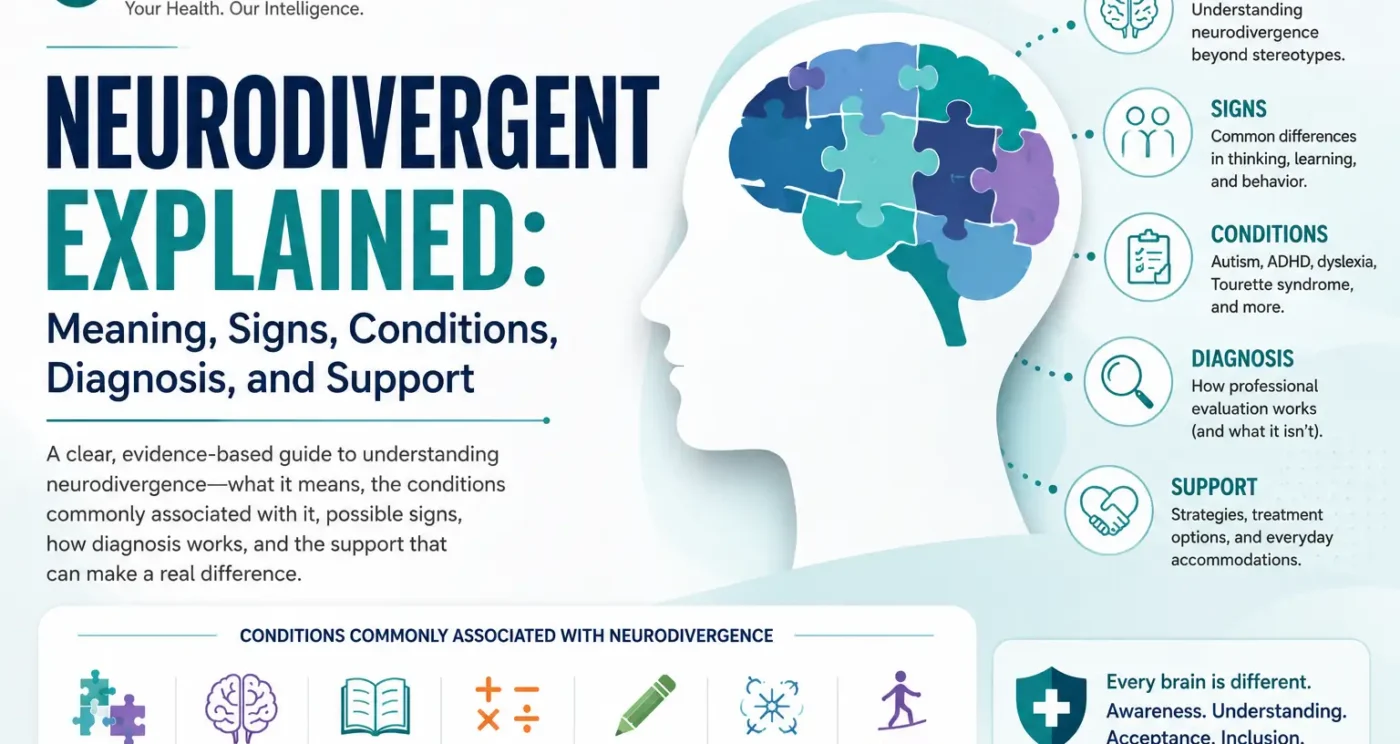
The word neurodivergent appears increasingly in conversations about autism, ADHD, learning differences, sensory needs, school, work, and mental health.
But being neurodivergent is not itself a medical diagnosis.
It is a broad, nonmedical term used to describe people whose brains develop, process information, communicate, learn, pay attention, or respond to the environment in ways that differ from what is considered typical. A neurodivergent person may have a formally diagnosed condition, such as autism or ADHD, but the term itself does not have a diagnostic test or universally accepted medical criteria.
The term is often connected with autism, attention-deficit/hyperactivity disorder (ADHD), dyslexia and other learning differences, developmental coordination differences, and Tourette syndrome, although there is no single medical list defining every condition that qualifies as neurodivergence. People with the same diagnosis may also differ in whether they personally use the word neurodivergent.
Understanding that distinction is important. Difficulty concentrating, sensory sensitivity, social differences, repetitive behaviors, problems with reading, or executive-function challenges may deserve evaluation—but they do not by themselves establish that someone has autism, ADHD, dyslexia, or another condition.
What Does Neurodivergent Mean?
Neurodivergent generally describes a person whose brain works or develops differently from the pattern considered neurologically typical.
Cleveland Clinic describes neurodivergent as a nonmedical term rather than a disease or diagnosis. The differences may affect learning, attention, communication, sensory processing, movement, behavior, or other aspects of daily life.
These differences can involve both challenges and strengths.
For example, one person may struggle with organization while being particularly skilled at recognizing patterns. Another may have strong knowledge in particular subjects but find noisy environments overwhelming.
However, it is important not to stereotype.
Not every neurodivergent person:
- Has exceptional memory
- Is unusually creative
- Has a special talent
- Struggles socially
- Dislikes eye contact
- Has sensory sensitivities
- Needs the same accommodations
Neurodivergent people differ from one another just as neurotypical people do.
What Is Neurodiversity?
Neurodiversity and neurodivergent are related terms, but they do not mean exactly the same thing.
Neurodiversity
Neurodiversity refers broadly to the fact that human brains vary in how they develop and function.
A group containing people with different neurological profiles can therefore be described as neurodiverse.
Neurodivergent
Neurodivergent usually describes an individual whose neurological development or functioning differs from dominant expectations.
Neurotypical
Neurotypical is commonly used for a person whose neurological functioning falls closer to what society considers typical.
None of these words is a formal medical diagnosis.
Cleveland Clinic traces the concept of neurodiversity to sociologist Judy Singer’s work in the late 1990s and describes it as an alternative to framing all neurological differences simply as “normal” versus “abnormal.”
Is Being Neurodivergent a Medical Diagnosis?
No.
There is no diagnosis called “neurodivergence” in the way there are clinical diagnoses such as:
- Autism spectrum disorder
- ADHD
- Tourette syndrome
- Specific learning disorders
There is also no blood test, brain scan, questionnaire, or online quiz that can medically determine whether someone is simply “neurodivergent.”
Instead, healthcare professionals evaluate the specific condition that may explain someone’s experiences.
For example, autism evaluation follows criteria related to development, social communication, behavior, interests, and other features. ADHD has its own diagnostic criteria involving persistent patterns of inattention and/or hyperactivity and impulsivity that impair functioning.
What Conditions Are Commonly Considered Neurodivergent?
There is no universally accepted medical list.
However, the term is commonly used in connection with several neurological, neurodevelopmental, and learning differences.
These commonly include:
- Autism
- ADHD
- Dyslexia
- Dyscalculia
- Dysgraphia
- Developmental coordination disorder, sometimes discussed using the term dyspraxia
- Tourette syndrome and other tic disorders
- Some intellectual and developmental disabilities
Some broader definitions also include additional neurological or psychiatric conditions, while other people use the term more narrowly.
That variation is one reason it is better to identify the specific diagnosis or difficulty when discussing medical care rather than treating neurodivergence as one condition.
Autism and Neurodivergence
Autism is one of the conditions most strongly associated with the neurodiversity movement.
Autism spectrum disorder (ASD) is a neurological and developmental disorder that affects how people interact, communicate, learn, and behave. NIMH notes that autism is considered developmental because signs generally appear early in life, although some people are not diagnosed until adolescence or adulthood.
Autistic people can differ substantially from one another.
Possible characteristics can include differences involving:
- Social communication
- Social interaction
- Repetitive movements or behaviors
- Strong or highly focused interests
- Preference for routine or predictability
- Sensory responses
- Learning
- Movement
- Attention
CDC emphasizes that some people without autism can also display individual autistic-like characteristics. A diagnosis depends on the overall developmental pattern and its effect on functioning—not on one behavior such as avoiding eye contact or preferring routines.
ADHD and Neurodivergence
ADHD is another condition commonly described within neurodivergent communities.
Attention-deficit/hyperactivity disorder is a developmental disorder involving persistent patterns of:
- Inattention
- Hyperactivity
- Impulsivity
A person may predominantly experience inattentive symptoms, hyperactive-impulsive symptoms, or a combination.
ADHD may affect:
- Organization
- Time management
- Attention
- Working memory
- Task completion
- Impulse control
- Emotional regulation
- School or work performance
- Relationships
Occasionally forgetting an appointment or having difficulty concentrating does not mean someone has ADHD.
For a clinical diagnosis, symptoms must meet specific criteria, begin during childhood, occur across more than one setting, persist over time, and interfere with functioning.
Dyslexia and Other Learning Differences
Learning differences are also commonly included under the neurodivergent umbrella.
Dyslexia primarily affects reading and language processing.
It is not a sign of low intelligence.
MedlinePlus explains that developmental reading disorder involves differences in the way the brain processes written language and can cause difficulty connecting language sounds with written letters and words.
Other learning disorders may affect:
- Writing
- Spelling
- Mathematics
- Reading comprehension
- Language processing
- Academic performance
MedlinePlus notes that learning disabilities affect how the brain takes in and uses information and that a person can have more than one learning disorder. ADHD can also occur alongside learning disabilities.
What Is Dyscalculia?
Dyscalculia refers to significant difficulty developing and using mathematical skills.
Someone may have persistent difficulty with:
- Number concepts
- Arithmetic
- Remembering math facts
- Estimating quantities
- Mathematical reasoning
A person who simply dislikes mathematics or struggles with one class does not automatically have dyscalculia.
Formal assessment considers the person’s academic performance, developmental history, education, and whether another condition better explains the difficulty.
What Is Dysgraphia?
Dysgraphia is a term used for significant difficulties involving written expression.
Possible problems may involve:
- Handwriting
- Spelling
- Grammar
- Punctuation
- Organizing written ideas
MedlinePlus describes dysgraphia as a learning disorder affecting writing skills and notes that other causes of learning problems should be considered before confirming the diagnosis.
Tourette Syndrome and Neurodivergence
Tourette syndrome is a neurological condition characterized by motor and vocal tics.
Tics are repeated movements or sounds that a person does not simply choose to make.
Examples can include:
- Blinking
- Facial movements
- Shoulder movements
- Head movements
- Throat clearing
- Grunting
- Other vocal sounds
CDC notes that Tourette syndrome typically begins in childhood and that tics can change in type and frequency over time.
One common misconception is that everyone with Tourette syndrome involuntarily shouts offensive words.
They do not.
CDC specifically notes that coprolalia—socially inappropriate or obscene vocalizations—is not required for Tourette syndrome and occurs in only a minority of people with the condition.
Can Someone Have More Than One Neurodivergent Condition?
Yes.
Neurodevelopmental conditions can occur together.
For example:
- Autism and ADHD can co-occur.
- ADHD can occur alongside a learning disorder.
- Tourette syndrome frequently co-occurs with ADHD, anxiety, or obsessive-compulsive symptoms.
- A person may have both dyslexia and dyscalculia.
CDC notes that most children diagnosed with Tourette syndrome have also been diagnosed with at least one additional mental, behavioral, or developmental condition.
This is one reason a comprehensive evaluation can be more useful than trying to explain every difficulty with a single label.
Are There “Signs of Being Neurodivergent”?
There is no official list of neurodivergent signs.
That is because neurodivergent is an umbrella description rather than a diagnosis.
However, people who eventually receive a diagnosis commonly associated with neurodivergence may report differences involving several areas.
These can include:
- Attention
- Organization
- Sensory processing
- Communication
- Learning
- Movement
- Impulse control
- Social interaction
- Routines
- Emotional regulation
The meaning of those experiences depends on their pattern, severity, duration, developmental history, and effect on daily functioning.
Attention and Executive-Function Differences
Some neurodivergent people experience difficulties with executive functions.
Executive functions are mental processes involved in managing activities such as:
- Planning
- Starting tasks
- Prioritizing
- Switching between tasks
- Keeping information in working memory
- Monitoring progress
- Controlling impulses
- Managing time
Executive-function difficulties are particularly associated with ADHD, although they are not unique to ADHD. NIMH notes that ADHD evaluations may include assessment of skills such as memory, planning, decision-making, and other cognitive functions.
Someone might understand exactly what needs to be done but still have difficulty initiating or organizing the task.
That is different from simply “not caring” or being lazy.
Sensory Differences
Some neurodivergent people process sensory information differently.
A person may be unusually sensitive—or less sensitive—to:
- Sound
- Light
- Touch
- Smells
- Taste
- Temperature
- Clothing textures
- Crowded environments
- Movement
Sensory differences are commonly reported in autism and can also occur in people with ADHD and other conditions. NHS guidance on autism in adults includes differences in sensitivity to sounds, lights, smells, tastes, and textures among possible characteristics.
However, sensory sensitivity by itself does not diagnose autism or another neurodevelopmental condition.
Some people may communicate or interact socially in ways that differ from typical expectations.
Examples can include:
- Preferring direct communication
- Difficulty interpreting indirect language
- Difficulty reading facial expressions or tone
- Taking language literally
- Needing more time to answer
- Preferring written communication
- Finding group conversations difficult
- Becoming exhausted after prolonged social interaction
These characteristics are particularly relevant to autism but can also occur for many other reasons.
Social anxiety, hearing problems, language disorders, depression, trauma, cultural differences, and personality can all affect communication.
Learning and Information Processing
A person’s neurodevelopmental profile can also influence how information is learned and remembered.
Someone might:
- Learn better visually
- Need instructions broken into smaller steps
- Process spoken information more slowly
- Struggle with reading despite understanding concepts well
- Excel in one academic area but struggle substantially in another
- Need additional repetition
- Have difficulty remembering verbal instructions
Again, these experiences do not point to one diagnosis automatically.
Formal learning evaluations can identify specific areas of strength and difficulty.
Emotional Regulation
Some people with ADHD, autism, or other neurodevelopmental differences describe difficulty regulating emotions.
They may experience:
- Frustration that escalates quickly
- Difficulty recovering from stress
- Feeling overwhelmed by unexpected changes
- Strong responses to sensory overload
- Trouble identifying or communicating emotions
Emotional dysregulation can also occur with anxiety disorders, mood disorders, trauma, sleep deprivation, and many other conditions.
It should therefore be understood in context rather than treated as proof of neurodivergence.
What Is Masking?
Masking, sometimes discussed more broadly as social camouflaging, refers to efforts to hide, suppress, or compensate for traits in order to meet social expectations.
An autistic person might, for example:
- Deliberately copy another person’s facial expressions
- Rehearse conversations
- Force eye contact despite discomfort
- Suppress repetitive movements
- Study social rules consciously
- Hide sensory distress
- Imitate other people’s mannerisms
NHS guidance notes that autistic adults may learn to adapt in ways that make autistic characteristics less noticeable, a process often called masking. It can make everyday social interaction tiring or stressful.
Research on autistic camouflaging has expanded substantially, although researchers continue to debate how it should be defined and measured. Systematic reviews have linked greater camouflaging with several mental-health and well-being concerns, while also cautioning that current evidence does not represent every autistic person equally.
Does Masking Only Happen in Women?
No.
People of any sex or gender may mask.
Research and clinical discussion have historically focused heavily on autistic women because masking has been proposed as one reason autism can sometimes be overlooked in girls and women.
However, current evidence shows that autistic men and people of other genders can also camouflage their behavior. NHS explicitly notes that although masking may be particularly relevant when recognizing autism in women, autistic men can mask as well.
What Can Neurodivergence Look Like in Children?
There is no single childhood presentation.
Depending on the underlying condition, parents, teachers, or healthcare professionals might notice differences involving:
- Speech and communication
- Social interaction
- Attention
- Hyperactivity
- Impulse control
- Reading
- Writing
- Mathematics
- Motor coordination
- Tics
- Sensory responses
- Routines and flexibility
- Academic progress
Many of these characteristics can also occur during typical childhood development.
Frequency, persistence, severity, developmental expectations, and impact on everyday life are what make evaluation important.
What Can Neurodivergence Look Like in Adults?
Some adults were diagnosed during childhood.
Others begin questioning their neurodevelopmental profile much later.
An adult might seek an evaluation because of persistent difficulties with:
- Organization
- Deadlines
- Relationships
- Sensory overload
- Social situations
- Workplace expectations
- Concentration
- Reading or writing
- Maintaining routines
- Managing daily responsibilities
Some adults have developed coping strategies that made their differences less obvious during childhood.
NIMH notes that adults can receive an autism diagnosis and that evaluation may examine social communication, sensory issues, repetitive behavior, restricted interests, and developmental history.
Adults can also receive an ADHD diagnosis, but ADHD symptoms must have been present during childhood even when the diagnosis was not made at that time.
Can Someone Be Neurodivergent Without Knowing It?
Possibly.
A person may spend years assuming that everyone experiences the same difficulties they do.
Some people are not evaluated until:
- School becomes more demanding
- They begin university
- They start working independently
- Parenting increases organizational demands
- Relationships become more complicated
- They learn that a family member has a neurodevelopmental condition
- They encounter information that reflects their own experiences
However, recognizing yourself in online content is not equivalent to receiving a clinical diagnosis.
Online education can be a useful starting point, but a professional evaluation is more appropriate when someone wants to understand persistent difficulties, obtain treatment, document disability-related needs, or rule out other conditions.
Is There a Test for Being Neurodivergent?
No.
There is no universal neurodivergence test.
There are assessments for individual conditions.
Autism
There is no blood test, brain scan, or single instrument that independently diagnoses autism. CDC explains that clinicians generally rely on developmental history and observed behavior, using standardized criteria and appropriate assessment tools.
ADHD
There is also no single test for ADHD.
Diagnosis involves several steps and may include interviews, symptom questionnaires, developmental history, information from people who know the individual, and assessment for other conditions that could cause similar difficulties.
Learning Disorders
Evaluation may include academic and psychological testing to determine whether reading, writing, or mathematical abilities are substantially affected.
Tourette Syndrome
There is no single blood or imaging test for Tourette syndrome. Diagnosis is based largely on the types of tics present, age at onset, and how long they have occurred.
Why Online Neurodivergent Quizzes Cannot Diagnose You
Online questionnaires can help people reflect on their experiences.
But they have important limitations.
A person may score highly because of:
- Anxiety
- Depression
- Sleep problems
- Trauma
- Learning difficulties
- Chronic stress
- Another neurodevelopmental condition
- Physical illness
- Medication effects
CDC makes this point particularly clearly with ADHD: sleep disorders, anxiety, depression, and learning disabilities can produce symptoms that resemble ADHD.
A screening result should therefore be treated as a possible reason to seek further evaluation—not as confirmation of a diagnosis.
How Is Autism Diagnosed?
Autism diagnosis is based primarily on developmental history and behavior.
CDC explains that evaluation may incorporate:
- Parent or caregiver descriptions of development
- Professional observation
- Communication and social behavior
- Restricted or repetitive behaviors and interests
- Developmental history
- Standardized assessment tools
No single autism assessment tool should be used by itself to establish a diagnosis.
For children, a primary care clinician may refer to specialists such as:
- Developmental-behavioral pediatricians
- Neurodevelopmental pediatricians
- Child neurologists
- Psychologists
- Other developmental specialists
Adults may be referred to a psychologist, neuropsychologist, psychiatrist, or another professional experienced in adult autism assessment.
How Is ADHD Diagnosed?
ADHD diagnosis also requires more than checking off a few common behaviors.
NIMH states that ADHD symptoms must:
- Begin before age 12
- Persist for at least six months
- Occur in two or more settings
- Interfere with school, work, relationships, or another important area of functioning
Evaluation may include:
- Medical and mental-health history
- Childhood history
- School experiences
- Interviews
- Standardized rating scales
- Reports from parents, partners, teachers, or others when appropriate
- Assessment for learning problems or other conditions
A healthcare professional must also consider other explanations for the symptoms.
Why Can Diagnosis Be More Complicated in Adults?
Adult assessment can be challenging because many neurodevelopmental diagnoses require evidence that characteristics were present during childhood.
An adult may not remember exactly how they behaved at age 7 or 10.
Old school records, family recollections, report cards, or other developmental information can sometimes help.
Other problems may also overlap with neurodevelopmental conditions.
For example:
- Anxiety can impair concentration.
- Depression can reduce motivation and energy.
- Chronic sleep deprivation can impair executive functioning.
- Trauma can influence behavior and social interaction.
- Learning disorders can cause academic difficulties.
- ADHD and autism can occur together.
A good evaluation therefore looks at the overall pattern rather than trying to confirm a diagnosis as quickly as possible.
Does Being Neurodivergent Mean Someone Has a Disability?
Not necessarily—and there is no single answer for everyone.
Some neurodivergent people identify strongly as disabled because their condition substantially affects everyday activities.
Others do not use that identity.
A person’s functional needs can also vary by environment.
Someone might function very well in a quiet, predictable workplace but have considerable difficulty in an open-plan office with interruptions, fluorescent lights, and frequent schedule changes.
The important question in healthcare is often not simply:
“Does this person have a label?”
but:
“What difficulties are they experiencing, and what support would help?”
Does Neurodivergence Need to Be “Cured”?
Neurodivergence itself is not an illness that has a single cure.
Cleveland Clinic specifically notes that being neurodivergent is not something that can broadly be prevented or cured. Instead, individual conditions and challenges may be managed or supported when needed.
For example:
- ADHD symptoms may respond to medication and behavioral treatment.
- A person with dyslexia may benefit from specialized reading instruction.
- An autistic person may benefit from communication, sensory, occupational, educational, or other individualized supports.
- A person with Tourette syndrome may not need treatment at all if tics are not causing difficulty, while behavioral therapy or medication may help when tics interfere with daily life.
The goal should be addressing the person’s needs rather than trying to make every person behave as though neurological differences do not exist.
Strengths and Challenges Can Exist Together
Neurodiversity discussions often emphasize strengths.
That can be valuable, particularly after decades of describing developmental differences only in terms of deficits.
However, the opposite extreme can also become misleading.
Not every neurodivergent person has an unusual talent.
And recognizing potential strengths should not minimize real disability.
The same person may simultaneously:
- Excel academically but struggle with daily organization
- Have strong technical skills but experience sensory overload
- Communicate exceptionally well in writing but find spontaneous conversation difficult
- Have excellent attention to detail but struggle with task switching
A useful approach recognizes both strengths and areas where support is needed.
What Support Can Help Neurodivergent People?
Support should be based on the person rather than the label.
Examples can include:
- Clear written instructions
- Predictable routines
- Additional processing time
- Noise reduction
- Quiet work areas
- Visual schedules
- Assistive technology
- Academic accommodations
- Occupational therapy when appropriate
- Speech or language support
- Behavioral treatment
- ADHD medication when clinically appropriate
- Learning intervention
- Flexible communication methods
- Mental-health care
- Workplace accommodations
What helps one person may be unnecessary or even unhelpful for another.
Support at School
Children with neurodevelopmental or learning conditions may benefit from educational assessment and individualized school support.
Depending on needs, this might include:
- Reading intervention
- Extra testing time
- Reduced-distraction testing
- Speech-language services
- Occupational therapy
- Behavior supports
- Assistive technology
- Classroom modifications
- Individualized education planning
MedlinePlus notes that specialized education and teaching approaches are central to supporting learning disabilities.
Parents who notice persistent difficulties with learning, attention, behavior, communication, or development can discuss concerns with both the child’s school and healthcare professional.
Support at Work
Adults may also benefit from adjustments that reduce unnecessary barriers.
Possible examples include:
- Written rather than verbal instructions
- Flexible work arrangements
- Noise-reducing headphones where safe
- Predictable scheduling
- Breaking large tasks into smaller steps
- Clear priorities and deadlines
- Reduced-distraction workspace
- Additional processing time
Not every neurodivergent worker needs accommodations.
And accommodations should be individualized rather than based on assumptions about a particular diagnosis.
Does Every Neurodivergent Person Need Treatment?
No.
Treatment is based on impairment, distress, health concerns, and individual goals, not simply on having a neurodevelopmental difference.
CDC makes this particularly clear for Tourette syndrome: many people whose tics do not interfere with daily life do not require treatment. Treatment becomes more relevant when tics cause pain, injury, distress, or problems at school, work, or socially.
Similarly, support for autism should address the individual’s communication, learning, sensory, behavioral, medical, or daily-living needs rather than attempting to eliminate harmless differences.
Mental Health and Neurodivergence Can Overlap
A neurodevelopmental condition and a mental-health condition are not the same thing.
But they can occur together.
For example, someone with autism or ADHD may also experience:
- Anxiety
- Depression
- Sleep problems
- Stress
- Other mental-health concerns
NIMH notes that ADHD commonly occurs alongside conditions such as anxiety, depression, learning disorders, and sleep problems.
That is one reason comprehensive care matters.
A clinician should not automatically attribute every emotional or physical symptom to autism, ADHD, or another neurodevelopmental diagnosis.
Primary care can also be a starting point for discussing mental-health concerns and deciding whether a more detailed assessment is needed.
Related MedIntelHub guide: Mental Health Screenings: Why Primary Care Visits Now Include Them. The guide explains the distinction between screening and diagnosis and how primary care may identify concerns that deserve closer evaluation.
When Should Someone Consider a Professional Evaluation?
An evaluation may be useful when persistent differences are affecting:
- School
- Work
- Relationships
- Communication
- Independent living
- Organization
- Academic performance
- Emotional well-being
- Sensory tolerance
- Daily responsibilities
It may also be reasonable to seek evaluation when someone has spent years developing elaborate coping strategies but is finding those strategies increasingly exhausting or ineffective.
For a child, concerns about development, learning, attention, behavior, or communication can be discussed with a pediatrician or other healthcare professional.
For an adult, primary care may be a useful starting point for obtaining an appropriate referral.
What Kind of Healthcare Professional Can Evaluate Neurodevelopmental Conditions?
The appropriate professional depends on the question being investigated.
Evaluation may involve:
- Pediatricians
- Developmental-behavioral pediatricians
- Psychologists
- Neuropsychologists
- Psychiatrists
- Neurologists
- Speech-language pathologists
- Occupational therapists
- Learning specialists
- School psychologists
Not every clinician performs every type of evaluation.
For example, someone seeking an adult autism evaluation should ideally see a professional with experience assessing autism in adults.
If you are preparing to see a specialist, it can help to bring examples of difficulties, previous evaluations, school records when available, medication lists, and your most important questions.
Related MedIntelHub guide: How to Prepare Questions Before a Specialist Appointment.
Can Primary Care Diagnose Neurodivergence?
Primary care clinicians do not diagnose “neurodivergence” itself because it is not a medical diagnosis.
However, primary care can be an important starting point.
A primary care professional may:
- Discuss symptoms and concerns
- Review medical history
- Ask about development
- Screen for overlapping mental-health concerns
- Consider sleep or medical conditions that could affect concentration or behavior
- Diagnose certain conditions in some circumstances
- Refer to an appropriate specialist
CDC notes, for example, that ADHD may be diagnosed by a primary care provider or mental-health professional, while some autism evaluations require referral to clinicians with more specialized developmental expertise.
Routine preventive appointments can also create opportunities to bring up concerns that have not previously been discussed.
Related MedIntelHub guide: Understanding Your Annual Physical: What Actually Gets Checked.
Should Adults Seek a Diagnosis?
That is an individual decision.
An adult may pursue formal evaluation because they want:
- Greater clarity about lifelong experiences
- Appropriate medical treatment
- Workplace or educational documentation
- A better understanding of strengths and difficulties
- Assessment for overlapping conditions
- Access to specialized services
Other adults may learn about neurodiversity and find the concept personally useful without seeking a formal diagnosis.
However, professional evaluation becomes particularly important when someone wants treatment, has significant functional difficulty, experiences worsening mental-health symptoms, or needs to distinguish a neurodevelopmental condition from other possible causes.
Common Myths About Neurodivergence
Myth: Neurodivergent means autistic.
Fact: Autism is one form of neurodivergence, but the term is also commonly associated with ADHD, learning disorders, Tourette syndrome, and other neurological or developmental differences.
Myth: Neurodivergent is a diagnosis.
Fact: It is a nonmedical umbrella term. Individual conditions have their own diagnostic criteria.
Myth: Everyone who is neurodivergent has the same traits.
Fact: Even people with the same diagnosis can have very different strengths, challenges, and support needs.
Myth: ADHD is simply poor discipline.
Fact: ADHD is a developmental disorder involving persistent patterns of inattention and/or hyperactivity and impulsivity that can impair daily functioning.
Myth: Dyslexia means low intelligence.
Fact: Dyslexia affects processing of written language and does not imply low intelligence.
Myth: Everyone with Tourette syndrome shouts inappropriate words.
Fact: Most people with Tourette syndrome do not have coprolalia.
Myth: Someone cannot be autistic if they make eye contact.
Fact: Autism cannot be confirmed or excluded based on one behavior. Some autistic people make eye contact, and others may consciously mask or adapt social behavior.
Myth: Adults cannot suddenly “get” ADHD.
Fact: ADHD can first be diagnosed in adulthood, but diagnostic criteria require evidence that symptoms began during childhood.
Frequently Asked Questions
What does neurodivergent mean in simple terms?
Neurodivergent is a nonmedical term describing someone whose brain develops or functions differently from what is considered neurologically typical.
These differences may involve attention, communication, learning, sensory processing, behavior, or other areas.
Is neurodivergent the same as autistic?
No.
Autistic people are commonly described as neurodivergent, but autism is only one condition associated with the broader term.
ADHD, dyslexia, Tourette syndrome, and several other learning or developmental differences are also commonly discussed as forms of neurodivergence.
Is ADHD neurodivergent?
ADHD is commonly included under the neurodivergent umbrella.
Medically, however, the diagnosis is attention-deficit/hyperactivity disorder, not “neurodivergence.”
Is dyslexia neurodivergent?
Dyslexia is commonly described as a neurodivergent learning difference.
It affects reading and language processing and is not a measure of intelligence.
Is anxiety considered neurodivergent?
There is no universally accepted answer.
Some broad uses of neurodivergent include certain mental-health conditions, while others reserve the term primarily for developmental and neurological differences such as autism, ADHD, dyslexia, and Tourette syndrome.
For medical purposes, it is clearer to identify the specific condition rather than assume every anxiety disorder represents neurodivergence.
Can you become neurodivergent later in life?
The answer depends on how the term is being used.
Conditions such as autism and ADHD are developmental, meaning they begin during childhood even when they are diagnosed later.
Other neurological conditions acquired later in life may be included within some broader definitions of neurodivergence, but terminology varies.
Can you be neurodivergent without a diagnosis?
Because neurodivergent is not itself a medical diagnosis, people sometimes use the term without having a formally diagnosed condition.
However, self-identification should not be confused with a clinical diagnosis of autism, ADHD, dyslexia, or another specific condition.
How do I know whether I am neurodivergent?
There is no single way to test for neurodivergence.
If you have persistent attention, learning, communication, sensory, behavioral, or developmental differences that affect your life, a healthcare professional can help determine whether evaluation for a specific condition is appropriate.
Is there a blood test for autism?
No.
CDC notes that autism does not have a diagnostic blood test. Diagnosis relies on developmental history, behavior, and clinical assessment.
Is there one test for ADHD?
No.
ADHD diagnosis involves multiple steps. Sleep disorders, anxiety, depression, learning disabilities, and other problems can produce similar symptoms and may need to be considered.
Can adults be diagnosed with autism?
Yes.
NIMH notes that adults can be evaluated for autism, often by professionals such as psychologists, neuropsychologists, or psychiatrists with experience in autism assessment.
Can adults be diagnosed with ADHD?
Yes.
However, symptoms must have started during childhood, even when they were not recognized or diagnosed at the time.
Does neurodivergence need treatment?
Not necessarily.
Treatment should address specific conditions, symptoms, health concerns, or functional difficulties.
Some people benefit primarily from accommodations or educational support. Others may benefit from medication, therapy, specialized instruction, or other services.
Is masking a sign of autism?
Masking can occur among autistic people, but it is not by itself diagnostic of autism.
Research describes autistic camouflaging as strategies used to hide or compensate for autistic characteristics in social settings, but similar behaviors can also occur for other reasons.
Can neurodivergent people live independently?
Many do.
Others need varying levels of assistance.
A diagnostic label by itself does not determine intelligence, independence, employment, relationships, or quality of life. Support needs differ substantially from person to person.
Conclusion
Neurodivergent is not a disease or a medical diagnosis.
It is an umbrella term used to describe people whose brains develop or function differently from what is considered neurologically typical.
Autism, ADHD, dyslexia and other learning disorders, Tourette syndrome, and developmental coordination differences are among the conditions commonly discussed within neurodivergent communities.
But neurodivergence does not have one set of symptoms.
Autism has its own diagnostic characteristics. ADHD has specific criteria. Dyslexia affects reading and language processing. Tourette syndrome involves motor and vocal tics. Different conditions can also occur together.
That is why an online checklist cannot reliably answer the question, “Am I neurodivergent?”
A more useful question may be:
“Are there persistent differences affecting my learning, attention, communication, sensory experiences, relationships, or daily functioning that deserve a closer evaluation?”
If the answer is yes, a primary care professional, psychologist, psychiatrist, neuropsychologist, developmental specialist, or another qualified clinician may help determine what type of assessment is appropriate.
Receiving a diagnosis does not change who someone is. It can, however, provide an explanation for longstanding experiences and help identify treatment, accommodations, educational strategies, or other support when those are needed.
At the same time, support should not depend on stereotypes. Neurodivergent people can have meaningful challenges, meaningful strengths, or both—and two people with the same diagnosis may have completely different needs.
Resources
Cleveland Clinic — Neurodivergent
Cleveland Clinic explains the meaning of neurodivergent and neurodiversity, the distinction from neurotypical, and why neurodivergent is a nonmedical term rather than a diagnosis.
Cleveland Clinic: Neurodivergent
National Institute of Mental Health — Autism Spectrum Disorder
NIMH provides information about autism, including development, characteristics, diagnosis in children and adults, and available support.
NIMH: Autism Spectrum Disorder
CDC — Autism Signs and Diagnosis
CDC explains common autism characteristics and why diagnosis relies on developmental history and behavior rather than a single medical test.
CDC: Autism Signs and Symptoms
National Institute of Mental Health — ADHD
NIMH provides evidence-based information about ADHD symptoms, diagnosis, treatment, and how the condition can appear across childhood and adulthood.
NIMH: Attention-Deficit/Hyperactivity Disorder
MedlinePlus — Learning Disabilities
MedlinePlus explains learning disorders, their effect on reading, writing, mathematics, and attention, and how children may be evaluated and supported.
MedlinePlus: Learning Disabilities
CDC — Tourette Syndrome
CDC provides information about motor and vocal tics, Tourette diagnosis, co-occurring conditions, treatment, and support.
MedIntelHub — Mental Health Screenings in Primary Care
This guide explains why primary care visits may include mental-health screening and why a screening result is not the same as a diagnosis.
Mental Health Screenings: Why Primary Care Visits Now Include Them
MedIntelHub — Preparing for a Specialist Appointment
This guide can help organize symptoms, developmental history, previous testing, medications, and questions before a specialist evaluation.
How to Prepare Questions Before a Specialist Appointment
MedIntelHub — Understanding Your Annual Physical
A routine primary care appointment can provide an opportunity to discuss persistent attention, learning, sleep, behavioral, or mental-health concerns and determine whether additional evaluation is appropriate.
Understanding Your Annual Physical: What Actually Gets Checked
MedIntelHub — Editorial Policy
For information about MedIntelHub’s standards for healthcare sourcing, accuracy, transparency, and educational content:
Editorial Disclaimer
This article is provided for general educational and informational purposes only.
Neurodivergent is a nonmedical umbrella term, not a diagnosis. The experiences described in this article should not be used to diagnose autism, ADHD, a learning disorder, Tourette syndrome, or another neurological, developmental, or mental-health condition.
Attention difficulties, sensory sensitivity, communication differences, learning problems, repetitive behaviors, emotional regulation difficulties, and executive-function problems can have many possible causes. A qualified healthcare or educational professional may need to consider developmental history, physical and mental health, sleep, medications, learning history, and other factors before reaching a diagnosis.
Online questionnaires and social-media content can help people learn about neurodevelopmental conditions but should not replace appropriate professional assessment when diagnosis, treatment, or formal accommodations are needed.
Treatment and support should be individualized according to the specific diagnosis, functional needs, personal preferences, age, health history, educational or workplace demands, and other circumstances.

David Bennett
David Bennett is an author at MedIntelHub, where he creates clear, practical, and well-researched content about healthcare, medical billing, insurance, and patient education. His goal is to make complex healthcare topics easier for readers to understand and use in everyday situations. David emphasizes accuracy, transparency, and reliable sourcing, using information from trusted organizations and official healthcare resources whenever possible. Content published by David is intended for educational purposes and should not replace advice from qualified medical, legal, or healthcare professionals.