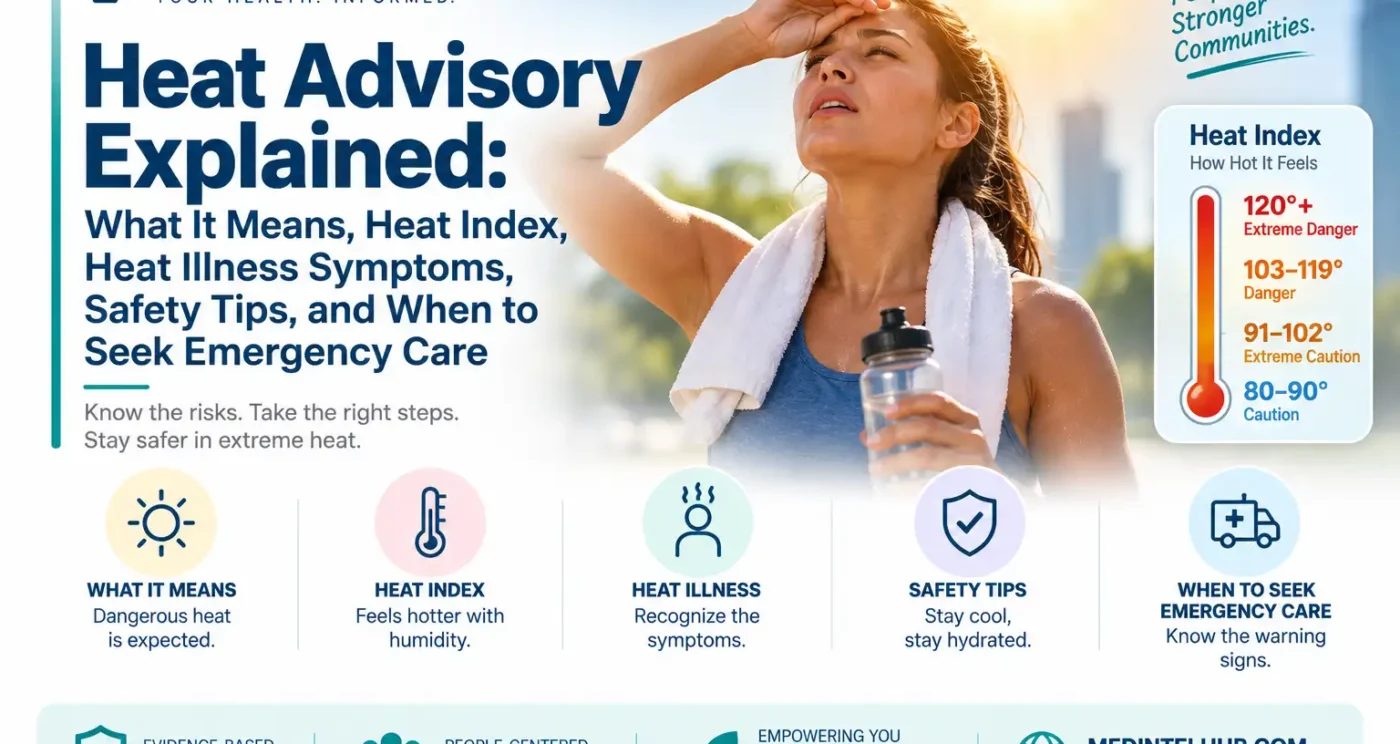
A Heat Advisory can be easy to underestimate.
The forecast may still show sunshine. Schools and businesses may remain open. Roads may look normal. Nothing about the weather necessarily feels like an approaching storm.
But a Heat Advisory is not simply the National Weather Service saying, “Tomorrow will be hot.”
In the United States, the National Weather Service (NWS) issues a Heat Advisory when dangerous heat conditions are expected or already occurring, but the event is not expected to reach the criteria for an Extreme Heat Warning. The NWS labels a Heat Advisory as “Take Action.”
That distinction matters because heat illness can develop gradually. A person might begin with a headache, thirst, heavy sweating, muscle cramps, or unusual fatigue. If heat exposure continues, symptoms can progress to dizziness, weakness, nausea, confusion, collapse, seizures, or heat stroke.
The risk also depends on more than the number displayed on a thermometer.
Humidity, direct sunlight, physical exertion, medications, age, pregnancy, chronic disease, access to air conditioning, and whether someone has had time to acclimatize to hot weather can all change how dangerous a hot day becomes. CDC’s current heat-health guidance emphasizes staying cool, staying hydrated, knowing the symptoms of overheating, and taking extra precautions for people at higher risk.
So when a Heat Advisory appears in the forecast, the practical question is not simply, “How hot will it get?”
It is:
“What will that heat mean for what I plan to do—and how will I recognize when my body is no longer coping with it?”
What Is a Heat Advisory?
A Heat Advisory is an official heat alert issued by a local National Weather Service forecast office.
The NWS defines it as an alert for dangerous heat conditions that are not expected to reach Extreme Heat Warning criteria. Its advice includes considering postponing or rescheduling outdoor activities, drinking water, taking frequent shade breaks, and spending time in a cool place during the hottest parts of the day and evening.
The word “advisory” can make the alert sound optional or mild.
That is misleading.
An advisory sits below the warning level, but the NWS still classifies it as a Take Action product.
People who work outside, exercise outdoors, do not have reliable cooling, or have medical conditions that increase heat sensitivity may run into trouble well before a forecast reaches the Extreme Heat Warning category.
What Temperature Triggers a Heat Advisory?
There is no single nationwide temperature or heat-index number that automatically triggers every Heat Advisory.
Local NWS offices determine alert thresholds for their areas and often coordinate with local health and emergency-management partners.
Why?
Because 95°F does not have the same public-health meaning everywhere.
People living in a region where high temperatures occur routinely may have more air conditioning, different building design, greater physiological acclimatization, and more established hot-weather routines than people experiencing an unusual heat event in a normally cool climate.
The National Weather Service specifically notes that local offices take local conditions into account when deciding when to issue heat alerts.
Other factors can also matter, including:
- Humidity
- Overnight temperatures
- How long the heat will persist
- Time of year
- Local climate
- Expected health impacts
So an article that says, “A Heat Advisory always starts at 105°F,” is oversimplifying the system.
Heat Advisory vs. Extreme Heat Watch vs. Extreme Heat Warning
These three alerts do not mean the same thing.
| NWS Alert | What It Means | General Action |
|---|---|---|
| Heat Advisory | Dangerous heat is expected or occurring but is below warning criteria | Take action |
| Extreme Heat Watch | Conditions are favorable for an extreme heat event, but timing or occurrence is still uncertain | Be prepared |
| Extreme Heat Warning | Extremely dangerous heat is expected or occurring | Take action immediately |
An Extreme Heat Warning represents the more dangerous level. The NWS advises avoiding outdoor activities during the heat of the day and spending as much time as possible in air-conditioned spaces, including overnight when necessary.
A watch is different.
It means the ingredients for an extreme heat event are present, but forecasters do not yet have enough certainty to issue a warning.
What Happened to the Term “Excessive Heat Warning”?
You may still see older websites, graphics, and articles referring to an Excessive Heat Warning or Excessive Heat Watch.
Those are now outdated NWS names.
On March 4, 2025, the National Weather Service changed:
- Excessive Heat Watch → Extreme Heat Watch
- Excessive Heat Warning → Extreme Heat Warning
The Heat Advisory name remained unchanged.
The change was part of the NWS Hazard Simplification Project, intended to make alert terminology easier for the public to understand.
Is a Heat Advisory Dangerous?
Potentially, yes.
It does not mean everyone will develop heat illness.
It means the forecasted conditions are dangerous enough that behavior should change—particularly for people spending considerable time outdoors or people who are more vulnerable to heat.
A person mowing a lawn for 20 minutes and someone roofing a house for eight hours may be exposed to the same weather but face very different physiological loads.
So might:
- A healthy 25-year-old athlete
- An 80-year-old living without air conditioning
- A pregnant outdoor worker
- Someone taking medicines that affect sweating or hydration
- A child playing sports
- Someone with heart or kidney disease
CDC emphasizes that hot weather can affect anyone, but certain groups need additional protection.
What Is the Heat Index?
The heat index estimates how hot the air feels when relative humidity is combined with the actual air temperature.
It is sometimes called the “feels-like” temperature.
Humidity matters because sweating cools the body mainly when sweat evaporates from the skin.
When the air already contains a large amount of moisture, sweat evaporates less efficiently. The body may continue sweating while losing some of its ability to cool itself effectively.
The National Weather Service uses heat index as one of several tools for evaluating potentially dangerous heat conditions.
For example, an air temperature of 96°F with 65% relative humidity produces a heat index around 121°F in the NWS example.
Can Direct Sunlight Make the Heat Index Worse?
Yes.
The standard heat index is designed around shady, light-wind conditions.
NWS says direct sunshine can increase the heat stress represented by the heat index by as much as 15°F.
That is one reason an athlete, construction worker, landscaper, or spectator sitting in full sun may experience conditions very differently from someone reading the same heat-index number from inside an air-conditioned building.
The number is useful.
Your actual exposure still matters.
What Is HeatRisk?
HeatRisk is another NWS tool designed to describe potential health impacts from heat.
Rather than considering only today’s temperature, HeatRisk takes into account factors including:
- How unusual the heat is for that location
- Time of year
- Duration of the heat
- Daytime and nighttime temperatures
- Whether the conditions reach levels associated with increased health complications
The forecast provides a color and numeric category intended to help people understand the potential level of concern and which groups may be especially vulnerable.
HeatRisk is supplemental to official NWS watches, warnings, and advisories rather than replacing them. The NWS currently describes it as an experimental product.
CDC recommends extra precautions outdoors when HeatRisk reaches red or higher.
What Is Wet Bulb Globe Temperature?
For outdoor workers and athletes, Wet Bulb Globe Temperature (WBGT) can sometimes provide more useful information than the heat index.
WBGT considers several environmental factors, including:
- Air temperature
- Humidity
- Wind
- Solar radiation
- Other heat-related conditions
Because it accounts for direct solar exposure and activity-related conditions more explicitly, it is often used for outdoor work, athletics, military training, and similar settings.
NWS notes that WBGT can help guide modifications to exercise and work intensity during hot conditions.
Someone planning a long outdoor practice or physically demanding job may therefore benefit from checking more than the daily high temperature.
What Should You Do During a Heat Advisory?
A Heat Advisory does not necessarily mean you have to remain indoors all day.
It does mean you should reconsider how much heat exposure you are accepting.
Useful steps include:
- Move strenuous outdoor activities to cooler hours when possible.
- Reduce exercise or work intensity.
- Take more frequent breaks.
- Spend breaks in shade or air conditioning.
- Carry water and drink regularly.
- Wear lightweight, breathable clothing when appropriate.
- Check on older adults and people living alone.
- Keep infants and young children cool and hydrated.
- Monitor people working or exercising outside.
- Know the symptoms of heat exhaustion and heat stroke.
The NWS specifically advises postponing or rescheduling outdoor activities when possible during a Heat Advisory and using frequent water and shade breaks when outdoor exposure cannot be avoided.
Should You Stay Indoors During a Heat Advisory?
Not necessarily.
But the hottest part of the day is a good time to reduce unnecessary outdoor exposure.
People without air conditioning may need to consider cooler public spaces, cooling centers, libraries, community centers, shopping centers, or another safe air-conditioned location.
CDC recommends using air conditioning or locating an air-conditioned site when home conditions become unsafe.
Evenings matter too.
If nighttime temperatures remain high, the body has less opportunity to recover from daytime heat exposure.
That is one reason prolonged heat events can become increasingly stressful over several days.
Are Fans Enough During Extreme Heat?
Not always.
This point surprises many people.
CDC’s July 2026 heat guidance says fans should be used when indoor temperatures are below 90°F. When indoor temperatures rise above 90°F, fan use can actually increase body temperature.
A fan moves air.
It does not lower the room’s actual temperature.
When the indoor environment becomes extremely hot, air conditioning or relocation to a cooler space may provide safer heat relief.
How Much Water Should You Drink During Hot Weather?
There is no single amount of water that is right for every person.
Fluid needs change according to:
- Body size
- Temperature
- Humidity
- Physical workload
- Exercise intensity
- Pregnancy
- Health conditions
- Medications
- Amount of sweating
CDC’s general guidance is to drink fluids regularly and carry water during hot weather rather than waiting until dehydration becomes severe. It also suggests limiting excessive alcohol and beverages high in caffeine, sugar, or sodium.
People with heart failure, kidney disease, dialysis needs, or medically prescribed fluid restrictions should not simply increase fluid intake dramatically based on generic heat advice. Their clinician can help develop an appropriate hot-weather plan.
Does Clear Urine Mean You Cannot Get Heat Illness?
No.
Urine color can provide a rough clue about hydration, but it is not a heat-illness test.
Someone can drink water and still overheat during heavy exertion.
Heat illness is influenced by heat production, environmental conditions, clothing, humidity, physiology, and the body’s ability to get rid of excess heat—not only hydration.
So “I drank plenty of water” should not be used to dismiss dizziness, weakness, confusion, or other concerning symptoms.
Who Is at Higher Risk During a Heat Advisory?
Anyone can develop heat illness.
Some people have less physiological reserve or face more intense exposure.
CDC identifies several groups needing extra precautions, including:
- Adults age 65 and older
- Infants and young children
- Pregnant people
- People with heart disease
- People with asthma and certain chronic illnesses
- People working outside
- People exercising outdoors
Risk can also increase with limited access to cooling, social isolation, previous heat illness, certain medications, and heavy physical work.
Why Are Older Adults More Vulnerable to Heat?
Aging can change the way the body responds to rising temperature.
CDC notes that older adults may not adjust as efficiently to sudden temperature changes. They are also more likely to have chronic medical conditions or use prescription medicines that affect sweating, fluid balance, or temperature regulation.
That is why “check on older neighbors” is more than a friendly suggestion during a heat wave.
Someone living alone may not recognize that their home has become dangerously hot until symptoms are already developing.
Why Are Infants and Young Children at Higher Risk?
Young children depend on caregivers to manage nearly every part of heat safety.
They cannot reliably:
- Recognize dehydration
- Find a cool building
- Refill a water bottle
- Change outdoor plans
- Explain early symptoms clearly
Young children also have physiological differences in heat regulation.
CDC includes infants and young children among groups requiring additional protection during hot conditions.
Children should never be left unattended in a parked vehicle, even for a brief errand.
Can Pregnancy Increase Heat Risk?
Yes.
Pregnancy changes blood circulation, fluid needs, metabolism, and temperature regulation.
CDC includes pregnant people among groups that may need additional protection from heat.
Someone who is pregnant does not need to panic when a Heat Advisory is issued, but avoiding unnecessary prolonged heat exposure, maintaining appropriate hydration, and responding early to symptoms become especially important.
Can Medications Make Heat More Dangerous?
Yes.
Some medicines can make people more likely to become dehydrated or overheated.
Others may affect:
- Sweating
- Thirst
- Blood pressure
- Fluid balance
- Kidney function
- Temperature regulation
CDC advises people to have a medication plan during hot weather and specifically warns not to stop or change medicines without first talking with a healthcare professional.
Medication storage matters too.
Some drugs need protection from high temperatures, and power outages can create problems for refrigerated medicines or electronic medical equipment.
Can Heat Affect Heart Disease?
Yes.
The cardiovascular system has to work harder when the body tries to lose heat.
Blood vessels near the skin widen, heart rate can increase, and dehydration can reduce circulating blood volume.
For someone with cardiovascular disease, those changes may place additional strain on the heart.
CDC specifically identifies people with heart conditions as a group that can experience worsening health during hot weather.
New chest pain should never be written off as “just the heat.”
Can Heat Affect Blood Pressure?
Yes.
Heat can alter blood pressure in several ways.
Blood-vessel dilation may lower pressure in some circumstances, while dehydration, medication effects, exertion, illness, or cardiovascular stress can complicate the response.
This is especially relevant for people taking:
- Diuretics
- Blood-pressure medicines
- Certain heart medications
Do not change the dose or timing of a prescribed medication simply because a Heat Advisory appears in the forecast.
Talk with the prescribing clinician if hot weather repeatedly causes dizziness, low readings, dehydration, or other problems.
Can Heat Affect the Kidneys?
Yes.
The kidneys depend on adequate blood flow and fluid balance.
Heavy sweating and dehydration can reduce kidney perfusion. Repeated or severe heat stress can contribute to acute kidney injury, particularly during strenuous physical work.
Heat can also trigger rhabdomyolysis, in which damaged muscle releases substances that can further injure the kidneys. CDC/NIOSH recognizes heat exposure and heavy physical exertion as important rhabdo risk factors.
Can Extreme Heat Cause Rhabdomyolysis?
Yes.
Rhabdomyolysis involves rapid muscle breakdown.
CDC/NIOSH specifically lists rhabdomyolysis among heat-related illnesses associated with heat stress and prolonged physical exertion. Damaged muscle releases proteins and electrolytes into the bloodstream, which can contribute to kidney damage, abnormal heart rhythms, and other complications.
Warning signs can include:
- Muscle pain or cramps worse than expected
- Marked weakness
- Exercise intolerance
- Tea- or cola-colored urine
Someone with these symptoms after intense exertion in hot conditions should stop activity and seek medical evaluation.
What Is Heat Exhaustion?
Heat exhaustion develops when the body loses too much water and salt, usually through heavy sweating.
It often occurs before heat stroke, but it should not be treated as harmless.
CDC/NIOSH lists symptoms including:
- Headache
- Nausea
- Dizziness
- Weakness
- Irritability
- Thirst
- Heavy sweating
- Elevated body temperature
- Decreased urine output
Someone with heat exhaustion needs to get out of the heat and begin cooling.
What Should You Do for Heat Exhaustion?
Move the person to a cooler environment.
Remove unnecessary clothing and begin cooling with cool water or cold compresses.
If the person is awake, alert, and able to swallow normally, encourage frequent sips of cool water.
CDC/NIOSH guidance for workers recommends medical evaluation for heat exhaustion and advises escalation to emergency care when appropriate.
Do not leave someone alone if they appear significantly ill.
And watch closely for a change in mental status.
Confusion changes the situation.
It can signal heat stroke.
What Is Heat Stroke?
Heat stroke is the most dangerous heat-related illness.
It occurs when the body’s normal temperature-control systems fail and core temperature rises rapidly.
Heat stroke can cause permanent organ damage or death without emergency treatment.
Possible symptoms include:
- Confusion
- Altered behavior
- Slurred speech
- Loss of consciousness
- Seizures
- Very high body temperature
- Severe weakness or collapse
- Hot skin
- Heavy sweating or sometimes dry skin
The neurological symptoms are especially important.
A person who becomes confused, disoriented, unconscious, or has a seizure during significant heat exposure should be treated as having a medical emergency.
Does Someone With Heat Stroke Always Stop Sweating?
No.
This myth can delay treatment.
People often learn that heat stroke means “hot, dry skin.”
Dry skin can occur, but CDC/NIOSH lists hot, dry skin or profuse sweating among heat-stroke findings.
So a person who is drenched in sweat can still have heat stroke.
Do not wait for sweating to stop before calling for help.
Heat Exhaustion vs. Heat Stroke
The distinction matters because heat stroke requires emergency treatment.
| Heat Exhaustion | Heat Stroke |
|---|---|
| Heavy sweating | Sweating may still be heavy or may decrease |
| Headache | Severe neurological symptoms may develop |
| Dizziness | Confusion or altered behavior |
| Nausea | Seizures can occur |
| Weakness | Collapse or loss of consciousness |
| Thirst | Very high body temperature |
| Reduced urination | Organ injury may develop |
| Needs cooling and medical assessment | Medical emergency — call 911 |
A person can progress from heat exhaustion to heat stroke.
If you are uncertain and the person has altered mental status, treat the situation as an emergency.
When Should You Call 911 for Heat Illness?
Call 911 for suspected heat stroke.
Emergency warning signs include:
- Confusion
- Slurred speech
- Seizure
- Loss of consciousness
- Severe disorientation
- Collapse
- Very high body temperature
- Rapid deterioration
- Inability to protect the airway
- Severe neurological symptoms
CDC/NIOSH specifically instructs people to call 911 for heat stroke and begin rapid cooling while emergency medical services are on the way.
How Do You Cool Someone With Heat Stroke?
Do not simply move the person into shade and wait.
Cooling should begin immediately while someone calls 911.
CDC/NIOSH recommends:
- Moving the person to a shaded or cool area
- Removing outer clothing
- Using a cold-water or ice bath when possible
- Wetting the skin
- Applying cold, wet cloths
- Soaking clothing with cool water
- Circulating air around the person
- Applying cold materials around areas such as the head, neck, armpits, and groin
The priority is reducing body temperature as quickly and safely as circumstances allow.
What Are Heat Cramps?
Heat cramps are painful muscle spasms associated with heavy sweating and physical activity in hot conditions.
They often involve:
- Arms
- Legs
- Abdomen
They may reflect losses of fluid and salt and can sometimes occur along with heat exhaustion.
NIOSH recommends stopping activity, moving to a cool place, and replacing fluids. Persistent cramps or cramps occurring in someone with heart disease or a medically restricted sodium intake deserve medical attention.
Severe muscle pain accompanied by weakness or dark urine raises a different concern—rhabdomyolysis.
What Is Heat Syncope?
Heat syncope means fainting or near-fainting associated with heat exposure.
It can happen after standing for a prolonged period or when someone stands suddenly after sitting or lying down.
Dehydration and lack of acclimatization can contribute.
A brief faint in hot weather should still be taken seriously.
Not every collapse is heat syncope.
Heart rhythm problems, seizures, low blood sugar, bleeding, stroke, medication effects, and other medical problems can also cause loss of consciousness.
What Is Heat Rash?
Heat rash develops when excessive sweating irritates the skin and sweat ducts.
Small bumps or blisters often occur in areas where sweat and clothing trap moisture, such as the:
- Neck
- Upper chest
- Groin
- Skin folds
CDC/NIOSH recommends keeping affected skin dry and moving to a cooler, less humid environment when possible.
Heat rash is uncomfortable but does not carry the same emergency risk as heat stroke.
Can You Exercise During a Heat Advisory?
Sometimes—but your normal workout may not be appropriate.
A Heat Advisory is a good reason to reconsider:
- Time of day
- Duration
- Intensity
- Location
- Access to shade
- Access to water
- Whether you are acclimatized
- Whether you are taking medications that affect heat tolerance
Moving a workout indoors or exercising early in the morning may be safer than trying to complete the same high-intensity session in peak afternoon heat.
NWS specifically recommends limiting strenuous outdoor work and scheduling activity earlier or later in the day when heat risk is elevated.
What Symptoms Mean You Should Stop Exercising?
Do not try to “push through” symptoms such as:
- Dizziness
- Unusual weakness
- Headache
- Nausea
- Severe muscle cramps
- Loss of coordination
- Confusion
- Feeling faint
- Severe unexpected muscle pain
Stopping early is much safer than waiting until someone collapses.
Dark urine or severe muscle weakness after intense exercise should also raise concern for rhabdomyolysis.
Can Outdoor Workers Keep Working During a Heat Advisory?
A Heat Advisory does not automatically close every outdoor workplace.
But physical labor generates its own heat inside the body.
NIOSH defines occupational heat stress as a combination of environmental heat, metabolic heat generated by work, and heat trapped by clothing or personal protective equipment.
That means someone lifting materials outdoors may face much greater heat strain than someone sitting outside in the same temperature.
Workplace strategies can include:
- More frequent rest breaks
- Shade
- Water access
- Work/rest schedules
- Reducing heavy tasks during peak heat
- Moving work to cooler hours
- Relief workers
- Acclimatization programs
NWS and OSHA/NIOSH guidance specifically support these types of work modifications.
What Is Heat Acclimatization?
Heat acclimatization is the gradual process by which the body becomes better able to tolerate repeated hot-weather exposure.
Over time, the body can become more efficient at sweating and handling cardiovascular stress.
This adaptation does not happen instantly.
NIOSH notes that lack of acclimatization increases heat-illness risk, particularly for new workers or people returning after time away.
A person returning from vacation, illness, or a cooler climate may therefore need time to rebuild heat tolerance.
Being physically fit does not eliminate the need for acclimatization.
Can Alcohol Make Heat Risk Worse?
It can.
Alcohol can contribute to dehydration and may impair judgment about how hot or sick someone feels.
CDC recommends limiting alcohol on hot days as part of hydration planning.
Someone who has been drinking may also be more likely to fall asleep or remain in a hot environment without recognizing worsening heat illness.
Can Heat Affect Sleep?
Yes.
Hot bedrooms can make it harder to fall asleep and remain asleep.
More importantly, high nighttime temperatures can prevent the body from getting a meaningful break after daytime heat exposure.
HeatRisk specifically takes the duration of unusual heat and overnight temperatures into account when estimating health concern.
Several consecutive hot nights can therefore matter even if daytime temperatures do not set records.
Is a Heat Advisory the Same as a Heat Wave?
No.
A Heat Advisory is an official National Weather Service alert.
A heat wave is a general description of a period of unusually hot weather lasting for multiple days.
A heat wave may result in:
- No formal alert
- A Heat Advisory
- An Extreme Heat Watch
- An Extreme Heat Warning
depending on how severe the conditions become and the local NWS criteria.
Does a Heat Advisory Mean Schools or Businesses Must Close?
Not automatically.
A Heat Advisory itself does not create one national closure rule.
Schools, employers, sports organizations, municipalities, and event organizers may use their own policies based on conditions, available cooling, heat index or WBGT, participant vulnerability, and local guidance.
Outdoor sports practices and strenuous work deserve particular attention because physical exertion generates additional body heat.
What Should Parents Do During a Heat Advisory?
Parents and caregivers can reduce risk by planning ahead.
Consider:
- Shifting outdoor play away from peak heat
- Offering water regularly
- Choosing shaded or indoor activities
- Watching for unusual tiredness or irritability
- Limiting strenuous sports when conditions are dangerous
- Checking playground surfaces before use
- Never leaving children unattended in vehicles
Young children may not clearly say, “I am overheating.”
Behavioral changes may be the first clue that something is wrong.
What Should Older Adults Do During a Heat Advisory?
Older adults should prioritize access to a cool environment.
Useful precautions include:
- Spending time in air conditioning
- Drinking appropriate fluids
- Reviewing heat-sensitive medications with a clinician when needed
- Avoiding strenuous activity during peak heat
- Having someone check in regularly
- Seeking help if the home becomes dangerously hot
CDC specifically recommends air-conditioned environments for older adults during hot weather.
When Should You Seek Medical Care for Heat Symptoms?
Do not wait until someone becomes unconscious.
Prompt medical evaluation is reasonable when there is:
- Persistent dizziness
- Significant weakness
- Repeated vomiting
- Severe headache
- Reduced urination
- Symptoms that are not improving after cooling
- Severe muscle pain after exertion
- Dark urine
- Worsening chronic medical symptoms
- Fainting
Heat exhaustion can require medical evaluation, particularly when symptoms are substantial.
A new medical problem also does not need to wait until the next annual checkup. MedIntelHub’s annual physical guide explains why preventive care and evaluation of an acute symptom are not necessarily the same type of visit. Understanding Your Annual Physical: What Actually Gets Checked
When Is Heat Illness an Emergency?
Seek emergency care immediately for:
- Confusion
- Slurred speech
- Seizure
- Loss of consciousness
- Severe disorientation
- Collapse with persistent symptoms
- Very high body temperature
- Severe breathing difficulty
- Stroke-like symptoms
- Serious chest pain
- Major neurological changes
- Suspected heat stroke
Call 911 and begin cooling rather than waiting to see whether the person improves on their own.
Heat Illness Symptoms at a Glance
| Condition | Common Clues | What to Do |
|---|---|---|
| Heat cramps | Painful muscle spasms after heavy sweating | Stop activity, cool down, replace fluids |
| Heat syncope | Dizziness or brief fainting | Lie or sit in cool area, hydrate, assess cause |
| Heat exhaustion | Heavy sweating, headache, nausea, dizziness, weakness, thirst | Cool immediately and obtain medical evaluation |
| Rhabdomyolysis | Severe muscle pain, weakness, exercise intolerance, dark urine | Stop activity and seek prompt medical care |
| Heat stroke | Confusion, slurred speech, seizure, collapse, very high temperature | Call 911 and cool immediately |
Frequently Asked Questions
What Does a Heat Advisory Mean?
A Heat Advisory means dangerous heat conditions are expected or already occurring but are not expected to reach the local criteria for an Extreme Heat Warning.
The NWS classifies it as a Take Action alert.
Is a Heat Advisory Serious?
Yes.
It is lower than an Extreme Heat Warning, but the expected conditions can still cause heat illness, particularly during prolonged outdoor exposure or in people with increased vulnerability.
What Temperature Causes a Heat Advisory?
There is no single national cutoff.
National Weather Service forecast offices use locally appropriate criteria because climate and heat-health risk vary by region.
Is a Heat Advisory Worse Than an Extreme Heat Warning?
No.
An Extreme Heat Warning represents more dangerous heat conditions.
Both alerts mean people should take precautions.
What Is the Difference Between a Heat Watch and Heat Advisory?
A Heat Advisory means dangerous heat is expected or occurring.
An Extreme Heat Watch means conditions are favorable for an extreme heat event, but its timing or occurrence is not yet certain.
Is “Excessive Heat Warning” Still Used?
The NWS renamed Excessive Heat Warning to Extreme Heat Warning in March 2025.
Excessive Heat Watch was similarly renamed Extreme Heat Watch.
What Is the Heat Index?
The heat index combines air temperature and relative humidity to estimate how hot conditions feel to the human body.
Does the Heat Index Include Direct Sunlight?
The standard heat index is calculated for shady, light-wind conditions.
NWS says full sunshine can increase the apparent heat stress by up to about 15°F.
What Is HeatRisk?
HeatRisk is a color- and number-based NWS forecast tool that considers how unusual the heat is, time of year, duration, nighttime temperatures, and expected health impacts.
Should I Stay Inside During a Heat Advisory?
Not necessarily all day.
But reducing outdoor exposure during the hottest hours, moving strenuous activities to cooler times, taking shade breaks, and using air-conditioned spaces can lower risk.
Are Fans Safe During a Heat Advisory?
It depends on the indoor temperature.
CDC advises using fans when indoor temperatures are below 90°F and warns that fans may increase body temperature when indoor temperatures exceed 90°F.
What Are the First Signs of Heat Exhaustion?
Possible symptoms include headache, nausea, dizziness, weakness, thirst, heavy sweating, irritability, elevated body temperature, and decreased urine output.
What Are the Warning Signs of Heat Stroke?
Confusion, altered behavior, slurred speech, loss of consciousness, seizure, and very high body temperature are major warning signs.
Heat stroke is an emergency.
Can You Still Sweat During Heat Stroke?
Yes.
CDC/NIOSH notes that people with heat stroke may have hot, dry skin or profuse sweating.
Should You Call 911 for Heat Stroke?
Yes.
Call 911 immediately and begin rapid cooling while waiting for emergency services.
Can Heat Cause Rhabdomyolysis?
Yes.
Heat stress combined with prolonged physical exertion can trigger rhabdomyolysis, which causes rapid muscle breakdown and can damage the kidneys or contribute to dangerous heart-rhythm problems.
Can Heat Affect the Kidneys?
Yes.
Dehydration, reduced kidney blood flow, severe heat stress, and heat-related rhabdomyolysis can all contribute to kidney problems.
Can Heat Affect Blood Pressure?
Yes.
Heat-related blood-vessel dilation, sweating, dehydration, cardiovascular stress, and medications can all affect blood pressure.
Can Medications Increase Heat Risk?
Some can.
CDC notes that many medicines can increase dehydration or overheating risk and advises patients not to stop or change medicines without talking to their healthcare professional.
Are Older Adults at Greater Risk From Heat?
Yes.
Adults 65 and older may adapt less effectively to sudden temperature changes and are more likely to have chronic conditions or take medications affecting heat tolerance.
Are Pregnant People More Vulnerable to Heat?
Pregnancy is among the conditions CDC identifies as requiring additional precautions during hot weather.
Can I Work Out During a Heat Advisory?
Possibly, but reducing intensity, moving activity to cooler hours, exercising indoors, and taking more breaks may be appropriate.
Do not continue exercising through dizziness, unusual weakness, confusion, nausea, or severe muscle symptoms.
Is Dark Urine After Exercising in the Heat Normal?
Do not assume it is.
Tea- or cola-colored urine accompanied by severe muscle pain or weakness may indicate rhabdomyolysis and deserves prompt medical evaluation.
Conclusion
A Heat Advisory does not mean disaster is inevitable.
It means the conditions have become dangerous enough that ordinary routines may need to change.
The National Weather Service classifies a Heat Advisory as a Take Action alert. It is issued when dangerous heat is expected or occurring but has not reached local Extreme Heat Warning criteria.
There is no one nationwide temperature that triggers every advisory.
Local climate matters. Humidity matters. How long the heat lasts matters. Warm nights matter. And the same weather can create very different risks for someone working outside, an older adult without air conditioning, a pregnant person, a child playing sports, or someone with heart or kidney disease.
The heat index helps describe how temperature and humidity feel together, but it is not the whole story. Direct sunshine can increase heat stress substantially, while tools such as HeatRisk and WBGT add information about duration, location, solar radiation, or physical activity.
For most people, the useful response to a Heat Advisory is practical rather than dramatic:
Move strenuous activity away from peak heat. Drink appropriate fluids. Use shade and air conditioning. Take breaks. Check on people who may need help. Pay attention to symptoms.
And know the line between discomfort and danger.
Headache, dizziness, nausea, unusual weakness, thirst, and heavy sweating can signal heat exhaustion.
Confusion, slurred speech, seizure, collapse, or loss of consciousness can signal heat stroke.
Heat stroke is not something to watch at home.
Call 911 and begin rapid cooling while help is coming.
One other warning deserves attention after intense outdoor exertion: severe muscle pain, profound weakness, or tea-colored urine can point to rhabdomyolysis rather than ordinary dehydration or muscle soreness.
A Heat Advisory is ultimately an early warning.
Using it that way—before someone becomes seriously ill—is what makes the alert useful.
Resources
National Weather Service — Understanding Heat Alerts
Current definitions for Heat Advisory, Extreme Heat Watch, and Extreme Heat Warning, along with recommended actions.
NWS: Understanding Heat Alerts
National Weather Service — Heat Forecast Tools
Information about heat index, Wet Bulb Globe Temperature, and HeatRisk.
National Weather Service — 2025 Heat Alert Terminology Changes
Explains the March 2025 change from Excessive Heat Watch/Warning to Extreme Heat Watch/Warning.
NWS: Heat Hazard Simplification
CDC — Heat and Your Health
Current public-health guidance on staying cool, hydration, fans, medications, HeatRisk, and people at increased risk.
CDC: About Heat and Your Health
Detailed information about heat stroke, heat exhaustion, rhabdomyolysis, heat syncope, heat cramps, and first aid.
CDC/NIOSH: Heat-Related Illnesses
CDC/NIOSH — Rhabdomyolysis Symptoms
Information about severe muscle symptoms, dark urine, CK testing, and when to seek medical care.
CDC/NIOSH: Signs and Symptoms of Rhabdomyolysis
MedIntelHub — Understanding Your Annual Physical
A routine preventive checkup and an appointment for an acute heat-related symptom do not necessarily serve the same purpose.
Understanding Your Annual Physical: What Actually Gets Checked
MedIntelHub — Editorial Policy
For more information about MedIntelHub’s standards for medical sourcing, accuracy, transparency, updates, and educational content:
Editorial Disclaimer
This article is provided for general educational and informational purposes only. It does not diagnose heat exhaustion, heat stroke, dehydration, rhabdomyolysis, kidney injury, heart disease, or another medical condition.
Heat-alert criteria vary by location. Always follow the current National Weather Service forecast and instructions from local health, emergency-management, workplace, school, or public-safety authorities.
Individual hydration needs also differ. People with heart failure, kidney disease, dialysis requirements, or prescribed fluid restrictions should follow individualized medical guidance rather than general advice to increase fluid intake.
Do not stop or change a prescription medicine because hot weather is forecast unless the prescribing healthcare professional advises you to do so.
Call 911 for suspected heat stroke, especially when heat exposure is accompanied by confusion, slurred speech, seizure, collapse, loss of consciousness, severe disorientation, or other rapidly worsening neurological symptoms. Begin appropriate cooling while emergency medical help is on the way.

David Bennett
David Bennett is an author at MedIntelHub, where he creates clear, practical, and well-researched content about healthcare, medical billing, insurance, and patient education. His goal is to make complex healthcare topics easier for readers to understand and use in everyday situations. David emphasizes accuracy, transparency, and reliable sourcing, using information from trusted organizations and official healthcare resources whenever possible. Content published by David is intended for educational purposes and should not replace advice from qualified medical, legal, or healthcare professionals.