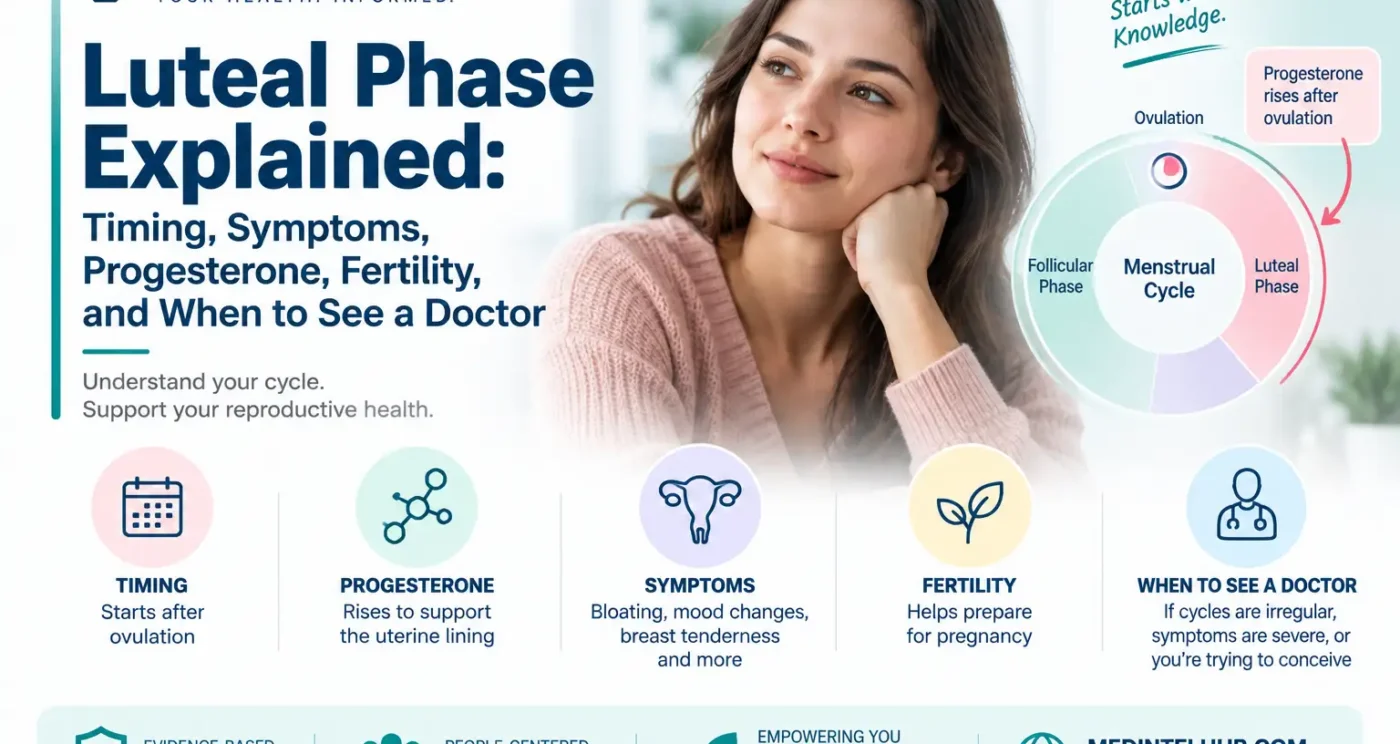
The luteal phase begins quietly.
Ovulation has already happened. The egg has left the ovary, and the follicle that released it changes into a temporary hormone-producing structure called the corpus luteum. From there, progesterone rises and the uterine lining shifts into a state that can support an early pregnancy.
If pregnancy does not occur, progesterone and estrogen eventually fall and the next period begins.
That sounds straightforward, but luteal-phase questions often become confusing once fertility apps, “day 21 progesterone” tests, implantation symptoms, PMS, and the idea of a “short luteal phase” enter the conversation.
One useful number to know is that a typical luteal phase lasts about 12 to 14 days, although the American Society for Reproductive Medicine (ASRM) notes that approximately 11 to 17 days can occur. Progesterone generally peaks about 6 to 8 days after ovulation.
The most important detail, though, is not a number.
The luteal phase is counted from ovulation—not from a fixed calendar day.
Someone with a 28-day cycle does not necessarily ovulate on day 14, and someone with a 35-day cycle should not automatically interpret a “day 21 progesterone” result the same way.
Understanding that timing makes the rest of the luteal phase much easier to follow.
Contents
- 1. What Is the Luteal Phase?
- 2. When Does the Luteal Phase Start?
- 3. How Long Does the Luteal Phase Last?
- 4. What Happens to Progesterone During the Luteal Phase?
- 5. What Is the Corpus Luteum?
- 6. What Are Common Luteal Phase Symptoms?
- 7. Why Do Breasts Feel Tender During the Luteal Phase?
- 8. Why Does Bloating Happen During the Luteal Phase?
- 9. Can the Luteal Phase Make You Tired?
- 10. Does Basal Body Temperature Rise During the Luteal Phase?
- 11. What Happens to Cervical Mucus During the Luteal Phase?
- 12. Is the Luteal Phase Fertile?
- 13. Can You Get Pregnant During the Luteal Phase?
- 14. When Does Implantation Happen?
- 15. Can You Feel Implantation?
- 16. When Can You Take a Pregnancy Test During the Luteal Phase?
- 17. Is PMS Part of the Luteal Phase?
- 18. What Is PMDD?
- 19. When Are Premenstrual Mood Symptoms Urgent?
- 20. What Is a Short Luteal Phase?
- 21. What Is Luteal Phase Deficiency?
- 22. Does a Short Luteal Phase Cause Infertility?
- 23. What Can Contribute to Abnormal Luteal Function?
- 24. Can PCOS Affect the Luteal Phase?
- 25. Can Thyroid Disease Affect the Luteal Phase?
- 26. Can High Prolactin Affect Ovulation?
- 27. Can Stress Change the Luteal Phase?
- 28. Can Under-Eating or Heavy Exercise Affect the Cycle?
- 29. What Is a Progesterone Blood Test?
- 30. When Should Progesterone Be Tested?
- 31. Does Low Progesterone Mean You Cannot Get Pregnant?
- 32. Do Progesterone Supplements Treat a Short Luteal Phase?
- 33. How Can You Track the Luteal Phase?
- 34. Can Birth Control Change the Luteal Phase?
- 35. Does Breastfeeding Affect the Luteal Phase?
- 36. Can Perimenopause Change the Luteal Phase?
- 37. When Should You See a Doctor About Your Luteal Phase?
- 38. When Are Cycle Symptoms an Emergency?
- 39. Luteal Phase at a Glance
- 40. Frequently Asked Questions
- 40.1. What Is the Luteal Phase?
- 40.2. When Does the Luteal Phase Begin?
- 40.3. How Long Is the Luteal Phase?
- 40.4. What Hormone Is Highest During the Luteal Phase?
- 40.5. What Are Common Luteal Phase Symptoms?
- 40.6. Does Your Temperature Rise During the Luteal Phase?
- 40.7. Is the Luteal Phase Before or After Ovulation?
- 40.8. Can You Get Pregnant During the Luteal Phase?
- 40.9. When Is the Fertile Window?
- 40.10. Does Implantation Happen During the Luteal Phase?
- 40.11. Can You Feel Implantation?
- 40.12. Can PMS Start During the Luteal Phase?
- 40.13. What Is PMDD?
- 40.14. Is a 10-Day Luteal Phase Abnormal?
- 40.15. What Is Luteal Phase Deficiency?
- 40.16. Does a Short Luteal Phase Cause Infertility?
- 40.17. What Does a Low Progesterone Level Mean?
- 40.18. When Should Progesterone Be Checked?
- 40.19. Does Progesterone Above 3 ng/mL Confirm Ovulation?
- 40.20. Can PCOS Affect the Luteal Phase?
- 40.21. Can Stress Affect the Luteal Phase?
- 40.22. Can Thyroid Problems Affect the Menstrual Cycle?
- 40.23. Can You Take a Pregnancy Test Before Your Period?
- 40.24. Do Period-Tracking Apps Know When You Ovulate?
- 41. Conclusion
- 42. Resources
- 42.1. American Society for Reproductive Medicine — Luteal Phase Deficiency
- 42.2. American Society for Reproductive Medicine — Fertility Evaluation
- 42.3. American Society for Reproductive Medicine — Optimizing Natural Fertility
- 42.4. American College of Obstetricians and Gynecologists — PMS
- 42.5. NICHD — Menstruation and the Menstrual Cycle
- 42.6. Office on Women’s Health — Pregnancy Tests
- 42.7. MedIntelHub — Preparing for a Specialist Appointment
- 42.8. MedIntelHub — Understanding Your Annual Physical
- 42.9. MedIntelHub — Editorial Policy
- 43. Editorial Disclaimer
What Is the Luteal Phase?
The menstrual cycle is often described in three broad stages:
- The follicular phase
- Ovulation
- The luteal phase
The follicular phase begins on the first day of menstruation and continues while follicles in the ovary develop.
Ovulation occurs when a mature follicle releases an egg.
The luteal phase starts after ovulation and continues until the next menstrual period begins.
If fertilization and implantation occur, hormonal signals maintain the corpus luteum so progesterone production can continue during early pregnancy. If pregnancy does not occur, the corpus luteum regresses, progesterone falls, and menstruation follows.
The luteal phase is therefore not simply “the week before your period.”
It is the entire post-ovulation portion of an ovulatory cycle.
When Does the Luteal Phase Start?
It starts after ovulation.
The problem is that ovulation does not happen on the same cycle day for everyone.
Even in someone whose periods appear fairly regular, ovulation can shift from one month to another.
NICHD notes that ovulation timing can vary considerably across the menstrual cycle rather than occurring universally on day 14.
For example, if someone ovulates around day 13, the luteal phase begins around that point.
If ovulation occurs closer to day 20, the luteal phase begins later.
That means two people with perfectly healthy cycles can have very different calendar dates for the same hormonal phase.
How Long Does the Luteal Phase Last?
ASRM’s updated 2026 committee opinion describes a typical luteal phase as approximately 12 to 14 days, with a range of around 11 to 17 days seen in normal cycles.
The follicular portion of the cycle tends to account for more month-to-month variation.
The luteal phase is usually somewhat more stable, but “stable” does not mean identical every month.
One cycle being a day or two shorter than another is not automatically abnormal.
Is a 10-Day Luteal Phase Too Short?
ASRM’s 2026 guidance describes luteal phase deficiency (LPD) as potentially being present when the luteal phase is 10 days or shorter.
That should not be turned into a self-diagnosis rule.
A short luteal phase can occur occasionally even in people who are fertile, and ASRM emphasizes that no currently available test has been proven to reliably diagnose isolated luteal phase deficiency or distinguish fertile from infertile patients.
A repeated pattern matters more than one unusual cycle.
What Happens to Progesterone During the Luteal Phase?
Progesterone becomes the dominant hormone of the luteal phase.
After ovulation, the follicle that released the egg transforms into the corpus luteum.
The corpus luteum produces progesterone, along with some estrogen.
Progesterone helps change the uterine lining from tissue that has mainly been growing under estrogen stimulation into tissue capable of supporting implantation and early pregnancy.
ASRM notes that progesterone generally reaches its highest levels about 6 to 8 days after ovulation in cycles where pregnancy has not occurred.
The level does not stay perfectly steady.
Progesterone is released in pulses and can fluctuate substantially even within a short period of time. ASRM reports that values can vary several-fold over a matter of hours in normally ovulating people.
That has an important consequence:
One progesterone measurement cannot tell the complete story of the luteal phase.
What Is the Corpus Luteum?
The corpus luteum is temporary.
Before ovulation, the egg develops inside an ovarian follicle.
After the egg is released, the remaining follicular tissue changes into the corpus luteum.
Its main job is to produce enough progesterone to support the uterine lining during the post-ovulation portion of the cycle.
What Happens if Pregnancy Does Not Occur?
Without an ongoing pregnancy signal, the corpus luteum eventually breaks down.
Progesterone and estrogen levels fall.
That hormonal withdrawal helps trigger shedding of the uterine lining, beginning the next menstrual period.
What Happens if Pregnancy Occurs?
After implantation begins, the developing pregnancy produces human chorionic gonadotropin, or hCG.
hCG signals the corpus luteum to keep functioning so that progesterone production continues during early pregnancy. ASRM specifically notes the importance of rising hCG in maintaining corpus-luteum progesterone secretion after implantation.
Eventually, the placenta becomes capable of producing enough progesterone to take over this role.
What Are Common Luteal Phase Symptoms?
Some people notice a clear change after ovulation.
Others barely notice the luteal phase at all.
Possible symptoms include:
- Breast tenderness
- Bloating
- Changes in appetite
- Mild fatigue
- Acne
- Mood changes
- Headache
- Changes in sleep
- Slightly higher basal body temperature
- Thicker cervical mucus
Many of these become more noticeable closer to menstruation and may fall under the broader category of premenstrual symptoms.
None of these symptoms can reliably tell you how high your progesterone is.
They also cannot prove that ovulation occurred.
Why Do Breasts Feel Tender During the Luteal Phase?
Hormonal shifts after ovulation can affect breast tissue.
Some people notice:
- Fullness
- Heaviness
- Soreness
- Greater nipple sensitivity
These changes often become strongest in the days leading up to menstruation and improve once bleeding begins.
Breast tenderness can also occur during early pregnancy, with hormonal medications, and for reasons unrelated to the menstrual cycle.
It is therefore not a reliable way to distinguish an ordinary luteal phase from early pregnancy.
Why Does Bloating Happen During the Luteal Phase?
Premenstrual bloating is common.
Hormonal changes can influence fluid balance and gastrointestinal function, leaving some people feeling swollen or uncomfortable before menstruation.
ACOG lists bloating, appetite changes, gastrointestinal symptoms, breast tenderness, fatigue, headache, and swelling among recognized PMS symptoms.
Persistent or severe bloating, particularly when it occurs throughout the month rather than predictably around menstruation, deserves a broader evaluation.
Can the Luteal Phase Make You Tired?
Some people feel more tired after ovulation or in the days before menstruation.
Sleep changes, PMS, pain, mood symptoms, appetite changes, and hormonal shifts may all contribute.
Fatigue is also very nonspecific.
Anemia, thyroid disease, sleep disorders, depression, infection, pregnancy, medications, and many other conditions can produce the same complaint.
Feeling tired during the luteal phase does not prove that progesterone is “too high” or “too low.”
Does Basal Body Temperature Rise During the Luteal Phase?
Usually, yes.
Progesterone has a thermogenic effect, which means it tends to raise body temperature slightly.
A person’s basal body temperature, or BBT, may rise after ovulation and remain somewhat higher through the luteal phase.
NICHD notes that body temperature typically rises slightly around ovulation, which is why temperature tracking has long been used as one method of identifying cycle patterns.
BBT is more useful for recognizing that ovulation likely already happened than for precisely predicting when it will occur.
Sleep disruption, fever, alcohol, shift work, travel, and inconsistent measuring times can all affect readings.
What Happens to Cervical Mucus During the Luteal Phase?
Cervical mucus often changes as ovulation passes.
Near the fertile window, estrogen can produce mucus that is:
- Clear
- Slippery
- Stretchy
- Wet
After ovulation, progesterone becomes more dominant.
Mucus generally becomes:
- Thicker
- Stickier
- Less abundant
- Less favorable for sperm movement
Not everyone notices a dramatic difference, and infections, medications, breastfeeding, hormonal contraception, and other factors can alter cervical secretions.
Is the Luteal Phase Fertile?
Most of the luteal phase falls after the main fertile window.
ASRM defines the fertile window as the six-day period ending on the day of ovulation. The highest chances of conception generally occur during the couple of days leading up to ovulation.
That makes biological sense.
Sperm can survive long enough for intercourse occurring before ovulation to result in fertilization once the egg is released.
The egg itself has a much shorter period of viability after ovulation.
So intercourse well into a correctly identified luteal phase is much less likely to result in conception from that act.
There is one catch:
People often estimate ovulation incorrectly.
If an app says someone is “3 days into the luteal phase” but ovulation actually has not occurred yet, pregnancy may still be possible.
Can You Get Pregnant During the Luteal Phase?
The answer depends on what is meant by “during.”
Pregnancy begins with fertilization around the time of ovulation and implantation later in the luteal phase.
Intercourse that occurred in the days before ovulation can therefore lead to a pregnancy that becomes established during the luteal phase.
Intercourse occurring well after the egg is no longer viable is much less likely to cause conception.
This is why fertility apps should not be treated as a guarantee of “safe days” unless someone is using a validated fertility-awareness method correctly and understands its limitations.
ASRM notes that smartphone calendar apps can estimate fertile windows but are not necessarily precise in predicting an individual’s actual day of ovulation.
When Does Implantation Happen?
After fertilization, the early embryo travels toward the uterus.
Implantation occurs later, after the embryo reaches and begins attaching to the uterine lining.
The exact timing varies between pregnancies.
The U.S. Office on Women’s Health notes that hCG begins being produced after implantation and that implantation often occurs around 10 days after conception, though individual timing differs.
That variability is one reason very early pregnancy tests can be negative even when pregnancy eventually becomes detectable.
Can You Feel Implantation?
There is no symptom that reliably confirms implantation.
Some people report:
- Mild cramping
- A small amount of spotting
- Breast tenderness
- Fatigue
The difficulty is that these experiences also occur in perfectly ordinary luteal phases.
Progesterone is elevated whether conception occurred or not during much of this time, so early pregnancy and premenstrual symptoms can feel remarkably similar.
A symptom checklist cannot confirm implantation.
A pregnancy test taken at an appropriate time is much more useful.
When Can You Take a Pregnancy Test During the Luteal Phase?
Some sensitive home tests can detect pregnancy before a missed period, but testing very early increases the chance of a false negative.
The Office on Women’s Health recommends that home urine testing is generally more accurate after the first day of a missed period, because hCG increases with time after implantation.
If an early test is negative but the period does not arrive, repeating it a few days later can be reasonable.
Cycle timing matters, especially for people with irregular ovulation.
Is PMS Part of the Luteal Phase?
Yes.
Premenstrual syndrome occurs during the later part of the luteal phase.
Common symptoms can include:
- Irritability
- Mood changes
- Anxiety
- Trouble concentrating
- Sleep changes
- Breast tenderness
- Bloating
- Food cravings
- Headache
- Fatigue
- Body aches
ACOG describes PMS as physical and emotional changes that occur repeatedly in the days before menstruation and interfere with normal life.
Symptoms typically improve shortly after the period begins.
What Is PMDD?
Premenstrual dysphoric disorder, or PMDD, is a more severe premenstrual disorder.
The mood symptoms can become intense enough to interfere with work, school, relationships, or ordinary functioning.
Possible features include:
- Severe irritability
- Depression
- Anxiety
- Feeling overwhelmed
- Marked mood swings
- Low energy
- Sleep changes
- Changes in appetite
- Difficulty concentrating
ACOG describes PMDD as a severe form of premenstrual illness in which symptoms significantly interfere with daily life.
PMDD is not simply “being emotional before a period.”
It is a recognized medical condition.
When Are Premenstrual Mood Symptoms Urgent?
Any suicidal thoughts or thoughts of self-harm require immediate help, whether they occur during the luteal phase or at another time of the month.
Severe depression, panic, or inability to function also deserves medical attention.
Tracking symptoms across at least a few cycles can help show whether the pattern is tightly linked to the premenstrual phase or remains present throughout the month.
ACOG specifically recommends prospective symptom tracking when PMS or PMDD is being evaluated.
What Is a Short Luteal Phase?
A short luteal phase means the interval between ovulation and the next menstrual period is shorter than expected.
ASRM’s 2026 committee opinion describes luteal phase deficiency as potentially being present with a luteal phase of 10 days or less.
But that definition comes with substantial uncertainty.
Short luteal phases have also been observed in fertile people with otherwise normal cycles.
A single short cycle therefore does not prove that something is wrong with fertility.
What Is Luteal Phase Deficiency?
Luteal phase deficiency, sometimes called luteal phase defect, refers broadly to concern that the progesterone-supported phase after ovulation is inadequate in duration, hormone exposure, or endometrial response.
Historically, LPD has been suggested as a possible explanation for infertility or early pregnancy loss.
The problem is that the diagnosis remains controversial.
ASRM’s updated 2026 opinion states that:
- LPD has not been proven to be an independent cause of infertility or recurrent pregnancy loss.
- No clinical diagnostic test has been proven to reliably distinguish fertile from infertile people with suspected LPD.
- Endometrial biopsy is not recommended to “date” the luteal phase.
- In natural, unstimulated cycles, no treatment for isolated LPD has been shown to improve pregnancy rates.
This is an important counterpoint to online fertility advice that presents luteal phase deficiency as a simple condition diagnosed from one number.
Does a Short Luteal Phase Cause Infertility?
Not necessarily.
Progesterone and adequate luteal function are clearly important for implantation and early pregnancy.
But proving that an isolated short luteal phase is independently responsible for infertility has been difficult.
ASRM’s 2026 update explicitly notes that LPD has not been established as an independent cause of infertility or recurrent pregnancy loss.
When conception is difficult, it is more useful to evaluate the full reproductive picture rather than focusing solely on the number of days between ovulation and menstruation.
What Can Contribute to Abnormal Luteal Function?
Sometimes an unusual luteal pattern is part of a broader ovulatory or hormonal problem.
ASRM recommends looking for underlying causes such as:
- Hypothalamic dysfunction
- Thyroid dysfunction
- Elevated prolactin
before assuming that isolated luteal phase deficiency is the problem.
Other cycle disorders can affect ovulation and therefore alter what the luteal phase looks like.
Can PCOS Affect the Luteal Phase?
Yes, mainly because polycystic ovary syndrome can disrupt ovulation.
When ovulation is irregular, predicting when the luteal phase begins becomes difficult.
If ovulation does not occur at all during a particular cycle, there is no normal ovulatory luteal phase in that cycle.
Ovulation predictor kits can also be harder to interpret in some people with PCOS because baseline LH may be elevated and produce misleading results. ASRM notes this limitation when discussing urinary LH testing.
Can Thyroid Disease Affect the Luteal Phase?
Yes.
Thyroid dysfunction can interfere with menstrual regularity and ovulation.
ACOG includes thyroid problems among medical conditions that can contribute to missed or irregular periods, while ASRM recommends evaluating thyroid dysfunction when abnormal luteal function is suspected.
That does not mean every small variation in cycle length requires thyroid testing.
Persistent irregularity or other thyroid symptoms make the question more relevant.
Can High Prolactin Affect Ovulation?
Yes.
Elevated prolactin can interfere with the hormonal signals needed for normal ovulation.
When ovulation becomes abnormal or absent, the luteal phase may also become difficult to define.
ASRM lists hyperprolactinemia among underlying conditions clinicians may investigate when luteal dysfunction is suspected.
Can Stress Change the Luteal Phase?
Significant physical or psychological stress can alter the hormonal signals controlling ovulation.
Often, the most noticeable effect is a change in when ovulation occurs, which can change overall cycle length.
ACOG lists stress among factors associated with amenorrhea and menstrual disruption.
That is different from the popular claim that everyday stress simply “crashes progesterone.”
Human reproductive hormones are more complicated than that.
Can Under-Eating or Heavy Exercise Affect the Cycle?
They can when energy availability becomes too low.
Very high training loads, major weight loss, and inadequate calorie intake can disrupt hypothalamic signaling and interfere with ovulation or menstruation.
When that happens, the issue is broader than a few days of luteal-phase variation.
Missing periods, increasingly irregular cycles, bone-health concerns, or signs of inadequate nutrition deserve medical evaluation.
What Is a Progesterone Blood Test?
A serum progesterone test measures progesterone in the blood.
It can be used as evidence that ovulation recently occurred.
ASRM states that a progesterone level above 3 ng/mL provides presumptive evidence of recent ovulation.
However, the number has an important limitation.
Progesterone is released in pulses.
Someone could have one measurement that looks relatively low and another taken several hours later that is substantially higher.
A single result can therefore help confirm ovulation but cannot reliably grade the “quality” of the luteal phase.
When Should Progesterone Be Tested?
Forget the automatic “day 21” rule.
ASRM recommends timing serum progesterone about one week before the expected next period, rather than using the same cycle day for everyone.
For someone with a predictable 28-day cycle, that may happen to fall near day 21.
For someone who ovulates much later, day 21 could be the wrong time entirely.
Why Is “Day 21 Progesterone” Misleading?
Imagine two people.
One ovulates on day 14.
Another ovulates on day 20.
Testing both on day 21 does not measure the same biological moment.
The first person is roughly a week into the luteal phase.
The second may be only a day past ovulation.
That is why test timing should follow the expected ovulation and next menstruation, not the calendar label.
Does Low Progesterone Mean You Cannot Get Pregnant?
Not from one test.
Progesterone fluctuates considerably during the luteal phase, and ASRM says there is no minimum single serum progesterone concentration that defines a normal or fertile luteal phase.
A low-looking result might reflect:
- Timing of the blood draw
- Pulsatile secretion
- Delayed ovulation
- An anovulatory cycle
- A broader hormonal problem
It requires context.
Do Progesterone Supplements Treat a Short Luteal Phase?
This depends heavily on the clinical setting.
Progesterone has established roles in some forms of fertility treatment and assisted reproduction.
That does not mean supplementation has been proven beneficial for anyone who notices a short natural luteal phase.
ASRM’s 2026 review states that no treatment for isolated LPD has been shown to improve pregnancy rates in natural, unstimulated cycles. It also emphasizes identifying and treating an underlying hormonal or medical condition when one is present.
Do not start over-the-counter hormone products or prescription progesterone based solely on an app or one blood result.
How Can You Track the Luteal Phase?
Several methods can help estimate ovulation.
Each has limitations.
Ovulation Predictor Kits
Urinary ovulation tests detect the luteinizing hormone, or LH, surge that usually precedes ovulation.
ASRM notes that an LH surge generally precedes ovulation by approximately 1 to 2 days.
A positive test suggests ovulation may be approaching.
It does not prove the egg was released.
Basal Body Temperature
BBT tends to rise after ovulation.
A sustained temperature shift can therefore provide retrospective evidence that the luteal phase probably started.
It is less useful for knowing in advance that ovulation will happen tomorrow.
Cervical Mucus
The transition from slippery, wet fertile-type mucus to thicker, drier mucus can provide another clue that ovulation has passed.
Menstrual Tracking Apps
Apps can be useful for organizing:
- Period dates
- Symptoms
- Temperature
- LH test results
They are less reliable when they simply predict ovulation from previous calendar dates.
ASRM cautions that app-based prediction does not necessarily identify an individual’s true fertile window precisely.
Can Birth Control Change the Luteal Phase?
Yes, because many hormonal contraceptives change or suppress normal ovulation.
With combined hormonal contraception, for example, ovulation is generally prevented.
That means the bleeding pattern someone experiences on hormonal contraception should not automatically be interpreted as a natural follicular-ovulatory-luteal cycle.
Similarly, progesterone measurements and app-based “luteal phase” predictions may not mean the same thing while using hormonal contraception.
Does Breastfeeding Affect the Luteal Phase?
It can affect the cycle indirectly by suppressing ovulation.
Prolactin levels associated with breastfeeding can delay the return of regular ovulatory cycles, particularly with frequent nursing.
As ovulation returns postpartum, cycles may be irregular for a while.
That makes calendar-only fertility predictions less dependable.
Can Perimenopause Change the Luteal Phase?
Yes.
During perimenopause, ovulation becomes less predictable.
Some cycles may still be ovulatory, while others are not.
Cycle length can become shorter, longer, or more variable.
A new pattern of irregular cycles later in reproductive life may reflect perimenopause, but pregnancy, thyroid disorders, medication effects, fibroids, and other causes may also need consideration.
When Should You See a Doctor About Your Luteal Phase?
Most people do not need medical testing simply because one cycle looks slightly different from the last.
Consider discussing the pattern with a healthcare professional when you have:
- Repeatedly very short intervals between ovulation and menstruation
- Persistently irregular cycles
- Months without a period
- Recurrent spotting before menstruation
- Difficulty becoming pregnant
- Recurrent pregnancy loss
- Severe PMS symptoms
- Possible PMDD
- New major changes in cycle length
- Symptoms suggesting thyroid or another hormone disorder
ACOG recommends evaluation when periods stop for more than three months without an explanation.
If fertility is the main concern, age and duration of trying to conceive matter too.
ASRM generally recommends an infertility evaluation after 12 months of regular unprotected intercourse when the female partner is under 35, and after 6 months for women 35 and older, with earlier evaluation when there are known reproductive concerns.
If you’re preparing for an OB/GYN or reproductive endocrinology visit, MedIntelHub’s specialist-appointment guide can help you organize cycle dates, laboratory results, medications, and questions before the visit.
How to Prepare Questions Before a Specialist Appointment
When Are Cycle Symptoms an Emergency?
Ordinary luteal-phase symptoms are not usually emergencies.
Some symptoms that happen around the same time can be.
Seek urgent medical attention for:
- Severe sudden pelvic or abdominal pain
- Heavy bleeding with fainting or significant dizziness
- Loss of consciousness
- Severe weakness
- A positive pregnancy test with severe one-sided pelvic pain
- Pregnancy symptoms plus shoulder-tip pain or fainting
Those can be warning signs of conditions such as ectopic pregnancy or significant bleeding and should not be dismissed as ordinary premenstrual cramping.
Severe suicidal thoughts or thoughts of self-harm also require immediate help, regardless of whether they seem related to PMDD.
Luteal Phase at a Glance
| Feature | What Usually Happens |
|---|---|
| Begins | After ovulation |
| Typical duration | About 12–14 days |
| Reported normal range | Approximately 11–17 days |
| Dominant hormone | Progesterone |
| Main hormone source | Corpus luteum |
| Progesterone peak | Roughly 6–8 days after ovulation |
| If no pregnancy occurs | Progesterone/estrogen fall and menstruation begins |
| If pregnancy occurs | hCG supports the corpus luteum and progesterone remains elevated |
| Fertility | Main fertile window has largely passed after ovulation |
| Common symptoms | Breast tenderness, bloating, mood/appetite changes, fatigue |
| PMS/PMDD | Symptoms occur during the late luteal phase |
The exact timing and symptoms vary between individuals.
Frequently Asked Questions
What Is the Luteal Phase?
It is the portion of an ovulatory menstrual cycle between ovulation and the start of the next period.
During this phase, the corpus luteum produces progesterone to support the uterine lining.
When Does the Luteal Phase Begin?
It begins after ovulation.
It does not universally begin on day 14.
How Long Is the Luteal Phase?
ASRM describes a typical luteal phase as about 12 to 14 days, with approximately 11 to 17 days occurring in normal cycles.
What Hormone Is Highest During the Luteal Phase?
Progesterone is the dominant hormone.
It is produced mainly by the corpus luteum after ovulation.
What Are Common Luteal Phase Symptoms?
Possible symptoms include breast tenderness, bloating, fatigue, appetite changes, acne, headache, mood changes, and a small increase in basal body temperature.
Some people notice almost nothing.
Does Your Temperature Rise During the Luteal Phase?
Usually.
Progesterone causes a small rise in basal body temperature after ovulation.
Is the Luteal Phase Before or After Ovulation?
After ovulation.
The follicular phase occurs before ovulation.
Can You Get Pregnant During the Luteal Phase?
Pregnancy can become established during the luteal phase because fertilization occurs around ovulation and implantation happens later.
Intercourse occurring well after correctly confirmed ovulation is much less likely to lead to conception because the egg has limited viability.
When Is the Fertile Window?
ASRM defines the fertile window as the six days ending on the day of ovulation, with the highest likelihood of conception generally around the days immediately preceding ovulation.
Does Implantation Happen During the Luteal Phase?
Yes.
Implantation occurs after fertilization, during the luteal phase.
Can You Feel Implantation?
There is no reliable physical sensation that proves implantation occurred.
Cramping, spotting, fatigue, or breast tenderness can also happen in cycles where pregnancy did not occur.
Can PMS Start During the Luteal Phase?
Yes.
PMS symptoms occur in the premenstrual portion of the luteal phase and usually improve after menstruation begins.
What Is PMDD?
PMDD is a severe premenstrual disorder in which mood and physical symptoms substantially interfere with everyday life.
Is a 10-Day Luteal Phase Abnormal?
A luteal phase of 10 days or less may raise the possibility of luteal phase deficiency according to current ASRM terminology.
One short cycle alone does not establish a disorder.
What Is Luteal Phase Deficiency?
LPD refers to suspected abnormal luteal function involving duration, progesterone exposure, or endometrial response.
Its diagnosis remains controversial, and ASRM states that no clinical test has been proven to reliably diagnose isolated LPD or distinguish fertile from infertile patients.
Does a Short Luteal Phase Cause Infertility?
It has been proposed as a contributor, but isolated LPD has not been proven to independently cause infertility or recurrent pregnancy loss.
What Does a Low Progesterone Level Mean?
It depends heavily on when the blood was drawn.
Progesterone changes throughout the luteal phase and fluctuates considerably even within a few hours.
One result cannot reliably assess overall luteal quality.
When Should Progesterone Be Checked?
ASRM recommends checking it approximately one week before the expected next period when the goal is to confirm ovulation, rather than automatically testing every patient on day 21.
Does Progesterone Above 3 ng/mL Confirm Ovulation?
A value above 3 ng/mL provides presumptive evidence that ovulation recently occurred.
It does not prove that luteal progesterone exposure is “optimal.”
Can PCOS Affect the Luteal Phase?
Yes, mainly because PCOS can cause irregular or absent ovulation.
Without ovulation, a normal ovulatory luteal phase does not develop.
Can Stress Affect the Luteal Phase?
Significant stress can affect the hormonal system controlling ovulation and menstrual timing.
It is usually more accurate to think of stress as potentially affecting ovulation and overall cycle regulation than simply “lowering progesterone.”
Can Thyroid Problems Affect the Menstrual Cycle?
Yes.
Thyroid disease can affect ovulation and menstrual regularity and may be investigated when abnormal cycle patterns persist.
Can You Take a Pregnancy Test Before Your Period?
Some tests can detect pregnancy early, but false negatives are more common before the expected period.
Home tests generally become more reliable after the first day of a missed period.
Do Period-Tracking Apps Know When You Ovulate?
They can estimate it.
Unless the app incorporates actual physiological information such as LH testing or temperature changes, its prediction should not be treated as proof that ovulation happened on a particular day.
Conclusion
The luteal phase does not need to be mysterious.
It begins after ovulation, usually lasts around 12 to 14 days, and is driven largely by progesterone from the corpus luteum.
If pregnancy does not occur, that temporary structure regresses. Progesterone and estrogen fall, and the next period begins.
If implantation occurs, rising hCG keeps the corpus luteum functioning so progesterone can continue supporting early pregnancy.
Many of the things people notice during this phase—breast tenderness, bloating, mood changes, fatigue, changes in appetite—are normal premenstrual symptoms. Others may experience very little.
The fertility side requires more caution.
The luteal phase begins after the most fertile days. ASRM defines the fertile window as the six days ending on ovulation, which means the best opportunity for conception usually occurs before the luteal phase is well underway.
Tracking can help, but calendar apps estimate. LH tests predict an approaching ovulation rather than proving it. Basal temperature usually confirms the shift only after it has happened.
Progesterone testing is another area where timing matters.
A “day 21 test” is not universally appropriate. ASRM recommends measuring progesterone about a week before the expected next period when the goal is to document ovulation. A level above 3 ng/mL can support evidence that ovulation occurred, but one result cannot tell you whether the entire luteal phase was adequate for fertility.
And the idea of a “luteal phase defect” is less settled than many fertility websites make it sound.
ASRM’s 2026 update acknowledges a luteal phase of 10 days or less as a possible clinical feature of LPD but also concludes that no test has been proven to reliably diagnose isolated LPD, and isolated LPD has not been established as an independent cause of infertility or recurrent pregnancy loss.
So one slightly short cycle or one low progesterone result should not become a diagnosis.
Look for the pattern.
Repeated cycle changes, trouble conceiving, months without a period, severe PMS or PMDD symptoms, or other signs of a hormonal disorder are much better reasons to speak with an OB/GYN or reproductive specialist.
Resources
American Society for Reproductive Medicine — Luteal Phase Deficiency
ASRM’s updated 2026 committee opinion reviews normal luteal physiology, typical phase length, progesterone testing, diagnostic limitations, and the current evidence surrounding luteal phase deficiency.
ASRM: Diagnosis and Treatment of Luteal Phase Deficiency
American Society for Reproductive Medicine — Fertility Evaluation
This guidance explains appropriate timing of progesterone testing, ovulation predictor kits, and evaluation of ovulatory function.
ASRM: Fertility Evaluation of Infertile Women
American Society for Reproductive Medicine — Optimizing Natural Fertility
ASRM explains the fertile window, timing of intercourse, cycle tracking, cervical mucus monitoring, ovulation kits, and limitations of app-based predictions.
ASRM: Optimizing Natural Fertility
American College of Obstetricians and Gynecologists — PMS
ACOG provides patient-focused information about premenstrual symptoms, PMDD, symptom tracking, and when treatment may be helpful.
NICHD — Menstruation and the Menstrual Cycle
NICHD explains ovulation timing, body-temperature changes, hormonal cycling, and menstruation.
NICHD: Menstruation and the Menstrual Cycle
Office on Women’s Health — Pregnancy Tests
This resource explains hCG, implantation, early pregnancy testing, and why testing before a missed period can produce false-negative results.
Office on Women’s Health: Pregnancy Tests
MedIntelHub — Preparing for a Specialist Appointment
Useful if cycle changes, fertility concerns, or hormone testing lead to an OB/GYN or reproductive endocrinology appointment.
How to Prepare Questions Before a Specialist Appointment
MedIntelHub — Understanding Your Annual Physical
Persistent menstrual or fertility concerns may require a problem-focused visit rather than waiting for routine preventive care.
Understanding Your Annual Physical: What Actually Gets Checked
MedIntelHub — Editorial Policy
Editorial Disclaimer
This article is intended for general educational purposes only. It does not diagnose luteal phase deficiency, infertility, PCOS, PMDD, thyroid disease, pregnancy, or another reproductive or hormonal condition.
Cycle length, ovulation timing, progesterone levels, fertility, and premenstrual symptoms vary considerably between individuals and from one cycle to another.
A period-tracking app, ovulation predictor test, basal body-temperature chart, or single progesterone level cannot provide a complete fertility diagnosis.
Do not start progesterone supplements, fertility medications, hormonal products, or other treatments based solely on cycle tracking or information in this article. Treatment decisions should be made with an appropriately qualified healthcare professional.
Seek urgent medical attention for severe sudden pelvic pain, heavy bleeding with fainting or significant dizziness, a positive pregnancy test with severe one-sided pain, loss of consciousness, or other rapidly worsening symptoms. Suicidal thoughts or thoughts of self-harm require immediate help regardless of menstrual-cycle timing.

David Bennett
David Bennett is an author at MedIntelHub, where he creates clear, practical, and well-researched content about healthcare, medical billing, insurance, and patient education. His goal is to make complex healthcare topics easier for readers to understand and use in everyday situations. David emphasizes accuracy, transparency, and reliable sourcing, using information from trusted organizations and official healthcare resources whenever possible. Content published by David is intended for educational purposes and should not replace advice from qualified medical, legal, or healthcare professionals.