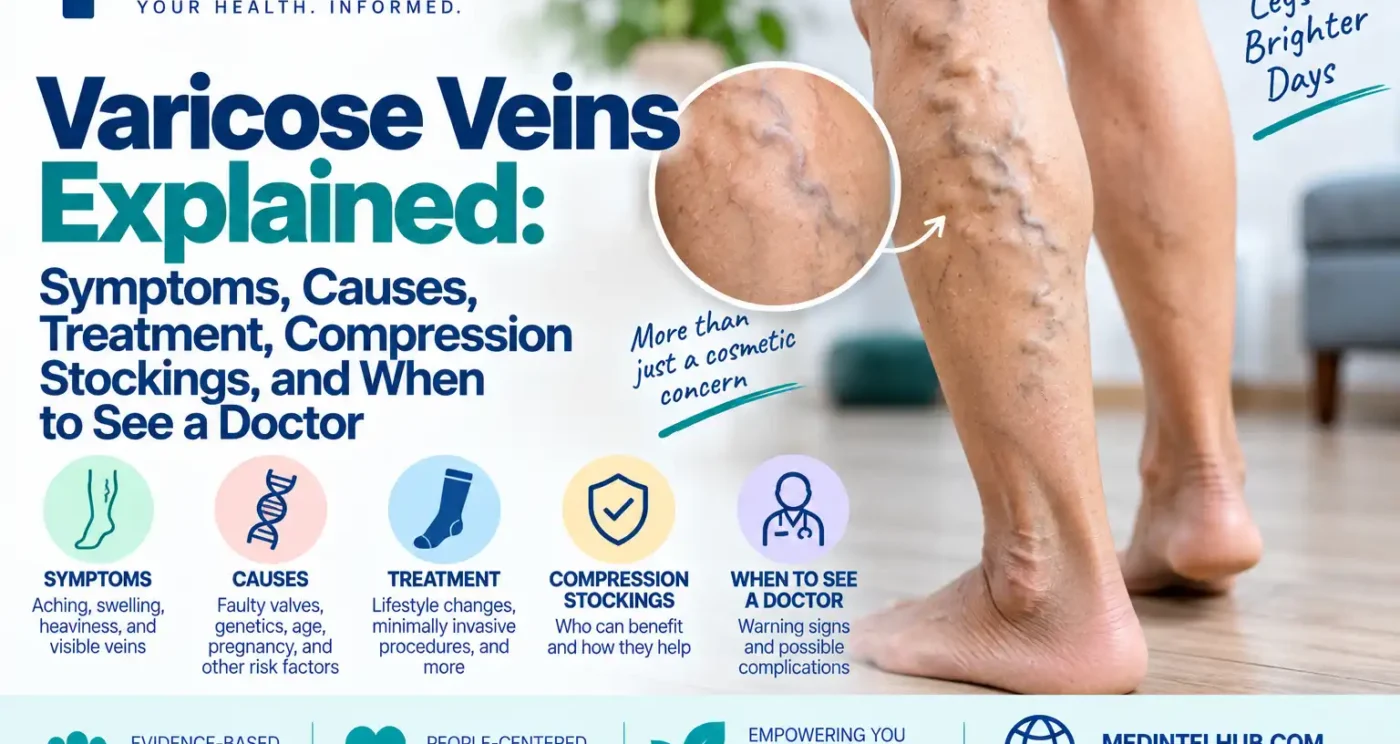
At first, a varicose vein may seem like little more than a cosmetic change.
A blue or purple vein begins standing out along the calf. Months later, it becomes more twisted or raised. After a long day on your feet, the leg may feel heavy or achy. Your ankle might swell by evening, then look almost normal again the next morning.
That pattern can happen when blood is no longer moving efficiently through the superficial veins of the leg.
Varicose veins are enlarged, twisted veins that develop when vein walls or one-way valves become weak or damaged. Instead of continuing efficiently toward the heart, some blood flows backward and pools inside the vein—a process called venous reflux. Over time, the affected vein can stretch, bulge, and become more visible beneath the skin.
For many people, varicose veins remain mostly an appearance concern.
For others, they become part of chronic venous disease, producing aching, heaviness, swelling, itching, skin discoloration, inflammation, ulcers, superficial blood clots, or occasionally significant bleeding.
Treatment has also changed.
Compression stockings can still help certain symptoms, but they do not repair a failed vein valve. Modern treatment increasingly uses outpatient procedures such as endovenous laser or radiofrequency ablation, nonthermal vein closure, sclerotherapy, and phlebectomy. Current U.S. vascular guidelines recommend intervention over long-term compression alone for many patients who have symptomatic axial reflux and are appropriate candidates for a procedure.
The important question is therefore not simply:
“Can I see a vein?”
It is:
“Is this vein causing symptoms, skin damage, clotting, bleeding, or another problem that deserves evaluation?”
What Are Varicose Veins?
Veins carry blood back toward the heart.
In the legs, that means moving blood upward against gravity.
The body has several mechanisms to help make that happen. Leg muscles squeeze the veins during walking, and one-way valves inside the veins help prevent blood from falling backward between heartbeats and muscle contractions.
When a vein wall stretches or a valve stops closing properly, blood can reflux downward.
The pressure inside that vein rises.
Over time, the vein becomes:
- Enlarged
- Twisted
- Elongated
- Bulging
- More visible beneath the skin
NHLBI describes weak or damaged vein walls and valves as the fundamental problem behind most leg varicose veins.
They are most common in the legs because standing creates substantial gravitational pressure in the lower-extremity veins.
What Do Varicose Veins Look Like?
The classic varicose vein is more noticeable than an ordinary surface blood vessel.
It may look:
- Blue
- Purple
- Greenish
- Skin-colored in some people
- Twisted
- Rope-like
- Raised above the skin
- Lumpy or bulging
NHS describes them as widened veins that appear swollen and twisted and may feel lumpy beneath the skin.
Their appearance can vary considerably with skin tone.
On lighter skin, blue and purple coloration may be obvious.
On deeper skin tones, color contrast may be less noticeable, while bulging, twisting, swelling, skin texture changes, or a rope-like feel may be easier to recognize.
What Do Varicose Veins Feel Like?
Some people feel nothing.
Others notice symptoms primarily after spending hours standing or sitting.
Possible symptoms include:
- Aching
- Heaviness
- Burning
- Throbbing
- Itching
- Leg fatigue
- Nighttime cramps
- Ankle or lower-leg swelling
- Tenderness around prominent veins
NHLBI notes that symptoms often worsen after prolonged sitting or standing and may improve when a person lies down or raises the legs.
That daily pattern is a useful clue.
A leg that feels progressively heavier by 6 p.m. but better after a night in bed fits venous congestion more closely than many other causes of leg pain.
Are Varicose Veins Always Painful?
No.
Someone can have very prominent veins and almost no discomfort.
Another person may have less dramatic-looking veins but substantial aching, heaviness, itching, or swelling.
Appearance and symptom severity do not always match.
That is why decisions about medical treatment should not be made from a photograph alone.
A clinician may need to assess the underlying reflux pattern, usually with duplex ultrasound when treatment is being considered.
Spider Veins vs. Varicose Veins: What Is the Difference?
These terms are often used interchangeably, but they describe different-sized vessels.
| Feature | Spider Veins | Varicose Veins |
|---|---|---|
| Size | Very small | Larger |
| Appearance | Thin, web-like or branching | Bulging, twisted, rope-like |
| Raised from skin | Usually no | Often |
| Color | Red, blue, purple | Blue, purple, greenish or skin-toned |
| Symptoms | Often mainly cosmetic | May cause aching, swelling, heaviness or itching |
| Underlying reflux | May or may not be significant | More often associated with venous reflux |
NHS notes that spider or thread veins are smaller red, blue, or purple veins and are distinct from the larger swollen veins seen in varicose disease.
Someone can have both at the same time.
What Causes Varicose Veins?
The central problem is usually venous hypertension caused by faulty valves, weakened vein walls, or both.
Imagine a series of small doors inside the vein.
Each door should open as blood moves upward and close afterward.
If those doors no longer seal properly, gravity allows some blood to fall back down.
That backward flow is called reflux.
Blood accumulates, venous pressure rises, and the superficial vein gradually stretches.
The process may involve one large superficial trunk vein, its branches, or multiple parts of the venous system.
Who Is More Likely to Develop Varicose Veins?
Several factors can increase the likelihood.
These include advancing age, pregnancy, family history, overweight or obesity, long periods of sitting or standing, limited physical activity, and a history of deep-vein thrombosis or other venous disease.
Some factors cannot be changed.
You cannot change your genetics or previous pregnancies.
Others can sometimes be modified, such as prolonged immobility, weight when medically appropriate, and physical activity.
Even then, lifestyle changes cannot guarantee prevention.
Someone can be active and healthy and still inherit a strong tendency toward varicose veins.
Are Varicose Veins Genetic?
Genetics appear to matter substantially.
Varicose veins commonly cluster in families, and both NHLBI and NHS include family history among recognized risk factors.
A family history does not mean someone is destined to develop severe disease.
It simply increases susceptibility.
Environmental and hormonal factors can then influence whether and when visible veins appear.
Why Does Pregnancy Cause Varicose Veins?
Pregnancy can place unusual demands on the venous system.
Blood volume increases.
Hormonal changes can make vein walls more distensible.
As the uterus enlarges, pressure on pelvic veins can make blood return from the legs more difficult.
For those reasons, varicose veins may first appear or worsen during pregnancy.
The encouraging part is that pregnancy-related varicose veins may improve after delivery.
NHS advises that compression stockings may be used for symptoms during pregnancy, while interventional treatment is generally postponed unless there is a compelling medical reason.
Can Standing All Day Cause Varicose Veins?
Prolonged standing can contribute to the problem.
When someone remains upright for hours, gravitational pressure stays high in the leg veins.
The calf muscles also provide less pumping assistance if the person is standing still rather than walking.
This can worsen:
- Aching
- Swelling
- Heaviness
- Venous pressure
Standing is better described as a risk and aggravating factor than the sole cause.
Someone whose valves and vein walls are genetically robust may stand frequently without developing significant varicose veins.
Can Sitting Too Long Make Varicose Veins Worse?
Yes.
The calf muscles act like a pump when you walk.
Long periods of sitting reduce that pumping action, allowing more blood to remain in the legs.
NHS recommends avoiding prolonged periods of sitting or standing when possible and staying physically active.
For someone with a desk job, frequent short walks may be more practical than trying to remain constantly on their feet.
Does Crossing Your Legs Cause Varicose Veins?
Crossing your legs has not been established as the primary cause of varicose veins.
Valve failure, vein-wall weakness, genetics, pregnancy, age, obesity, prior venous disease, and prolonged immobility are much more important.
Changing position regularly is still useful for circulation.
But someone should not assume their varicose veins developed because they sat cross-legged.
Can Being Overweight Cause Varicose Veins?
Excess body weight can increase pressure on the leg veins and is associated with varicose-vein risk.
Weight management may therefore improve symptoms in someone with overweight or obesity.
But weight is not the entire explanation.
Thin people develop varicose veins too.
And once valves have become incompetent, weight loss does not necessarily make established veins disappear.
Are Varicose Veins Dangerous?
Usually not immediately.
Many people live with them for years without serious complications.
But varicose veins are not always purely cosmetic.
Possible complications include:
- Persistent swelling
- Chronic skin inflammation
- Brown skin discoloration
- Thickened skin
- Venous leg ulcers
- Superficial vein thrombosis
- Bleeding
- Deep-vein thrombosis in some patients
NHLBI, MedlinePlus, and NHS all describe skin changes, ulcers, clotting, and bleeding among possible complications of chronic varicose-vein disease.
Can Varicose Veins Cause Skin Discoloration?
Yes.
Longstanding venous hypertension can damage small vessels and tissues around the ankle and lower leg.
Skin may become:
- Brown
- Reddish-brown
- Darker than surrounding skin
- Dry
- Flaky
- Itchy
- Thickened or hardened
MedlinePlus describes skin-color changes, dry irritated skin, and thickening of tissue around the legs and ankles when venous flow becomes sufficiently impaired.
Those changes are more than a cosmetic issue.
They suggest more advanced chronic venous disease.
What Is Venous Eczema?
Venous eczema—also called stasis dermatitis or varicose eczema—develops when longstanding venous pressure contributes to inflammation of the lower-leg skin.
The skin may become:
- Itchy
- Dry
- Scaly
- Inflamed
- Darkened
- Easily irritated
NHS identifies itchy, flaky, dry skin over affected veins as one complication of varicose-vein disease.
Good skin care is important because cracked, fragile skin is more vulnerable to infection and ulceration.
What Is a Venous Leg Ulcer?
A venous ulcer is an open sore caused by chronic venous hypertension and tissue damage.
They commonly develop around the lower leg or ankle.
A typical ulcer may:
- Heal slowly
- Produce drainage
- Become painful
- Recur after healing
- Become infected
NHLBI warns that varicose-vein disease can lead to ulcers, while NHS advises medical assessment for a leg sore that has not healed within two weeks.
An ulcer should not simply be covered indefinitely without addressing the venous disease contributing to it.
Can Varicose Veins Cause Blood Clots?
Varicose veins can be associated with superficial vein thrombosis, sometimes called superficial thrombophlebitis.
The affected vein may suddenly become:
- Hard
- Tender
- Warm
- Painful
- Rope-like
A superficial clot is different from a deep-vein thrombosis, but the distinction is clinically important because superficial thrombosis can occasionally coexist with or extend toward deeper veins.
The 2023 U.S. vascular guideline includes dedicated recommendations for evaluating and treating superficial vein thrombosis because of its relationship with venous thromboembolism.
Varicose Veins vs. DVT: What Is the Difference?
A deep-vein thrombosis, or DVT, is a blood clot in a deep vein, usually in the lower leg, thigh, or pelvis.
It is not the same as ordinary varicose veins.
Possible DVT symptoms include:
- New swelling, often affecting one leg
- Pain or tenderness
- Aching or cramping
- Increased warmth
- Red or discolored skin
NHLBI advises prompt medical attention for suspected DVT because a clot can break loose and travel to the lungs.
A chronic bulging vein that has looked the same for years is one situation.
A leg that suddenly becomes swollen, painful, warm, and noticeably different from the other is another.
Do not assume sudden one-sided swelling is simply your varicose veins acting up.
What Is a Pulmonary Embolism?
A pulmonary embolism, or PE, occurs when a blood clot—often from a DVT—travels to the lungs and blocks pulmonary blood flow.
Possible symptoms include:
- Sudden shortness of breath
- Pain with deep breathing
- Rapid breathing
- Rapid heartbeat
- Cough, sometimes with blood
- Lightheadedness
- Fainting
Pulmonary embolism can be life-threatening.
New chest pain or shortness of breath together with a swollen or painful leg requires emergency evaluation.
Can Varicose Veins Bleed?
Yes.
It is uncommon, but it can be serious.
A vein sitting immediately beneath thin, damaged skin may rupture spontaneously or after relatively minor trauma.
Because venous pressure can remain high while someone is standing, bleeding may be brisk.
NHLBI classifies bleeding from varicose veins as a medical emergency, and the 2023 SVS/AVF/AVLS guideline calls for prompt specialist referral after a bleeding episode.
What Should You Do if a Varicose Vein Starts Bleeding?
If bleeding occurs:
- Lie down or sit down safely.
- Raise the affected leg above the level of the heart.
- Apply firm direct pressure directly over the bleeding point.
- Keep the pressure in place rather than repeatedly lifting the dressing to check.
- Seek urgent medical assistance.
Current vascular guidance specifically recommends leg elevation and direct compression as immediate measures for bleeding varicose veins.
Do not stand upright and wait for it to stop.
And do not place a tight tourniquet above the bleeding vein; inappropriate proximal constriction can worsen venous bleeding.
Even if bleeding stops, the underlying venous disease should be evaluated because another episode can occur.
How Are Varicose Veins Diagnosed?
Diagnosis usually begins with examination of the legs.
A clinician may look at the veins while you are standing and ask about:
- Pain
- Heaviness
- Swelling
- Itching
- Skin changes
- Ulcers
- Previous blood clots
- Family history
- Pregnancy history
- Work involving prolonged standing
NHLBI notes that physical examination is often enough to recognize visible varicose veins.
If symptoms are significant or treatment is being planned, the next major test is usually a duplex ultrasound.
What Is a Duplex Ultrasound?
A duplex ultrasound uses sound waves to examine both the structure of the veins and the direction of blood flow.
It can show:
- Which valves are failing
- Where reflux occurs
- Whether the great or small saphenous vein is involved
- How extensive the problem is
- Whether a clot is present
- Which veins should be treated
NHLBI calls duplex ultrasound a common diagnostic test for varicose veins, and NHS notes that specialists typically use it to confirm the diagnosis and plan treatment.
This matters because the visible vein may be only the surface manifestation of reflux farther up the leg.
Do All Varicose Veins Need Treatment?
No.
A painless vein that causes no swelling, skin damage, thrombosis, ulceration, or other complication may not need medical treatment.
Some people choose treatment primarily because they dislike the appearance.
Others need treatment because symptoms interfere with:
- Work
- Exercise
- Sleep
- Standing
- Daily activity
NHS notes that intervention is not always necessary, while symptoms such as pain, heaviness, swelling, itching, skin changes, and ulceration make specialist assessment more relevant.
What Can Help Varicose Veins at Home?
Conservative measures can reduce symptoms even though they do not repair the failed valves.
Useful approaches may include:
- Walking and regular physical activity
- Avoiding prolonged immobility
- Raising the legs while resting
- Weight management when relevant
- Moisturizing dry lower-leg skin
- Compression stockings when appropriate
NHLBI and NHS both recommend activity and leg elevation as practical symptom-management strategies.
Does Walking Help Varicose Veins?
Yes, especially with symptoms.
Walking causes the calf muscles to contract.
Those contractions help push blood upward through the leg veins.
NHLBI specifically notes that walking and exercise improve the muscle-pump function that assists venous return.
Walking does not repair a damaged valve.
But it may reduce stagnation, heaviness, and swelling and supports broader cardiovascular health.
Can Exercise Make Varicose Veins Disappear?
Usually not.
Exercise can improve venous return and symptom control.
An enlarged vein with established valve failure typically does not shrink permanently back to normal simply because someone begins exercising.
That does not make exercise pointless.
It means exercise is symptom management and general health support, not a vein-ablation technique.
Does Leg Elevation Help?
Yes.
Raising the legs reduces gravitational pressure and allows blood and fluid to move out of the lower extremities more easily.
That can temporarily improve:
- Aching
- Heaviness
- Swelling
NHLBI and NHS both recommend elevation when symptoms occur.
If swelling becomes persistent despite overnight rest and elevation, the underlying disease may be progressing.
Do Compression Stockings Help Varicose Veins?
They can.
Compression stockings squeeze the leg more firmly near the ankle and usually less strongly farther upward.
This supports venous return and may help reduce:
- Swelling
- Aching
- Heaviness
- Fatigue
MedlinePlus describes compression as useful for swelling and heavy, aching legs.
But there is an important limitation:
Compression stockings manage pressure and symptoms. They do not restore a damaged valve to normal.
NHLBI explicitly notes that compression relieves symptoms while procedures address the reflux causing the varicose veins.
Are Compression Stockings the First Treatment Everyone Must Try?
Not necessarily.
This is an area where older advice and insurance requirements can create confusion.
The 2025 SCAI chronic venous disease guideline suggests compression rather than no compression for patients with symptomatic varicose veins, although the certainty of evidence is very low and interventional alternatives may be preferred by some patients.
At the same time, the more varicose-vein-specific 2023 SVS/AVF/AVLS guideline recommends superficial venous intervention over long-term compression stockings for patients with symptomatic axial reflux of the great or small saphenous vein who are suitable candidates for treatment.
Those statements are not contradictory.
Compression can help symptoms.
But if the person has documented reflux, wants definitive treatment, and is an appropriate procedural candidate, compression does not have to be viewed as the only long-term solution.
Do You Have to Wear Compression Stockings for Three Months Before Treatment?
Not from a medical-guideline standpoint for every patient.
The 2023 SVS/AVF/AVLS guideline specifically suggests against requiring a mandatory three-month compression trial before endovenous treatment for an appropriate symptomatic candidate who wishes to proceed.
Insurance authorization policies can still differ.
That means a payer may impose requirements that are not identical to clinical guideline recommendations.
What Compression Strength Should You Buy?
There is no single pressure appropriate for everyone.
Compression stockings come in different strengths and lengths.
Higher pressure is not automatically better.
Choosing compression may depend on:
- Amount of swelling
- Severity of venous disease
- Presence of an ulcer
- Arterial circulation
- Skin condition
- Ability to put the stockings on
- Other medical conditions
MedlinePlus recommends discussing the appropriate stocking type and pressure with a healthcare professional.
Who Should Be Careful With Compression Stockings?
People with significant arterial circulation problems need particular caution.
Compression that is safe for someone with normal arterial flow may be inappropriate when blood delivery to the foot is already substantially reduced.
NHS specifically warns that compression stockings may not be suitable for people with problems involving arterial blood flow.
This is one reason high-strength compression should not be chosen simply because it sounds more effective.
What Treatments Can Get Rid of Varicose Veins?
Modern treatment usually aims to close or remove the abnormal superficial vein.
Blood then reroutes through healthy veins.
Depending on the reflux pattern, treatments may include:
- Endovenous laser ablation
- Radiofrequency ablation
- Other nonthermal endovenous closure techniques
- Sclerotherapy
- Foam sclerotherapy
- Ambulatory phlebectomy
- Surgical ligation and stripping in selected cases
The exact choice depends on vein anatomy, symptoms, previous treatment, expertise, patient preference, and availability.
What Is Endovenous Ablation?
Endovenous ablation closes a refluxing vein from inside.
A clinician uses ultrasound to guide a thin catheter into the abnormal vein.
Depending on the technique, the vein is then closed using heat or a nonthermal mechanism.
The body gradually redirects blood through functioning veins.
For suitable patients with symptomatic axial reflux of the great or small saphenous vein, current U.S. vascular guidelines recommend endovenous ablation over traditional high ligation and stripping.
What Is Radiofrequency Ablation?
Radiofrequency ablation, or RFA, is a thermal endovenous treatment.
A catheter delivers controlled radiofrequency energy to the vein wall.
The vein contracts and seals.
It is typically performed with ultrasound guidance and local anesthesia, and many patients go home the same day.
NHS describes radiofrequency ablation as one of the main endothermal treatments for varicose veins.
What Is Endovenous Laser Treatment?
Endovenous laser ablation—often abbreviated EVLA or EVLT—works on the same general principle.
Instead of radiofrequency energy, laser energy heats the vein wall and causes the vein to close.
Current U.S. guidelines support both thermal and appropriate nonthermal ablation techniques depending on anatomy, clinician expertise, and patient preference.
Where Does the Blood Go After a Vein Is Closed?
This question worries many patients.
Closing a diseased superficial vein does not normally stop the leg from draining blood.
The majority of venous return occurs through deeper healthy veins.
Once a refluxing superficial vein is closed, blood is redirected through other functioning pathways.
The purpose is to remove a pathway that is allowing blood to fall backward rather than eliminating healthy circulation.
What Is Sclerotherapy?
Sclerotherapy involves injecting a substance into the abnormal vein.
The medication irritates the inner lining, causing the vein to collapse and eventually close.
Sclerotherapy is commonly used for:
- Spider veins
- Smaller varicose veins
- Selected tributary veins
- Certain refluxing veins
MedlinePlus describes sclerotherapy as a common office-based treatment in which a solution is injected to close the abnormal vessel.
What Is Foam Sclerotherapy?
In foam sclerotherapy, the sclerosant is mixed into a foam.
The foam displaces blood within the vein and increases contact between the medication and the vein wall.
NHS describes ultrasound-guided foam sclerotherapy as an option when endothermal ablation is unsuitable.
The best treatment depends on which vein is refluxing.
Foam is not automatically better simply because it can treat a larger area.
What Is Ambulatory Phlebectomy?
Phlebectomy removes visible surface varicose veins through very small skin openings.
A clinician makes tiny punctures and extracts segments of the abnormal vein.
It may be used:
- By itself for selected veins
- Alongside saphenous-vein ablation
- For bulging tributaries remaining after another procedure
MedlinePlus describes phlebectomy as removal of abnormal veins through small skin cuts.
Is Vein Stripping Still Used?
Yes, but much less often as the default first approach.
Traditional ligation and stripping involves surgically tying and physically removing a refluxing vein.
Current SVS/AVF/AVLS guidance recommends endovenous ablation over stripping for many suitable patients with symptomatic great or small saphenous reflux.
Surgery still has a role when:
- Anatomy makes endovenous treatment unsuitable
- Appropriate technology is unavailable
- Other clinical factors favor surgery
NHS similarly describes stripping as an option when simpler endovenous procedures are unsuitable.
Do Varicose Veins Come Back After Treatment?
They can.
Successful treatment can permanently close the specific vein that was treated.
But a person who develops venous valve disease remains predisposed to future problems.
Over time:
- New veins may become incompetent.
- New varicosities may appear.
- Previously treated areas may require further evaluation.
- Additional treatment sessions may be needed.
NHLBI notes that new varicose veins can develop even after successful treatment.
So “the vein was treated” and “I can never develop another varicose vein” are not the same statement.
Is Varicose Vein Treatment Cosmetic?
Sometimes.
If the only concern is appearance and there is no pain, swelling, reflux-related skin disease, ulceration, clotting, or bleeding, treatment may be considered cosmetic.
But symptomatic venous disease is not merely cosmetic.
Medical reasons for treatment can include:
- Persistent pain
- Heaviness
- Swelling
- Skin changes
- Recurrent superficial thrombosis
- Ulcers
- Bleeding
Insurance coverage depends on the policy and the documentation of medical necessity.
Can Varicose Veins Be Prevented?
Not completely.
Some major risk factors cannot be altered.
You cannot change:
- Age
- Genetic predisposition
- Previous pregnancy
- Certain prior venous injuries
Measures that may support venous health include staying physically active, avoiding prolonged immobility, managing weight when appropriate, and changing position regularly.
These actions may improve symptoms and reduce venous pressure.
They cannot guarantee that valve failure will never occur.
Can Varicose Veins Go Away Naturally?
Established varicose veins generally do not disappear completely on their own.
Pregnancy-related veins are an important exception because they may improve substantially after delivery.
Symptoms can also fluctuate.
A vein may look less prominent after a night of elevation and much larger after standing all day.
That change does not necessarily mean the underlying valve has repaired itself.
Can Creams Remove Varicose Veins?
No topical cream has been shown to repair a failed venous valve or close a major refluxing vein.
Moisturizers can still be useful when chronic venous disease causes dry, irritated skin.
But products advertised as “dissolving” or permanently removing varicose veins through the skin should be viewed cautiously.
Definitive treatments act on the vein itself.
When Should You See a Doctor for Varicose Veins?
You do not necessarily need medical treatment simply because you can see a vein.
Evaluation becomes more useful when varicose veins cause:
- Persistent aching or pain
- Heaviness
- Swelling
- Significant itching
- Skin discoloration
- Dry or damaged lower-leg skin
- A hard painful vein
- An open sore
- Repeated worsening
- Interference with work or activity
NHS recommends medical assessment for symptomatic veins, worsening disease, and leg sores that do not heal.
A new symptomatic vein problem also does not need to wait for the next routine preventive checkup. MedIntelHub’s guide explains why a specific medical concern may deserve a separate problem-focused visit:
Understanding Your Annual Physical: What Actually Gets Checked
When Should You See a Vein or Vascular Specialist?
Specialist evaluation is especially reasonable when:
- Symptoms are persistent despite conservative care.
- Duplex ultrasound shows significant reflux.
- Skin changes are developing.
- There is a venous ulcer.
- A superficial vein has thrombosed.
- A varicose vein has bled.
- Previous varicose-vein treatment has failed or disease has returned.
- You are considering ablation, sclerotherapy, or phlebectomy.
Before a vascular appointment, it can help to bring a medication list, previous ultrasound results, a history of blood clots, details about previous vein procedures, and a short timeline of symptoms.
MedIntelHub’s appointment-planning guide can help organize those questions:
How to Prepare Questions Before a Specialist Appointment
When Are Varicose Veins Urgent?
Seek prompt medical assessment when:
- A vein begins bleeding.
- One leg suddenly becomes significantly swollen.
- New calf or thigh pain develops.
- A vein becomes hard, hot, and painful.
- An ulcer develops.
- Skin changes rapidly worsen.
- There is sudden unexplained leg redness or warmth.
These changes can indicate complications that are different from uncomplicated chronic varicose veins.
When Are Varicose Veins an Emergency?
Two situations deserve particular attention.
Active Bleeding
NHLBI advises calling emergency services for bleeding from varicose veins. Immediate measures include lying down, elevating the affected leg, and applying firm direct pressure.
Possible Pulmonary Embolism
Seek emergency medical care for:
- Sudden shortness of breath
- Chest pain, especially with breathing
- Fainting or severe lightheadedness
- Coughing blood
- Rapid breathing
These symptoms are particularly concerning when they occur with new swelling or pain in one leg.
A visible varicose vein by itself is usually not an emergency.
Bleeding or possible venous thromboembolism is different.
Varicose Veins at a Glance
| Question | Key Point |
|---|---|
| What are varicose veins? | Enlarged, twisted superficial veins |
| What causes them? | Weak or damaged valves and vein walls causing reflux |
| Common symptoms | Aching, heaviness, itching, swelling, cramping |
| Are they always dangerous? | No, but complications can occur |
| Spider veins vs. varicose veins | Spider veins are smaller and usually flat |
| Main diagnostic test | Duplex ultrasound when further assessment is needed |
| Do compression stockings cure them? | No; they can help symptoms |
| Can walking help? | Yes, particularly with venous return and symptoms |
| Can established veins disappear naturally? | Usually not |
| Modern treatment | Ablation, sclerotherapy, phlebectomy and selected surgery |
| Does treatment permanently prevent all new veins? | No |
| Bleeding vein | Requires urgent/emergency attention |
| Sudden one-sided swelling | DVT must be considered |
Frequently Asked Questions
What Causes Varicose Veins?
Varicose veins usually develop when vein walls or one-way valves become weakened or damaged, allowing blood to flow backward and pool in the leg.
What Are the First Signs of Varicose Veins?
Some people first notice a visible twisted vein.
Others begin with heaviness, aching, itching, mild ankle swelling, or discomfort after spending a long time standing.
Are Varicose Veins Dangerous?
Most are not immediately dangerous.
Complications can include chronic swelling, skin changes, superficial thrombosis, ulcers, bleeding, and DVT.
What Is the Difference Between Spider Veins and Varicose Veins?
Spider veins are small, thin surface vessels that are usually flat.
Varicose veins are larger, bulging veins and are more likely to be associated with venous reflux and symptoms.
Can Varicose Veins Cause Leg Swelling?
Yes.
Ankle and lower-leg swelling commonly occurs when venous pressure remains elevated, particularly later in the day.
Can Varicose Veins Cause Itching?
Yes.
Itching can occur directly around the vein or as part of chronic venous skin inflammation.
Why Do My Varicose Veins Hurt More at Night?
Long periods of standing or sitting during the day can allow venous pressure and fluid accumulation to build.
Some people therefore notice aching, heaviness, or cramping later in the day or at night.
Can Varicose Veins Cause Blood Clots?
They can be associated with superficial vein thrombosis.
Sudden significant swelling, pain, warmth, or discoloration should be medically assessed because DVT may need to be excluded.
How Do I Know if I Have a DVT Instead of Varicose Veins?
You cannot reliably diagnose DVT at home.
New one-sided swelling, pain, tenderness, warmth, or discoloration deserves prompt evaluation.
Can Varicose Veins Bleed?
Yes.
Bleeding is uncommon but can be significant. Leg elevation and firm direct pressure are immediate first-aid measures, followed by urgent medical care.
Does Walking Help Varicose Veins?
Yes.
Walking activates the calf-muscle pump and helps return venous blood toward the heart.
Can Exercise Get Rid of Varicose Veins?
No.
Exercise may improve symptoms and circulation but does not normally repair an incompetent valve.
Does Losing Weight Remove Varicose Veins?
Usually not.
Weight management may reduce venous pressure and symptoms when excess weight is present, but established refluxing veins may remain.
Do Compression Stockings Work?
They can help reduce swelling, aching, and heaviness.
They do not permanently repair the reflux causing varicose veins.
Do You Have to Wear Compression Stockings Before Vein Treatment?
Not necessarily.
The 2023 SVS/AVF/AVLS guideline suggests against requiring a mandatory three-month compression trial for suitable symptomatic patients who want endovenous therapy.
Insurance policies may still impose their own requirements.
What Is the Best Compression Level?
There is no universal compression pressure appropriate for everyone.
The correct strength depends on symptoms, arterial circulation, venous disease severity, ulcers, and other medical factors.
Can Compression Stockings Be Dangerous?
They can be inappropriate in some people with significant arterial circulation problems.
A clinician should assess suitability when there is concern about arterial disease.
What Is the Best Treatment for Varicose Veins?
It depends on the anatomy and reflux pattern.
For many suitable patients with symptomatic axial reflux, current vascular guidelines favor endovenous ablation over traditional stripping.
What Is Endovenous Ablation?
It is a minimally invasive procedure that closes an abnormal refluxing vein from inside using thermal or nonthermal techniques.
Is Laser Treatment the Same as Surgery?
No.
Endovenous laser ablation uses a catheter and laser energy to close the vein from inside and is generally less invasive than traditional stripping.
What Is Radiofrequency Ablation?
RFA uses radiofrequency heat delivered through a catheter to close the diseased vein.
What Is Sclerotherapy?
Sclerotherapy involves injecting a medication into an abnormal vein to make it close.
It is often used for spider veins, tributaries, and selected varicose veins.
Can Treated Varicose Veins Come Back?
The specific treated vein may remain closed, but new varicose veins can develop elsewhere because the underlying tendency toward venous disease remains.
Can Pregnancy Cause Varicose Veins?
Yes.
Pregnancy increases venous pressure and is a recognized risk factor. Veins that appear during pregnancy may improve after childbirth.
Should Varicose Veins Be Treated During Pregnancy?
Procedures are generally postponed during pregnancy unless treatment is medically necessary.
Compression stockings may be used to help symptoms.
Can Varicose Veins Cause Ulcers?
Yes.
Longstanding venous hypertension can damage lower-leg skin and contribute to slowly healing venous ulcers.
When Should You Worry About Varicose Veins?
Seek medical evaluation for persistent pain, swelling, skin changes, hard or inflamed veins, nonhealing sores, or worsening symptoms.
Bleeding, sudden one-sided swelling, or symptoms suggesting pulmonary embolism require more urgent attention.
Conclusion
Varicose veins begin with a problem that cannot always be seen from the outside.
A valve stops closing properly.
Blood falls backward.
Pressure builds.
Eventually the vein stretches enough to become the familiar blue, purple, twisted cord beneath the skin.
For some people, that is where the story ends.
The vein looks different but causes little trouble.
For others, the increasing venous pressure produces aching, heaviness, swelling, itching, skin discoloration, ulcers, inflammation, or bleeding.
That difference determines how aggressively the condition needs to be managed.
Walking, leg elevation, weight management when relevant, and compression stockings can all improve symptoms. Compression is particularly useful for swelling and heaviness, but it should be understood for what it is: a way to manage venous pressure, not a way to repair a damaged valve.
Definitive treatment has become far less invasive than traditional vein surgery for many patients.
Endovenous laser treatment, radiofrequency ablation, nonthermal closure, sclerotherapy, and phlebectomy can often be performed without traditional stripping. The 2023 U.S. vascular guideline recommends endovenous ablation over long-term compression alone for many appropriate symptomatic patients with documented axial reflux and also recommends it over traditional stripping when anatomy and expertise allow.
Duplex ultrasound helps determine whether that kind of treatment makes sense.
And a few warning signs should never be treated as ordinary cosmetic vein problems.
Sudden one-sided swelling and pain may represent DVT. Chest pain or shortness of breath can signal pulmonary embolism. A bleeding varicose vein can produce substantial blood loss and requires immediate attention.
Most varicose veins are manageable.
The important part is knowing when they have stopped being merely visible and started becoming medically significant.
Resources
National Heart, Lung, and Blood Institute — Varicose Veins
NHLBI provides patient-focused information about symptoms, venous valve failure, duplex ultrasound, compression therapy, treatment, ulcers, and bleeding.
Society for Vascular Surgery / American Venous Forum / American Vein & Lymphatic Society — Clinical Guidelines
The major U.S. guideline covers compression therapy, duplex-based evaluation, endovenous ablation, sclerotherapy, superficial vein thrombosis, bleeding varicose veins, and treatment selection.
2023 U.S. Varicose Vein Clinical Practice Guideline
SCAI — 2025 Chronic Venous Disease Guideline
Current guidance discusses compression therapy and interventional treatment options for symptomatic chronic venous disease.
2025 SCAI Chronic Venous Disease Guideline
NHS — Varicose Veins
Covers symptoms, pregnancy, self-care, duplex ultrasound, endothermal ablation, foam sclerotherapy, compression stockings, surgery, and complications.
NHLBI — Deep Vein Thrombosis and Pulmonary Embolism
Useful for distinguishing chronic varicose-vein symptoms from the warning signs of potentially dangerous venous blood clots.
MedIntelHub — Editorial Policy
For more information about MedIntelHub’s approach to sourcing, medical accuracy, transparency, and patient education:
Editorial Disclaimer
This article is intended for general educational and informational purposes only. It does not diagnose varicose veins, chronic venous insufficiency, superficial vein thrombosis, deep-vein thrombosis, pulmonary embolism, arterial disease, or another cause of leg swelling or pain.
Do not choose high-strength compression stockings solely from general online advice if you have known or suspected arterial circulation problems, significant neuropathy, open wounds, or other vascular disease. Compression type and strength may need individualized assessment.
Visible varicose veins do not automatically require treatment. Likewise, sudden leg swelling or pain should not automatically be blamed on pre-existing varicose veins.
If a varicose vein begins bleeding, lie or sit safely, elevate the affected leg, apply firm direct pressure to the bleeding point, and obtain urgent medical assistance.
Seek emergency medical care for sudden shortness of breath, chest pain, coughing blood, fainting, or other symptoms that could indicate pulmonary embolism.

David Bennett
David Bennett is an author at MedIntelHub, where he creates clear, practical, and well-researched content about healthcare, medical billing, insurance, and patient education. His goal is to make complex healthcare topics easier for readers to understand and use in everyday situations. David emphasizes accuracy, transparency, and reliable sourcing, using information from trusted organizations and official healthcare resources whenever possible. Content published by David is intended for educational purposes and should not replace advice from qualified medical, legal, or healthcare professionals.