It often starts with an itch.
Maybe you were pulling weeds over the weekend, hiking through brush, clearing a fence line, or playing with a dog that had been running through the woods. Nothing seemed unusual at the time. Then a day or two later, a few itchy bumps appear on your arm.
By evening, there are more.
Some form a straight line. Others become tiny blisters. The itching can become intense enough to interrupt sleep, and when another patch appears the next morning, it is easy to wonder whether the rash is somehow spreading through your body.
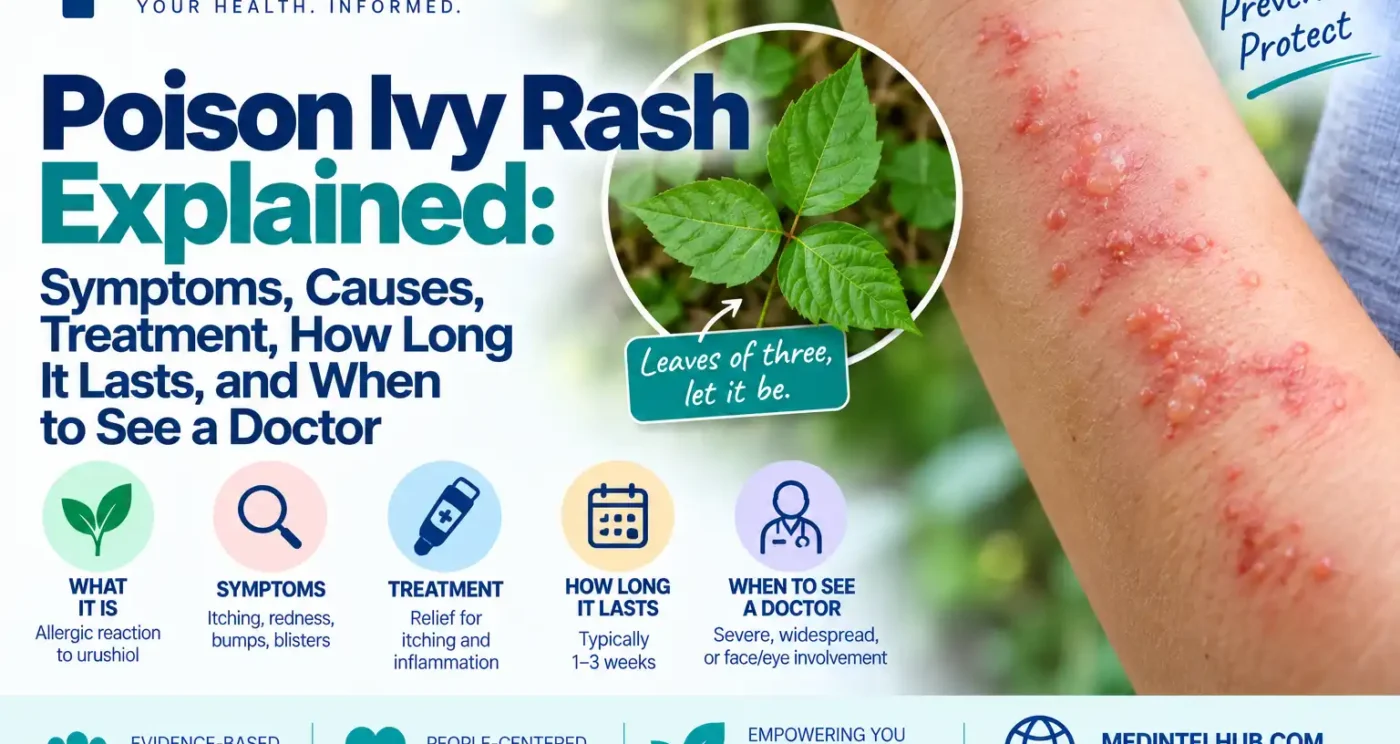
That pattern is typical of poison ivy rash, an allergic skin reaction caused by urushiol, an oily substance found in poison ivy, poison oak, and poison sumac. The rash can cause intense itching, swelling, bumps, and fluid-filled blisters and commonly lasts for a couple of weeks.
One of the biggest misconceptions is that poison ivy is contagious.
The rash itself does not spread from person to person, and fluid from poison ivy blisters does not cause new poison ivy rashes. What can spread the reaction is urushiol that remains on skin, clothing, shoes, gardening tools, outdoor equipment, or even a pet’s fur.
Understanding that distinction can make poison ivy much easier to manage.
What Is a Poison Ivy Rash?
Poison ivy rash is a form of allergic contact dermatitis.
Contact dermatitis is inflammation that develops after the skin encounters something capable of triggering an irritant or allergic reaction.
With poison ivy, the trigger is urushiol.
Urushiol is present throughout poison ivy, poison oak, and poison sumac, including the leaves, stems, vines, roots, flowers, and other plant parts. When the oil touches susceptible skin, the immune system recognizes it as a foreign substance and produces an inflammatory reaction.
The result may include:
- Intense itching
- Inflamed or discolored skin
- Raised bumps
- Swelling
- Fluid-filled blisters
- Oozing
- Crusting as the rash heals
The reaction can be mild and limited to one small area or extensive enough to involve large portions of the body.
Is Poison Ivy Actually Poisonous?
The name can be misleading.
Poison ivy does not typically “poison” someone in the way swallowing a toxic chemical would.
For the familiar skin rash, the problem is primarily an immune reaction to urushiol.
The immune system becomes sensitized to the oil and responds with allergic contact dermatitis.
That is why two people touching the same plant may not develop exactly the same rash.
One may develop a few itchy bumps.
Another may develop extensive blistering and swelling.
The amount of urushiol, the area exposed, and the person’s immune sensitivity all affect the severity.
What Does a Poison Ivy Rash Look Like?
The classic rash is intensely itchy, inflamed, and blistering.
It may appear as:
- Small bumps
- Raised patches
- Blisters
- Streaks
- Lines
- Clusters of lesions
- Swollen skin
CDC describes poison-plant dermatitis as producing bumps, patches or streaks, weeping blisters, swelling, and itching.
The exact color depends partly on skin tone.
On lighter skin, inflammation may appear bright pink or red.
On darker skin, redness may be less obvious, and the rash can appear darker, purple-brown, grayish, or closer to the surrounding skin tone. Swelling, blistering, texture changes, and intense itching can therefore be particularly useful clues.
Why Does Poison Ivy Often Appear in Lines?
Linear streaks are one of the classic clues.
They happen because a poison ivy leaf, vine, stem, or urushiol-coated object can brush across the skin in a line.
Mayo Clinic notes that poison ivy frequently forms a straight-line pattern after direct plant contact. When exposure comes from contaminated clothing or pet fur, however, the distribution can be much less orderly.
So straight lines support the diagnosis, but their absence does not rule it out.
Can Poison Ivy Look Like Black Spots?
Rarely, yes.
The American Academy of Dermatology describes an uncommon reaction called black-spot poison ivy dermatitis, in which black spots or streaks can appear rather than the more familiar red, blistering eruption.
Because dark spots have many other possible causes, a new unusual black skin eruption should not automatically be self-diagnosed as poison ivy.
How Soon Does Poison Ivy Rash Appear?
The timing is more variable than many people realize.
If you have reacted to poison ivy, poison oak, or poison sumac before, the AAD says a new rash commonly appears within about 4 to 48 hours.
If you have never previously developed a rash from these plants, the first recognizable reaction may take considerably longer—sometimes 2 to 3 weeks.
That can make the first episode confusing.
Someone may develop an itchy blistering rash and have difficulty remembering what they touched two weeks earlier.
Why Can Poison Ivy Appear Days Later?
The allergic reaction does not happen at exactly the same speed everywhere.
One area of skin may have received a large amount of urushiol and react first.
Another area may have received only a small amount and develop symptoms later.
Skin thickness also differs across the body.
As a result, new patches can become visible over several days even though the exposure happened at roughly the same time.
This is one reason people commonly believe the rash is “spreading.”
Does Poison Ivy Rash Spread Through the Body?
No—not in the way people often imagine.
Once urushiol has been washed away or absorbed, the dermatitis itself does not travel through the bloodstream from one patch of skin to another.
New patches generally reflect one of two things:
- Different exposed areas reacting at different times.
- New contact with urushiol that remained on an object, clothing, equipment, pet fur, or another surface.
AAD specifically explains that blistering appearing in new areas is commonly mistaken for spread when it actually reflects delayed reactions or continued urushiol exposure.
Is Poison Ivy Contagious?
No.
You cannot catch poison ivy simply by touching another person’s established rash.
AAD states clearly that the rash itself is not contagious.
You can hug someone who has poison ivy without catching the dermatitis from their blisters.
The exception involves remaining plant oil.
If urushiol is still present on the person’s skin, clothing, footwear, or equipment, touching the oil can expose you.
Once the urushiol has been thoroughly removed, the rash itself cannot infect another person.
Does Poison Ivy Blister Fluid Spread the Rash?
No.
This is one of the most persistent poison ivy myths.
The fluid that leaks from poison ivy blisters does not cause the rash to spread.
CDC specifically notes that blister fluid will not cause new poison ivy blisters in the affected person or someone else.
So if one blister breaks and another patch appears the next day, the new patch was not created by the liquid from the first blister.
The delayed allergic response or another urushiol exposure is the more likely explanation.
Can Scratching Spread Poison Ivy?
Scratching an established, clean rash does not make urushiol circulate through the body.
But scratching can still create problems.
It can damage the skin barrier and increase the chance that bacteria enter the area.
AAD recommends avoiding scratching because broken skin may become infected.
Scratching immediately after fresh exposure can also potentially move urushiol if the oil is still on the fingers or under the nails.
That is why washing beneath the nails after suspected exposure is important.
Can You Get Poison Ivy From Another Person’s Clothes?
Yes.
This is a different situation from touching the rash.
Urushiol can remain on:
- Shirts
- Pants
- Jackets
- Shoes
- Gloves
- Hats
- Backpacks
- Gardening equipment
If the contaminated object has not been cleaned, handling it can transfer oil to the skin and create a new exposure.
CDC reports that urushiol can remain active on objects for years—potentially up to five years—if the surface is not properly cleaned.
That gardening glove sitting in the shed since last summer can therefore still matter.
Can Pets Spread Poison Ivy?
Pets can carry urushiol on their fur.
A dog may run through poison ivy without developing the same obvious human rash because the coat protects much of the skin.
But the oil can remain on that fur.
Someone petting or bathing the animal may then get urushiol on their hands and arms.
AAD advises washing a pet that may have contacted poison ivy while wearing gloves so the person doing the washing does not become exposed.
Pet collars, leashes, harnesses, and blankets may need cleaning as well if they were exposed.
Can Gardening Tools Carry Poison Ivy Oil?
Absolutely.
Urushiol can remain on:
- Pruning shears
- Shovels
- Rakes
- Lawnmowers
- Axes
- Gloves
- Sports equipment
- Camping gear
CDC recommends cleaning contaminated tools with soap and plenty of water or an appropriate cleaning agent while protecting the skin from contact.
Repeated poison ivy episodes after yard work may therefore come from contaminated tools rather than a newly discovered plant each time.
What Should You Do Immediately After Touching Poison Ivy?
Act quickly.
The goal immediately after exposure is not to treat the allergic rash—it is to remove as much urushiol as possible before more of it binds to the skin.
AAD recommends promptly washing exposed skin gently with soap and water, rubbing alcohol, or a poison-plant cleansing product, followed by thorough rinsing. Wash beneath the fingernails as well.
The sooner this happens, the better.
AAD notes that washing within approximately 10 to 20 minutes may sometimes prevent a rash, although cleaning can still be worthwhile later and may reduce severity.
Avoid aggressive scrubbing.
Friction can irritate the skin and may spread remaining oil across a larger area before it is rinsed away.
Should You Shower After Poison Ivy Exposure?
Yes.
A prompt shower can help remove urushiol from exposed skin.
Pay particular attention to:
- Hands
- Forearms
- Legs
- Ankles
- Neck
- Areas beneath fingernails
Then change clothing.
Wash clothing separately as appropriate rather than putting contaminated clothes back on later.
FDA recommends washing skin with soap and cool water as soon as possible after suspected poisonous-plant exposure.
Should You Wash Poison Ivy Clothing?
Yes.
Contaminated clothes can cause another exposure long after the original outdoor activity.
Wash the clothing thoroughly before wearing it again.
CDC recommends washing exposed clothing with detergent and hot water and cleaning equipment that may have contacted the plants.
Wear gloves when handling heavily contaminated clothing so you do not transfer oil back onto bare skin.
What Are the Main Symptoms of Poison Ivy Rash?
Poison ivy can produce several overlapping symptoms.
Intense Itching
For many people, itching is the worst part.
AAD notes that the itch can become severe enough to wake someone from sleep.
Swelling
Skin may become puffy or noticeably swollen.
Swelling can be especially dramatic on thinner tissues such as the eyelids.
Blisters
Fluid-filled blisters may form and eventually open.
The fluid does not spread poison ivy.
Oozing and Crusting
After blisters open, the area may weep before drying and crusting.
That can look alarming but can still be part of the normal healing process.
Burning or Tenderness
Although itching is usually dominant, some people also experience burning or discomfort.
Can Poison Ivy Cause Severe Swelling?
Yes.
Swelling becomes especially important when the rash involves the:
- Face
- Eyelids
- Mouth
- Hands
- Genitals
A face that becomes substantially swollen or an eye that swells shut deserves prompt medical attention.
AAD lists facial swelling, particularly when an eye closes, among severe reactions that require medical care.
Can Poison Ivy Affect the Eyes?
Poison ivy dermatitis can affect the eyelids and surrounding facial skin.
Because the eyelid tissue is thin, swelling can be significant.
Contact a healthcare professional promptly when the rash is around the eyes, particularly if there is substantial swelling.
Eye pain, changes in vision, severe eye redness, or suspected direct exposure involving the eye itself should not be treated as an ordinary skin rash.
Do not place hydrocortisone, calamine, or other skin products directly in the eye unless a healthcare professional specifically directs their use.
Can Poison Ivy Affect the Mouth or Genitals?
Yes.
Urushiol transferred by the hands or clothing can reach sensitive areas.
A rash involving the mouth or genital region can be extremely uncomfortable and may swell substantially.
Both Mayo Clinic and AAD recommend medical evaluation for poison ivy involving these areas, particularly when the reaction is severe.
Can Poison Ivy Cause Breathing Problems?
Skin exposure usually causes dermatitis rather than respiratory disease.
Burning poison ivy is different.
When poison ivy, poison oak, or poison sumac burns, urushiol-containing particles can become airborne in smoke.
Inhaling that smoke can cause serious respiratory irritation or allergic problems.
CDC specifically warns against burning these plants because inhalation can cause severe respiratory reactions.
Mayo Clinic identifies breathing difficulty after inhaling poison ivy smoke as a reason for emergency medical attention.
Never Burn Poison Ivy
Do not burn poison ivy, poison oak, or poison sumac as a method of clearing land.
The leaves do not become harmless simply because they are on fire.
If someone develops difficulty breathing after smoke exposure, seek emergency medical help.
How Long Does Poison Ivy Rash Last?
Most cases resolve without permanent skin damage.
Mayo Clinic says poison ivy rash typically clears within about two to three weeks.
AAD provides additional detail: people who have reacted previously may sometimes clear within approximately 1 to 14 days, while a person’s first rash can persist for three weeks or longer.
A reasonable patient expectation is therefore:
Most uncomplicated poison ivy dermatitis improves over roughly one to three weeks, although some cases last longer.
Can Poison Ivy Last a Month?
It can, especially after a first or severe reaction.
But a rash that remains significant after several weeks deserves another look.
Possible explanations include:
- Severe dermatitis
- Repeated exposure to urushiol
- Secondary skin infection
- Another type of contact dermatitis
- A different skin condition entirely
Mayo Clinic recommends evaluation when the rash is not getting better after several weeks.
Why Does Poison Ivy Seem Worse After Several Days?
The rash often does not appear everywhere at once.
Different exposed areas can react at different speeds.
In addition, the inflammatory reaction can intensify before it begins to settle.
MedlinePlus notes that the worst symptoms may occur several days after contact rather than immediately.
This can make the middle of the episode feel considerably worse than the beginning.
Does Poison Ivy Get Worse Each Time You Get It?
Repeated exposure can produce significant reactions in people who are already sensitized.
AAD notes that greater exposure can be associated with more severe allergic reactions.
That does not mean every subsequent outbreak must be worse than the last.
The amount of urushiol and where it contacts the body matter greatly.
Can You Be Immune to Poison Ivy?
Some people appear not to react, but that should not be treated as permanent immunity.
AAD notes that a small number of people seem unaffected but can become sensitive later.
Someone who has pulled poison ivy with bare hands for years without developing dermatitis should therefore not assume future exposure is safe.
How Is Poison Ivy Diagnosed?
Most cases do not require laboratory testing.
A clinician can usually diagnose poison ivy based on:
- Appearance
- Distribution
- Severe itching
- Blisters
- Linear streaks
- Recent plant or outdoor exposure
Mayo Clinic states that diagnosis generally comes from examining the rash and that additional testing is usually unnecessary.
The difficult part is sometimes recognizing that the rash is not poison ivy.
What Can Be Mistaken for Poison Ivy?
Several conditions can produce an itchy or blistering rash.
These include:
- Allergic contact dermatitis from another substance
- Irritant dermatitis
- Eczema
- Insect bites
- Scabies
- Impetigo
- Shingles
- Other plant reactions
A painful one-sided blistering eruption, for example, may raise concern for shingles rather than poison ivy.
An infected rash may develop increasing warmth, pain, pus, or fever rather than simply itch.
If the pattern is unusual or there was no plausible exposure, it is better to have the diagnosis checked than to keep applying random rash treatments.
How Is Poison Ivy Rash Treated?
Most mild cases can be managed at home while the immune reaction runs its course.
The goal is to reduce:
- Itching
- Inflammation
- Skin irritation
- Scratching
- Secondary infection
AAD and Mayo Clinic recommend options such as cool wet compresses, short cool or lukewarm baths, colloidal oatmeal, calamine lotion, and appropriate over-the-counter topical corticosteroids for mild disease.
The rash ultimately resolves as the inflammatory reaction settles.
Does Calamine Lotion Help Poison Ivy?
It can help soothe itching and dry weeping skin.
FDA includes calamine among over-the-counter skin protectants that can help relieve poison ivy symptoms.
Calamine does not remove urushiol after the allergic reaction is already established.
Think of it as symptom relief rather than a cure.
Does Hydrocortisone Help Poison Ivy?
An over-the-counter hydrocortisone product may reduce itching and inflammation in mild, localized poison ivy dermatitis, particularly early in the reaction.
AAD includes hydrocortisone among home-treatment options for mild cases.
Do not assume it is appropriate for every location.
The face, eyelids, genital area, and large body surfaces require more caution because skin thickness and medication absorption differ.
If the rash is extensive or located in a sensitive area, get medical advice.
Do Antihistamines Help Poison Ivy?
Oral antihistamines may help some people with itching, particularly if severe itching is interfering with sleep.
Mayo Clinic lists oral antihistamines among symptom-relief options.
Some antihistamines cause substantial drowsiness, which matters for driving, operating machinery, alcohol use, and other sedating medications.
There is another useful distinction:
AAD advises against applying topical antihistamine directly to poison ivy rash because it can worsen itching or dermatitis.
Do Oatmeal Baths Help?
They can help soothe irritated, itchy skin.
AAD and FDA both recognize colloidal oatmeal baths as a comfort measure for poison ivy dermatitis.
Keep the water cool or lukewarm rather than extremely hot.
Hot water may temporarily distract from itching but can worsen dryness and irritation.
Do Cool Compresses Help?
Yes.
A clean cloth dampened with cool water can be placed on the affected area for temporary relief.
Mayo Clinic recommends cool, wet compresses as one way to manage itching while the rash heals.
This is particularly useful when the skin feels hot or swollen.
Should You Pop Poison Ivy Blisters?
No.
Leave them intact whenever possible.
AAD advises leaving poison ivy blisters alone. If a blister opens on its own, the overlying skin should not be deliberately removed because it helps protect the raw skin underneath.
Popping blisters does not make poison ivy heal faster.
It can increase irritation and infection risk.
What Should You Do if a Blister Breaks?
Keep the area gently clean.
Avoid peeling away the remaining skin.
Watch for increasing:
- Pain
- Warmth
- Redness
- Swelling
- Pus
- Foul drainage
Those may suggest secondary infection rather than normal blister fluid.
Can Poison Ivy Become Infected?
Yes.
Poison ivy itself is an allergic reaction rather than a bacterial infection.
But scratching and broken blisters can damage the skin barrier and provide an entry point for bacteria.
Mayo Clinic and AAD identify pus, increasing pain, and other signs of infection as reasons to seek medical evaluation.
Do Antibiotics Treat Poison Ivy?
No.
Antibiotics do not treat the urushiol-triggered allergic reaction.
Mayo Clinic notes that antibiotics may be prescribed only when a secondary bacterial infection develops.
Taking leftover antibiotics for an itchy poison ivy rash will not make the allergic dermatitis disappear.
When Are Prescription Steroids Used for Poison Ivy?
More severe poison ivy may require prescription treatment.
A clinician may consider systemic corticosteroid therapy when the rash is:
- Widespread
- Severely blistering
- Very swollen
- Affecting sensitive areas
- Causing substantial functional problems
Mayo Clinic notes that oral corticosteroids may be prescribed when poison ivy is widespread or produces many blisters.
Do not use leftover prednisone or another person’s steroid prescription.
The medication, dose, duration, and safety considerations depend on the patient’s age, medical history, other medications, severity of the rash, and other factors.
Can Poison Ivy Come Back After Steroid Treatment?
A rash can sometimes flare again when systemic steroid treatment is stopped too soon or when exposure to urushiol continues.
That is one reason prescription treatment should be completed exactly as directed rather than shortened simply because the skin looks better after a few days.
A recurrent rash also warrants checking whether contaminated clothing, tools, equipment, or pets are causing fresh exposure.
Does Bleach Cure Poison Ivy?
Household bleach should not be used as a poison ivy skin treatment.
Once the allergic reaction has developed, trying to “kill” it with caustic household chemicals does not remove the immune response.
Harsh chemicals can create an additional irritant or chemical injury on top of already inflamed skin.
Use medically recommended symptom-relief measures rather than experimenting with corrosive cleaning products on the body.
Does Apple Cider Vinegar Cure Poison Ivy?
There is no established evidence that apple cider vinegar cures urushiol dermatitis.
Acidic substances can sting and further irritate blistered skin.
Something that dries the rash temporarily should not automatically be interpreted as treating the underlying inflammation.
Does Rubbing Alcohol Treat an Existing Rash?
Rubbing alcohol has a potential role immediately after exposure because it can help remove urushiol.
That is different from repeatedly applying alcohol to an established blistering rash.
Once dermatitis is present, excessive alcohol can dry and irritate damaged skin.
AAD recommends rubbing alcohol as one option for rapid decontamination after exposure, followed by thorough rinsing—not as repeated rash therapy.
Can Poison Ivy Leave Scars?
Most uncomplicated poison ivy dermatitis heals without permanent scarring.
Temporary discoloration can remain after the rash itself has resolved.
The risk of lasting marks increases when the skin is repeatedly scratched, deeply damaged, or develops secondary infection.
Avoiding picking and scratching therefore helps both comfort and healing.
Can Poison Ivy Leave Dark Marks?
Yes.
Post-inflammatory skin-color changes can remain after inflammation settles.
These may be especially noticeable in darker skin tones.
The discoloration can take longer to fade than the itching and blisters themselves.
Persistent or changing pigmentation should be evaluated if it does not follow the expected healing pattern.
How Can You Prevent Poison Ivy?
The best treatment is avoiding urushiol exposure in the first place.
That starts with learning what poisonous plants look like and being especially careful during hiking, landscaping, farming, forestry work, camping, or yard cleanup.
Practical prevention includes protective long sleeves, pants, boots, and gloves; washing skin promptly after suspected exposure; cleaning clothing and tools; cleaning pets and pet equipment when necessary; and never burning poison ivy, poison oak, or poison sumac. CDC recommends protective clothing and careful decontamination for people working around poisonous plants.
What Does Poison Ivy Look Like?
The familiar phrase is:
“Leaves of three, let it be.”
Poison ivy commonly has three leaflets branching from one point.
However, the plant can vary considerably by location and season.
It may grow as:
- A vine
- A ground plant
- A shrub-like plant
Mayo Clinic notes that poison ivy leaves can differ in shape, color, texture, and edge pattern.
The three-leaf rule is useful, but it is not a complete plant-identification course.
When clearing unfamiliar vegetation, protective clothing remains sensible.
Can You Get Poison Ivy in Winter?
Yes.
The plant does not become safe simply because leaves have fallen.
AAD notes that all parts of poison ivy, poison oak, and poison sumac—including roots—can contain urushiol and produce dermatitis throughout the year.
Dead vines and plant material should therefore still be handled cautiously.
Can You Get Poison Ivy Without Touching the Plant?
Yes.
Indirect exposure is common.
Possible routes include:
- Pet fur
- Tools
- Gloves
- Clothing
- Shoes
- Sporting equipment
- Outdoor furniture
- Camping equipment
CDC recognizes direct contact, indirect surface contact, and inhalation from burning plants as routes of urushiol exposure.
Someone who cannot remember touching poison ivy may therefore still have been exposed.
When Should You See a Doctor for Poison Ivy?
A small, clearly recognizable rash can often be treated at home.
Medical evaluation becomes more important when the reaction is extensive, severe, unusual, or located in a sensitive area.
Contact a healthcare professional when:
- The rash is severe or widespread.
- Significant swelling continues.
- The rash affects the face, eyes, mouth, or genitals.
- Itching is severe enough to prevent sleep.
- Large areas are blistering.
- Pus or increasing tenderness suggests infection.
- Fever develops.
- The rash is not improving after several weeks.
- You are not sure the rash is actually poison ivy.
AAD recommends professional evaluation for severe, multi-area, possibly infected, or uncertain rashes. Mayo Clinic similarly recommends care for severe or widespread disease, facial or genital involvement, fever, infection, or a rash that is not resolving.
When Is Poison Ivy an Emergency?
The most important emergency involves breathing.
Call emergency services if someone develops significant breathing difficulty after inhaling smoke from burning poison ivy, poison oak, or poison sumac.
Emergency assessment is also appropriate for severe difficulty swallowing, rapidly worsening facial or throat swelling, collapse, or another serious allergic reaction.
A badly itchy arm rash is miserable.
Breathing difficulty is different.
Do not wait at home to see whether serious respiratory symptoms improve.
Poison Ivy Rash at a Glance
| Question | Key Point |
|---|---|
| What causes the rash? | Urushiol oil from poison ivy, poison oak, or poison sumac |
| What does it look like? | Itchy bumps, patches, streaks, swelling, or blisters |
| How soon can it appear? | Often 4–48 hours in previously sensitized people; a first reaction may take much longer |
| Is it contagious? | No |
| Does blister fluid spread it? | No |
| Why do new spots appear? | Delayed reaction or new contact with residual urushiol |
| Can pets carry urushiol? | Yes |
| How long does it last? | Commonly about 1–3 weeks |
| Can mild cases be treated at home? | Usually |
| Can severe cases need prescription steroids? | Yes |
| Should blisters be popped? | No |
| Can the rash become infected? | Yes, especially after scratching |
| Is burning poison ivy dangerous? | Yes—smoke can cause serious respiratory exposure |
Frequently Asked Questions
What Does Poison Ivy Rash Look Like?
It commonly causes an intensely itchy eruption with raised patches, streaks, swelling, bumps, and blisters.
Linear streaks often reflect the way the plant brushed across the skin.
How Soon Does Poison Ivy Show Up?
Someone who has reacted before may develop the rash within roughly 4 to 48 hours.
A person’s first recognizable reaction can take 2 to 3 weeks to appear.
How Long Does Poison Ivy Last?
Most cases clear within roughly two to three weeks. AAD notes that previously sensitized people may clear sooner, while a first rash can persist for three weeks or longer.
Is Poison Ivy Contagious?
No.
Touching someone’s established poison ivy rash will not give you poison ivy.
Can Poison Ivy Blisters Spread the Rash?
No.
CDC specifically states that blister fluid does not spread the dermatitis.
Why Does My Poison Ivy Keep Spreading?
It probably is not spreading from the existing rash.
Different skin areas may be reacting at different times, or you may be touching an object that still has urushiol on it.
Can You Get Poison Ivy From Clothing?
Yes.
Urushiol can remain on unwashed clothing and cause a new exposure later.
Can Dogs Carry Poison Ivy?
Yes.
Urushiol can remain on a dog’s fur and transfer to human skin.
How Long Can Poison Ivy Oil Stay on Objects?
CDC notes that urushiol can remain active on contaminated surfaces for up to several years if it is not properly removed.
Should You Pop Poison Ivy Blisters?
No.
AAD advises leaving blisters intact. If one opens naturally, leave the protective overlying skin in place when possible.
Does Calamine Lotion Help?
It can reduce itching and help soothe or dry weeping areas.
Does Hydrocortisone Help?
Over-the-counter hydrocortisone may help a mild, localized reaction.
Severe or extensive dermatitis may need prescription treatment.
Do Antihistamines Help Poison Ivy?
Oral antihistamines may help control itching for some people.
AAD advises against applying antihistamines directly to the rash because topical antihistamines can worsen irritation.
Do Antibiotics Treat Poison Ivy?
No.
Antibiotics only become relevant when a separate bacterial skin infection develops.
When Are Oral Steroids Used?
A clinician may prescribe oral corticosteroids for severe, widespread, significantly swollen, or heavily blistered poison ivy.
Can Poison Ivy Affect the Eyes?
Yes, particularly the eyelids and surrounding skin.
Substantial facial or eye-area swelling deserves prompt medical evaluation.
Can Poison Ivy Affect the Genitals?
Yes.
Urushiol can be transferred there by hands or contaminated clothing, and significant genital involvement should be medically evaluated.
Can Poison Ivy Cause Breathing Problems?
It can when urushiol-containing smoke from burning poisonous plants is inhaled.
Difficulty breathing after this exposure is an emergency.
Can You Get Poison Ivy in Winter?
Yes.
Roots, vines, stems, and other plant material can still contain urushiol.
Does Poison Ivy Leave Scars?
Most uncomplicated cases do not permanently scar, although temporary discoloration can remain after the inflammation clears.
Repeated scratching or secondary infection can increase the likelihood of lasting marks.
When Should I Worry About Poison Ivy?
Seek medical advice for severe or widespread rash, significant swelling, facial, eye, mouth, or genital involvement, infection, fever, uncontrolled itching, or a rash that is not improving within a few weeks.
Conclusion
Poison ivy can look as though it has a mind of its own.
One patch appears on Monday.
Another shows up Tuesday.
Blisters open. New bumps appear several inches away. It is easy to conclude that the fluid is spreading the rash across the skin.
Usually, it is not.
The real culprit is urushiol.
Different amounts of the oil can cause different areas to react at different times, and urushiol left behind on clothing, gardening tools, shoes, outdoor gear, or pet fur can create entirely new exposures. Once the oil has been removed, the rash itself is not contagious, and blister fluid does not spread it.
That makes early decontamination extremely useful.
Wash exposed skin promptly, clean beneath the nails, change clothing, and clean anything else that may have contacted the plant. AAD notes that washing within 10 to 20 minutes can sometimes prevent a rash, although cleaning later can still help reduce exposure.
Once dermatitis has developed, treatment is mostly about controlling symptoms while the reaction resolves.
Cool compresses, colloidal oatmeal baths, calamine, and appropriate hydrocortisone can help mild cases. More extensive disease may need prescription corticosteroid treatment.
Most cases improve in roughly one to three weeks.
And the blisters?
Leave them alone.
They are uncomfortable, but their fluid is not contagious. Scratching and opening them creates more risk of infection than benefit.
Finally, remember the exposure that is very different from ordinary skin contact:
Never burn poison ivy, poison oak, or poison sumac.
Urushiol can become airborne in the smoke and cause serious respiratory problems. Difficulty breathing after inhaling smoke from these plants requires emergency medical attention.
For most people, poison ivy is temporary.
Knowing how urushiol actually behaves can keep a miserable rash from becoming an even bigger problem.
Resources
American Academy of Dermatology — Poison Ivy, Oak, and Sumac Treatment
Current dermatologist-reviewed guidance on washing after exposure, treating itching, blister care, and deciding when the rash requires professional evaluation.
AAD: How to Treat Poison Ivy, Oak, and Sumac
American Academy of Dermatology — When the Rash Appears
AAD explains why first-time reactions can take longer to develop and why poison ivy can appear in different places at different times.
AAD: When Does Poison Ivy Rash Appear?
CDC/NIOSH — Poisonous Plants and Work
CDC guidance covers urushiol exposure, contaminated tools and clothing, blister fluid, protective clothing, and the serious danger of burning poison ivy, oak, or sumac.
CDC: Poisonous Plants and Work
FDA — Outsmarting Poison Ivy and Other Poisonous Plants
FDA provides practical guidance on immediate washing, over-the-counter symptom relief, and warning signs that should prompt medical care.
FDA: Outsmarting Poison Ivy and Other Poisonous Plants
Mayo Clinic — Poison Ivy Rash
Mayo Clinic reviews symptoms, causes, typical duration, treatment, and circumstances that warrant medical or emergency attention.
MedlinePlus — Poison Ivy, Oak, and Sumac
Patient-focused information from the National Library of Medicine on poisonous-plant exposure and treatment resources.
MedlinePlus: Poison Ivy, Oak, and Sumac
MedIntelHub — Understanding Your Annual Physical
A significant new rash, infection, facial swelling, or other acute skin problem does not necessarily need to wait for a routine preventive visit.
Understanding Your Annual Physical: What Actually Gets Checked
MedIntelHub — Editorial Policy
For information about MedIntelHub’s approach to healthcare sourcing, accuracy, transparency, and patient education:
Editorial Disclaimer
This article is intended for general educational and informational purposes only. It does not diagnose poison ivy, poison oak, poison sumac dermatitis, infection, shingles, eczema, or another cause of a skin rash.
Do not use household bleach, harsh chemicals, or unprescribed systemic corticosteroids to treat a suspected poison ivy rash.
Medication choices can depend on age, pregnancy, medical conditions, other medications, the location of the rash, and the extent of skin involvement. Follow product directions and consult a healthcare professional or pharmacist when uncertain.
Seek prompt medical care for severe or widespread dermatitis, substantial facial swelling, involvement around the eyes, mouth, or genitals, fever, pus or other signs of infection, or symptoms that fail to improve.
Seek emergency medical assistance for significant difficulty breathing or swallowing, severe facial or throat swelling, collapse, or serious respiratory symptoms after inhaling smoke from burning poison ivy, poison oak, or poison sumac.

David Bennett
David Bennett is an author at MedIntelHub, where he creates clear, practical, and well-researched content about healthcare, medical billing, insurance, and patient education. His goal is to make complex healthcare topics easier for readers to understand and use in everyday situations. David emphasizes accuracy, transparency, and reliable sourcing, using information from trusted organizations and official healthcare resources whenever possible. Content published by David is intended for educational purposes and should not replace advice from qualified medical, legal, or healthcare professionals.