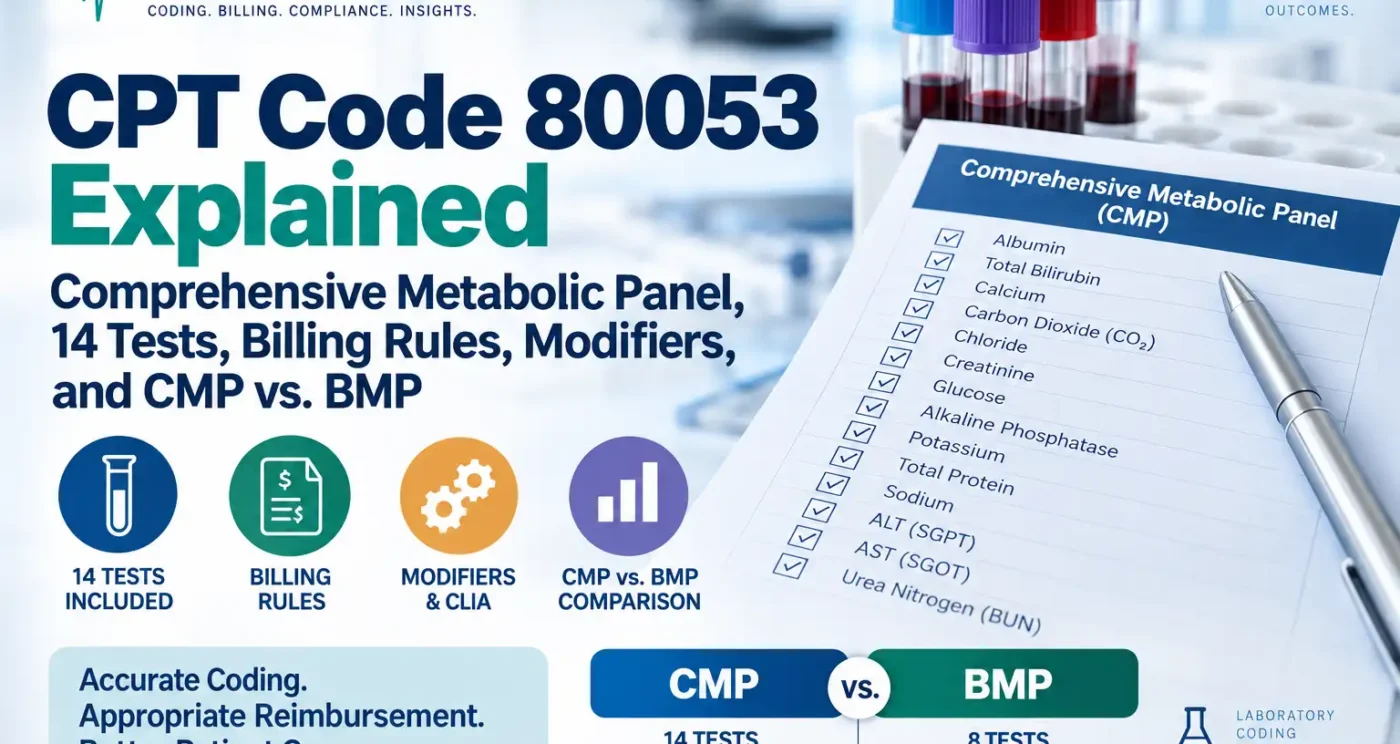
A comprehensive metabolic panel can look simple on a laboratory order: one panel name, one blood draw, one line on the claim. The coding logic is less forgiving. CPT code 80053 represents a defined comprehensive metabolic panel, not just any group of chemistry tests that happens to look like a CMP.
That distinction matters when a laboratory performs only part of the panel, repeats one component later the same day, adds another chemistry test, or uses a point-of-care analyzer that may qualify as CLIA-waived. A claim can be clinically sensible and still be coded incorrectly if the panel rules are overlooked.
This guide explains what CPT code 80053 represents, which 14 tests make up the panel, how it differs from a basic metabolic panel (BMP), what Medicare’s panel rules say, when modifier 91 may be relevant, how QW depends on the test system, and where medical necessity and payer policy fit into the billing process.
Quick coding note: CPT availability, laboratory performance, medical necessity, coverage, CLIA status, and reimbursement are separate questions. A valid CPT code does not by itself guarantee payer coverage or payment.
CPT Code 80053 at a Glance
| Item | Practical meaning |
| CPT 80053 | Comprehensive metabolic panel (CMP) |
| Number of defined components | 14 laboratory tests |
| Common clinical use | Broad assessment of glucose, electrolytes, kidney-related markers, proteins, and liver-related analytes |
| Key billing rule | The defined panel components must be performed before the complete panel code is reported |
| Related BMP code | 80048 for the basic metabolic panel using total calcium |
| Common repeat-test modifier | 91, when the same clinical laboratory test must be repeated on the same date for a medically necessary reason and the modifier’s requirements are met |
| CLIA waived? | Sometimes, depending on the specific FDA-waived test system; 80053 is not universally waived |
| Medicare payment system | Clinical Laboratory Fee Schedule (CLFS), subject to coverage and other Medicare requirements |
The CMS Medicare Claims Processing Manual, Chapter 16 states that the AMA definition controls which component tests belong in an organ- or disease-oriented panel and that Medicare will not pay the panel code unless all tests in the definition are performed. CMS also requires laboratories to use the panel code rather than unbundle its components when all components of the defined panel are performed.
What Is CPT Code 80053?
CPT code 80053 is the code used to report a comprehensive metabolic panel, usually shortened to CMP. Clinically, a CMP is a blood chemistry panel that measures 14 substances and gives clinicians a broad view of several areas of physiology.
The National Library of Medicine’s MedlinePlus CMP guide describes the panel as a 14-test blood test that can provide information about metabolism, glucose, electrolyte and fluid balance, kidney-related markers, proteins, and liver-related measurements.
For billing, however, the word panel has a precise meaning. CPT 80053 is not a flexible label for a laboratory’s preferred “chemistry bundle.” It represents a specific group of component tests.
That is why a laboratory should first ask what was actually performed, not simply what the order was called.
What 14 Tests Are Included in CPT 80053?
The current CMS laboratory manual’s chemistry-panel table identifies the following 14 component tests for the comprehensive metabolic panel.
| CMP component | Individual CPT code | What it generally measures or reflects |
| Albumin | 82040 | Major blood protein produced by the liver |
| Alkaline phosphatase (ALP) | 84075 | Enzyme associated with liver/biliary and bone processes |
| Alanine aminotransferase (ALT/SGPT) | 84460 | Enzyme commonly used in liver assessment |
| Aspartate aminotransferase (AST/SGOT) | 84450 | Enzyme found in liver and other tissues |
| Total bilirubin | 82247 | Bilirubin concentration in blood |
| Total calcium | 82310 | Calcium concentration |
| Chloride | 82435 | Electrolyte level |
| Carbon dioxide/bicarbonate | 82374 | Acid-base/electrolyte-related measurement |
| Creatinine | 82565 | Kidney-related waste product measurement |
| Glucose | 82947 | Blood glucose level |
| Potassium | 84132 | Electrolyte level |
| Total protein | 84155 | Total concentration of major blood proteins |
| Sodium | 84295 | Electrolyte level |
| Urea nitrogen (BUN) | 84520 | Kidney-related nitrogen waste measurement |
This table is a practical coding reference, not an invitation to interpret individual lab results without clinical context. An abnormal value may have many possible causes, and reference ranges can differ among laboratories. MedlinePlus advises that CMP results should be interpreted alongside the patient’s history, medications, symptoms, and other findings.
Why the “14 tests” point matters for billing
A laboratory may have an order set that contains most of these tests. That does not automatically make it CPT 80053.
For Medicare, the current Claims Processing Manual says the panel code is not payable unless all tests in the defined panel are performed. The same manual also instructs laboratories, for current claims, to bill the panel code and not unbundle the individual components when all components are performed.
A missing component changes the coding question.
What Does a CMP Evaluate Clinically?
The CMP is often ordered because it collects several types of information in one blood panel. According to MedlinePlus, it can help clinicians review areas such as:
- Blood glucose
- Kidney-related measurements
- Liver-related measurements
- Protein levels
- Fluid and electrolyte balance
- General metabolic status
It may be ordered as part of a routine evaluation, to investigate symptoms, to monitor a known condition, or to watch for treatment effects. That does not mean every use is automatically covered by every insurer.
The clinical reason for ordering the panel and the payer’s benefit and medical-necessity rules still matter.
Does CPT 80053 Require All 14 Tests?
For reporting the complete CPT-defined panel, yes.
CMS states that all component tests in the accepted panel definition must be performed before the panel code is billed. If a laboratory performs a custom group of tests that does not include the complete CMP, the coding should reflect the services actually performed rather than treating the incomplete set as 80053.
This is a common point of confusion because a laboratory information system may use internal names such as “CMP,” “chemistry 14,” “metabolic profile,” or a custom order set. The claim still has to follow the standardized panel definition.
Example: one CMP component is not performed
Suppose a physician orders a CMP, but the laboratory ultimately performs only 13 of the 14 required components because one test is canceled and no reportable result is produced.
The complete 80053 panel has not been performed. The billing team should evaluate the individual tests that were actually completed and the applicable payer rules instead of reporting the complete CMP code simply because the original order said “CMP.”
The exact claim configuration can depend on the circumstances, payer edits, and laboratory workflow. The central principle is that the code should match the services actually performed.
Complete CMP vs. Unbundling the Individual Tests
When all 14 CMP components are performed, reporting every component separately can create an unbundling problem.
The 2026 Medicare NCCI Policy Manual, Chapter 10, says that when all tests of a CPT-defined panel are performed, the provider or supplier shall bill the panel code. NCCI also maintains procedure-to-procedure edits that pair panel codes with their included component tests.
You can review the current guidance on the CMS Medicare NCCI Policy Manual page.
This means the normal coding pathway for a complete CMP is not:
80053 + 82040 + 82247 + 82310 + … all other included components
That would represent the panel and its included work at the same time.
Instead, when the full defined CMP was ordered and performed, the panel code is the central reporting code.
What if the lab performs only part of the panel?
Then the panel code may not apply. The individual tests actually performed may need to be reported, subject to the payer’s rules and any other applicable panel or edit logic.
What if the lab performs the CMP plus another test?
That is a different situation. CMS says a custom panel can include tests beyond the defined CPT panel, and those additional tests can be billed separately when they are not already components of the panel and otherwise meet billing requirements.
For example, a clinician might order a CMP plus magnesium. Magnesium is not one of the 14 defined CMP components. The additional test may be separately reportable if it was ordered, performed, medically supported, and not otherwise bundled under the applicable payer’s rules.
Separately reportable does not mean automatically covered.
CPT 80053 vs. CPT 80048: CMP vs. BMP
CPT 80048 represents a basic metabolic panel (BMP) with total calcium. The CMP contains the same eight core chemistry measurements found in that BMP plus six additional tests associated mainly with proteins and liver-related chemistry.
MedlinePlus describes the BMP as an eight-test panel. It also explains that a CMP adds albumin, total protein, total bilirubin, ALP, ALT, and AST.
| Test | BMP 80048 | CMP 80053 |
| Glucose | Yes | Yes |
| BUN | Yes | Yes |
| Creatinine | Yes | Yes |
| Sodium | Yes | Yes |
| Potassium | Yes | Yes |
| Chloride | Yes | Yes |
| CO2/bicarbonate | Yes | Yes |
| Total calcium | Yes | Yes |
| Albumin | No | Yes |
| Total protein | No | Yes |
| Total bilirubin | No | Yes |
| Alkaline phosphatase | No | Yes |
| ALT | No | Yes |
| AST | No | Yes |
The practical distinction
A BMP answers a narrower chemistry question. It focuses on glucose, kidney-related measurements, calcium, and electrolytes/acid-base balance.
A CMP includes those eight measurements and adds six tests that provide more information about proteins and liver-related chemistry.
From a coding standpoint, the correct code follows the actual defined panel that was performed. It should not be chosen simply because one panel reimburses differently or because a laboratory’s internal order set happens to use a similar name.
What About CPT 80047?
CPT 80047 is also a basic metabolic panel, but it uses ionized calcium rather than total calcium. That distinction is easy to miss because both 80047 and 80048 belong to the BMP family.
The CMS chemistry-panel table separates them:
- 80047 — BMP using ionized calcium
- 80048 — BMP using total calcium
- 80053 — comprehensive metabolic panel, which uses total calcium as one of its defined components
The exact analytes performed should drive the code selection.
CPT 80053 vs. CPT 80076: CMP vs. Hepatic Function Panel
CPT 80076 represents a hepatic function panel. It overlaps with part of the CMP, but the panels are not identical.
Both include several liver-related measurements, such as:
- Albumin
- Alkaline phosphatase
- ALT
- AST
- Total bilirubin
- Total protein
The hepatic function panel also includes direct bilirubin, which is not one of the 14 defined CMP components.
That difference matters when laboratories try to combine or “rebuild” panels from individual tests. A BMP plus a hepatic function panel is not automatically equivalent to a CMP because the component sets differ and can overlap.
When more than one panel is ordered or performed on the same date, the laboratory should review the actual component tests, NCCI edits, payer instructions, and whether any test is being counted twice.
Can 80053 and 80048 Be Billed Together?
Usually, simply reporting a BMP and CMP together for the same patient on the same date would create substantial component overlap because the eight tests in 80048 are included within the 14-test CMP.
That does not mean there can never be a legitimate same-day repeat chemistry service. It means the claim needs a specific clinical and coding rationale rather than two overlapping panel codes submitted as if they were independent groups of tests.
If the complete CMP is performed and later one component must be repeated because the patient’s condition or treatment requires a new result, the repeated component may be the more appropriate coding focus. CMS specifically addresses this repeat-component scenario in its NCCI guidance.
Modifier 91 and CPT 80053
Modifier 91 is one of the most important modifiers in laboratory billing because it is designed for repeat clinical diagnostic laboratory testing under appropriate circumstances.
The CMS Medicare NCCI FAQ gives a direct panel example: if all tests in a defined panel are performed and one component is then repeated on the same date as a medically reasonable and necessary service, the CPT code for the repeated component may be reported with modifier 91.
Example: CMP followed by repeat potassium
A patient has a CMP in the morning. The potassium result is clinically important to treatment. After intervention, the clinician orders another potassium level later that day to evaluate the patient’s response.
The initial complete panel may be reported as 80053. If the later potassium test meets the requirements for repeat testing, the individual potassium code may be reported with modifier 91, subject to the payer’s rules.
The repeated service is not another entire CMP unless the entire panel is medically necessary and actually repeated.
When modifier 91 should not be used
CMS states that repeat testing should not be reported with modifier 91 when a test is simply rerun:
- To confirm the initial result when only one result is clinically required
- Because of a specimen problem
- Because of equipment malfunction
- For quality-control reasons
- For another reason when a normal one-time reportable result is all that is required
A rerun caused by a laboratory problem is not the same as a new medically necessary test performed during the patient’s course of treatment.
Modifier 59 vs. Modifier 91 for Laboratory Panel Components
The 2026 Medicare NCCI manual notes that modifiers 59 or 91 may be used in certain medically necessary repeat-testing circumstances when a panel component is repeated on the same date.
They should not be treated as interchangeable “denial fix” modifiers.
Modifier 91 is specifically associated with a repeat clinical diagnostic laboratory test when multiple results are needed in the course of treatment.
Modifier 59 is a broader NCCI-associated modifier used to identify a distinct procedural service when the circumstances support that distinction.
When the issue is a medically necessary same-day repeat of the same laboratory test, modifier 91 usually describes the nature of the event more directly. Laboratories should still verify payer-specific instructions, because claim-edit behavior can differ.
A modifier should describe what actually happened. It should not be appended solely to make an edit disappear.
Does CPT 80053 Require Modifier QW?
Not automatically.
The QW modifier identifies certain tests performed under CLIA-waived status. Whether 80053 can be billed with QW depends on the specific test system, not just the CPT number.
CMS has recognized specific waived analyzer systems for which 80053QW is appropriate. For example, CMS waived-test materials have listed certain Abaxis Piccolo/Piccolo xpress comprehensive metabolic panel reagent-disc systems under 80053QW.
The important point is not the brand name itself. The important point is that CLIA complexity is tied to the test system and methodology.
CMS’s current CLIA test-complexity guidance explains that the FDA categorizes tests as waived, moderate complexity, or high complexity. A facility must hold a certificate appropriate for the testing it performs.
Do not assume “CMP = waived”
Many CMPs are performed in laboratories operating under nonwaived CLIA certification. In those settings, QW may not apply.
Conversely, a point-of-care CMP performed on a current FDA-waived system in a laboratory with the appropriate Certificate of Waiver may require QW for Medicare claims when CMS’s current waived-test instructions call for it.
Because CMS publishes quarterly CLFS and CLIA updates, laboratories should verify the current waived-test file and analyzer classification rather than relying on a years-old device list.
CMS issued both July 2026 and October 2026 quarterly laboratory updates covering CLFS and CLIA changes.
CLIA Requirements for CPT 80053
CLIA governs laboratory testing quality and certification. CMS currently describes test complexity in three broad categories:
- Waived
- Moderate complexity
- High complexity
A laboratory’s certificate should match the highest complexity of testing it performs. CMS’s CLIA application guidance explains that laboratories performing only waived tests can operate under a Certificate of Waiver, while nonwaived testing carries additional personnel and certification requirements.
CPT coding and CLIA status solve different problems:
- CPT 80053 identifies the laboratory service.
- CLIA status addresses the regulatory complexity and certification requirements for the test system used.
- QW, when applicable, communicates waived-test status on the claim.
The same CPT code can therefore appear in different laboratory settings with different CLIA implications.
CPT 80053 and Medical Necessity
A CMP may be clinically useful in many circumstances, but the CPT code itself does not prove medical necessity.
The ordering clinician’s documentation and diagnosis coding should reflect the actual reason for testing. Depending on the patient’s situation, a CMP may be used in the evaluation or monitoring of issues involving:
- Diabetes or abnormal glucose
- Kidney function
- Liver-related conditions
- Electrolyte abnormalities
- Dehydration or fluid-balance concerns
- Medication monitoring
- Metabolic conditions
- Broader diagnostic workups
Those are clinical examples, not a universal list of “covered diagnoses.”
A payer may have different coverage rules for diagnostic testing, routine health assessment, chronic-condition monitoring, or screening. Some Medicare policies are national; others may be influenced by local contractor rules or by the specific service context.
Diagnosis selection should begin with the medical record, not with a generic internet list of ICD-10-CM codes said to “pay with 80053.”
For a broader look at how diagnosis coding, charge capture, edits, and payer adjudication connect, see MedIntelHub’s medical billing workflow.
Screening CMP vs. Diagnostic CMP
A common billing misunderstanding is that the same laboratory panel is always processed the same way because the CPT code is unchanged.
The reason for testing can affect coverage.
A CMP may be ordered:
- As part of a routine wellness evaluation
- To evaluate symptoms
- To monitor a diagnosed condition
- To assess treatment effects
- Before or during medication therapy
Those scenarios can fall under different benefit and medical-necessity rules. A commercial plan may treat routine laboratory work differently from diagnostic testing. Medicare has its own rules for covered preventive services and for diagnostic laboratory services.
The laboratory should not change a diagnosis merely to obtain payment. The claim should accurately reflect the documented reason for the test and applicable coding rules.
Who Must Order the Test?
For Medicare diagnostic laboratory services, ordering requirements can matter. In general, the test should be ordered by an authorized treating practitioner when required, and the record should support why the testing is being used in the patient’s care.
That order is only one piece of the claim. A valid order does not override panel coding rules, CLIA requirements, medical necessity, or a payer’s coverage policy.
Is the Blood Draw Included in CPT 80053?
CPT 80053 describes the laboratory panel, not the venipuncture procedure itself.
A blood-collection service may have separate coding and payment rules. For Medicare, the 2026 CLFS annual update notes separately payable specimen-collection fees for certain codes and circumstances. Whether a collection code is separately reportable depends on the setting, the service performed, and payer policy.
Do not assume that every laboratory panel automatically supports a separate collection charge, and do not assume that the panel code itself describes the venipuncture.
Medicare Payment for CPT 80053 in 2026
Medicare generally pays clinical diagnostic laboratory tests under the Clinical Laboratory Fee Schedule (CLFS) rather than the Medicare Physician Fee Schedule.
CMS’s Clinical Laboratory Fee Schedule page explains that most clinical diagnostic laboratory tests are paid using CLFS methodology based on private-payer rate data, subject to statutory rules.
A significant 2026 policy point is that legislation enacted February 3, 2026 delayed the next phase of CLFS payment reductions. CMS states that there is no phase-in reduction in 2026 under that provision. Beginning in 2027, statutory limits on annual reductions apply for the following years unless law or policy changes again.
CMS also publishes updated CLFS files during the year. The 2026 Q3 CLFS release incorporates the July 2026 changes.
A fee-schedule amount does not prove coverage
CMS expressly notes on its CLFS files page that the presence of a code or payment amount does not mean Medicare covers the test in every circumstance.
That distinction is fundamental:
- The code must correctly describe the service.
- The service must be medically and administratively eligible for coverage.
- The laboratory must meet applicable CLIA requirements.
- The claim must meet payer billing rules.
- Only then does the fee schedule become part of the payment calculation.
Does Medicare Apply Patient Cost-Sharing to CMP Testing?
CMS explains that beneficiaries generally do not have cost-sharing for clinical diagnostic laboratory tests paid under the CLFS. The details can become more complicated in certain settings, where laboratory services may be packaged with other facility payment systems or where a service is noncovered.
The safest billing explanation is therefore not “CMPs are always free.” It is that Medicare’s CLFS generally does not impose beneficiary cost-sharing for covered clinical diagnostic laboratory tests, while coverage and setting-specific rules still matter.
CMP Billing Workflow: A Practical Sequence
A clean 80053 claim usually begins well before the claim is transmitted.
A useful workflow looks like this:
Order → specimen → actual tests performed → panel validation → CLIA/test-system check → diagnosis/medical necessity → modifiers if applicable → claim edits → payer submission
This sequence prevents several common errors.
1. Confirm the order and reason for testing
The laboratory should have the information needed to support the requested service and the applicable diagnosis reporting.
2. Confirm what was actually performed
Do not rely only on the order-set name. Verify that all 14 CMP components produced reportable results if 80053 is going to be submitted.
3. Apply panel logic
If all components of the defined panel are performed, report the panel code rather than unbundling the components for Medicare and other payers that follow comparable panel rules.
4. Identify additional or repeated tests
Determine whether any test falls outside the CMP or was repeated later for a medically necessary reason.
5. Check CLIA status
If the laboratory is operating under a Certificate of Waiver, verify that the exact test system is categorized as waived and whether QW is required.
6. Run coding and payer edits
NCCI edits, payer-specific rules, frequency edits, diagnosis edits, and duplicate-service edits may affect claim processing.
For broader denial-prevention ideas, MedIntelHub’s claim-denials checklist walks through common causes of preventable billing problems.
Six Practical CPT 80053 Billing Examples
Example 1: Complete CMP performed
A clinician orders a CMP. The laboratory performs all 14 defined components and reports all results.
Coding logic: 80053 describes the complete defined panel. The included component tests should not also be separately unbundled on the same claim simply to increase payment.
Payer check: Verify medical necessity, diagnosis reporting, CLIA status, and current payer policy.
Example 2: Only 12 CMP components are completed
A CMP is ordered, but two required component tests are canceled and never performed.
Coding logic: The complete defined panel was not performed. Do not assume 80053 applies merely because the order was named “CMP.” Review the individual tests actually completed and applicable payer rules.
Example 3: CMP plus magnesium
A clinician orders a CMP and a magnesium level. All CMP components and the magnesium test are performed.
Coding logic: The defined CMP may be reported with 80053. Magnesium is not one of its 14 defined components, so the additional test may be separately reportable if all other coding and payer requirements are satisfied.
Example 4: CMP followed by repeat potassium after treatment
A CMP is performed in the morning. A treatment decision is made based on the potassium result, and the clinician orders another potassium later that day to assess response.
Coding logic: Report the original CMP as appropriate. The later potassium may be reportable with its individual CPT code and modifier 91 if the repeat-test requirements are met.
Do not: Use modifier 91 merely because the first sample was hemolyzed or the analyzer malfunctioned.
Example 5: CMP on a CLIA-waived point-of-care system
An office laboratory with a valid Certificate of Waiver performs a complete CMP using a currently FDA-waived analyzer system that CMS recognizes for waived billing.
Coding logic: 80053 may be reported with QW when the current CMS waived-test rules for that system require it.
Key check: Confirm the exact analyzer/test cartridge, current waived classification, laboratory certificate, and current quarterly CMS instructions.
A clinician orders a BMP and several liver-related tests.
Coding logic: Do not automatically convert the combination to 80053 or 80076. Compare the actual analytes performed with the defined panel components. Check for overlap, determine whether a complete defined panel was actually performed, and apply NCCI/payer rules.
Common CPT 80053 Billing Errors
Reporting 80053 when a required component was never performed
The complete panel code requires the complete defined panel.
Billing the CMP and all 14 components together
This can represent unbundling of services already included in the panel.
Treating a laboratory’s custom chemistry bundle as a CPT-defined CMP
Internal test names do not change the standardized CPT panel definition.
Confusing 80048 with 80053
A BMP has eight defined components; a CMP has 14.
Ignoring the ionized-calcium distinction between 80047 and 80048
BMP code selection depends in part on which calcium test is included.
Assuming the hepatic function panel is just the “liver part” of 80053
The panels overlap but are not identical. Direct bilirubin is included in 80076 but not in the defined CMP.
Using modifier 91 for a technical rerun
Modifier 91 is for medically necessary repeat testing in the course of treatment, not laboratory troubleshooting.
Adding modifier 59 only to override an edit
A modifier must reflect a genuine distinct-service circumstance.
Assuming every CMP is CLIA waived
Waived status depends on the test system and its FDA/CMS classification.
Automatically appending QW to every 80053 claim
QW applies only when the waived-test circumstances support it.
Picking a diagnosis from a generic “covered ICD-10 list”
The diagnosis code should reflect the documented clinical reason for testing. Coverage policies can vary by payer and context.
A payer’s reimbursement policy does not redefine the CPT panel itself.
Using an old Medicare fee amount
CMS updates CLFS files throughout the year. Use the current file for the relevant date of service.
| CPT code | General panel | Key distinction |
| 80047 | Basic metabolic panel | Uses ionized calcium |
| 80048 | Basic metabolic panel | Uses total calcium; 8 components |
| 80051 | Electrolyte panel | Sodium, potassium, chloride, CO2/bicarbonate |
| 80053 | Comprehensive metabolic panel | 14 components; expands on the BMP with proteins and liver-related tests |
| 80061 | Lipid panel | Cholesterol/triglyceride-focused panel |
| 80069 | Renal function panel | Renal-focused chemistry grouping with its own defined components |
| 80076 | Hepatic function panel | Liver-focused panel; includes direct bilirubin |
The current CMS chemistry-panel table remains a useful Medicare reference for understanding how these defined panels overlap.
Why CMP Coding Is a Good Example of “Coding Is Not Coverage”
CPT 80053 can be perfectly valid from a code-selection standpoint and still encounter a payment problem.
The payer might question:
- The diagnosis
- The frequency of testing
- Whether the service is screening or diagnostic
- Whether the laboratory is eligible to bill the service
- CLIA certification
- Duplicate or overlapping testing
- Same-day panel/component combinations
- Whether the test was reasonable and necessary
Conversely, a payer authorization or a clinician’s order does not make an incorrectly assembled panel into CPT 80053.
This distinction is part of a broader coding principle: code selection describes the service; coverage rules determine whether the payer will reimburse that service under the patient’s circumstances.
MedIntelHub’s guide to 2026 CPT code changes explains the same distinction in the context of annual coding updates: a valid or newly created CPT code is not the same thing as a coverage guarantee.
Frequently Asked Questions About CPT Code 80053
What is CPT code 80053?
CPT 80053 is the code used to report the defined comprehensive metabolic panel, commonly called a CMP. The panel contains 14 specified chemistry tests.
How many tests are included in CPT 80053?
Fourteen. The panel includes glucose, total calcium, sodium, potassium, chloride, CO2/bicarbonate, BUN, creatinine, albumin, total protein, total bilirubin, alkaline phosphatase, ALT, and AST.
Does CPT 80053 require all 14 tests?
Yes, the complete defined panel should be performed before the panel code is reported. CMS states that it will not pay the panel code unless all tests in the accepted panel definition are performed.
What is the difference between CPT 80053 and 80048?
80048 is a basic metabolic panel with eight components using total calcium. 80053 is a comprehensive metabolic panel containing those eight measurements plus albumin, total protein, total bilirubin, alkaline phosphatase, ALT, and AST.
What is the difference between CPT 80053 and 80047?
Both relate to metabolic panels, but 80047 is a BMP built around ionized calcium. The common 80048 BMP and 80053 CMP use total calcium as defined components.
What is the difference between CPT 80053 and 80076?
80053 is a 14-test comprehensive metabolic panel. 80076 is a hepatic function panel with a different component set. The hepatic panel includes direct bilirubin; the CMP does not.
Can 80053 and 80048 be billed together?
The two panels substantially overlap because the BMP components are included in the CMP. Routine reporting of both for the same patient and date can create overlapping or duplicate billing concerns. A legitimate repeat-testing situation should be coded based on what was actually repeated and why.
Can the individual CMP tests be billed separately with 80053?
The included component tests should not routinely be billed separately in addition to a complete panel. CMS’s current panel rules require use of the panel code when all panel components are performed.
Can an extra laboratory test be billed with 80053?
Potentially. A medically supported test that is not part of the defined CMP may be separately reportable, subject to payer rules and any applicable edits.
What does modifier 91 mean with CMP testing?
Modifier 91 identifies a repeat clinical diagnostic laboratory test when the same test is medically necessary more than once on the same date to obtain multiple results during treatment. It is not meant for reruns caused by specimen or equipment problems.
Can a CMP be billed twice on the same day?
Only if the complete panel is actually repeated and the circumstances satisfy applicable coding, medical-necessity, unit, modifier, and payer rules. Often, the clinically necessary repeat involves one component rather than the entire CMP.
Does CPT 80053 require modifier QW?
Not in every setting. QW applies when the test is performed using a test system that is categorized as CLIA waived and current CMS billing instructions require the modifier.
Is CPT 80053 CLIA waived?
The code itself is not universally “waived” or “nonwaived.” CLIA complexity depends on the specific testing system. CMS has recognized certain CMP analyzers as waived, while other laboratory methods may be moderate or high complexity.
Does Medicare cover CPT 80053?
Medicare can cover clinically appropriate diagnostic laboratory testing when applicable requirements are met, but the existence of CPT 80053 on the CLFS does not guarantee coverage in every circumstance. Medical necessity, diagnosis, ordering requirements, CLIA status, and other rules still apply.
How is CPT 80053 paid by Medicare?
Clinical diagnostic laboratory testing is generally paid under the Medicare Clinical Laboratory Fee Schedule. CMS publishes current CLFS files and updates them during the year. The applicable amount should be verified for the date of service rather than taken from an old commercial fee table.
Practical Takeaway
CPT 80053 looks straightforward because “CMP” is familiar to clinicians, patients, and laboratories. The billing rules become clearer once the panel is treated as a defined set of 14 tests rather than a loose chemistry bundle.
For a clean claim, verify that every required component was actually performed, use the panel code when the complete defined panel is present, separate true add-on tests from included components, and reserve repeat-test modifiers for circumstances that genuinely meet their definitions.
CLIA deserves the same precision. A particular point-of-care system may be waived; that does not make every 80053 service a QW claim.
The safest workflow is to match the code to the tests performed, the modifier to the actual clinical event, and the diagnosis to the documented reason for testing—then verify current payer and CMS requirements before submission.
Resources
Centers for Medicare & Medicaid Services — Medicare Claims Processing Manual, Chapter 16
CMS’s primary Medicare laboratory billing manual. Section 90.2 addresses organ- or disease-oriented panels, the requirement that all panel components be performed, and the chemistry-panel table used in this article.
Medicare Claims Processing Manual, Chapter 16
Centers for Medicare & Medicaid Services — 2026 Medicare NCCI Policy Manual, Chapter 10
Current 2026 Medicare correct-coding policy for pathology and laboratory services, including panel reporting and medically necessary repeat component testing.
Centers for Medicare & Medicaid Services — Medicare NCCI FAQ Library
CMS answers common NCCI questions, including how modifier 91 may be used when a panel component must be repeated on the same date for a medically necessary reason.
Centers for Medicare & Medicaid Services — Clinical Laboratory Fee Schedule
Current Medicare CLFS information, including 2026 data-reporting and payment-policy updates.
Clinical Laboratory Fee Schedule
Centers for Medicare & Medicaid Services — CLIA Test Complexity
Current CMS overview of waived, moderate-complexity, and high-complexity laboratory testing and the role of FDA test categorization.
Understanding CLIA Certification, Accreditation & Test Complexity
National Library of Medicine — Comprehensive Metabolic Panel
Patient-friendly clinical overview of the 14 CMP measurements, common uses of the test, and how results are interpreted in context.
Comprehensive Metabolic Panel (CMP) — MedlinePlus
National Library of Medicine — Basic Metabolic Panel
Clinical overview of the eight-test BMP and how it differs from a CMP.
Basic Metabolic Panel (BMP) — MedlinePlus
Editorial Guidelines & Medical Disclaimer
MedIntelHub provides medical coding, billing, laboratory, and health information for educational and informational purposes. This article does not diagnose disease, interpret an individual’s laboratory results, or replace advice from a physician, laboratory professional, certified coder, compliance professional, or other qualified healthcare professional.
CPT coding, HCPCS reporting, ICD-10-CM diagnosis coding, NCCI edits, CLIA requirements, Medicare rules, commercial-payer policies, and reimbursement requirements can change. Laboratories and billing teams should verify the current CPT code set or another properly licensed coding resource, the latest CMS guidance, current CLIA/FDA test-system classification, and the policy of the payer receiving the claim before submission.
A CPT code does not guarantee coverage or payment. A laboratory test can be correctly coded but still be noncovered because of medical-necessity, benefit, frequency, authorization, provider, setting, or other payer requirements.
Patients should discuss abnormal or unexpected CMP results with the healthcare professional who ordered the test. Laboratory values need clinical context and should not be used in isolation to self-diagnose or change medications.
MedIntelHub develops health and coding content using authoritative sources such as CMS, NIH/NLM, official payer materials, and current coding guidance. Review our Editorial Policy for more information about our standards.
CPT is a registered trademark of the American Medical Association. This article uses brief code references for educational discussion and does not reproduce the CPT codebook or replace licensed CPT resources.

David Bennett
David Bennett is an author at MedIntelHub, where he creates clear, practical, and well-researched content about healthcare, medical billing, insurance, and patient education. His goal is to make complex healthcare topics easier for readers to understand and use in everyday situations. David emphasizes accuracy, transparency, and reliable sourcing, using information from trusted organizations and official healthcare resources whenever possible. Content published by David is intended for educational purposes and should not replace advice from qualified medical, legal, or healthcare professionals.