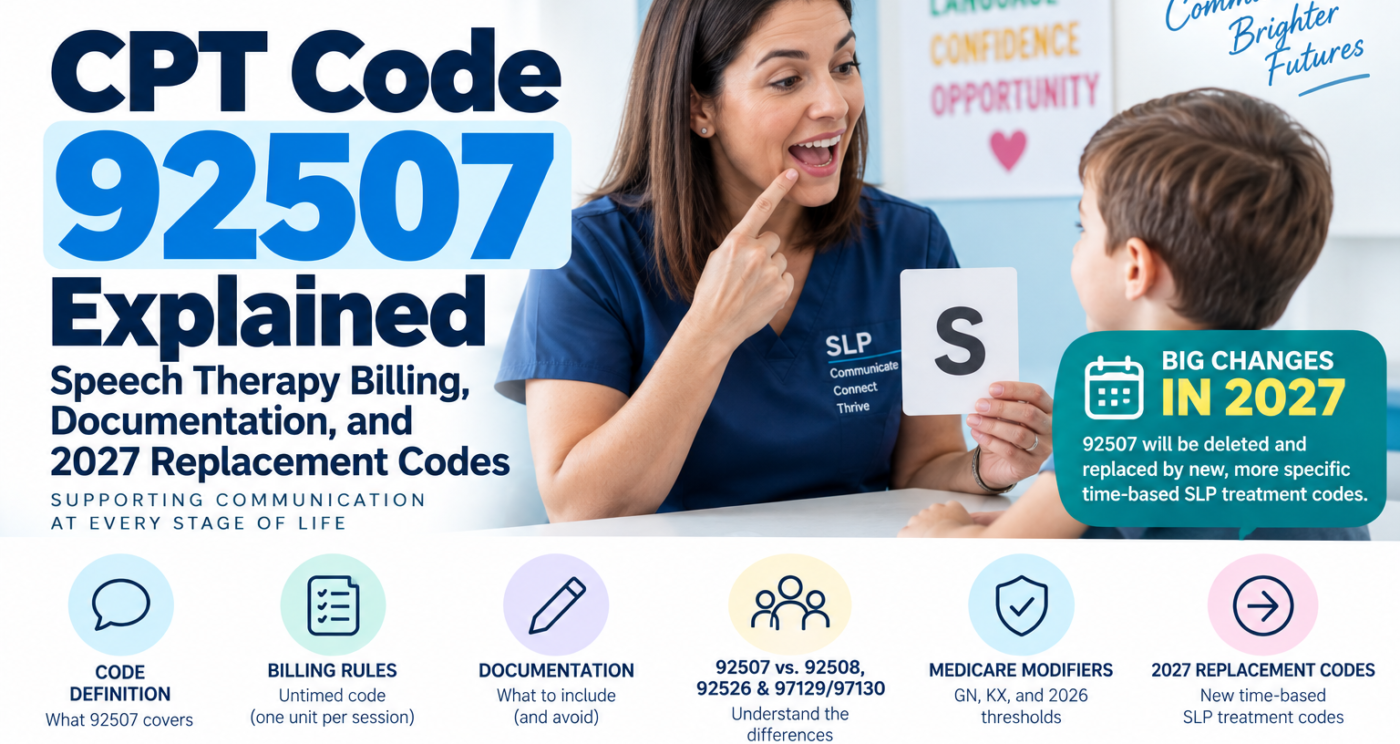
CPT code 92507 has been one of the most familiar treatment codes in speech-language pathology for years. In 2026, it still serves as the broad individual-treatment code used for many speech, language, voice, communication, and auditory-processing services. But that familiar workflow is approaching a major change.
The 2027 CPT code set, released by the American Medical Association in September 2026, removes 92507 effective January 1, 2027 and replaces it with 10 more specific, time-based treatment codes. That means practices need to understand two coding systems at once: how to report 92507 correctly for the rest of 2026, and how to prepare documentation, time capture, charge entry, authorizations, and payer mapping for the new 2027 structure.
This guide focuses on those practical distinctions. It explains what 92507 covers today, why it is an untimed per-session code, how it differs from 92508, 92526, and cognitive-treatment codes, what Medicare modifiers and documentation issues matter, and what is changing on January 1, 2027.
CPT 92507 at a Glance
| Question | 2026 answer |
| What is 92507? | An individual speech-language pathology treatment code used for speech, language, voice, communication, and/or auditory-processing treatment. |
| Is 92507 timed? | No. In 2026 it is a per-session, untimed code. |
| How many units are normally reported? | One unit on a single date of service; session duration alone does not create additional units. |
| Does Medicare’s 8-minute rule apply? | No. The 8-minute timed-unit methodology does not determine units for 92507. |
| What modifier commonly identifies an SLP plan of care for Medicare? | GN. |
| What happens in 2027? | 92507 is deleted and replaced by 10 time-based codes organized into five clinical treatment categories. |
What Is CPT Code 92507?
For dates of service through December 31, 2026, CPT 92507 is the principal individual-treatment code used by speech-language pathologists for a broad range of communication-focused therapy. The official CPT descriptor is maintained by the American Medical Association, so the current licensed CPT code set remains the authoritative source for exact wording and instructions.
In practical terms, 92507 can encompass individual skilled intervention addressing speech production, language, voice, communication, auditory processing, and related aural-rehabilitation needs when the service fits the code and the patient’s plan of care.
The code does not by itself establish coverage. The documentation still has to support the impairment being treated, the need for skilled speech-language pathology, the treatment provided, and any payer-specific medical-necessity or authorization requirements.
For a broader explanation of how documentation, coding, claim creation, payer edits, and payment fit together, see MedIntelHub’s Medical Billing Workflow: From Patient Visit to Payment.
What Treatment Areas Can 92507 Cover in 2026?
Because 92507 is broad, two patients billed with the same code can receive very different clinical treatment. The common element is not a particular exercise or worksheet; it is that the session is an individual speech-language pathology treatment service that falls within the code’s scope.
- Speech sound production, including articulation or phonological treatment.
- Motor-speech intervention for conditions such as apraxia or dysarthria when appropriately documented.
- Receptive and expressive language treatment.
- Fluency treatment, including intervention for stuttering or cluttering.
- Voice or resonance treatment when appropriate for the patient’s condition and plan of care.
- Communication treatment associated with neurologic disease, injury, developmental conditions, or other documented impairments.
- Auditory-processing treatment or certain aural-rehabilitation services when the service fits current coding and coverage requirements.
The diagnosis does not choose the CPT code by itself. The clinician’s skilled intervention, the treatment objective, and the documented service are what support procedure-code selection.
Is CPT 92507 Timed or Untimed?
In 2026, CPT 92507 is an untimed, per-session code. CMS’s 2026 NCCI Policy Manual specifically identifies 92507 and 92508 as services reported per session and states that a per-session code should not be converted into 15-minute increments.
For Medicare reporting, 92507 is generally submitted with one unit for a single date of service. A longer session does not automatically create two, three, or four units.
Why the Medicare 8-Minute Rule Does Not Apply to 92507
The Medicare 8-minute methodology is used to determine units for certain timed rehabilitation procedures whose code descriptors are built around time, such as 15-minute services. Current 92507 is not one of those codes.
That distinction matters because therapy practices often work with both timed and untimed services. A billing system configured to convert every therapy minute into 15-minute units can overstate units for 92507.
| Individual treatment duration | Typical 2026 92507 reporting concept |
| 20 minutes | 1 unit, if the service otherwise meets reporting and payer requirements. |
| 30 minutes | 1 unit. |
| 45 minutes | 1 unit. |
| 60 minutes | 1 unit; duration alone does not create four 15-minute units. |
92507 vs. 92508: Individual vs. Group Speech Therapy
The distinction between 92507 and 92508 is primarily the treatment format. 92507 is the individual service. 92508 is used for group speech-language treatment involving two or more individuals.
A Medicare contractor article states that when the patient is not receiving direct one-on-one treatment but is being supervised in a group-therapy setting, the group-treatment code should be used. The clinician should not describe a simultaneous group session as individual therapy simply because each patient has an individualized plan of care.
| Issue | 92507 | 92508 |
| Treatment format | Individual | Group |
| Number of patients | One patient receiving the individual service | Two or more individuals in group treatment |
| Timed in 2026? | No | No |
| Usual unit concept | One per session/date of service | One group-treatment encounter |
| 2027 status | Deleted January 1, 2027 | Retained, with revised CPT instructions |
92507 vs. 92526: Communication Treatment vs. Swallowing Treatment
CPT 92526 addresses a different clinical service: treatment of swallowing dysfunction and/or oral function for feeding. It should not be treated as a substitute for 92507 simply because both services may be provided by an SLP.
For example, a session focused on expressive-language impairment after stroke is conceptually different from a dysphagia session focused on safe and effective swallowing. If the patient has both communication and swallowing needs, code selection should follow the actual services performed and current payer/NCCI rules rather than assuming one broad ‘speech therapy’ code applies to everything.
92507 vs. 97129 and 97130: Cognitive Treatment
Cognitive-treatment coding requires especially careful review because Medicare NCCI imposes same-day restrictions. The 2026 NCCI Policy Manual states that a single practitioner should not report 92507 and/or 92508 on the same date as 97129, 97130, and/or 97533.
That does not mean cognitive-communication impairment is never treated by an SLP. It means the claim must follow the coding structure and NCCI rules that apply to the service actually performed.
CMS also explains an important exception for different practitioner types. If, for example, an SLP performs 92507 while an occupational therapist separately performs a cognitive-treatment service on the same date, a single billing entity may be able to report both with an appropriate NCCI-associated modifier when the circumstances support separate services.
The modifier is not a generic denial fix. It should describe a real, documented distinction that the NCCI edit permits.
Why SLPs Should Not Substitute PT/OT Codes for 92507
The 2026 Medicare NCCI manual states that speech-language pathologists may perform services reported with 92507, 92508, or 92526, but that codes such as 97110, 97112, 97150, and 97530 are generally PT/OT services and should not be unbundled from the SLP services.
This is an important billing distinction. A speech-language session may involve movement, posture, functional tasks, or repetitive practice, but code selection is not based on which activity visually resembles a physical or occupational therapy technique.
The clinician’s discipline, treatment objective, service definition, documentation, and payer rules determine the reportable code.
Documentation Requirements for CPT 92507
The treatment note should show why skilled speech-language pathology was needed, what was treated, what the clinician did, and how the patient responded. A generic entry such as ‘speech therapy performed’ does not provide enough information to understand the medical necessity or skilled nature of the service.
- The communication impairment or functional problem being addressed.
- The relationship between the treatment session and the established plan of care.
- Specific treatment goals or target skills.
- The skilled intervention or strategy used by the SLP.
- The patient’s performance or response to treatment.
- Cueing, prompting, modeling, feedback, or other clinician support when relevant.
- Changes in assistance or task complexity.
- Progress toward functional goals or a reason continued skilled treatment remains necessary.
- The date of service and required authentication/signature information.
- Any payer-specific documentation elements required for authorization, recertification, or continued coverage.
Weak vs. Stronger Documentation
| Weak note concept | Stronger documentation concept |
| Worked on language. Patient tolerated session. | Identify the language target, the treatment strategy, level of cueing, measurable or descriptive response, and how the task supports a functional communication goal. |
| Practiced articulation. | Identify the speech-sound target, context or level of practice, clinician cueing/modeling, patient accuracy or response, and progression toward the plan-of-care goal. |
| Voice exercises completed. | Document the voice problem being addressed, skilled technique, patient response, relevant cues, and functional carryover or next-step plan. |
| Auditory training performed. | Describe the auditory-processing or aural-rehabilitation objective, the structured task, level of support, response, and relation to the patient’s functional communication needs. |
Documentation does not need to become artificially long. The goal is to make the skilled service understandable and defensible.
The GN Modifier for Medicare Speech-Language Pathology
For Medicare outpatient therapy claims, GN identifies services delivered under an outpatient speech-language pathology plan of care. CMS contractor guidance states that providers use GN to identify services delivered personally by an SLP or under an outpatient SLP plan of care.
GN should not be confused with GP, which identifies physical therapy plans of care, or GO, which identifies occupational therapy plans of care. Commercial and Medicaid plans may use their own modifier rules, so Medicare’s modifier requirement should not automatically be copied to every payer.
KX Modifier and the 2026 Medicare Therapy Threshold
For calendar year 2026, CMS set the KX modifier threshold at $2,480 for physical therapy and speech-language pathology services combined. Occupational therapy has a separate $2,480 threshold.
Once the applicable Medicare threshold is exceeded, claims for medically necessary therapy generally require the KX modifier to confirm that continued services are justified by the medical record. KX is not an automatic approval and does not replace documentation, medical necessity, or other coverage rules.
CMS also continues the $3,000 targeted medical review threshold for PT/SLP combined and $3,000 separately for OT through 2027. Crossing that amount does not mean every claim is automatically audited, but it increases the importance of clean documentation and correct modifier use.
CMS has also approved a 2026 Recovery Audit Contractor review topic focused on therapy claims billed with KX, and 92507 appears on the listed speech-therapy codes. That makes documentation supporting continued medical necessity particularly important during the remainder of 2026.
Medical Necessity and ICD-10-CM Coding
The CPT code tells the payer what service was performed. ICD-10-CM coding communicates the documented condition, impairment, symptom, or other clinical reason for treatment. Those two pieces should make clinical sense together, but there is no single diagnosis code that guarantees payment for 92507.
Possible conditions may involve aphasia, dysarthria, apraxia, fluency disorders, developmental or acquired language disorders, voice disorders, auditory-processing problems, or communication impairment associated with neurologic disease or injury. The actual diagnosis should come from the medical record.
Medical necessity is broader than diagnosis. A payer may look for an appropriate evaluation, measurable functional limitation, realistic treatment goals, skilled intervention, progress, and a continuing reason why treatment requires professional SLP expertise.
CPT 92507 does not carry a universal prior-authorization requirement. Authorization depends on the payer, plan, benefit, network, diagnosis, age, and sometimes the number of visits already used.
When authorization is required, the approved service should be compared with the claim before submission. A valid authorization number does not guarantee reimbursement if the code, diagnosis, provider, date range, visit count, or documentation does not match payer requirements.
For a broader authorization workflow, see MedIntelHub’s Prior Authorization: A Clear Guide for Patients & Practices.
Common CPT 92507 Billing and Denial Risks
| Common problem | Why it matters |
| Billing multiple units because the session lasted longer | 92507 is a per-session code in 2026; time alone does not create 15-minute units. |
| Applying the Medicare 8-minute rule | The current code is untimed, so timed-unit methodology does not determine 92507 units. |
| Using individual treatment when care was actually group therapy | 92508 may be the appropriate group-treatment code. |
| Using 92507 for swallowing treatment | 92526 describes swallowing/oral-function treatment when that is the service performed. |
| Same-practitioner reporting with 97129/97130 | Medicare NCCI restricts those same-day combinations for a single practitioner. |
| Unbundling PT/OT procedure codes | NCCI warns against reporting 97110, 97112, 97150, or 97530 as unbundled SLP services. |
| Missing GN on applicable Medicare claims | Medicare therapy claims require the appropriate plan-of-care modifier. |
| KX errors after the threshold | Claims over the applicable Medicare threshold need correct KX handling and supporting medical necessity. |
| Documentation that only names activities | The record should show the skilled treatment purpose, clinician work, patient response, and functional relevance. |
| Diagnosis or authorization mismatch | The submitted claim should match the documented condition and any payer approval requirements. |
For a broader denial-prevention framework, see MedIntelHub’s Claim Denials: A Practical Prevention and Follow-Up Checklist.
Does CPT 92507 Have a Fixed Reimbursement Rate?
No single reimbursement amount applies to every 92507 claim. Medicare payment can vary by year, geographic locality, setting, and other Physician Fee Schedule factors. Commercial insurers may use negotiated fee schedules, and Medicaid payment varies by state and program.
A published national average should not be treated as a guaranteed payment amount. Practices should use the fee schedule or contract that applies to the patient’s payer and the actual date of service.
The Major 2027 Change: CPT 92507 Is Being Deleted
The biggest reason to review 92507 now is that the code has an end date. The AMA released the 2027 CPT code set on September 9, 2026. ASHA’s current implementation guidance confirms that 92507 remains in effect through December 31, 2026 and is deleted effective January 1, 2027.
Beginning in 2027, individual treatment that was commonly reported under one broad code will move into five clinical categories, each with a base code for the initial 30 minutes of direct one-on-one treatment and an add-on code for each additional 15 minutes.
This is a structural change, not just a code-number swap. It affects clinical categorization, time capture, documentation, fee schedules, authorizations, EHR configuration, charge entry, and payer edits.
The 10 New 2027 Speech-Language Treatment Codes
| Clinical category | Base code | Add-on code | Time structure |
| Fluency treatment | 92654 | 92655 | Initial 30 minutes + each additional 15 minutes |
| Speech sound production treatment | 92656 | 92657 | Initial 30 minutes + each additional 15 minutes |
| Language comprehension/expression treatment | 92658 | 92659 | Initial 30 minutes + each additional 15 minutes |
| Combined speech sound + language treatment | 92660 | 92661 | Initial 30 minutes + each additional 15 minutes |
| Voice, upper-airway dysfunction, and/or resonance treatment | 92662 | 92663 | Initial 30 minutes + each additional 15 minutes |
The official CPT codebook contains the complete descriptors and parenthetical instructions. Practices should use the licensed 2027 CPT resource for final coding decisions rather than relying only on summary tables.
How the New 2027 Time Structure Works
The new codes are time-based, which is a major change from current 92507. ASHA’s implementation guidance explains that the base codes represent the initial 30 minutes of direct one-on-one contact, while the add-on codes represent each additional 15 minutes.
ASHA’s current CPT timing summary uses the general midpoint convention for these services. For the base code, 16 through 37 minutes can support one unit. Once the base service is reportable, additional 15-minute code units follow the applicable time thresholds.
| Direct one-on-one treatment time | General 2027 reporting concept |
| Less than 16 minutes | The 30-minute base code generally does not reach its CPT minimum-time threshold. |
| 16-37 minutes | One unit of the appropriate 30-minute base code. |
| 38-52 minutes | Base code plus one unit of the corresponding 15-minute add-on code. |
| 53-67 minutes | Base code plus two units of the corresponding add-on code. |
| Longer sessions | Continue applying the applicable time thresholds and code-specific instructions. |
This timing structure should not be confused with simply carrying Medicare’s existing therapy 8-minute rule over to the new codes. The 2027 code family has its own CPT time design, and payer implementation should be verified.
2026 vs. 2027: Why Date of Service Controls
| Date of service | Coding framework |
| December 31, 2026 | Use the 2026 CPT code set. 92507 remains available for applicable individual treatment. |
| January 1, 2027 | Use the 2027 CPT code set. 92507 is deleted, and the new clinical/time-based code family takes effect. |
Practices should not use the new code numbers early simply because the 2027 CPT code set has already been published. Likewise, claims for late-2026 dates of service should not be converted to 2027 codes just because the claim is submitted in January.
92508 Group Treatment Remains in 2027
The individual-treatment code changes do not eliminate group speech-language therapy. ASHA’s current guidance states that 92508 remains as the group-treatment code for two or more individuals, with revised CPT instructions.
That means a practice needs separate 2027 workflows for individual time-based treatment and group treatment. A group session should not be forced into one of the new one-on-one time-based code pairs.
2027 CPT Codes Are Final; Medicare Payment Is Still Proposed
The code-set change and Medicare payment policy should be kept separate. The AMA has released the 2027 CPT code set, so the deletion of 92507 and the new code numbers are established for the 2027 CPT year.
As of September 17, 2026, however, CMS’s Medicare values and payment policies for the new codes are still part of the CY 2027 Medicare Physician Fee Schedule proposed-rule process. ASHA reports that CMS has proposed values for all 10 codes, but final Medicare payment will not be established until the CY 2027 MPFS final rule.
Commercial insurers and Medicaid programs are also not required to copy Medicare’s payment rates. Each payer may establish its own coverage, authorization, fee-schedule, and claims-processing rules.
Preparing an SLP Practice for January 1, 2027
Because the change affects both clinical classification and time reporting, implementation should not be left to the billing department on January 2.
- Update EHR code libraries, charge masters, superbills, and practice-management systems.
- Remove 92507 from 2027 date-of-service workflows while preserving it for late 2026 claims and corrections.
- Map common treatment plans to the five new clinical categories.
- Teach clinicians how to document the primary treatment category and direct one-on-one treatment time.
- Update documentation templates so direct treatment minutes are captured clearly.
- Review how combined speech sound and language treatment should be reported under the dedicated 2027 pair.
- Contact Medicare Advantage, Medicaid, and major commercial payers about effective dates, authorizations, and fee schedules.
- Check whether existing authorizations referencing 92507 need replacement or amendment for 2027 visits.
- Test clearinghouse and practice-management edits before the first January claims are released.
- Monitor denial trends during the first weeks of implementation and correct mapping problems quickly.
An authorization issued in 2026 may list 92507 for visits extending into 2027. Practices should not assume the payer will automatically translate that approval to the new code family.
Before January appointments, verify whether the payer will reissue the authorization, crosswalk the old code internally, or require a new request. Also verify approved units or visits because the 2027 codes use time-based units in a way 92507 did not.
Why Documentation Templates Need to Change
A 2026 treatment note can support 92507 without converting session length into timed CPT units. In 2027, direct treatment time becomes part of code selection and unit reporting.
The note therefore needs to support both the clinical category and the time. For example, a treatment template should make it clear whether the session focused on fluency, speech sound production, language, combined speech-and-language treatment, or voice/upper-airway/resonance treatment, as well as how much direct one-on-one treatment time was provided.
A 2026 Pre-Submission Checklist for 92507
- Confirm the date of service is in 2026 when using 92507.
- Confirm the session was individual rather than group treatment.
- Verify that the service fits the current 92507 treatment scope.
- Report one unit rather than converting the session into 15-minute units.
- Do not apply the Medicare 8-minute rule to 92507.
- Verify the diagnosis and plan of care support the communication treatment provided.
- Use GN on applicable Medicare outpatient SLP claims.
- Check the 2026 KX threshold when Medicare therapy spending reaches the applicable level.
- Review same-day services for NCCI conflicts, especially 97129, 97130, and 97533.
- Do not unbundle PT/OT procedure codes from speech-language treatment.
- Confirm authorization, visit limits, and payer-specific coverage requirements.
Frequently Asked Questions About CPT 92507
What does CPT code 92507 mean?
For 2026 dates of service, 92507 is the broad individual speech-language pathology treatment code used for speech, language, voice, communication, and/or auditory-processing treatment within the code’s scope.
Is CPT 92507 a timed code?
No. In 2026 it is an untimed, per-session code. Session duration alone does not create additional units.
Does Medicare’s 8-minute rule apply to 92507?
No. Medicare’s timed-unit methodology does not determine units for the current 92507 code.
How many units of 92507 can be billed for a 60-minute session?
For current Medicare reporting, 92507 is generally one unit for the session. A 60-minute duration does not automatically create four units.
What is the difference between 92507 and 92508?
92507 is individual treatment. 92508 is group speech-language treatment involving two or more individuals.
What is the difference between 92507 and 92526?
92507 addresses communication-related treatment within its scope, while 92526 addresses treatment of swallowing dysfunction and/or oral function for feeding.
Can 92507 and 97129 be billed by the same practitioner on the same day?
Medicare NCCI says a single practitioner should not report 92507 or 92508 on the same date as 97129, 97130, and/or 97533. Different practitioner types may create a separately reportable situation when the NCCI rules and documentation support it.
Can an SLP bill 97112 or 97530 instead of 92507?
Medicare NCCI states that 97110, 97112, 97150, and 97530 are generally PT/OT services and should not be unbundled from SLP treatment codes such as 92507.
What modifier is used with 92507 for Medicare?
GN identifies services under an outpatient speech-language pathology plan of care. Other modifiers may apply depending on the claim circumstances.
What is the 2026 KX threshold for SLP services?
CMS set the 2026 KX threshold at $2,480 for PT and SLP services combined. OT has a separate $2,480 threshold.
Does KX guarantee Medicare payment?
No. KX indicates that services above the threshold remain medically necessary and supported by the record; it does not replace other Medicare coverage and billing requirements.
Not as a universal CPT rule. Prior authorization depends on the patient’s payer and plan.
What diagnosis codes support 92507?
The ICD-10-CM diagnosis should accurately reflect the documented condition or communication impairment. There is no single diagnosis code that guarantees coverage.
Is 92507 being deleted?
Yes. The 2027 CPT code set deletes 92507 effective January 1, 2027.
When is the last day to use 92507?
For services that meet the code requirements, 92507 remains available for dates of service through December 31, 2026.
What replaces 92507 in 2027?
Ten time-based codes replace it: five base codes for the initial 30 minutes and five corresponding add-on codes for each additional 15 minutes.
What are the 2027 replacement code numbers?
The new pairs are 92654/92655, 92656/92657, 92658/92659, 92660/92661, and 92662/92663, each assigned to a specific clinical treatment category.
Can I use the new 2027 codes before January 1?
No. Use the code set that applies to the date of service. The new codes take effect January 1, 2027.
Will all payers adopt the new codes the same way?
The CPT codes become effective nationally as part of the 2027 CPT set, but coverage, authorization, reimbursement, and claims-processing implementation can vary by payer.
Are Medicare payment rates for the new codes final yet?
As of September 17, 2026, CMS has proposed Medicare values for the new code family, but final 2027 Medicare payment policy is still pending the CY 2027 MPFS final rule.
Practical Takeaway
For the remainder of 2026, the most important billing fact is simple: 92507 is still the current individual speech-language treatment code, and it remains an untimed per-session service rather than a 15-minute code.
The more significant operational challenge is what comes next. On January 1, 2027, one broad code becomes five clinical code pairs with direct-treatment-time requirements. Practices that update their documentation, authorization mapping, EHR configuration, charge capture, and payer workflows before year-end will be in a much better position to avoid invalid-code denials and time-reporting errors.
The final coding decision should always follow the current CPT codebook, the actual service performed, the date of service, Medicare NCCI rules when applicable, and the individual payer’s coverage and billing requirements.
Resources
American Speech-Language-Hearing Association — New Speech-Language Pathology Treatment Codes Replacing 92507
ASHA summarizes the January 1, 2027 deletion of 92507, the five new clinical code pairs, time structure, group-code status, and implementation considerations.
American Medical Association — AMA Releases CPT 2027 Code Set
The AMA announced the 2027 CPT code set on September 9, 2026, confirming the annual code release that includes the new speech-language treatment codes.
American Medical Association — AMA Releases CPT 2027 Code Set
Centers for Medicare & Medicaid Services — 2026 Medicare NCCI Policy Manual
CMS’s current NCCI manual includes units-of-service rules for 92507/92508 and same-day coding guidance involving SLP, cognitive, PT, and OT services.
Centers for Medicare & Medicaid Services — 2026 Medicare NCCI Policy Manual
Centers for Medicare & Medicaid Services — Therapy Services
CMS provides current 2026 Medicare therapy information, including the $2,480 KX threshold for PT and SLP combined and the $3,000 targeted medical review threshold.
Centers for Medicare & Medicaid Services — Therapy Services
CMS Medicare Coverage Database — Outpatient Speech Language Pathology Billing and Coding
This Medicare contractor article provides current billing guidance for individual and group speech-language pathology treatment and supporting documentation.
CMS Medicare Coverage Database — Outpatient Speech Language Pathology Billing and Coding
ASHA — Understanding Timed and Untimed CPT Codes
ASHA explains the distinction between timed and untimed codes and the timing principles that will become especially relevant when the new SLP treatment codes begin in 2027.
ASHA — Understanding Timed and Untimed CPT Codes
Editorial Guidelines & Medical Disclaimer
This article is for educational and informational purposes. It does not diagnose a speech, language, voice, swallowing, auditory-processing, or other medical condition, and it does not replace assessment, treatment planning, or clinical judgment by a qualified healthcare professional.
Coding, billing, Medicare, Medicaid, commercial-payer, authorization, modifier, documentation, coverage, and reimbursement requirements can change. CPT code 92507 remains effective through December 31, 2026 and the replacement codes become effective January 1, 2027, but payer implementation and payment policies may vary. As of September 17, 2026, final CY 2027 Medicare payment for the new code family has not yet been established.
CPT is a registered trademark of the American Medical Association. MedIntelHub summarizes publicly available information and does not replace the official current CPT codebook, Medicare manuals, NCCI edit files, Medicare Administrative Contractor policies, or payer-specific billing guidance.
Review MedIntelHub’s Editorial Policy for more information about our sourcing, review standards, and limitations.

David Bennett
David Bennett is an author at MedIntelHub, where he creates clear, practical, and well-researched content about healthcare, medical billing, insurance, and patient education. His goal is to make complex healthcare topics easier for readers to understand and use in everyday situations. David emphasizes accuracy, transparency, and reliable sourcing, using information from trusted organizations and official healthcare resources whenever possible. Content published by David is intended for educational purposes and should not replace advice from qualified medical, legal, or healthcare professionals.