A doctor recommends an MRI, procedure, therapy service, medical device, or medication.
Then someone says:
“Your insurance requires prior authorization.”
For patients, that can sound as if the insurance company is deciding whether the doctor is allowed to provide care.
For practices, it usually means another administrative step must be completed before the service can move forward smoothly.
Prior authorization is a health-plan review process used for certain services, treatments, drugs, supplies, or equipment before coverage is approved under the plan’s rules.
HealthCare.gov defines prior authorization as approval from a health plan that may be required before a person receives a service or fills a prescription for it to be covered.
But there is an important catch:
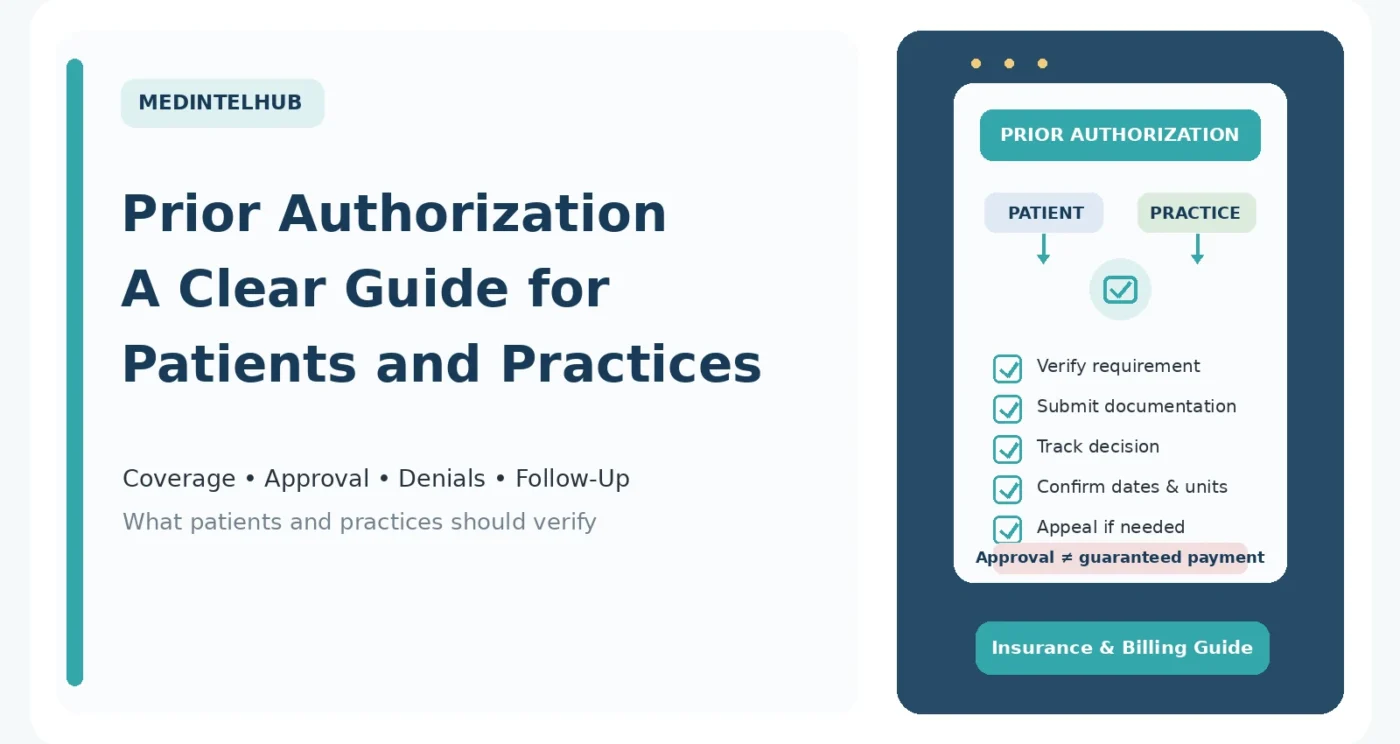
Prior authorization is not a guarantee of final payment.
HealthCare.gov also notes that preauthorization does not promise that the plan will ultimately cover the cost.
Important: Prior authorization rules vary by health plan, benefit, service, provider, and date of care. Patients and practices should verify current requirements directly with the applicable payer. This article is for educational purposes and does not replace plan documents, payer guidance, coding resources, or professional billing or compliance advice.
Prior authorization, sometimes called preauthorization, prior approval, or precertification, is a process in which the health plan reviews a requested service before it is provided or covered.
The payer may ask whether:
- The service is covered under the patient’s plan
- The service meets medical-necessity criteria
- The patient meets specific clinical requirements
- A lower-cost or alternative treatment should be tried first
- The requested provider or facility is appropriate under the plan
- The requested number of visits, units, or days is supported
Depending on the request, the health plan may:
- Approve it
- Deny it
- Approve only part of it
- Request more information
- Approve it for a limited time, number of visits, or number of units
The answer depends on the plan.
Examples that may require authorization include:
- Advanced imaging such as MRI or CT scans
- Certain surgeries or procedures
- Some hospital admissions
- Physical, occupational, or speech therapy
- Home health services
- Durable medical equipment
- Specialty medications
- Infusion services
- Certain behavioral-health services
- Some out-of-network services
A service that requires authorization under one health plan may not require it under another.
Even plans offered by the same insurance company can have different rules.
This distinction causes a lot of confusion.
A referral generally involves one healthcare professional directing a patient to another provider or specialist.
Prior authorization is an approval process involving the health plan.
A patient may need:
- A referral but no prior authorization
- Prior authorization but no referral
- Both
- Neither
That is why patients should not assume that receiving a referral means the insurer has approved the service.
If you are preparing for specialist care, see our MedIntelHub guide How to Prepare Questions Before a Specialist Appointment.
An authorization can be approved and the later claim can still have payment problems.
Possible reasons include:
- The patient’s coverage changed before the service
- The service occurred outside the authorized date range
- The provider or facility differed from the authorization
- The number of units or visits exceeded what was approved
- The final claim did not match the authorized service
- The patient had not met applicable deductible or cost-sharing requirements
- Other claim-processing or coverage rules applied
Authorization should therefore be viewed as one important part of the billing process, not as a promise that the entire claim will be paid.
For medical services, the healthcare practice or facility often submits the request because clinical documentation is usually needed.
The request may be handled by:
- A physician office
- A hospital
- A specialist’s authorization team
- A billing or revenue-cycle department
- A pharmacy
- A medical-equipment supplier
Patients may still need to participate.
For example, the insurer may need updated coordination-of-benefits information, confirmation of another health plan, or other information from the patient.
Patient Checklist: Before a Scheduled Service
If you are told that prior authorization is required, ask a few specific questions.
1. Ask who is submitting the request
Do not assume someone else is handling it.
Ask:
“Is your office submitting the prior authorization, or do I need to contact my insurance plan?”
2. Ask whether the request has actually been submitted
There is a difference between:
“We know authorization is required.”
and:
“The authorization request was submitted on Monday.”
If the service is approaching and no request has been sent, delays become more likely.
When possible, confirm:
- The service or procedure
- The provider
- The facility
- The date or date range
- The number of visits or units
For example, an approval for one imaging facility may not automatically cover the same test at another facility.
Once approved, write down:
- Authorization number
- Date approved
- Expiration date
- Approved visits or units
- Name of the insurer if you called
- Reference number for the call
Keep this information until the claim is fully processed.
5. Confirm that the provider and facility are in network
Prior authorization and network status are different issues.
An insurer can authorize a service without necessarily eliminating all out-of-network cost concerns.
Patients should check both.
6. Ask what you may owe
Authorization does not mean the service is free.
You may still have:
- A deductible
- A copayment
- Coinsurance
- Out-of-network costs
If you later receive an insurance statement, our MedIntelHub article Understanding Your Explanation of Benefits (EOB) Statement can help you compare the insurer’s processing with the provider bill.
For practices, prevention starts with confirming the exact payer requirement.
1. Verify the patient’s exact plan
Do not check authorization rules based only on the insurance-company name.
Confirm:
- Plan name
- Member ID
- Product type
- Primary or secondary status
- Date of service
Rules can differ between commercial, Medicare Advantage, Medicaid managed care, and other products offered by the same payer.
Use the payer’s current portal, provider manual, authorization tool, or other official source.
When possible, verify based on the exact procedure, service, place of service, and plan.
Do not rely indefinitely on an old spreadsheet of authorization requirements.
3. Check whether a referral is also required
Authorization does not replace a referral requirement.
Confirm both when applicable.
4. Gather the supporting clinical information
Depending on the request, the payer may need:
- Diagnosis information
- Clinical notes
- Previous treatment history
- Test results
- Imaging findings
- Medication history
- Documentation of failed or attempted treatments
- Orders from the treating clinician
Submitting incomplete information can turn a straightforward request into a delay or denial.
Check:
- Procedure or service
- Units
- Provider
- Facility
- Place of service
- Dates
If the treatment plan changes after approval, determine whether the authorization also needs to be changed.
Track the Request Until a Decision Is Made
Submitting the request is not the end of the process.
Practices should record:
- Date submitted
- Submission method
- Authorization or case number
- Payer status
- Additional information requested
- Decision date
- Approved dates
- Approved units or visits
- Denial reason if denied
A request that is waiting for medical records should not sit in the same work queue as a request already approved.
What Changed in 2026?
Prior authorization rules are becoming more standardized for several CMS-regulated payer types.
Under the CMS Interoperability and Prior Authorization Final Rule, important operational requirements began in 2026.
For impacted payers subject to the new decision-timeframe requirements, prior authorization decisions for medical items and services must generally be sent within:
- 72 hours for expedited or urgent requests
- 7 calendar days for standard requests
CMS’s current FAQ clarifies that the decision-timeframe requirement does not apply in exactly the same way to Qualified Health Plan issuers on the Federally-facilitated Exchanges, so practices should verify the rules for the specific payer type.
Beginning in 2026, impacted payers must also provide a specific reason when they deny a prior authorization request for medical items or services covered by the rule.
That is important because a vague denial such as “not approved” gives a practice very little information about what needs to be corrected or appealed.
CMS also requires impacted payers to publicly report certain prior authorization metrics.
For the first reporting year, payers were required to post 2025 data by March 31, 2026.
The public metrics can include information such as:
- Percentage of standard requests approved
- Percentage denied
- Percentage approved after appeal
- Expedited approval and denial rates
- Average and median decision times
This does not resolve an individual patient’s authorization, but it increases transparency about how payer authorization processes operate.
The 2024 CMS final rule also requires impacted payers to implement a Prior Authorization API for medical items and services, generally beginning January 1, 2027.
The electronic system is intended to help providers identify:
- Which items or services require authorization
- What documentation is needed
- Whether the request is approved
- How long the approval remains valid
- The specific reason for a denial
- Whether the payer needs more information
The API requirements in that rule generally exclude drugs.
CMS proposed additional electronic prior-authorization requirements for drugs in 2026, but those proposals should not be treated as final requirements unless and until CMS finalizes them.
Drug authorization rules can work differently from authorization for medical procedures or services.
For example, Medicare Part D plans may use prior authorization, step therapy, and quantity limits.
A prescriber may need to show that a drug is medically necessary or that the patient meets specific plan requirements.
In some cases, the patient or prescriber can ask the plan for an exception to a drug-coverage rule.
Practices should therefore keep medical-service prior authorization and pharmacy prior authorization workflows separate enough to follow the correct payer rules.
Medicare Advantage plans can use prior authorization, but CMS has placed limits and continuity-of-care requirements on how it is used.
CMS requires coordinated-care Medicare Advantage plans to use prior authorization to confirm diagnoses or other medical criteria and to determine whether an item or service is medically necessary under applicable rules.
CMS also requires that when a prior authorization for a course of treatment is approved, the approval remain valid for as long as medically reasonable and necessary under the applicable coverage criteria, medical history, and treating-provider recommendation.
In addition, when a person receiving an active course of treatment switches to a new Medicare Advantage plan, the new plan must generally provide at least a 90-day transition period during which it may not require prior authorization for that active course of treatment.
See the CMS Medicare Advantage and Part D final-rule summary for these protections.
What About Original Medicare?
Original Medicare does not require prior authorization for every service.
CMS uses prior authorization and pre-claim review for certain categories of Medicare Fee-for-Service services and items.
Current initiatives include certain:
- Hospital outpatient department services
- Repetitive scheduled non-emergency ambulance transport
- Durable medical equipment, prosthetics, orthotics, and supplies
- Other services included in specific CMS review programs
You can review the current programs on the CMS Prior Authorization and Pre-Claim Review Initiatives page.
Because CMS updates these programs, providers should verify whether a particular item or service is subject to prior authorization for the patient’s location and date of service.
A denial does not always mean the process is finished.
Start by identifying the exact reason.
Ask:
- Was information missing?
- Did the payer apply a medical-necessity rule?
- Was the wrong service or code requested?
- Was the request submitted to the wrong plan?
- Did the payer require a different treatment first?
- Did the request lack documentation?
Because impacted payers covered by the 2026 CMS rule must provide a specific denial reason for applicable medical-service prior authorizations, that reason should help guide the next step.
Resubmission, Reconsideration, or Appeal?
These are not always the same action.
If the request was missing information, the practice may be able to supply the documentation or resubmit the request.
If the payer made a decision that the patient or provider believes is incorrect, a formal reconsideration or appeal may be appropriate.
Follow the appeal instructions in the denial notice and the payer’s current policy.
For a broader denial-management checklist, see our related MedIntelHub article Claim Denials: A Practical Prevention and Follow-Up Checklist.
What if the Request Is Urgent?
Standard prior authorization should not be treated as the right process for a medical emergency.
HealthCare.gov notes that preauthorization requirements generally do not apply before emergency care.
If care is urgent but not an emergency, the clinician or practice can ask the payer whether the request qualifies for expedited review.
Under the 2026 CMS requirements discussed above, affected payers subject to those timeframes generally must decide expedited medical-service requests within 72 hours.
The patient’s medical situation, not convenience alone, determines whether an expedited request is appropriate.
Do not wait until the morning of the procedure to ask.
Several days beforehand, contact the practice and ask:
- Has the authorization been approved?
- What is the authorization number?
- Does it cover this exact service?
- Does it cover this provider and facility?
- Are the dates correct?
- Is there anything the insurance company still needs?
If the answer is that authorization is still pending, ask what the office recommends doing with the scheduled appointment.
Do not assume that showing up automatically makes the service covered.
What Practices Should Check Before the Claim Is Submitted
Once the service has been performed, compare the authorization with the claim.
Check:
- Patient
- Payer
- Date of service
- Procedure or service
- Provider
- Facility
- Units or visits
- Authorization number
A valid authorization does not help much if the claim is submitted with information that does not match it.
For the full claim process, see our MedIntelHub guide Medical Billing Workflow: From Patient Visit to Payment.
- Ask whether authorization is required.
- Ask who will submit it.
- Confirm that it was actually submitted.
- Ask what service, provider, and facility are being authorized.
- Get the authorization number when approved.
- Check the expiration date and approved visits or units.
- Confirm network status separately.
- Ask about deductible, copay, and coinsurance.
- Keep copies of approval or denial notices.
- If denied, ask what can be corrected or appealed.
- Verify the exact health plan and coverage.
- Confirm whether the service requires authorization.
- Check referral requirements separately.
- Confirm service, code, provider, facility, units, and dates.
- Gather complete clinical documentation.
- Submit through the payer’s current required channel.
- Record the case or authorization number.
- Track requests for additional information.
- Record approval dates, expiration, and units.
- Compare the final claim with the authorization.
- If denied, identify the exact reason before resubmitting.
- Track reconsideration or appeal deadlines.
The Bottom Line
Prior authorization is an insurance review process that can affect whether a planned service, treatment, drug, or medical item is covered under a health plan.
It is not the same as a referral.
It is also not a guarantee of final payment.
For patients, the most useful steps are to confirm who is submitting the request, what exactly was approved, how long the approval lasts, and whether the provider and facility are in network.
For practices, the strongest process is to verify the exact plan, check current payer requirements, send complete documentation, track the request, and make sure the eventual claim matches the authorization.
In 2026, CMS began requiring important prior authorization process improvements for several payer types, including faster decisions for many medical-service requests and specific reasons for applicable denials.
More electronic prior authorization requirements are scheduled to take effect in 2027.
Even with those changes, the basic rule remains the same:
Do not assume.
Verify the requirement, document the approval, track the details, and follow up before the service or claim becomes a problem.
Sources and References
- HealthCare.gov — Prior Authorization. Definition of prior authorization and its role in health-plan coverage.
- HealthCare.gov — Preauthorization. Explanation that preauthorization may be required before non-emergency services and does not guarantee final payment.
- Centers for Medicare & Medicaid Services — Interoperability and Prior Authorization Final Rule. Official summary of 2026 prior-authorization process requirements and 2027 API requirements.
- Centers for Medicare & Medicaid Services — Prior Authorization API FAQ. Current CMS guidance on decision timeframes, denial reasons, public metrics, and electronic prior authorization requirements.
- Centers for Medicare & Medicaid Services — 2024 Medicare Advantage and Part D Final Rule. Medicare Advantage continuity-of-care protections and limits on prior-authorization use.
- Centers for Medicare & Medicaid Services — Prior Authorization and Pre-Claim Review Initiatives. Current Original Medicare Fee-for-Service prior-authorization and pre-claim-review programs.
- Medicare.gov — Drug Plan Rules. Information about Medicare Part D prior authorization, step therapy, quantity limits, and exceptions.
- HealthCare.gov — Appealing a Health Plan Decision. General information about internal appeals and external review rights.
Editorial Disclaimer
MedIntelHub provides healthcare, insurance, medical billing, and patient-education information for educational purposes only.
This article does not provide legal, coding, reimbursement, insurance-contract, or medical advice. Prior authorization requirements, decision timeframes, appeal rights, network rules, and patient costs vary by health plan, service, and healthcare setting and can change over time.
Patients should verify coverage and authorization requirements with their health plan and healthcare provider. Practices should verify current payer policies, plan documents, contracts, coding guidance, and authorization requirements before providing or billing non-emergency services.
For more information about our publication, visit About MedIntelHub.

David Bennett
David Bennett is an author at MedIntelHub, where he creates clear, practical, and well-researched content about healthcare, medical billing, insurance, and patient education. His goal is to make complex healthcare topics easier for readers to understand and use in everyday situations. David emphasizes accuracy, transparency, and reliable sourcing, using information from trusted organizations and official healthcare resources whenever possible. Content published by David is intended for educational purposes and should not replace advice from qualified medical, legal, or healthcare professionals.