You may go to a primary care appointment expecting questions about blood pressure, medications, sleep, or pain.
Then the doctor or nurse asks whether you have been feeling down, anxious, worried, or less interested in things you normally enjoy.
For some patients, that can feel unexpected.
But mental health screening has become an increasingly common part of preventive and primary care.
That does not mean every appointment includes the same questionnaire, and it does not mean answering “yes” to a screening question gives you a mental health diagnosis.
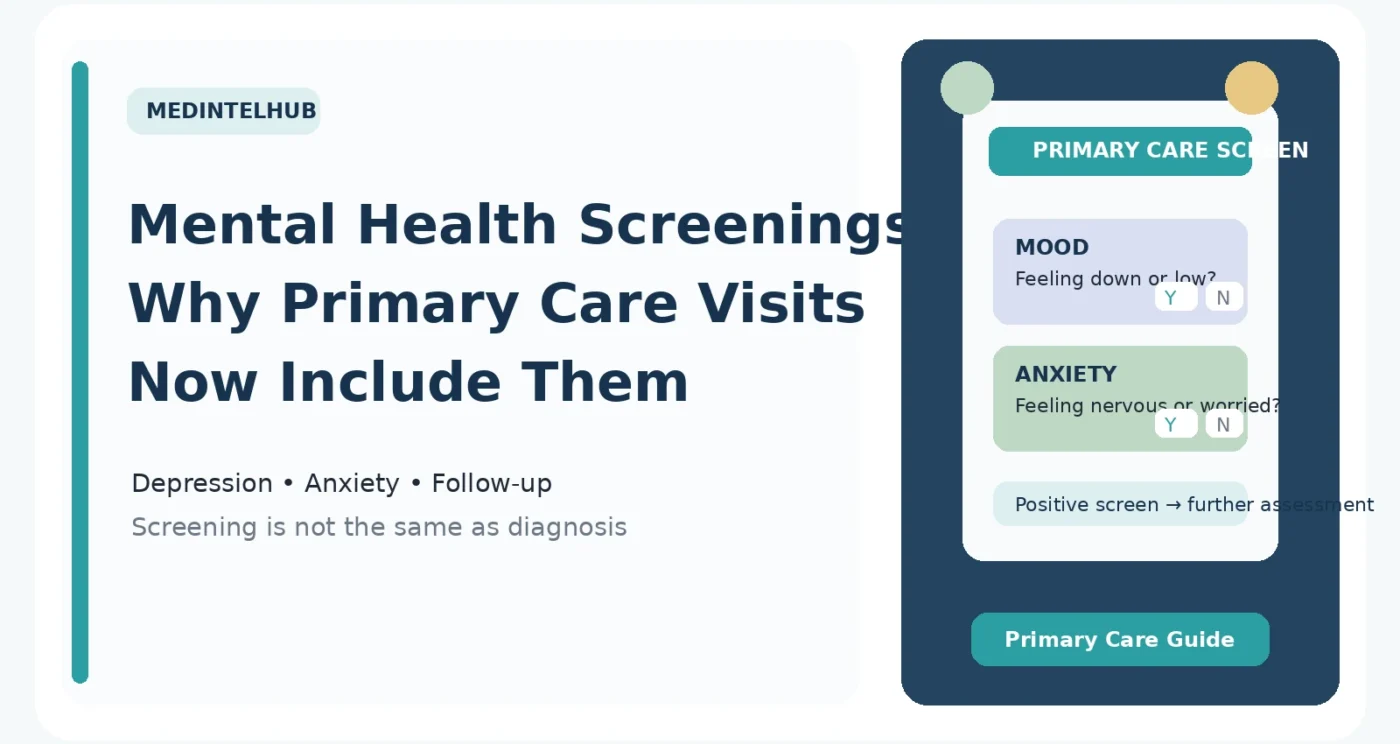
Screening is an early check. It is designed to identify people who may need a closer assessment.
Current recommendations from the U.S. Preventive Services Task Force support depression screening in adults, including pregnant and postpartum people and adults age 65 and older. The Task Force also recommends anxiety screening in adults age 64 and younger, including pregnant and postpartum people.
For younger patients, the USPSTF recommends depression screening for adolescents ages 12 to 18 and anxiety screening for children and adolescents ages 8 to 18.
These recommendations are one reason mental health questions are appearing more often in routine healthcare.
Important: A mental health screening questionnaire is not a diagnosis. A positive screen usually means the healthcare professional should ask additional questions and decide whether a diagnostic evaluation, follow-up, referral, or treatment is appropriate.
What Is a Mental Health Screening?
A mental health screening is usually a short set of standardized questions about symptoms, mood, thoughts, behavior, or daily functioning.
Depending on the patient and the reason for the visit, a primary care practice may screen for issues such as:
- Depression
- Anxiety
- Alcohol misuse
- Unhealthy drug use
- Behavioral or emotional concerns in children and adolescents
Some questionnaires contain only a few questions.
Others are longer and may be used after an initial screen suggests that more information is needed.
The purpose is not to label a patient.
It is to notice possible concerns that may otherwise go unrecognized.
Why Is Primary Care a Common Place for Screening?
Primary care is often where people have the most regular contact with the healthcare system.
A patient may see a primary care clinician for a yearly checkup, medication refill, blood-pressure follow-up, diabetes care, fatigue, headaches, or another physical concern without ever making a separate appointment with a mental health professional.
That gives primary care teams an opportunity to notice symptoms that may affect health, functioning, sleep, work, school, relationships, or a person’s ability to manage another medical condition.
Mental and physical health also overlap.
For example, depression or anxiety can occur alongside chronic pain, heart disease, diabetes, sleep problems, pregnancy, and other health concerns.
Symptoms such as fatigue, trouble concentrating, appetite changes, poor sleep, or low energy may have several possible causes.
A mental health screen can provide one piece of the overall picture.
Depression Screening Is Recommended for Adults
The U.S. Preventive Services Task Force recommends depression screening in adults, including pregnant and postpartum people and adults age 65 and older.
The recommendation applies to adults who do not already have a diagnosed depression disorder and who are not presenting with recognized signs or symptoms that would already require clinical evaluation.
One important part of the recommendation is what happens after screening.
A positive result should be followed by additional assessment to determine whether depression is actually present, how severe the symptoms are, and whether another condition may also need attention.
What Questions Are Used to Screen for Depression?
Primary care practices can use several standardized depression-screening tools.
The USPSTF identifies versions of the Patient Health Questionnaire, or PHQ, among commonly used tools in adults.
You may see a short questionnaire asking about symptoms over the past two weeks, such as:
- Feeling down or depressed
- Having little interest or pleasure in activities
- Sleep difficulties
- Changes in energy
- Appetite changes
- Difficulty concentrating
A short initial questionnaire may be followed by a longer one when additional information is needed.
The exact tool and process can differ by practice.
A Positive Depression Screen Does Not Automatically Mean Depression
This distinction matters.
Screening tools are designed to identify people who may have a condition.
They are not designed to replace a clinical evaluation.
The USPSTF states that positive depression-screening results should lead to additional assessment to confirm the diagnosis and evaluate the patient’s symptoms.
For example, feeling tired and sleeping poorly can occur with depression, but those symptoms can also have physical, medication-related, lifestyle, or other causes.
The clinician may ask more questions before deciding what should happen next.
Anxiety Screening Has Also Become More Common
Anxiety is another reason patients may encounter mental health questions during primary care.
The USPSTF recommends screening for anxiety disorders in adults age 64 and younger, including pregnant and postpartum people.
For adults age 65 and older, the USPSTF currently says there is not enough evidence to determine the overall balance of benefits and harms of routine anxiety screening.
That does not mean clinicians should ignore anxiety symptoms in older adults.
It means the evidence is not sufficient for the Task Force to make a recommendation for or against routine screening in asymptomatic adults age 65 and older.
What Does an Anxiety Screening Ask?
Several brief anxiety-screening questionnaires are available.
The USPSTF notes that versions of the Generalized Anxiety Disorder, or GAD, scale are commonly used in the United States.
Questions may ask how often a person has experienced problems such as:
- Feeling nervous or on edge
- Difficulty controlling worry
- Worrying about different things
- Trouble relaxing
- Restlessness
As with depression screening, an anxiety questionnaire alone cannot diagnose an anxiety disorder.
The USPSTF says a positive anxiety screen should be followed by a confirmatory diagnostic assessment.
Mental Health Screening Can Start With Only a Few Questions
One reason mental health screening works well in primary care is that an initial screen does not necessarily require a long appointment.
Some practices give patients a questionnaire while they are waiting.
Others include it in an electronic check-in form or patient portal before the visit.
A medical assistant, nurse, or clinician may review the responses.
If the answers do not suggest a concern, the visit may simply continue.
If a response needs attention, the clinician can ask follow-up questions.
Why Ask Questions When the Patient Did Not Mention a Mental Health Problem?
Not everyone recognizes symptoms as depression or anxiety.
Some people may focus on physical symptoms.
Others may feel embarrassed, assume the problem is not serious enough, or simply not know how to bring it up.
A standardized screening process gives patients a routine opportunity to answer questions that they might not otherwise raise themselves.
It can also reduce the idea that mental health is somehow separate from routine healthcare.
If every eligible patient is asked the same basic questions, the conversation does not have to depend entirely on whether the patient decides to bring up the subject first.
What Happens if the Screen Is Positive?
A positive screen is usually the beginning of a conversation, not the end of one.
The next steps may include:
- More detailed questions about symptoms
- A longer standardized questionnaire
- Reviewing how symptoms affect daily life
- Reviewing medications and medical conditions
- Discussing stress, sleep, alcohol, or substance use
- A diagnostic evaluation
- Follow-up with the primary care clinician
- Referral to a mental health professional
- Discussion of treatment options when appropriate
The right next step depends on the screening result, the patient’s symptoms, medical history, preferences, safety concerns, and available services.
Screening Works Best When Follow-Up Is Available
Simply handing someone a questionnaire is not enough.
The USPSTF emphasizes that people who screen positive should receive further evaluation and, when appropriate, treatment or referral to evidence-based care.
Medicare makes a similar point in its depression-screening coverage rules.
Medicare Part B covers one depression screening each year when it is provided in a primary care setting where follow-up treatment and referrals are available.
You can review the current Medicare coverage details on the Medicare depression-screening page.
For a more detailed look at billing and coverage, see our MedIntelHub guide: Mental Health Screenings at Primary Care Visits: How Billing and Coverage Work.
Does Medicare Cover Mental Health Screening?
Original Medicare Part B covers one depression screening each year.
Medicare says the screening must take place in a primary care setting, such as a doctor’s office, that can provide follow-up treatment or referrals to a mental health professional.
When the provider accepts Medicare assignment, Medicare says the patient pays nothing for the covered depression screening.
That does not mean every service that happens after a positive screen is free.
Follow-up evaluation, treatment, or visits with a mental health professional may involve copayments or coinsurance depending on the service and coverage.
What About Private Insurance?
Coverage depends on the health plan and the service.
HealthCare.gov lists depression screening among preventive services for adults that Marketplace plans and many other health plans generally cover without copayments or coinsurance when applicable requirements are met.
HealthCare.gov also notes that preventive services are generally covered at no cost when received from an in-network provider, but coverage details can vary and $0 cost is not guaranteed in every situation.
Children’s preventive benefits also include behavioral assessments and routine depression screening for adolescents beginning at age 12.
If you receive an insurance statement after a screening, our MedIntelHub guide Understanding Your Explanation of Benefits (EOB) Statement can help you compare what the insurer processed with any bill you receive.
Screening and Treatment Are Not the Same Service
This is one of the most important insurance distinctions.
A preventive screening can have different coverage rules from a diagnostic evaluation or treatment visit.
For example:
A patient may receive a covered preventive depression screen during primary care.
If the screening result leads to a separate diagnostic evaluation, psychotherapy, medication management, or another mental health service, those services may be subject to the patient’s normal cost-sharing rules.
That is why “the screening was covered” does not necessarily mean all follow-up mental health care will have no out-of-pocket cost.
What About Children and Teenagers?
Mental health screening is also part of preventive care for many younger patients.
The USPSTF recommends screening adolescents ages 12 to 18 for major depressive disorder.
For children age 11 and younger, the Task Force currently says there is not enough evidence to recommend for or against routine depression screening.
The USPSTF also recommends anxiety screening for children and adolescents ages 8 to 18.
For children age 7 and younger, the evidence is currently insufficient for the Task Force to make a recommendation for or against routine anxiety screening.
These age cutoffs apply to USPSTF preventive-screening recommendations. They do not mean younger children with concerning symptoms should not be evaluated.
If a child or adolescent is showing symptoms, a healthcare professional can assess those symptoms regardless of whether the patient falls into a routine screening age group.
What About Suicide-Risk Screening?
Patients sometimes assume that depression screening and suicide-risk screening are exactly the same thing.
They are related, but they are not identical.
Some depression questionnaires include questions about thoughts of self-harm or being better off dead. A concerning response can lead to an immediate safety assessment.
At the same time, the USPSTF currently concludes that evidence is insufficient to determine the balance of benefits and harms of universal suicide-risk screening in asymptomatic adults and in children and adolescents.
That does not mean healthcare professionals should ignore suicidal thoughts or warning signs.
A patient who reports thoughts of self-harm, expresses suicidal intent, or has other concerning symptoms needs appropriate clinical assessment rather than simply waiting for a routine screening schedule.
Do You Have to Answer Mental Health Questions?
Patients can ask why a question is being asked and how the information will be used.
If a question feels uncomfortable, it is reasonable to say so.
At the same time, answering honestly can give the healthcare professional information that may affect the care they recommend.
If you do not understand a question, ask for clarification instead of guessing what it means.
You can also ask:
- What is this questionnaire screening for?
- What does my result mean?
- Does this result mean I have a diagnosis?
- Do I need another assessment?
- Who will follow up with me?
- Will this create another visit or charge?
What if You Are Asked About Mental Health During a Telehealth Visit?
Mental health screening does not always require an in-person appointment.
A primary care practice may send a questionnaire through a patient portal before a virtual visit or ask screening questions during the appointment.
Privacy matters.
If you expect to discuss sensitive mental health information during a virtual visit, finding a reasonably private place and using headphones can make the conversation easier.
For more information about virtual primary care, see our MedIntelHub article Telehealth in 2026: How Virtual Visits Are Changing Primary Care.
Sleep Questions May Be Part of the Conversation Too
Mental health questionnaires often ask about sleep because changes in sleep can occur alongside depression and anxiety.
But poor sleep does not automatically mean a person has a mental health condition.
Sleep problems can have many causes.
If sleep itself is the main concern, see our MedIntelHub guide 7 Small Habits That Actually Improve Sleep Quality.
How to Prepare if You Want to Discuss a Screening Result
If a screening result leads to a follow-up appointment or referral, it can help to write down what you have noticed.
Consider noting:
- When the symptoms started
- Whether they happen every day or only sometimes
- Changes in sleep
- Changes in appetite
- Changes in concentration or energy
- Whether symptoms affect work, school, relationships, or daily activities
- Current medications and supplements
- Questions about treatment or referral options
If you are seeing another clinician after the screening, our MedIntelHub guide How to Prepare Questions Before a Specialist Appointment may help you organize the visit.
Mental Health Screening Is Not a Judgment
Some people worry that being asked mental health questions means the clinician thinks something is wrong with them.
Usually, routine screening is much less personal than that.
It is similar in concept to checking blood pressure or asking about tobacco use.
The clinician is looking for a potential health concern that may not be obvious without asking.
A low screening score does not mean a person will never experience a mental health problem.
A higher score does not automatically mean a diagnosis.
It is information that helps decide whether the conversation should go further.
The Bottom Line
Mental health questions are becoming a more familiar part of primary care because depression, anxiety, and other behavioral health concerns can affect overall health and may otherwise go unnoticed.
The USPSTF recommends routine depression screening for adults and for adolescents ages 12 to 18.
It also recommends anxiety screening for adults age 64 and younger and for children and adolescents ages 8 to 18.
But screening is not the same thing as diagnosis.
A questionnaire can identify possible symptoms.
A healthcare professional still needs to decide whether the result requires more assessment, follow-up, referral, or treatment.
Coverage can also change depending on what happens after the screening.
Medicare covers one annual depression screening in an appropriate primary care setting, while private-plan preventive benefits vary according to the plan and applicable coverage requirements.
If you are asked mental health questions during a routine visit, you can ask why the screening is being done, what the result means, and what happens next.
That conversation is part of the purpose of screening.
Sources and References
- U.S. Preventive Services Task Force — Depression and Suicide Risk in Adults: Screening. Recommendation supporting depression screening in adults, including pregnant and postpartum people and older adults, with information about commonly used screening instruments and follow-up assessment.
- U.S. Preventive Services Task Force — Anxiety Disorders in Adults: Screening. Recommendation supporting anxiety screening in adults age 64 and younger and explaining the evidence gap for routine screening in adults age 65 and older.
- U.S. Preventive Services Task Force — Depression and Suicide Risk in Children and Adolescents: Screening. Recommendation supporting depression screening in adolescents ages 12 to 18.
- U.S. Preventive Services Task Force — Anxiety in Children and Adolescents: Screening. Recommendation supporting anxiety screening for children and adolescents ages 8 to 18.
- Medicare.gov — Depression Screening. Current information about Medicare Part B coverage for one annual depression screening in an appropriate primary care setting.
- HealthCare.gov — Preventive Care Benefits for Adults. Information about preventive services, including depression screening, covered by Marketplace plans and many other health plans.
- HealthCare.gov — Preventive Care Benefits for Children. Information about behavioral assessments and routine depression screening for adolescents beginning at age 12.
- HealthCare.gov — Mental Health and Substance Use Coverage. Information about mental and behavioral health services as essential health benefits in Marketplace plans.
Editorial Disclaimer
MedIntelHub provides healthcare, insurance, and patient-education information for educational purposes only. This article does not provide a mental health diagnosis or individualized medical advice.
Mental health screening recommendations, clinical practices, insurance coverage, and patient costs can vary according to age, symptoms, health plan, provider, and individual circumstances. A screening questionnaire should not replace evaluation by an appropriate healthcare professional when symptoms or safety concerns are present.
If you or another person may be in immediate danger or experiencing a medical or mental health emergency, seek appropriate emergency medical care.
For more information about our publication, visit About MedIntelHub.

David Bennett
David Bennett is an author at MedIntelHub, where he creates clear, practical, and well-researched content about healthcare, medical billing, insurance, and patient education. His goal is to make complex healthcare topics easier for readers to understand and use in everyday situations. David emphasizes accuracy, transparency, and reliable sourcing, using information from trusted organizations and official healthcare resources whenever possible. Content published by David is intended for educational purposes and should not replace advice from qualified medical, legal, or healthcare professionals.