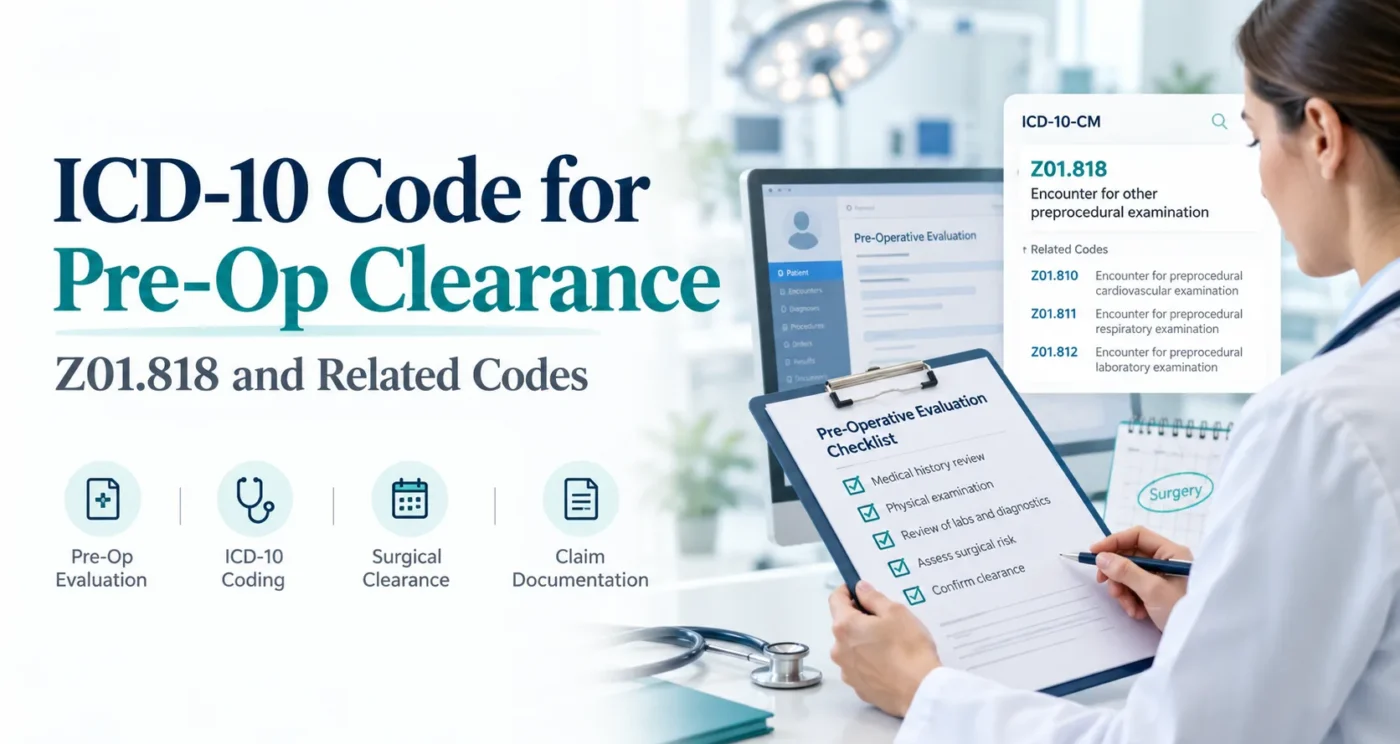
A surgeon requests “medical clearance” before a patient’s scheduled operation. The primary care office completes the visit, reviews the medication list, discusses anesthesia-related risks, and sends its assessment back to the surgical team. When the claim is prepared, someone has to choose the diagnosis code. Should it be Z01.818, the condition requiring surgery, or a code for an existing medical problem?
For an outpatient visit devoted to preoperative evaluation only, the answer usually begins in the Z01.81 family of ICD-10-CM codes. The particular code depends on the examination documented. The condition prompting surgery and relevant evaluation findings are then reported as additional diagnoses, as applicable. This article uses the FY 2027 ICD-10-CM guidelines effective October 1, 2026, and separates diagnosis coding from the question of whether insurance will pay for the service.
Quick Answer: What Is the ICD-10 Code for Pre-Op Clearance?
Z01.818 — Encounter for other preprocedural examination is commonly used for a general preoperative medical evaluation when a more specific preprocedural examination code does not describe the documented encounter. It is a valid, billable ICD-10-CM diagnosis code in the FY 2027 code set. “Billable” here means specific enough to report on a claim; it does not mean the insurer must reimburse the visit.
A targeted cardiovascular evaluation may instead support Z01.810. A respiratory preprocedural examination may support Z01.811. A preprocedural laboratory examination may support Z01.812. None of these codes should be chosen solely because the referral form uses the phrase “pre-op clearance.”
The official guideline is unusually direct. Under Section IV.M, Patients receiving preoperative evaluations only, a code from Z01.81 is sequenced first. A code describing why the surgery is planned follows, and relevant findings from the evaluation are also coded. See the CMS FY 2027 ICD-10-CM Official Guidelines for Coding and Reporting.
Pre-Op Clearance ICD-10-CM Codes at a Glance
| ICD-10-CM code | Official code description | Typical documented context |
| Z01.810 | Encounter for preprocedural cardiovascular examination | A cardiovascular assessment requested before a procedure |
| Z01.811 | Encounter for preprocedural respiratory examination | A focused pulmonary or respiratory assessment before a procedure |
| Z01.812 | Encounter for preprocedural laboratory examination | Blood or urine testing performed as a preprocedural examination |
| Z01.818 | Encounter for other preprocedural examination | A general or other preprocedural examination not represented by the specific choices above |
The parent category Z01.81 — Encounter for preprocedural examinations is not a complete billable code. The medical record must support selection of a more specific child code. The descriptions above correspond to the current classification; consult the CDC ICD-10-CM release files for the official tables, index, and notes.
These are ICD-10-CM diagnosis codes, not CPT procedure codes. The diagnosis code describes the reason for the encounter. A separately reported office visit, laboratory test, or other service is identified with an appropriate CPT or HCPCS code. MedIntelHub’s guide to ICD-10, CPT, and HCPCS code sets explains the distinction.
When Is Z01.818 the Right Code?
Picture a patient awaiting elective joint replacement. The surgeon requests a general medical assessment, and the primary care clinician reviews the patient’s health conditions, medications, functional status, and other information relevant to proceeding with surgery. The visit is not exclusively a cardiac or pulmonary evaluation. If the documentation supports that general preprocedural purpose, Z01.818 may be the most appropriate first-listed diagnosis.
The code’s official description is Encounter for other preprocedural examination. It also covers a preprocedural examination not otherwise specified within this group. Although people call the appointment a “clearance physical,” it is not automatically an annual preventive visit. The clinical purpose is different: the team is assessing issues that might affect a planned procedure and perioperative management.
The record needs to show what the clinician actually did. A scheduling note that says “pre-op” is not a substitute for a documented evaluation, and ordering a single blood test does not transform a laboratory encounter into a comprehensive preoperative examination.
Z01.818 versus Z01.810: General evaluation or cardiovascular assessment?
A surgeon might request a cardiovascular assessment because a patient has a history of heart failure, palpitations, or another issue relevant to surgery. When the clinician performs a preprocedural cardiovascular examination, Z01.810 is the more descriptive examination code. Any separately reportable documented cardiovascular condition should be assessed under the applicable coding rules.
The presence of an ECG alone does not establish that an entire office visit was a cardiovascular consultation. The reason for the encounter and the work documented matter more than the equipment used. Conversely, do not default to Z01.818 when a specifically documented preprocedural cardiovascular examination is better represented by Z01.810.
Z01.818 versus Z01.811: Respiratory clearance
A focused respiratory evaluation may be requested for a patient with chronic lung disease, breathing symptoms, or particular anesthesia concerns. Z01.811 describes the preprocedural respiratory examination. It does not replace an additional diagnosis code for a confirmed respiratory condition that affects the encounter.
A clinician evaluating new shortness of breath as a medical complaint may be performing a diagnostic visit rather than a preprocedural examination-only encounter. The symptoms and circumstances should be reviewed before assigning a Z01.81 code as the reason for service.
Z01.818 versus Z01.812: Laboratory-only preparation
Z01.812 describes an encounter for a preprocedural laboratory examination. Consider a patient who comes to a laboratory for blood work ordered before an operation, without a separately performed medical clearance visit. The preprocedural lab code may fit that encounter if supported by the order and record.
It should not automatically replace Z01.818 on the clinician’s claim just because laboratory tests were ordered during a broader evaluation. A laboratory claim and a clinician’s E/M claim may reflect different services and different first-listed diagnosis choices. Review the relevant orders, documentation, and claim instructions rather than copying one code across every service.
Preoperative Evaluation Versus Annual Physical, Surgical Visit, and Diagnostic Care
“Pre-op clearance” can refer to several quite different activities. A primary care clinician may assess overall perioperative risk. A cardiologist may evaluate a specific cardiovascular concern. An anesthesiology team may complete its preanesthesia assessment. A surgeon may review consent, procedure instructions, and expected recovery. Those are not interchangeable services for coding or reimbursement.
A routine annual physical serves a preventive purpose. A problem-focused appointment addresses a symptom or illness. A preprocedural examination prepares for a planned intervention. Patients can encounter more than one purpose during a visit, but the final codes and billing must reflect the care actually provided. See MedIntelHub’s article on what an annual physical includes for the preventive-care distinction.
The word “clearance” deserves care, too. A clinician can document risk assessment, optimization, recommendations, and whether further assessment appears necessary. A diagnosis code does not certify that an operation is risk-free or make the decision for every member of the surgical and anesthesia team.
How to Sequence ICD-10 Codes for a Preoperative Evaluation
For outpatient preoperative evaluation-only encounters, the FY 2027 official guidance specifies the order. This is not a general rule for every visit occurring before surgery; it applies when the purpose of the encounter is the preoperative evaluation itself.
- List the applicable Z01.81 examination code first. Choose the specific code supported by the visit, such as Z01.818 or Z01.810.
- Add the condition that explains the planned surgery. The surgical indication should be taken from the documented record, not guessed from a procedure name.
- Code relevant findings from the evaluation. Report additional conditions or findings as appropriate under the outpatient guidelines and the documentation.
For example, a medical preoperative evaluation before a planned right knee replacement for documented unilateral primary osteoarthritis of the right knee might be reported as Z01.818 first, followed by M17.11. If a documented, managed comorbidity affects the evaluation, it may warrant an additional diagnosis. This is an illustrative sequence, not an automatic code set for every knee-replacement patient.
What about diabetes, hypertension, or another ongoing condition?
The preoperative visit does not erase the patient’s other diagnoses. Under Section IV.J, outpatient coders report documented coexisting conditions that require or affect care, treatment, or management. For example, documented hypertension may influence perioperative medication planning and the clinician’s assessment. Its code is not reported merely because the condition appears somewhere in an old problem list.
Do not infer a specific diagnosis from a high reading or an abnormal test without sufficient provider documentation. Outpatient guidance also prohibits coding conditions as confirmed when they are characterized only as suspected, probable, or ruled out. A provider query may be appropriate when the record is unclear.
What if surgery takes place that day?
An ambulatory surgery claim is not the same thing as an office encounter solely for preoperative evaluation. Section IV.N addresses ambulatory surgery and instructs coding of the diagnosis for which surgery was performed, subject to its additional rules. Applying the pre-op evaluation sequencing rule to the surgical facility claim can therefore be incorrect.
The service date, clinical setting, and reason for the specific claim should be reviewed independently. A pre-op evaluation performed in a physician office days before surgery, the surgeon’s routine preparation, and the actual surgical encounter may follow different billing conventions.
Documentation That Supports a Pre-Op Examination Code
A coding-friendly note does not have to be long for the sake of being long. It does, however, need to make the encounter’s purpose recognizable. Useful elements often include:
- The planned procedure, approximate timing, and documented reason for surgery.
- The requesting clinician and the specific question being asked, if applicable.
- Relevant medical history, medications, allergies, and previous anesthesia or surgical issues.
- Pertinent symptoms, vital signs, examination findings, and review of records or tests.
- Clinical assessment of problems affecting perioperative care and any recommended next steps.
- A documented plan: for example, proceed with current management, obtain targeted assessment, or coordinate treatment with a specialist.
- Communication with the surgical or anesthesia team when part of the service.
Not every patient needs every test or every examination element. The documentation should reflect the work that was clinically appropriate and performed. A generic phrase such as “patient cleared” may leave unanswered questions about the encounter’s medical necessity, findings, and management decisions.
When a preoperative laboratory test or ECG is performed separately, the associated order and interpretation also matter. Report established diagnoses and documented findings in a way consistent with official guidelines; do not invent an illness to justify a routine service.
Five Pre-Op Clearance ICD-10 Coding Examples
The scenarios below show possible outpatient diagnosis sequencing based on stated facts. They are educational illustrations, not complete claim submissions or guarantees of coverage. In real claims, verify the exact record, laterality, coding instructions, and date of service.
Example 1: General medical evaluation before right knee replacement
A patient has documented unilateral primary osteoarthritis of the right knee and is scheduled for replacement surgery. A family medicine clinician performs a separate general preoperative medical assessment. No new condition is identified.
Possible diagnosis sequence: Z01.818 first; M17.11 second. Z01.818 represents the examination, and M17.11 explains the planned operation. The surgery’s procedure code is not supplied by these diagnoses.
Example 2: Cardiovascular assessment before gallbladder surgery
A patient scheduled for cholecystectomy is referred for a specific preprocedural cardiovascular examination. The record identifies gallbladder calculus without cholecystitis or obstruction and separately documents hypertension that is reviewed during the visit.
Possible diagnosis sequence: Z01.810; K80.20; I10, as supported by the actual record. This example assumes hypertension was relevant to the assessment. The cardiology service must still meet any medical necessity and billing requirements.
Example 3: Respiratory assessment before an elective procedure
A clinician performs a targeted respiratory assessment requested before an operation. The visit reviews a previously diagnosed, uncomplicated asthma condition. The planned surgical diagnosis is documented separately.
Possible diagnosis sequence: Z01.811 first, then the documented surgical indication, followed by an appropriate asthma code if reportable. The asthma code must reflect the provider’s stated type and severity; do not choose an unspecified code without checking whether the record allows greater specificity.
Example 4: Preprocedural blood work without a medical office evaluation
A patient visits the laboratory for blood and urine testing ordered before a planned procedure. The service involves specimen collection and testing, not a comprehensive clinician clearance appointment.
Possible diagnosis code: Z01.812, where appropriate for the laboratory encounter and payer requirements. Do not append an office E/M code for a professional evaluation that did not occur. An abnormal result that prompts a later assessment may create a distinct diagnostic encounter.
Example 5: A new symptom changes the reason for the appointment
A patient arrives expecting preoperative clearance but reports new exertional chest discomfort. The clinician prioritizes evaluating that complaint, and the planned clearance is deferred pending further workup.
Coding question: Was this a preoperative evaluation-only encounter, or was diagnostic assessment of the symptom the principal service? The chief reason for the actual visit should control selection under the outpatient rules. Do not reflexively assign Z01.818 first when the documented visit was instead primarily for a symptom requiring assessment. New or concerning chest symptoms warrant timely professional evaluation, and potentially emergency care depending on their severity and associated features.
Are Pre-Op Tests Automatically Medically Necessary?
No. “Before surgery” explains timing; it does not by itself establish that a particular test is useful or covered. The patient’s health, the procedure, and the question being asked should guide investigation. Blanket laboratory panels, ECGs, or cardiac stress tests are not necessarily appropriate for every patient.
The 2024 AHA/ACC guideline on perioperative cardiovascular care favors a stepwise cardiovascular assessment. It discourages routine stress testing in low-risk patients or in those with adequate functional capacity when testing would not otherwise be indicated. The guideline also discusses situations where more focused evaluation is reasonable.
Coding staff should not decide whether a patient needs a test. Their job is to translate the documented services and reasons into accurate codes, flag unclear documentation, and recognize when a code or medical-necessity edit requires review.
Billing a Preoperative Visit: ICD-10 Is Not the E/M Code
A diagnosis such as Z01.818 explains why the patient was evaluated. It does not describe the professional service delivered. When a separately billable physician or qualified healthcare professional evaluation occurs, the practice generally selects the appropriate E/M code for the setting and work documented. For office or outpatient services, selection follows the current requirements for medical decision-making or qualifying time, as applicable.
A referral does not automatically create a separately payable consultation. Medicare does not recognize traditional office/outpatient CPT consultation codes 99242–99245 for Part B payment. Its Evaluation and Management Services booklet instructs clinicians providing such services to report the appropriate E/M visit code instead. Some other payers may handle consultation codes differently, so use their current instructions.
The surgeon’s routine pre-op visit may be bundled
Medicare’s global surgery rules generally include the surgeon’s routine preoperative visits after the decision to operate, within the applicable global-period window. A surgeon’s standard pre-op conversation, consent review, or procedure preparation is therefore not automatically an independent E/M charge. By contrast, medically necessary work by another clinician may fall outside the surgeon’s global package, depending on circumstances and coverage requirements.
The CMS Medicare Claims Processing Manual, Chapter 12 explains the global package and exceptions, including the initial decision for major surgery and services provided by other physicians. The CMS Global Surgery booklet is a helpful summary. Neither resource establishes that every requested clearance appointment is payable.
Insurance coverage and medical necessity are separate decisions
A plan can recognize a valid diagnosis code and still deny the claim based on coverage, insufficient documentation, bundled services, noncovered routine testing, or other requirements. Medicare, Medicaid programs, and commercial plans can differ in utilization policies, coding edits, network provisions, and payment rules. A state Medicaid policy should not be presented as a nationwide rule.
Before submission, check the relevant payer policy, E/M selection, diagnosis support, test orders, and any applicable authorization or referral conditions. MedIntelHub’s claim denial prevention checklist offers a broader workflow for identifying preventable coding and documentation problems.
Common Preoperative Clearance Coding Mistakes
Using Z01.818 on every referral. A documented cardiovascular, respiratory, or laboratory-focused encounter may support another Z01.81 code. Begin with the actual service, not a saved billing template.
Putting the surgical diagnosis first for an evaluation-only visit. That contradicts the specified Section IV.M sequence. The same sequence should not be applied mechanically to an actual ambulatory surgery encounter.
Coding from the scheduling description alone. “Pre-op clearance” does not reveal whether a full examination, narrow consultation, or specimen collection occurred. Obtain the substantive note and relevant order.
Mistaking a general clearance visit for a preventive physical. The purpose of the visit can change both diagnosis coding and patient coverage expectations.
Reporting unconfirmed findings as established disease. An abnormal result may require assessment, but the clinician’s diagnostic conclusions and outpatient uncertainty rules remain relevant.
Assuming a valid code guarantees reimbursement. ICD-10-CM, CPT/HCPCS, medical necessity, global surgery, and payer policy are separate steps in a valid claim.
FY 2027 ICD-10-CM: What Changed on October 1, 2026?
The FY 2027 ICD-10-CM release applies to covered U.S. healthcare encounters from October 1, 2026, through September 30, 2027. This replaces the prior FY 2026 release for services on or after October 1, 2026. The four preprocedural examination codes listed in this guide remain recognizable choices in the current set; the key issue for this topic is selecting and sequencing them correctly, not inventing a newly created “clearance” code.
The CDC ICD-10-CM files page and CMS ICD-10 release page are the best starting points for checking current code files and changes. Always verify against the edition in effect for the date of service, particularly when reviewing an older claim or preparing a correction. Later guidance, annual updates, and payer-specific edits may change operational requirements.
Frequently Asked Questions
What is the ICD-10-CM code for general pre-op clearance?
Z01.818, Encounter for other preprocedural examination, is commonly appropriate for a documented general preoperative evaluation that is not more accurately described by another Z01.81 code. Select it based on the encounter, not the referral wording alone.
Is Z01.818 billable in 2026?
Yes. Z01.818 is a specific, reportable ICD-10-CM diagnosis code in the FY 2027 release effective October 1, 2026. That classification status does not ensure insurance payment for the related service.
Is Z01.81 a billable ICD-10 code?
No. Z01.81 is the parent subcategory. Claims ordinarily need a valid, more specific code such as Z01.810, Z01.811, Z01.812, or Z01.818.
What ICD-10 code is used for preoperative cardiac clearance?
Z01.810 describes an encounter for a preprocedural cardiovascular examination. Report documented cardiac conditions and the surgical indication as additional diagnoses when applicable under official guidelines.
What code should be used for pulmonary clearance before surgery?
Z01.811 describes a preprocedural respiratory examination. It is not a blanket code for every patient with asthma or COPD: the visit must actually be a preprocedural respiratory examination, and any additional conditions require documentation.
What is the difference between Z01.812 and Z01.818?
Z01.812 identifies a preprocedural laboratory examination, while Z01.818 describes another kind of preprocedural examination, often a general medical assessment. Blood tests ordered during a general visit do not automatically make the clinician’s encounter laboratory-only.
Which diagnosis goes first when billing a pre-op evaluation?
For outpatient preoperative evaluation-only visits, Section IV.M instructs coding the appropriate Z01.81 examination code first. Next report the condition explaining the operation, followed by applicable findings. The rule differs from coding the actual surgery.
Should the reason for surgery be coded even if the appointment is only for clearance?
Yes, the FY 2027 guideline says to assign a code describing the condition that is the reason for surgery as an additional diagnosis. Use the documented surgical indication, not an assumption about what the surgeon plans to treat.
Can Z01.818 be used with diabetes or hypertension codes?
Potentially. Documented coexisting conditions may be coded when they affect the encounter’s care, treatment, or management. Do not automatically copy every historical diagnosis from a problem list onto the claim.
Is a pre-op exam the same as an annual physical?
No. An annual physical focuses on preventive health, while a preoperative evaluation addresses clinical considerations related to a planned procedure. The examinations may share some components, but the reason for service is different.
Does Z01.818 mean a patient is medically cleared for surgery?
No. It identifies the reason for the medical encounter. Whether a patient can proceed with surgery is a clinical decision informed by the evaluation and the broader surgical and anesthesia plan; the code is not a certificate of safety.
Can a surgeon bill a separate preoperative visit?
Sometimes, but not merely because a pre-op visit happened. Medicare’s global surgery policy bundles many routine surgeon-performed preoperative services. An initial visit leading to the decision for major surgery or another separately payable service can be handled differently under the applicable rules.
Does Medicare pay for a preoperative consultation?
A medically necessary preoperative assessment may be covered when documentation and billing criteria are satisfied. Medicare does not pay traditional outpatient consultation CPT codes 99242–99245 as consultation codes; the appropriate E/M code is used instead. Routine screening and bundled surgeon services may not be separately covered.
What if pre-op testing finds a new abnormal result?
The clinician should assess and document the significance of the result. Coding depends on what is confirmed, the actual reason for the encounter, and applicable outpatient rules. Do not code a suspected diagnosis as established solely because a test was abnormal.
Should Z01.818 be used for the claim for the operation itself?
Not automatically. The diagnosis for the actual ambulatory surgery generally reflects the condition for which the surgery was performed, following the relevant surgical coding guidance. A preoperative examination claim and a surgical claim serve different purposes.
The Practical Coding Decision
A useful first question is not “What code does our practice use for clearance?” It is “What type of encounter did the clinician document?” A general preoperative assessment may lead to Z01.818; a cardiovascular, respiratory, or laboratory-focused assessment may lead to another Z01.81 code. For an evaluation-only outpatient visit, the guideline also tells you where the surgical indication belongs in the sequence.
From there, the rest of the work is familiar: code documented conditions accurately, select the proper service code, and check what the payer covers. A valid pre-op diagnosis is one part of a defensible claim, not a substitute for the medical record.
Resources
CMS and NCHS — FY 2027 ICD-10-CM Official Coding Guidelines
The principal source for outpatient first-listed diagnosis rules, specifically Section IV.M for preoperative evaluation-only encounters and Section IV.N for ambulatory surgery. Read the FY 2027 coding guidelines.
CDC/NCHS — ICD-10-CM Files
Provides current release files, including the FY 2027 code set effective October 1, 2026, and the materials used to validate descriptions and code selection. Review official ICD-10-CM files.
CMS — ICD-10 Releases
Lists official diagnosis and inpatient procedure code releases and corresponding applicability dates. Review CMS ICD-10 releases.
CMS — Medicare Claims Processing Manual, Chapter 12
Explains Medicare physician-service billing, including global surgery services and situations in which preoperative services may be separately reportable. Read Chapter 12.
CMS — Evaluation and Management Services
Summarizes professional E/M billing and Medicare’s treatment of office and outpatient consultation codes. Read the E/M services booklet.
CMS — Global Surgery
Summarizes surgical package definitions and billing responsibilities that influence separately reportable preoperative encounters. See the CMS Global Surgery booklet.
American College of Cardiology — Perioperative Cardiovascular Guideline Summary
Outlines evidence-based preoperative cardiovascular risk assessment and explains why routine cardiac testing is not always helpful. Read the ACC guideline summary.
Editorial Guidelines & Medical Disclaimer
This MedIntelHub article is for education and general information. It does not diagnose a medical condition, determine whether an individual is fit for surgery, or replace professional medical advice, clinical judgment, or qualified coding guidance. Medication adjustments, testing decisions, and plans to proceed with an operation should be made with the appropriate treating professionals. New, severe, or worsening symptoms—including concerning chest discomfort or breathing difficulty—may require urgent medical evaluation.
The discussion is grounded in official CMS and CDC/NCHS ICD-10-CM guidance, Medicare billing materials, and professional perioperative clinical guidance. Coding, billing, and reimbursement requirements change, and payer coverage policies differ. Before submitting claims, verify the applicable date-of-service version of ICD-10-CM, current CPT/HCPCS rules, documentation, medical necessity, and the relevant Medicare, Medicaid, or commercial payer policies. Review MedIntelHub’s editorial standards for information about sourcing and review.

David Bennett
David Bennett is an author at MedIntelHub, where he creates clear, practical, and well-researched content about healthcare, medical billing, insurance, and patient education. His goal is to make complex healthcare topics easier for readers to understand and use in everyday situations. David emphasizes accuracy, transparency, and reliable sourcing, using information from trusted organizations and official healthcare resources whenever possible. Content published by David is intended for educational purposes and should not replace advice from qualified medical, legal, or healthcare professionals.