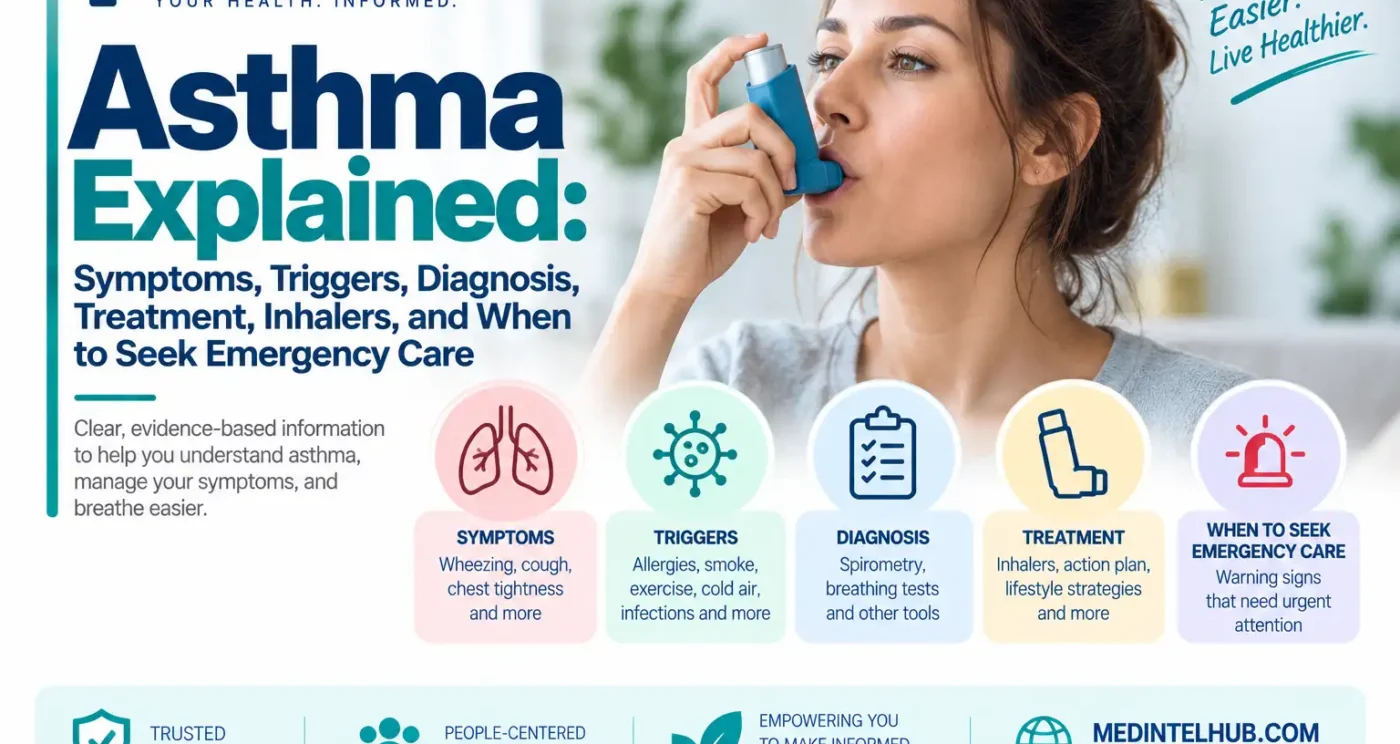
Asthma does not always look dramatic.
For one person, it may be a cough that keeps showing up after a cold. Someone else notices a faint whistle when breathing out during exercise. A child may wake several nights each month coughing but seem perfectly well during the day. Another person may go months without symptoms and then suddenly struggle to breathe after wildfire smoke, pollen, a respiratory infection, or cold air.
That variation is part of asthma itself.
Asthma is a chronic respiratory disease characterized by variable symptoms—such as wheezing, coughing, shortness of breath, and chest tightness—together with variable airflow out of the lungs. The airways can become inflamed, sensitive, narrowed by tightening muscles, and clogged with additional mucus. Symptoms often come and go rather than remaining equally severe every day.
A person may therefore feel completely normal between episodes.
That does not mean the underlying tendency has disappeared.
Asthma also deserves more respect than the phrase “just use an inhaler” suggests. Severe exacerbations can become life-threatening. At the same time, modern asthma treatment has changed significantly: the 2026 Global Initiative for Asthma (GINA) strategy continues to emphasize treatment that includes an inhaled corticosteroid rather than relying only on a traditional short-acting bronchodilator.
With the right diagnosis, inhaler technique, treatment plan, and follow-up, however, many people with asthma can exercise, work, sleep, travel, and live without frequent symptoms.
Contents
- 1. What Is Asthma?
- 2. What Are the Symptoms of Asthma?
- 3. What Does Asthma Feel Like?
- 4. Can Asthma Cause a Cough Without Wheezing?
- 5. Can Asthma Symptoms Be Worse at Night?
- 6. What Causes Asthma?
- 7. What Is an Asthma Trigger?
- 8. Can Allergies Trigger Asthma?
- 9. Can a Cold Trigger an Asthma Attack?
- 10. Can Exercise Trigger Asthma?
- 11. Can Cold Air Trigger Asthma?
- 12. Can Smoke and Air Pollution Make Asthma Worse?
- 13. Can Strong Emotions Trigger Asthma?
- 14. What Is an Asthma Attack?
- 15. What Are the Early Signs of an Asthma Attack?
- 16. What Does a Severe Asthma Attack Look Like?
- 17. Can You Have a Severe Asthma Attack Without Loud Wheezing?
- 18. When Should You Call 911 for Asthma?
- 19. How Is Asthma Diagnosed?
- 20. What Is Spirometry?
- 21. What If Spirometry Is Normal?
- 22. What Is a Bronchodilator Response Test?
- 23. What Is a Peak Flow Meter?
- 24. What Is a FeNO Test?
- 25. Are Allergy Tests Part of Asthma Diagnosis?
- 26. What Conditions Can Look Like Asthma?
- 27. Asthma vs. COPD: What Is the Difference?
- 28. Asthma vs. Bronchitis: What Is the Difference?
- 29. How Is Asthma Treated?
- 30. What Changed in Asthma Inhaler Treatment?
- 31. What Is an Inhaled Corticosteroid?
- 32. Are Steroid Inhalers Safe?
- 33. What Is a Reliever or Rescue Inhaler?
- 34. Rescue Inhaler vs. Controller Inhaler
- 35. What Is ICS-Formoterol?
- 36. Is Albuterol Still Used for Asthma?
- 37. Is Using a Rescue Inhaler Frequently a Bad Sign?
- 38. What Is Montelukast Used for in Asthma?
- 39. What Are Biologic Medicines for Asthma?
- 40. Why Does Inhaler Technique Matter So Much?
- 41. What Is an Asthma Action Plan?
- 42. What Does Well-Controlled Asthma Look Like?
- 43. Can Asthma Go Away?
- 44. Can Adults Develop Asthma for the First Time?
- 45. Can Children Have Asthma?
- 46. Can Children “Grow Out of” Asthma?
- 47. Is Asthma Genetic?
- 48. Can Asthma Cause Chest Pain?
- 49. Can Asthma Cause Low Oxygen?
- 50. Can Asthma Be Cured?
- 51. Can Asthma Attacks Be Prevented?
- 52. When Should You See a Doctor for Possible Asthma?
- 53. When Should Someone With Asthma Contact Their Doctor?
- 54. When Is Asthma an Emergency?
- 55. Asthma at a Glance
- 56. Frequently Asked Questions
- 56.1. What Are the First Signs of Asthma?
- 56.2. What Does Asthma Feel Like?
- 56.3. Can You Have Asthma Without Wheezing?
- 56.4. Is Asthma Contagious?
- 56.5. Can Allergies Trigger Asthma?
- 56.6. Can a Cold Cause an Asthma Attack?
- 56.7. Can Exercise Trigger Asthma?
- 56.8. Should People With Asthma Avoid Exercise?
- 56.9. How Is Asthma Diagnosed?
- 56.10. What Is Spirometry?
- 56.11. Can Spirometry Be Normal if You Have Asthma?
- 56.12. What Is FeNO?
- 56.13. What Is a Rescue Inhaler?
- 56.14. Is Albuterol a Rescue Inhaler?
- 56.15. What Is a Controller Inhaler?
- 56.16. Are Steroid Inhalers Dangerous?
- 56.17. Can Montelukast Treat Asthma?
- 56.18. What Is an Asthma Action Plan?
- 56.19. Can Asthma Go Away?
- 56.20. Can Adults Suddenly Develop Asthma?
- 56.21. Can Children Grow Out of Asthma?
- 56.22. When Should You Go to the ER for Asthma?
- 57. Conclusion
- 58. Resources
- 58.1. Global Initiative for Asthma — 2026 Strategy Report
- 58.2. Global Initiative for Asthma — 2026 Summary Guide
- 58.3. National Heart, Lung, and Blood Institute — Asthma Symptoms
- 58.4. National Heart, Lung, and Blood Institute — Asthma Diagnosis
- 58.5. National Heart, Lung, and Blood Institute — Treatment and Action Plan
- 58.6. National Heart, Lung, and Blood Institute — Asthma Attacks
- 58.7. MedIntelHub — Montelukast Explained
- 58.8. MedIntelHub — Understanding Your Annual Physical
- 58.9. MedIntelHub — Editorial Policy
- 59. Editorial Disclaimer
What Is Asthma?
Asthma is a chronic condition affecting the airways—the tubes carrying air into and out of the lungs.
In asthma, three processes can contribute to breathing difficulty:
- Inflammation: the airway lining becomes swollen and sensitive.
- Bronchoconstriction: muscles surrounding the airways tighten.
- Mucus production: additional mucus can further narrow the passage available for air.
The result is variable airflow limitation.
GINA defines asthma by a pattern of respiratory symptoms that vary over time and in intensity, combined with evidence that expiratory airflow also varies.
“Variable” is the key word.
Someone may have normal breathing on Tuesday and significant wheezing on Friday.
Symptoms may be worse:
- At night
- Early in the morning
- During exercise
- With respiratory infections
- During allergy season
- In cold air
- Around smoke or pollution
The disease is chronic even when symptoms are intermittent.
What Are the Symptoms of Asthma?
The four classic asthma symptoms are:
- Wheezing
- Cough
- Shortness of breath
- Chest tightness
NHLBI notes that the pattern itself often provides important clues: symptoms may come and go, worsen during viral infections, and appear with exercise, allergies, cold air, laughing, or crying.
Not everyone experiences all four.
Some people rarely wheeze.
Others mainly cough.
And a person with severe airway obstruction may occasionally move so little air that the expected loud wheezing becomes less noticeable—a reason absence of wheeze should never be used by itself to decide that a serious breathing problem is safe.
What Does Asthma Feel Like?
Descriptions differ from person to person.
Some say it feels like a tight band has been wrapped around the chest.
Others describe trying to breathe through a narrow straw.
A mild episode may feel like needing to take more deliberate breaths during exercise. A more severe attack can make ordinary conversation, walking across a room, or lying down feel exhausting.
NHLBI describes people during asthma attacks reporting chest pressure, difficulty getting enough air, coughing, wheezing, or lightheadedness.
The important question is not whether the sensation matches someone else’s description perfectly.
It is whether there is a recurrent pattern of variable respiratory symptoms.
Can Asthma Cause a Cough Without Wheezing?
Yes.
Some people have cough-variant asthma, where cough is the main or sometimes only obvious symptom.
The cough may be worse:
- At night
- Early in the morning
- After exercise
- In cold air
- During respiratory infections
But chronic cough has many alternatives, including postnasal drip, reflux, medication effects, chronic infection, smoking-related disease, and other lung conditions.
GINA specifically notes that additional diagnostic strategies may be needed when cough is the only symptom.
A cough lasting weeks therefore should not automatically be labeled asthma without evaluation.
Can Asthma Symptoms Be Worse at Night?
Yes.
Night waking from asthma is clinically meaningful.
Someone may:
- Wake coughing
- Feel chest tightness in bed
- Need a reliever inhaler overnight
- Wake earlier than usual because breathing feels uncomfortable
NHLBI notes that nighttime asthma symptoms can indicate that asthma is not adequately controlled.
Being accustomed to waking up coughing does not make it normal.
If asthma regularly interrupts sleep, the treatment plan deserves review.
What Causes Asthma?
There is no single cause.
Asthma appears to develop through an interaction among genetics, immune responses, airway biology, and environmental exposures.
Factors associated with asthma can include:
- Family history of asthma or allergic disease
- Allergies
- Certain childhood respiratory exposures
- Tobacco smoke exposure
- Air pollution
- Occupational irritants or sensitizers
- Obesity in some asthma phenotypes
- Other environmental and biological influences
Some people develop asthma in childhood.
Others develop it for the first time as adults.
Having a risk factor does not guarantee asthma, and someone can develop asthma without an obvious family history.
What Is an Asthma Trigger?
A trigger is something that provokes symptoms or an exacerbation in someone whose airways are susceptible.
It is not necessarily what caused the underlying asthma.
For example, cold air may repeatedly make someone’s asthma worse, but cold air did not necessarily create the disease.
Common triggers include:
- Viral respiratory infections
- Pollen
- Dust mites
- Mold
- Animal allergens
- Tobacco smoke
- Wildfire smoke
- Air pollution
- Exercise
- Cold or dry air
- Occupational dusts and fumes
- Strong odors
- Certain medicines in susceptible people
- Strong emotional reactions
Different people have different triggers.
Trying to avoid every possible item on an asthma-trigger list is usually less useful than learning which triggers actually matter to the individual.
Can Allergies Trigger Asthma?
Yes.
Allergic asthma is common.
Someone may develop breathing symptoms after exposure to allergens such as:
- Pollen
- Dust mites
- Mold
- Animal dander
NHLBI notes that identifying and reducing exposure to relevant allergens can be part of managing allergic asthma.
But not every person with asthma has allergies.
And not every positive allergy test means that allergen actually worsens asthma.
The history matters: does exposure repeatedly line up with symptoms?
Can a Cold Trigger an Asthma Attack?
Very commonly.
Respiratory viruses are among the most frequent asthma triggers.
A person may begin with an ordinary runny nose or sore throat and then notice that the illness “moves into the chest”:
- Cough becomes more persistent
- Wheezing appears
- Nighttime symptoms increase
- Reliever medication is needed more often
- Exercise becomes harder
NHLBI specifically notes that asthma symptoms often begin or worsen with viral infections such as colds.
This is one reason people with asthma benefit from having an action plan before the next respiratory infection arrives.
MedIntelHub’s Sniffles Explained guide provides additional context on distinguishing common-cold symptoms from allergies and other causes of nasal symptoms.
Can Exercise Trigger Asthma?
Yes.
The more precise term is exercise-induced bronchoconstriction, or EIB.
During exercise—especially in cold or dry conditions—the airways may narrow, causing:
- Cough
- Wheezing
- Chest tightness
- Breathlessness
- Reduced exercise performance
NHLBI recognizes exercise as a common asthma trigger and notes that clinicians may recommend preventive reliever treatment before exercise for some patients.
Having asthma does not mean someone should stop being physically active.
With appropriate treatment, many people with asthma can participate fully in sports.
Frequent exercise symptoms may instead be a sign that asthma management needs improvement.
Can Cold Air Trigger Asthma?
Yes.
Cold, dry air can irritate sensitive airways.
The effect can become stronger during exercise because a person is breathing faster and moving larger amounts of cold air through the respiratory tract.
Some people notice symptoms almost immediately when running outside in winter.
Others mainly cough after returning indoors.
This does not mean cold weather damages everyone’s lungs—it means certain asthmatic airways react to the environmental change.
Can Smoke and Air Pollution Make Asthma Worse?
Yes.
Tobacco smoke, vaping aerosols, wildfire smoke, traffic pollution, and workplace fumes can irritate the airways.
For someone with asthma, exposure may increase:
- Cough
- Wheezing
- Chest tightness
- Reliever use
- Risk of an exacerbation
The practical goal is reducing exposure where possible rather than expecting an inhaler to make heavy smoke exposure harmless.
Can Strong Emotions Trigger Asthma?
They can.
Laughing, crying, anxiety, excitement, or intense stress may change breathing patterns enough to provoke symptoms in susceptible people. NHLBI includes rapid breathing from laughing or crying among possible triggers.
That does not mean asthma is psychological.
Asthma is an airway disease.
Emotion can trigger breathing changes in the same way exercise or cold air can; it does not make the underlying condition imaginary.
What Is an Asthma Attack?
An asthma attack—also called an asthma exacerbation or flare-up—occurs when airway narrowing and inflammation become significantly worse.
During an attack:
- Airway muscles tighten
- The lining becomes more swollen
- Mucus may increase
- Airflow becomes harder
NHLBI notes that attacks may develop gradually or come on quickly and can become life-threatening.
An attack is not simply “having asthma symptoms.”
It is a meaningful worsening from the person’s usual state.
What Are the Early Signs of an Asthma Attack?
An attack does not always begin with dramatic gasping.
Earlier clues may include:
- Cough becoming more frequent
- Mild wheezing
- Increasing chest tightness
- Waking at night
- Needing reliever medication more often
- Feeling unusually winded during normal activity
- Declining peak-flow readings in people who monitor them
Recognizing a familiar early pattern can make an asthma action plan much more useful.
Waiting until someone can barely breathe removes valuable time.
What Does a Severe Asthma Attack Look Like?
More severe symptoms can include:
- Marked difficulty breathing
- Trouble walking because of breathlessness
- Difficulty speaking full sentences
- Very rapid breathing
- Visible effort using neck or chest muscles
- Extreme fatigue
- Confusion or drowsiness
- Blue or gray lips or skin
- Little improvement after prescribed reliever treatment
NHLBI advises calling 911 when asthma medicines are not relieving symptoms or breathing remains very difficult.
A serious asthma attack can progress quickly.
Do not wait for every symptom on the list to appear.
Can You Have a Severe Asthma Attack Without Loud Wheezing?
Yes.
Wheezing requires enough airflow to create a whistling sound.
In extremely narrowed airways, airflow may become so limited that breath sounds become faint.
So “I don’t hear wheezing anymore” is not necessarily reassuring if the person is visibly struggling to breathe.
Clinical appearance—breathing effort, ability to speak, mental status, oxygenation, response to treatment—matters much more.
When Should You Call 911 for Asthma?
Call emergency services when someone with asthma has severe breathing difficulty or when the prescribed rescue treatment is not adequately relieving a serious attack.
Emergency warning signs include:
- Severe or rapidly worsening breathlessness
- Inability to speak normally because of breathing difficulty
- Blue or gray discoloration
- Confusion or unusual drowsiness
- Collapse
- Extreme exhaustion
- Failure to improve after the prescribed reliever
- Symptoms matching the emergency zone of the person’s asthma action plan
NHLBI specifically recommends calling 911 if medicines are not relieving symptoms during an attack or breathing remains very hard.
How Is Asthma Diagnosed?
Asthma should not ideally be diagnosed from symptoms alone.
GINA’s 2026 strategy defines diagnosis around two things:
- A characteristic pattern of variable respiratory symptoms.
- Objective evidence that expiratory airflow varies.
That second part is important because wheezing, coughing, and shortness of breath can occur in many other conditions.
Whenever practical, GINA recommends confirming the diagnosis before long-term inhaled corticosteroid treatment is started, because treatment can normalize lung function and make later confirmation harder.
What Is Spirometry?
Spirometry is one of the most common asthma tests.
You breathe deeply and then blow as hard and completely as possible into a device that measures:
- How much air you can exhale
- How quickly you can exhale it
A bronchodilator may then be given.
The test is repeated to see whether airflow improves.
NHLBI lists spirometry and bronchodilator responsiveness testing among the main tests used when asthma is suspected.
Improvement after a bronchodilator can support the diagnosis because asthma airflow limitation is characteristically variable.
What If Spirometry Is Normal?
That does not always end the evaluation.
Someone with intermittent asthma may have completely normal lung function on a symptom-free day.
Depending on the situation, a clinician may consider:
- Repeating spirometry when symptoms are present
- Peak-flow monitoring
- Exercise challenge
- Methacholine or another bronchial challenge test
- FeNO testing
- Additional evaluation for another diagnosis
GINA notes that more than one test may be necessary to confirm asthma or exclude other causes.
What Is a Bronchodilator Response Test?
This compares lung function before and after inhaling a medicine that rapidly opens the airways.
If airflow improves significantly, that provides evidence that airway narrowing is reversible.
NHLBI describes bronchodilator responsiveness testing as comparing spirometry or peak-flow results before and after a fast-acting bronchodilator.
It is one piece of the diagnosis rather than a standalone yes-or-no test in every situation.
What Is a Peak Flow Meter?
A peak expiratory flow meter is a small handheld device that measures how fast a person can blow air out.
It can be useful for:
- Monitoring asthma at home
- Detecting worsening airflow
- Following an asthma action plan
- Comparing today’s reading with a personal best
NHLBI notes that peak flow can also be used when spirometry is unavailable.
Not everyone with asthma needs to check peak flow every day.
For some people, symptoms are more useful; for others—especially those with poor awareness of worsening obstruction—objective readings can provide an important warning.
What Is a FeNO Test?
Fractional exhaled nitric oxide, or FeNO, measures nitric oxide in exhaled breath.
Higher values can suggest a particular pattern of airway inflammation known as Type 2 inflammation.
NHLBI notes that FeNO can help when an asthma diagnosis or treatment approach remains uncertain.
GINA cautions that FeNO does not diagnose asthma by itself. High levels can occur in non-asthma conditions, while a low result does not rule asthma out.
Are Allergy Tests Part of Asthma Diagnosis?
Sometimes.
Allergy testing can identify sensitization to substances such as:
- Pollen
- Mold
- Dust mites
- Animal allergens
NHLBI says allergy testing may be useful when the history suggests allergic asthma.
But an allergy test answers a different question from spirometry.
It can help identify triggers.
It does not by itself prove that someone has asthma.
What Conditions Can Look Like Asthma?
Several problems can produce cough, wheezing, or shortness of breath.
Possibilities include:
- COPD
- Viral respiratory infection
- Chronic sinus/postnasal drainage
- Gastroesophageal reflux
- Inducible laryngeal obstruction or vocal-cord dysfunction
- Anxiety or panic episodes
- Heart disease
- Pulmonary embolism
- Bronchiectasis
- Other lung diseases
This is why recurrent breathing symptoms deserve proper evaluation.
Someone experiencing severe new chest pain or shortness of breath should also not assume it is asthma simply because they already have an inhaler.
Asthma vs. COPD: What Is the Difference?
Both can cause:
- Wheezing
- Cough
- Breathlessness
- Reduced airflow
They are not the same disease.
Asthma often features more variable symptoms and airflow and commonly begins earlier in life, although adult onset is possible.
COPD tends to involve more persistent airflow limitation and is strongly associated with long-term exposure to tobacco smoke or other inhaled pollutants.
Some people have features of both diseases.
A spirometry pattern and clinical history are much more useful than trying to distinguish them from wheezing alone.
Asthma vs. Bronchitis: What Is the Difference?
“Bronchitis” simply means inflammation involving the bronchial tubes.
Acute bronchitis is commonly associated with a respiratory infection and often produces cough that resolves with the illness.
Asthma is a chronic airway disorder with recurring variable airflow limitation.
Someone with asthma can also develop bronchitis or another respiratory infection.
That combination can make symptoms significantly worse.
How Is Asthma Treated?
Asthma treatment has two broad goals:
- Keep current symptoms controlled.
- Reduce future risks, especially serious exacerbations.
Modern treatment may involve:
- Inhaled corticosteroid-containing medication
- Reliever medication
- Long-acting bronchodilators when appropriate
- Other controller medicines
- Biologic therapy for selected severe asthma
- Trigger reduction
- Correct inhaler technique
- An asthma action plan
- Regular reassessment
Treatment should be adjusted according to symptom pattern, exacerbation history, lung function, age, comorbidities, and how the person responds.
What Changed in Asthma Inhaler Treatment?
This is an area where older advice can be misleading.
For years, many people with mild asthma were told to carry a short-acting beta2-agonist (SABA) such as albuterol and use it whenever symptoms appeared.
That medicine relaxes airway muscle quickly.
The limitation is that it treats bronchoconstriction without directly treating the underlying airway inflammation.
The 2026 GINA strategy continues to recommend ICS-containing treatment rather than SABA-only treatment. GINA’s 2026 World Asthma Day guidance emphasizes anti-inflammatory inhalers for people with asthma and notes that ICS-containing treatment reduces attacks and preventable asthma deaths.
For adults and adolescents with infrequent symptoms, GINA’s preferred Track 1 option is an as-needed low-dose ICS-formoterol inhaler. People with more frequent symptoms may use ICS-formoterol as both maintenance and reliever therapy, depending on the treatment step.
Treatment availability, regulatory approvals, insurance coverage, age, and local guidelines differ, so an individual’s inhaler plan should come from their clinician.
What Is an Inhaled Corticosteroid?
An inhaled corticosteroid (ICS) reduces inflammation inside the airways.
It is not the same as anabolic steroids used to build muscle.
ICS medicines can help:
- Reduce symptoms
- Reduce asthma attacks
- Improve control
- Lower the risk of serious outcomes
GINA describes inhaled corticosteroids as essential anti-inflammatory asthma treatment and emphasizes their role in reducing exacerbations and preventable deaths.
Are Steroid Inhalers Safe?
For most people who need them, inhaled corticosteroids have a well-established role and benefit.
Because the medicine is delivered directly to the airways, exposure is different from taking high-dose systemic corticosteroid tablets for long periods.
Possible local side effects can include:
- Hoarseness
- Throat irritation
- Oral thrush
Good inhaler technique and following instructions about mouth rinsing or spacer use can reduce some local effects.
As with any medication, the lowest effective treatment level is generally preferred once good asthma control has been maintained—but stepping down should be planned with the treating clinician rather than done abruptly.
What Is a Reliever or Rescue Inhaler?
A reliever is used when asthma symptoms appear.
Traditionally, the best-known relievers have been SABA inhalers such as albuterol.
Current GINA guidance increasingly favors anti-inflammatory reliever (AIR) treatment that combines rapid bronchodilation with an inhaled corticosteroid in a single inhaler when appropriate and available.
The precise reliever someone should use depends on their prescribed treatment track.
That is why borrowing another person’s inhaler or assuming every “blue inhaler” should be used the same way is unsafe.
Rescue Inhaler vs. Controller Inhaler
| Feature | Reliever/Rescue | Controller |
|---|---|---|
| Main purpose | Relieve symptoms quickly | Reduce underlying disease activity and future risk |
| When used | During symptoms or according to action plan | Regularly or as part of an ICS-containing regimen |
| Opens airways quickly | Yes, depending on medicine | Some controller combinations also contain a rapid bronchodilator |
| Treats inflammation | SABA alone does not; ICS-containing reliever does | Usually yes |
| Replaces long-term control | No | Designed for ongoing control |
Asthma medication categories have become less rigid because ICS-formoterol can sometimes serve both maintenance and reliever roles.
That is one reason patients should know the actual names and purpose of their inhalers, not simply their colors.
What Is ICS-Formoterol?
ICS-formoterol combines:
- An inhaled corticosteroid to treat inflammation
- Formoterol, a bronchodilator that begins working quickly
For many adults and adolescents, GINA’s preferred approach uses this combination as the reliever, and at higher treatment steps the same type of inhaler can be used for both maintenance and symptom relief—known as maintenance-and-reliever therapy (MART).
This is not appropriate with every ICS/LABA combination.
Do not assume any combination inhaler can be used as a rescue medicine unless the treatment plan specifically says so.
Is Albuterol Still Used for Asthma?
Yes.
Albuterol remains a widely used rapid bronchodilator.
The change in modern guidance is not that albuterol suddenly stopped opening airways.
The concern is SABA-only asthma management.
A bronchodilator can relieve airway tightening without treating the inflammation driving future attacks.
Current GINA guidance therefore favors incorporating inhaled corticosteroid treatment rather than relying on SABA alone.
Is Using a Rescue Inhaler Frequently a Bad Sign?
It can be.
Frequent reliever use may mean:
- Asthma is not well controlled
- Trigger exposure has increased
- Inhaler technique is poor
- Controller treatment is inadequate
- A respiratory infection is worsening symptoms
Increasing reliance on reliever medication deserves review rather than simply requesting another refill indefinitely.
Night waking and activity limitation are other signs that control may not be as good as it seems.
What Is Montelukast Used for in Asthma?
Montelukast is an oral leukotriene receptor antagonist.
It can be useful in selected patients, including some with asthma or exercise-related symptoms.
It is generally less effective than inhaled corticosteroids for preventing asthma exacerbations and is not a rescue medicine.
Montelukast also carries an FDA Boxed Warning for serious neuropsychiatric effects, including reported suicidal thoughts and actions.
For a detailed discussion of its uses and warning, see MedIntelHub’s Montelukast Explained: Uses, Side Effects, FDA Boxed Warning, and When to See a Doctor.
What Are Biologic Medicines for Asthma?
Some people continue to have severe asthma despite optimized inhaled treatment.
For selected patients, specialists may use biologic therapies targeting specific inflammatory pathways.
These are not simply “stronger inhalers.”
Eligibility may depend on:
- Asthma phenotype
- Eosinophil levels
- Allergy-related markers
- Exacerbation history
- Current treatment
- Other clinical factors
GINA maintains separate 2026 guidance for difficult-to-treat and severe asthma because confirming the diagnosis, checking adherence and technique, addressing comorbidities, and determining inflammatory phenotype all matter before escalating treatment.
Why Does Inhaler Technique Matter So Much?
Because a perfectly chosen medicine cannot work properly if most of it never reaches the lungs.
Common mistakes include:
- Inhaling too early or too late
- Not sealing lips around the mouthpiece
- Breathing at the wrong speed for the device
- Forgetting to prime a new device when required
- Not using a spacer when prescribed
- Failing to load a dose correctly
- Stopping the inhalation too soon
Different inhalers require different techniques.
Someone who changes devices should be taught the new technique rather than assuming it works exactly like the old one.
GINA specifically recommends checking inhaler technique frequently.
What Is an Asthma Action Plan?
An asthma action plan is a written, individualized set of instructions for everyday care and worsening symptoms.
NHLBI describes an action plan as documenting:
- Triggers to avoid
- Daily medicines
- How to recognize worsening asthma
- What to do during an attack
- When to contact a clinician
- When to seek emergency care
Many plans use green, yellow, and red zones.
The real value is not the color scheme.
It is having decisions made before someone is frightened and struggling to breathe.
What Does Well-Controlled Asthma Look Like?
Control means more than avoiding hospitalization.
A person whose asthma seems “not too bad” may still be living with unnecessary symptoms.
Clinicians look at factors such as:
- Daytime symptom frequency
- Night waking
- Reliever use
- Activity limitation
- Exacerbations
- Lung function when appropriate
Being unable to run, climb stairs, laugh, sleep, or play sports without symptoms is not automatically an unavoidable part of asthma.
The goal is usually much better control than simply “I haven’t been to the ER.”
Can Asthma Go Away?
Symptoms can become much less active.
Some children appear to enter long periods of remission as they grow older.
Adults can also go through long symptom-free periods.
But asthma may recur later, particularly with:
- Respiratory infection
- Allergens
- Smoking
- Occupational exposure
- Other triggers
So years without symptoms do not always prove the underlying airway tendency has permanently disappeared.
Can Adults Develop Asthma for the First Time?
Yes.
Adult-onset asthma is real.
Someone does not need a childhood asthma history.
Adult asthma may appear after:
- Respiratory illness
- Occupational exposure
- New allergic disease
- Hormonal changes
- Other environmental or health changes
New adult wheezing deserves evaluation because alternative diagnoses—including COPD, heart disease, and inducible laryngeal obstruction—also become relevant.
Can Children Have Asthma?
Yes.
Asthma is common in childhood.
Diagnosis can be more difficult in very young children because preschool children frequently wheeze during viral infections even when they do not go on to have persistent asthma.
NHLBI notes that standard asthma diagnostic testing does not work as well in very young children.
Clinicians may therefore rely more heavily on symptom patterns, risk factors, response to treatment, and repeated assessment.
Can Children “Grow Out of” Asthma?
Some children experience a major reduction or disappearance of symptoms as they get older.
Others continue to have asthma into adulthood.
And symptoms can return after years of apparent remission.
So “growing out of asthma” is possible in a practical sense for some children, but it does not follow one predictable timeline.
Is Asthma Genetic?
Genetics contribute.
Asthma and allergic disease often cluster in families.
But asthma is not usually inherited through one simple gene where having an affected parent guarantees the disease.
Environmental exposures and immune development also matter.
A child can develop asthma without an affected parent, and a child with two affected parents may never develop it.
Can Asthma Cause Chest Pain?
Asthma more commonly causes chest tightness or pressure.
Some people describe that sensation as pain.
But chest pain has many potential causes, including:
- Heart disease
- Pulmonary embolism
- Pneumonia
- Musculoskeletal pain
- Reflux
- Anxiety
- Other pulmonary problems
New severe chest pain should not automatically be blamed on asthma.
If chest pain is accompanied by severe shortness of breath, sweating, fainting, or other concerning symptoms, urgent evaluation may be necessary.
Can Asthma Cause Low Oxygen?
Yes, particularly during a serious exacerbation.
When airflow becomes severely limited, oxygen levels can fall.
A mild or moderate attack can still occur with a normal oxygen reading, however.
Home pulse oximeters also have limitations.
A normal number should not override obvious signs of severe respiratory distress such as inability to speak, extreme breathing effort, confusion, or exhaustion.
Can Asthma Be Cured?
There is currently no universal cure for asthma.
But asthma can often be controlled extremely well.
Treatment can:
- Reduce symptoms
- Reduce night waking
- Allow normal physical activity
- Reduce exacerbations
- Lower hospitalization risk
- Protect lung function
This is why it is more useful to ask, “How well controlled is the asthma?” than simply, “Do I still have it?”
Can Asthma Attacks Be Prevented?
Not every attack can be prevented.
Risk can often be reduced by:
- Using ICS-containing treatment as prescribed
- Learning correct inhaler technique
- Following an asthma action plan
- Avoiding tobacco smoke
- Reducing relevant allergen exposure
- Managing associated allergic rhinitis
- Treating respiratory infections appropriately
- Attending follow-up visits
- Reviewing treatment when symptoms become more frequent
GINA emphasizes a continuing cycle of assessment, treatment, and review rather than assuming one prescription should remain unchanged forever.
When Should You See a Doctor for Possible Asthma?
Consider medical evaluation if you notice a recurring pattern such as:
- Repeated wheezing
- Cough that regularly wakes you at night
- Coughing after exercise
- Breathlessness with activity that seems excessive
- Chest tightness after cold air exposure
- Respiratory infections repeatedly causing chest symptoms
- Symptoms around pollen, pets, dust, or mold
- Repeated need to borrow or use a bronchodilator
The goal is not simply to obtain an inhaler.
It is to determine whether asthma is actually the diagnosis.
GINA recommends objective airflow testing whenever feasible instead of relying on symptoms alone.
When Should Someone With Asthma Contact Their Doctor?
Asthma deserves reassessment when the usual pattern changes.
Reasons include:
- Symptoms occurring more frequently
- Waking at night
- Reliever use increasing
- Exercise becoming more difficult
- Attacks becoming more severe
- Peak-flow values dropping
- Medication side effects
- Inhalers not seeming to work as well
- Repeated urgent-care or emergency visits
Do not wait for the next routine annual physical if breathing symptoms are clearly worsening.
A problem-focused visit allows the clinician to assess lung function, inhaler use, adherence, triggers, and whether treatment needs adjusting.
When Is Asthma an Emergency?
Asthma becomes an emergency when breathing is severely compromised or the person’s usual rescue plan is failing.
Seek emergency care for:
- Severe shortness of breath
- Difficulty speaking because of breathlessness
- Blue or gray lips or skin
- Confusion
- Drowsiness during a severe attack
- Collapse
- Extreme exhaustion
- Rapidly worsening symptoms
- Little or no improvement after prescribed rescue treatment
NHLBI’s guidance is straightforward: call 911 when asthma medicines do not relieve an attack or breathing remains very difficult.
Asthma at a Glance
| Feature | What It Means |
|---|---|
| Common symptoms | Wheeze, cough, shortness of breath, chest tightness |
| Typical pattern | Symptoms vary over time and intensity |
| Common triggers | Viruses, allergens, exercise, cold air, smoke, pollution |
| Main diagnostic test | Spirometry with assessment of variable airflow |
| Other tests | Peak flow, challenge testing, FeNO, allergy evaluation |
| Core treatment principle | ICS-containing therapy to address airway inflammation |
| Reliever | Rapid symptom-relief medicine prescribed for the individual’s treatment plan |
| Action plan | Written instructions for daily treatment and worsening symptoms |
| Emergency signs | Severe breathing difficulty, cyanosis, confusion, failure of rescue treatment |
Frequently Asked Questions
What Are the First Signs of Asthma?
Possible early symptoms include recurring cough, mild wheezing, chest tightness, shortness of breath, or nighttime coughing.
The pattern becomes more suggestive when symptoms come and go or repeatedly appear with exercise, viruses, allergies, or cold air.
What Does Asthma Feel Like?
People may describe chest tightness, difficulty getting enough air, wheezing, coughing, or feeling as though they are breathing through a narrow passage.
Can You Have Asthma Without Wheezing?
Yes.
Cough or breathlessness may be more prominent, and cough-variant asthma can occur.
Wheezing is not required in every episode.
Is Asthma Contagious?
No.
Asthma itself cannot be passed from one person to another.
Respiratory viruses that trigger asthma attacks can be contagious.
Can Allergies Trigger Asthma?
Yes.
Pollen, mold, dust mites, and animal allergens can trigger symptoms in people with allergic asthma.
Can a Cold Cause an Asthma Attack?
Yes.
Viral respiratory infections are common asthma triggers.
Can Exercise Trigger Asthma?
Yes.
Exercise-induced bronchoconstriction can cause coughing, wheezing, breathlessness, or chest tightness during or after activity.
Should People With Asthma Avoid Exercise?
Usually no.
Appropriately controlled asthma should allow most people to remain physically active.
Consistent exercise symptoms may mean the asthma plan needs review.
How Is Asthma Diagnosed?
Diagnosis is based on characteristic variable symptoms plus evidence of variable expiratory airflow, usually from spirometry or another objective lung-function test.
What Is Spirometry?
Spirometry measures how much air you can force out of your lungs and how fast you can exhale it.
Testing before and after a bronchodilator can help show whether airflow obstruction improves.
Can Spirometry Be Normal if You Have Asthma?
Yes.
Intermittent asthma may produce normal lung function between episodes.
Repeat testing or another diagnostic method may sometimes be needed.
What Is FeNO?
FeNO is a breath test measuring nitric oxide, which can be elevated with certain types of airway inflammation.
It can support asthma assessment but does not diagnose asthma by itself.
What Is a Rescue Inhaler?
A rescue or reliever inhaler provides rapid symptom relief.
The specific recommended reliever depends on the person’s asthma treatment plan.
Is Albuterol a Rescue Inhaler?
Yes.
Albuterol is a short-acting bronchodilator commonly used for rapid relief.
Current GINA guidance, however, recommends ICS-containing asthma treatment rather than managing asthma with SABA alone.
What Is a Controller Inhaler?
A controller reduces the underlying disease activity and future risk.
Inhaled corticosteroids are central anti-inflammatory controller medicines.
Are Steroid Inhalers Dangerous?
All medicines can have side effects, but inhaled corticosteroids have an important established role in preventing asthma attacks.
Local effects such as hoarseness or oral thrush can occur, and technique matters.
Can Montelukast Treat Asthma?
Yes, in selected patients.
It is not a rescue medicine, is generally less effective than inhaled corticosteroids for preventing exacerbations, and carries an FDA Boxed Warning for serious neuropsychiatric effects.
What Is an Asthma Action Plan?
It is a written plan explaining daily treatment, how to recognize worsening asthma, which medicines to use, and when to contact a clinician or seek emergency care.
Can Asthma Go Away?
Symptoms can become inactive for long periods, particularly in some children.
Asthma can also recur later.
Can Adults Suddenly Develop Asthma?
Yes.
Asthma can begin in adulthood even without a childhood history.
Can Children Grow Out of Asthma?
Some children’s symptoms improve substantially with age, but others continue to have asthma or experience recurrence later.
When Should You Go to the ER for Asthma?
Emergency care is appropriate when breathing remains very difficult despite prescribed reliever treatment, symptoms are rapidly worsening, or signs such as blue/gray skin, confusion, collapse, or extreme exhaustion appear.
Conclusion
Asthma is more than occasional wheezing.
It is a chronic airway disease in which symptoms and airflow can change substantially from one day—or even one hour—to another.
That variability explains why asthma can be easy to dismiss.
A person may cough through an entire respiratory infection and then feel completely well. Someone else may exercise normally most of the year but struggle every spring. A child may sleep poorly from nighttime coughing while having enough energy to play during the day.
The pattern is what matters.
Current GINA guidance recommends confirming asthma with evidence of variable expiratory airflow whenever possible instead of diagnosing it from symptoms alone. Spirometry, bronchodilator response testing, peak flow, challenge testing, and selected inflammatory tests can all play a role.
Treatment has evolved too.
The modern goal is not simply to relax tightened airway muscles whenever symptoms appear. It is also to treat the underlying inflammation that makes serious attacks possible.
That is why the 2026 GINA strategy continues to emphasize ICS-containing treatment and moves away from SABA-only asthma management.
Some people need only relatively simple treatment.
Others require daily maintenance inhalers, MART, additional medicines, or biologic therapy.
What matters is matching treatment to the individual’s asthma—and then checking whether it is actually working.
Nighttime coughing, increasing reliever use, reduced exercise tolerance, or repeated attacks are not signs to simply tolerate.
They are clues that control may need improvement.
And when an attack becomes severe, the priorities change quickly.
If prescribed rescue medicine is not relieving the symptoms, breathing remains very difficult, the person cannot speak normally, becomes confused or exhausted, or develops blue or gray discoloration, call 911.
Asthma can be dangerous.
It can also be managed remarkably well.
The difference often comes down to getting the diagnosis right, using anti-inflammatory treatment appropriately, knowing how the inhalers work, and having a clear plan before breathing becomes an emergency.
Resources
Global Initiative for Asthma — 2026 Strategy Report
GINA’s current global guidance covers asthma diagnosis, inhaler treatment, exacerbation prevention, treatment steps, severe asthma, and the role of ICS-containing therapy.
Global Initiative for Asthma — 2026 Summary Guide
The current 2026 summary provides practical recommendations for asthma diagnosis and management.
National Heart, Lung, and Blood Institute — Asthma Symptoms
NHLBI provides patient-focused information about wheezing, cough, shortness of breath, chest tightness, and common symptom patterns.
National Heart, Lung, and Blood Institute — Asthma Diagnosis
Covers spirometry, bronchodilator response testing, peak flow, challenge testing, FeNO, and allergy testing.
National Heart, Lung, and Blood Institute — Treatment and Action Plan
NHLBI explains reliever and controller medicines, trigger management, exercise-related asthma, and written asthma action plans.
NHLBI: Asthma Treatment and Action Plan
National Heart, Lung, and Blood Institute — Asthma Attacks
Covers symptoms of an exacerbation, emergency treatment, and when to call 911.
MedIntelHub — Montelukast Explained
For more information about montelukast’s asthma role and FDA Boxed Warning:
Montelukast Explained: Uses, Side Effects, FDA Boxed Warning, and When to See a Doctor
MedIntelHub — Understanding Your Annual Physical
Persistent or worsening breathing symptoms may require a problem-focused medical visit rather than waiting for routine preventive care.
Understanding Your Annual Physical: What Actually Gets Checked
MedIntelHub — Editorial Policy
Editorial Disclaimer
This article is intended for general educational and informational purposes only. It does not diagnose asthma, determine asthma severity, or provide an individualized inhaler regimen.
Wheezing, coughing, chest tightness, and shortness of breath can occur with many conditions. Asthma diagnosis often requires objective lung-function testing.
Do not start, stop, substitute, or change the frequency of an inhaled corticosteroid, bronchodilator, combination inhaler, montelukast, biologic medicine, or systemic corticosteroid based solely on information in this article.
Asthma inhalers are not interchangeable. A combination inhaler should only be used as a reliever if the prescribed asthma plan specifically identifies it for that purpose.
Follow your personal asthma action plan when symptoms worsen.
Call 911 or seek emergency medical care when severe breathing difficulty does not improve with prescribed rescue treatment, or when symptoms include inability to speak normally, blue or gray skin or lips, confusion, collapse, extreme exhaustion, or other signs of a life-threatening asthma attack.

David Bennett
David Bennett is an author at MedIntelHub, where he creates clear, practical, and well-researched content about healthcare, medical billing, insurance, and patient education. His goal is to make complex healthcare topics easier for readers to understand and use in everyday situations. David emphasizes accuracy, transparency, and reliable sourcing, using information from trusted organizations and official healthcare resources whenever possible. Content published by David is intended for educational purposes and should not replace advice from qualified medical, legal, or healthcare professionals.