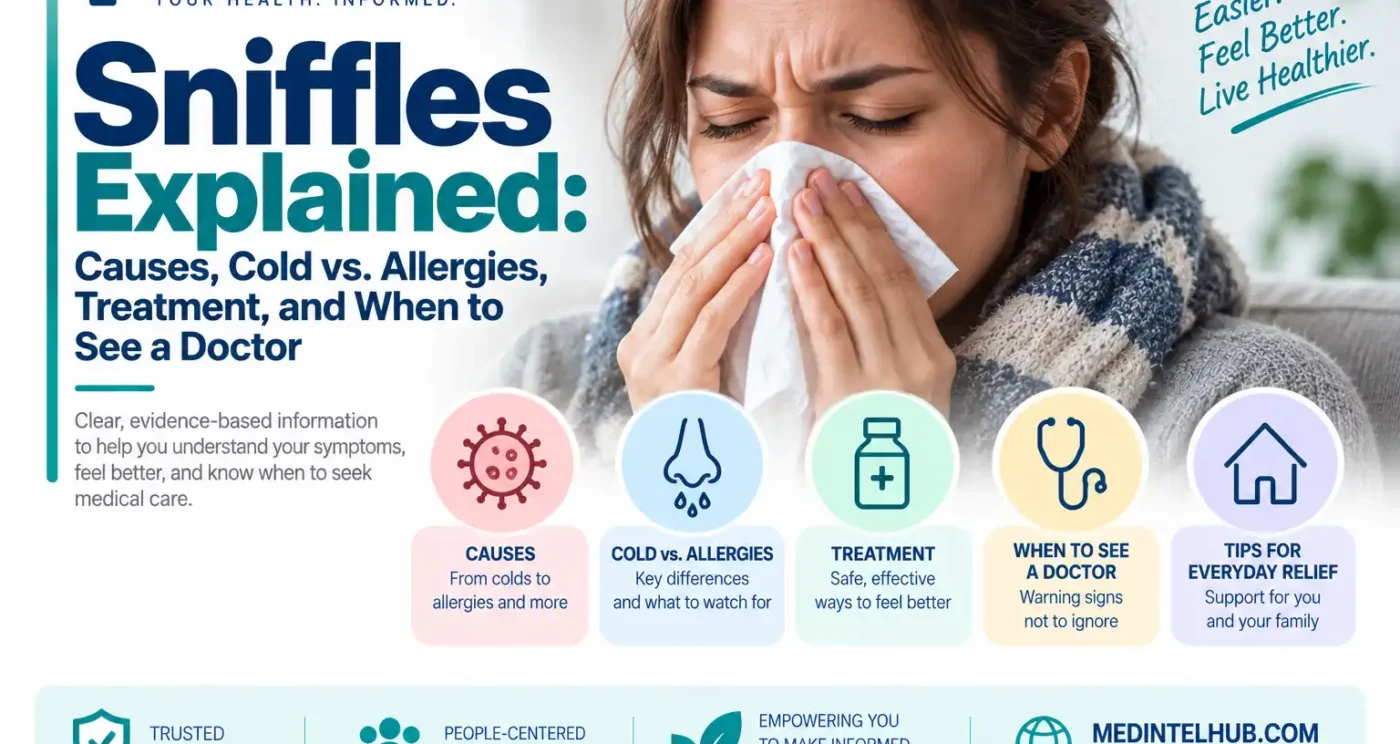
You wake up with a nose that will not stop running.
By lunchtime, you have gone through half a box of tissues. Maybe you are sneezing. Maybe one side of your nose feels blocked. Your throat is a little scratchy, but otherwise you feel fine.
Is it a cold? Allergies? The beginning of the flu? Something going on with your sinuses?
“The sniffles” is not a medical diagnosis. It is an everyday way of describing symptoms such as a runny nose, nasal congestion, sneezing, or frequent nose-blowing. Those symptoms can come from several different conditions, and the first day or two does not always make the cause obvious.
A common cold is certainly one possibility. CDC describes colds as viral infections of the upper respiratory tract that commonly cause a runny or stuffy nose, sneezing, cough, sore throat, headache, and mild body aches. Allergic rhinitis can look remarkably similar but tends to bring more itching and watery eyes. Nonallergic rhinitis, influenza, COVID-19, sinus infections, environmental irritants, and even pregnancy can also cause a persistently runny or blocked nose.
That means one tissue full of clear mucus tells you very little.
What matters more is the whole pattern: how quickly symptoms started, whether your nose or eyes itch, whether you have fever or body aches, whether someone around you is sick, how long symptoms last, and whether they are getting better or worse.
What Do “the Sniffles” Mean?
“The sniffles” usually refers to mild symptoms involving the nose.
Someone using the phrase may mean:
- A runny nose
- A stuffy or congested nose
- Frequent sneezing
- Sniffling
- Postnasal drainage
- Mild throat irritation
- Watery eyes
The term does not tell you what caused the symptoms.
MedlinePlus lists the common cold, influenza, sinus infections, allergies, pregnancy, nasal polyps, certain nasal medicines, and nonallergic rhinitis among possible explanations for a runny or congested nose.
For most otherwise healthy people, a few days of mild sniffles are more annoying than dangerous.
The situation changes when the nasal symptoms are joined by significant breathing trouble, dehydration, persistent fever, worsening illness, or symptoms that simply refuse to improve.
Why Does Your Nose Run When You Are Sick?
The nose is lined with tissue that produces mucus.
That mucus is useful. It traps particles, moisturizes incoming air, and helps protect the respiratory tract.
During a respiratory infection, inflammation causes the lining of the nose to produce more secretions. Some mucus comes out through the nostrils. Some travels backward toward the throat.
That backward drainage is commonly called postnasal drip.
MedlinePlus notes that excess mucus draining down the back of the throat can contribute to coughing or a sore throat.
So the cough that appears with a cold is not always coming entirely from the lungs.
Sometimes an irritated throat and constant drainage are part of the reason someone keeps clearing or coughing.
Why Does Your Nose Feel Blocked?
A stuffy nose is not simply a nose “filled with mucus.”
Much of the blocked sensation comes from swelling.
Blood vessels in the tissues lining the nasal passages become inflamed and enlarged, narrowing the space available for air to move through.
That explains why blowing your nose repeatedly may remove plenty of mucus yet still leave you feeling congested.
The problem is partly the swollen tissue itself.
What Causes the Sniffles?
Several very different conditions can produce almost the same opening symptoms.
The most common possibilities include:
- Common cold
- Allergic rhinitis
- COVID-19
- Influenza
- Other respiratory viruses
- Sinusitis
- Nonallergic rhinitis
- Smoke or air pollution
- Perfume and strong odors
- Dry or cold air
- Weather changes
- Certain medications
- Pregnancy-related nasal congestion
It is possible to have more than one problem at the same time.
Someone with seasonal allergies, for example, can still catch a cold.
Someone with a viral infection can also develop a sinus complication later.
Are the Sniffles Usually a Cold?
Often, yes.
The common cold is a viral infection of the upper respiratory tract. Many different respiratory viruses can cause it, rather than one single “cold virus.” CDC says adults in the United States average about two to three colds per year, while children generally have more.
Typical symptoms include:
- Runny nose
- Nasal congestion
- Sneezing
- Cough
- Sore throat
- Headache
- Mild body aches
- Sometimes a low-grade fever
Cold symptoms tend to become most noticeable early in the illness and usually improve on their own. CDC says colds generally last less than a week, although some symptoms—particularly cough or congestion—can linger longer.
A person with a cold may begin with nasal symptoms one day and develop a cough or sore throat later.
Cold vs. Allergies: How Can You Tell?
This is where the sniffles become frustrating.
Both a cold and allergic rhinitis can cause sneezing, congestion, and a watery nose. MedlinePlus explicitly notes that sneezing, coughing, and runny nose can occur with either one.
There are still clues.
| Feature | Cold | Allergic Rhinitis |
|---|---|---|
| Runny nose | Common | Common |
| Nasal congestion | Common | Common |
| Sneezing | Common | Often prominent |
| Itchy nose | Less typical | Common |
| Itchy/watery eyes | Less typical | Common |
| Sore throat | Common | May occur from drainage |
| Mild body aches | Can occur | Unusual |
| Fever | Sometimes | Not typical |
| Symptoms after pollen/pet/dust exposure | Not necessary | Often present |
| Duration | Usually improves as infection clears | Can continue as long as exposure continues |
Allergic rhinitis typically produces symptoms soon after exposure to something the person is allergic to. Common triggers include pollen, dust mites, mold, and animal dander. Itchy eyes, nose, mouth, or throat are particularly suggestive of an allergic process.
No single feature is perfect.
A person with allergies can have a sore throat from drainage. A person with a cold can sneeze 20 times. Looking at the complete pattern is more useful than using one symptom as a diagnostic test.
Why Do Allergies Cause the Sniffles?
Allergic rhinitis occurs when the immune system reacts to a normally harmless substance as though it were a threat.
The trigger may be:
- Tree pollen
- Grass pollen
- Ragweed
- Mold
- Dust mites
- Animal dander
After exposure, the immune system releases inflammatory chemicals, including histamine.
That reaction can cause a watery runny nose, sneezing, itching, nasal congestion, and watery eyes.
The timing can offer useful clues.
Someone who feels perfectly well during winter but begins sneezing, itching, and rubbing watery eyes every spring may have a very different problem from someone whose sore throat and runny nose appeared two days after a coworker became sick.
Can You Have the Sniffles Without a Fever?
Absolutely.
Many adults with a common cold never develop a meaningful fever.
Allergic rhinitis generally does not cause fever either.
So:
No fever does not automatically mean allergies.
And having a fever does not identify which respiratory virus is responsible.
Other symptoms, exposures, testing when appropriate, and how the illness evolves provide more information.
Can the Sniffles Be COVID-19?
Yes.
COVID-19 can overlap clinically with other respiratory infections. Someone may have congestion, sore throat, cough, fatigue, fever, or other symptoms, and a mild case can initially resemble an ordinary cold.
CDC advises people with cold-like symptoms to consider COVID-19 or influenza testing when those infections are suspected, particularly if they are at increased risk for severe illness.
Why does that matter if the illness feels mild?
Because treatment windows matter.
CDC’s current guidance says antiviral treatment for COVID-19 should generally begin within 5–7 days of symptom onset, depending on the treatment, while influenza antivirals work best when started very early—ideally within about two days.
Someone at higher risk should therefore not necessarily wait a week to decide whether “the sniffles” were actually flu or COVID-19.
Can Influenza Start With a Runny Nose?
It can.
Influenza often has a more abrupt, systemic feel than a typical cold, with symptoms such as fever, chills, headache, fatigue, cough, and body aches.
But respiratory illnesses overlap.
CDC notes that influenza and COVID-19 can cause similar acute respiratory symptoms and may circulate at the same time.
That makes symptom guessing imperfect.
If knowing the diagnosis would change treatment—especially for someone at increased risk—testing becomes more useful.
Can RSV Cause the Sniffles?
Yes.
Respiratory syncytial virus, or RSV, is another respiratory virus that can begin with cold-like symptoms.
In many older children and healthy adults, it may remain relatively mild.
Infants, older adults, and people with certain underlying health problems can become much sicker.
That is why a mild runny nose in a healthy college student and a respiratory illness in a very young infant deserve different levels of concern.
What Is Postnasal Drip?
Not all nasal mucus comes out the front.
Some drains behind the nose and down the throat.
That can create:
- Frequent throat clearing
- A tickling sensation
- Cough
- Mild sore throat
- Hoarseness
- A feeling of mucus sitting in the throat
MedlinePlus notes that postnasal drainage can contribute to both coughing and throat irritation.
Postnasal drip can happen with colds, allergies, sinus problems, and nonallergic rhinitis.
It is therefore a symptom, not a diagnosis.
What Is Nonallergic Rhinitis?
Some people spend months saying, “I have allergies,” only for allergy testing to be unrevealing.
Another possibility is nonallergic rhinitis.
This condition causes nasal congestion, runny nose, sneezing, and watery drainage without an allergic reaction or respiratory infection driving the symptoms.
Triggers can include:
- Perfume
- Cleaning products
- Air pollution
- Dry air
- Alcohol
- Spicy foods
- Strong emotions
- Certain medicines
Someone may walk into a heavily fragranced store and immediately begin sniffling.
That does not necessarily mean they are allergic to perfume.
The odor may simply be irritating sensitive nasal tissue.
Can Smoke Cause a Runny Nose?
Yes.
Cigarette smoke, wildfire smoke, pollution, chemical fumes, and other airborne irritants can inflame the nasal passages.
In people with nonallergic rhinitis, relatively small exposures may be enough to trigger congestion or watery drainage.
Smoke exposure can also aggravate asthma and other respiratory conditions.
Persistent cough, wheezing, chest tightness, or breathing difficulty should not be reduced to “just nasal irritation.”
Can Perfume Trigger the Sniffles?
It can.
Strong perfumes, cleaning products, and other odors are recognized triggers of nonallergic rhinopathy.
Again, the mechanism is not always allergy.
A person may react strongly to an odor without having an IgE-mediated allergy to the product.
This distinction can matter when allergy testing is being considered.
Can Weather Changes Make Your Nose Run?
Yes.
Cold air, dry air, and sudden environmental changes can trigger nasal symptoms in sensitive people.
A person who develops a watery nose every time they step outside into winter air may not be catching repeated infections.
Environmental rhinitis may be a better explanation.
Patterns are useful.
Symptoms that appear predictably with cold weather, meals, fragrance, or specific environmental conditions deserve to be described that way during a medical visit.
Can Pregnancy Cause the Sniffles?
Pregnancy can contribute to nasal congestion.
MedlinePlus lists pregnancy among causes of a stuffy or runny nose.
Hormonal and circulatory changes can make nasal tissues swell even when there is no infection.
Medication choices also deserve more caution during pregnancy.
Someone who is pregnant should check with a clinician or pharmacist before assuming that an over-the-counter decongestant or multi-symptom cold medicine is appropriate.
Does Green or Yellow Mucus Mean You Need Antibiotics?
No.
Mucus color gets far more diagnostic power online than it deserves.
Yellow or green nasal discharge can develop during a viral respiratory infection as immune cells and inflammatory material accumulate.
Color alone does not prove a bacterial infection.
CDC emphasizes that antibiotics do not treat viral colds and will not make someone with an ordinary cold recover faster. Unnecessary antibiotics can also cause side effects and contribute to antimicrobial resistance.
The more useful questions are:
How long have symptoms lasted?
Are they improving?
Did they improve and then become significantly worse?
Is there severe facial pain or prolonged fever?
Those patterns matter more than the color on a tissue.
When Do the Sniffles Suggest a Sinus Infection?
Most sinus infections are caused by viruses, according to CDC. Bacteria cause a smaller proportion.
A sinus problem becomes more worth evaluating when there is:
- Severe headache or facial pain
- Symptoms that worsen after initially improving
- Symptoms lasting more than 10 days without improvement
- Fever lasting longer than 3–4 days
- Repeated sinus infections
That “better, then worse” pattern is particularly useful.
Someone may have what looks like an ordinary viral cold, start recovering, and then develop substantially worse facial pain, fever, or nasal symptoms.
That deserves a different look than congestion that has simply been present for three days.
Can the Sniffles Turn Into a Sinus Infection?
A viral upper-respiratory infection can lead to inflammation and blockage of the sinus drainage pathways.
Most cases still resolve without antibiotics.
Occasionally, bacterial sinusitis develops.
The important point is that having sinus pressure during a cold does not automatically mean you have a bacterial sinus infection.
Timing, severity, and the direction symptoms are moving are more useful.
How Long Should Cold Sniffles Last?
CDC says a typical cold generally lasts less than a week.
That is an average pattern, not an expiration date.
Nasal congestion or coughing can sometimes take longer to disappear completely.
CDC recommends medical evaluation when symptoms last more than 10 days without getting better, or when symptoms improve and then return or worsen.
So day eight with mild but steadily improving congestion is different from day eight with worsening fever and facial pain.
What Helps the Sniffles?
The answer depends on what is causing them.
For an uncomplicated viral cold, the goal is mainly to make yourself more comfortable while the immune system clears the infection.
CDC notes that common colds have no cure and generally improve on their own.
Reasonable supportive measures may include rest, adequate fluids, saline nasal spray, humidified air, and appropriate over-the-counter symptom relief when safe for the person using it.
Allergy-related sniffles need a different strategy.
Avoiding the trigger when possible and using appropriately selected allergy treatments may be much more helpful than treating the symptoms as though they came from an infection.
Does Drinking Water Cure a Cold?
No.
Staying hydrated can make you more comfortable and helps replace fluid losses.
It does not kill cold viruses.
The same is true for many home remedies: feeling better and shortening the actual infection are not always the same thing.
There is nothing wrong with using safe comfort measures.
Just be skeptical of products promising to “flush out” a cold overnight.
Can Saline Spray Help a Runny or Stuffy Nose?
Yes, saline can help keep nasal passages moist and loosen mucus.
It contains no decongestant drug and therefore does not cause the same rebound congestion associated with overuse of certain medicated sprays.
Nasal rinses are another option for some people, but water safety matters.
How Do You Safely Use a Nasal Rinse?
Never use ordinary unboiled tap water directly in a neti pot or nasal-rinsing device.
CDC says sinus rinsing should use:
- Store-bought distilled water
- Sterile water
- Tap water that has been boiled and then cooled
Rare but extremely serious infections have occurred after contaminated water was introduced through the nose.
Water that is safe to drink is not automatically safe to force into the nasal passages.
Follow the cleaning instructions for the device as well.
Do Decongestants Help?
Decongestants can temporarily reduce nasal blockage in some people.
They are not appropriate for everyone, and they do not cure the infection causing a cold.
Oral or nasal decongestants can also interact with health conditions or medications.
People with certain cardiovascular conditions, pregnancy, medication combinations, or other health concerns should ask a clinician or pharmacist before using them.
Can Nasal Decongestant Spray Make Congestion Worse?
Yes.
This is the frustrating part.
Certain medicated decongestant sprays can provide impressive short-term relief, but using them longer than directed can produce rebound congestion.
The person then feels blocked again and uses more spray, which keeps the cycle going.
MedlinePlus warns that overusing some nonprescription nasal sprays or drops can actually make nasal stuffiness worse.
Saline spray is different because it does not contain the same decongestant medication.
Do Antihistamines Help the Sniffles?
They can help substantially when allergic rhinitis is the cause.
Antihistamines reduce histamine-related symptoms such as:
- Sneezing
- Itching
- Watery eyes
- Runny nose
Their usefulness for an ordinary viral cold is much less straightforward.
CDC’s outpatient guidance notes that antihistamines by themselves do not have strong evidence for treating cold symptoms, although some combination products can provide short-term symptom relief.
That is another reason it helps to know what you are treating.
Should You Take Antibiotics for the Sniffles?
Usually no.
A common cold is viral.
Antibiotics target bacteria.
CDC’s 2026 guidance is explicit: antibiotics do not help people recover from viral colds.
Taking antibiotics “just in case” also has downsides, including allergic reactions, diarrhea, C. difficile infection, and increasing antibiotic resistance.
There are legitimate bacterial respiratory infections that require antibiotics.
A clinician should make that distinction based on the actual illness rather than the presence of mucus alone.
What About Vitamin C, Zinc, Echinacea, or Elderberry?
These products are popular because everyone would like a cold to disappear faster.
Evidence is mixed.
Some complementary approaches have limited evidence of modest benefit in selected circumstances, but results across studies are inconsistent, and supplement quality and dosing vary.
CDC’s Yellow Book notes that evidence for remedies such as echinacea and elderberry is limited or low quality, while other popular products have not shown consistent benefit.
Supplements can also interact with medications or be inappropriate during pregnancy or for certain medical conditions.
“Natural” does not automatically mean risk-free.
What Helps Sniffles in Children?
Children catch respiratory viruses frequently, especially after starting daycare or school.
For young children, simple supportive measures are often more useful than a cabinet full of cold medicine.
Options may include age-appropriate fluids, saline nose drops or spray, and gentle nasal suction in infants when appropriate.
FDA notes that saline drops or sprays can help keep children’s nasal passages moist and that suction devices can be especially useful for babies.
Are Cough and Cold Medicines Safe for Babies?
This deserves extra caution.
FDA says children younger than 2 years should not receive cough-and-cold medicines containing a decongestant or antihistamine because serious and potentially life-threatening reactions have occurred. Manufacturers also label these products not to be used in children under 4 years old.
Combination products can be especially confusing because the same active ingredient may appear in more than one bottle.
Parents should read the Drug Facts label carefully and ask the child’s healthcare professional or pharmacist when uncertain.
Can Babies Have Honey for a Cold?
Not before age 1.
CDC’s common-cold guidance specifically cautions that babies under 12 months should not be given honey.
Older children may sometimes use honey for cough comfort, but it does not cure the underlying viral infection.
How Can You Tell Whether the Sniffles Are Allergies?
Patterns matter.
Consider allergies more strongly when:
- The nose or eyes itch
- Eyes become watery
- Sneezing comes in repeated bursts
- Symptoms appear after pollen, pets, dust, or mold exposure
- Symptoms recur at the same time each year
- There are no meaningful body aches or fever
- Symptoms continue for weeks while the trigger remains present
MedlinePlus describes itchy nose, mouth, eyes, or throat, sneezing, watery eyes, and runny nose as common early allergic-rhinitis symptoms.
If symptoms are persistent or severe, allergy evaluation may help identify triggers and determine whether medication, environmental changes, or testing makes sense.
Why Do I Wake Up With the Sniffles Every Morning?
Morning symptoms can point toward something in the sleeping environment.
Possibilities include:
- Dust mites
- Pet dander
- Mold
- Dry indoor air
- Bedding exposure
- Nonallergic rhinitis
- Overnight postnasal drainage
Someone who feels congested every morning for six months but otherwise feels well probably has a different problem from someone who woke congested yesterday after their family developed a respiratory infection.
A symptom diary can be surprisingly useful.
Note where you sleep, whether pets enter the bedroom, whether windows are open, whether symptoms improve after leaving home, and whether the pattern changes with seasons.
Why Does My Nose Run When I Eat?
Some people develop nasal drainage while eating, especially with hot or spicy foods.
That can occur with nonallergic rhinitis rather than a food allergy.
MedlinePlus includes spicy foods and eating in general among potential triggers for nonallergic rhinopathy.
A genuine food allergy usually raises different concerns, especially when symptoms include hives, swelling, wheezing, throat tightness, vomiting, or anaphylaxis.
How Do You Know if the Sniffles Are Contagious?
It depends on the cause.
A cold, influenza, COVID-19, RSV, and other viral respiratory infections can spread between people.
Allergic rhinitis cannot.
Nonallergic rhinitis cannot.
Someone with a clearly pollen-triggered runny nose is not contagious simply because they keep sneezing.
Early in an illness, though, the cause may not be obvious.
Reasonable respiratory hygiene—covering coughs and sneezes, hand hygiene, avoiding close contact when sick, and following current public-health guidance—can reduce transmission when an infection is possible. CDC notes that respiratory viruses can spread through droplets and close contact.
When Should You Test for Flu or COVID-19?
Testing is particularly worth considering when:
- A respiratory virus is circulating locally
- You have had a known exposure
- Symptoms fit COVID-19 or influenza
- You live with someone medically vulnerable
- You are at increased risk for severe illness
- A positive result could change treatment
CDC recommends prompt testing and medical contact for higher-risk people because antiviral treatment is time-sensitive.
You do not need to wait until you feel extremely ill before calling.
When Should You See a Doctor for the Sniffles?
Most uncomplicated colds and mild allergy symptoms can be managed without an office visit.
CDC recommends seeking medical care when respiratory symptoms are accompanied by situations such as:
- Trouble breathing or unusually fast breathing
- Dehydration
- Fever lasting more than four days
- Symptoms lasting more than 10 days without improvement
- Symptoms that improve and then return or worsen
- Worsening of an underlying chronic medical condition
Persistent congestion also deserves evaluation when it keeps interfering with sleep, work, school, or normal breathing.
Someone with months of chronic congestion may need evaluation for allergies, nonallergic rhinitis, nasal polyps, medication effects, or another structural problem rather than repeated treatment for “colds.”
A new respiratory problem also does not have to wait for a routine preventive visit. MedIntelHub’s guide to annual physicals explains why a preventive checkup and an appointment for a specific new symptom are not necessarily the same kind of visit.
Understanding Your Annual Physical: What Actually Gets Checked
When Should You See an Allergist or ENT Specialist?
Specialist evaluation may be useful when:
- Nasal symptoms continue for months
- Allergy treatment is not working
- The trigger remains unclear
- Sinus infections keep returning
- One side of the nose stays blocked
- Nasal polyps are suspected
- Smell remains significantly reduced
- Symptoms are severely affecting sleep or daily life
An allergist can help evaluate allergic triggers.
An ear, nose, and throat specialist may be more useful when the concern involves chronic sinus disease, structural blockage, polyps, or other nasal problems.
If a specialist visit is coming up, writing down when symptoms occur and what makes them better or worse can make the appointment more useful. MedIntelHub’s specialist-appointment guide recommends bringing a symptom timeline, medication list, previous results, and your most important questions.
How to Prepare Questions Before a Specialist Appointment
When Are the Sniffles an Emergency?
A runny nose itself is rarely an emergency.
The symptoms around it can be.
Seek emergency help for:
- Severe difficulty breathing
- Blue, gray, or unusually pale lips or skin
- Severe chest pain
- Confusion
- Loss of consciousness
- Severe dehydration
- Swelling of the tongue or throat
- Rapid facial swelling with breathing difficulty
- Signs of a severe allergic reaction
- Severe respiratory distress in an infant or child
A stuffy nose accompanied by significant swelling around an eye, vision changes, or severe facial symptoms also deserves prompt medical evaluation. MedlinePlus specifically advises medical attention when nasal congestion occurs with swelling around the forehead, eye, nose, or cheek or with blurred vision.
Do not assume a serious breathing problem is simply an unusually bad cold.
Sniffles at a Glance
| Pattern | Possible Explanation |
|---|---|
| Runny nose + sneezing + sore throat | Common cold |
| Runny nose + itchy/watery eyes | Allergic rhinitis |
| Symptoms after perfume or smoke | Nonallergic rhinitis |
| Fever/body aches + respiratory symptoms | Flu, COVID-19, or another infection may need consideration |
| Symptoms >10 days without improvement | Sinusitis or another problem deserves evaluation |
| Better, then significantly worse | Possible secondary complication |
| One-sided persistent blockage | Structural nasal problem may need evaluation |
| Severe breathing difficulty | Emergency evaluation |
No row in this table is a diagnosis by itself.
Frequently Asked Questions
What Does “the Sniffles” Mean?
“The sniffles” is an informal term for symptoms such as a runny nose, stuffy nose, sneezing, or frequent nose-blowing.
It does not identify the cause.
Are the Sniffles the Same as a Cold?
No.
A cold commonly causes the sniffles, but allergies, influenza, COVID-19, sinus problems, nonallergic rhinitis, pregnancy, and environmental irritants can cause similar nasal symptoms.
Can Allergies Cause the Sniffles?
Yes.
Allergic rhinitis commonly causes a watery runny nose, sneezing, itching, watery eyes, and congestion after exposure to allergens such as pollen, dust mites, mold, or animal dander.
How Can I Tell a Cold From Allergies?
Itching of the nose or eyes and a recurring exposure-related pattern lean more toward allergies.
Sore throat and mild body aches fit a cold better.
There is still substantial overlap, so no single symptom can reliably distinguish them.
Can You Have a Cold Without a Fever?
Yes.
Fever is not required for a common cold. When it occurs in older children or adults, CDC says it is usually low grade.
Can COVID-19 Cause Only Mild Cold-Like Symptoms?
Yes.
COVID-19 can overlap with other respiratory illnesses. Testing is especially worth considering when you are at increased risk for severe disease or when the result could change treatment.
Can Flu Start Like a Cold?
It can.
Influenza often produces more abrupt systemic symptoms, but early respiratory symptoms can overlap with other viral illnesses.
Why Is My Nose Running if I Do Not Feel Sick?
Allergies and nonallergic rhinitis are common possibilities.
Environmental triggers such as perfume, smoke, dry air, pollution, or spicy food can produce nasal symptoms without an infection.
Why Is My Nose Stuffy if Nothing Comes Out?
Congestion is largely caused by swelling of the blood vessels and tissues lining the nose, not simply by mucus filling the nasal passages.
Does Green Mucus Mean I Need Antibiotics?
No.
Mucus color alone does not prove a bacterial infection.
Most ordinary colds are viral, and antibiotics do not help viral infections.
When Might a Sinus Infection Need Evaluation?
CDC recommends medical evaluation for severe headache or facial pain, symptoms lasting more than 10 days without improvement, worsening after initial improvement, fever lasting more than 3–4 days, or repeated sinus infections.
Can Perfume Make Your Nose Run?
Yes.
Strong odors are recognized triggers for nonallergic rhinitis.
Can Cold Weather Give You a Runny Nose Without Making You Sick?
Yes.
Environmental temperature and dry air can trigger nasal drainage in some people without an infection.
Can Pregnancy Cause Nasal Congestion?
Yes.
Pregnancy is among the recognized causes of nasal congestion.
Do Antibiotics Help a Cold?
No.
Antibiotics do not work against the viruses responsible for ordinary colds.
Does Saline Spray Help?
Saline can moisturize nasal passages and help loosen secretions.
Nasal irrigation may also help some people, but only distilled, sterile, or previously boiled and cooled water should be used for sinus rinsing.
Can Nasal Spray Make Congestion Worse?
Certain medicated decongestant sprays can cause rebound congestion when used longer than directed.
Are Antihistamines Good for a Cold?
They are most clearly useful when allergies are responsible for symptoms.
Evidence for antihistamines alone in an ordinary cold is limited.
Are Cough and Cold Medicines Safe for Babies?
FDA says children under 2 should not receive cough-and-cold medicines containing decongestants or antihistamines because serious adverse effects can occur. Products are also voluntarily labeled not to be used in children under 4.
How Long Should the Sniffles Last?
An uncomplicated common cold usually lasts less than a week, although individual symptoms can linger.
Symptoms lasting more than 10 days without improvement deserve medical attention.
When Should I Worry About a Runny Nose?
Seek medical care when it occurs with breathing difficulty, dehydration, prolonged fever, significant facial pain or swelling, vision changes, worsening after initial improvement, or symptoms that persist beyond the expected course.
Conclusion
The sniffles are simple only in name.
A runny nose may be the beginning of a cold. Or it may be spring pollen drifting through an open window. It could be perfume irritating sensitive nasal tissue, a respiratory virus such as flu or COVID-19, or congestion related to a sinus problem.
The nose does not provide a diagnostic label with the mucus.
Look at the pattern instead.
Itchy eyes and nose make allergies more likely.
A sore throat, cough, and mild aches fit a common cold.
Symptoms that repeatedly appear around perfume, smoke, weather changes, or spicy food may point toward nonallergic rhinitis.
And symptoms lasting more than 10 days without improvement—or getting substantially worse after they seemed to be improving—deserve a closer look.
The color of mucus is much less useful than many people think.
Green drainage does not automatically mean antibiotics are needed, and clear drainage does not automatically mean allergies.
For most uncomplicated colds, treatment is supportive. Rest, appropriate fluids, saline, and carefully selected symptom relief can make the waiting easier while the infection runs its course. Antibiotics do not cure viral colds.
Testing becomes more important when COVID-19 or influenza is possible and the person is at increased risk for severe disease because antiviral treatment works best when started promptly.
And some symptoms should move the conversation beyond “the sniffles” altogether.
Significant breathing difficulty, severe dehydration, confusion, throat swelling, chest pain, or other rapidly worsening symptoms require urgent assessment.
In other words, the tissue box may tell you that your nose is irritated.
The rest of the symptoms tell you why that matters.
Resources
CDC — About the Common Cold
Current CDC information on cold causes, symptoms, duration, spread, and when other respiratory viruses should be considered.
CDC — Managing the Common Cold
CDC’s March 2026 guidance covers symptom management, antibiotic use, testing for influenza and COVID-19, early antiviral treatment, and when to seek medical care.
MedlinePlus — Stuffy or Runny Nose
A patient-focused overview of congestion, postnasal drip, allergies, infections, pregnancy, nasal-spray overuse, and warning signs.
MedlinePlus: Stuffy or Runny Nose
MedlinePlus — Allergic Rhinitis
Information about pollen, dust, animal dander, itching, sneezing, watery eyes, congestion, and other allergy symptoms.
MedlinePlus: Allergic Rhinitis
MedlinePlus — Nonallergic Rhinitis
Covers nasal symptoms triggered by perfume, pollution, dry air, foods, medicines, and other nonallergic irritants.
MedlinePlus: Nonallergic Rhinopathy
CDC — Sinus Infection Basics
CDC guidance on viral versus bacterial sinus infections and warning patterns such as symptoms lasting more than 10 days or worsening after initial improvement.
CDC — Safe Sinus Rinsing
Explains why nasal rinses should use distilled, sterile, or previously boiled and cooled water rather than ordinary tap water.
CDC: How to Safely Rinse Sinuses
FDA — Children’s Cough and Cold Medicines
Current FDA information about age-related risks, decongestants, antihistamines, saline, and safe use of children’s cold products.
FDA: Children’s Cough and Cold Medicines
MedIntelHub — Preparing for a Specialist Appointment
Useful when persistent nasal symptoms lead to an allergy or ENT referral.
How to Prepare Questions Before a Specialist Appointment
MedIntelHub — Editorial Policy
MedIntelHub’s standards for sourcing, accuracy, transparency, updates, and patient education.
Editorial Disclaimer
This article is intended for general educational and informational purposes only. It does not diagnose a common cold, allergic rhinitis, COVID-19, influenza, RSV, sinusitis, nonallergic rhinitis, or another respiratory condition.
Runny nose, congestion, sneezing, cough, sore throat, fever, and fatigue can occur with many different illnesses. Symptoms alone may not reliably distinguish one respiratory virus from another.
Over-the-counter medications are not appropriate for everyone. Age, pregnancy, blood pressure, heart disease, kidney disease, medications, and other health factors can affect which products are safe. Read Drug Facts labels carefully and ask a healthcare professional or pharmacist when uncertain.
Children require additional medication precautions. FDA advises against cough-and-cold products containing decongestants or antihistamines in children younger than 2 years, and manufacturers label many products not to be used in children younger than 4.
When using a nasal-rinsing device, use only distilled, sterile, or previously boiled and cooled water.
Seek urgent or emergency medical care for severe breathing difficulty, confusion, loss of consciousness, severe dehydration, blue or gray lips or skin, significant chest pain, severe allergic swelling, or another rapidly worsening symptom.

David Bennett
David Bennett is an author at MedIntelHub, where he creates clear, practical, and well-researched content about healthcare, medical billing, insurance, and patient education. His goal is to make complex healthcare topics easier for readers to understand and use in everyday situations. David emphasizes accuracy, transparency, and reliable sourcing, using information from trusted organizations and official healthcare resources whenever possible. Content published by David is intended for educational purposes and should not replace advice from qualified medical, legal, or healthcare professionals.