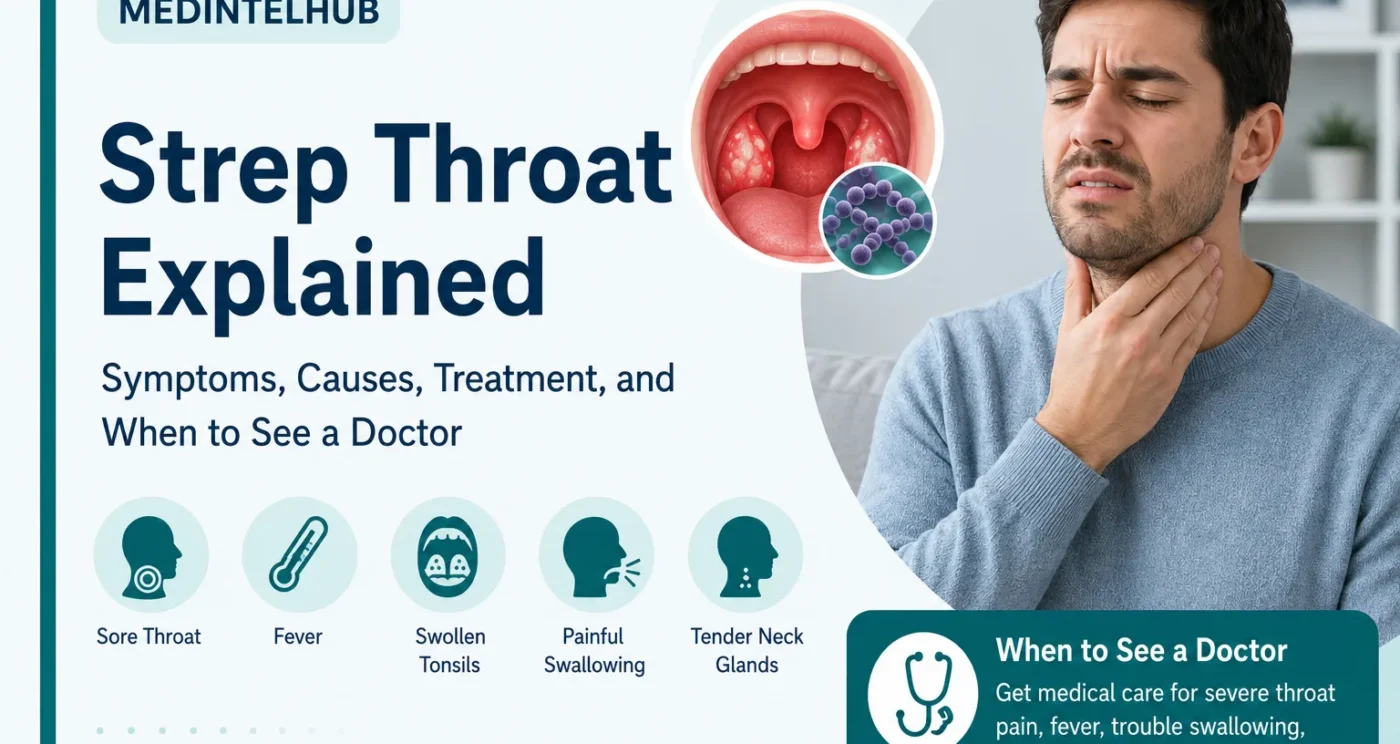
A sore throat can come from many different infections, but strep throat is different from the average viral sore throat.
Strep throat is a bacterial infection of the throat and tonsils caused by group A Streptococcus, also called group A strep or GAS. It commonly causes a sore throat that begins quickly, pain when swallowing, fever, swollen lymph nodes in the neck, and red or swollen tonsils. White patches may also appear on the tonsils.
However, symptoms alone cannot reliably confirm strep throat. Most sore throats are caused by viruses. According to the Centers for Disease Control and Prevention (CDC), only about 1 in 10 adults and 3 in 10 children with a sore throat actually have strep throat.
That distinction matters because viral sore throats do not benefit from antibiotics, while confirmed strep throat is generally treated with antibiotics to shorten illness, reduce transmission, and lower the risk of certain complications.
What Is Strep Throat?
Strep throat, medically called group A streptococcal pharyngitis, is an infection of the throat and tonsils caused by group A Streptococcus bacteria.
The infection is particularly common among school-age children, although teenagers and adults can also develop it.
CDC reports that strep throat is most common among children between 5 and 15 years old and is uncommon in children younger than 3.
Strep throat is only one possible cause of a sore throat.
Other causes include:
- Common cold viruses
- Influenza
- COVID-19
- Infectious mononucleosis
- Allergies
- Irritation from smoke
- Other bacterial or viral infections
This is one reason a red or painful throat should not automatically be assumed to be strep.
What Causes Strep Throat?
Strep throat is caused by group A Streptococcus bacteria.
These bacteria can live in the nose and throat and spread from one person to another through respiratory secretions.
Someone with group A strep can release bacteria when talking, coughing, or sneezing.
Transmission can occur when another person:
- Breathes in respiratory droplets containing the bacteria
- Touches their nose or mouth after contacting contaminated respiratory secretions
- Shares cups, glasses, plates, or utensils with an infected person
- Has close contact with an infected person’s saliva or nasal secretions
Close household contact is an important risk factor, which is one reason strep throat can spread through families, classrooms, daycare centers, and other group environments.
How Long After Exposure Does Strep Throat Start?
Symptoms do not usually appear immediately after exposure.
CDC states that the incubation period for strep throat is generally 2 to 5 days.
Someone exposed on one day might therefore feel well for several days before developing symptoms.
What Are the Symptoms of Strep Throat?
Strep throat often begins relatively quickly.
Common symptoms include:
- Sudden sore throat
- Pain when swallowing
- Fever
- Red throat
- Red and swollen tonsils
- Swollen or tender lymph nodes at the front of the neck
- Tiny red spots on the roof of the mouth, known as petechiae
- White patches or streaks of pus on the tonsils
Children may also experience symptoms that are less typical in adults, including:
- Headache
- Nausea
- Vomiting
- Stomach pain
- Rash
A person does not have to experience every symptom to have strep throat.
What Does Strep Throat Look Like?
A throat affected by strep may appear very red and inflamed.
The tonsils may be:
- Red
- Enlarged
- Covered with white patches
- Streaked with pus
Small red spots can sometimes be seen on the roof of the mouth.
Swollen lymph nodes in the front of the neck may also be noticeable or tender.
However, appearance alone is not enough to diagnose strep throat.
Several viral illnesses can produce red tonsils, swollen glands, fever, or even white patches. A healthcare professional may therefore need to perform a strep test.
One of the most useful distinctions is whether symptoms look more like group A strep or a respiratory virus.
| Feature | More Typical of Strep Throat | More Typical of Viral Sore Throat |
|---|---|---|
| Sudden sore throat | Common | Can occur |
| Painful swallowing | Common | Common |
| Fever | Common | Can occur |
| Swollen front-neck lymph nodes | Common | Can occur |
| Red/swollen tonsils | Common | Can occur |
| White tonsil patches | Can occur | Can also occur |
| Cough | Usually absent | Common |
| Runny nose | Usually absent | Common |
| Hoarse voice | Usually absent | Common |
| Pink eye | Usually absent | More suggestive of viral infection |
CDC specifically identifies cough, runny nose, hoarseness, and conjunctivitis as symptoms that are more suggestive of a viral cause than strep throat.
That does not mean every person without a cough has strep.
When clear viral symptoms are absent, testing may still be necessary because the physical examination alone cannot reliably distinguish group A strep from other causes of sore throat.
Can You Have Strep Throat Without a Fever?
Yes.
Fever is a common symptom of strep throat, but it is not required for the diagnosis.
Some people—particularly those with milder illness—may have a sore throat, painful swallowing, swollen lymph nodes, or tonsil changes without developing an obvious fever.
Likewise, having a high fever does not automatically mean someone has strep throat.
Testing is more reliable than relying on one symptom.
Can Strep Throat Cause a Rash?
Yes.
Certain group A strep infections can produce scarlet fever, which combines a strep infection with a characteristic rash.
The rash often:
- Begins as small red areas
- Develops a rough or finely bumpy texture
- Feels somewhat like sandpaper
- Starts around the neck, underarms, or groin
- Spreads to other parts of the body
A person may also develop a red, bumpy “strawberry tongue.”
A sore throat accompanied by a new rash should be evaluated by a healthcare professional.
Is Strep Throat Contagious?
Yes.
Group A strep bacteria are contagious.
They most commonly spread through respiratory droplets and direct contact with respiratory secretions.
Close contact therefore increases the chance of infection.
People living in the same household as someone with strep throat may have greater exposure, as may people in:
- Schools
- Daycare centers
- Dormitories
- Military training facilities
- Other crowded environments
Not everyone exposed will develop an infection.
How Long Is Strep Throat Contagious After Starting Antibiotics?
Appropriate antibiotic treatment quickly reduces someone’s ability to spread group A strep.
CDC states that treatment with an appropriate antibiotic for at least 12 hours limits transmission. People with strep throat should generally remain home from work, school, or daycare until they:
- No longer have a fever, and
- Have received appropriate antibiotics for at least 12 to 24 hours
The appropriate return time can depend on age, setting, symptoms, and local school or workplace requirements.
Who Is Most Likely to Get Strep Throat?
Anyone can develop strep throat, but it is particularly common among children.
The highest-risk age group is 5 through 15 years.
Other factors that can increase exposure include:
- Living with someone who has strep throat
- Having school-age children in the household
- Working around children
- Attending school or daycare
- Living or working in crowded environments
Strep throat can occur at any time of year, although group A strep pharyngitis is often seen more frequently during colder months and the school year.
How Is Strep Throat Diagnosed?
A clinician may begin by asking about symptoms and examining the mouth, throat, tonsils, and lymph nodes.
The examination can suggest strep, but it does not always establish the diagnosis.
CDC recommends confirmation using either:
- A rapid antigen detection test, commonly called a rapid strep test
- A throat culture
Both involve collecting a sample from the throat with a swab.
What Is a Rapid Strep Test?
A rapid strep test checks a throat swab for evidence of group A strep bacteria.
The main advantage is speed.
Results may be available during the same healthcare visit.
Rapid tests are highly specific, meaning a positive test is generally useful for confirming strep throat. However, they are not as sensitive as throat culture, so some infections can be missed.
What Is a Throat Culture?
A throat culture involves collecting a sample from the throat and allowing bacteria in that sample to grow in a laboratory.
It takes longer than a rapid test, but CDC identifies throat culture as the gold-standard diagnostic test for group A strep pharyngitis.
A culture may find some infections that a rapid test misses.
What Happens If a Rapid Strep Test Is Negative?
The answer depends partly on age.
Children older than age 3
CDC recommends following a negative rapid antigen test with a throat culture because untreated group A strep in children can lead to acute rheumatic fever.
Adults
A follow-up throat culture after a negative rapid test is usually not required because acute rheumatic fever is very uncommon in adults.
A healthcare professional may make different decisions when individual circumstances warrant additional evaluation.
Can Strep Throat Be Diagnosed Just by Looking at the Throat?
Usually not with enough certainty to replace testing.
Redness, enlarged tonsils, pus, fever, and swollen glands can suggest strep, but other illnesses can produce similar findings.
When a person does not have obvious symptoms of a viral infection, CDC notes that clinical examination alone cannot reliably distinguish viral pharyngitis from group A strep pharyngitis.
Testing helps avoid two problems:
- Missing a true group A strep infection.
- Giving antibiotics to someone whose sore throat is actually viral.
How Is Strep Throat Treated?
Confirmed strep throat is treated with antibiotics.
CDC states that patients with a positive rapid strep test or throat culture should receive appropriate antibiotic treatment.
Antibiotics can:
- Shorten the duration of symptoms
- Reduce transmission to close contacts
- Lower the risk of complications
Penicillin and amoxicillin remain the preferred antibiotics for most people with group A strep pharyngitis.
Other antibiotics may be used when a person has a penicillin allergy or another clinical reason to use an alternative.
The specific drug, dose, and duration should be determined by a healthcare professional.
Why Shouldn’t Every Sore Throat Get Antibiotics?
Because most sore throats are viral.
Antibiotics kill or inhibit bacteria. They do not treat viruses.
Taking antibiotics when they are not needed can cause side effects and contributes to antibiotic resistance.
A negative throat culture generally means antibiotics are not needed for group A strep because the bacteria are not causing the sore throat.
This is why testing can be an important part of responsible treatment.
Do Antibiotics Work Quickly for Strep Throat?
Many people begin feeling better relatively soon after treatment begins, although recovery varies.
CDC advises contacting a healthcare professional if a person with confirmed strep throat is not feeling better after 48 hours of antibiotics.
Feeling better does not necessarily mean the prescribed treatment should be stopped early.
Antibiotics should be taken exactly as prescribed unless the treating healthcare professional changes the instructions.
Do not:
- Save leftover antibiotics for another infection
- Share antibiotics
- Take someone else’s prescription
- Stop treatment simply because the sore throat has improved without discussing it with the prescriber
What Can Help With Strep Throat Pain?
Antibiotics treat the bacterial infection, but supportive care can make the throat more comfortable while recovery takes place.
Options may include:
- Drinking plenty of fluids
- Using warm or cool liquids depending on which feels better
- Gargling with warm salt water if able to gargle safely
- Using throat lozenges when age-appropriate
- Using a cool-mist humidifier
- Taking an appropriate over-the-counter pain or fever medicine when medically suitable
MedlinePlus lists acetaminophen or ibuprofen among common over-the-counter options for sore-throat discomfort, although medication choice should take into account age, medical conditions, allergies, pregnancy, other medicines, and individual circumstances.
Children should not be given medications intended for adults without professional guidance, and lozenges or hard candies can be choking hazards for young children.
Can Strep Throat Go Away Without Antibiotics?
Symptoms may eventually improve without treatment in some people, but confirmed strep throat should generally be treated with antibiotics.
The reason is not simply to make the throat feel better.
Appropriate antibiotic treatment:
- Shortens the illness
- Reduces transmission
- Decreases the chance of complications, including acute rheumatic fever
Waiting for confirmed strep throat to disappear on its own is therefore different from allowing an uncomplicated viral sore throat to resolve naturally.
How Long Does Strep Throat Last?
The exact duration varies.
MedlinePlus notes that strep throat symptoms commonly improve over about a week, and people treated appropriately often begin improving earlier.
A practical course may look something like this:
Exposure
Symptoms commonly appear 2 to 5 days after exposure.
Early illness
Sore throat, painful swallowing, fever, and swollen glands may begin relatively suddenly.
After antibiotics
Symptoms often begin improving over the next several days, and the ability to spread the bacteria drops substantially after appropriate treatment has been underway for 12 to 24 hours.
If symptoms are not improving
Contact a healthcare professional if symptoms are not improving after about 48 hours of antibiotics.
What Happens If Strep Throat Is Not Treated?
Most people recover, but untreated group A strep pharyngitis is associated with an increased risk of uncommon complications.
Some complications result from the bacteria spreading from the throat into nearby tissues.
CDC lists examples including:
- Cervical lymphadenitis
- Mastoiditis
- Peritonsillar abscess
- Retropharyngeal abscess
These complications are more likely following untreated infection.
Other complications occur because of an immune reaction after the original infection.
These include:
- Acute rheumatic fever
- Post-streptococcal glomerulonephritis
Complications are uncommon, but their possibility is one reason accurate diagnosis and treatment matter.
What Is Rheumatic Fever?
Acute rheumatic fever is an inflammatory condition that can occur after certain group A strep infections.
It usually develops 1 to 5 weeks after the original infection and can affect the:
- Heart
- Joints
- Brain
- Skin
In some cases, inflammation can damage the heart valves and lead to rheumatic heart disease.
Acute rheumatic fever is much more common in school-age children than in adults.
Treating confirmed strep throat with appropriate antibiotics reduces the risk of acute rheumatic fever.
What Is Post-Streptococcal Glomerulonephritis?
Post-streptococcal glomerulonephritis is an uncommon kidney condition that can occur after certain group A strep infections.
It results from an immune response rather than bacteria directly invading the kidneys.
Possible symptoms can include:
- Dark or reddish-brown urine
- Swelling
- Reduced urine output
- Elevated blood pressure
It requires medical evaluation.
Not every person with strep throat is at significant risk of this complication, but it is one of the recognized delayed complications of group A strep infection.
What Is a Peritonsillar Abscess?
A peritonsillar abscess is a pocket of pus that forms near a tonsil.
It is an uncommon but potentially serious complication of throat infection.
Possible warning signs include:
- Severe throat pain, sometimes worse on one side
- Increasing difficulty swallowing
- Difficulty opening the mouth
- Swelling in the throat or neck
- A change in the voice
- Difficulty handling saliva
A suspected abscess requires prompt medical evaluation.
When Should You See a Doctor for Strep Throat?
Consider medical evaluation when a sore throat is severe, develops suddenly, or occurs with features suggestive of strep.
Contact a healthcare professional if you or your child has:
- Significant pain when swallowing
- Fever with a sore throat
- Swollen or tender neck lymph nodes
- Red or swollen tonsils
- White patches on the tonsils
- A new rash
- Symptoms that persist or worsen
- Repeated episodes of sore throat
- Known close exposure to someone with strep throat
Testing can determine whether group A strep is actually present.
A new, significant sore throat also does not have to wait until a routine preventive appointment. MedIntelHub’s guide to annual physicals explains that a routine preventive visit and an appointment for a new medical problem may serve different purposes.
Understanding Your Annual Physical: What Actually Gets Checked
When Is a Sore Throat an Emergency?
Most cases of strep throat are not emergencies.
However, symptoms suggesting difficulty protecting the airway, swallowing fluids, or maintaining hydration deserve more urgent attention.
CDC recommends seeking medical care for a sore throat accompanied by:
- Difficulty breathing
- Difficulty swallowing
- Blood in saliva or phlegm
- Excessive drooling, particularly in a young child
- Dehydration
- Joint swelling and pain
- A rash
- Symptoms that are becoming worse instead of better
Severe trouble breathing should be treated as a medical emergency.
For an infant younger than 3 months, CDC advises prompt medical attention for a temperature of 100.4°F (38°C) or higher.
Can You Get Strep Throat More Than Once?
Yes.
Having strep throat does not provide reliable lifelong protection.
CDC notes that people can become infected with group A strep more than once.
Repeated sore throats are not always repeated strep infections, however.
Someone with frequent episodes may have:
- Repeated group A strep infections
- Recurrent viral illnesses
- Chronic tonsil problems
- Another cause of throat irritation
- Group A strep carriage
A healthcare professional can help determine what is happening.
What Is a Strep Carrier?
A strep carrier is someone who has group A strep bacteria in the throat but does not have symptoms of active strep infection.
CDC states that carriers generally:
- Do not require antibiotics
- Are less likely to spread the bacteria
- Are very unlikely to develop complications
The situation can become confusing if a carrier later develops a viral sore throat.
Their strep test may still be positive because the bacteria were already present, even though a virus is causing the current symptoms.
Repeated positive tests should therefore be interpreted in the context of symptoms and clinical history.
How Can You Help Prevent Strep Throat?
There is currently no routine vaccine used to prevent strep throat.
Prevention centers largely on reducing exposure to group A strep.
Helpful measures include:
- Wash hands frequently with soap and water.
- Use alcohol-based hand sanitizer when soap and water are unavailable.
- Cover coughs and sneezes.
- Avoid sharing cups and eating utensils with someone who is ill.
- Wash dishes and utensils after use by an infected person.
- Avoid close contact with people who are actively ill when practical.
- Seek treatment when group A strep infection is suspected or confirmed.
Someone diagnosed with strep throat should also follow healthcare guidance about when it is safe to return to school, work, or childcare.
Frequently Asked Questions
What are the first signs of strep throat?
Strep throat often begins with a rapidly developing sore throat and pain when swallowing. Fever, red or swollen tonsils, swollen lymph nodes at the front of the neck, and white tonsil patches can follow or occur at the same time.
What does strep throat look like?
The throat may appear red and inflamed, and the tonsils can be enlarged or covered with white patches or streaks of pus. Tiny red spots may appear on the roof of the mouth.
Appearance alone cannot confirm the diagnosis.
Does strep throat cause coughing?
Cough is not a typical feature of group A strep pharyngitis.
A cough—particularly with a runny nose, hoarseness, or conjunctivitis—is more suggestive of a viral respiratory infection.
Can strep throat occur without white spots?
Yes.
White patches are possible but are not required. Someone can have confirmed strep throat without visible white spots on the tonsils.
Can strep throat occur without fever?
Yes.
Fever is common but not universal. A person can have strep throat without a measured fever.
How soon after exposure does strep throat start?
Symptoms usually begin about 2 to 5 days after exposure.
How is strep throat tested?
A healthcare professional usually collects a throat swab and performs either a rapid antigen test or throat culture.
The rapid test provides faster results, while throat culture remains the diagnostic gold standard.
What antibiotic is commonly used for strep throat?
Penicillin or amoxicillin is generally the first-choice treatment for group A strep pharyngitis. Alternative antibiotics may be selected for people with certain allergies or other clinical considerations.
Do antibiotics treat every sore throat?
No.
Antibiotics do not treat viral infections, and viruses cause most sore throats. Antibiotics should not be used simply because someone’s throat hurts or looks red.
When can a child return to school after strep throat?
CDC recommends that people with strep throat remain home until they are fever-free and have received appropriate antibiotics for at least 12 to 24 hours.
School or childcare policies can have additional requirements.
How long does strep throat take to improve?
Many people begin improving within several days after starting appropriate antibiotics.
CDC advises contacting the healthcare provider if symptoms are not improving after 48 hours of antibiotic treatment.
Can strep throat cause a rash?
Yes.
Group A strep can cause scarlet fever, which produces a red rash that commonly feels rough like sandpaper.
Can untreated strep throat damage the heart?
Rarely, untreated group A strep infection can be followed by acute rheumatic fever, which can inflame the heart and potentially cause long-term valve damage known as rheumatic heart disease.
Can you get strep throat twice?
Yes.
A previous infection does not provide permanent protection, so a person can develop strep throat again.
Conclusion
Strep throat is a bacterial infection caused by group A Streptococcus, but not every red or painful throat is strep.
Most sore throats are viral. CDC estimates that only around 1 in 10 adults and 3 in 10 children with a sore throat have strep throat.
Typical symptoms include a sore throat that starts quickly, pain with swallowing, fever, swollen lymph nodes at the front of the neck, and red or swollen tonsils. White patches may occur, but they are not required.
Cough, runny nose, hoarseness, and pink eye make a viral infection more likely.
Because symptoms can overlap, a rapid strep test or throat culture may be needed to confirm the diagnosis. Children older than 3 generally need a follow-up culture when a rapid test is negative, while adults usually do not.
Confirmed strep throat is treated with antibiotics. Penicillin and amoxicillin remain the preferred options for most patients, and treatment helps shorten symptoms, reduce transmission, and lower the risk of complications.
Most infections resolve without serious problems. Rare complications can include abscesses around the tonsils, acute rheumatic fever, and post-streptococcal kidney inflammation.
A sore throat accompanied by trouble breathing, significant difficulty swallowing, excessive drooling, dehydration, or rapidly worsening symptoms deserves prompt medical attention.
Resources
Centers for Disease Control and Prevention — About Strep Throat
CDC provides patient-focused information on symptoms, causes, risk factors, prevention, testing, and treatment.
CDC — Clinical Guidance for Group A Streptococcal Pharyngitis
This clinical resource covers symptoms, testing, antibiotic treatment, return-to-school guidance, and complications.
CDC: Clinical Guidance for Strep Throat
CDC — Testing for Strep Throat and Scarlet Fever
This resource explains rapid strep tests, throat cultures, negative-test follow-up, and what to do after a positive result.
CDC: Testing for Strep Throat or Scarlet Fever
CDC — Preventing Group A Strep Infection
CDC explains hand hygiene, respiratory hygiene, and other practical ways to reduce the spread of group A strep.
CDC: Preventing Group A Strep Infection
CDC — Scarlet Fever Symptoms
This resource explains the characteristic rash, strawberry tongue, throat symptoms, and potential complications associated with scarlet fever.
CDC: Symptoms of Scarlet Fever
MedlinePlus — Strep Throat
MedlinePlus provides patient information on strep throat symptoms, testing, treatment, supportive care, and complications.
MedIntelHub — Understanding Your Annual Physical
This MedIntelHub guide explains the distinction between routine preventive care and evaluation of a new medical problem.
Understanding Your Annual Physical: What Actually Gets Checked
MedIntelHub — Editorial Policy
For more information about MedIntelHub’s standards for healthcare sourcing, accuracy, transparency, updates, and educational content:
Editorial Disclaimer
This article is provided for general educational and informational purposes only. It does not diagnose strep throat, determine whether antibiotics are appropriate for an individual, or replace evaluation by a qualified healthcare professional.
Many infections and noninfectious conditions can cause sore throat, swollen tonsils, fever, or white throat patches. Testing may be necessary to determine whether group A strep is responsible.
Antibiotic selection, medication dosage, treatment duration, and supportive care depend on age, allergies, pregnancy, kidney or liver function, other medical conditions, current medications, and individual circumstances. Antibiotics should be taken only as prescribed.
Seek prompt medical attention for difficulty breathing, significant difficulty swallowing, excessive drooling, dehydration, rapidly worsening symptoms, or other severe or concerning symptoms.
For information about MedIntelHub’s sourcing and editorial standards, review the MedIntelHub Editorial Policy.

David Bennett
David Bennett is an author at MedIntelHub, where he creates clear, practical, and well-researched content about healthcare, medical billing, insurance, and patient education. His goal is to make complex healthcare topics easier for readers to understand and use in everyday situations. David emphasizes accuracy, transparency, and reliable sourcing, using information from trusted organizations and official healthcare resources whenever possible. Content published by David is intended for educational purposes and should not replace advice from qualified medical, legal, or healthcare professionals.