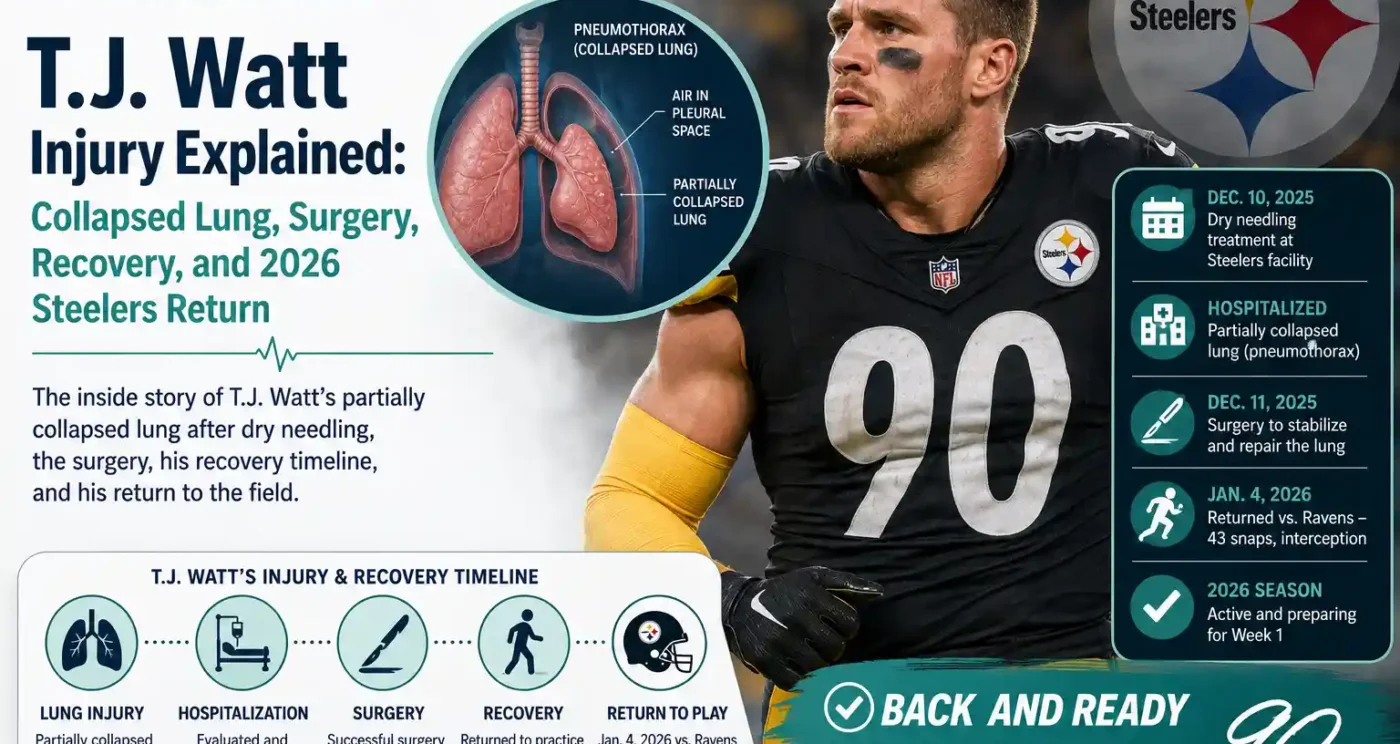
T.J. Watt went from an ordinary day at the Pittsburgh Steelers’ practice facility to the hospital in a matter of hours.
On December 10, 2025, Watt underwent a dry-needling treatment at the team facility. He later said that something did not feel right afterward and that the pain became significant enough for him to be taken to the hospital. The Steelers initially described the problem simply as a “lung situation” while further testing was underway.
The diagnosis turned out to be much more serious than routine post-treatment soreness: Watt had suffered a partially collapsed lung, or pneumothorax. His brother, J.J. Watt, subsequently announced that T.J. had undergone successful surgery to stabilize and repair the lung. Watt was released from the hospital on December 12.
The injury forced one of Pittsburgh’s most important defenders to miss three consecutive games.
Yet it did not end his season.
Watt gradually returned to practice, was a full participant by the first week of January and came back for Pittsburgh’s regular-season finale against Baltimore. He played 43 defensive snaps and intercepted Lamar Jackson in the Steelers’ AFC North-clinching win. A week later, he was still practicing fully and said his body felt good heading into the playoffs.
And as the 2026 NFL season approaches, the old lung injury is not currently keeping him out. NFL.com lists Watt as active, while Pittsburgh deliberately held him and other established veterans out of preseason action as the team prepared for its September 13 opener against Atlanta.
So Watt’s injury is no longer primarily a “when will he return?” story.
He already did.
The more interesting questions now are how the lung collapsed, what surgery was required, why dry needling can rarely cause pneumothorax, and how an NFL player can safely get back to a collision sport after a lung injury.
What Happened to T.J. Watt?
The first public sign that something unusual had happened came on December 11.
The Steelers announced that Watt had experienced discomfort at the team’s practice facility the previous day and had been taken to a local hospital for evaluation of his lung.
Head coach Mike Tomlin said Watt had remained in the hospital overnight and was undergoing additional testing. At that stage, Tomlin said he did not yet know what had caused the problem.
More information followed quickly.
Watt’s brother J.J. said T.J. had undergone surgery on December 11 to stabilize and repair a partially collapsed lung that occurred after a dry-needling treatment session at the Steelers facility. Reuters and ESPN also reported the connection between the pneumothorax and the dry-needling session.
Watt later gave his own account.
When he spoke publicly before his return in January, he said he underwent dry needling at the facility, felt wrong shortly afterward and developed significant pain that ultimately sent him to the hospital.
That distinction is useful. Watt himself established the sequence of events; outside observers do not need to speculate about symptoms or mechanisms he has never described.
What Is a Collapsed Lung?
A collapsed lung in this context is called a pneumothorax.
Normally, the lung sits expanded inside the chest. There is only a very small potential space—the pleural space—between the lung and the inside of the chest wall.
With a pneumothorax, air gets into that space.
As the air accumulates, it pushes against the lung and prevents it from expanding normally. The lung may collapse only partly or, in more severe cases, much more extensively.
That is what the phrase partially collapsed lung means.
It does not necessarily mean the entire lung suddenly stopped functioning.
But even a partial pneumothorax can require urgent medical attention because the size of the air leak can change and breathing can become impaired.
Is a Pneumothorax the Same as a Punctured Lung?
The terms often overlap in everyday reporting.
A pneumothorax describes the presence of air in the pleural space causing partial or complete lung collapse.
People sometimes use “punctured lung” when that air escaped because the lung or surrounding tissue was penetrated or injured. Cleveland Clinic notes that pneumothorax is also commonly called a punctured lung.
In Watt’s case, reputable reports alternately described the injury as a partially collapsed or partially punctured lung.
The most precise diagnosis publicly established is pneumothorax/partial lung collapse.
What Is Dry Needling?
Dry needling is a technique used to address certain types of musculoskeletal pain and movement problems.
A trained provider inserts thin, solid needles through the skin and into or around selected muscles or trigger points. Unlike an injection, the needle does not deliver medication—the needle itself is the intervention.
It may be used as part of a broader rehabilitation program alongside exercise, stretching and other physical-therapy techniques.
Cleveland Clinic describes common after-effects as soreness, stiffness or bruising around the treatment area. Serious complications are uncommon.
But “uncommon” does not mean impossible.
Can Dry Needling Cause a Collapsed Lung?
Yes, although pneumothorax is considered a rare serious complication.
The concern is greatest when dry needling is performed over parts of the upper back, shoulder or chest where a needle inserted too deeply may enter the pleural space surrounding the lung.
Cleveland Clinic specifically warns that dry needling in the thoracic region can, in very rare circumstances, cause pneumothorax and that new shortness of breath following treatment requires prompt evaluation.
Published medical case reports document the same complication.
A 2025 case report in Physical Therapy described pneumothorax following dry needling around the shoulder-blade region and emphasized the importance of anatomical knowledge and early recognition. Another published case similarly documented pneumothorax after dry needling for musculoskeletal pain.
That does not mean dry needling routinely causes lung injuries.
The complication is uncommon.
Watt’s case became notable precisely because this was not the expected outcome of a routine treatment session.
Did Dry Needling Definitely Cause T.J. Watt’s Pneumothorax?
The responsible wording is that Watt’s pneumothorax was publicly reported as occurring after or during a dry-needling session, and Watt himself said he began feeling abnormal shortly after that treatment.
His brother similarly linked the lung injury to the dry-needling session when announcing the surgery.
What should not be added are unsupported legal conclusions.
There is no basis from the information discussed here to label the incident:
- Medical malpractice
- Negligence
- Intentional wrongdoing
- A violation of a professional standard
Those require facts and legal findings beyond the existence of an adverse medical event.
What Symptoms Did T.J. Watt Have?
Watt has been relatively specific about one symptom: pain.
The Steelers initially said he experienced “discomfort” at the facility.
When Watt later discussed the episode himself, he described the pain as significant and said he did not feel right after dry needling. That pain ultimately led to the hospital evaluation.
It is better not to add symptoms he has never publicly confirmed.
For example, chest pain and shortness of breath are classic pneumothorax symptoms in general, but that does not mean both were necessarily part of Watt’s presentation.
What Are the Symptoms of a Collapsed Lung?
For people generally, pneumothorax can cause:
- Sudden chest or shoulder pain
- Pain that becomes worse with breathing or coughing
- Shortness of breath
- Chest tightness
- Rapid breathing
- Rapid heart rate
- Fatigue
More significant pneumothorax can cause low oxygen levels, lightheadedness, bluish discoloration of the lips or skin, severe breathing difficulty or circulatory collapse.
These symptoms should not be watched at home when a collapsed lung is a possibility.
Pneumothorax can worsen and, in severe forms, become life-threatening.
How Do Doctors Diagnose a Pneumothorax?
The clinical evaluation usually begins with symptoms, physical examination and oxygen measurements.
Imaging then helps confirm the diagnosis.
Chest X-Ray
A chest X-ray can show air outside the lung and demonstrate whether part of the lung has collapsed.
It is one of the main tests used for pneumothorax.
CT Scan
A CT scan can provide more detailed images when the diagnosis is uncertain or clinicians need more information about the cause, extent or associated chest injuries.
Physical Examination
A clinician may hear reduced or absent breath sounds over the affected side because the lung is not expanding normally.
Oxygen saturation, respiratory rate, heart rate and blood pressure can also help show how much the pneumothorax is affecting the patient.
The exact tests used for Watt have not been fully disclosed publicly.
Did T.J. Watt Need Surgery?
Yes.
On December 12, J.J. Watt announced that T.J. had undergone successful surgery the previous day to stabilize and repair the partially collapsed lung. T.J. was then released from the hospital.
The Steelers themselves initially referred to it more generally as a medical procedure.
Tomlin said Watt was home resting comfortably but would not play against Miami.
What has not been publicly disclosed is the exact surgical technique.
That is an important boundary.
It would be inappropriate to state that Watt definitely underwent a particular chest-tube, thoracoscopic, pleurodesis or lung-resection procedure unless he or his medical team confirms it.
How Is a Collapsed Lung Normally Treated?
Treatment depends on the size of the pneumothorax, symptoms, the cause and whether air continues leaking.
Observation and Oxygen
A small, stable pneumothorax may sometimes be monitored while the body gradually absorbs the trapped air.
Supplemental oxygen may be used in selected cases.
Needle Aspiration
Doctors may use a needle or catheter to remove air from the pleural space and allow the lung to expand again.
Chest Tube
A larger pneumothorax may require a tube placed through the chest wall.
The tube drains trapped air from around the lung, reducing pressure and allowing the lung to re-expand. It may remain in place for several days while clinicians make sure the air leak has stopped.
Surgery
Surgery can be needed when there is persistent leakage, failure of the lung to expand normally, recurrence or certain traumatic lung injuries.
Watt fell into this surgical category, but his precise operation remains private.
How Serious Was T.J. Watt’s Injury?
It was serious enough to require hospitalization, surgery and a three-game absence.
Watt himself described the experience as frightening because of the severity of his pain and the sudden progression from going to work to needing an operation.
At the same time, his recovery moved relatively quickly.
He was discharged shortly after surgery, returned to the Steelers facility during his recovery and was back on the practice field by December 24.
A serious diagnosis and a successful recovery are not contradictory.
The medical problem can be significant while still responding well to treatment.
How Many Games Did T.J. Watt Miss?
Watt missed three consecutive games.
He was unavailable against:
- Miami
- Detroit
- Cleveland
The Steelers formally ruled him out for the Browns game on December 26, making it his third straight absence because of the lung problem.
Before the injury, Watt had not missed a game since the 2022 season.
That made the interruption particularly noticeable for Pittsburgh’s defense.
When Did T.J. Watt Start Practicing Again?
His first practice after the lung injury came on December 24, 2025, exactly two weeks after the incident.
ESPN reported that Watt participated on a limited basis and went through individual defensive work.
He continued practicing during the week but was still held out of the Cleveland game.
That was an important detail in the recovery process.
Returning to practice and returning to an NFL game are not the same threshold.
The team could use practice to see how Watt responded to exertion before exposing him to full-speed contact.
When Did T.J. Watt Return to the Steelers Lineup?
Watt returned on January 4, 2026, against the Baltimore Ravens.
By the Friday before the game, he had become a full practice participant and no longer carried an injury designation.
Watt said his week of practice had gone well and that he felt confident about playing.
He had missed three games.
Then he walked directly back into a game that would decide the AFC North.
How Did T.J. Watt Play in His First Game Back?
His return was not merely ceremonial.
Watt played 43 defensive snaps, which accounted for 83% of Pittsburgh’s defensive plays, and he intercepted Ravens quarterback Lamar Jackson.
The Steelers won 26-24 and secured the AFC North title.
NFL.com’s game analysis specifically noted the impact of Watt returning after several weeks away because of the lung injury.
From a recovery standpoint, 43 snaps offered the Steelers considerably more information than a few practice drills could.
He had to sprint, change direction, engage blockers and repeatedly recover between plays in a live NFL game.
Was Watt on a Snap Count?
There had been some uncertainty about how much he would play.
But Watt ended up handling 43 defensive snaps.
Defensive coordinator Teryl Austin later said he monitored Watt during the game and that Watt continued to indicate he was doing well.
There was no indication afterward that the lung had caused a setback.
By the following week, Watt said his body felt good and that he was pleased with how he had responded to the Baltimore game.
Did T.J. Watt Play in the Playoffs?
Yes.
Watt remained a full practice participant before Pittsburgh’s Wild Card game against Houston and did not carry a lung-related limitation that prevented him from playing.
He played in the playoff game and recorded six tackles and a fumble recovery.
Pittsburgh lost the game, but from Watt’s personal injury perspective, the appearance was another step confirming that he had successfully returned to competition.
Why Is a Collapsed Lung Especially Important for a Football Player?
Playing edge rusher places substantial demands on the respiratory system.
A player such as Watt repeatedly has to:
- Sprint off the line
- Fight through large offensive linemen
- Twist and rotate through contact
- Chase ball carriers
- Tackle at high speed
- Absorb chest and shoulder impacts
- Recover quickly before the next snap
The concern after a pneumothorax is not simply whether the athlete can tolerate everyday walking.
The lung must be adequately healed for strenuous exercise and, in football, for substantial physical contact.
Sports-medicine literature notes that athletes should generally not return to intense or contact activity until the pneumothorax has fully resolved. Repeat imaging and symptom resolution are commonly part of that decision-making process.
How Soon Can an Athlete Return After a Pneumothorax?
There is no single universal timetable.
A sports-medicine review addressing American football notes that return to play after complete radiographic resolution may commonly occur around three to four weeks, although individual timelines vary and earlier returns have been reported.
Another sports-medicine review emphasizes that there are no universally agreed return-to-play guidelines and that decisions should be individualized according to symptoms, imaging, the cause of the pneumothorax and the demands of the sport.
Watt’s timeline fits reasonably within that broad range.
His lung injury occurred December 10.
He returned to a game on January 4—about three and a half weeks later.
That does not mean another athlete with a collapsed lung should expect exactly the same recovery.
What Do Doctors Look for Before Return to Play?
The precise criteria depend on the injury and treating specialists.
In general, considerations may include:
Resolution of the Pneumothorax
The lung should have re-expanded and trapped pleural air should have resolved appropriately.
Follow-Up Imaging
Chest imaging can help confirm that the pneumothorax has resolved.
No Significant Symptoms
Chest pain, breathlessness or exercise intolerance would be important concerns during return-to-play planning.
Ability to Exercise
An athlete needs to tolerate increasing cardiovascular demand before returning to full competition.
Risk of Reinjury
That matters particularly in collision sports such as football.
Medical Clearance
Sports-medicine literature stresses that return-to-play decisions after pulmonary injuries need to be individualized rather than based solely on a calendar.
Watt’s full practice participation before the Baltimore game indicates that Pittsburgh had already progressed him through substantial football activity before returning him to competition.
Could a Collapsed Lung Happen Again?
Pneumothorax can recur.
How likely recurrence is depends heavily on why the pneumothorax occurred.
A spontaneous pneumothorax in someone with underlying lung abnormalities has a different risk profile from an injury associated with a medical procedure or trauma.
MedlinePlus notes that recurrence is possible after pneumothorax, particularly in certain spontaneous cases.
That general information should not be turned into a percentage for Watt.
His personal recurrence risk would depend on the exact injury, surgical repair, follow-up imaging and other medical details that have not been made public.
Does Surgery Reduce the Risk of Another Pneumothorax?
Certain procedures can be used specifically when doctors are concerned about continued air leakage or recurrence.
For example, surgery may repair the site of an air leak, and some patients undergo procedures intended to help the lung adhere more securely to the chest wall.
But since Watt’s exact operation has not been publicly identified, it would be speculative to claim that he underwent any specific recurrence-prevention procedure.
We only know that his surgery was described publicly as stabilizing and repairing the partially collapsed lung.
What Is T.J. Watt’s Injury Status in 2026?
The important update is that the collapsed lung is not currently keeping Watt out of football.
NFL.com lists him as active. During the Steelers’ 2026 preseason, Watt and veteran defensive lineman Cameron Heyward were held out of preseason game action while Pittsburgh prepared its veteran defense for the regular season. No new lung-related injury was identified as the reason.
The Steelers are scheduled to open the regular season at home against the Atlanta Falcons on September 13, 2026.
That means the correct current framing is:
Watt recovered from the December 2025 lung injury, returned for the final regular-season game and playoffs, and is active entering the 2026 Steelers season.
It would be inaccurate to write as though he is still waiting for clearance from the original pneumothorax.
Why Did the Steelers Hold Watt Out of Preseason Games?
Established NFL veterans often receive different preseason workloads from younger players fighting for roster spots.
Steelers coverage in August noted that Watt and Heyward had both been held out while the defense worked toward being at full strength for the regular season.
There was no accompanying announcement of a new pneumothorax or major lung setback.
Therefore, preseason nonparticipation should not automatically be interpreted as evidence that Watt’s December lung injury returned.
T.J. Watt’s Lung Injury Timeline
| Date | What happened | Status |
|---|---|---|
| Dec. 10, 2025 | Underwent dry needling at Steelers facility; later developed significant pain/discomfort | Taken to hospital for lung evaluation |
| Dec. 11 | Further evaluation confirmed serious lung problem | Underwent surgery to stabilize and repair partially collapsed lung |
| Dec. 12 | Steelers and J.J. Watt provided updates | Released from hospital; ruled out vs. Miami |
| Week 15 | Steelers vs. Dolphins | Did not play |
| Week 16 | Steelers vs. Lions | Did not play |
| Dec. 24 | Returned to practice | Limited participant |
| Week 17 | Steelers vs. Browns | Ruled out for third straight game |
| Jan. 2, 2026 | Full practice participation | No Week 18 injury designation |
| Jan. 4 | Returned vs. Ravens | 43 defensive snaps and an interception |
| Jan. 12 | Wild Card vs. Texans | Played; six tackles and a fumble recovery |
| Aug.–Sept. 2026 | Steelers preparation for new season | Active; no current lung-related absence reported |
| Sept. 13, 2026 | Scheduled Week 1 vs. Falcons | 2026 regular-season opener |
What Should Someone Do After Chest Pain Following Dry Needling?
Most post-treatment soreness after dry needling is not pneumothorax.
However, new chest pain or difficulty breathing after needling near the chest, shoulder or upper back deserves prompt medical attention.
Cleveland Clinic specifically advises urgent evaluation when shortness of breath occurs after thoracic dry needling because pneumothorax, although rare, is possible.
Other concerning symptoms can include:
- Sharp chest pain
- Increasing breathlessness
- Rapid breathing
- Fast heart rate
- Lightheadedness
- Bluish lips or skin
- Severe weakness or collapse
A person should not drive themselves through severe respiratory distress while waiting to see if it improves.
When Is a Collapsed Lung an Emergency?
A suspected pneumothorax deserves urgent evaluation.
Call emergency services for severe or rapidly worsening symptoms such as:
- Significant difficulty breathing
- Severe chest pain
- Blue or gray discoloration of the lips or skin
- Fainting or near-fainting
- Severe lightheadedness
- Rapid deterioration
- Signs of shock
A particularly dangerous form called tension pneumothorax can place enough pressure inside the chest to interfere with the heart and circulation, making it a life-threatening emergency.
Watt had immediate access to professional medical care through the Steelers organization.
Someone developing similar symptoms outside a professional sports environment should seek emergency evaluation rather than trying to manage the problem at home.
When Might a Lung Specialist Be Needed?
A pulmonologist or thoracic surgeon may become involved when someone has:
- A large pneumothorax
- Persistent air leakage
- Recurring pneumothorax
- Underlying lung disease
- A pneumothorax requiring surgery
- Difficulty achieving complete lung re-expansion
People recovering from a serious pulmonary problem may also need follow-up imaging and individualized guidance about exercise, travel and return to physical activity.
If you are preparing for that kind of appointment, keeping discharge paperwork, imaging reports, medication lists and questions together can make the visit much more productive.
MedIntelHub: How to Prepare Questions Before a Specialist Appointment
Frequently Asked Questions
What happened to T.J. Watt?
T.J. Watt suffered a partially collapsed lung in December 2025 following a dry-needling treatment session at the Steelers practice facility.
He was hospitalized and underwent surgery to stabilize and repair the lung.
When did T.J. Watt injure his lung?
The incident occurred on December 10, 2025.
He experienced significant discomfort after dry needling and went to the hospital.
Did T.J. Watt have a collapsed lung?
Yes.
The injury was publicly described as a partially collapsed lung, or pneumothorax.
Was T.J. Watt’s lung punctured?
Some reports used the term partially punctured lung while others described it as partially collapsed.
The confirmed medical issue was pneumothorax requiring surgical repair.
How did T.J. Watt’s lung collapse?
Watt’s lung injury was publicly reported in connection with a dry-needling treatment at the Steelers facility.
Watt later said he underwent dry needling, felt wrong shortly afterward and developed significant pain.
What is dry needling?
Dry needling is a technique in which trained providers insert thin needles through the skin into or around muscle tissue or trigger points to address certain pain and movement problems.
Unlike an injection, no medication is delivered through the needle.
Can dry needling puncture a lung?
Rarely, yes.
Pneumothorax is a recognized serious complication when dry needling is performed near areas where the lung lies beneath the tissues, particularly the thoracic region.
Did T.J. Watt need surgery?
Yes.
J.J. Watt said his brother underwent successful surgery on December 11 to stabilize and repair the partially collapsed lung.
What surgery did T.J. Watt have?
The exact surgical procedure has not been publicly disclosed.
It would therefore be inaccurate to state that he definitely had a particular chest-tube, thoracoscopic or pleurodesis procedure.
How long was T.J. Watt hospitalized?
Watt went to the hospital after developing significant pain on December 10 and was released on December 12 following surgery.
How many games did T.J. Watt miss?
He missed three consecutive regular-season games while recovering from the lung injury.
When did T.J. Watt return to practice?
He returned to practice on December 24, 2025, initially in a limited capacity.
When did T.J. Watt return to play?
Watt returned on January 4, 2026, against the Baltimore Ravens in Pittsburgh’s regular-season finale.
How did T.J. Watt play after returning?
He played 43 defensive snaps against Baltimore and recorded an interception as Pittsburgh won the AFC North.
Did T.J. Watt play in the playoffs?
Yes.
He played in Pittsburgh’s Wild Card game against Houston and finished with six tackles and a fumble recovery.
Did T.J. Watt have another lung problem after returning?
There has been no current public report establishing another pneumothorax or lung-related absence as of September 3, 2026.
NFL.com lists Watt as active.
Is T.J. Watt injured now?
As of the latest available information, the December lung injury is not keeping him out.
He is listed as active and is preparing with the Steelers for the 2026 regular season.
Is T.J. Watt expected to play in 2026?
He is active entering the season, and Pittsburgh is scheduled to open against Atlanta on September 13.
There is currently no public indication that his previous pneumothorax is expected to prevent him from participating.
Can an NFL player return after a collapsed lung?
Yes, when the lung has adequately healed and the athlete has received appropriate medical clearance.
Sports-medicine literature generally recommends avoiding contact competition until the pneumothorax has completely resolved. Return timing varies according to imaging, symptoms, treatment and the athlete’s sport.
How long does a collapsed lung take to heal?
There is no one recovery time.
Cleveland Clinic notes that many pneumothoraces heal over several days to a couple of weeks, but larger injuries, surgery and return to high-intensity contact sports can require a longer recovery.
Watt returned to an NFL game about three and a half weeks after his injury.
Can a collapsed lung happen again?
Yes, recurrence is possible.
The risk depends on the cause of the pneumothorax, underlying lung health and treatment received. Watt’s individual recurrence risk cannot be determined from public information.
Conclusion
T.J. Watt’s December 2025 lung injury began in an unexpected place: during a treatment session rather than on the football field.
After receiving dry needling at the Steelers practice facility on December 10, Watt said he began feeling wrong and developed significant pain. He was taken to the hospital, where the problem was ultimately identified as a partially collapsed lung.
The next day, he underwent surgery.
His brother J.J. Watt said the operation successfully stabilized and repaired the lung, and T.J. was released from the hospital on December 12.
He then had to wait.
Watt missed three games before returning to practice, first on a limited basis and eventually at full participation.
By January 4, he was back on the field.
His first game could hardly have carried more pressure: Pittsburgh needed the regular-season finale against Baltimore to claim the AFC North. Watt responded by playing 43 defensive snaps and recording an interception in the Steelers’ 26-24 victory.
He also played the following week in the postseason.
That makes his recovery more than a story about receiving medical clearance. He returned to the physical demands of NFL football and handled substantial playing time without a publicly reported lung setback.
The medical side of the story is equally important.
Pneumothorax occurs when air accumulates between the lung and chest wall, preventing the lung from expanding normally. Dry needling is generally used for musculoskeletal pain and movement problems, but a pneumothorax is a rare recognized complication when needling occurs near the thorax.
Watt’s experience should not be used to suggest that dry needling commonly results in a collapsed lung.
It should, however, serve as a reminder that new chest pain or breathing difficulty after any procedure involving the upper chest or back deserves prompt medical attention.
And the latest Steelers update is reassuring.
Watt is listed as active heading toward Pittsburgh’s 2026 regular season, with the Steelers scheduled to host Atlanta on September 13.
So the current headline is no longer that T.J. Watt is recovering.
He recovered, returned for the Steelers’ playoff push, and is back preparing for another season.
Resources
Pittsburgh Steelers — Initial T.J. Watt Lung Update
The Steelers’ official report covers Watt’s hospitalization, initial symptoms and Mike Tomlin’s first comments about the situation.
Steelers: Tomlin Provides an Update on T.J. Watt
Pittsburgh Steelers — T.J. Watt’s Return
Watt spoke directly about his dry-needling session, pain, hospitalization, recovery and readiness to return for the Ravens game.
Steelers: Watt Ready to Return vs. Ravens
Pittsburgh Steelers — Week 18 Injury Report
Pittsburgh confirmed Watt had become a full practice participant and had no game designation before his January return.
Steelers: Week 18 Injury Report
Reuters — Surgery for T.J. Watt’s Collapsed Lung
Reuters reported the partially collapsed lung, dry-needling context, surgical repair and hospital release.
Reuters: T.J. Watt Has Surgery for Collapsed Lung
MedlinePlus — Collapsed Lung
MedlinePlus explains pneumothorax symptoms, diagnosis, chest-tube treatment, surgery and possible recurrence.
MedlinePlus: Collapsed Lung (Pneumothorax)
Cleveland Clinic — Pneumothorax
Cleveland Clinic provides patient-focused information about collapsed lungs, including symptoms, causes, treatment and emergency warning signs.
Cleveland Clinic: Pneumothorax
Cleveland Clinic — Dry Needling
This resource explains dry needling and identifies pneumothorax as a rare but serious complication of needling around the thoracic region.
Cleveland Clinic: Dry Needling
American Physical Therapy Association — Dry Needling
APTA provides professional information about dry needling and training considerations for physical therapists.
MedIntelHub — Preparing for a Specialist Appointment
A practical guide for organizing symptoms, imaging, medications and questions before a pulmonary, thoracic or sports-medicine consultation.
How to Prepare Questions Before a Specialist Appointment
MedIntelHub — Editorial Policy
For more information about MedIntelHub’s standards for healthcare sourcing, accuracy, transparency and educational content:
Editorial Disclaimer
This article discusses T.J. Watt’s lung injury only to the extent that information has been publicly disclosed by Watt, the Pittsburgh Steelers, his family or reputable news organizations.
It does not attempt to determine the exact surgical technique used, reconstruct private imaging results, assess his individual recurrence risk or make legal conclusions about the dry-needling treatment.
General information about pneumothorax and dry needling is provided for educational purposes only and should not be used to diagnose or treat an individual.
A professional athlete’s recovery timeline should also not be used as a personal return-to-exercise guideline. Pneumothorax severity, cause, treatment, follow-up imaging, symptoms, underlying health and type of sport all affect recovery.
Sudden chest pain, shortness of breath, bluish lips or skin, fainting, rapidly worsening breathing difficulty or other symptoms suggesting pneumothorax require urgent medical evaluation.

David Bennett
David Bennett is an author at MedIntelHub, where he creates clear, practical, and well-researched content about healthcare, medical billing, insurance, and patient education. His goal is to make complex healthcare topics easier for readers to understand and use in everyday situations. David emphasizes accuracy, transparency, and reliable sourcing, using information from trusted organizations and official healthcare resources whenever possible. Content published by David is intended for educational purposes and should not replace advice from qualified medical, legal, or healthcare professionals.