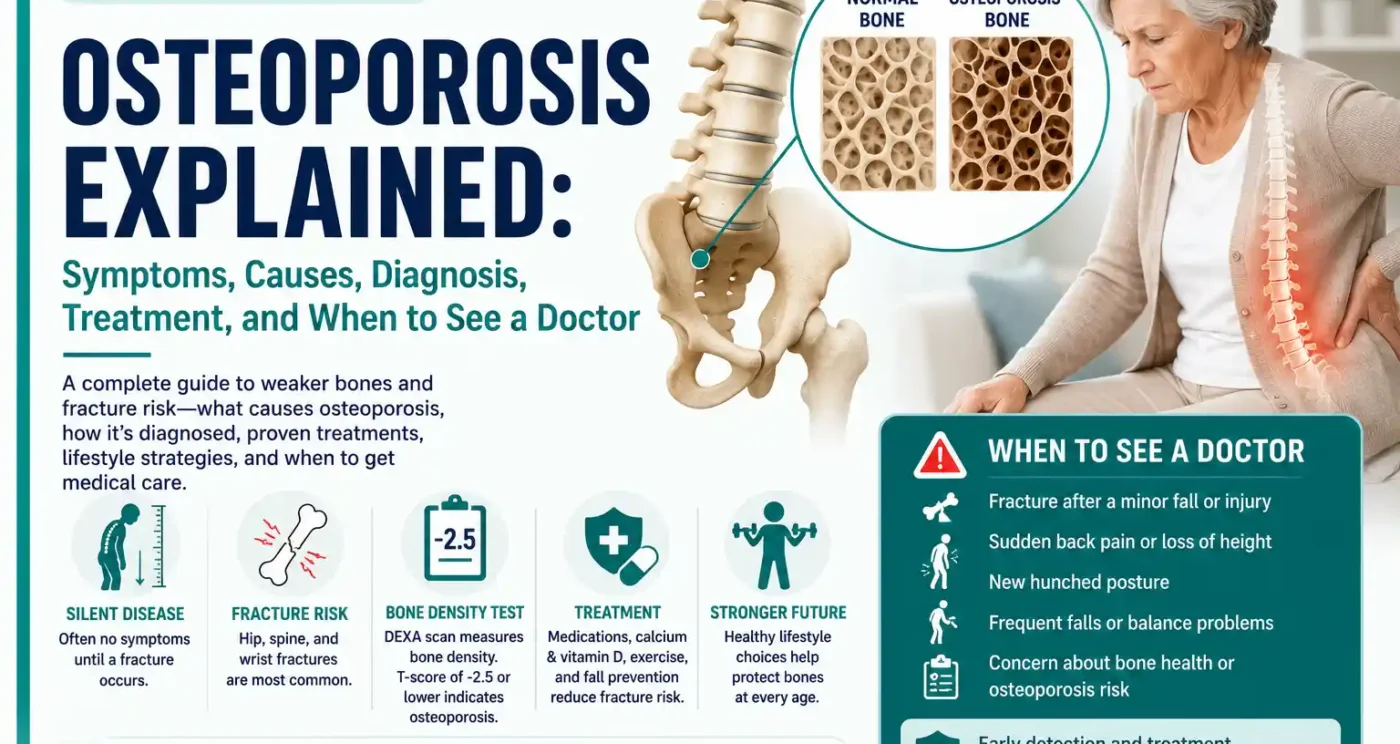
Osteoporosis can weaken bones for years without causing obvious symptoms.
A person may feel completely well until a relatively minor fall results in a broken wrist or hip, or a vertebra in the spine develops a compression fracture. That is why osteoporosis is often called a “silent disease.”
Osteoporosis develops when bone mineral density and bone mass decrease, or when the structure and quality of bone change enough to reduce its strength. The result is a higher risk of fractures, particularly in the hip, spine, and wrist.
The condition is especially common after menopause and in older adults, but it is not exclusively a women’s disease. Men can develop osteoporosis too, and certain medical conditions and medications can accelerate bone loss at almost any adult age.
The good news is that osteoporosis can often be detected before a major fracture occurs, and treatment can substantially reduce future fracture risk.
What Is Osteoporosis?
Osteoporosis is a bone disease in which bones lose enough density, mass, or structural strength that they become more likely to break.
Bone may look solid, but it is living tissue that is constantly being broken down and rebuilt.
During childhood and early adulthood, the body generally builds bone efficiently. Later in life, bone breakdown can begin to outpace new bone formation. When too much bone is lost, the internal architecture becomes weaker.
That does not necessarily make a bone look different from the outside.
Instead, the problem is that the bone becomes less able to tolerate everyday forces.
With advanced osteoporosis, fractures can sometimes occur after:
- A fall from standing height
- Bending
- Lifting
- Coughing
- Other stresses that normally would not break healthy bone
NIAMS notes that osteoporosis-related fractures most commonly involve the hip, vertebrae of the spine, and wrist.
Why Is Osteoporosis Called a Silent Disease?
Osteoporosis generally does not cause symptoms while bone density is gradually declining.
You usually cannot feel bones becoming thinner.
There may be no pain, weakness, or obvious physical sign until a fracture occurs.
For some people, the first indication of osteoporosis is a broken bone.
A fracture in the spine can be particularly easy to miss because not every vertebral compression fracture causes dramatic pain. Multiple vertebral fractures over time may contribute to loss of height or a more stooped posture.
NIAMS identifies severe back pain, height loss, and spinal curvature such as kyphosis as possible signs of vertebral fractures caused by osteoporosis.
What Are the Symptoms of Osteoporosis?
Early osteoporosis usually has no symptoms.
When the disease has progressed or caused fractures, possible signs can include:
- A fracture after a minor fall or injury
- Sudden back pain from a vertebral compression fracture
- Gradual loss of height
- Increasingly stooped or hunched posture
- Reduced mobility after a fracture
- Hip, wrist, or other fractures occurring with relatively low trauma
These symptoms are not specific to osteoporosis.
Back pain, for example, has many possible causes. A person with back pain should not assume osteoporosis is responsible without appropriate evaluation.
Does Osteoporosis Cause Bone Pain?
Not usually by itself.
The reduction in bone density generally does not hurt.
Fractures caused by osteoporosis can be painful.
A spinal compression fracture may cause sudden, intense back pain, although some vertebral fractures cause much less noticeable discomfort.
Hip fractures are usually painful and can substantially impair walking and independence.
Persistent or sudden bone or back pain in someone at risk for osteoporosis deserves medical evaluation, particularly after a fall or other injury.
What Causes Osteoporosis?
Osteoporosis develops when bone loss exceeds the body’s ability to replace and maintain strong bone.
Aging is one of the most important contributors.
As people get older, new bone formation slows while bone breakdown continues. Hormonal changes can accelerate this process.
For women, declining estrogen around and after menopause is particularly important. Men can also lose bone with age, and low sex-hormone levels may contribute in some cases.
However, osteoporosis does not have only one cause.
Medical conditions, medications, nutrition, body size, genetics, and lifestyle can all influence fracture risk.
Who Is at Higher Risk for Osteoporosis?
Risk factors identified by NIAMS include:
- Increasing age
- Female sex
- Menopause and lower estrogen levels
- Smaller or thinner body size
- Family history of osteoporosis or parental hip fracture
- Low calcium or vitamin D intake
- Poor nutrition
- Smoking
- Excessive alcohol use
- Physical inactivity
- Certain endocrine or hormonal disorders
- Gastrointestinal diseases that interfere with nutrient absorption
- Rheumatoid arthritis
- Some cancers
- HIV/AIDS
- Eating disorders such as anorexia nervosa
- Long-term use of certain medications
Having one risk factor does not mean someone will develop osteoporosis.
Likewise, osteoporosis can sometimes occur even when no obvious risk factor is identified.
Can Medications Cause Osteoporosis?
Some medications can accelerate bone loss or increase fracture risk.
One of the best-established examples is long-term glucocorticoid therapy, such as prolonged treatment with prednisone.
NIAMS also identifies several other medication groups that may contribute to bone loss in some patients, including certain antiseizure medicines, cancer therapies, proton-pump inhibitors, selective serotonin reuptake inhibitors, and thiazolidinediones.
This does not mean these medicines should be stopped because of osteoporosis concerns.
For many conditions, their benefits are important.
Instead, a clinician may assess bone health, use the lowest appropriate medication exposure when possible, and consider preventive or osteoporosis treatment when fracture risk becomes significant.
Never stop a prescribed medication without discussing it with the prescriber.
Why Does Menopause Increase Osteoporosis Risk?
Estrogen helps regulate bone remodeling.
When estrogen levels fall around menopause, bone loss can accelerate.
NIAMS notes that osteoporosis often begins developing around the menopausal transition, and postmenopausal women represent one of the groups at highest risk for osteoporotic fractures.
The rate of bone loss is not identical in every woman.
Genetics, body weight, nutrition, physical activity, smoking, alcohol use, medications, and other health conditions can all influence an individual’s risk.
Can Men Get Osteoporosis?
Yes.
Osteoporosis is often discussed as a women’s health issue because postmenopausal women have high rates of bone loss, but men also develop the condition.
NIAMS notes that older men are at risk and that fractures caused by fragile bones in men remain an important health problem. A fracture after age 50 can be an important signal that osteoporosis may be present.
Risk factors in men include:
- Older age
- Long-term glucocorticoid use
- Low testosterone or estrogen levels
- Smoking
- Excessive alcohol consumption
- Rheumatoid arthritis
- Diabetes
- Neurological disorders that increase fall risk
- Low muscle strength
Men with major osteoporotic fractures can experience substantial complications, which makes osteoporosis assessment important when risk factors are present.
What Is Osteopenia?
Osteopenia, now often called low bone mass, means bone density is below the expected range for a healthy young adult but has not reached the conventional DXA threshold used to define osteoporosis.
For postmenopausal women and men age 50 or older:
| T-score | General Interpretation |
|---|---|
| −1.0 or higher | Normal bone density |
| Between −1.0 and −2.5 | Low bone mass/osteopenia |
| −2.5 or lower | Consistent with osteoporosis |
Osteopenia does not mean a person will inevitably develop osteoporosis.
It also does not mean fracture risk is insignificant.
Age, previous fractures, medications, family history, fall risk, and other factors all matter.
Some people with osteopenia have a high enough overall fracture risk that medication may still be considered.
Which Bones Are Most Commonly Affected?
Osteoporosis can weaken almost any bone, but the most clinically important fractures commonly occur in the:
Hip
Hip fractures can lead to surgery, hospitalization, loss of mobility, and prolonged rehabilitation.
Spine
Vertebral compression fractures can cause pain, height loss, posture changes, and reduced physical function.
Wrist
Wrist fractures commonly occur when someone instinctively reaches out during a fall.
NIAMS identifies the hip, vertebral spine, and wrist as among the most frequent sites of osteoporosis-related fracture.
Why Are Hip Fractures So Serious?
A hip fracture is more than a broken bone.
It can have a major effect on independence, mobility, and overall health.
The 2025 U.S. Preventive Services Task Force osteoporosis recommendation notes that only about 40% to 60% of people who experience a hip fracture recover their previous level of mobility and ability to perform daily activities.
Recovery can involve:
- Surgery
- Hospitalization
- Physical rehabilitation
- Walking aids
- Temporary or long-term assistance with daily activities
Older adults may also face complications related to immobility and other medical conditions.
Preventing the first hip fracture is therefore one of the major goals of osteoporosis screening and treatment.
Can Osteoporosis Cause Height Loss?
Yes.
Height loss can occur when one or more vertebrae in the spine collapse or compress.
A person may gradually notice:
- Clothes fitting differently
- Reduced height compared with previous measurements
- A more rounded upper back
- Difficulty standing fully upright
Small changes in height can occur with normal aging, but significant or progressive height loss deserves discussion with a healthcare professional.
It may indicate previously unrecognized vertebral fractures.
What Is a Fragility Fracture?
A fragility fracture is a fracture occurring with relatively low trauma—often a force that would not normally break a healthy bone.
A common example is breaking a bone after falling from standing height.
Fragility fractures are important because they may reveal osteoporosis even when the person had never previously been diagnosed.
Someone who develops a fracture after age 50, particularly after a minor fall, should ask whether evaluation for osteoporosis is appropriate. NIAMS specifically identifies fractures later in life as an important warning sign, including in men.
How Is Osteoporosis Diagnosed?
Evaluation generally begins with medical history and a physical examination.
A healthcare professional may ask about:
- Previous fractures
- Falls
- Family history of hip fracture or osteoporosis
- Smoking
- Alcohol use
- Nutrition
- Physical activity
- Menopause
- Medical conditions
- Long-term medication use
- Changes in height
- Back pain
The physical examination may include assessment of posture, height, balance, walking pattern, and muscle strength.
The most widely used test for measuring bone mineral density is a DXA scan.
What Is a DXA or DEXA Scan?
DXA stands for dual-energy X-ray absorptiometry. You may also see it written as DEXA.
It is a quick, noninvasive test that uses low levels of X-rays to measure bone mineral density.
The hip and lumbar spine are commonly assessed because these sites are strongly related to fracture risk.
NIAMS describes central DXA of the hip and spine as the most reliable approach for diagnosing osteoporosis and helping predict fracture risk.
The test usually does not require an injection or anesthesia.
What Does a T-Score Mean?
A T-score compares a person’s bone mineral density with the average bone density of a healthy young adult.
For postmenopausal women and men age 50 or older:
- −1.0 or above: generally considered normal
- Between −1.0 and −2.5: low bone density or osteopenia
- −2.5 or lower: generally consistent with osteoporosis
The lower the T-score, the lower the measured bone density.
NIAMS notes that fracture risk rises significantly with each one-point decrease in T-score.
However, the T-score should not be interpreted in isolation.
A person’s fracture history, age, medications, fall risk, and other factors may substantially change the treatment decision.
What Is a Z-Score?
A Z-score compares bone density with people of similar age, sex, and other demographic characteristics rather than with a young adult reference group.
Z-scores are more commonly used in:
- Premenopausal women
- Men younger than 50
- Children
A Z-score of −2.0 or lower indicates bone density that is low for age and can prompt clinicians to look more carefully for medical conditions or medications contributing to bone loss.
A low Z-score does not automatically establish the same diagnosis that a T-score would in an older adult.
Who Should Be Screened for Osteoporosis?
Current U.S. Preventive Services Task Force recommendations, updated in January 2025, recommend osteoporosis screening for:
- Women age 65 and older
- Postmenopausal women younger than 65 who have one or more risk factors and are found to be at increased fracture risk through clinical risk assessment
For men, the USPSTF concluded that current evidence remains insufficient to determine whether routine population screening provides more benefit than harm. That does not mean men should never receive bone-density testing; clinicians may use individual judgment when risk factors, medications, or fractures suggest osteoporosis.
These screening recommendations apply to people without already known osteoporosis or a history of fragility fractures.
Someone who has already sustained a low-trauma fracture may need diagnostic evaluation regardless of routine screening age.
What Is FRAX?
FRAX is a fracture-risk assessment tool.
It combines clinical factors—and optionally femoral-neck bone mineral density—to estimate a person’s 10-year probability of:
- Hip fracture
- Major osteoporotic fracture involving the clinical spine, hip, forearm, or shoulder
Factors considered can include age, sex, weight, height, previous fracture, parental hip fracture, smoking, glucocorticoid use, rheumatoid arthritis, secondary osteoporosis, and alcohol intake.
FRAX is useful because two people with identical T-scores can have very different overall fracture risks.
One clarification is worth making: although FRAX originated from work at a former WHO Collaborating Centre, the current FRAX organization states that the tool itself was not developed or endorsed by WHO.
Are Blood Tests Used to Diagnose Osteoporosis?
Blood tests do not usually replace DXA for measuring bone density.
However, laboratory testing may help determine why someone has low bone density.
Depending on the person’s history, a healthcare professional may investigate:
- Calcium abnormalities
- Vitamin D deficiency
- Kidney disease
- Thyroid or parathyroid disorders
- Hormonal abnormalities
- Malabsorption
- Other causes of secondary osteoporosis
The exact testing varies considerably.
This is particularly important when osteoporosis occurs at an unusually young age, is unexpectedly severe, or develops without obvious age-related risk factors.
How Is Osteoporosis Treated?
The primary goal of osteoporosis treatment is not simply to make a DXA number look better.
The goal is to reduce the likelihood of fractures.
Treatment can include:
- Nutrition
- Physical activity
- Strength and balance training
- Fall prevention
- Smoking cessation
- Limiting excessive alcohol use
- Treating underlying medical causes
- Medication for people whose fracture risk warrants it
The appropriate plan depends on the person’s age, fracture history, bone density, medical conditions, kidney function, medications, and estimated future fracture risk.
What Medicines Are Used for Osteoporosis?
Several medication classes can reduce fracture risk.
The major categories include:
| Medication Type | Examples | General Role |
|---|---|---|
| Bisphosphonates | Alendronate, risedronate, zoledronic acid, ibandronate | Slow bone breakdown |
| RANKL inhibitor | Denosumab | Reduces bone resorption |
| PTH/PTHrP-related therapy | Teriparatide, abaloparatide | Stimulates new bone formation |
| Sclerostin inhibitor | Romosozumab | Increases bone formation and decreases resorption |
| Selective estrogen receptor modulators | Raloxifene | Used in selected postmenopausal patients |
| Other hormone-related approaches | Selected estrogen-based treatment | Appropriate only for certain patients |
Treatment choice should be individualized.
Different medicines reduce different types of fracture risk and have different precautions.
Are Bisphosphonates First-Line Osteoporosis Treatment?
They commonly are.
The Endocrine Society recommends considering bisphosphonates as initial treatment for many postmenopausal women at high fracture risk. Options include alendronate, risedronate, zoledronic acid, and ibandronate.
These medicines slow the activity of cells that break down bone.
However, the drugs are not interchangeable in every situation.
For example, the Endocrine Society notes that ibandronate is not recommended specifically for reducing hip or other nonvertebral fracture risk.
Kidney function, gastrointestinal problems, ability to follow oral dosing instructions, previous fractures, and overall fracture risk can influence which medication is appropriate.
What Is a Bisphosphonate Holiday?
Bisphosphonates can remain in bone after treatment stops.
For some people who become low-to-moderate risk after several years of treatment, clinicians may consider a temporary break—commonly called a bisphosphonate holiday.
The Endocrine Society recommends reassessing fracture risk after approximately 3 to 5 years of bisphosphonate therapy. People who remain at high risk may need to continue treatment, while selected lower-risk patients may be candidates for a treatment break.
This is a clinical decision, not something a patient should initiate independently.
A medication holiday is also not appropriate for every osteoporosis drug.
How Does Denosumab Work?
Denosumab is an antiresorptive medication that reduces the activity of cells responsible for breaking down bone.
It can be an effective treatment for people at high fracture risk.
Unlike bisphosphonates, however, its effects reverse relatively quickly when injections are missed or stopped.
For that reason, the Endocrine Society advises against a routine denosumab drug holiday and recommends that treatment not be delayed or stopped without a plan for subsequent osteoporosis therapy.
This is an especially important safety point.
Why Shouldn’t Denosumab Be Stopped Suddenly?
Stopping or substantially delaying denosumab can cause bone turnover to increase rapidly.
Bone density may decline, and the risk of vertebral fractures can rise.
FDA specifically advises patients not to stop, skip, or delay Prolia (denosumab) without discussing it with their healthcare professional, because fractures—including spinal fractures—can occur after discontinuation.
If denosumab needs to be discontinued, clinicians frequently plan another antiresorptive treatment to reduce this rebound risk.
This is very different from the way selected patients may take a bisphosphonate holiday.
Is Denosumab Safe With Kidney Disease?
Kidney health requires particular attention.
In 2024, FDA added a Boxed Warning to Prolia because denosumab can cause severe hypocalcemia—dangerously low blood calcium—in patients with advanced chronic kidney disease, particularly people receiving dialysis or those with chronic kidney disease-mineral and bone disorder.
That does not mean everyone with kidney disease is unable to receive denosumab.
It means the benefits and risks require careful assessment, and people with advanced CKD may need specialist involvement and closer calcium monitoring.
What Are Bone-Building Osteoporosis Medicines?
Some osteoporosis drugs primarily stimulate new bone formation rather than only slowing bone breakdown.
These include:
- Teriparatide
- Abaloparatide
- Romosozumab
The Endocrine Society recommends considering teriparatide or abaloparatide for people at very high fracture risk, including selected patients with severe or multiple vertebral fractures.
These treatments are generally used for a limited period.
After completing an anabolic course, an antiresorptive medicine is commonly needed to preserve the bone-density gains.
What Is Romosozumab?
Romosozumab is another bone-building treatment used in selected patients at very high fracture risk.
The Endocrine Society recommends up to one year of therapy in appropriate postmenopausal women with very high fracture risk, followed by antiresorptive treatment to maintain benefits.
Cardiovascular history matters.
Current guideline recommendations caution against using romosozumab in women at high cardiovascular or stroke risk, including those with a history of myocardial infarction or stroke.
Treatment therefore requires individualized risk assessment.
Is Calcium Important for Osteoporosis?
Yes.
Calcium is a major structural component of bone.
However, more calcium is not automatically better.
The NIH Office of Dietary Supplements lists general recommended daily amounts for adults as:
- Adults 19–50: 1,000 mg
- Men 51–70: 1,000 mg
- Women 51–70: 1,200 mg
- Adults 71 and older: 1,200 mg
These totals include calcium from food plus supplements, not supplements alone.
Food sources include dairy products, canned fish with edible bones, some green vegetables, tofu, and calcium-fortified foods.
A clinician can help determine whether supplementation is necessary.
How Much Vitamin D Do Adults Need?
Vitamin D supports calcium absorption and normal bone health.
NIH dietary reference values list:
- Adults 19–70: 600 IU (15 mcg) daily
- Adults 71 and older: 800 IU (20 mcg) daily
These are general dietary recommendations for healthy people, not individualized treatment doses.
Someone with documented vitamin D deficiency, malabsorption, kidney disease, or another medical condition may need a different plan.
High-dose vitamin D should not be taken indefinitely without medical guidance.
Should Everyone With Osteoporosis Take Supplements?
Not automatically.
The goal is adequate calcium and vitamin D—not simply taking the largest supplement possible.
NIAMS recommends a balanced diet and notes that supplements may be useful when someone cannot obtain sufficient calcium or vitamin D through food and other appropriate sources.
Supplements can also interact with medicines.
For example, calcium can interfere with absorption of certain medications, including thyroid replacement and some antibiotics.
It is sensible to review supplements with a physician or pharmacist rather than assuming that over-the-counter products are risk-free.
Is Exercise Good for Osteoporosis?
Yes, but the type of exercise matters.
NIAMS recommends combining:
- Weight-bearing exercise
- Resistance or strength training
- Balance training
These activities can help strengthen muscles, preserve bone, improve coordination, and reduce the likelihood of falls.
Examples can include walking, stair climbing, carefully selected strength exercises, resistance bands, and balance activities.
People who already have osteoporosis or vertebral fractures may need modifications.
Are Some Exercises Unsafe With Osteoporosis?
Potentially.
Someone with significant osteoporosis should not automatically begin high-impact workouts or aggressive spinal movements.
NIAMS advises people with osteoporosis to avoid sudden or excessive strain and recommends individualized exercise guidance when fracture risk is substantial.
The National Institute on Aging also advises caution with movements involving forceful spinal twisting or deep forward bending in people with osteoporosis because those movements may increase vertebral-fracture risk in susceptible individuals.
A physical therapist can help design a safer program when previous fractures or significant bone loss are present.
Why Is Fall Prevention Part of Osteoporosis Treatment?
A strong bone is less likely to fracture, but preventing the fall in the first place is just as important.
The National Institute on Aging reports that more than one in four adults age 65 and older fall each year.
Fall-prevention strategies can include:
- Strength and balance exercises
- Reviewing medicines that cause dizziness or sedation
- Checking vision and hearing
- Using adequate lighting
- Removing tripping hazards
- Installing bathroom grab bars
- Standing up slowly when prone to dizziness
- Using a cane or walker when necessary
For someone with osteoporosis, preventing one fall may prevent a life-changing fracture.
Can Osteoporosis Be Reversed?
This question needs some nuance.
Osteoporosis is not usually described as something that is simply “cured.”
However, treatment can:
- Slow bone loss
- Increase bone density with some medications
- Improve bone strength
- Substantially lower fracture risk
People taking bone-building medications may experience meaningful increases in bone mineral density.
Some patients may later move from an osteoporosis-range T-score into a higher bone-density range.
But that does not necessarily mean all future fracture risk has disappeared or that treatment can automatically be stopped.
The person’s history of osteoporosis and previous fractures remains clinically important.
How Long Does Osteoporosis Treatment Last?
There is no universal duration.
It depends heavily on the medication and the person’s ongoing fracture risk.
For example:
- Bisphosphonate therapy is often reassessed after approximately 3–5 years.
- Selected lower-risk patients may then take a supervised bisphosphonate holiday.
- Denosumab generally should not be interrupted without a follow-on treatment plan.
- Teriparatide and abaloparatide are generally used for limited treatment periods.
- Romosozumab is generally limited to about 12 months, followed by antiresorptive treatment.
Treatment therefore needs periodic reassessment rather than an automatic stop date.
How Often Is Bone Density Rechecked?
The interval depends on why the test was performed and whether treatment has started.
The Endocrine Society recommends monitoring bone mineral density every 1 to 3 years in high-risk individuals with low bone density who are undergoing osteoporosis management.
Some people may need less frequent testing.
Repeated scans should ideally be interpreted alongside changes in fracture risk, medication adherence, and clinical history rather than based on a small numerical change alone.
Can Osteoporosis Be Prevented?
Not every case is preventable.
Age, genetics, menopause, and some illnesses cannot be eliminated.
Still, supporting bone health throughout life may reduce risk.
Helpful measures include:
- Adequate calcium and vitamin D
- Regular weight-bearing activity
- Resistance training
- Maintaining muscle strength
- Avoiding smoking
- Avoiding excessive alcohol consumption
- Addressing fall risk
- Treating medical conditions that contribute to bone loss
- Reviewing medications that may affect bone health
Building strong bones earlier in life also provides a larger reserve before age-related bone loss begins.
When Should You See a Doctor About Osteoporosis?
Consider discussing bone health with a healthcare professional if:
- You have had a fracture after a relatively minor fall.
- You have lost noticeable height.
- You have developed a new stooped posture.
- You experience sudden unexplained back pain.
- You have been taking long-term glucocorticoids.
- You have a medical condition associated with bone loss.
- You entered menopause early.
- A parent had a hip fracture.
- You have had repeated falls.
- You are due for osteoporosis screening based on age and risk.
Women age 65 and older should generally be screened under current USPSTF recommendations, while younger postmenopausal women may qualify based on fracture-risk assessment.
Routine preventive visits are also an opportunity to review fall history, medications, nutrition, and whether age-appropriate screening is due. MedIntelHub’s annual-physical guide explains how preventive screening and risk assessment can fit into a routine checkup.
Understanding Your Annual Physical: What Actually Gets Checked
When Is a Possible Osteoporosis Fracture an Emergency?
Osteoporosis itself is usually managed through routine or specialist care.
A suspected fracture can require urgent treatment.
Seek prompt or emergency medical assessment after a fall or injury if there is:
- Severe hip or groin pain
- Inability to stand or bear weight
- A visibly deformed limb
- Severe sudden back pain after minor trauma
- New weakness or numbness
- Loss of bladder or bowel control
- Major trauma
- Head or neck injury
- Severe pain accompanied by fainting or other concerning symptoms
Someone with osteoporosis may fracture a bone after trauma that would appear minor in another person.
Do not assume that being able to move the limb means a fracture is impossible.
What Kind of Doctor Treats Osteoporosis?
Osteoporosis may be diagnosed and treated by several types of healthcare professionals.
Depending on the situation, care can involve:
- Primary care physicians
- Endocrinologists
- Rheumatologists
- Geriatricians
- Gynecologists
- Orthopedic specialists after a fracture
- Physical therapists
- Other bone-health specialists
Complex cases—such as osteoporosis at a young age, multiple fractures, treatment failure, or severe kidney disease—may benefit from specialist evaluation.
If you are preparing for a specialist visit, organizing your previous fractures, medications, DXA results, and questions beforehand can make the appointment more useful.
MedIntelHub: How to Prepare Questions Before a Specialist Appointment
Frequently Asked Questions
What are the first signs of osteoporosis?
Usually, there are none.
Osteoporosis commonly progresses silently until a fracture occurs. Possible later signs include height loss, stooped posture, sudden back pain from a vertebral fracture, or fractures after relatively minor trauma.
Does osteoporosis hurt?
Bone loss itself generally does not cause pain.
Pain is more likely when osteoporosis causes a fracture, particularly a vertebral compression fracture.
What is the most common cause of osteoporosis?
There is no single cause for everyone.
Age-related bone loss and hormonal changes after menopause are major contributors. Genetics, nutrition, medical conditions, medications, smoking, alcohol use, and physical activity can also affect risk.
What is the difference between osteopenia and osteoporosis?
For postmenopausal women and men age 50 or older, a T-score between −1.0 and −2.5 is generally classified as low bone mass or osteopenia, while −2.5 or lower is consistent with osteoporosis.
However, fracture risk depends on more than T-score alone.
What is the best test for osteoporosis?
Central DXA testing of the hip and spine is the standard test used to measure bone mineral density and diagnose osteoporosis in most adults.
Is a T-score of −2.5 always osteoporosis?
A T-score of −2.5 or lower at an appropriate skeletal site in a postmenopausal woman or man age 50 or older is generally consistent with osteoporosis.
However, clinicians interpret the result alongside medical history because other bone diseases can sometimes affect bone-density measurements.
Can someone have osteoporosis with a T-score better than −2.5?
Yes.
A person may still be clinically considered to have osteoporosis or sufficiently high fracture risk based on factors such as certain fragility fractures and overall fracture-risk assessment, even when the T-score is above −2.5.
At what age should women have a bone-density test?
The USPSTF recommends screening women age 65 and older.
Postmenopausal women younger than 65 should first have their clinical fracture risk assessed; those at increased risk should be screened.
Should men be screened for osteoporosis?
The USPSTF currently says evidence is insufficient to recommend routine screening for all men.
That does not prevent clinicians from ordering DXA when an individual man has important risk factors, fractures, or another medical reason for testing.
Can men develop severe osteoporosis?
Yes.
Men can develop osteoporosis and serious fragility fractures, particularly at older ages or in the presence of risk factors such as glucocorticoid use, hormonal abnormalities, smoking, chronic illness, or low muscle strength.
What is FRAX?
FRAX is a tool that estimates a person’s 10-year risk of hip fracture and major osteoporotic fracture using clinical risk factors, with or without femoral-neck bone density.
Is walking enough to treat osteoporosis?
Walking is a useful weight-bearing activity and can support general health.
However, an osteoporosis exercise program often benefits from resistance training and balance exercises as well, particularly because muscle strength and balance help reduce falls.
Exercise does not replace medication when fracture risk is high enough to warrant drug therapy.
Can calcium cure osteoporosis?
No.
Calcium is necessary for bone health, but calcium alone does not reverse established osteoporosis.
Adequate calcium and vitamin D are part of a broader treatment plan that can also include exercise, fall prevention, treatment of underlying causes, and medication.
Is vitamin D alone enough to treat osteoporosis?
No.
Vitamin D helps the body absorb calcium, but osteoporosis treatment should be based on the individual’s overall fracture risk.
People at high risk may need prescription medication in addition to adequate nutrition and exercise.
What is the most common medication for osteoporosis?
Bisphosphonates are among the most commonly used initial medications for people at high fracture risk.
The best treatment depends on fracture history, kidney function, bone density, gastrointestinal health, and other individual factors.
Can you stop osteoporosis medication when your bone density improves?
Not automatically.
Some bisphosphonate users may qualify for a supervised treatment holiday after reassessment.
Other medicines behave differently. Denosumab should not be stopped or substantially delayed without a follow-on treatment plan because rapid bone loss and vertebral fractures can occur.
Can osteoporosis cause a hunched back?
Yes, but usually because of vertebral fractures rather than osteoporosis directly.
Multiple compression fractures can reduce vertebral height and contribute to a rounded or stooped upper-back posture.
Can coughing cause an osteoporosis fracture?
In severe osteoporosis, vertebral fractures can occasionally occur with ordinary stresses such as coughing, bending, or lifting.
New severe back pain after one of these activities deserves medical evaluation.
Does osteoporosis always get worse?
Not necessarily.
Appropriate treatment can slow bone loss, increase bone density with some therapies, and substantially reduce fracture risk.
Progress depends on the cause, treatment, medication adherence, nutrition, physical activity, falls, and other medical factors.
Conclusion
Osteoporosis is easy to overlook because it often causes no symptoms until a fracture occurs.
The condition develops when bone density, mass, or internal structure deteriorates enough to make bones less resistant to everyday forces. The hip, spine, and wrist are among the most common fracture sites.
Age and menopause are major risk factors, but osteoporosis is not limited to older women. Men can develop it, and medical conditions, long-term glucocorticoid treatment, poor nutrition, smoking, excessive alcohol use, and other factors can contribute.
DXA is the standard bone-density test. In postmenopausal women and men age 50 or older, a T-score between −1.0 and −2.5 indicates low bone mass, while −2.5 or lower is generally consistent with osteoporosis.
Current U.S. screening recommendations call for routine osteoporosis screening in women age 65 and older and risk-based screening in younger postmenopausal women. Evidence remains insufficient for a population-wide screening recommendation in men, so individual risk assessment matters.
Treatment is about more than improving a scan result.
The real goal is to prevent fractures.
Adequate calcium and vitamin D, strength and weight-bearing exercise, balance training, fall prevention, and avoiding smoking can support bone health. People at higher fracture risk may also need medication.
Bisphosphonates remain common first-line options, while denosumab and bone-building therapies can be appropriate in selected patients. Medication plans require ongoing review because the drugs are not interchangeable and should not all be stopped in the same way. In particular, denosumab should not be discontinued without medical planning because rapid bone loss and vertebral fractures can follow.
Most importantly, osteoporosis does not have to wait for a hip fracture to be discovered.
Age-appropriate screening, recognizing fragility fractures, reviewing risk factors, and discussing bone health with a healthcare professional can identify the problem earlier—when there is still an opportunity to reduce the likelihood of a serious fracture.
Resources
National Institute of Arthritis and Musculoskeletal and Skin Diseases — Osteoporosis
NIAMS provides detailed information about osteoporosis symptoms, causes, diagnosis, treatment, nutrition, exercise, and fracture prevention.
NIAMS — Understanding Bone Density Test Results
This resource explains T-scores, Z-scores, osteopenia, osteoporosis, and how bone-density results are interpreted.
NIAMS: Bone Mineral Density Tests — What the Numbers Mean
U.S. Preventive Services Task Force — Osteoporosis Screening
The USPSTF’s January 2025 recommendation provides current U.S. screening guidance for women age 65 and older, younger postmenopausal women at increased risk, and the evidence status for screening men.
USPSTF: Osteoporosis to Prevent Fractures — Screening
Endocrine Society — Osteoporosis Treatment Guidelines
The Endocrine Society provides clinical recommendations covering bisphosphonates, denosumab, anabolic treatments, romosozumab, treatment duration, and monitoring.
Endocrine Society: Pharmacological Management of Osteoporosis
NIH Office of Dietary Supplements — Calcium
NIH provides age- and sex-specific calcium recommendations, food sources, supplement considerations, and medication interactions.
NIH Office of Dietary Supplements — Vitamin D
This resource explains vitamin D’s role in calcium absorption and provides current dietary reference amounts.
National Institute on Aging — Falls and Fracture Prevention
NIA provides practical guidance on strength, balance, home safety, medications, and other strategies that can reduce falls among older adults.
NIA: Falls and Fractures in Older Adults
MedIntelHub — Understanding Your Annual Physical
MedIntelHub’s preventive-care guide explains how age-appropriate screening, medication review, fall history, and other health risks can be addressed during routine care.
Understanding Your Annual Physical: What Actually Gets Checked
MedIntelHub — Editorial Policy
For information about MedIntelHub’s approach to medical sourcing, accuracy, transparency, updates, and educational content:
Editorial Disclaimer
This article is provided for general educational and informational purposes only. It does not diagnose osteoporosis, determine an individual’s fracture risk, or recommend a particular medication or supplement.
Bone density results must be interpreted together with age, fracture history, medical conditions, medications, fall risk, and other clinical factors. A low T-score can have causes other than typical age-related osteoporosis, particularly in younger people or patients with complex medical conditions.
Osteoporosis medications have different benefits, risks, treatment durations, and stopping requirements. Do not begin, stop, delay, or change a prescription osteoporosis medicine without guidance from the prescribing healthcare professional. This is especially important with denosumab because stopping or delaying treatment without appropriate follow-on therapy can increase fracture risk.
Seek prompt medical evaluation after a fall or injury if there is severe pain, inability to stand or bear weight, visible deformity, sudden severe back pain, new neurological symptoms, or another reason to suspect a fracture.
For more information about MedIntelHub’s healthcare sourcing and editorial standards, review the MedIntelHub Editorial Policy.

David Bennett
David Bennett is an author at MedIntelHub, where he creates clear, practical, and well-researched content about healthcare, medical billing, insurance, and patient education. His goal is to make complex healthcare topics easier for readers to understand and use in everyday situations. David emphasizes accuracy, transparency, and reliable sourcing, using information from trusted organizations and official healthcare resources whenever possible. Content published by David is intended for educational purposes and should not replace advice from qualified medical, legal, or healthcare professionals.