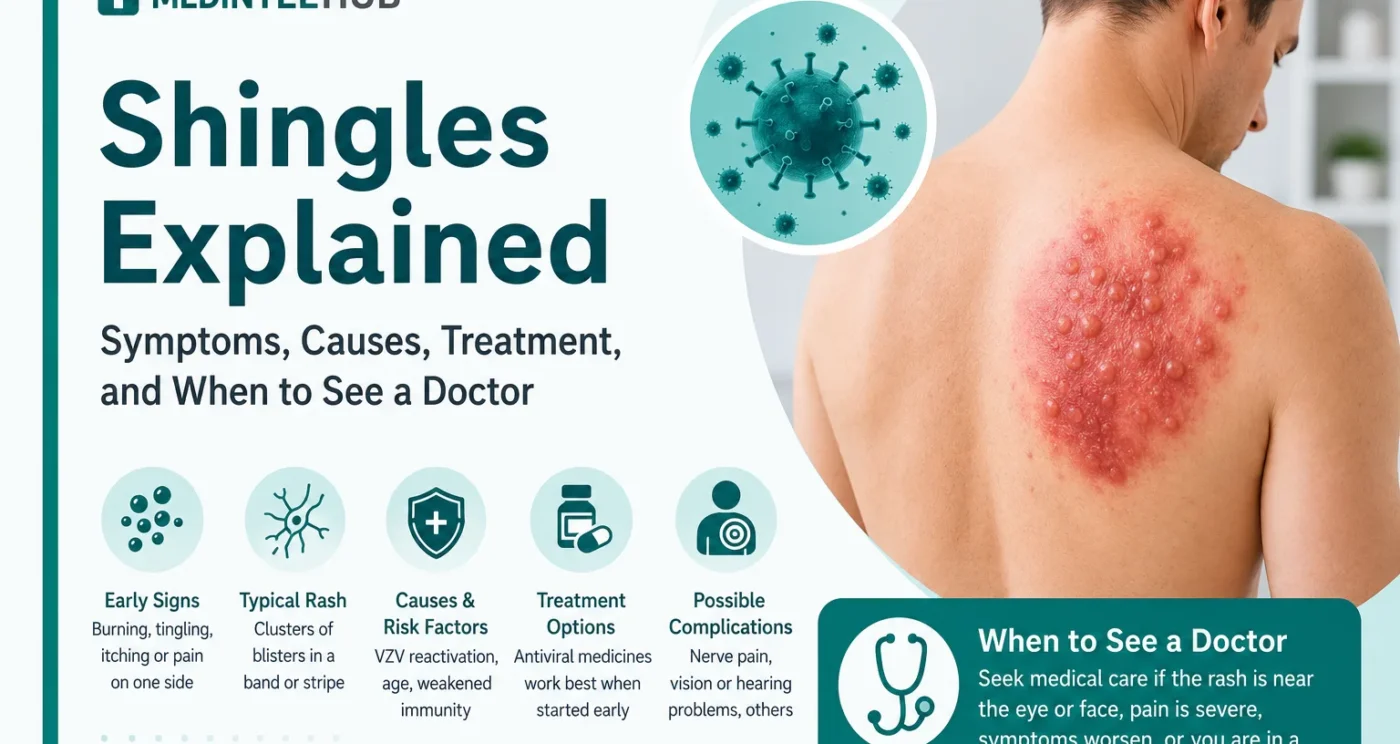
Shingles symptoms may begin before a rash becomes visible. A person may first notice burning, tingling, itching, unusual skin sensitivity, or pain on one side of the body. A painful, blistering rash can then appear in the same area several days later.
Shingles, also called herpes zoster, is caused by the varicella-zoster virus, or VZV—the same virus responsible for chickenpox. After a person has chickenpox, the virus remains inactive in nerve tissue and can reactivate years or even decades later as shingles.
About 1 in 3 people in the United States will develop shingles during their lifetime, and the risk rises with age.
For most people, the visible rash clears within a few weeks. However, shingles can sometimes cause long-lasting nerve pain, vision problems, hearing problems, or other complications. Recognizing the early signs and contacting a healthcare professional promptly can be important because antiviral treatment works best when started early.
What Is Shingles?
Shingles is a viral illness caused by the reactivation of varicella-zoster virus.
After someone recovers from chickenpox, the immune system controls the infection, but VZV does not completely leave the body. Instead, it remains dormant in sensory nerve tissue.
Years later, the virus can reactivate and travel along a nerve toward the skin, producing the characteristic painful shingles rash.
Shingles commonly affects one or two neighboring nerve distributions, known as dermatomes. The rash frequently appears on the trunk or face and usually remains on one side of the body rather than crossing the body’s midline.
Although shingles is more common as people get older, younger adults and even children can develop it.
What Causes Shingles?
Shingles does not represent a new case of chickenpox.
It occurs when VZV already present in the body becomes active again.
Exactly why the virus reactivates at a particular time is not always clear. However, two of the most important risk factors are increasing age and weakened cellular immunity.
The risk can therefore be higher in people who:
- Are older
- Have medical conditions that weaken immune function
- Take certain immune-suppressing medicines
- Receive treatments that suppress the immune system
Having one of these risk factors does not mean someone will definitely develop shingles. It means their likelihood of developing the illness may be higher.
What Are the Early Signs of Shingles?
The early symptoms of shingles can appear several days before the characteristic rash.
Common warning signs include:
- Burning or tingling
- Localized pain
- Itching
- Unusual sensitivity to touch
- Headache
- General malaise or feeling unwell
- Fever in some people
- Chills in some people
- Sensitivity to bright light in some cases
CDC notes that pain, itching, or tingling can develop in the area where the rash later appears. Headache, malaise, and light sensitivity can also occur before the rash.
The pain can range from mild irritation to intense burning, aching, stabbing, or nerve-like discomfort.
Because these symptoms can occur before visible skin changes appear, early shingles may initially resemble other medical conditions depending on where the pain is located.
What Does a Shingles Rash Look Like?
A typical shingles rash consists of clusters of fluid-filled blisters.
The rash often forms a band or stripe on one side of the body. The torso is a common location, although shingles can also occur on one side of the face.
After the rash appears:
- New blisters may continue forming for about 3 to 5 days.
- The lesions gradually begin to dry.
- Blisters typically scab over within about 7 to 10 days.
- The rash generally clears within 2 to 4 weeks.
People with weakened immune systems are more likely to have an atypical or widespread rash, which may resemble chickenpox. A widespread blistering rash should be medically evaluated promptly.
Where Does Shingles Usually Appear?
Shingles can appear anywhere along a nerve affected by VZV reactivation.
Common locations include:
- Chest
- Back
- Abdomen
- Waist
- Neck
- Face
A classic presentation is a painful stripe that begins near the spine and wraps around one side of the torso.
The rash usually remains on either the right or left side rather than appearing symmetrically on both sides.
Shingles on the face requires extra attention because certain facial nerves are connected with structures involving the eye and ear.
Can You Have Shingles Without a Rash?
Yes, but it is less common.
Shingles without the typical rash is sometimes called zoster sine herpete.
CDC notes that shingles can be difficult to diagnose before the rash appears or in cases where no rash develops.
Without visible blisters, burning, tingling, or nerve pain can resemble many other conditions.
Persistent unexplained one-sided nerve-like pain should therefore be medically evaluated rather than assumed to be shingles.
How Long Does Shingles Last?
The visible rash generally lasts several weeks.
A typical course may look like this:
Before the Rash
Pain, burning, itching, or tingling may begin several days before skin lesions appear.
First Several Days
New blisters can continue developing.
Around Days 7–10
Many of the blisters begin drying and forming scabs.
Within 2–4 Weeks
The visible rash generally clears.
The pain does not always disappear when the skin heals.
Some people develop persistent nerve pain that lasts for months or even years.
Is Shingles Contagious?
You cannot directly “catch shingles” from someone who has shingles.
However, a person with active shingles can spread varicella-zoster virus to someone who has never had chickenpox or received the chickenpox vaccine.
That exposed person can develop chickenpox—not shingles.
VZV can spread through direct contact with fluid from shingles blisters and through virus particles originating from active lesions.
A person with shingles can generally spread VZV from the time the rash appears until the lesions have dried and crusted over. The risk of transmission is lower when the rash is completely covered.
How Can You Avoid Spreading Shingles?
If you have active shingles:
- Cover the rash when possible.
- Avoid touching or scratching the lesions.
- Wash your hands frequently.
- Avoid sharing items that contact uncovered lesions.
- Continue precautions until the rash has crusted over.
CDC particularly recommends avoiding susceptible people at higher risk from VZV exposure, including pregnant people who have never had chickenpox or the chickenpox vaccine, premature or low-birth-weight infants, and people with weakened immune systems.
Who Is at Higher Risk of Shingles?
Anyone with prior VZV infection can potentially develop shingles.
Risk rises significantly with age, particularly after age 50, and people with weakened immune systems are also more likely to develop shingles or experience an atypical presentation.
Some medications and medical treatments that suppress immune function can also increase risk.
Higher risk does not mean shingles is inevitable. It does make vaccination and early recognition especially important.
How Is Shingles Diagnosed?
Once the typical rash appears, shingles can often be diagnosed from the patient’s symptoms and the characteristic distribution of the lesions.
CDC notes that the clinical appearance is often distinctive enough for diagnosis after the rash develops.
Testing may be helpful when:
- The appearance is unusual
- The diagnosis is uncertain
- No typical rash is present
- The patient has a weakened immune system
When laboratory confirmation is needed, CDC identifies polymerase chain reaction, or PCR, as the most helpful test for confirming VZV.
Material from a blister or lesion may be collected for testing.
How Is Shingles Treated?
Prescription antiviral medicines are commonly used to treat shingles.
The three preferred antivirals identified by CDC are:
- Acyclovir
- Valacyclovir
- Famciclovir
These medicines do not remove latent VZV permanently from the body, but they can shorten and reduce the severity of an active shingles episode.
CDC states that antiviral treatment can speed lesion resolution, reduce formation of new lesions and viral shedding, and decrease acute pain.
The appropriate medication and dose can depend on factors such as:
- Age
- Kidney function
- Immune status
- Other medications
- Rash location
- Severity
- Other medical conditions
Antiviral medicines require a prescription.
Why Does Early Shingles Treatment Matter?
Timing matters.
CDC states that shingles treatment is most effective within 72 hours of symptom onset and emphasizes early diagnosis and treatment.
For that reason, someone who develops a painful, blistering, one-sided rash should contact a healthcare professional promptly rather than waiting several days to see whether it disappears.
Passing the 72-hour mark does not automatically mean treatment is no longer useful.
Patients with ongoing new lesions, significant symptoms, immune suppression, eye involvement, or other complications may still need antiviral therapy. The treating clinician should make that decision.
What Can Help With Shingles Pain and Itching?
Shingles pain can range from mild to severe.
Depending on individual health circumstances, treatment may include appropriate over-the-counter or prescription pain medicines.
CDC also suggests measures such as:
- Cool or wet compresses
- Calamine lotion
- Oatmeal baths
These may help reduce itching and skin discomfort.
Keeping the affected skin clean may also reduce irritation and the risk of secondary bacterial infection.
Avoid deliberately breaking or opening shingles blisters.
People with severe or persistent pain should contact a healthcare professional rather than repeatedly increasing over-the-counter medication on their own.
What Is Postherpetic Neuralgia?
Postherpetic neuralgia, usually abbreviated PHN, is the most common complication of shingles.
PHN causes persistent nerve pain in the area where the shingles rash previously occurred, even after the skin has healed.
The pain may feel:
- Burning
- Stabbing
- Aching
- Electric
- Extremely sensitive to light touch
CDC estimates that approximately 10% to 18% of people who develop shingles also experience PHN. The risk increases with age.
For some people, PHN improves within weeks or months. For others, it can last much longer and interfere with sleep, work, clothing tolerance, and ordinary daily activities.
Treatment options for persistent nerve pain can include topical treatments and prescription medicines. A healthcare professional can determine which option is appropriate.
What Other Complications Can Shingles Cause?
Shingles can sometimes affect more than the skin.
Possible complications include:
- Postherpetic neuralgia
- Vision loss
- Hearing problems
- Balance problems
- Facial weakness
- Secondary bacterial skin infections
- Pneumonia
- Encephalitis, or inflammation of the brain
CDC lists hearing loss, vision loss, encephalitis, and pneumonia among recognized shingles complications.
People with weakened immune systems are at greater risk of severe or widespread disease.
Shingles Around the Eye: When Is It Urgent?
A shingles-like rash on the forehead, eyelid, nose, or around the eye requires prompt medical evaluation.
Shingles involving the nerves serving the eye can lead to eye inflammation and potentially permanent vision loss.
MedlinePlus specifically warns that shingles affecting the eye can cause blindness if appropriate medical care is not received.
Symptoms that warrant urgent attention include:
- Rash around the eye
- Eye pain
- Eye redness
- Significant light sensitivity
- New blurred or reduced vision
- Swelling around the eye
These symptoms should not be managed with home remedies alone.
What If Shingles Affects the Ear or Face?
Shingles involving facial or ear nerves can occasionally affect hearing, balance, or facial movement.
One possible complication is Ramsay Hunt syndrome, which can occur when shingles affects certain nerves around the ear and face. MedlinePlus lists deafness, facial-nerve complications, and Ramsay Hunt syndrome among possible shingles complications.
Prompt medical evaluation is appropriate for symptoms such as:
- Severe ear pain
- Facial weakness
- Difficulty closing one eye
- New hearing changes
- Dizziness
- Balance problems
- A blistering rash near or inside the ear
When Should You See a Doctor for Shingles?
Contact a healthcare professional as soon as you suspect shingles, particularly when a painful or tingling one-sided rash appears.
Early evaluation matters because antiviral therapy is most effective when treatment begins promptly.
Prompt medical attention is especially important when:
- The rash is near an eye
- The rash affects the face or ear
- Pain is severe
- The rash is widespread
- The patient has a weakened immune system
- Significant weakness develops
- Confusion or other neurological symptoms occur
New symptoms do not need to wait until a routine preventive appointment.
MedIntelHub’s annual-physical guide explains why a routine checkup and a visit for a new medical problem are not always the same type of appointment.
Understanding Your Annual Physical: What Actually Gets Checked
Can You Get Shingles More Than Once?
Yes.
Having shingles once does not guarantee that it will never happen again.
CDC states that people can experience another shingles episode and recommends Shingrix even for adults who previously had shingles when they otherwise meet vaccination recommendations.
A previous shingles episode should therefore not be considered lifelong protection.
Can Shingles Be Prevented?
Vaccination is the best available way to reduce the risk of shingles and its complications.
The shingles vaccine currently used in the United States is Shingrix, a recombinant zoster vaccine.
For healthy adults ages 50–69, CDC reports Shingrix was 97% effective against shingles in clinical trials. Effectiveness was approximately 91% in adults age 70 and older.
Preventing shingles also reduces the risk of postherpetic neuralgia.
Who Should Get the Shingles Vaccine?
CDC currently recommends a 2-dose Shingrix series for:
- Adults age 50 years and older
- Adults age 19 years and older who are or will be immunodeficient or immunosuppressed because of disease or therapy
For most adults age 50 and older, the second dose is given 2 to 6 months after the first dose.
For certain immunocompromised adults who would benefit from completing the series more quickly, the second dose may be given 1 to 2 months after the first.
This is a two-dose vaccine series, not a routine booster recommendation.
CDC also recommends Shingrix even for eligible people who previously had shingles or previously received the older Zostavax vaccine.
Vaccination status can also be reviewed during preventive care. MedIntelHub’s annual-physical guide discusses vaccine review as one component of an individualized preventive visit.
Should You Get Shingrix During an Active Shingles Outbreak?
No.
Shingrix is a preventive vaccine. It does not treat an active shingles episode or postherpetic neuralgia.
CDC recommends delaying Shingrix while someone is experiencing an acute shingles episode. Vaccination can be considered after the acute stage has passed and symptoms have improved.
There is no required fixed waiting period after a previous shingles episode. CDC generally advises making sure the rash has resolved before vaccination.
Can Pregnant People Get the Shingles Vaccine?
CDC currently has no routine ACIP recommendation for Shingrix during pregnancy and advises considering vaccination after pregnancy when indicated.
A pregnant person who develops symptoms that could represent shingles should contact their healthcare professional for individualized medical evaluation rather than waiting for the rash to disappear.
Frequently Asked Questions
What Are the First Symptoms of Shingles?
The earliest symptoms are often localized pain, burning, itching, tingling, or unusual skin sensitivity.
These sensations may begin several days before the rash appears. Fever, headache, chills, or general malaise can also occur.
What Does Shingles Look Like at First?
The rash may begin as an irritated or reddish area and then develop into clusters of fluid-filled blisters.
It typically appears in a band on one side of the torso or on one side of the face.
How Long Does Shingles Last?
The blisters usually crust within about 7 to 10 days, and the visible rash generally clears within 2 to 4 weeks.
Pain or abnormal skin sensations can persist much longer in people who develop postherpetic neuralgia.
Is Shingles Contagious?
A person with shingles can transmit varicella-zoster virus to someone who is not immune to chickenpox.
The exposed person could develop chickenpox, not shingles.
A person with active shingles is considered potentially infectious from rash onset until the lesions have crusted over.
Can Shingles Spread Across the Whole Body?
Typical shingles usually involves one or two neighboring nerve distributions.
A widespread rash can occur, particularly in people with weakened immune systems, and should be medically evaluated promptly.
Can You Get Shingles Without Having Had Chickenpox?
Shingles requires varicella-zoster virus to already be present in the body.
Most cases follow earlier natural chickenpox infection. Rarely, shingles can result from reactivation of vaccine-strain VZV after chickenpox vaccination, although CDC reports that vaccinated children have lower shingles rates than children who had natural chickenpox.
Can You Get Shingles Twice?
Yes.
Shingles can recur, although many people experience only one episode. Eligible adults should still receive Shingrix even if they previously had shingles.
What Medicines Are Used to Treat Shingles?
Common prescription antiviral medicines include:
- Acyclovir
- Valacyclovir
- Famciclovir
Treatment is generally most effective when started early.
Do Antibiotics Treat Shingles?
No.
Shingles is caused by a virus, so antibiotics do not treat the underlying VZV infection.
Antibiotics may be appropriate only if a separate bacterial infection develops.
When Should You Worry About Shingles?
Seek prompt medical evaluation when shingles is suspected.
Urgent assessment is especially important when the rash affects the eye or face, vision changes occur, the rash becomes widespread, severe neurological symptoms develop, or the person has a significantly weakened immune system.
Conclusion
Shingles is more than a skin rash.
The condition occurs when varicella-zoster virus—the same virus that causes chickenpox—reactivates after remaining dormant in the body.
Early symptoms commonly include pain, burning, itching, or tingling on one side of the body. A blistering rash usually follows in the same area.
The blisters generally crust within 7 to 10 days, and the visible rash usually clears within 2 to 4 weeks. Some people, however, develop persistent nerve pain after the rash disappears. This complication, called postherpetic neuralgia, can last for months or years.
Shingles affecting the eye, face, or ear deserves particular attention because complications can affect vision, hearing, balance, or facial movement. People with weakened immune systems also have a greater risk of atypical or severe disease.
Antiviral medicines can shorten the illness and reduce acute symptoms, and treatment is most effective when started early.
Vaccination remains the best way to reduce the risk of shingles and related complications. CDC currently recommends a two-dose Shingrix series for adults age 50 and older and for adults age 19 and older who are or will be immunocompromised because of disease or treatment.
Resources
Centers for Disease Control and Prevention — About Shingles
CDC explains what causes shingles, how VZV spreads, treatment options, and ways to reduce transmission.
CDC — Shingles Symptoms and Complications
This resource explains early symptoms, the typical rash timeline, and complications such as postherpetic neuralgia.
CDC: Shingles Symptoms and Complications
CDC — Clinical Overview of Shingles
CDC’s clinical resource covers diagnosis, PCR testing, antiviral treatment, complications, and treatment timing.
CDC: Clinical Overview of Shingles
CDC — Shingles Vaccination
This page provides current recommendations for Shingrix, including age-based guidance, immunocompromised adults, previous shingles episodes, and vaccine timing.
U.S. Food and Drug Administration — Shingrix
FDA provides current regulatory and product information for the recombinant zoster vaccine.
MedlinePlus — Shingles
MedlinePlus provides patient-focused information about shingles symptoms, treatment, complications, and recovery.
MedIntelHub — Understanding Your Annual Physical
For more information about preventive care, vaccine review, and why new symptoms may require a separate problem-focused visit:
Understanding Your Annual Physical: What Actually Gets Checked
MedIntelHub — Editorial Policy
MedIntelHub’s Editorial Policy explains its standards for healthcare sourcing, accuracy, transparency, updates, and educational limitations.
Editorial Disclaimer
This article is provided for general educational and informational purposes only. It is not intended to diagnose shingles, recommend treatment for an individual, or replace evaluation by a qualified healthcare professional.
Painful or blistering rashes can have causes other than shingles and may require different treatment. Seek prompt medical evaluation if you think you may have shingles, particularly when symptoms involve the eye, face, or ear; the rash is widespread; you have a weakened immune system; or symptoms are severe or rapidly worsening.
Treatment, medication selection, vaccine timing, and complication risk can vary according to age, pregnancy status, immune function, kidney function, other medical conditions, medications, and individual circumstances.
For more information about MedIntelHub’s sourcing and editorial standards, review the MedIntelHub Editorial Policy.

David Bennett
David Bennett is an author at MedIntelHub, where he creates clear, practical, and well-researched content about healthcare, medical billing, insurance, and patient education. His goal is to make complex healthcare topics easier for readers to understand and use in everyday situations. David emphasizes accuracy, transparency, and reliable sourcing, using information from trusted organizations and official healthcare resources whenever possible. Content published by David is intended for educational purposes and should not replace advice from qualified medical, legal, or healthcare professionals.